NONLOCAL MEANS SCHEME FOR IMAGE NOISE REDUCTION
Zayed M. Ramadan
Department of Electronics and Communications Engineering, Faculty of Engineering, Al-Ahliyya Amman University, Amman, Jordan
E-Mail: [email protected]
ABSTRACT
The nonlocal means (NLM) filtering scheme has gained an increasingly interest in the last decade for its great performance in image restoration. This scheme yields attractive results in removing Gaussian noise from an image by replacing the intensity value of each pixel by weighted average of the pixel intensities in a search neighborhood in the image. It is primarily based on repeated patterns that often exit in images. The selection of the kernel functions in such nonlocal means image restoration scheme is a major concern of researchers in order to improve the restored image quality. The Gaussian function is a standard kernel function commonly applied in the NLM filtering. In this paper, two functions for a nonlocal means image filtering scheme are proposed through a specific NLM method using an adaptive window size that varies according to the characteristics of the search regions in the image. Zero-mean Gaussian noise with different values of standard deviation corrupting various images of different characteristics has been used in the computer simulations. Mean squared error (MSE) and mean absolute error (MAE) have been used as measuring indices for the quality of the output restored image. Results show that these two functions work well and yield better performance mainly for images with a lot of details and edges than the conventional NLM scheme that uses the Gaussian kernel function and a fixed window size.
Keywords: nonlocal means, nonlocal filtering, Gaussian, kernel functions, adaptive window.
1. INTRODUCTION
Image denoising or restoration is one of the main areas in the literature of image processing where filters are designed to remove the noise that corrupts images, and thus to restore the original true images [1, 2]. Many of those proposed image filters use a defined local neighborhood or kernel around each pixel to produce an output image that is as close as possible to the original uncorrupted image [3-13]. For example, in the standard median filter with a 3x3 kernel size, each pixel value in the image is replaced by the median value of all pixels in a3x3 window around that particular pixel. This window is a sliding one that moves over the entire image such that all image pixels are covered. Similarly, the average filter replaces the pixel value at the center of the sliding window by the mean value of the window pixels.
In recent years, a new approach using nonlocal means filtering has raised and gained more attention by researchers for its efficient removal of Gaussian noise [14]. This approach takes advantage of the usual existence of similar patterns or regions in images to find estimates of the values of the restored intensities of the image pixels. Instead of using local regions around each pixel, this nonlocal scheme searches for similarities in regions or patches within a search bound in the image.
This scheme replaces the intensity value of each pixel in the image by a weighted average of the pixel intensities in a search neighborhood. This average is based on the similarity between the search and reference patches. Such similarity is measured through the Euclidian distance which measures the sum of square differences of distances between pixels in a patch. In order to have more weight for the pixels close to the center of the patch, a Gaussian weight distribution kernel function is commonly used.
One of the main challenging problems in nonlocal means filtering is the selection of the kernel functions. The conventional NLM algorithm uses the standard Gaussian function as the kernel function and a fixed size of the sliding window. This method has been improved from different perspectives by researchers.
The image denoising scheme proposed in [15] uses the NLM algorithm together with a principal component analysis to improve the complexity and performance of the standard NLM filtering. In [16], a probabilistic early termination (PET) approach is used to speed-up the NLM processing time. The Stein’s unbiased risk estimate (SURE) together with the NLM method have been used in [17] for improvement of filtering performance and speed-up.
The Euclidian median is used in [18] and [19] to improve the performance of the conventional NLM method for large amounts of noise. In [20], a NLM method that primarily addresses the preservation of structure details of images is proposed. An adaptive-size window algorithm is proposed in [21] where the window size varies according to classification of the regions in the image.
The NLM filtering method introduced in [22] is focused on selection of pixel weights based on statistical shrinkage perspective and the James-Stein shrinkage estimator. In [23], the proposed method adapts the weight given to each pixel in the center of the window based on Stein's unbiased risk estimate principle. An improvement of the Local James Stein (LJS) method is introduced in [24] using direct bounds and re-parameterization based on the Baranchik's mini-max estimator.
reduces the noise in magnetic resonance (MR) images by varying the size of the search window according to the edginess of an image. In [27], the proposed method is based on adaptive search window that varies depending on the characteristics of the search region. A small search window size is used for smooth or homogeneous regions in the image, and large size of such window is used for non-smooth or nonhomogeneous regions.
In this paper, two proposed kernel functions have been implemented in the adaptive NLM method [27], and their simulation results using several images of different features are investigated. The research method is introduced in section 2, results and discussion are shown in section 3 and conclusions are presented in section 4.
2. RESEARCH METHOD
The kernel or weighting functions, used to compute the weighting factors of a search neighborhood of pixels in the NLM filtering, have a primary impact on the quality of the restored filtered image. The two proposed kernel functions in this paper are defined as follows:
𝐹𝑢𝑛𝑐𝑡𝑖𝑜𝑛 1: 𝑤(𝑖, 𝑗) = 𝑒−‖𝑁(𝑖)−𝑁(𝑗)‖23𝜆3 (1)
𝐹𝑢𝑛𝑐𝑡𝑖𝑜𝑛 2: 𝑤(𝑖, 𝑗)
= | cos (𝜋‖𝑁(𝑖) − 𝑁(𝑗)‖3.5𝜆 2)| , (2)
where 𝑁(𝑖) and 𝑁(𝑗) definethe LxL search neighbourhood centred at pixels i and j, respectively, ‖. ‖2 denotes the weighted Euclidean distance, and 𝜆 is a smoothing parameter that controls the smoothing degree of these weighting functions.
The Gaussian function typically used in the conventional NLM method is defined as follows:
𝑤(𝑖, 𝑗) = 𝑒−‖𝑁(𝑖)−𝑁(𝑗)‖2,𝑎22𝜆2 , (3)
where ‖𝑁(𝑖) − 𝑁(𝑗)‖2,𝑎2 is a Gaussian weighted Euclidian distance with a standard deviation = a.
The two proposed functions in Equations 1 and 2 have been used in the variant NLM method [27] where the size of the search window has been made adaptive based on the smoothness of the image region, the pixel to be denoised lies in. In particular, that size varies according to a gray level difference computed for each pixel using the conventional NLM method. The size of the search window is then determined to be small, medium or large based on the mean and standard deviation of this gray level difference image through using two threshold values.
The values of parameters used in the computer simulations are the same as those in [27]. In particular, for the conventional NLM algorithm, the size of the search window is chosen to be KxK=21×21, the neighbourhood size is 7×7 and = 0.75σ. For the proposed algorithm, the size of the search window is selected to be KxK=9×9, 15×15 and 21×21 for small, medium and large search
windows, respectively. The size of neighbourhood is chosen as 7×7 and = 0.7σ for medium and large search windows and = σ for small search window.
The performance quantitative indices for measuring the quality of the restoration methods in this paper are the mean squared error (MSE) and the mean absolute error (MAE). These measuring indices are defined as follows:
𝑀𝐴𝐸 =𝑀𝑁 ∑ ∑|𝑅1 𝑖,𝑗− 𝑇𝑖,𝑗| (4) 𝑁
𝑗=1 𝑀
𝑖=1
𝑀𝑆𝐸 =𝑀𝑁 ∑ ∑(𝑅1 𝑖,𝑗− 𝑇𝑖,𝑗)2 𝑁
𝑗=1 𝑀
𝑖=1
, (5)
where | . | stands for absolute value, MSE is the mean squared error between the restored image (R) and the uncorrupted true image (T), M and N are the total number of pixels in the horizontal and vertical dimensions of the image, 𝑅𝑖,𝑗 is the pixel intensity value in the (𝑖, 𝑗)𝑡ℎ location of the output restored image and 𝑇𝑖,𝑗 is the pixel intensity value in the (𝑖, 𝑗)𝑡ℎ location of the input true image.
It should be noted that that the commonly used peak signal-to- noise ratio as an quality measuring index is defined in terms of MSE as follows:
𝑃𝑆𝑁𝑅 = 10 𝑙𝑜𝑔10((𝐿 − 1) 2
𝑀𝑆𝐸 ) dB (6)
For an MxN image (total number of pixels =MN) with a dynamic range between 0 and L-1, the image pixel values lie between 0 and L-1, i.e., (L-1) is the maximum pixel value in the image. If each pixel in the image represents 8 bits per sample, then 𝐿 = 28=256.
3. RESULTS AND DISCUSSIONS
The simulations in this paper were performed using MATLAB 8.6 (R2015b) on a laptop equipped with a 2.6-GHz Intel i7 CPU and 16 GB RAM.
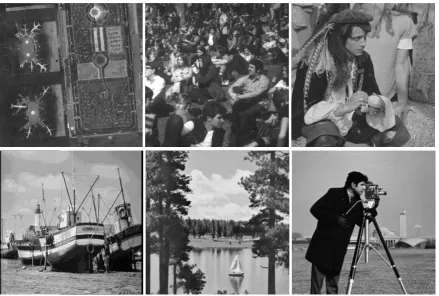
Six images have been tested in the computer simulations, namely, Lax, Crowd, Pirate, Boats, Lake and Cameraman and are all shown in Figure 1. Those images were corrupted by Gaussian noise of zero mean and different values of standard deviation before being restored by the proposed filtering method and the traditional NLM image filtering algorithm.
and MAE, the better the performance of the restoration method is.
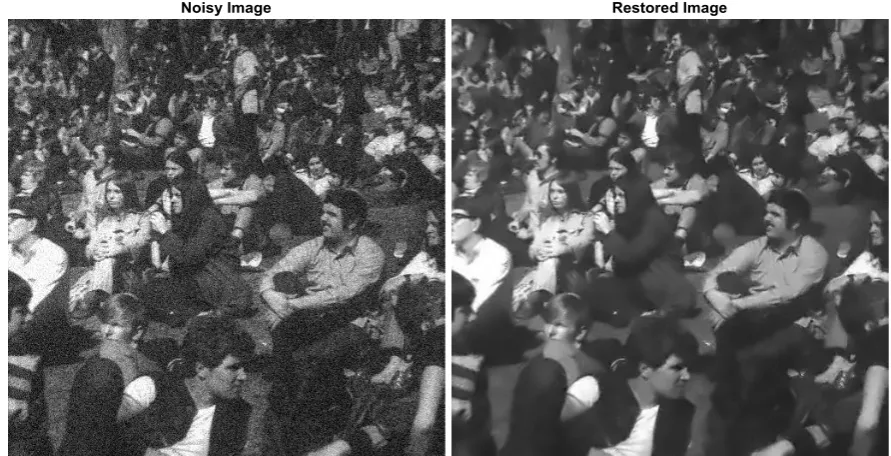
Figure 2 shows the Lax image in three forms: before being corrupted by noise, after being subjected to Gaussian noise of standard deviation =20, and after being restored using the proposed method with Function 1. Figure 3 shows similar results for the Crowd image. The numerical (quantitative) results (Tables 1-3) and visual quality (Figure 2 and Figure 3) show that the two proposed functions in the adaptive NLM method work satisfactory and the results outperform that of the conventional NLM
algorithm in terms of both MAE and MSE for such relatively small amount of Gaussian noise.
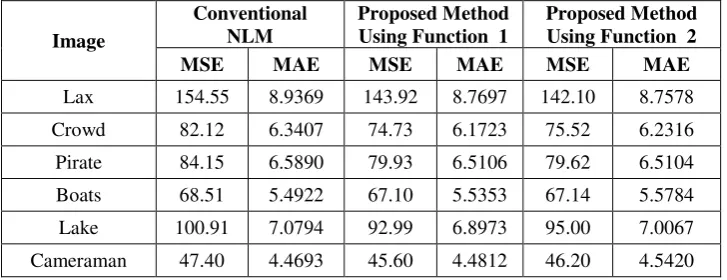
[image:3.595.80.520.241.537.2]The significance of such improvement in the performance of the proposed scheme over the conventional NLM method varies based on the characteristics and details of the image being corrupted with noise. The more details and edges that exit in the image, the more significant the improvements are in the performance of the proposed method. In addition, the performance of the proposed method using Function 1 is slightly better than that using Function 2 in most cases as shown in Tables 1-3.
Figure 1. Tested Clean images (from left to right), first row: Lax, Crowd, and Pirate, second row: Boats, Lake and Cameraman.
Figure 2. Lax image: Corrupted by Gaussian noise with σ=20 (left), and restored one
[image:3.595.113.487.576.752.2]Figure 3. Crowd image: Corrupted by Gaussian noise with σ=20 (left), and restored one using the
[image:4.595.73.519.95.323.2]proposed method with Function 1 (right).
Table 1. MSE and MAE of several restored images after being corrupted with zero mean Gaussian noise of standard deviation = 10.
Image
Conventional NLM
Proposed Method Using Function 1
Proposed Method Using Function 2
MSE MAE MSE MAE MSE MAE
Lax 65.90 6.2523 64.68 6.2108 64.33 6.1959
Crowd 37.81 4.3874 34.69 4.2556 35.10 4.2856
Pirate 38.53 4.5744 36.62 4.4825 36.72 4.4878
Boats 29.71 3.6872 28.61 3.6552 28.58 3.6799
Lake 48.77 5.1794 46.54 5.0862 46.33 5.0979
[image:4.595.117.480.589.730.2]Cameraman 21.99 3.1103 20.30 3.0717 20.53 3.0812
Table 2. MSE and MAE of several restored images after being corrupted with zero mean Gaussian noise of standard deviation = 15.
Image
Conventional NLM
Proposed Method Using Function 1
Proposed Method Using Function 2
MSE MAE MSE MAE MSE MAE
Lax 107.56 7.7341 105.11 7.6946 104.67 7.6794
Crowd 59.31 5.4305 54.10 5.2506 54.67 5.3006
Pirate 61.86 5.7002 58.16 5.5838 58.17 5.5896
Boats 48.97 4.6542 46.58 4.6229 47.37 4.6894
Lake 76.16 6.2746 69.55 6.0616 71.05 6.1482
Table 3. MSE and MAE of several restored images after being corrupted with zero mean Gaussian noise of standard deviation = 20.
Image
Conventional NLM
Proposed Method Using Function 1
Proposed Method Using Function 2
MSE MAE MSE MAE MSE MAE
Lax 154.55 8.9369 143.92 8.7697 142.10 8.7578
Crowd 82.12 6.3407 74.73 6.1723 75.52 6.2316
Pirate 84.15 6.5890 79.93 6.5106 79.62 6.5104
Boats 68.51 5.4922 67.10 5.5353 67.14 5.5784
Lake 100.91 7.0794 92.99 6.8973 95.00 7.0067
Cameraman 47.40 4.4693 45.60 4.4812 46.20 4.5420
4. CONCLUSIONS
The traditional NLM filtering method uses a fixed size search window and a standard Gaussian kernel function. In this paper, an adaptive NLM algorithm with two proposed kernel functions has been examined. Six images of different characteristics corrupted by Gaussian noise with zero mean and different values of standard deviation have been used in the computer simulations using MSE and MAE as performance measuring indices. The results show that the adaptive NLM method with either of the proposed kernel functions outperforms the conventional NLM method in terms of both numerical results and visual image quality mainly for images that have a lot of textures or details and edges corrupted with relatively small amounts of Gaussian noise.
REFERENCES
[1] C. Bovik. 2010. Handbook of Image and Video Processing, Academic Press.
[2] R. C. Gonzalez and Richard E. Woods. 2017. Digital Image Processing, Pearson.
[3] P. Milanfar. 2013. A Tour of Modern Image Filtering: New Insights and Methods both Practical and Theoretical. IEEE Signal Processing Magazine. 30(1): 106-128.
[4] Z. M. Ramadan. 2012. Efficient Restoration Method for Images Corrupted with Impulse Noise. Circuits, Systems, and Signal Processing, 31 (4): 1397-1406.
[5] A. K. Samantaray, P. Kanungo, B. Mohanty. 2018. Neighbourhood Decision Based Impulse Noise Filter. IET Image Processing. 12(7): 1222-1227.
[6] M. Mafi, H. Rajaei, M. Cabrerizo, M. Adjouadi. 2018. A Robust Edge Detection Approach in the Presence of High Impulse Noise Intensity through Switching Adaptive Median and Fixed Weighted Mean Filtering.
IEEE Transactions on Image Processing. 27(11): 5475-5490.
[7] Z. M. Ramadan. 2013. Monochromatic-Based Method for Impulse Noise Detection and Suppression in Color Images. Circuits, Systems, and Signal Processing. 32(4): 1859-1874.
[8] P. Civicioglu. 2007. Using Uncorrupted Neighborhoods of the Pixels for Impulsive Noise Suppression with ANFIS. IEEE Transactions on Image Processing. 16(3): 759-773.
[9] Y. Zhang, W. Liu, I. E. Magnin, Y. Zhu. 2013. Feature-Preserving Smoothing of Diffusion Weighted Images Using Nonstationarity Adaptive Filtering. IEEE Transactions on Biomedical Engineering. 60(6): 1693-1701.
[10] Z. M. Ramadan. 2014. Salt-and-Pepper Noise Removal and Detail Preservation Using Convolution Kernels and Pixel Neighborhood. American Journal of Signal Processing. 4(1): 16-23.
[11] Z. M. Ramadan. 2014. A New Method for Impulse Noise Elimination and Edge Preservation. Canadian Journal of Electrical and Computer Engineering. 37(1): 2-10.
[12] E. Luo, S. Parameswaran, T. Q. Nguyen. 2018. Patch Matching for Image Denoising Using Neighborhood-Based Collaborative Filtering. IEEE Transactions on Circuits and Systems for Video Technology. 28(2): 392- 401.
[14] A. Buades, B. Coll, J. M. Morel. 2005. A Review of Image Denoising Algorithms, with a New One. SIAM Journal on Multiscale Modeling and Simulation: A SIAM Interdisciplinary Journal. 4(2): 490-530.
[15] T. Tasdizen. 2008. Principal Components for Non-Local Means Image Denoising. 15th IEEE International Conference on Image Processing, San Diego, CA, USA. pp. 1728-1731.
[16] R. Vignesh, B. T. Oh, C-CJ. Kuo. 2010. Fast Non-Local Means (NLM) Computation with Probabilistic Early Termination. IEEE Signal Processing Letters. 17(3): 277-280.
[17] V. D. Van, Dimitri, M. Kocher. 2011. Nonlocal Means with Dimensionality Reduction and Sure-Based Parameter Selection. IEEE Transactions on Image Processing. 20(9): 2683-2690.
[18] K. N. Chaudhury, A. Singer. 2012. Non-local Euclidean Medians. IEEE Signal Processing Letters. 19(11): 745-748.
[19] Z. Sun, S. Chen. 2013. Analysis of Non-Local Euclidean Medians and its Improvement. IEEE Signal Processing Letters. 20(4): 303-306.
[20] A. Buades, B. Coli, J.-M. Morel. 2010. Image Denoising Methods. A New Nonlocal Principle. SIAM Review. 52(1): 113-147.
[21] W. Zeng, X. Lu. 2011. Region-Based Non-Local Means Algorithm for Noise Removal. Electronics Letters. 47(20): 1125-1127.
[22] Y. Wu, B. Tracey, P. Natarajan, J. P. Noonan. 2013. James-Stein Type Center Pixel Weights for Non-Local Means Image Denoising. Signal Processing Letters IEEE. 20(4): 411-414.
[23] J. Salmon. 2010. On Two Parameters for Denoising with Non-Local Means. IEEE Signal Processing Letters. 17(3): 269-272.
[24] M. P. Nguyen, S. Y. Chun. 2017. Bounded Self-Weights Estimation Method for Non-Local Means Image Denoising Using Minimax Estimators. IEEE Transactions on Image Processing. 26(4): 1637-1649.
[25] H. Yu, M. Tan. 2016. Fast Non-Local Means with Size-Adaptive Search Window. The Journal of Engineering. 2016(3): 20-22.
[26] Kang, O. Choi, J.D. Kim, D. Hwang. 2013. Noise Reduction in Magnetic Resonance Images Using Adaptive Non-Local Means Filtering. Electronics Letters. 49(5): 650-653.