International Journal of Emerging Technology and Advanced Engineering
Website: www.ijetae.com (ISSN 2250-2459, ISO 9001:2008 Certified Journal, Volume 5, Issue 1, January 2015)
An Effective Contribution of Social Media Networks in
Foreign Language Learning Case Study: Community
Diploma College, King Khalid University, KSA
Vasanthi Muniasamy1, Dr. Intisar Magboul Ejalani2, Dr. Anandhavalli31Lecturer, 3Associate Professor, Department of Information Systems, King Khalid University, KSA 2
Asst. Professor, Department of Management, King Khalid University, KSA
Abstract— Social Media (SM) is websites increasingly popular and built to allow people to express themselves and to interact socially with others. Most SMT are dominated by youth particularly College students. The proliferation of popular social media tools, which can accessed from any communication devices has become pervasive in the lives of today’s student life. The present paper aims to measure an effective contribution of social media networks in foreign language learning skills among students. For this purpose, a survey was carried out to examine students’ perceptions and attitudes about using these social platforms for learning foreign languages. Results of the research study revealed that the great majority of the students actually use these web-based applications to enhance their language skills. Most importantly, they agreed that social media contribute in improving their listening, reading, speaking and writing skills. Accordingly, we strongly recommend that instructors use these online tools in distant, blended, or face-to-face learning systems.
Keywords—Social Media, Foreign Language Learning, Second Language Learning, KKU
I. INTRODUCTION
Technology has inevitably become the most powerful tool in almost every aspect of human„s daily life. Technology is regarded as a major revolution and this has a significant impact on education. The use of Information Technology (IT) and the Internet are the new paradigm of learning in 21st century. These technological advancements allow people to easily access, gather, analyze, and share, transfer data & knowledge. This makes it possible for them to function as teachers, study-mates and more importantly, as tools to improve entire teaching and learning process [1]. Learning communities have evolved from the traditional classroom to virtual education settings in which students come together in a virtual environment to exchange ideas, solve problems, explore alternatives, and create new meanings along a connected journey. Now the students are Net Generation or digital natives. These digital natives bring new challenges to the teaching and learning environment. In the last seven years, the social media technology becomes more popular characterization of websites that allowed digital users to interact with each other as contributors to a website.
Social media include a wide variety of online tools including social networks, blogs, micro-blogs, wikis as well as media sharing and bookmarking websites. As educational resources, social media tools can also be used to differentiate the learning process. The social media resources allow learners to elect and share learning materials that best meet their learning style and interests. The dynamic and engaging nature of many social media tools may encourage students to expand more time and energy on their academic activities as a consequence of the collaborative, constructivist and authentic learning opportunities they can create. They use these online communities to interact with friends, play games and watch television. Most importantly, students make use of these web-based tools for foreign language / Second Language learning purposes. The objective of this paper is, therefore, to measure the potential role that social media technologies may have on students‟ foreign language learning skills.
II. SOCIAL MEDIA – AN OVERVIEW
International Journal of Emerging Technology and Advanced Engineering
Website: www.ijetae.com (ISSN 2250-2459, ISO 9001:2008 Certified Journal, Volume 5, Issue 1, January 2015)
Blogs, another early part of the social network phenomenon, were sufficiently developed to gain the name weblogs in 1997.The first use of the term Web 2.0 was in 2004. Social Network refers to a perceived second generation of Web development and design that facilitates communications and secures information sharing, interoperability, and collaboration on the World Wide Web. This concept has led to the development and evolution of Web-based communities, hosted services, and applications; such as social-networking sites, video-sharing sites, wikis, blogs (Web 2.0, 2009). Websites and applications enable users to create and share content or to participate in social networking. SNS (Social Networking Site) is the phrase used to describe any Web site that enables users to create public profiles within that Web site and form relationships with other users of the same Web site who access their profile. Social networking sites can be used to describe community-based Web sites, online discussions forums, chat rooms and other social spaces online. One of the important developments associated with online Internet presence is the advent of social media. These social media tools can be very useful as e-learning tools which can serve for an educational purpose. A social media tool represents “a virtual community” in which people with shared interests can communicate by posting and exchanging information about themselves. Social networking sites have in the recent years gained considerable popularity in global scale, and have attracted a significant part of the online community. In fact, a recent survey of 3000 students from across the US shows that 90% of college students use Facebook and 37% use Twitter.
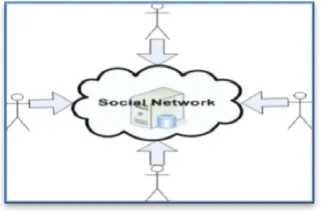
[image:2.595.84.246.616.722.2]The above observations can be explained by the fact that these sites make it possible for people to connect to each other in an easy and timely manner, and to exchange and share various kinds of information among them. Social media provide a great benefit to the current generation of university and college students as these tools were created with the primary intent of facilitating sharing, discussion and collaboration.
Fig. 1 Sample View of current state of SNA
Social media is playing a big role in boosting academic like in social and education systems as a whole. The Figure 1 shows the simple view of current state of Social Network Application (SNA).
International Journal of Emerging Technology and Advanced Engineering
Website: www.ijetae.com (ISSN 2250-2459, ISO 9001:2008 Certified Journal, Volume 5, Issue 1, January 2015)
In these online channels, one can watch or listen to a variety of spoken languages (formal, informal, colloquial, slang) of all genres (debates, talks, shows, movies, etc.) and learn a lot of vocabulary in context, which will undoubtedly help them improve their language proficiency. Beyond just getting materials from this set of social media tools, language learners can also broadcast themselves. By producing their own videos, students can apply the target language to real-world situations, and by uploading them on social media, they can get feedback on their speaking skills from others
III. RESEARCH METHODOLOGY
A. Samples
A survey was conducted among the Community Diploma College students King Khalid University, Abha, Kingdom of Saudi Arabia to investigate an effective contribution of social media networks in foreign language learning. The data was gathered via survey distributed to 120 students.
The questions are easy to understand and each participant is asked to fill out the given questionnaire to measure the students‟ response.
B. Data Analysis
Analysis of the collected data has revealed that all the surveyed students reported to be members of at least one social network. Results have actually shown that the great majority of informants have a Twitter account. For more information about students‟ membership in various social online communities is shown in Figure 1.
As is clearly seen, the most popular social network among community diploma college students in King Khalid University is Twitter (49.03%), other social networks like MySpace, Live mocha, Viadeo, Babble, Busuu, Unilang, Lang-8, Palabea, Italki.com, voxSwap, Myngle and English Baby (23.23%) and Google+ (18.71%). The online networks that are less frequently used by students are LinkedIn (1.94%). The low percentage associated with LinkedIn may be due to the fact that these online communities are mainly used for work-related purposes and more surprise that Facebook is utilized by the less percentage (7.10%) of students only.
Figure.2 Student’s Membership in Social online Communities
With regard to the use of social media for learning foreign languages, 66.88% of the surveyed students reported that they use this set of online tools to enhance their foreign language skills. The most common languages that the students are interested in improving or learning are given in Figure 3. The students were also asked to choose from a list the social media network technologies that they use to boost their language skills. Results showed that most of the students like video sharing websites and Chat Tools. Nonetheless, it has been observed that though there are social online communities, such as Live mocha and Busuu, which are dedicated to language learning, none of the respondents seems to be using them.
E- English G-German F- French I – Italy C- Chinese T- Turkey J - Japanese
Figure.3 Student’s Second Language Preferences via Social Media 7.10%
49.03%
18.71%
1.94%
23.23%
0 0.1 0.2 0.3 0.4 0.5 0.6
66.88%
0.65% 16.23%
1.30% 1.30% 8.44%
5.19%
International Journal of Emerging Technology and Advanced Engineering
Website: www.ijetae.com (ISSN 2250-2459, ISO 9001:2008 Certified Journal, Volume 5, Issue 1, January 2015)
[image:4.595.316.564.131.379.2]This implies that students generally prefer to use a platform through which they can not only learn a language but also interact with friends, colleagues and family. The technologies used by students are given in Figure 4.
Figure.4 Student’s Social Media Network technology Usage
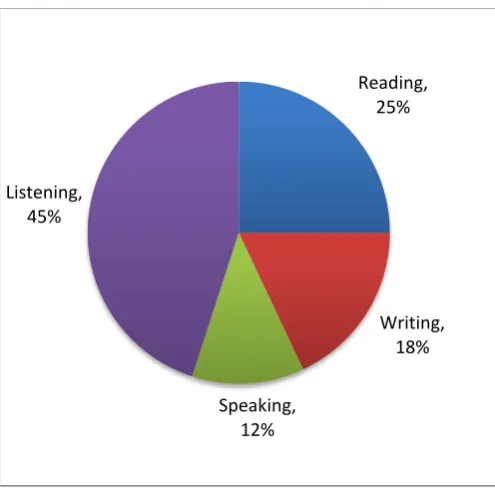
[image:4.595.48.298.197.380.2]To investigate the impact of student‟s foreign language learning skills, the students were asked to select the major language skills - listening, speaking, reading or writing. Figure 5 shows the percentage ratings associated with each language skill. As the figure displays, the main language skill reported to be improving is listening. Of those who participated in the survey, 45% reported that listening is the most noticeable skill. Listening is usually considered as the weakest skill of most language learners. Easy access to the rich database of audio and video materials on social media certainly contributes in enhancing this Listening Language skill.
Figure.5 Student’s Improved Skills Rating after Social Media Use
Figure 6 shows that students (68.32%) are satisfied with the social media tools for improving their foreign language skills.
S. Agree–Strongly Agree S. Disagree – Strongly Disagree
Figure.6 Student’s Satisfaction of using Social Media Tools in Foreign Language Learning
3.42%
44.52%
2.74%
14.38%
34.25%
0.68% 0
0.05 0.1 0.15 0.2 0.25 0.3 0.35 0.4 0.450.5
Reading, 25%
Writing, 18%
Speaking, 12% Listening,
45%
68.32%
17.82%
11.88%
1.98% 0
0.1 0.2 0.3 0.4 0.5 0.6 0.7 0.8
[image:4.595.314.568.435.624.2]International Journal of Emerging Technology and Advanced Engineering
Website: www.ijetae.com (ISSN 2250-2459, ISO 9001:2008 Certified Journal, Volume 5, Issue 1, January 2015)
IV. CONCLUSION
Based on data collected from 120 students, this research measures the effective contribution of SMN in Foreign language learning skills. Results of the research study demonstrated that most of the surveyed students claimed they favor the use of these internet-based applications as these help them improve their four language skills, namely listening, reading, writing and speaking. Given these educational benefits, we can stipulate that social media tools are capable of enriching the language learning experience. Therefore, we recommend that educators use these online social communities whether they work in fully online, blended, or face - to- face language learning environments.
Acknowledgment
We would like to thank the Students, Community Diploma College, King Khalid University, Kingdom of Saudi Arabia for their cooperation for this research study.
REFERENCES
[1] Yee H., Luan W., Ayub A., & Mahmud R. (2009). A Review of the Literature: determinants of Online Learning among Students. European Journal of Social Sciences. 8, 2. 246.
[2] Wikipedia, http://en.wikipedia.org/wiki/socialmedia
[3] Micheal M.Van Wyk, (2014). Using Social media in an open Distance Learning Teaching Practice Course. ISSN 2039-9340.M. Young, The Techincal Writers Handbook. Mill Valley, CA: University Science, 1989.
[4] Haenlein, M., & Kaplan, A. (2010). “Users of the world, unite! The challenges and opportunities of social media. Business Horizons”, 1(53), 59-68.