International Journal of Emerging Technology and Advanced Engineering
Website: www.ijetae.com (ISSN 2250-2459, ISO 9001:2008 Certified Journal, Volume 7, Issue 11, November 2017)
484
Characterization of LiClO
4Doped PVDF Solid Polymer
Electrolyte
K.Venkata Ramana1, M. Chandra Shekar2, A.R.Subrahmanyam 3
, M.Ravindar Reddy4, V. Madhusudhana Reddy5,
1,3,4 Department of S&H, MVSR Engineering College, Hyderabad, TS, India 2
Department of Physics, JNT University, Hyderabad, India
4 Department of S & H, Malla Reddy college of Engineering &Technology, Hyderabad, TS, India
Abstract— New polymer electrolytes based on Poly Vinylidene Difluoride (PVDF) with Lithium Per chlorate ( LiClO4) samples have been prepared by
solution casting method. X-ray diffraction measurements were carried out on these samples. The X-ray diffraction measurements clearly reveal the modification of PVDF crystalline structure with increasing Lithium per chlorate content. The surface morphology of these polymer complexed films is analyzed by Scanning Electron Microscopy (SEM). FTIR studies have been carried out to confirm the complexation of PVDF with Lithium per Chlorate. The optical measurements were taken on these samples using UV spectroscopic method .Finally the results obtained are presented and discussed.
Keywords— FTIR,LithiumPerchlorate, Optical Absorption, UV Spectra, XRD Studies
I.INTRODUCTION
:
Polymer complexes with suitable salts are widely used as solid polymer electrolytes which play very important role in development of various electro chemical devices such as batteries, photo Electron chemical cells, electro chromic display devices due to their high chemical corrosion resistance, heat resistance and mechanical strength and toughness [1, 2,3].
The aim of the present work is to study the structural, optical properties of complexed
polymer electrolytes based LiClO4 and PVDF.
These are prepared by doping different
concentrations of LiCO4 in PVDF. Various
properties of these polymer samples are studied using techniques like XRD, FTIR, SEM and UV absorption. The obtained results are presented and discussed.
II.PREPARATION OF POLYMER ELECTROLYTES:
Pure PVDF (320000MW from Merck)
complexed with LiClO4 in various compositions
(90:10), (80:20), (70:30) & (60:40) by wt% ratio, are prepared using solution caste technique.
PVDF & LiClO4 are dissolved in DMF; The
solutions obtained are stirred 10-12 hours to get homogeneous Mixture. The stirred solutions are allowed to evaporate slowly. After 48 hours a solid polymer layers are obtained about 100 microns thickness. These polymers are dried in
vacuum at 10-3torr.
The film is carefully separated from the dish and stored in an evaluated desiccator. The X-ray diffraction (XRD) patterns of these polymers were taken with PHILIPS PW 3710. X-ray
International Journal of Emerging Technology and Advanced Engineering
Website: www.ijetae.com (ISSN 2250-2459, ISO 9001:2008 Certified Journal, Volume 7, Issue 11, November 2017)
485
Fourier transform infrared(FTIR) spectra of these systems were carried out using JASCO FTIR-5300 spectrometer over a wave number range
400-4000cm-1.The surface morphology of these
polymer systems were observed using Scanning electron Microscope(SEM).Optical absorption Spectra are recorded at room temperature in the
range 200-1000 nm using optical spectrometer.
III.XRDSTUDIES
The X-ray diffraction pattern of pure PVDF and
PVDF complexed with LiClO4 are shown in
fig.1. The pure PVDF has a characteristic peak corresponding to lattice at 1804ꞌ [4,5] indicating semi crystalline nature of the polymer. As the
concentration of LiClO4 increases in PVDF, the
peaks become less intense and broadened. The existence of new peaks and change in intensities clearly indicates a decreasing in degree of crystallinity in the pure polymer and confirm the
complexation of Li COo4 With PVDF.
Fig-1: X-ray diffraction Pattern of pure PVDF
& PVDF complexed with LiClO4.
IV.FTIR Analysis
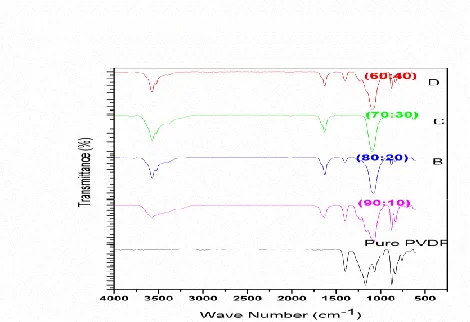
The FTIR Spectra of Pure PVDF and PVDF
doped with LiClO4 as shown in fig2. From the
fig it is observed that for pure PVDF C-H
bending is observed around 1066 cm-1, C-O
stretching at 883.4 cm-1 and band corresponding
to C-F stretching is observed at 1175 cm-1. For
all concentrations of LiClo4 these stretching are
altered.
Fig.2: FTIR Spectra of pure PVDF & PVDF complexed with LiClO4.
The broadening of existing peaks inPVDF and also presence of some additional peaks clearly
indicates the complexation of LiclO4 with
PVDF
V.OPTICAL PROPERTIES
The information about band structure can be studied by optical absorption. In direct band semiconductor, the transition of electron from conduction band to valance band is associated
with a phonon of the appropriate magnitude
.Davis and Shaliday [6] reported that near fundamental band edge direct band transitions occur and can be observed by
[image:2.612.340.575.222.383.2] [image:2.612.79.291.465.595.2]International Journal of Emerging Technology and Advanced Engineering
Website: www.ijetae.com (ISSN 2250-2459, ISO 9001:2008 Certified Journal, Volume 7, Issue 11, November 2017)
486
The relation given in equation is based on the analysis of Thtupalli and Tomlin[7]
(h )2 =C1(h -Egd).
where hυ is photon energy, Egd is direct band
gap, n is the refractive index, α is absorption coefficient and C1 are constant The direct band
gap values obtained by plotting (αh )2
[image:3.612.70.304.113.409.2]vs h curves are shown in fig3 and are tabulated in Table 1.
polymer Direct band
gap(ev)
Pure PVDF 2.374
PVDF: LiClO4 (90:10) 2.310
PVDF:LiClO4 (80:20) 2.169
PVDF:LiClO4( 70:30) 1.543
PVDF:LiClO4(60:40) 2:448
VI.SEMSTUDIES
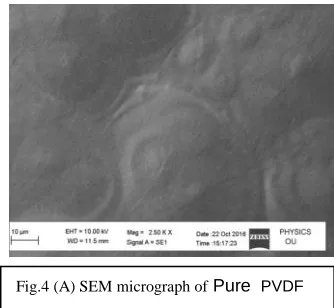
The surface morphology of pure PVDF and PVDF doped with various concentrations of
LiClO4 are shown in Fig.4 (A). Pure PVDF
surface appears to be semi crystalline which is also confirmed by XRD studies. As the
concentration of Liclo4 increases the degree of
crystallinity seems to be decreased in all composites. For 70:30 composition strong link is observed between PVDF polymer and the dopant which indicates certain hopping sites for conduction, As the concentration increases drastic changes observed from hexagonal (90:10) to more amorphous (60:40).Among (70:30) in the optimal concentration for better conducting behaviour.
[image:3.612.371.538.538.692.2]International Journal of Emerging Technology and Advanced Engineering
Website: www.ijetae.com (ISSN 2250-2459, ISO 9001:2008 Certified Journal, Volume 7, Issue 11, November 2017)
487
I.
VI. CONCLUSIONS
Pure PVDF and PVDF doped with LiClO4 for
Various Concentration are prepared by Solution cast method. The complexation of PVDF
polymer with Liclo4 has been confirmed with
XRD and FTIR spectra. The surface morphology
of pure PVDF and PVDF +LiclO4 polymer
electrolytes at different weight percentage is studied using SEM. Increase in concentration of
Liclo4 decrease the degree of crystallinity of
PVDF. The direct band gap values of PVDF
+LiClO4 (70:30) polymer electrolyte indicates
the influence of LiClO4 on PVDF for better
conducting properties.
ACKNOWLEDGEMENTS
The author thanks the Head Department Physics,
Osmania University for their constant
encouragement and providing necessary
facilities. Also one of the authors (KVR) thanks HOD, S&H, Principal, MVSR Engineering
College, Hyderabad for their constant
encouragement.
References
[1] Rao S S, Sunar M. “Piezoelectricity and Its Use in Disturbance Sensing and Control of Flexible Structures: A survey”, Applied Mechanics Review, 47, No 4, 113-123, 1994.
Fig.4 (B) SEM micrograph oPVDF:Li ClO4(90:10) complexed
electro lyte film
complexed electro lyte film
Fig.4 (C) SEM micrograph oPVDF:Li ClO4(80:20)
complexed electro lyte film
Fig.4 (D) SEM micrograph oPVDF:Li ClO4(70:30)
complexed electro lyte film Fig.4 (C) SEM micrograph oPVDF:Li Clo4(80:20)
complexed electro lyte film
Fig.4 (E) SEM micrograph oPVDF:Li ClO4(60:40) complexed
International Journal of Emerging Technology and Advanced Engineering
Website: www.ijetae.com (ISSN 2250-2459, ISO 9001:2008 Certified Journal, Volume 7, Issue 11, November 2017)
488
[2] Sundar V, Newnham R E. “Electrostriction”, ENGnetBASE 2000, CRC Press LLC, chap. 50, http://www.engnetbase.com, 1999.[3] Wirsen A. Electro active Polymer Materials, Technomic Publishing, Lancaster, PA, 1986.
[4] Gregorio R J R, Ueno E M. “Effect of Crystalline Phase, Orientation and Temperature on the Dielectric Properties of PVDF”, Journal of Material Science, 34, 4489-4500, 1999 [5] Xu H, Shanthi H, Bharti V, Zhang Q M. “Structural,
Conformational, and Polarization Changes of Poly(vinylidene fluoride-trifluoroethylene) Copolymer Induced by High Energy Electron Irradiatio”, Macromolecules, 33, 4125-4131, 2000.