International Journal of Emerging Technology and Advanced Engineering
Website: www.ijetae.com (ISSN 2250-2459,ISO 9001:2008 Certified Journal, Volume 5, Issue 3, March 2015)
Performance Analysis of Hybrid DWT and DCT based
Compression Techniques for Low Bit Rate
Esha Gupta
1, Poorva Waingankar
21
PG student, TCET Kandivali (E), India 2Associate Professor, TCET Kandivali (E), India
Abstract— In this paper, comparison of three Video compression techniques i.e. Discrete Cosine Transform (DCT), Discrete Wavelet Transform (DWT) and Hybrid is done. DCT is applied to Rows, Columns and Rows*Columns separately to frames in a video with compression factor of 2, 4 and 8, whereas Discrete Wavelet Transform(DWT) is applied till 2nd level of DWT decomposition and Hybrid-1 combining DCT and DWT 1st level is applied on videos, Hybrid -2 combining DCT and DWT 2nd level is applied on different Videos. Accordingly, peak signal to noise ratio (PSNR), Size on hard disc, Compression Ratio (CR) is studied for these methods.DCT proves to be suitable for videos having more number of frames whereas DWT is suitable for more percent of still part in a video.
Keywords— CR, DCT, DWT, Hybrid, PSNR I. INTRODUCTION
Compression is basically of two types: Lossy and Lossless. Lossy compression technique consists of basically three main steps: Transform quantization and coding. The main difference between Lossy and Lossless Compression technique is that in lossy compression, a high compression can be achieved but the video quality may be or may be not visually apparent but in Lossless it reduces the number of bits in such a way that reconstructed video is numerically equal to the original video [1]. A wide usage of Lossy compression techniques is found in Multimedia, internet telephony as lossy methods are easily suitable for natural images such as photos where loss of Fidelity can be accepted to a substantial bit-rate. Hence, Lossy compression is applicable to audio as well as videos.
The Transform coding plays a vital role in Lossy Compression techniques where original data (Time domain) is decomposed or converted into data segments (Frequency domain), which are then quantized and coded accordingly. The standard Transforms being DCT (discrete cosine transform), where co-related co-efficient in an input data are taken into consideration, transformed and
Depending on the requirement of the user, and the type of video to be sent DCT, DWT or Hybrid is applied. Compression is done on the criteria that high order values should be dropped and low order values to be accepted, as lower order values are susceptible to Human eyes .i.e. Human eyes cannot distinguish the difference between compressed and uncompressed images
II. METHODOLOGY
In this paper three compression techniques i.e. DCT, DWT and Hybrid are applied to different videos and compared in terms of PSNR, and Compression Ratio. Four different types of videos are taken and these three methods are applied on four different videos, to compare PSNR and Compression ratio at the same time acceptance level (in terms of visual quality) also.
A. Discrete cosine transform
International Journal of Emerging Technology and Advanced Engineering
Website: www.ijetae.com (ISSN 2250-2459,ISO 9001:2008 Certified Journal, Volume 5, Issue 3, March 2015) B. Discrete wavelet transform
Wavelets are very useful for compressing images, have more advantages than Fourier, hence preferred. Basically the 2-D wavelet analysis uses mother wavelet but requires extra effort at every step of decomposition level. Here, Daubechieus Filters are used, and Set partitioning in hierarchical tree(SPIHT) [3][4] algorithm is used because of its low computational complexity ,mostly for sub band coefficients and using Singular value decomposition(SVD)[5] in which original image is decomposed in form USV’, where U and V’ are Eigen vectors whereas S is a diagonal matrix representing Eigen values ,and off diagonal elements of S are zero, where Eigen vectors use Vector quantization techniques and Eigen values use scalar quantization. The DWT method can be applied up to many levels of decomposition; here only two levels are taken into consideration. DWT is thus taken as DWT-1st and DWT -2nd levels.
C. Hybrid
Hybrid is a compression method which is combination of two methods .i.e. DCT and DWT. It utilises some properties of DCT and some properties of DWT, thus it can be said an intermediate method between the two methods. The images are converted into gray scale images on which DWT compression is applied which produces a set of sub band coefficients till 2-D DCT method can b applied, and then the coefficients are quantised and encoded ,this whole process constitutes a Hybrid compression technique. The original video can be reconstructed by applying compressed video to the decoder section. [6]In this paper, a combination of DCT method(.i.e. applied to rows, columns and rows*columns through a compression factor of 2, 4 and 8) along with DWT -1st level makes Hybrid -1 method which is then applied to different videos to observe the PSNR and CR of the videos. Similarly again combination of DCT method but with DWT-2nd level is done ,to make Hybrid -2 method ,which is applied to videos, and then PSNR and CR of the videos obtained by Hybrid -2 is compared with that obtained by Hybrid -1 method.
III. RESULTS AND DISCUSSION
The results obtained by applying DCT, DWT and Hybrid Methods can be categorized in terms of performance parameters which are peak signal to noise ratio(PSNR), compression ratio(CR).
A. Peak Signal to Noise Ratio
Peak Signal to Noise Ratio describes the quality of an image or video. It is peak signal to noise ratio, hence highest the PSNR, better the quality of compressed video or reconstructed video
(Fig.1. A Hybrid Compression Method)
International Journal of Emerging Technology and Advanced Engineering
Website: www.ijetae.com (ISSN 2250-2459,ISO 9001:2008 Certified Journal, Volume 5, Issue 3, March 2015) TABLE. I.
Discrete CosineTransform:
[image:3.612.41.296.167.381.2] [image:3.612.341.536.213.431.2] [image:3.612.337.569.457.692.2]Comparison of PSNR Value for Compressed and Uncompressed Video File using DCT Method for Different Clips
Table II.
Different Video Clips and their Respective Frame numbers
From Table.II Video Clip 3 has highest number of frames, hence PSNR of Clip 3 is highest and DCT explores this quality. PSNR decreases as compression factor increases from 2 to 8. When DCT is applied to Rows, PSNR obtained is more as compared to PSNR obtained for Columns which is comparatively more than the PSNR for Rows*Columns. The reason for applying DCT in terms of rows, columns and rows*columns is to show the results for PSNR, when DCT is applied separately to Rows, Columns and Rows* Columns. A higher PSNR generally indicates that the reconstruction is of higher quality, hence DCT applied to rows generates video of high quality then that
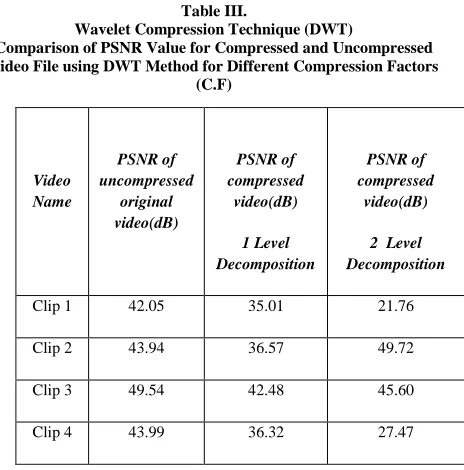
In DWT, there are different types of level applied. Here DWT decomposition is shown till 2nd level and DWT multilevel decompositions can be shown further. Below, Table III shows comparative PSNR values for Compressed and Uncompressed Video files using DWT method for different compression factors.
(Fig.2. Co-relation between PSNR and Number of frames of video)
Table III.
Wavelet Compression Technique (DWT)
Comparison of PSNR Value for Compressed and Uncompressed Video File using DWT Method for Different Compression Factors
(C.F) Rows Columns Rows*Columns
C.F C.F C.F
V O.V 2 4 8 2 4 8 2 4 8 Clip
1 42.05 40. 30 35. 18 30. 85 37. 87 33. 99 30. 21 36. 96 32. 23 28. 24 Clip
2 43.94 41. 78 36. 58 32. 16 39. 75 35. 43 31. 87 38. 81 33. 59 29. 66 Clip
3 49.54 46. 24 41. 85 36. 45 43. 10 38. 84 34. 77 42. 56 37. 43 32. 77 Clip
4 43.99 41. 37 36. 10 31. 01 37. 67 33. 69 30. 19 37. 09 32. 19 28. 06
Sr. No Video Clips No of Frames
1 Clip 1 124
2 Clip 2 865
3 Clip 3 1203
4 Clip 4 750
Video Name PSNR of uncompressed original video(dB) PSNR of compressed video(dB) 1 Level Decomposition PSNR of compressed video(dB)
2 Level Decomposition
Clip 1 42.05 35.01 21.76
Clip 2 43.94 36.57 49.72
International Journal of Emerging Technology and Advanced Engineering
Website: www.ijetae.com (ISSN 2250-2459,ISO 9001:2008 Certified Journal, Volume 5, Issue 3, March 2015) As seen from Table.III, PSNR for Video Clips 1, 2, 3
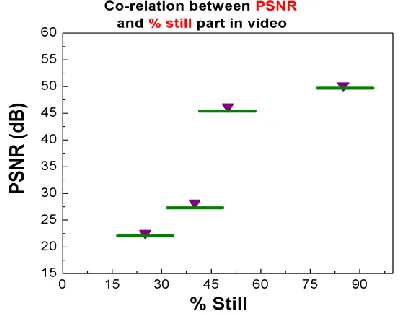
[image:4.612.336.536.138.296.2]and 4 when DWT 1st level is applied is comparatively better then PSNR obtained when DCT is applied on them. Thus for better video quality, DWT is good then DCT.DWT-1 is again extended to DWT-2 level, and the table below shows PSNR values for DWT-2 in comparison with DWT. PSNR, is more for Video Clip 2, 3 because in Clip 2, 3 percentage of still is more than in Clip 1,4 in DWT-2 level as compared to DWT-1,and as whole DWT shows good PSNR values compared to DCT. This depends on the type of videos used. Here %still in Clip 2, 3 is more and in any video if the percentage of still is more .i.e. %still (in background plus object) is high then in that case, PSNR of DWT is high and so is Compression .Fig.3 shows co-relation between PSNR and Percent of Still part in a video, which is linear which means that more the percentage of still part better will be the PSNR value, and inversely proportional to percent of moving part in a video.
[image:4.612.323.567.147.570.2]By comparing PSNR table for DCT,DWT-1st level and Hybrid-1, PSNR of Hybrid-1 is in between that of DCT and DWT, it means if a medium quality video is required prefer Hybrid. According to the graph for Rows, and especially for Compression factor 2, PSNR of Hybrid is between DCT and DWT, but as the graph moves towards right .i.e. towards Compression factor 4,8 PSNR of DWT is much better than DCT, Hybrid. Here DCT is combined along with DWT 2nd level to form Hybrid 2 and compare it with Hybrid 1 for PSNR, CR etc. In the table 6, given below ,PSNR values for hybrid 2 especially for Video Clips 2 and 3 are better than for Clips 1 and4.The reason behind this is DWT -2 gives a better PSNR which is explained in DWT section, it mainly depends on video types, frames etc. Table IV shows different videos with background and object part of it. And here %M and %S are” percentage of moving part and still part” respectively.
Table IV
Different Videos with Background and Objects having Moving and Still part in terms of Percentage and Total Moving and Still part
calculated in each Video
(Fig.3.Co-relation between Peak Signal to Noise Ratio and % still part in video)
Table. V.
Hybrid-1 Compression Technique
Comparison of PSNR(dB) value for compressed using Hybrid-1 method (DWT+DCT) of different compression factors and
uncompressed video file
B. Compression Ratio
From Compression comes Compression ratio. From the table given below it is seen that as compression increases from CF 2 to CF8 for Rows, Columns and Rows*Columns, Compression ratio decreases substantially. Compression in this paper is expressed as ratio of compressed video upon uncompressed video, which can be expressed in terms of percentage for simplification.
Clip s Background (%M,%S) Object (%M,%S) Total Moving Total Still % M % S
1 70M/30S 80M/20S 150 50 75 25
2 10M/90S 20M/80S 30 170 15 85
3 55M/45S 45M/55S 100 100 50 50
4 28M/72S 92M/08S 120 80 60 40
Rows Columns Rows*Columns
C.F C.F C.F
Clip s
O.V 2 4 8 2 4 8 2 4 8
1 42. 0 37. 3 32. 0 27. 9 38. 3 32. 2
27.4 35.7 29.8 1
25.45
2 43. 9 38. 5 33. 3 29. 4 38. 6 33. 7 29.5 2 36.4 2 31.0 9 27.21
3 49. 5 43. 2 37. 2 32. 7 40. 0 35. 3 31.6 7 38.8 8 33.3 5 29.43
[image:4.612.323.569.374.573.2]International Journal of Emerging Technology and Advanced Engineering
Website: www.ijetae.com (ISSN 2250-2459,ISO 9001:2008 Certified Journal, Volume 5, Issue 3, March 2015) Table VI
Hybrid 2 Compression Technique :
Comparison of PSNR value for compressed using Hybrid method (DWT+DCT) of different compression factors and uncompressed
[image:5.612.42.303.181.606.2] [image:5.612.45.300.185.392.2]video file (using DWT 2nd Level)
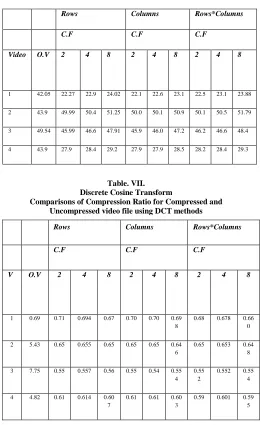
Table 7 Discrete Cosine Transform: Comparisons of Compression Ratio for Compressed and Uncompressed video file using DCT methods
Table 7 Discrete Cosine Transform: Comparisons of Compression Ratio for Compressed and Uncompressed video file using DCT methods
Table VII Discrete Cosine Transform:
Table. VII. Discrete Cosine Transform
Comparisons of Compression Ratio for Compressed and Uncompressed video file using DCT methods
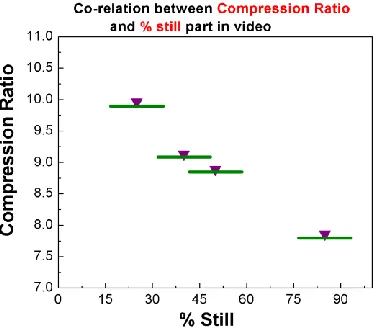
As PSNR increases in case of Clip 2, 3 so does the compression but compression ratio decrease. Figure.4 shows the co-relation between Compression Ratio and Still percentage in a video, which is shown in the Table .The graph here shows the correlation between Compression
As Figure 3 shows a linear correlation between PSNR and % still means Compression also increases, but compression and compression ratio are inversely proportional, hence above graph shows the results. Now moving onto Hybrid technique, Compression ratio that obtained by Hybrid-1 level will be between the Compression values obtained from DCT and DWT-1 level. Similarly Compression Ratio obtained by Hybrid-2 level will be between those obtained by DCT and DWT-2 level. Table IX shows Compression ratio obtained by Hybrid-2 level respectively.
IV. CONCLUSION
From above mentioned experimental work carried out using DCT, DWT and Hybrid Compression techniques it can be seen that DCT shows good visual quality as Clip 2 and 3 has more number of frames. But DCT technique shows poor quality for Compression factor 4, 8 .DWT shows relatively less acceptance level of video considering visual quality as compared to DCT but is best for Clip3 as “percentage of still part” is more in Video clip 3 and Hybrid-1 shows comparatively good visual quality as compared to Hybrid-2
Table VIII Compression Ratio for DWT:
Compression Ratio for compressed and uncompressed video files using DWT methods using (1st level and 2nd level)
But Hybrid 2 shows poor visual quality as compared to Hybrid-1. Also as DCT moves from Compression factor 2 , 4 to 8, compression is more but visual quality degrades.DWT1 shows better visual quality than DWT-2 , Hence it can be said that if more compression is required DWT-2,Hybrid 2 can be used, while if acceptance level of
Video
Name Original video size on Hard Disk
C.R by
DWT 1 C.R by
DWT 2
Clip 1 693 Kb 0.317 0.099
Clip 2 5.43 Mb 0.167 0.078
Clip 3 7.75 Mb 0.225 0.088
Clip 4 4.82 Mb 0.278 0.091
Rows Columns Rows*Columns
C.F C.F C.F
Video O.V 2 4 8 2 4 8 2 4 8
1 42.05 22.27 22.9 24.02 22.1 22.6 23.1 22.5 23.1 23.88
2 43.9 49.99 50.4 51.25 50.0 50.1 50.9 50.1 50.5 51.79
3 49.54 45.99 46.6 47.91 45.9 46.0 47.2 46.2 46.6 48.4
4 43.9 27.9 28.4 29.2 27.9 27.9 28.5 28.2 28.4 29.3
Rows Columns Rows*Columns
C.F C.F C.F
V O.V 2 4 8 2 4 8 2 4 8
1 0.69 0.71 0.694 0.67 0.70 0.70 0.69 8
0.68 0.678 0.66 0
2 5.43 0.65 0.655 0.65 0.65 0.65 0.64 6
0.65 0.653 0.64 8
3 7.75 0.55 0.557 0.56 0.55 0.54 0.55 4
0.55 2
0.552 0.55 4
4 4.82 0.61 0.614 0.60 7
0.61 0.61 0.60 3
International Journal of Emerging Technology and Advanced Engineering
Website: www.ijetae.com (ISSN 2250-2459,ISO 9001:2008 Certified Journal, Volume 5, Issue 3, March 2015)
Fig.4. Co-relation between Compression ratio and % still)
DCT is preferred when number of frames is more but DWT is preferred when “percentage of still” is more in a video, as seen in Clip 2 and 3 ,while Hybrid is mixture of both DCT and DWT, which shows very high compression but medium visual quality between DCT and DWT
.
Table IX
Hybrid-2 Compression Technique:
Comparison of Compression Ratio for compressed and uncompressed video file using Hybrid method (DWT+DCT) for different
[image:6.612.65.254.137.304.2]compression factors (using 2nd level DWT)
Table X
Comparison of Visual Quality for Rows and Compression Factor 2
REFERENCES
[1] Kurt Novak and Fayez S. Shahin, “A Comparison of Two lmage Compression Techniques for Softcopy Photogrammetry”, June.1996 [2] K.D.Mukeshbhai, and B.P.Mavjibhai, “Priority based Partial Image
Compression using DCT”, ISSN No: 2347- 4890, Vol. 1Issue3, Nov.2013
[3] J.Malý, P. Rajmic, “DWT-SPIHT Image Codec Implementation,”dsp.vscht.cz/konference_matlab/Matlab07/.../maly _rajmic.pdf
[4] Ali Kadhim, Al-Janabi, “Low Memory Set-Partitioning in Hierarchical Trees Image Compression Algorithm”, International Journal of Video & Image Processing and Network Security IJVIPNS-IJENS Vol:13 No:02
[5] Adriana Dapena , Stanley Ahalt , “A Hybrid DCT-SVD Image-Coding Algorithm ” , IEEE Transactions On Circuits And Systems For Video Technology, Vol. 12, No. 2, February 2002.
[6] Zixiang Xiong, Kannan Ramchandran, Michael T. Orchard, and Ya-Qin Zhang, “A Comparative Study Of DCT And Wavelet-Based Image Coding ” , IEEE Transactions On Circuits And Systems For Video Technology, Vol. 9, No. 5, August 1999
Appendix
Screenshots of two videos out of four video clip are shown below:
Original video after DCT
Rows Columns Rows*Columns
C.F C.F C.F
Vide o
O.V 2 4 8 2 4 8 2 4 8
1 0.693 0.106 0.108 0.105 0.101 0.102 0.09 0.106 0.105 0.101
2 5.43 0.078 0.080 0.077 0.076 0.075 0.070 0.076 0.074 0.070
3 7.75 0.088 0.087 0.085 0.088 0.087 0.083 0.088 0.085 0.078
4 4.82 0.093 0.092 0.089 0.090 0.088 0.087 0.092 0.088 0.084
Video
clips
DCT DWT Hybrid
CF 2 CF4 CF8 1 2 1 2
Clip 1 Best Good Good Good Avg Avg Avg
Clip 2 Good Good Poor Good Avg Good Poor
Clip 3 Best Best Good Best Good Good Avg
International Journal of Emerging Technology and Advanced Engineering
Website: www.ijetae.com (ISSN 2250-2459,ISO 9001:2008 Certified Journal, Volume 5, Issue 3, March 2015)
After DWT-1 after Hybrid
Video clip 2
Original Video after DCT