Electromyographic Activity Using Elastic
Resistance and Nautilus Machine Exercises
Saied Jalal Aboodarda, Sport Center, University Malaya, Malaysia
Dr Ahmad Munir Che Muhamed, Sport Center, University Malaya, Malaysia
Abstract
The purpose of this study, therefore, was to quantify and
compare Integrated Electromyography (I-EMG) within
perfuming 8-RM seated knee extension in contribution of
Elastic Resistance and Nautilus Machine exercises. All data
were collected within one testing session. Subjects completed
8-RM seated knee extension by three modalities of resistance
exercises comprised of Nautilus Machine (NM), elastic tubing
with original elongation (EO%) and elastic tubing with 30%
decrement of original elongation (E30°.4). Electromyographic
muscle activation and range of motion were collected and
synchronized from Vastus Lateralis (VL). Results:
manipulating the resting length of elastic resistance resulted in
significantly higher I-EMG for E300
/ 0 in compare with EO°.4
(25% increasing muscle activation); however, no significant
difference observed between E300
/ 0 and NM (P= 0.443). Based
on these results, it seems that shortened form of elastic exercise
(E300/0) and NM exercises offer equivalent muscle activation. Thus, they could be used interchangeably for lower body
strength development.
Introduction
The variability of external moment of force and ability to
provide maximal muscular tension within various segments
of range of motion have been addressed as critical
parameters in introducing a superior resistance exercise type
[1, 2]. Based on some considerations such as accessibility
and price of accommodative exercise devices (e.g. Cybex
Isokinetic dynamometer) and mechanical disadvantages of
Assoc. Prof. Fatimah Binti Ibrahim,Dept of Biomedical Engineering, University Malaya, Malaysia
Dr. Mohamad Shariff Bin A Hamid, Faculty of Medicine, University Malaya, Malaysia
traditional free weight exercises( known as sticking point;
Behm, [3], Variable Resistance Training (VRT) has been
proposed as reliable modes of contraction for achieving
further muscular adaptation [4-6]. Among many modalities
of VRT, Elastic Resistance and CAM-Nautilus Machine
exercises seems to be more applied among athletes and
recreational lifters [5, 7, 8]. However, the debate over
differences in rate of neuromuscular activity between these
two modes of exercise is not proposed by any direct
investigation.
Electromyography (EMG) has been introduced as an
experimental technique which provides the most direct
assessment of neuromuscular activation and adaptation [9,
10]. Measuring the integrated EMG signal (IEMG) is
comprised of quantifying the amount of motor unit activation
in the muscle from electrodes place over the belly of the
muscle [11]. McBride [12] stated that " ... surface EMG may
not identify any specific neural mechanism but can serve as a
cross measure of the amount of muscle activity changes that
may occur as a result of given stimulus". Although, some
previous investigations have been concentrated on
scrutinizing the proficiency of elastic resistance training via
measuring EMG [6, 13], no study to date has attempted to
quantify and compare muscle activation and torque
production in contribution of elastic material and nautilus
machine within performing 8-RM knee extension exercise.
of electromyographical activation during varies segments of
range of motion in elastic resistance is not significantly
different from Nautilus machine exercises it might be more
likely to introduce elastic resistance as a viable mode of
exercise in athletic setting. The purpose of this study,
therefore, was to quantify and compare Integrated
Electromyography (I-EMG) within perfuming 8-RM seated
knee extension in contribution of elastic resistance and
nautilus machine exercises.
Method
Experimental Approach to the Problem
All data were collected within one testing session. Subjects
completed 8-RM seated knee extension by three modalities
of resistance exercises comprised of nautilus machine (NM),
elastic tubing with original elongation (EO%) and elastic
tubing with 30% decrement of original elongation (E30%).
Electromyographic muscle activation and kinematic values
such as range of motion were collected and synchronized
from Vastus Lateralis (VL). Thus, I-EMG was quantified
and compared as dependent variables and independent
variables were three aforementioned resistance exercises.
Subjects. Nine male (age=24.0± 2.6years; height= 179 ± 2em;
weight= 85.14 ± 7.2kg) and five female (age=24.7 ± 2.2years;
height= 157 ± 5 ern; weight= 56,2 ± 5.02 kg) recreationally
active university students gave their consent to voluntarily
participate in the study which was approved by the ethical
committee of University Malaya. None of the subjects had
had experience of regular resistance training. They were
asked not contribute in any resistance training 48 hours
before data collection.
Instrumentation. EMG muscle activity values were collected
with a sample rate of 1000 Hz using a 16 bit acquisition
mode with an eight channel Telelvlyo'P' 2400T G2
(Noraxon, Scottsdale, Arizona, USA) EMG system.
Pre-gelled silver/silver chloride adhesive disk surface electrodes
(Meditrace, Canada) were used to detect electromyographic
signals. All EMG signals were passed through preamplifier
leads to a frequency-modulation transmitter. Range of
motion in dominant knee was monitored using a 2D
electrogoniometer in 200 uv and a two dimension
accelerometer (lOg) was places at the lateral side of the
shank to measure linear acceleration of the shank and foot
(Noraxon, Scottsdale, Arizona, USA). A PC-Interface
receiver (Noraxon, Scottsdale, Arizona, USA) which could
receive WiFi based telemetry data was used to forward the
data from transmitter to a notebook (ASUS 3F3 China) via
USB. We collected the EMG data with data acquisition
package Myoresearch-XP, Master Edition (Noraxon,
Scottsdale, Arizona, USA). Data were collected from all
8-RM while the first, 4th plus 5th and 8th repetitions has been
selected for data analyze. Various color code of Thera-Band
elastic tubing (Hygienic Corporation, Akron, OH) were used
to provide elastic resistance.
Data Collection. All data were collected within one testing
session and the order of the measurement was randomized
across 3 exercise modalities. Following the warm up
comprised of static stretching and 5 minutes biking on an
ergometer with desired pace, the subjects were allowed at
least 5 minutes of rest, during which time the
electrogoniometer and accelerometer were strapped to the
subject's dominant knee and ankle respectively. The load
cell were placed in series with nautilus machine cable
(between cable and weight stock) to measure MVIC. Before
placement of electrodes subject's skin was prepared by
shaving hair and removing dead-skin from the surface with a
roughing pad and cleansing the surface with alcohol. Based
on scientific recommendation (Alkner, Tesch and Berg,
1999) surface electrodes were placed over Vastus Lateralis
(VL) as representer of Quadriceps muscle group. Electrodes
were placed on the longitudinal axis over VL muscle 2/3 on
side of the patella. The ground electrode was placed on the
patella bone (SENIAM).
After electrodes placement, subject were seated on the leg
extension nautilus machine chair. The shin lever arm pat of
the nautilus machine was adjusted to put the knee in the 60°
of extension which has been indicated the best angle for
MVIC of the knee [14]. A 5-second baseline signal was
collected to ensure that no artifact was observed. Then, the
subject performed three MVIC trials on the dominant limb.
Each MVIC trial was lasted 5 second and 90 second rest
intervals were assigned between the trials to prevent fatigue
[14]. After completion of 3 trials, the highest value
automatically was selected by Myoresearch-XP as MVIC
and this value were establish as a EMG reference value for
EMG data collection throughout the study.
Following measuring MVIC, the subjects completed 8-RM
tests with 3 modes of resistance exercise in a random order.
In all 3 modes of exercises, subjects were instructed and
asked to perform the exercise within 80° to 180° of knee
extension. The cadence of performing the exercise was 2
second concentric and 2 second eccentric set by a
metronome. A second pause between every repetition was
assigned to avoid interference of stretch shortening cycle in
potential of movement in early concentric. Counting the
number of repetitions in all modes of exercises was
continued until subject could perform 8-RM without any
compromise in the correct style and range of motion. Lifting
more than 8 repetitions with the current resistance in the
assigned range of motion, subject performed next trial with
heavier weight in nautilus exercise or adds up more tubing
until the subject was no longer able to perform more than 8
repetitions.
The Myoreseach-XP software is capable of calculating
IEMG value by integration of the full wave rectified signals
and synchronize the data with other 3 sensors. After
collecting the data, based on the electrogoniometer traces
each repetition was divided into concentric and eccentric
phases by putting markers on the peak and lowest place in
the beginning and end of each repetition. Then, the record
mean value of concentric or eccentric phase of contraction
was manually divided by three; which ultimately separated
each phase of contraction to 3 equal segments (totally 6
segments: 3 segments concentric and 3 segments eccentric).
Saved EMG data were preceded for full waved rectified and
smoothness. Then, the software automatically translated the
Mean EMG and Area of Each Segment to I-EMG values
transferable into excel software.
Statistical Analyses
Differences in mean EMG value and resultant muscle torque
of biceps brachii within various segments (1 to 6),
repetitions (1, 4+5 and 8) and modalities of exercise (NM,
EO% and E30%) were examined using a 3 x 3 x 6 repeated
measure analyze of variance (ANOVA) across the factors
(segments, repetitions, exercise modalities). Since repeated
measure ANOVA doesn't monitor differences across every
couple of values, pair t-tests were used to examine the
effects of various modes of exercises in I-EMG within
segments in analogous repetitions.
Results
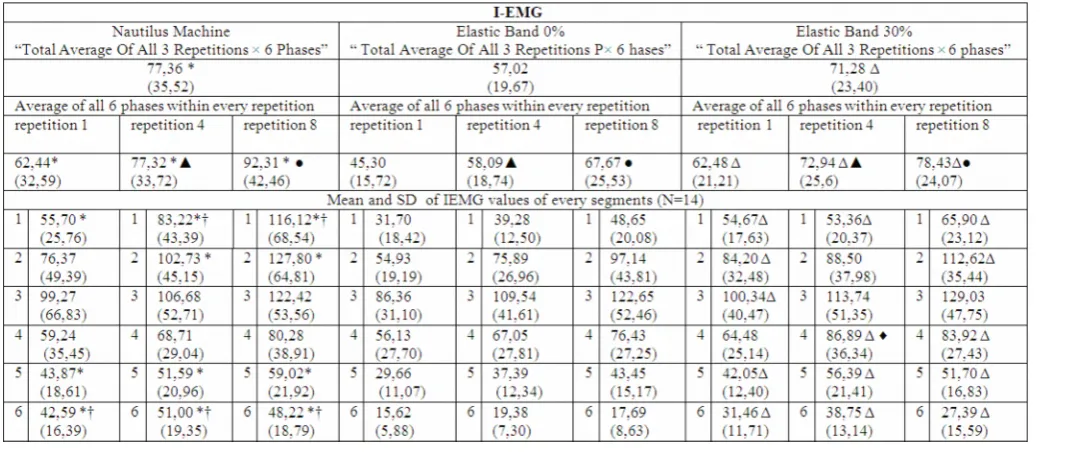
The ensemble I-EMG values for 3 exercise types comprised
of Average of I-EMG (average of all 6 segments within
every repetition) and Total of Average I-EMG (average of
all 6 segments x 3 repetitions) in addition to I-EMG value
within various segments are listed in table 1. Total of
Average I-EMG demonstrated no significant difference
between E30% and NM (P =0.443); while, both modes of
exercise attained significantly higher value than EO% (P = 0,011 and P = 0.00 for M and E30%, respectively; all P <
Examining similar repetitions within various modes of
exercise in Average of I-EMG level also advocated
aforementioned finding (all P<0.05). The data in this level
demonstrated, except in first repetition which E30%
displayed slightly higher value than nautilus machine (P =
0.996), NM exercise generated non-significantly higher
value than E30% (P = 0.155 and P = 0.570 in repetition 4
and 8 respectively) and statistically higher value than EO%.
- - Nautaltl$:
••••••• EL1.41<0" .
- - Ela..4i,30G<0
,
•...
:
" ,'
-.
- - - '
....
-110
100
.
c
*0
~ SO
:t
-
"
u )()i:
"
..
-10-e
10
0 0 resistance exercises also
The comparison between elastic
exhibited significantly higher value in favor of E30% (all P
< 0.05). In segmental level, the differentiations of muscle
activation in similar phases between various exercise types
are exhibited in table 1. These results indicated that in the
early concentric and late eccentric segments (i.e. first and 6th
segments) NM generated significantly higher muscle
activation than both elastic modalities; E30% also attained
higher value than EO% (all p<0.05). In the mid-concentric
and mid-eccentric segments both nautilus and E30% show
significantly higher muscle activity than EO%, though no
Figure 1 . Ensemble of all 3 repetitions representing the value of every segment,
*
= Nautilus is significantly higher than Elastic 000. 6.=Elastic 3000 is significantly higher than Elastic 00 0 _ 0 =Nautilus is significantly higher than Elastic 30%.significant differences displayed between E30% and NM.
Finally, in late concentric and early eccentric phases , no
significant differences has been observed between 3 types of
exercises; except, E30% which demonstrated significantly
[image:4.595.325.538.47.213.2]higher Mean I-EMG value than EO% in 4th phase.
TABLE I I-EMG Values Within Various Levels of Exercise Modalities I-DIG
Na utilus Mac hine Elas tic Band 0% Elastic Ba nd 30%
"Total A ver age Of All 3 Repet it ions x 6 Phases" " Tota l A ver age Of A ll 3 Repetit ion s p x 6 h ases' " To ta l Avera ge Of All 3 Repe tition s x 6 phases"
i i ,36 ' 5i ,02 iL 28Li
(35,52) (19,6i ) (23A O)
Aver age of all 6 phas es w ithin every repe tition Ave rag e of all 6 phas es within every repeti ti on Average of all 6 phases w ithin every repe ti tion repet ition I repe tit io n -l repe tit ion 8 repe tition I repe tition-l repe tit ion 8 repet ition I rep eti ti on -l repe tition 8
62A -l' i i ,32 , "- 92,3 1 ' e -l5,30 58,09 "- 6i ,6i e 62A8Li i2 ,9-lLi"- iS A3Lie
(32,59) (33,i 2) (-l2A 6) (1 5,i 2) (1 8,i-l ) (25,53) (2 1,2 1) (25,6) (2-l,Oi )
M ean and SO ofI EM G va lues of everv segmen ts (N- I-l)
I 55,iO ' I 83,22'i I 116, 12'i I 3 L i O I 39,28 I -l8,65 I 5-l,6i Li I 53,36Li I 65,9 0 Li
(25,i 6) (-l3,39) (68,5-l) (18A 2) (1 2, 50 ) (20,08) ( Ii ,63) (20,3i ) (23, 12)
2
ie.s:
2 102,i3 ' 2 I n ,80 ' 2 5-l,93 2 i 5,89 2 9i, l -l 2 8-l,20 Li 2 88,50 2 112,62Li(-l9,39) (-l5, 15) (6U I ) (19, 19) (26,96) (-l3,8 1) (32A 8) (3i ,98) (35,-l-l)
3 99,2i 3 106,68 3 122A2 3 86,36 3 109,5-l 3 122,65 3 100,3-lLi 3 I13,i -l 3 129,03
(66,83) (52,i l ) (53,56) (3 L1 0) (-lL 6 1) (52A 6) (-lOA i ) (5 1,35) (-li ,i 5)
-l 59,2-l -l
ss,n
-l 80,2 8 -l 56,13 -l 6i ,05 -l i6 A3 -l 6-lA 8 -l 86,89 Li • -l 83,92 Li(35A 5) (29,0-l) (38,9 1) (2i ,iO ) (2i ,81) (2 i ,25) (25, 1-l) (36,3-l) (2i A 3)
5 -l3,8i ' 5 5 1,59 ' 5 59,02 ' 5 29,66 5 3i ,39 5 -l3A 5 5 -l2,05Li 5 56,39 Li 5 5UOLi
(18 ,6 1) (20,96) (2 1,92) (1L Oi ) (1 2,3-l) (15,1i ) ( 12A O) (2 lA I ) (16,83) 6 -l2, 59
' t
6 5 1,00' t
6 -l8,22' t
6 15,62 6 19,38 6 Ii ,69 6 3 1A6 Li 6 38,i5Li 6 2i ,39Li(16 ,39 ) (19 ,35) (18,i9 ) (5,88) (i ,30) (8,63) (1 U I ) (13, 1-l) (15,59)
• NM is significantly higher than EO% . ~E30%) is significantly higher than EO% . tNM is signifi cantly higher than E30% .• E30% is significantly higher than NM . "- Significantly higher than repetition I.e Significantly higher than repetition I and 4.
Discussion.
This investigation speculated whether various modalities of
elastic resistance (EO% and E30%) could generate as much
muscle activation as NM exercises. The present findings
[image:4.595.37.575.401.627.2]matching various color code of elastic tubing, has
successfully developed muscle activation and torque
production in Total Average I-EMG values (ensemble of all
6 segments x 3 repetitions) throughout elastic resistance
exercises. More specifically, utilizing aforementioned
strategies resulted in 25% increasing muscle activation in
E30% in compare with EO%.
within entire range of motion in E30%. This sub-maximal
muscle activation from initiation of the set might slow down
further increase motor unit recruitment in repetition 4 and 8.
However, the finding cannot be interpreted as a
disadvantage for E30% because it still statistically showed
higher values within all 3 repetitions.
FIGCRE 2. Ensemble ofall 6 phases representing the value of every repetition.
'*
NMis significantly higher than E3000.IJ.
E30% is significantly higher than EO%In the early concentric and late eccentric segments, NM
generated significantly higher muscle activation than both
EO% and elastic 30%. Greater provided external resistance
as well as concomitant higher inertia of force in these two
segments is the reason for observing higher I-EMG value in
NM. However, 66.57% increasing I-EMG in phase 1 and
I-EMG. The present finding in segmental level displayed an
ascending-descending I-EMG profile for knee extensors
which completely supports previous research outcomes
recommended ball-shaped loading profile of VRT. Utilizing
these modes of exercises is characterized by increasing
muscle tension progressively throughout concentric phase
and decreasing tension throughout eccentric phase of
contraction. Therefore, the linear increment of external
moment of force in elastic resistance and nautilus machine
exercises within the concentric phase of contraction has met
the torque requirement of quadriceps muscles.
I ~P "
....•
.. ...
..
.
' "..
'.. . . . ...-..Naul ili!>
.. . . . tasuc
... la!>lic 3
I pi 100
90
80
~ 70
~
..:.
60
;"
=t
-;"so
...
-e
030
20 However, the visual inspection of figure 2 demonstrated
various slops for muscle activation curves within 3 exercise
modalities. Interestingly , the more repetitions were
completed, the more distinction has been observed between
NM and elastic resistance. For example, E30% and NM
demonstrated 0.06% differentiation in repetition 1 (in favor
of E30%), while, 17.69% in repetition 8 (in favor of NM).
These alterations could be attributed to various loading
profile of 3 exercise types [11] and could indicate the higher
efficiency of nautilus exercises in generating muscle
activation within performing 8-RM. In the other hand,
differentiations between elastic resistance exercises
exhibited a downward range from 37.2% in repetition 1, to
25.56% in repetition 4 and 15.90% in repetition 8 (all in
favor of E30%). The possible explanation might be
attributed to more constant near maximal recoil of force
Average of I-EMG. Examining Inter-exercise I-EMG values
within similar repetitions supported preceding findings
based on insignificant difference between E30% and NM.
However, Intra-exercise I-EMG values demonstrated a
general trend in which within all types of exercise higher
1-EMG was achieved while approaching to the last repetitions
of 8-RM (figure 2). This increase in magnitude of muscle
activation could be attributed to neuromuscular fatigue. The
results are in line with previous findings indicating that
motor unit activation was increased with fatigue in last few
repetition ofa set [15,16]. In advocate of this explanation,
Behm [3] suggested that following fatigue, stronger neural
drive is generated to conquer some of the effects of fatigue
85.20% in phase 6 for E30% in compared with EO%
supported effectiveness of two applied strategies in
developing muscle tension in elastic resistance exercises.
In the mid-concentric and mid-eccentric segments, NM
displayed 34.62% and E30% showed 35.82% significantly
higher muscle activity than EO% in phase 2 and 5; although
no significant differences observed between E30% and NM
(2.89% in favor of NM). Regarding that nautilus machine is
being designed to provide required muscular tension in all
range of motion itself, the merit of applying elastic 30%
become more obvious when it reached the tension generated
in nautilus machine within these two segments.
In late concentric phase (third segment), although E30%
showed slightly higher I-EMG value than NM (4.48%), no
statistical differences has been observed between three
modes of training. In the early eccentric phase (4thsegment),
E30% demonstrated significantly (17.88%) higher I-EMG
value than EO%. Based on these results, it seems that
shortened form of elastic exercise (E30%) and NM exercises
offer equivalent muscle activation. Thus, they could be used
interchangeably for lower body strength development;
while, EO% exercises might not be considered as a reliable
mode of exercise for achieving further neuromuscular
adaptation for quadriceps since it couldn't elicit adequate
muscle activation. However, this is not to say that EO% is
not an effective lift, but rather that it may be applied in
various levels of rehabilitation or primary level of training
period.
References
[1].
[2].
[3].
[4].
[5].
[6].
[7].
[8].
Fleck SJ, William J Kraemer. Designing Resistance Training Program: Human Kinetics; 2004.
Wallace BJ, Winchester JB, McGuigan MR. Effects of Elastic Bands on Force and Power Characteristics during the Back Squat Exercise. The Journal of Strength & Conditioning Research. 2006; 20(2):268-72.
Behm DG. Surgical tubing for sport and velocity specific training. . NCSA 1. 1988; 10(4):66-70.
Hodges GN. The effect of movement strategy and elastic starting strain on shoulder resultant fount moment during elastic resistance exercise: Manitoba; 2006.
Anderson CE, Sforzo GA, Sigg JA. The Effects of Combining Elastic and Free Weight Resistance on Strength and Power in Athletes. The Journal of Strength & Conditioning Research. 2008; 22(2):567-74 10.1519/JSC.ObOI3e3181634dle.
Ebben WE, Jensen RL. Electromyographic and Kinetic Analysis of Traditional, Chain, and Elastic Band Squats. The Journal of Strength & Conditioning Research. 2002; 16(4):547-50. Page PA, John Lamberth, Ben Abadie, Robert Boling, Robert Collins, Robert Collins. Posterior Rotator Cuff Strengthening Using Theraband® in a Functional Diagonal Pattern in Collegiate Baseball Pitchers. J Athl Train. 1993 28.(4 ):346-54. Treiber FA, Lott J, Duncan J, Slavens G, Davis H. Effects of Theraband and Lightweight Dumbbell Training on Shoulder Rotation Torque and Serve Performance in College Tennis
[9].
[10]. [11].
[12].
[13].
[14].
[15].
[16].
Players. The American Journal of Sports Medicine. 1998 July 1998; 26(4):510-5.
SALE D. Neural Adaptation to Resistance Training. Medicine and science in sport and exercise. 198820 (5): 135-45. Konrad P. The ABC ofEMG: Noraxon Company; 2005. Welsch EA, Bird M, Mayhew JL. Electromyographic Activity of the Pectoralis Major and Anterior Deltoid Muscles during Three Upper-Body Lifts. The Journal of Strength&
Conditioning Research. 2005; 19(2):449-52.
McBride J, Blaak JB, T. T-M. Effect of resistance exercise volume and complexity on EMG, strength, and regional body composition. Eur J Appl Physiol 2003 90(5-6):626-32
Lim Y, Chow 1. Electromyographic Comparison of Biceps Curls Performance Using a Dumbbell and an Elastic Tubing. north American congress on biomechanics waterloo, Canada; 1998. Matheson JW, Kernozek TW, Fater DCW, Davies G1. Electromyographic activity and applied load during seated quadriceps exercises. Medicine& Science in Sports&Exercise. 2001;33(10):1713-25.
KREAMER WJ, RATAMESS NA. Hormonal Response and Adaptation to Resistance Exercise and Training. Jounal of Sport Medicine. 2005 ;35(4):339-61.