International Journal of Emerging Technology and Advanced Engineering
Website: www.ijetae.com (ISSN 2250-2459,ISO 9001:2008 Certified Journal, Volume 5, Issue 10, October 2015)
354
Efficiency MAC MIMO Cooperative Protocol for Wireless
Sensor Networks
Walid BOUDHIAFI
1, Wided ABIDI
2, Sid' El Moctar SIDI 'HAMED
3, Tahar EZZEDINE
41,2.3,4SysCom Laboratory, University of Tunis El-manar, National Engineering School (ENIT) of Tunis
Abstract- In wireless sensor networks where multiple antennas cannot be integrated into a single node, the MIMO technology (Multiple Input Multiple Output) allow cooperatives to exploit to increase performance or reduce the energy used for communications. In this paper, MIMO cooperative strategies are proposed for wireless sensor networks, where energy consumption is the most important constraint. Their advantage in terms of error and energy consumption rate on single-antenna techniques (SISO), even multi-step. A selection of the number of transmit and receive antennas, optimal in terms of energy efficiency, is also proposed according to the transmission distances. we propose in this paper a new protocol for wireless sensor networks. The main challenge of this protocol remains to increase the wireless sensor networks lifetime. This network protocol is dedicated for large-scale wireless sensor network. We use two aspects: In the first aspect based on the sensor network decomposition cluster and the second based on the MAC MIMO cooperative protocol. We develop an analytical model that aims to calculate the probability of error, then, we calculate the energy consumption and transmission time based on the probability of transmission errors and bit error rate for point-to-point transmission and MAC MIMO cooperative.
Keywords- wireless sensor networks, energy, MIMO cooperative, hierarchical protocol, MAC protocol, BER (bit error rate).
I. INTRODUCTION
Wireless sensor networks can be define as a collection of sensor nodes that interact with the real environment which collectively participate in the transmission of data between them, to one or more collection of sensors.
The theme of sensor networks is particularly active for several years. It now represents a strong application potential because of its use of various applications (military, environmental, medical and commercial). The critical objective of the current research is to minimize the energy (to maximize the network lifetime), minimize
the transmission delay and
the reliability of end-to-end
and the probability of error.
These points remain the main challenge for a new protocol that we represent in the following. Therefore, the main concern of our protocol is to extend the life of the system by saving energy expended by each network sensor [8]. This protocol is based on a special architecture of cooperative communication between the sensor nodes.
The network is organized in the form of clusters, a cluster that contains the sender node is called the sender cluster, a cluster for the receipt, which contains the receiving node, and intermediate clusters for intermediate communications.
In the literature, to define routing approaches for large sensor networks, efforts have been directed at defining a hierarchical topology, two or more levels, based on clusters. These nodes requiring computing capacity and most important communication, the choice requires instrumentation network for applying selection criteria. Another critical point is the need for decentralization of decisions, especially in large networks. In this context, our research goal is to propose a MAC protocol based on a topology organized as clusters with a cooperative MIMO communication between them.
This paper is structured as follows: In the first section, we present the important MIMO concept to minimize energy in wireless sensor networks. The second section we make the description of our protocol. Thirty section is devoted to the study of the performance of the protocol in terms of calculation of the probability of error. Finally, the conclusion summarizes the work presented.
II.MULTIPLE NODES CONCEPT IN WIRELESS SENSOR
NETWORKS (MIMOCOOPERATIVE)
A major design requirement of wireless sensor networks is to reduce the energy consumption of the each sensor nodes. The exploitation of multiple nodes in wireless sensor networks (cooperative MIMO) is inevitable in order to provide higher reliability communication link and reduce transmission power. Therefore, the MIMO technology has used to fulfil the demand for providing reliable high-speed wireless communication links in harsh environments. In addition, The MIMO concept has been offered to be exploited in Ad hoc network. Indeed, the station base and the access point to tackle the challenges of low transmission rates with no constraints on energy efficiency. But, in wireless sensor networks have energy constraints due to the fact that each sensor node depends on its battery for its operation.
International Journal of Emerging Technology and Advanced Engineering
Website: www.ijetae.com (ISSN 2250-2459,ISO 9001:2008 Certified Journal, Volume 5, Issue 10, October 2015)
355
In this context, we use the concept in the cooperative MIMO wireless sensor network to reduce total energy consumption for each sensor node. Multiple sensor nodes are physically grouped together to cooperatively transmit and/or receive. Within a cluster, sensor nodes can communicate with relatively low power as compared to inter-cluster communication .Furthermore, by using this cooperative MIMO concept, we can provide the advantages of traditional MIMO systems to wireless sensor networks particularly in terms of energy efficient operation.III. PROTOCOL DESCRIPTION
In heuristic approaches proposed for wireless sensor networks based on clustering technique, cluster members do not transmit their data collected directly to the base station but at their head cluster is [2] [3] . As a result, the cluster head node (CH) acts as a coordinator between the members of the cluster, for example, it will aggregate the data captured by the sensor nodes, and transmit them to a remote base station either directly or via a way of multi-hop transmission. Therefore, the CH node receives more packets; consequently, it will consume more energy for long-range transmission, which causes a high error probability. The energy will be depleted rapidly in CH nodes if elected for a long period, for example, the LEACH protocol [2] or HEED protocol [3]. Therefore, other techniques should avoid CH node election process as an example PEGASIS protocol [6] or ZHLS protocol [7], so the protocols that are based on the election technology can quickly deplete their batteries because of their extensive use. Thus, it can cause bottlenecks in clusters and subsequently triggers CH nodes reelection process.
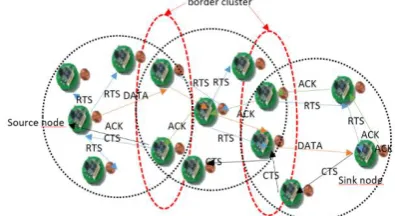
In this protocol, we operate two major aspects, one based on the hierarchy to organize the network as areas or clusters, avoiding the notion of election or CH node. The second aspect is to use the MAC protocol for MIMO cooperative transmission between clusters. This protocol generally described in the following figure:
• Network decomposition form clusters or areas. • The frontiers nodes.
[image:2.595.59.269.641.728.2]• A cooperative communication for transmission.
Figure 1: wireless sensor network decomposing form clusters
In the following we detail the construction of clusters and algorithms that illustrate how our protocol.
In this section, we propose to decompose the network as cluster or area but avoiding the technique of election of a CH node since it wastes energy in a huge way in the cluster. Consequently, we are moving towards a distributed decomposition. We deploy nodes in a random or unconstrained deployment (without sensor node localization or without location information). We propose an algorithm for the organization of the network as cluster or area, the input for our algorithm parameters is as follows:
• Each node has an IDnode.
At the end of the execution of the algorithm[1], the nodes should be assigned to clusters. The division into clusters is proposed a distributed process and as an actor trigger, some nodes called nodes-inviting. These nodes have different roles CH nodes. We require that each cluster contain a single node-calling that will play the role of cluster builder through invitation messages to other nodes by propagation step by step. The nodes receiving these messages can accept or decline the invitation. Once the initial invitation messages, the nodes-inviting lose their special properties because they make no management and subsequently becomes a normal node as the other nodes in the cluster (it only monitoring). Then, we have avoided the CH node problem in the cluster as a source of energy. Border nodes characterize each cluster, these nodes act as a bridge between the clusters, and they ensure communication in the form of MIMO cooperative.
A. Building a cluster
After the form of cluster network organization; now focusing on the transmission of data using a MAC MIMO cooperative approach. Indeed, among the target MAC protocols minimizing energy consumption, for this it uses the mechanism listening / sleep as a result, these protocols are not adequate for real-time applications because delays caused by this mechanism among these protocols we find SMAC, TMAC, DMAC and ZMAC. We designed our algorithm so that we do not use the mechanism listening / sleep to minimize transmission delay.
We describe the cooperative MIMO MAC protocol algorithm in the figure 2.
[image:2.595.332.530.652.760.2]International Journal of Emerging Technology and Advanced Engineering
Website: www.ijetae.com (ISSN 2250-2459,ISO 9001:2008 Certified Journal, Volume 5, Issue 10, October 2015)
356
IV. PERFORMANCE OF THE PROTOCOLIn this section, we study the performance of this protocol resulted in the calculation of the probability of error, energy consumption, and the delay (the time required for the transmission of a packet from sending node to the receiving node) for point-to-point transmission according to the probability of error. we express the energy consumption based on the probability of error in the context of MIMO MAC cooperative and the delay.
1) Bit Error Rate
In this section, we calculate the bit error rate BER (Bit Error Rate) pb. In the context cooperative MIMO based on
a probability of error for the point-to-point transmission. In this calculation of probability, we do not use the FEC code (Forward Error Correction). [9]
Either PP: The packet error probability, so the
relationship between the two probabilities is given by equation (1):
( ) (1)
L: packet length in bits.
Pr: receiving power, PN: the noise power, Eb: bit by
receiving power, N0: the noise power density, B:
bandwidth, PN: the noise power, Eb: bit by receiving
power,
We consider the error generated from two cases:
The transmitter cluster to the cluster and of these receptors to the receiver node [4]. The space-time code is not used (each node sends the same data packet for each reception cluster node at the same time). Each receiving node receives multiple packets sent by the cluster nodes issuer, the MISO communication type for each receptor cluster node.
Let p (eM-1), the probability of error for the MISO
transmission and pepp (dest): the probability of error
between border nodes (border nodes in the cluster receipt) to the receiving node so the error generated for each path is given by equation (4):
: The complementary probability
( )( ( )) (3)
( - ( ) ( )) Or
=( ( ) ( )) (4)
The calculation of the probability of error depends on channel type and the type of modulation and coding in the channel.
We use BPSK modulation under Raylight fading channel (fading) and without the use of space-time code or channel coding.
Let ( ) the expression of the probability of error for a signal on instantaneous noise
( ) (√ ) (5)
The signal to noise Instant for point-to-point transmission.
(6)
Pt transmission power, d: distance between the transmitter and the receiver node, λ fainting, α: This is the path loss between 2 and 4
The signal to instantaneous noise follows an exponential distribution with parameter
( )
(7)
We use the theory of Chernoff bound:
( ) ( )
Since there are M transmitter node from cluster transmitter and the probability of error for a signal on instantaneous noise given by equation (6)
∑
∑ (8)
We use Moment generating function :
( ) ∏
(9)
( ) ( ) ( ) ∏
Subsequently we use the decision rule [4] to the receiver node level since he will receive much of the same package type these cluster neighboring nodes.
If each receiving node in the cluster receive the same bit error rate (BER) [4] so the bit error probability of reception after the formation of N node in the cluster receiver is given by the equation:
∑ ( ) ( )
(10) ∏ ( )
∏ ( )
∏ ( )
∏ ( )
International Journal of Emerging Technology and Advanced Engineering
Website: www.ijetae.com (ISSN 2250-2459,ISO 9001:2008 Certified Journal, Volume 5, Issue 10, October 2015)
[image:4.595.69.292.147.305.2]357
Figure 3: variation of the bit error rate for the different COOPERATIVE MIMO system
In figure 3: shows the variation of the bit error rate for the different COOPERATIVE MIMO system and point-to-point.
In point-to-point transmission, transmission power is pt, we use pt /2 and pt / 4 for transmission 2 * 2 MIMO COOPERATIVE and 4 * 4 MIMO COOPERATIVE.
We have demonstrated the effectiveness of the cooperative communication to decrease the bit error rate depending on the transmission power; consequently, the reduction of the probability of error decreases the energy consumption and reduce the latency.
2) Energy consumptions in cooperative MAC MIMO The cooperative MIMO system can play a particularly important role in the transmission medium or long distance transmission of energy which dominates the overall consumption [5] [1].
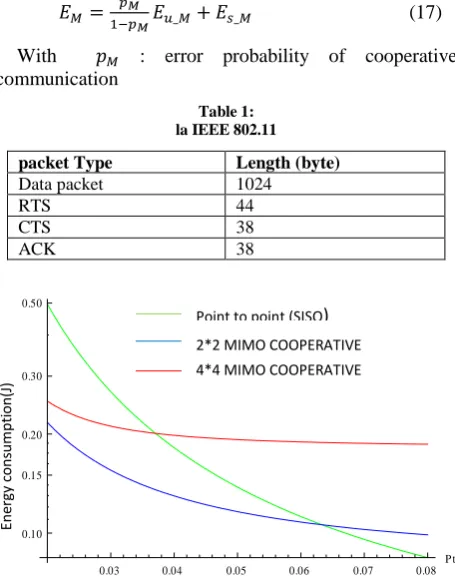
We interested in the Pt transmission power consumption. Therefore, we use the technique without collision CSMA / CD and the RTS / CTS technique to establish the connection between the transmitter nodes, the receiver node and the ACK packet to make the data packet reception. As a result, there are two types of energy consumed during transmission:
: Energy consumption for transmission corruption
packet and : Energy consumption for successful
transmission packet.
(12)
(13)
The total energy consumed for point-to-point transmission as a function of the probability of error.
(14)
In this section, we calculate the energy using the cooperative MAC MIMO between the two clusters: the sender cluster (M nodes) and receiver cluster (N nodes).
In our protocol, the energy calculation is not in [4] because there is no energy consumed for the recruitment of nodes to the transmitter or receiver because the cluster is set from the cluster network decomposing. So there are two types of energy consumed during transmission is as follows:
: Energy consumption for transmission corruption
packet and : Energy consumption for successful transmission packet.
(
) (15)
And
( )
Whit , , , and the energy
consumed during the transmission of RTC, CTS and ACK. : is the energy used to collect packet receiver neighboring nodes
(17)
[image:4.595.318.546.359.650.2]With : error probability of cooperative communication
Table 1: la IEEE 802.11
packet Type Length (byte)
Data packet 1024
RTS 44
CTS 38
ACK 38
Figure 3: variation of Energy consumption for the different COOPERATIVE MIMO system
V. CONCLUSION
In this paper, we developed a new protocol that concatenates two fundamental aspects; the first aspect is to define a distributed architecture of wireless sensor network.
0.2 0.4 0.6 0.8 1.0 P t
10 5 10 4 0.001 0.01 0.1 1
2*2 MIMO COOPERATIVE
4*4 MIMO COOPERATIVE Point to point (SISO)
Bit error
ra
te
0.03 0.04 0.05 0.06 0.07 0.08
P t 0.10
0.50
0.20 0.30
0.15
2*2 MIMO COOPERATIVE 4*4 MIMO COOPERATIVE Point to point (SISO)
Ene
rg
y c
o
ns
um
pt
io
n(
International Journal of Emerging Technology and Advanced Engineering
Website: www.ijetae.com (ISSN 2250-2459,ISO 9001:2008 Certified Journal, Volume 5, Issue 10, October 2015)
358
This architecture is note based on the notion of electing CH for each cluster we have shown that it leads to energy waste at the CH nodes. Remaining within the context of organizing the form of sensor network cluster but based on the nodes-guests, after the construction of the cluster nodes inviting back normal nodes and they only monitoring. Each cluster node knows these neighboring nodes including borders nodes. Borders nodes provide cooperative communication between clusters in which we operate the second aspect, which is the MAC MIMO cooperative transmission.Thus, we have dismantled the effectiveness of this protocol to reduce the probability of error with respect to the point-to-point transmission, in fact, reduced energy consumption and delay, this protocol makes it reliable network in terms of communication.
REFERENCES
[1] Walid BOUDHIAFI,Taher EZZEDINE , Ridha BOUALLEGUE et Ammar BOUALLAGUE« Conception d‟un nouveau protocole pour le réseau de capteurs sans fil ». Revue Méditerranéenne des Télécommunications vo.2, n°1, janvier 2012
[2] Heinzelman W, Chandrakasan A et Balakrishnan H « Energy-efficient communicationprotocol for wireless sensor networks », proceedings.
[3] Younis.OetFahmy.S, « Distributed Clustering in Ad-hoc Sensor Networks: A Hybrid,Energy-Efficient Approach », proceedings of the IEEE Infocom, Mars 2004.
[4] Haiming Yang, Hsin-Yi Shen, Biplab Sikdar “A MAC Protocol for Cooperative MIMO Transmissions in Sensor networks” Department of ECSE, Rensselaer Polytechnic Institute, Troy, NY 12180 USA
[5] Tuan-Duc Nguyen, Olivier Berder, Olivier Sentieys « Optimisation énergétique des transmissions MIMO coopératives pour les réseaux decapteurs » IRISA 2008.
[6] Lindsey, S. Raghavendra, C.S. PEGASIS: Power-efficient gathering in sensor information systems. IEEE Aerospace Conference Proceedings. 2002, Vol. 3, pp. 3-1130
[7] Hamma, T. Katoh, T. Bista, B.B. Takata, T. An Efficient ZHLS Routing Protocol for Mobile Ad Hoc Networks. 17th International Conference on Database and Expert Systems Applications. 2006, pp. 66-70.