International Journal of Emerging Technology and Advanced Engineering
Website: www.ijetae.com (ISSN 2250-2459, ISO 9001:2008 Certified Journal, Volume 9, Issue 10, October 2019)
245
Exponential-Gamma Distribution
Ogunwale O. D.
1,
Adewusi O. A.
2, Ayeni T. M.
3 1Department of Statistics, Ekiti State University, Nigeria. Abstract— Statistical distributions are widely applied todescribe different real world phenomena. As a result of the usefulness of statistical distributions, many researchers have studied their theory extensively and new distributions are developed. The quest for developing more efficient and flexible probability distribution still remain strong in the field of probability theory and statistics. In this paper, we propose a new probability distribution called Exponential-Gamma distribution and derive appropriate expressions for its statistical properties.
Keywords— Exponential-Gamma distribution (EGD), Moment generating function, Probability density function (pdf), Survival function.
I. INTRODUCTION
Statistical distributions are commonly applied to describe real world phenomena. Due to the usefulness of statistical distributions, their theory is widely studied and new distributions are developed. The quest for developing more efficient and flexible probability distribution remain strong in the field of probability theory and statistics [5]. The obvious reason for generalizing a standard distribution is because the generalized form in most times provides larger efficiency and flexibility in modeling real life data. The interest in developing more flexible probability distributions have received so much attention over the years from various researchers who have combined different continuous distributions such as[11], [6],[1],[4],[7],[8] and [2] More so, several studies [9] and [13] have shown that distributions of combined random variables are more flexible, perform better and have wider applicability[3]. Motivated by the recent developments in generating new distributions and the need for continuous extension and generalization to more complex situations, we introduce Exponential-Gamma and study its statistical properties.
II. METHODS
A. Derivation of the Exponential-Gamma Distribution (EGD)
The probability density function of the Exponential-gamma distribution (EGD) is derived in this section.
Theorem 1: Let X1 and X2 be a continuous independent random variables such that; X1~E(x,λ) and X2~G(x,α,λ) then their probability density function is given as;
1
( )
e
x, ,
0
f x
x
(1) 12
( )
, , ,
0
( )
x
x
e
f x
x
(2)Therefore, the probability density function of Exponential-Gamma distribution is obtained by
1 2 1 2
( ,
)
( ). ( )
f x x
f x
f x
, wheref x x
( ,
1 2)
is the product off x
( )
1 andf x
( )
2 , then the new pdf of E-G is given as;1 1 2 1 2
( ,
)
, , ,
0
( )
x
x
e
f x x
x
(3)For convenient evaluation we’ll let,
f x x
( ,
1 2)
f x
( )
. It is easy to confirm the legitimacy of the newlydeveloped Exponential-Gamma Distribution by using appropriate statistical methods.B. Statistical properties
In this section, we present the statistical properties of EGD especially the first four moments, the variance, coefficient of variation, Skewness, Kurtosis, Moment generating function and Characteristic function
C. Moments
Theorem 3: If X is a continuous random variable distributed as an Exponential-Gamma (x, α, λ), then the rth non-central
moment is given by
1
'
1
(
)
( )
2
r r
r
.Proof:
' 0
( ; , ) dx
r
r
x f x
1 1 2
0
( )
x r
x
e
x
dx
International Journal of Emerging Technology and Advanced Engineering
Website: www.ijetae.com (ISSN 2250-2459, ISO 9001:2008 Certified Journal, Volume 9, Issue 10, October 2019)
246
let
u
2
x
,
,
2
u
x
then,2
du
dx
so that (4)reduces to:
1 1 01
( )
2
r u r
u
e du
1 '1
(
)
( )
2
r r
r
(5)Substituting r=1,2,3 and 4 in equation (5) we obtain the mean, the second moment, third and the fourth moment for EGD. We also obtained the Variance by the association
2 ' ' 2 1
Mean= 1' 1
2
(6)2'
(
21)
2
Variance=
2 ' ' 2 1
2 1 2(
1)
2
2
2 1
2
2
( )
2
V x
(7)Then the 3rd and the 4th moments is given as;
'
3 2 3
(
1)(
2)
2
and'
4 3 4
(
1)(
2)(
3)
2
(8)respectively.
D. Moment generating function
Theorem 4: If X is a continuous random variable distributed as a E-G(x, α, λ), then the moment generating function is
defined as 1
( )
(2
t)
xM t
. Proof:
0M ( )
xt
E e
txe f x
tx( ; , )
dx
1 1 2 0
( )
( )
x tx x
x
e
e
M t
dx
(9)let
u
x
(2
t
),
(2
)
u
x
t
, then(2
)
du
dx
t
so that (9) is reduced to:
1
1 0
( )(2
t)
u
u
e du
1( )
(2
t)
xM t
(10)E. Characteristics function
Theorem 5: If is a random variable distributed as a E-G(x, α, λ), then the characteristics function
x( )
it
isdefined as 1
( )
(2
)
xit
it
. Proof:
0( )
itx itx( ; , )
x
it
E e
e f x
dx
1 1 2
0
( )
x itx
x
e
e
dx
(11)Let
u
x
(2
it
),
(2
)
u
x
it
then,(2
)
du
dx
it
so that (11) is reduced to:1
1 0
( )(2
)
u
u
e dx
International Journal of Emerging Technology and Advanced Engineering
Website: www.ijetae.com (ISSN 2250-2459, ISO 9001:2008 Certified Journal, Volume 9, Issue 10, October 2019)
247
1( )
(2
)
xit
it
(12)F. Coefficient of variation (C.V) is a standardized measure of dispersion of a probability distribution and is given as;
.
C V
Therefore the C.V of the EGD is given as;
2( 1)
1
2
2
2
.
2
C V
2 1 2 1 22
.
1
1
C V
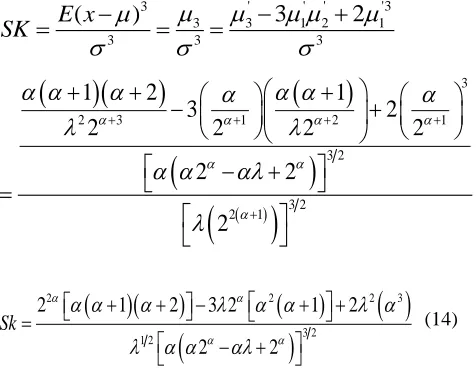
(13)G. Skewness and Kurtosis
Skewness is a measure of the asymmetry of the probability distribution of a real-valued random variable about its mean and is given as;
' ' ' '3 3
3 3 1 2 1
3 3 3
3
2
(
)
E x
SK
32 3 1 2 1
3 2 3 2 2 1
1
2
1
3
2
2
2
2
2
2
2
2
2 2 2 3
3 2 1 2
2
1
2
3 2
1
2
2
2
Sk
(14)Kurtosis is a descriptor of the shape of a probability distribution and is given as;
' ' ' '2 ' '4 4
4 1 3 1 2 1
4
4 4 4
4
6
3
(
)
E x
K
2 44 3 1 3 2 1 2 1
2 2 2 1
1 2 3 1 2 1
4 6 3
2 2 2 2 2 2
2 2 2
3 2 2 2 3 3 4
2
2 1 2 3 4 2 1 2 6 2 1 3
2 2 K (15)
H. Cumulative distribution function
The cumulative distribution function of a random variable X evaluated at x is the probability that X will take a value less than or equal to x and is defined as;
0
( )
( )
x
F x
P X
x
f x dx
Theorem 6: If is a continuous random variable from the Exponential-Gamma distribution, the cumulative density
function (cdf) is defined by
( )
( , )
2
( )
x
F x
.Proof:
1 1 2 0
( )
( )
x x
x
e
F x
dx
(16)Let
u
2
x
,2
u
x
, then2
du
dx
so that (16) isreduced to:
1 1 01
( )
2
x
u
u
e du
Where 1 0
( , )
x
u
u
e du
x
is an incomplete lower gamma function. Then the cdf of EGD is given as;
( )
( , )
2
( )
x
F x
(17) [image:3.612.50.288.448.634.2]International Journal of Emerging Technology and Advanced Engineering
Website: www.ijetae.com (ISSN 2250-2459, ISO 9001:2008 Certified Journal, Volume 9, Issue 10, October 2019)
248
From Figure 1, it is observed that the Exponetial-Gamma distribution increasingly resembles the exponential distribution; the spread reduces with increasing scale parameter. Furthermore, the distribution shows positive skewness for different values of the scale parameter. The cdf plots shown in Figure 2 increase from 0 to 1 as X
increases.
I. Survival function
The survival function also known as reliability function is a function that gives the probability that a patient, device, or other object of interest will survive beyond any given specified time and is defined as;
S x
( ) 1
F x
( )
where; F(x) is the cumulative distribution function of x
then, the survival function of EGD is given as;
( , )
( ) 1
2
( )
x
S x
(18)J. Hazard function
The hazard function also called the force of mortality, instantaneous failure rate, instantaneous death rate, or age-specific failure rate is the instantaneous risk that the event of interest happens, within a very narrow time frame and is defined as;
( )
( )
( )
f x
h x
S x
where f(x) and S(x) is the pdf and survival function therefore, we obtain the hazard function of EGD as;
1 1 2
( , )
( )
1
( )
2
( )
x
x
e
x
h x
1 1 2
2
( )
2
( )
( , )
x
x
e
h x
x
(19)K. Maximum Likelihood Estimator
Let
X , X ,..., X
1 2 n be a random sample of size n from Exponential-Gamma distribution. Then the likelihood function is given by;1
1
1 1
L( , ; )
exp
2
( )
nn n
i i
i i
x
x
x
(20)by taking logarithm of (20), we find the log likelihood function as;
1 1
log( ) log log log ( ) ( 1) log 2
n n
i i
i i
L n n n x x
(21)
Therefore, the MLE which maximizes (21) must satisfy the following normal equations;
'
1
log
( )
log
log
( )
n
i i
L
n
n
x
(22)1
log
2
n
i i
L
n
n
x
International Journal of Emerging Technology and Advanced Engineering
Website: www.ijetae.com (ISSN 2250-2459, ISO 9001:2008 Certified Journal, Volume 9, Issue 10, October 2019)
249
The solution of the non-linear system of equations is obtained by differentiating (21) with respect to
( , )
gives the maximum likelihood estimates of the model parameters. The estimates of the parameters can be obtained by solving (22) and (23) simultaneously as it cannot be done analytically, therefore a numerical technique can be adopted. The solution can also be obtained directly by using any statistical software when data sets are available.
III. CONCLUSION
Numerous distributions have been defined and proved to be widely applied in the field of probability and statistics. In this paper, we defined, studied and established a new two-parameter distribution named Exponential-Gamma distribution and have derived various properties of the Exponential-Gamma distribution, including the first four moments, moment generating function, characteristics function cumulative distribution function, skewness, kurtosis and its maximum likelihood estimate.
REFERENCES
[1] Adamidis, K., Dimitrakopoulou, T. and Loukas, S. (2005). On a generalization of the exponential-geometric distribution, Statist. and Probab. Lett., 73 259-269.
[2] Afaq, A., Ahmad, S. P. and Ahmed, A. (2017). Characterization and Estimation of Weibull-Rayleigh Distribution with Applications to Life Time Data Appl. Math. Inf. Sci .Lett. 5, No. 2, 71-79 (2017) http://dx.doi.org/10.18576/amisl/050206
[3] Akarawak, E. E. E., Adeleke, I. A., and Okafor, R. O. (2017), The Gamma-Rayleigh Distribution and Applications to Survival Data Nigerian Journal of Basic and Applied Science 25(2): 130-142 DOI: http://dx.doi.org/10.4314/njbas.v25i2.14 ISSN 0794-5698
[4] Al-Aqtash, R., Lee C. and Famoye, F. (2014). Gumbel-weibull distribution: Properties and applications. J. Mod. Applied Stat. Methods, 13: 201-225.
[5] Alzaatreh, A., Lee, C. and Famoye, F. (2013), ―A new method for generating families of continuous distributions‖, Metron,vol. 71(1), pp.63-79,
[6] Famoye, F., Lee C., and Olumolade, O. (2005). The Beta-Weibull distribution. J. Stat. Theory Appl. 4(2), 121–136
[7] Faton, M. and Ibrahim, E. (2014). Transmuted Weibull-geometric distribution and its applications, Scientia Magna Vol. 10, No. 1, 68-82
[8] Faton, M. and Ibrahim, E. (2015). Weibull Rayleigh Distribution: Theory and Applications Appl. Math. Inf. Sci. 9, No. 4, 2127-2137 http://dx.doi.org/10.12785/amis/090452
[9] Gupta, R. D. and Kundu, D. (2001). Exponentiated Exponential Family: An Alternative to Gamma and Weibull Distributions. Biometrical Journal, 43(1): 319 – 326.
[10] Nadaraja, S. and Kotz, S. (2005). The beta exponential distribution; Reliability Engineering and System Safety 91 (2006) 689–697 www.elsevier.com/locate/ress