International Journal of Emerging Technology and Advanced Engineering
Website: www.ijetae.com (ISSN 2250-2459, ISO 9001:2008 Certified Journal, Volume 9, Issue 3, March 2019)
88
Drip Irrigation
M. Tarun
1, Shruti Bhargava Choubey
2Sreenidhi Institute of Science and Technology Hyderabad, India.
Abstract-- In the field of agriculture, use of correct methodology of irrigation is vital and it's documented that irrigation by drip is extremely economical and economical. In the typical drip irrigation system, the farmer must keep watch on irrigation timetable, that is totally different for various crops. The project makes the irrigation automated. With the utilization of low price sensors and therefore the easy electronic equipment makes this project a coffee price product, which can be bought even by a poor farmer.This project is best fitted to places wherever water is scares and must be utilized in restricted amount. Also, assemblage countries will afford this straightforward and low price resolution for irrigation and procure sensible yield on Crops. The heart of the project is that the Intel 89c51microcontroller.UART controller that will be used in this project. A 16×2 liquid crystal display is connected to the microcontroller, which displays the humidity level and ambient temperature. Three pushbuttons are provided to set the limits of humidity for switching the individual solenoid valves controlling the water flow to the field. The wetness and temperature levels square measure transmitted at regular interval to the laptop through the RS232 port for information work and analysis. The wetness sensors square measure created exploitation Al sheets and housed in simply out there materials. The aim is to use the promptly out there material to construct low price sensors. Five relays square measure controlled by the microcontroller through the high current driver IC, ULN2003. Four relays square measure provided for dominant four coil valves, which controls the flow of water to four different parts of the field. One relay is employed to shut-off the most motor that is employed to pump the water to the sector.
I. INTRODUCTION
The continuous increasing demand of the food needs the fast improvement in food production technology. In a country like India, where the economy is mainly based on agriculture and the climatic conditions are isotropic, still we are not able to make full use of agricultural resources. The main reason is that the lack of rains of land reservoir water. The continuous extraction of water from earth is reducing the water level thanks to that ton of land is coming back slowly within the zones of un-irrigated land. Another vital reason of this can be thanks to unplanned use of water thanks to that a major quantity of water goes waste.
In the fashionable drip irrigation systems, the foremost important advantage is that water is provided close to the basis zone of the plants drip by drip thanks to that a large quantity of water is saved. At the current era, the farmers have been using irrigation technique in India through the manual control in which the farmers irrigate the land at the regular intervals. This method generally consumes a lot of water or generally the water reaches late thanks to that the crops get dried. Water deficiency is damaging to plants before visible wilt happens. Slowed rate, lighter weight fruit follows slight water deficiency. This downside is absolutely corrected if we have a tendency to use automatic small controller based mostly drip irrigation system during which the irrigation can present itself only there'll be intense requirement of water.
Irrigation system uses valves to show irrigation ON and OFF. These valves is also simply machine-controlled by exploitation controllers and solenoids. Automating farm or nursery irrigation permits farmers to use the correct quantity of water at the correct time, notwithstanding the supply of labor to show valves on and off. In addition, farmers exploitation automation instrumentation square measure ready to cut back runoff from over watering saturated soils, avoid irrigating at the wrong time of day, which will improve crop performance by ensuring adequate water and nutrients when needed. Automatic Drip Irrigation may be a valuable tool for correct soil wetness management in extremely specialised greenhouse vegetable production and it's a straightforward, precise methodology for irrigation. It conjointly helps in time saving, removal of human error in adjusting out there soil wetness levels and to maximise their web profits.
The entire automation work is divided in 2 sections, first is to study the basic components of irrigation system thoroughly and then to design and implement the control circuitry. So we'll 1st see a number of the essential platform of drip irrigation system.
II. DEFINITION OF IRRIGATION
International Journal of Emerging Technology and Advanced Engineering
Website: www.ijetae.com (ISSN 2250-2459, ISO 9001:2008 Certified Journal, Volume 9, Issue 3, March 2019)
89
Types of irrigation:1. Surface irrigation 2. Localized irrigation 3. Drip Irrigation 4. Sprinkler irrigation
Drip irrigation conjointly referred to as trickle irrigation or microirrigation is associate irrigation methodology that minimizes the utilization of water and plant food by permitting water to drip slowly to the roots of plants, either onto the soil surface or directly onto the basis zone, through a network of valves, pipes, tubing, and emitters
III. CONCEPT MODERN IRRIGATION SYSTEM
The traditional irrigation strategies like overhead sprinklers, flood type feeding systems usually wet the lower leaves and stem of the plants. The entire soil surface is saturated and infrequently stays wet long when irrigation is completed. Such condition promotes infections by leaf mold fungi. The flood kind strategies consume great amount of water and therefore the space between crop rows remains dry and receives wetness solely from incidental precipitation. On the contrary the drip or trickle irrigation may be a sort of fashionable irrigation technique that slowly applies tiny amounts of water to a part of plant root zone. Drip irrigation methodology is made-up by Israelis in Seventies. Water is provided often, typically daily to take care of favorable soil wetness condition and stop wetness stress within the plant with correct use of water resources.
Figure(1)
A wetted profile developed within the plant’s root zone is as shown in Figure (1). Its shape depends on soil characteristics. Drip irrigation saves water as a result of solely the plant’s root zone receives wetness. Little water is lost to deep percolation if the right quantity is applied. Drip irrigation is widespread as a result of it will increase yields and reduce each water needs and labor.
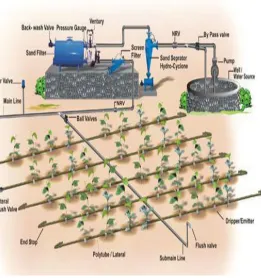
Drip irrigation needs concerning 1/2 the water required by mechanical device or surface irrigation. Lower in operation pressures and flow rates lead to reduced energy prices. A higher degree of water control is attainable. Plants will be equipped a lot of precise amounts of water. Disease and bug injury is reduced as a result of plant foliage stays dry. Operating cost is usually reduced. Federations might continue throughout the irrigation method as a result of rows between plants stay dry. Fertilizers will be applied through this sort of system. This can lead to a discount of chemical and chemical prices. When compared with overhead mechanical device systems, drip irrigation results in less soil and wind erosion. Drip irrigation will be applied beneath a large vary of field conditions. A typical Drip irrigation assembly is shown in figure (2) below.
[image:2.612.326.587.403.681.2] [image:2.612.67.286.487.675.2]International Journal of Emerging Technology and Advanced Engineering
Website: www.ijetae.com (ISSN 2250-2459, ISO 9001:2008 Certified Journal, Volume 9, Issue 3, March 2019)
90
DESIGN OF MICRO CONTROLLER Primarily Based DRIP IRRIGATION SYSTEM: –The key parts that ought to be thought-about whereas coming up with a mechanical model: -.
1. Flow: -You can measure the output of your water supply with a one or five gallon bucket and a stopwatch. Time however long it takes to fill the bucket and use that range to calculate what proportion water is offered per hour. Gallons per minute x 60=number of gallons per hour.
2. Pressure (The force pushing the flow): – Most product operate best between twenty and forty pounds of pressure. Normal household pressure is 40-50 pounds.
3.Water Supply & Quality: – town and H2O ar straightforward to filter for drip irrigation systems. Pond, ditch and a few H2O have special filtering wants. The quality and supply of water can dictate the kind of filter necessary for your system. .
4.Soil Type and Root Structure: – The soil type will dictate how a regular drip of water on one spot will spread. Sandy soil needs nearer electrode spacing as water percolates vertically at a quick rate and slower horizontally. With a clay soil water tends to unfold horizontally, giving a large distribution pattern. Emitters will be spaced additional apart with clay sort soil. A loamy sort soil can turn out a a lot of even percolation dispersion of water. Deep-rooted plants will handle a wider spacing of emitters, whereas shallow unmoving plants ar most with efficiency moire slowly (low gap emitters) with emitters spaced approximate. On clay soil or on a side, short cycles repeated frequently work best. On sandy soil, applying water with higher gap emitters lets the water spread out horizontally better than a low gap emitter.
5.Elevation: – Variations in elevation will cause a amendment in water pressure at intervals the system. Pressure changes by one pound for each two.3 foot change in elevation. Pressure-compensating emitters ar designed to figure in areas with massive changes in elevation.
6.Timing: – Watering during a regular regular cycle is crucial. On clay soil or hillsides, short cycles recurrent oft work best to forestall runoff, erosion and wasted water. In sandy soils, slow watering victimisation low output emitters is usually recommended. Timers facilitate stop the too-dry/too-wet cycles that stress plants and retard their growth. They conjointly yield watering at optimum times like early morning or late evening.
7. Watering Needs: – Plants with totally different water wants might need their own watering circuits. For example, orchards that get patterned weekly would like a unique circuit than a garden that gets patterned daily. Plants that ar drought tolerant can got to be moire otherwise than plants requiring a great deal of water.
The Elements Of Small Controller Primarily Based Drip Irrigation System Ar As Follows: –
I) Pump II) Water Filter III) Flow Meter IV) Control Valve
V) Chemical Injection Unit VI) Drip lines with Emitters
VII) Moisture and Temperature Sensors.
VIII)Micro controller Unit (The brain of the system).
The Micro Controller Unit Is Now Explained In Detail: –
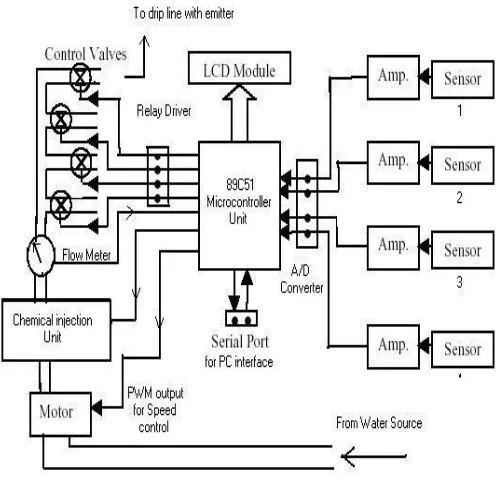
The automatic system consists of wetness sensors, temperature sensors, Signal conditioning circuit, Digital to analog converter, LCD Module, Relay driver, solenoid control valves, etc. The unit is expressed in Figure – (3) below.
[image:3.612.334.582.435.680.2]International Journal of Emerging Technology and Advanced Engineering
Website: www.ijetae.com (ISSN 2250-2459, ISO 9001:2008 Certified Journal, Volume 9, Issue 3, March 2019)
91
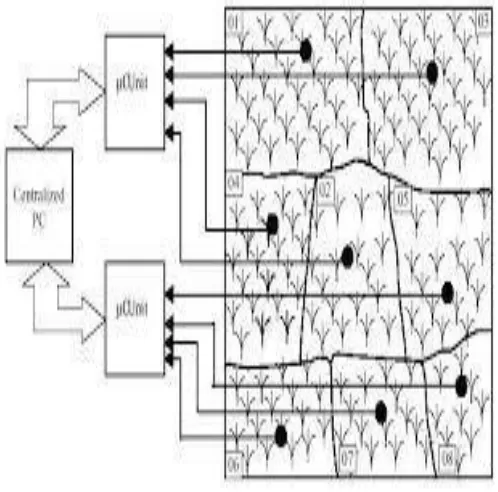
The vital parameters to be measured for automation of irrigation system ar soil wetness and temperature. The entire field is 1st divided in to tiny sections such every section ought to contain one wetness sensing element and a temperature sensing element. RTD like PT100 will be used as a temperature sensing element whereas Densitometer will be used because the wetness sensing element to notice wetness contents of soil. These sensors ar buried within the ground at needed depth. Once the soil has reached desired wetness level the sensors send a proof to the small controller to show off the relays, which control the valves.Figure – (4) Application to field
IV. SENSOR
The signal send by the sensing element is boosted unto the specified level by corresponding electronic equipment stages. Then the amplified signal is fed to A/D converters of desired resolution to get digital style of perceived input for microcontroller use.
A 16X1 line alphanumeric display module will be utilized in the system to observe current readings of all the sensors and also the current standing of various valves. The solenoid valves are controlled by microcontroller though relays. A Chemical injection unit is employed to combine needed quantity of fertilizers, pesticides, and nutrients with water, whenever required. Varying speed of pump motor will management pressure of water. It will be obtained with the assistance of PWM output of microcontroller unit.
A flow meter is connected for analysis of total water consumed.
The required readings is transferred to the Centralized pc for additional analytical studies, through the interface gift on microcontroller unit. While applying the automation on massive fields quite one such microcontroller units is interfaced to the Centralized pc the microcontroller unit has in-built timer in it, which operates parallel to sensor system. In case of detector failure the timer turns off the valves once a intensity of your time, which may prevent the further disaster. The microcontroller unit might warn the pump failure or inadequate quantity of water input with the assistance of flow meter.
Advantages:
1. Are relatively simple to design and install.
2. This is terribly helpful to any or all atmospheric condition any it's economic friendly.
3. This makes increase in productivity and reduces water consumption.
4. Here we are micro controllers so there is error free. 5. This is safest and no manpower is required. Permit
alternative yard and garden work to continue once irrigation is happening, as only the immediate plant areas are wet.
6. Reduce soil erosion and nutrient leaching.
7. Reduce the prospect of disease by keeping foliage dry.
8. May be concealed to maintain the beauty of the landscape, and to reduce vandalism and liability when installed in public areas.
9. Require smaller water sources, as an example, but half the water required for a system.
Disadvantages:
1. This is only applicable for large size farms. 2. Equipment is costlier.
3. Require frequent maintenance for efficient operation. 4. Have restricted life once installation because of the
deterioration of the plastic parts in a very hot, arid climate when exposed to ultraviolet light.
V. CONCLUSION
[image:4.612.52.301.268.514.2]International Journal of Emerging Technology and Advanced Engineering
Website: www.ijetae.com (ISSN 2250-2459, ISO 9001:2008 Certified Journal, Volume 9, Issue 3, March 2019)
92
Using this technique, one will save personnel, water to enhance production and ultimately profit.REFERENCES
[1] Sanford, S. and J. Panuska, 2018. Irrigation Management in Wiscons in, Bulletin A4119, University of Wisconsin‐
Extension. https://learningstore.uwex.edu/Assets/pdfs/A4119.pdf [2] Shock C., 2013. Introduction to Drip Irrigation, Bulletin EM 8782, O
regon State University. https://catalog.extension.oregonstate.edu/e m8782
[3] Simonne, E., R. Hochmuth, J. Breman, W. Lamont, K. Treadwell, an d A. Gazula, 2015. Drip‐
Irrigation Systems for Small Conventional Vegetable Farms and Or ganic Vegetable Farms, Bulletin HS1144, University of Florida Ext ension, Gainesville, FL. http://edis.ifas.ufl.edu/pdffiles/HS/HS38800 .pdf
[4] Tomasko, S. and G. Nice, 2013. Wisconsin Private & Commercial P esticide Applicator: Chemigation, University of Wisconsin‐
Extension. Available at: https://patstore.wisc.edu/secure/default.asp [5] Van der Gulik, T.W., 1999. B.C. Trickle Irrigation Manual, B.C. Mi
nistry of Agriculture and Food, Abbotsford, B.C. Canada. Available from Irrigation Industry Association of British Columbia www.irrig ationbc.com
[6] Van der Gulik, T., 2015. Trickle Irrigation Scheduling Using Evapot ranspiration Data, B.C. Ministry of Agriculture and Food, 2004. http s://www2.gov.bc.ca/assets/gov/farming‐natural‐resources‐and‐
industry/agriculture‐and‐seafood/agricultural‐land‐and‐
environment/water/500‐series/577100‐
4_trickle_irrig_scheduling_using_evapotranspiration_data.pdf [7] Wright, J., D. Wildung, T. Nennich, 2012. Water Management consi
derations and soil moisture monitoring tools for high tunnel producti on, pg 42 in Minnesota High Tunnel Production Manual for Comme rcial Growers http://www.extension.umn.edu/garden/fruit‐