Assessing collaborative performance on
construction projects through knowledge
exchange : a UK Rail Strategic Alliance
case study
Staykova, G and Underwood, J
http://dx.doi.org/10.1108/ECAM0820160179
Title Assessing collaborative performance on construction projects through knowledge exchange : a UK Rail Strategic Alliance case study
Authors Staykova, G and Underwood, J
Type Article
URL This version is available at: http://usir.salford.ac.uk/40910/
Published Date 2017
USIR is a digital collection of the research output of the University of Salford. Where copyright permits, full text material held in the repository is made freely available online and can be read, downloaded and copied for noncommercial private study or research purposes. Please check the manuscript for any further copyright restrictions.
Assessing Collaborative Performance on Construction Projects through
Knowledge Exchange: A UK Rail Strategic Alliance Case Study
Gergana Staykova and Jason Underwood
School of the Built Environment, University of Salford, Salford, UK
Abstract
Purpose – How knowledge exchange can be used for the continuous assessment and improvement of collaborative performance of project-based organisations in construction is explored. Collaboration on construction projects must be facilitated by people alongside practice of continuous performance assessment and improvement. However, currently available assessment tools fail to explicitly define appropriate behaviours and actions due to a poor understanding of what it means for people to collaborate. On the other hand, it is established that knowledge exchange is the focus of collaborative efforts on construction projects; therefore, as most knowledge resides with people, it represents their role in collaboration.
Design/methodology/approach – Through a phenomenological/interpretivist and qualitative methodology, how knowledge exchange can be used for the continuous assessment and improvement of collaborative performance in project-based organisations in construction is explored. A single case study of a UK rail strategic alliance was adopted and 6 semi-structured interviews were conducted and subsequently analysed through a thematic analysis.
Findings – An assessment tool is proposed based on a set of 20 characteristics of knowledge exchange, divided into seven categories and linked to indicators of collaboration. The tool can be applied to highly collaborative projects where BIM and Lean are implemented, and project participants are collocated. By measuring their performance against the set criteria, project teams can assess which of their behaviours and actions are inappropriate, and focus their efforts on correcting them.
Originality/value – Defining the abstract indicators traditionally used to assess collaboration in terms of characteristics pertinent to day-to-day communication amongst participants on collaborative projects to facilitate the continuous assessment and improvement of collaborative performance.
Keywords: Collaborative performance assessment, knowledge exchange, rail strategic alliance
Introduction
Yet, in knowledge intensive industries such as construction (Rezgui, 2001), innovation requires new combinations of knowledge (e.g. Ruan et al., 2012). However, construction sector performance has long been failed by poor communication and exchange of information between project participants (Isikdag & Underwood, 2010). Thus, effective and efficient knowledge exchange (KE) is key to collaborative efforts on construction projects according to research on BIM (e.g. Eastman et al., 2011), alliancing (e.g. Holt et al., 2000) and Lean (Zimina et al., 2012). Moreover, as knowledge resides in people (Choo, 1998; Choo et al., 2000), KE therefore represents the fundamental role of people in collaboration. This paper presents a study that proposes to define the abstract role of people in collaboration in terms of KE, and thus allow for objective measurement and strategic performance improvement. In doing so, the study bridges the gap between existing research on assessing collaboration in the construction industry on the one hand, and KE on the other.
Assessing collaboration through Knowledge Exchange
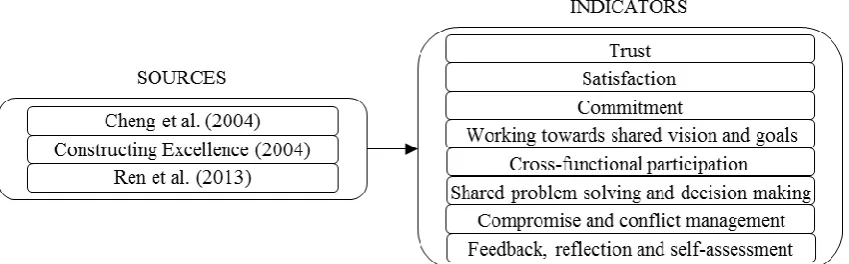
Analysis on how collaboration is defined from various perspectives within the construction industry reveals that behaviour is one of the most important factors for project success, suggesting that the role of people is critical in collaboration (Baiden et al., 2006; Eastman et al., 2011; Grilo and Jardim-Goncalves, 2010; Ren et al., 2013; Wilkinson, 2005; Zimina et al., 2012). Koskela et al. (2010) emphasise that while BIM, relational contracts, and Lean provide mechanisms to enable collaboration across technologies, organisations, and project phases, their successful implementation depends on collaboration between people. However, little is known about what it means for people to collaborate (Zimina et al., 2012), and although assessment tools (Cheng et al., 2004; Constructing Excellence, 2004; Ren et al., 2013) employ indicators tailored to the actions and behaviour of people, such as trust; satisfaction; commitment; working towards shared vision and goals; cross-functional participation; shared problem solving and decision making; compromise and conflict management; and feedback, reflection and self-assessment, they lack substance to allow for objective measurement, and thus, potentially neglect the most significant opportunity to improve project performance.
Additionally, the adopted definition of collaboration revealed that KE takes a central place in the concept of collaboration. Innovation requires new combinations of knowledge in knowledge intensive industries (Holt et al., 2000; Kim & Lee, 2006; McAdam, 2005; Rezgui et al., 2010; Ruan et al., 2012), such as construction (Rezgui, 2001), and supporting the view that poor communication and exchange of information is a major cause for the lagging performance of the industry (Isikdag & Underwood, 2010). On the other hand, as most knowledge resides in people (Choo, 1998; Choo et al., 2000), KE represents the fundamental contribution of people in collaboration, and therefore turns into an invaluable source of evidence for performance assessment. Additionally, KE is an inherently explicit “unit” of measurement, observable in any communication activity, making personal interpretation redundant. Consequently, if collaboration is defined in terms of KE, the threat to accuracy of results from self-reporting is significantly reduced. Furthermore, KE spans across the project lifecycle and can thus provide evidence for continuous assessment and improvement of collaborative performance.
Figure 1. Indicators of collaboration as identified in the definition of collaboration and the reviewed assessment tools.
The characteristics of Knowledge Exchange
The fields of construction and, more broadly, organisational management highlight six main characteristics of KE, namely; content, purpose, participants, frequency, style and retention.
Content: Tacit, informal, sensitive
According to Polanyi (1966), there are two types of knowledge in organisations: explicit and tacit. The former can be described as factual, and is often embedded in “procedure manuals, organisation maps, work break-down structure, document management systems, collaborative intranets and extranets” (Dave & Koskela, 2009: page 894), whereas the latter is subjective, derived from individual experience and judgement, and is exchanged between people (Choo, 1998; Choo et al., 2000). Arenius et al. (2003) argue that sharing both types is important for the successful outcome of the project, while others suggest that success and innovation in the Architecture, Engineering and Construction (AEC) industry depend on “on-the-job experience” (Dave & Koskela, 2009; Kamara et al., 2002; Styhre et al., 2006; Styhre & Gluch, 2010), and therefore, effective and efficient KE involves sharing of tacit knowledge. Hardwick et al. (2013), and Schilling and Phelps (2007) suggest that trust enables the transition from exchanging codified and explicit knowledge to more contextualised tacit knowledge.
Additionally, networking is a social communication process, which encourages communities to share knowledge, and emphasise the importance of such socialisation, especially in the fragmented construction industry (McDonald, 2003; Ruan et al. 2012). Moreover, Rezgui et al. (2010); Davenport and Prusak (1998) highlight that the transfer of informal knowledge helps to maintain trust. Hardwick et al. (2013) also observe that the sharing of private and social information enhances the emotional trust ties between partners, while indicating progressive collaboration. According to Child (2001), trust involved in collaboration between organisations reflects the quality of relationships between the people who represent these organisations.
[image:4.595.87.512.73.205.2]exchange of sensitive and potentially vulnerable knowledge – a necessary condition for innovation (Coffey, 2010; Wiewiora et al., 2013).
Purpose: Shared problem solving, conflict management, feedback
According to Ochieng and Price (2009), construction projects are complicated processes in a turbulent environment, undergoing constant changes. They are defined by Senaratne and Sexton (2008) as problem-solving processes, which require intensive information processing and knowledge from project team members. Consequently, the success of construction projects depends on the participants contributing their knowledge and expertise towards a practical solution to a common problem and a mutually beneficial outcome (Ruan et al., 2012). Cheng et al. (2004) note that joint problem solving within an alliance fosters management satisfaction and, consequently, commitment to team collaboration.
Considering the fragmented and typically adversarial nature of the AEC industry, sharing knowledge to facilitate conflict resolution is attributed to collaborative construction projects, where the focus is on facilitating resolution informally rather than through litigation (Huxham, 1991). Child (2001) proposes that the willingness to overcome differences and work through other unforeseen difficulties arising during collaboration is a manifest of trust between partners, which according to Sharma (1998), demonstrates commitment to collaborative success, and therefore also satisfaction. Moreover, it involves focusing the dialogue on long-term strategic outcomes, while balancing short-term individual goals; this is enabled by the exchange of multi-disciplinary expertise (Huxham, 1991).
Furthermore, in order for any problem solution or conflict resolution to be of mutual benefit, it must be subjected to feedback through KE. This is of particular importance to construction projects due to their highly fragmented knowledge and expertise, and the significant interdependency between the various construction disciplines and phases (Wiewiora et al., 2013). Thus, an alliance seeks feedback to continuously improve partners’ joint performance (Bennett, 1998), where ideas are examined from the different knowledge perspectives of project stakeholders, and refined accordingly (Dave & Koskela, 2009). Holt et al. (2000) and Williams (2007) further emphasise that such criticism must be constructive, recognising that mistakes are opportunities to learn for the sake of the long-term success of collaboration. Therefore, they note that there must be honesty and trust.
Participants: Diversity
KE activities. Holt et al. (2000) highlight the fact that such vertical and horizontal integration displays cross-functional participation, commitment and learning, but paradoxically, must be preceded by unlearning traditional definitions of boundaries, roles, responsibilities and authority.
Frequency: proactivity
Since knowledge is fragmented and particularised to the disciplines, which, in turn, are highly interdependent, and as changes happen on a daily basis, new knowledge acquired by any participant must be disseminated proactively to allow for adequate coordinated response in achieving the common goals. Similar to the propositions from Forme et al. (2007), the Constructing Excellence Effective Teamwork matrix (Constructing Excellence, 2004) suggests that knowledge sharing evolves from a “strictly on a ‘need to know’ basis”, through reactive sharing – “when others need it” – to “actively and openly” sharing knowledge and ideas around the whole team. In addition, De Long and Fahey (2000) note that cultures that emphasise collaboration and frequency of interactions have greater KE outcomes. However, Wiewiora et al. (2013: page 1170) found that project participants are often very protective of their knowledge, recognising its power and “withholding knowledge as being a way to advance their careers”, i.e. a sign of competitiveness rather than collaboration.
Style: Assertive-cooperative
While the diversity of participants enables a variety of private constructions to interact and thus lead to creativity and innovation, Hardy et al. (2005) point out that simply including diverse stakeholders is not sufficient to ensure that diverse knowledge is exchanged. To avoid the risk of failing to communicate one’s knowledge and views due to being dominated or overlooked on the one hand, or being overly identified with the team, rather than the employer on the other, Hardy et al. (2005) propose that it is important for participants to engage in assertive talk. Additionally, it is emphasised that assertiveness must be received with cooperative attitudes and individual views discussed in the context of the project interests to foster creativity and produce fit-for-purpose mutually beneficial results (Hardy et al., 2005). Therefore, an assertive and cooperative style of KE are balanced to ensure that stakeholder interests are aligned in the context of the project goals leading to participant satisfaction and commitment.
Retention
Proposed theoretical framework for assessing collaborative performance on construction projects based on the measure of Knowledge Exchange
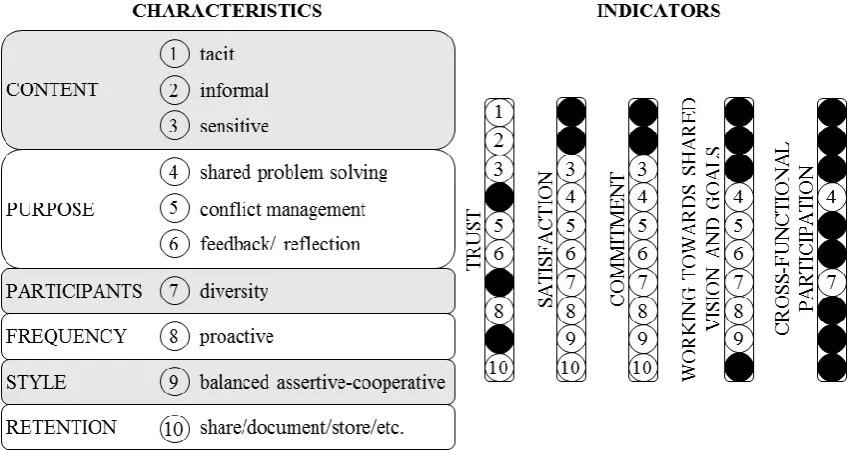
The review of the literature on knowledge in both the construction industry and the wider field of organisation management identified six categories and ten characteristics of KE relating to six indicators of collaboration (Figure 2). These derived propositions form the basis of a theoretical framework which is explored further with the objective of defining a comprehensive set of KE criteria against which the collaborative performance of construction projects can be assessed.
Figure 2. Proposed theoretical framework: characteristics of KE and their links to the indicators of collaboration (represented by numbered circles).
Research Methodology
The nature of the study lends itself to phenomenological research (Krogh et al., 2009) from an interpretive stance (Holloway & Wheeler, 2002, pp.7-8) and qualitative in hypothesising the characteristics of KE and their effects on the surface phenomenon of collaboration (Fellows & Liu, 2003; Maxwell, 2013; Naoum, 2007; Robson, 1993). Moreover, the study is exploratory in diagnosing these characteristics, screening for alternatives, and discovering new ideas, with the aim of conceptualising a tool for assessing collaborative performance based on the characteristics of KE (Robson, 1993; Zikmund, 1997). The explorative nature requires the collection of rich and deep data (Bryman, 1988), for which a case study is a well-suited research strategy, while it is argued that for the qualitative and exploratory nature of the research, a study of a single representative case will be beneficial, and sufficient. The selected case is a strategic alliance between a major UK rail operator and six contractors: two providing design and construction services in civil engineering, two in track renewal, one in overhead line electrification (OLE), and one in signalling and signalling power, and telecommunications. The representativeness of the case is defined by the pure alliancing model it has adopted, underpinned by collaborative principles, values and behaviours, shared risks and rewards, Target Value Design (TVD), BIM, and the collocation of over 200 people employed in the alliance.
[image:7.595.86.513.194.419.2]diversity of participants that possess sufficient insight into the knowledge-intensive processes within the case study organisation and the quality of data (Dawson, 2006) (Table I). A sample size of five to twenty five is considered sufficient for qualitative research (Creswell, 1998) or at least six (Morse, 1994). Interviews are an essential source of evidence when conducting exploratory case studies on human affairs (Yin, 2003), such as collaboration and KE. The use of less structured or semi-structured interviews allow participants to raise unanticipated ideas, enabling the exploration of diverse, novel perspectives (Gill et al., 2008; Mason, 2002; Maxwell, 2013).
[image:8.595.84.514.337.489.2]The analysis of data was guided by the theoretical propositions derived from literature (Figure 2), which allowed for the data to be systematically filtered out and organised according to the propositions as recommended by Robson (1993), such that answers to the research questions or alternative explanations were readily available to be explored further through the subsequent interviews. Following the organisation of the data into patterns and categories, factoring and relating variables were adopted as they allow for the examination of similarities and the conceptualisation of relationships between categories of concepts and ideas emerging from the data (Miles et al., 2013). This met the requirements for the qualitative and explorative nature of the research.
Table I. Demographics of selected participants.
ID Position Discipline Alliance partner
Previous alliancing
Years of experience
P01 Manager Work package design & engineering Civils No 25-30
P02 Engineer OLE design & engineering OLE No 20-25
P03 Engineer Signalling design & engineering Rail Yes 20-25
P04 Director Alliance leadership Rail Yes 20-25
P05 Manager Work package design & engineering Signalling No 30+
P06 Manager Work package planning & controls Rail Yes 30+
Findings
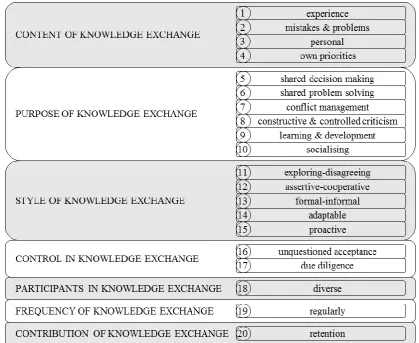
Figure 3. Main categories and the themes they comprise.
Content of knowledge exchange
trust to overcome the fear of losing competitiveness. This expands on the difficulties in KE that engineering practitioners face, and further emphasises the contrast with P04. Therefore, the exchange of tacit knowledge relates to the collaborative indicators of trust, commitment and working towards shared vision and goals.
Open sharing of mistakes and problems was emphasised by most participants, which can be likened to the sensitive content discussed previously (mistakes and problems). The contribution of such lesson-sharing to learning and improvement within the alliance was highlighted by P01 and P02, while P02 and P04 acknowledged that openly sharing problems is key for resolution and alliance progress. Therefore, openly sharing mistakes and problems is associated with a commitment to team performance and collaborative effort in achieving a shared vision and goals. P03 appreciated the potential for difficulty when people intentionally avoid admitting problems or mistakes in order to protect their employer’s reputation and explained that alliance partners must enforce honesty, even at the expense of damaging their reputation, as a sign of support for the alliance. Thus, speaking openly about mistakes and problems displays a degree of commitment to the team from the governance of the participating companies by implying that collective progress through learning from mistakes and problem resolution is prioritised over maintaining reputation. Additionally, P03 identified a potential barrier to sharing mistakes and problems posed by human behaviour rather than corporate policy and, along with P04, cited trust between partners as a necessary precondition for overcoming such psychological barriers. Interestingly, P05 presented a different perspective on how problems are handled within the alliance in conveying isolation rather than support for sharing and resolution. This suggests that the disclosure of problems and mistakes is significantly affected by their perception of commitment from their partners and experiences of collaboration and therefore displays trust, commitment and the strive towards shared vision and goals.
Social exchange between collaborating parties is a characteristic of KE that emerged from the analysis (personal knowledge). Most participants with whom the topic was discussed appeared positive about socialising, except P01 who expressed doubts related to the risk of cliques developing. Nevertheless, P01 subsequently added that social communication is essential in a collaborative workplace. P02, P03 and P04 referred to the exchange of private knowledge as a way of familiarising with and understanding each other. P03 also detailed the contribution of personal familiarity to productivity within the alliance in facilitating, for instance, shared problem solving, which is promoted through the building of trust between partners. Furthermore, P03 discussed the project and alliance-wide benefits that social exchange helps to achieve, explaining that it helps to build familiarity and understanding of different people, their views, their aspirations, which in turn enables collaborating parties to align differing objectives and appropriately motivate joint efforts towards achieving mutually beneficial outcomes. Thus, sharing personal knowledge is associated with trust-building between partners, as well as the work towards a shared vision and goals.
that it will not be misused in opportunistic situations. In addition, P04 hinted at the necessary precondition of commitment to alliance success in order to be open about such sensitive knowledge, since hiding it introduces risk of failure. As such, sharing interests, objectives and priorities signals collaborative indicators such as trust, commitment and the work towards a shared vision and goals.
Purpose of knowledge exchange
Six themes emerged to describe the various collaborative purposes for KE, including shared decision making, shared problem solving, conflict management, constructive and controlled criticism, learning and development, and socialising. Shared decision making, as a purpose for KE, was previously identified as the same as shared problem solving. However, based on the analysis it is defined separately whereby shared decision making is perceived to have a significant impact on collaborative performance with all participants referring to it as a process embedded in the concept of collaboration. While sharing objectives facilitates their alignment, shared decision making enables this alignment to be preserved. P04 also emphasised that there must be unanimous agreement amongst partners and further details of how this contributes to collaborative performance are offered by P02 and P03 where the alliance partners’ objectives would not be met if decisions were made autonomously. Accordingly, shared decision making is critical in maintaining a balance across participants’ fulfilment of their goals and preventing the advancement of some at the expense of others. The avoidance of compromising or reckless decisions is facilitated by shared discussions amongst partners, and thus reflects the cross-functional efforts towards mutually beneficial goals. In addition, P03 connected shared decision-making and commitment, suggesting that decisions must be made in the presence of all parties to ensure full commitment to enforcing them. Therefore, taking part in decision-making shows an intention to take ownership of decisions and act upon them, which is ultimately the result of a strong interest in, and support for, team progress.
The purpose of shared problem solving is a characteristic of KE which was found to have a significant impact on collaborative performance. P02 emphasised that because collaborating partners are interdependent within the alliance, problems must be jointly addressed, while P01 referred explicitly to how knowledge is exchanged to achieve this. Consequently, offering knowledge to help collectively resolve a problem is interpreted as commitment to the alliance performance, and a contribution towards its success. P06 offered a practical explanation as to why shared problem solving is critical for the progress of the alliance, referring to collectively resolving problems as a way of ensuring unobstructed application for building permission. Thus cross-functional efforts towards finding a solution to a common problem are the result of commitment and determination to achieve mutually beneficial outcomes. P03, on the other hand, took a behavioural perspective of the impact of shared problem solving on collaboration and trust being built by people with a willingness to work together. Therefore, the collective resolution of problems is related to the development of trust between collaborating partners, and associated with the development of confidence in each other’s goodwill. Thus, shared problem solving is a reflection of trust, commitment, cross-functional participation and the work towards a shared vision and goals in collaborative relationships.
Although conflict management appeared of significant importance to collaboration on construction projects, it was only briefly discussed by one of the participants. It is important to note, however, that most participants, with the exception of P04 and P05, are engaged with the last package of works, and currently in the phase of scope definition. Thus, it can be argued that their lack of experience in conflict management in the alliance could be due to having recently joined. P05, on the other hand, having been involved for longer, acknowledged that collaboration motivates cross-disciplinary conflict resolution as it reminds partners of their responsibilities to each other, and more specifically, working to accommodate everyone’s interests for the sake of achieving collective success. Since failure is a source of dissatisfaction for the alliance, conflict management, as a mechanism for achieving success, is encouraged by the partners’ commitment and willingness to achieve satisfaction from collectively accomplishing their shared vision and goals.
opportunity to learn rather than a source of embarrassment or personal judgement. In summary, a commitment to progress through learning and improvement results in a constructive and controlled approach to criticism amongst collaborating partners.
Learning and development was identified as a further theme that describes KE. However, unlike criticism, learning emerges through the dedicated sharing of experience and mentoring rather than through addressing emerging problems and mistakes. P01 and P02 referred to learning from colleagues within the alliance as having a positive long-term impact on performance. However, considering their attempt to set up regular sessions for proactive KE amongst alliance colleagues, P01 admitted having yet to find anybody to share anything although, at the same time, they have not asked anyone. Thus, such activities are related to additional time and effort by employees, and sometimes require investment from the governance to firstly implement and secondly participate. It is concluded that learning and development can only be realised if there is a long-term commitment to performance improvement and success, leading to mutual satisfaction from joint effort.
The final theme associated with a purpose for KE concerns socialising and its contribution to collaboration. Participants showed support for alliance participants engaging in social activities, claiming it is essential to gain familiarity with people across the alliance, which is necessary to enhance collaborative performance. This may be explained by the proposition that informal interaction is an effective way of exchanging personal knowledge which, in turn, is critical for building social trust between collaborating partners. In addition, emphasis is placed on such activities taking place outside of the workplace by P02, P03 and P04, while P01 expressed doubts about the advantages of socialising outside, although also noting people getting quite socially involved with each other. Nevertheless, participants also appreciated the difficulties involved in engaging people in social activities, referring to the lack of interest and motivation. Although having recognised benefits, socialising requires significant commitment to collaboration in order for people to identify themselves with the alliance and invest time out of their working hours in exchanging personal knowledge with colleagues. Thus, socialising is a valuable addition to the day-to-day joint activities at work because it allows partners to gain each other’s trust, and is a sign of commitment to the team as an entity, while also promoting satisfaction from the successful outcome of collaboration.
Style of knowledge exchange
Another characteristic of the style of KE is the balance between asserting one’s own priorities and cooperating to achieve the shared vision and goals (assertive-cooperative). While prioritising one’s own interests is important to ensure they are met, collaborative project success requires the accomplishment of everyone’s objectives. Both P02 and P04 agreed it is appropriate to reinstate one’s priorities if there is a concern they are being compromised. However, neither P01 nor P04 identified a situation when it might be necessary for someone to assert their position in the alliance, referring to the alignment of partners’ objectives as the reason why there are no conflicts of interest. In contrast, the need to reinstate one’s priorities appears more relevant to P05, who conveyed disappointment at the lack of mutual benefits. While the discrepancy between P01 and P05 may be explained by the fact that P01 has joined the alliance more recently, the contradiction between P04 and P05 suggests poor communication across organisational levels of the alliance, which has led to the compromise of interests, and consequently the decline in satisfaction with and commitment to the alliance. In summary, maintaining a balance between asserting own priorities and cooperation to achieve the common goals is found to relate to the commitment and satisfaction of partners, as well as their efforts to produce mutually beneficial results through cross-functional participation in discussions.
The balance between formality and informality was identified as an additional characteristic of the style of KE (formal-informal). Three participants emphasised that while both formal and informal KE can contribute to the effectiveness and efficiency of collaboration, none of them must prevail and they both need to be equally combined. It was suggested that formality is important to maintain participants’ focus on the job at hand, but if excessive, enforces artificial interaction, which hinders KE. Thus, formality is key in maintaining productivity and fulfilling one’s commitment to the alliance, while informal interaction is necessary to steer proactive KE amongst participants. Therefore, balanced formal and informal KE displays mutual trust between partners and a commitment to work effectively in order to satisfy shared goals.
A theme which appeared with only one of the participants, but is nevertheless considered a valuable addition, is the adaptation of style of KE in accordance with the audience [P03] (adaptable). Adjusting the style of expression, including the level of detail communicated and use of terminology, is associated with one’s willingness to accommodate the needs of their audience (i.e. their alliance partners) in order to facilitate productive KE, where knowledge is adequately conveyed, well understood, and subsequently applied in coordinated actions across disciplines in order to achieve the alliance’s vision and goals. Therefore, the adaptable style of KE is a reflection of partners’ commitments and satisfaction from investing joint efforts to accomplish mutually beneficial results.
acknowledged that proactive KE stimulates collaborative performance by educating partners to recognise and avoid actions that potentially compromise someone else’s interests. Furthermore, P05 referred to the relationship between proactive sharing and team spirit. The relationship between the lack of proactive communication and the preference to sit amongst familiar people reveals the importance of social trust in encouraging partners to proactively exchange knowledge rather than sharing only when required to. Therefore, it is suggested that reactive KE indicates mistrust between partners, while proactivity is a positive sign that reflects trust, commitment, and collective responsibility for team success, leading to mutual satisfaction.
Control in knowledge exchange
Two themes were found to relate to the exercising of control over KE in the alliance, namely the unquestioned acceptance of knowledge, and sharing with due diligence.
Participants discussed the meaning behind the exercising of control over knowledge input from partners within the alliance, unanimously agreeing on its relationship to trust (unquestioned acceptance). The unchallenged acceptance of knowledge from a partner displays trust in their skills and competence. Omission of control over knowledge input is also associated with social trust between participants, through their confidence in each other’s goodwill in acting upon spoken advice, instruction, or request, without questioning its legitimacy. This means the absence of paperwork to safeguard oneself from being accountable for someone else’s knowledge input should it lead to mistakes. Therefore, the acceptance of knowledge without the exercising any control indicates trust between collaborating parties.
It was also identified that partners must fulfil their work with due diligence in order to demonstrate its trustworthiness and gain each other’s confidence in the knowledge they share; only then will it be accepted unquestioned. This is a stance taken by both P02 and P03 and further reinforced by P03 who emphasised the importance of due diligence, not only for the purpose of building trust, but also for preventing failures which may compromise someone’s or everyone’s objectives, whether commercial or otherwise. Therefore, exercising due diligence has an important role in both building trust and achieving mutually beneficial outcomes, and thus requires a level of commitment to the responsibilities towards partners when involved in a collaborative relationship.
Participants in knowledge exchange
A theme characterising the participants in KE with regards to collaboration was identified as participant diversity.
pointed to a behavioural barrier to exchanging knowledge with new and diverse people. The need to be amongst “people they know” (within a specific discipline) can be interpreted as
discomfort in proactively communicating with unfamiliar people, which could be due to lack of trust between partners and can thus prevent the flow of knowledge across disciplines. Therefore, straightforward KE between diverse people is a reflection of trust. Although team diversity appears difficult to achieve in that it requires trust, commitment, cross-functional participation and collective efforts towards shared vision and goals, its contribution to collaborative performance far outweighs such difficulties, and ultimately leads to team satisfaction.
Frequency of knowledge exchange
The frequency of KE relates to the relationship between regular KE and effective and efficient collaboration (regularly).
This theme appeared across the majority of participants with regard to the regular exchange of knowledge in the alliance as a means of enhancing productivity. However, different reasons as to why regular interaction is important were highlighted. P01 and P05 emphasised the need for frequent meetings as a means of coordination across the team and to ensure that everyone’s efforts are focused in an appropriate direction. P03 noted that the regular exchange of up-to-date knowledge across the alliance is essential to maintain momentum in their progress towards the desired outcomes. In addition, both P05 and P06 explained that frequent communication is necessary to collectively respond to emerging problems and concerns across the team in due time to prevent disruption to the alliance performance. Therefore, the regular KE between partners reflects their commitment to support each other and to collectively accomplish their shared vision and goals. Furthermore, P02 recognised the value of frequent interaction for acquiring new knowledge and skills. Thus, exchanging knowledge often contributes not only to team performance, but also to satisfaction with individual improvement and advancement, and is motivated by partners’ commitment to each other’s long-term prosperity. In summary, regular KE displays a collective effort towards the achievement of mutually beneficial outcomes, as well as the significant individual and team commitment of partners, and as such often leads to satisfaction.
Contribution of the knowledge exchange
The contribution of KE in relation to the value of knowledge retention after its exchange was a theme to emerge.
industry-wide progress through learning and improvement. Accordingly, the retention of knowledge for future use on the project, self-education of partners, or application within the wider construction industry requires significant commitment, considering the implementation efforts necessary for it to be effective. However, this has a positive effect on partners’ satisfaction gained from their contribution to collaborative success.
Discussion
The potential of KE to provide evidence for assessing collaborative performance is substantiated by the case study findings. Participants from different organisational levels and project disciplines discussed various knowledge-intensive processes within the alliance, e.g. problem solving, handling of mistakes, learning and development; confirming that KE is a major focus for collaborative efforts. Furthermore, the fact that participants were engaged in different stages of project delivery confirms that KE spans across the project lifecycle and is a source of evidence for continuous assessment. Moreover, analysis extended the list of characteristics of KE associated with collaborative behaviour, which can serve as criteria for assessment, to 20, thereby adding 10 further characteristics to those already identified from the literature.
Shared decision making, under the category “Purpose” of KE, emerged from the findings as being associated with trust, commitment, cross-functional participation and working towards shared vision and goals (indicators of collaboration). Furthermore, in addition to the balance between assertiveness and cooperation, which aligned to the category “Style” of KE, the findings indicated that amongst other concerns, a balance between formal and informal styles of exchange is necessary in collaboration. “Control” was a completely new category of KE characteristics that emerged from the findings, which was not identified in the literature and suggests two interrelated themes: the unquestioned acceptance of someone else’s knowledge input, and the exercising of due diligence before offering knowledge to anyone. Constructive and controlled criticism as a purpose of KE is an example of a characteristic which was explored in the literature, but expanded through the findings, which relates overall to the commitment on collaborative construction projects. For criticism to be truly constructive, it must take into account a wide variety of viewpoints in order to lead to maximal performance improvement.
Proposed assessment tool of collaborative performance on construction projects based on the measure of Knowledge Exchange
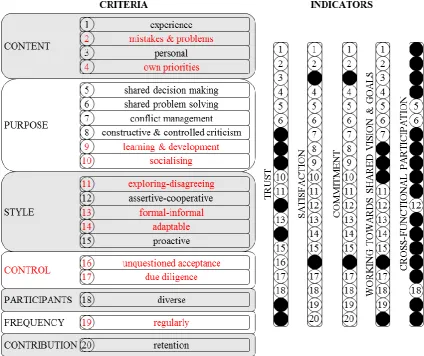
Figure 4. Proposed assessment mechanism of collaborative performance on construction projects based on the measure of Knowledge Exchange (assessment criteria additional to those identified in the literature are highlighted in red and the links are represented by numbered circles).
Conclusion
This paper has presented a study that explores how KE can be used for the continuous assessment and improvement of collaborative performance on construction projects. From a critical appraisal of the existing body of knowledge, a theoretical framework was proposed. Qualitative research based on this framework was carried out on a UK rail strategic alliance case study where Lean principles and BIM are implemented, and enabled a collaborative project environment. In line with propositions from the literature, the outcomes of the case study confirmed the need for performance assessment and the suitability for KE to provide the required evidence.
Findings resulted in a set of 20 characteristics of KE divided into seven categories where links were established between the characteristics of KE and collaborative indicators. This allowed abstract indicators, traditionally used to assess collaboration, to be described in terms of characteristics pertinent to day-to-day communication amongst participants on collaborative projects. The proposed assessment criteria enable practitioners to appreciate the actions and behaviours that collaboration implies, and to seek appropriate methods to reinforce them across project team members. In particular, it is expected that if teams strive to comply with the prescribed criteria, an increase in cross-functional and cross-hierarchical interactions, shared social activities, learning initiatives, and feedback polls, will be observed,
experience
mistakes & problems
1
2
18
[image:18.595.84.509.77.433.2]thus leading to better awareness and appreciation amongst participants, less conflicts of interest, more efficient decisions, a growth of skills and mutual benefits, and a comfortable work environment. Therefore, such a mechanism of assessing the level of collaboration performance based on the measure of knowledge exchange has the potential to enhance construction sector productivity by enhancing the development and improvement of collaborative working, if consistently applied within the industry.
However, several limitations of the current study are acknowledged. Although the study set out to provide criteria for measuring the indicators of collaboration without the need for personal interpretation, and while the ones proposed are considered sufficiently self-explanatory, their objectivity has not been tested. Therefore, the accurate measuring of criteria through self-reporting needs to be tested and evidenced. Furthermore, although the findings suggest that collaboration is successful at different degrees across the organisational levels and teams of the alliance, the causes have not been explored. In addition, collaboration may not have to function equally well across the alliance and there may be participants whose positions do not require cross-disciplinary collaboration. Therefore, further research should explore the extent to which collaborative performance assessment is required. Finally, the findings presented are limited to a single-case study of a rail strategic alliance in the UK, which is significantly different from the majority of projects traditionally found in the UK and global construction industries. Therefore, the proposed assessment mechanism needs to be explored on differing types of procured projects and global perspectives in order to establish the generalisability of the criteria.
References
Arenius, M., Artto, K., Lahti, M. & Meklin, J. (2003). Project companies and the multi-project paradigm – a new management approach. In Slevin, D.P., Cleland, D.I. & Pinto, J.K. (Eds.), The frontiers of project management research (pp.289-307). Norwood, MA: Project Management Institute.
Arif, M., Egbu, C., Alom, O. & Khalfan, M.M.A. (2008). Measuring knowledge retention: a case study of a construction consultancy in the UAE. Engineering, Construction and Architectural Management, 16(1), 92-108.
Baiden, B.K., Price, A.D.F., Dainty, A.R.J. (2006). The extent of team integration within construction projects. International Journal of Project Management, 24(1), 13–23.
Bennett, J. (1998). The seven pillars of partnering: a guide to second generation partnering. London: Thomas Telford.
BIM Industry Working Group. (2011). A report for the Government Construction Client Group: Building Information Modelling (BIM) working party strategy paper. Retrieved from http://www.bimtaskgroup.org/wp-content/uploads/2012/03/BIS-BIM-strategy-Report.pdf
Bryman, A. (1988). Quantity and quality in social research. London: Unwin Hyman.
Cheng, E.W.L., Li, H., Love, P.E.D. & Irani, Z. (2004). Strategic alliances: a model for establishing long-term commitment to inter-organizational relations in construction.
Building And Environment, 39(4), 459-468.
Choo, C.W. (1998). The knowing organization: how organizations use information to construct meaning, create knowledge, and make decisions. New York, NY: Oxford University Press.
Choo, C.W., Detlor, B. & Turnbull, D. (2000). Web work: information seeking and knowledge management on the World Wide Web. Dordrecht: Kluwer Academic Publishers.
Coffey, V. (2010). Understanding organisational culture in the construction industry. Oxon: Spon Press.
Constructing Excellence. (2004). Effective teamwork: a best practice guide for the construction industry. Watford: Constructing Excellence.
Creswell, J.W. (1998). Qualitative inquiry and research design: choosing among five traditions. London: Sage Publications.
Dave, B. & Koskela, L. (2009). Collaborative knowledge management – a construction case study. Automation in Construction, 18(2009), 894-902.
Davenport, T.H. & Prusak, L. (1998). Working knowledge: how organizations manage what they know. Boston, MA: Harvard Business Press.
Dawson, C. (2006). A practical guide to research methods (2nd ed.). Oxford: How To Books.
De Long, D.W. & Fahey, L. (2000). Diagnosing cultural barriers to knowledge management.
The Academy of Management Executive, 14(4), 113-127.
Eastman, C., Teicholz, P., Sacks, R. & Liston, K. (2011). BIM handbook: a guide to building information modelling for owners, managers, designers, engineers, and contractors
(2nd ed.). Hoboken, NJ: John Wiley & Sons.
Egan, J. (1998). Rethinking construction: report of the Construction Task Force. London: HMSO.
Farmer, M. (2016). The Farmer Review of the UK Construction Labour Model. Construction Leadership Council.
Fellows, R. & Liu, A. (2003). Research methods for construction (2nd ed.). Oxford: Blackwell Science.
Fiol, C.M. (1995). Thought worlds colliding: the role of contradiction in corporate innovation processes. Entrepreneurship Theory and Practice, 19(3), 71-90.
Forme, F.G., Genoulaz, V.B. & Campagne, J. (2007). A framework to analyse collaborative performance. Computers in Industry, 58(7), 687-697.
Gassel, F.J.M., Lascaris-Comneno, T. & Maas, G.J. (2014). The conditions for successful automated collaboration in construction. Automation in Construction, 39(2014), 85-92.
Grilo, A. & Jardim-Goncalves, R. (2010). Value proposition on interoperability of BIM and collaborative working environments. Automation in Construction, 19(2010), 522-530.
Hardwick, J., Anderson, A.R. & Cruickshank, D. (2013). Trust formation processes in innovative collaborations: networking as knowledge building practices. European Journal of Innovation Management, 16(1), 4-21.
Hardy, C., Lawrence, T.B. & Grant, D. (2005). Discourse and collaboration: the role of conversations and collective identity. Academy of Management Review, 30(1), 58-77.
Holloway, I. & Wheeler, S. (2002). Qualitative research in nursing (2nd ed.). Oxford: Blackwell Publishing.
Holt, G.D., Love, P.E.D. & Li, H. (2000). The learning organisation: toward a paradigm for mutually beneficial strategic alliances. International Journal of Project Management, 18(6), 415-421.
Huxham, C. (1991). Facilitating collaboration: issues in multi-organizational group decision support in voluntary, informal collaborative settings. Journal of Operational Research Society, 42(12), 1037-1045.
Isikdag, U. & Underwood, J. (2010). Two design patterns for facilitating Building Information Model-based synchronous collaboration. Automation in Construction, 19(2010), 544-553.
Kamara, J.M., Augenbroe, G., Anumba, C.J. & Carrillo, P.M. (2002). Knowledge
management in the architecture, engineering and construction industry. Construction Innovation, 2(1), 53-67.
Kim, S. & Lee, H. (2006). The impact of organizational context and information technology on employee knowledge-sharing capabilities. Public Administration Review, 66(3), 370-385.
Knauseder, I., Josephson, P. & Styhre, A. (2007). Learning approaches for housing, service and infrastructure project organizations. Construction Management and Economics, 25(8), 857-867.
Koskela, L., Owen, R. & Dave, B. (2010). Lean Construction, Building Information
Modelling and Sustainability. In Proceedings of the ERACOBUILD workshop on BIM and Lean: 15-16 April 2010 in Malmö, Sweden.
Krogh, G., Lamastra, C.R. & Haefliger, S. (2009). Phenomenon-based research in
management and organization science: towards a research strategy. Retrieved from www.kites.unibocconi.it/wps/allegatiCTP/von%20Krogh.doc
Latham, M. (1994). Constructing the team. London: HMSO.
MacBryde, J. & Mendibil, K. (2003). Designing performance measurement systems for teams: theory and practice. Management Decision, 41(8), 722-733.
Maxwell, J.A. (2013). Qualitative research design: an interactive approach (3rd ed.). London: Sage Publications.
McAdam, R. (2005). A multi-level theory of innovation implementation: normative
evaluation, legitimisation and conflict. European Journal of Innovation Management, 8(3), 373-388.
McDonald, D.W. (2003). Recommending collaboration with social networks: a comparative evaluation. In Proceedings of the 2003 ACM Conference on Human Factors in
Computing Systems: 5-10 April 2003 in Fort Lauderdale, FL, USA.
Miles, M.B., Huberman, A.M. & Saldana, J. (2013). Qualitative data analysis: a methods sourcebook (3rd ed.). London: Sage Publications.
Morse, J.M. (1994). Designing funded qualitative research. In Denzin, N.K. & Lincoln, Y.S. (Eds.), Handbook of qualitative research (2nd ed., pp.220-235). Thousand Oaks, CA: Sage Publications.
Naoum, S.G. (2007). Dissertation research & writing for construction students (2nd ed.). Oxford: Butterworth-Heinemann.
Ochieng, E.G. & Price, A.D.F. (2009) Framework for managing multicultural project teams.
Engineering, Construction and Architectural Management, 16(6), 527-543.
Polanyi, M. (1966). The tacit dimension. New York, NY: Doubleday.
Ren, Z., Anumba, C.J. & Yang, F. (2013). Development of CDPM matrix for the measurement of collaborative design performance. Automation in Construction, 32(2013), 14-23.
Rezgui, Y. (2001). Review of information and knowledge management practices state of the art in the construction industry. Knowledge Engineering Review, 16(3), 241-254.
Rezgui, Y., Hopfe, C.J. & Vorakulpipat, C. (2010). Generations of knowledge management in the architecture, engineering and construction industry: an evolutionary perspective.
Advanced Engineering Informatics, 24(2), 219-228.
Robson, C. (1993). Real world research: a resource for social scientists and practitioner-researchers. Oxford: Blackwell Publishers.
Ruan, X., Ochieng, E.G., Price, A.D.F. & Egbu, C.O. (2012). Knowledge integration process in construction projects: a social network analysis approach to compare competitive and collaborative working. Construction Management and Economics, 30(1), 5-19.
Schilling, M.A. & Phelps, C.C. (2007). Interim collaboration networks: the impacts of large-scale network structure on firm innovation. Management Science, 53(7), 1113-1126.
Sharma, D.D. (1998). A model for governance in international strategic alliances. Journal Of Business and Industrial Marketing, 13(6), 511-528.
Simon, S.E. (1944). The placing and management of building contracts: report of the Central Council for Works and Buildings. HM Stationery Office.
Styhre, A. & Gluch, P. (2010). Managing knowledge in platforms: boundary objects and stocks and flows of knowledge. Construction Management And Economics, 28(6), 589-599.
Styhre, A., Josephson, P.E. & Knauseder, I. (2006). Organization learning in non-writing communities: The case of construction workers. Management Learning, 37(1), 83-100.
Wiewiora, A., Trigunarsyah, B., Murphy, G. & Coffey, V. (2013). Organizational culture and willingness to share knowledge: a competing values perspective in Australian context.
International Journal of Project Management, 31(8), 1163-1174.
Wilkinson, P. (2005). Construction collaboration technologies: the extranet evolution. Oxon and New York, NY: Taylor & Francis.
Williams, M. (2007). Building genuine trust through interpersonal emotion management: a threat regulation model of trust and collaboration across boundaries. Academy of Management Review, 32(2), 595-621.
Wolstenholme, A., Austin, S.A., Bairstow, M., Blumenthal, A., Lorimer, J., McGuckin, S., Rhys Jones, S., Ward, D., Whysall, D., Le Grand, Z. and Guthrie, W., 2009. Never waste a good crisis: A review of Progress since Rethinking Construction and Thoughts for Our Future.
Yang, L., Chen, J. & Wang, H. (2012). Assessing impacts of information technology on project success through knowledge management practice. Automation in Construction, 22(2012), 182-191.
Yin, R.K. (2003). Case study research: design and methods (3rd ed.). London: Sage Publications.
Yin, Y.Y., Qin, S.F. & Holland, R. (2011). Development of a design performance measurement matrix for improving collaborative design during a design process.
International Journal of Productivity and Performance Management, 60(2), 152-184.
Zikmund, W. (1997). Business research methods (5th ed.). Sydney: Dryden Press.
Zimina, D., Ballard, G. & Pasquire, C. (2012). Target value design: using collaboration and a lean approach to reduce construction cost. Construction Management and Economics, 30(5), 383-398.