S T U D Y P R O T O C O L
Open Access
TRACE (Routine posTsuRgical Anesthesia
visit to improve patient outComE): a
prospective, multicenter, stepped-wedge,
cluster-randomized interventional study
Valérie M. Smit-Fun
1, Dianne de Korte-de Boer
1*, Linda M. Posthuma
2, Annick Stolze
3, Carmen D. Dirksen
4,5,
Markus W. Hollmann
2, Wolfgang F. Buhre
1and Christa Boer
3Abstract
Background:Perioperative complications occur in 30–40% of non-cardiac surgical patients and are the leading cause of early postoperative morbidity and mortality. Regular visits by trained health professionals may decrease the incidence of complications and mortality through earlier detection and adequate treatment of complications. Until now, no studies have been performed on the impact of routine postsurgical anesthesia visits on the incidence of postoperative complications and mortality.
Methods:TRACE is a prospective, multicenter, stepped-wedge cluster randomized interventional study in academic and peripheral hospitals in the Netherlands. All hospitals start simultaneously with a control phase in which standard care is provided. Sequentially, in a randomized order, hospitals cross over to the intervention phase in which patients at risk are routinely followed up by an anesthesia professional at postoperative days 1 and 3, aiming to detect and prevent or treat postoperative complications. We aim to include 5600 adult patients who are at high risk of developing complications. The primary outcome variable is 30-day postoperative mortality. Secondary outcomes include incidence of postoperative complications and postoperative quality of life up to one year following surgery.
Statistical analyses will be performed to compare the control and intervention cohorts with multilevel linear and logistic regression models, adjusted for temporal trends and for clusters (hospitals). The time horizon of the economic (cost-effectiveness) evaluation will be 30 days and one year following surgery.
Discussion:TRACE is the first to study the effects of a routine postoperative visit by an anesthesia healthcare professional on mortality and cost-effectiveness of surgical patients. If the intervention proves to be beneficial for the patient and cost-effective, the stepped-wedge design ensures direct implementation in the participating hospitals.
Trial registration:Nederlands Trial Register/Netherlands Trial Registration,NTR5506. Registered on 02 December 2015.
Keywords:Anesthesiology, Postsurgical complications, Failure-to-rescue, In-hospital mortality, Stepped-wedge cluster randomized trial
* Correspondence:[email protected]
1Department of Anaesthesiology & Pain Medicine, Maastricht University
Medical Centre +, P. Debeyelaan 25, 6229 HX Maastricht, The Netherlands Full list of author information is available at the end of the article
Background
Perioperative complications occur in approximately 30– 40% of non-cardiac surgical patients [1] and are the leading cause of early postoperative morbidity and mortality [2]. Moreover, the occurrence of early complications seems to be associated with long-term mortality that persists for years after surgery [3]. Several studies have demonstrated that surgical complications increase the overall cost of care [4–6]. Therefore, avoiding or even early treatment of com-plications is valuable in terms of cost-effectiveness [5,7].
Although there is little variation in the occurrence of complications among hospitals, the resulting in-hospital mortality related to perioperative complications varies considerably [1]. In 1992, Silber et al. created the term failure-to-rescue to describe the percentage of deaths in relation to complications per surgical procedure [8]. Depending on the type of surgery, the failure-to-rescue rate varied widely across hospitals [9, 10]. Most likely, some organizations are able to cover the needs of patients with complications better than others [1, 8, 11, 12]. A more recent trial from the ISOS group observed a failure-to-rescue rate in the range of 1.7–3.6% in a mixed cohort of more than 44,000 patients in 27 countries [13].
Factors contributing to the development of failure-to-rescue have been studied intensely over the past 15 years; however, most of the data come from na-tional or instituna-tional databases and only little is known about failure-to-rescue rates in Europe [13]. It has been hypothesized that regular visits by highly educated and trained health professionals such as intensive care physi-cians, surgeons, or anesthesiologists can contribute to a decreased incidence of complications by earlier detection and adequate treatment.
Until now, no studies have been performed on the im-pact of routine postsurgical anesthesia visits on the inci-dence of postoperative complications. Therefore, we designed a nation-wide study in which patients at risk are routinely followed up by an anesthesia professional at post-operative days 1 and 3, aiming to detect and prevent or treat postoperative complications. Based on the available literature, we hypothesized that routine postsurgical anesthesia visits decrease the incidence of failure-to-rescue and reduce postoperative 30-day mortality by 50%.
Research questions
(1) What is the incidence of postoperative complications in this study cohort?
(2) Is there an impact of regular anesthesia visits on postoperative days 1 and 3 in reducing
postoperative complications, 30-day mortality, and length of stay?
(3) What is the impact of the routine anesthesia visits on the time to implementation of rescue therapy,
the utilization of high-care and intensive care facilities after complications, and the length of stay in these units? (4) What is the impact of routine anesthesia visits on
the quality of recovery 30 days after surgery and on the quality of life one year after surgery?
(5) Is the implementation of routine anesthesia visits after surgery cost-effective compared to standard postoperative care?
Methods/Design Study design
The TRACE study is a multicenter prospective interven-tional study with a stepped-wedge design, aiming to re-cruit 5600 patients. In the beginning of the study all participating medical centers will provide perioperative care using the standard approach. All patients included during the standard approach period will be enrolled in the control group. Stepwise and at equal time periods, interventional postoperative anesthesia care will be im-plemented in the participating centers. The order in which the centers start with the intervention is random-ized. The additional anesthesia care will consist of anesthesia visits on postoperative days 1 and 3 to follow up patient care and enhance rescue therapy when needed. By the end of the study, all participating centers will have implemented the intervention.
Study schedule and randomization
Figure 1 shows the planned study schedule. Total re-cruitment time covers 31 weeks. All hospitals start in week 1 in the control phase and after week 8 sequen-tially cross over to the intervention phase. Between the two phases there is a one-week transition period (depicted with an x). In week 24, all hospitals will have started the intervention phase.
In total, 2800 patients will be recruited in the control phase and 2800 in the intervention phase. Each hospital will recruit 700 patients. The first hospitals to cross over (A–D) will recruit more patients in the intervention phase than in the control phase and the last hospitals (E–H) will recruit more patients in the control phase than in the intervention phase.
Randomization for the order in which hospitals cross over from the control phase to the intervention phase was performed before the first patient was recruited. The names of the eight hospitals were ordered randomly using envelope drawing. This randomized order was translated into the schedule presented in Fig.1.
Inclusion and exclusion criteria Inclusion criteria
Aged≥60 years;
Aged≥45 years with a revised cardiac risk index (rCRI) > 2;
Aged≥18 years with an indication for postoperative invasive pain therapy;
Aged≥18 years with a postoperative surgical APGAR-score (sAPGAR) < 5.
Exclusion criteria
Patients undergoing cardiac surgery and patients with an indication for a postoperative stay in the intensive care unit.
Recruitment and consent
Patients will be recruited by a member of study team (anesthesiologist or research assistant) preoperatively, ei-ther during the preoperative screening or directly after hospital admission. Patients receive a written patient in-formation letter and are additionally orally informed about the study aims and the study phase they will enter (control or intervention). If they agree to participate, they will be asked to sign informed consent.
Intervention and control condition
During the intervention phase, all participants will re-ceive a postoperative visit from the anesthesiologist at postoperative days 1 and 3. The postoperative visit is standardized and based on the Modified Early Warning Score (MEWS). The MEWS includes the following mea-surements: respiratory rate; heart rate and rhythm; sys-temic oxygen saturation; systolic blood pressure; body temperature; level of consciousness; and urine output. Other measurements include: visual analogue score to assess pain during rest and movement; nausea/vomiting; defecation; and mobilization. In case of a higher MEWS score and/or other concerns, the anesthesia health pro-fessional will advise the treating physician on further diagnosis, treatment, and follow-up of the patient.
During the control phase, participants will receive standard care, without a standardized visit from the anesthesiologist. The treating physician may ask the anesthesiologist in consultation when deemed necessary. Standard of care may slightly differ across the different participating hospitals.
Participating centers
The study will be performed in eight Dutch hospitals, representing general hospitals, tertiary referral hospitals, and academic centers. All participating hospitals re-ceived approval from the Board of Directors to partici-pate in the TRACE study.
Data collection
Patient and clinical data will be collected at several time-points during the study period: at inclusion (base-line); intraoperatively; postoperatively at days 1 and 3; dur-ing hospital stay; from hospital discharge until 30 days; and until 12 months. Data records will be coded and tran-scribed by local investigators into an Internet-based elec-tronic case record form.
Data to be collected from patient record files include patient baseline characteristics, data on surgery and anesthesia, intraoperative adverse events, the postopera-tive clinical course, postoperapostopera-tive in-hospital adverse events, and post-discharge events measured at 30 days and at 12 months after the date of surgery. During the intervention period, data collection additionally includes anesthesia interventions on postoperative days 1 and 3.
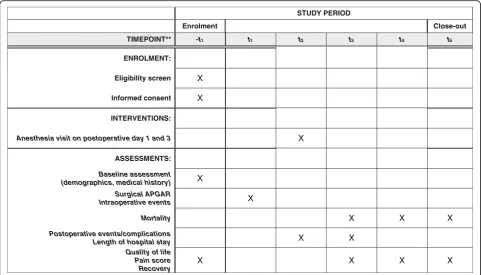
Data will also be collected from patient questionnaires, completed at inclusion, seven days, 30 days, and 12 months postoperatively. The questionnaires include questions on quality of life (EuroQol Dutch EQ-5D-5 L), pain scores (numeric rating scale, NRS), functional re-covery (Functional Rere-covery Index), and expected/per-ceived recovery (Global Surgery Recovery index). See Fig. 2 for an overview of enrolment, intervention, and assessments.
Outcome measures
The primary outcome measure will be the mortality at 30 days after surgery. Secondary outcome measures will be incidence of postoperative complications (in eight do-mains—infectious, cardiac/transfusion, pulmonary, ven-ous thromboembolic, renal, neurological, surgical, and other—in line with Meguid et al. [14]), time to imple-ment rescue therapy, length of stay in hospital, length of stay in a high-care unit, quality of recovery 30 days after surgery, and postoperative quality of life up to one year following surgery.
[image:3.595.57.542.89.154.2]Sample size calculation
The calculation is based on the primary outcome param-eter 30-day mortality. In an earlier Dutch study, postop-erative all-cause death was 1.85% [15]. Recently, the EUSOS study observed a mortality rate of approximately 2% [16], which is in line with previous results.
We considered a difference of 50% between monitored and non-monitored patients to be clinically relevant. In order to detect a reduction from 2% to 1% in postoperative 30-day mortality, with an alpha of 0.05 and a power of 80%, and a 1:1 ratio between control and intervention group, a total of 4638 patients have to be included in a parallel randomized controlled trial (RCT) design. To compensate for inter-institutional variation, a possible time-effect inherent to the stepped-wedge design, and drop-out, we increased this sample size with 20%. The rela-tively uncommon approach of applying a 20% inflation fac-tor was discussed extensively during the grant application and ethical approval processes and was finally approved by both the Netherlands Organisation for Health Research and Development and the Medical Ethical Commitee.
Thus, we estimate a requirement of 5600 patients. With eight participating hospitals, this translates into 700 patients per hospital. Figure1 illustrates how these patients will be divided across hospitals and between the control and intervention groups.
Statistical analysis
Primary and secondary outcome measures (proportions with 95% confidence intervals or means with standard deviations) will be calculated and presented in tables. A patient flow chart will be presented to account for inclu-sions per hospital and drop-out.
For the primary outcome and binary secondary out-comes, multi-level mixed effect logistic regression with random time by cluster interaction will be used to com-pare between the cohort that has not and the cohort that has received the intervention according to the stepped-wedge schedule. Time effects will be modelled according to appropriate methods, e.g. using spline func-tions. For continuous secondary outcomes, multi-level mixed effect linear regression will be used and for count-able secondary outcomes, multi-level mixed effect Pois-son regression models will be used. Analyses will be performed using SPSS and R.
On cluster level, protocol analyses will be per-formed (i.e. if the intervention phase starts later than ex-pected in a certain hospital, patients will be allocated to the control group until the hospital has actually crossed over). Once the intervention phase has started, individ-uals within that cluster will be analyzed according to the intention-to-treat principle. Adjustments will be made for temporal trends and for clusters within hospitals
STUDY PERIOD
Enrolment Close-out
TIMEPOINT** -t1 t1 t2 t3 t4 t5
ENROLMENT:
Eligibility screen X
Informed consent X
INTERVENTIONS:
Anesthesia visit on postoperative day 1 and 3 X
ASSESSMENTS:
Baseline assessment
(demographics, medical history) X
Surgical APGAR
Intraoperative events X
Mortality X X X
Postoperative events/complications
Length of hospital stay X X
Quality of life Pain score
Recovery
X X X X
** -t1 enrolment and baseline assessment (1 day before surgery), t1 intraoperative assessment, t2 assessment on postoperative day 1 and 3, t3 assessment 7 days after surgery, t4 assessment 30 days after surgery, t5 assessment 1 year after surgery
[image:4.595.57.539.88.363.2][17]. An economic evaluation from a hospital perspec-tive will be performed for postoperaperspec-tive anesthesia follow-up of high risk surgical patients compared to standard postoperative care. The time horizon of the economic evaluation will be 30 days and one year fol-lowing surgery. For reasons of efficiency, the analysis after one year will be performed in a subset of study par-ticipants. A cost-effectiveness analysis will be performed, based on the incremental costs per postsurgical visit. Standard sensitivity analysis will be performed to test whether results are robust for changing certain parame-ters, e.g. cost-prices. Confidence intervals surrounding the mean differential costs will be calculated by the bootstrap method. The latter will also be used to quan-tify the uncertainty surrounding the incremental cost-effectiveness ratio [18, 19]. Additionally, a budget impact analysis will be performed to assess the afford-ability of a routine postoperative visit by an anesthesia healthcare professional by relating the increase in cost due to investment in anesthesia professionals to the cost-savings due to the expected reduction in complica-tions and hence length of hospitalization and mortality.
Trial status
At the time of initial manuscript submission, recruit-ment had started (November 2016) but has not been completed. We expect recruitment to be completed in September 2018. The current protocol version is version 5 (3 January 2018).
Discussion
To our knowledge, the TRACE study is the first to study the effects of a routine postoperative visit by an anesthesia healthcare professional on the mortality and cost-effectiveness of surgical patients.
We have chosen for a stepped-wedge design because randomization on a patient level or cluster level (e.g. a hospital ward) was not feasible. It is logistically very challenging to have two parallel care paths within a hos-pital, for example in a RCT, where there is a chance of information transfer because the same healthcare profes-sionals have to apply two different forms of postopera-tive care. Cluster randomization is only possible with certain heterogeneity within wards; however, this is not the case because patients with different conditions are not randomly distributed over hospital wards. An im-portant advantage of the stepped-wedge design is that the design ensures implementation of the intervention in all centers. Thus, no hospitals will be withheld from the new approach and the implementation phase follows naturally after the research phase.
The TRACE study introduces a change in postoperative patient care by the anesthesiologist that was set up in col-laboration with surgical specialists. The knowledge and
skills of the anesthesiologist as perioperative physician are believed to benefit the patient. In practice, it may be diffi-cult to separate beneficial effects by the anesthetist from enhanced care by the surgeon and ward physician. There-fore, with this study we aim to gain insight into whether the introduction of postoperative monitoring by the anesthesiologist leads to more monitoring/consults by the ward physician or nurses. This could be a beneficial side effect of the intervention to the patient.
Acknowledgements
The authors would like to thank all colleagues in the participating centers (Antonius Hospital Nieuwegein, Catharina Hospital Eindhoven, MC Haaglanden, Rijnstate Hospital Arnhem, WestFries Gasthuis Hoorn, Radboud UMC Nijmegen) for their support in conducting the TRACE study.
Funding
This study is funded by The Netherlands Organisation for Health Research and Development (ZonMw), the Dutch Society for Anaesthesia (NVA), and the individual participating centers. It is furthermore supported by the Dutch Society for Surgery (NVvH) and the umbrella organization of nine health insurers in The Netherlands (Zorgverzekeraars Nederland). The TRACE study is also supported by a grant from the European Society of Anaesthesiology (ESA).
Authors’contributions
VS, MH, WB, and CB concepted the study; VS, DK, CD, MH, WB, and CB designed the study and wrote the study protocol; VS, DK, LP, AS, and CB are responsible for study conduct in all participating centers; VS, DK, and WB drafted the manuscript; all authors read and approved the final manuscript.
Ethics approval and consent to participate
Ethics approval is obtained from the institutional review board of the VUmc Amsterdam (NL56004.029.16; NTR5506). Patients will only be included in the study after written informed consent has been obtained.
Consent for publication
Not applicable.
Competing interests
The authors declare that they have no competing interests.
Publisher’s Note
Springer Nature remains neutral with regard to jurisdictional claims in published maps and institutional affiliations.
Author details
1Department of Anaesthesiology & Pain Medicine, Maastricht University
Medical Centre +, P. Debeyelaan 25, 6229 HX Maastricht, The Netherlands.
2Department of Anaesthesiology, Academic Medical Centre Amsterdam,
Meibergdreef 9 H1Z-132, 1105 AZ Amsterdam, The Netherlands.
3Department of Anesthesiology, VU University Medical Centre, De Boelelaan
1117, 1081 HV Amsterdam, The Netherlands.4Department of Clinical
Epidemiology and Medical Technology, Maastricht University Medical Centre +, Maastricht, The Netherlands.5Care and Public Health Research Institute
(CAPHRI), Maastricht University, Maastricht, The Netherlands.
Received: 26 April 2018 Accepted: 28 September 2018
References
1. Ghaferi AA, Birkmeyer JD, Dimick JB. Complications, failure to rescue, and mortality with major inpatient surgery in medicare patients. Ann Surg. 2009; 250(6):1029–34.
2. Pearse RM, Harrison DA, James P, et al. Identification and characterisation of the high-risk population in the United Kingdom. Citical Care. 2006;10:R81. 3. Khuri SF, Henderson WG, DePalma RG, et al. Determinants of long-term
4. Volanthen R, Slankamenac K, Breitenstein S, et al. The impact of
complications on costs of major surgical procedures: a cost analysis of 1200 patients. Ann Surg. 2011;254(6):907–13.
5. Birkmeyer JD, Gust C, Dimick JB, et al. Hospital quality and the cost of inpatient surgery in the United States. Ann Surg. 2012;255(1):1–5. 6. Nathan H, Atoria CL, Bach PB, et al. Hospital volume, complications, and
cost of cancer surgery in the elderly. J Clin Oncol. 2015;33(1):107–14. 7. Pradarelli JC, Healy MA, Osborne NH, et al. Variations in Medicare
expenditures for treating perioperative complications. JAMA Surgery. 2016; 151(12):e163340.
8. Silber JH, Williams SV, Krakauer H, et al. Hospital and patient characteristics associated with death after surgery. A study of adverse occurrence and failure to rescue. Med Care. 1992;30(7):615–29.
9. Ghaferi AA, Osborne NH, Birkmeyer JD, et al. Hospital characteristics associated with failure to rescue from complications after pancreatectomy. Surgery. 2010;211:325–30.
10. Sheetz KH, Dimick JB, Ghaferi AA. Impact of hospital characteristics on failure to rescue following major surgery. Ann Surg. 2016;263:692–7. 11. Trinh VQ, Trinh Q, Tian Z, et al. In-hospital mortality and failure-to-rescue
rates after radical cystectomy. BJU Int. 2013;112(2):E20–7.
12. Johnston MJ, Arora S, King D, et al. A systematic review to identify the factors that affect failure to rescue and escalation of care in surgery. Surgery. 2015;157:752–6.
13. Ahmad T, Bouwman RA, Grigoras I, et al. Use of failure-to-rescue to identify international variation in postoperative care in low-, middle- and high-income countries: a 7-day cohort study of elective surgery. Br J Anaesth. 2017;119(2):258–66.
14. Meguid RA, Bronsert MR, Juarez-Colunga E, et al. Surgical Risk Preoperative Assessment System (SURPAS): II. Parsimonious risk models for postoperative adverse outcomes addressing need for laboratory variables and surgeon specialty-specific models. Ann Surg. 2016;264(1):10–22.
15. Noordzij PG, Poldermans D, Schouten O, et al. Postoperative mortality in the Netherlands: a population-based analysis of surgery-specific risk in adults. Anesthesiology. 2010;112(5):1105–15.
16. Pearse RM, Rhodes A, Moreno R, et al. Mortality after surgery in Europe: a 7 day cohort study. Lancet. 2012;380(9847):1059–65.
17. Hemming K, Haines TP, Chilton PJ, et al. The stepped wedge cluster randomised trial: rationale, design, analysis, and reporting. BMJ. 2015;350:h391. 18. Briggs AH, Claxton K, Sculpher MJ. Decision modelling for health economic
evaluation. Oxford: Oxford University Press; 2006.