212
RANKING OF CLOUD SERVICE PROVIDERS IN CLOUD
1
C.S. RAJARAJESWARI, 2 M. ARAMUDHAN
1Research Scholar, Bharathiyar University,Coimbatore, Tamil Nadu, India.
2Assoc. Professor, Department of IT, PKIET, Karaikal, India.
E-mail:1[email protected], 2[email protected]
ABSTRACT
Cloud Computing is an innovative technology in the field of information technology. Federated cloud is an amalgamation of several cloud service providers. Since there are many cloud service providers in the federated cloud, users get confusion in choosing the best cloud service provider for their requirements. To choose the best cloud service from the available and eligible cloud service providers ranking concept is proposed. Poincare Plot method (PPM) based mathematical model is proposed to find the rank of the cloud service providers in federated cloud management system. The proposed ranking model reveals that the federated cloud model improves the performance of resource provisioning when compared to the existing rank model using Analytical Hierarchy Process (AHP).
Keywords:Federated Cloud, Service Level Agreement, Broker Manager, Cloud Broker, Cloud Ranking
1. INTRODUCTION
Cloud computing is the recent technology, provides services to users through internet using the concept of “pay-per-use” model. The three main services provided by the cloud computing architecture are Software as a Service (SaaS), Platform as a Service (PaaS) and Infrastructure as a Service (IaaS). In the beginning, negotiation is made between user and cloud service provider. Service Level agreement (SLA) is made between user and service provider based on the successful negotiation [1]. SLA is the official agreement made between user and provider. SLA consists of both functional and non-functional parameters. Functional parameters consist of CPU core, memory size, CPU speed and so on. Non-functional parameters consist of execution time, response time, cost etc [11].
Single cloud model works well if the workload is medium. If the number of incoming requests is on the higher side, single cloud model lacks in parameters like execution time, response time and so on. Single cloud model gets degraded when the workload becomes heavy. Small organizations cannot compete with the large or well-known organizations even though they have enough resources to solve the user requirements. In order to overcome these issues, federated cloud model was proposed.
Federated cloud is an amalgamation of several cloud service providers. Federated cloud model
provides flexible, reliable and on-demand resource provisioning. Since there are many cloud service providers in the federated cloud, users get confusion in choosing the best cloud service provider for their requirements. Hence it is necessary to find the rank of cloud service providers in the federated cloud management system. To choose the best cloud service from the available and eligible cloud service providers ranking concept is proposed. Poincare Plot method (PPM) based mathematical model is proposed to find the rank of the cloud service providers in federated cloud management system. The proposed ranking model reveals that the federated cloud model improves the performance of resource provisioning when compared to the existing rank model using Analytical Hierarchy Process (AHP).
In the proposed model, Broker Manager (BM) takes the responsibility of allocating user requests among the cloud service providers in the federated cloud model. Ranking model in the broker manger is used to find the rank of the cloud service providers, matching with the user requirements. Poincare Plot method (PP) based mathematical model is proposed to find the rank of the cloud service providers in federated cloud management system.
213 allocation of their job to the best cloud service provider.
Proposed ranking model helps the users to assign their workload to the provider without any confusion. Poincare plot method (PPM) is the proposed mathematical model is used to find the rank of cloud service providers. Broker manager choose the top rank cloud service provider among the ranked cloud service providers and assign the request.
This paper is organized into the following sections. Section 2 discusses about the related work. Section 3 describes the proposed architecture of the federated cloud model. Section 4 deals with case study of the proposed resource provisioning model and section 5 discuss the conclusion and future work.
2. RELATED WORK
With the increasing popularity of cloud computing, many researchers studied the performance of clouds for different types of applications.
Proposed Federated cloud concepts in [7], does not include customer-driven service management, computational risk management and autonomic management of Clouds which improve the system efficiency, minimization of SLA violation and the profitability of service providers.
Proposed models and techniques [4] are critical for the design of stochastic provisioning algorithms across large federated cloud systems where resource availability is uncertain. The mapping function implemented by continuous double action, sensor unit was used to predict the geographic distribution of users.
Proposed Federated cloud mechanism [6], does not deal the plan to investigate various scenarios that arise during handling federated cloud infrastructure using the FCM architecture.
Proposed SLA based Inter cloud operations [5], does not use simulation to investigate and evaluate the performance and efficiency of different SLA-aware match making algorithms by supporting multiple SLA parameters. SLA-oriented Dynamic Provisioning Algorithm supports integration of market based provisioning policies and virtualization technologies for flexible allocation of resources to applications.
Proposed comparison of different cloud services [2] can be obtained through Service Measurement
Index (SMI) and Analytic Hierarchy Process (AHP) but the ranking algorithm proposed here cannot cope with variation in QoS attributes.
3. PROPOSED FEDERATED CLOUD MODEL
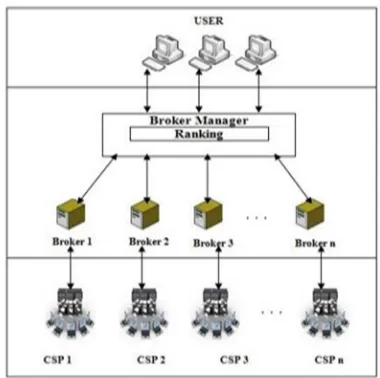
[image:2.612.322.512.220.409.2]The proposed federated cloud model for ranking the cloud service providers is exemplified in Figure 1.
Figure 1: Federated Cloud Model
Cloud users submit their request to the Broker Manger. Broker manger plays a vital role in allocation process of the incoming request [8]. Broker manager verifies the incoming request and choose the best service provider. Each broker is connected with a cloud service provider.
Broker manager finds the matching cloud service providers for the incoming request based on the parameters given by the user. After selecting the matched cloud service provider, BM assigns the rank to the selected cloud service provider using Poincare Plot method (PPM).
214
Table 1: Selected Providers List matrix
Service
Provider Status Availability of provider
Poincare plot is used to quantify self-similarity in the process [10]. Poincare Plot Method (PPM) finds the standard deviation values of the given SLA parameters such as security, availability, cost, storage etc. Standard deviation is the measure of the variability or dispersion of the given parameters. At first Poincare plot method finds the standard deviation normal-to-normal (SDNN) using formula 1.
SDNN = 2
1
1 ( )
1 n
i
X X
N−
∑
= − (1) SDNN means standard deviation of all intervals of the given input parameters. X denotes the value of each input parameter; N denotes the total number of input parameters and denotes the mean value of input parameters. After calculating SDNN, Poincare plot method calculates Standard Deviation of intervals (SDSD). SDSD is the standard deviation of the temporal differences of consecutive intervals, which can be calculated using (2).2 2
( ) ( )
SDSD= E ∆x −E ∆x
(2)
∆x is the temporal difference of consecutive
intervals of the input parameters. Δx2 is the square of ∆x. Based on SDNN and SDSD values, Standard
Deviation 1 (SD1) and Standard Deviation 2 (SD2) are calculated using the formulas given in (3) and (4).
2
1 1
2
SD = SDSD
(3)
2 2
2 2 1
2
SD = SDNN − SDSD
(4)
Ratio between SD1 and SD2 gives the deviation value of the service providers. Formula 5 represents the ration calculation.
1
2 SD Ratio
SD
= (5)
The service provider which has the minimum deviation value (ratio) will be considered as the best service provider for the incoming request.
Since only few ranking models are available in the federated cloud, the proposed rank model is compared with the existing rank model using Analytical Hierarchy Process (AHP)
In the existing federated cloud model2, ranking calculation was done using (AHP). AHP model decompose the user requirements into constituent parts and builds hierarchy. Problem decomposition, judgment of priorities at each level and aggregation of these priorities leads to heavy workload for broker manager. Finding Local rank and global rank in hierarchical structure increases the workload. Customers are required to provide two categories of application requirements: essential and non-essential. Customers must assign the weights to the requirements based on the weight list given by the broker manager. Assigning weights to the requirements at user side leads to misunderstanding of assigning values for their requirements. AHP does not provide flexibility in solving ranking problem.
Existing work does not provide the clear conclusion of best cloud service provider for user requirement. In that, based on the parameter value the ranking is analyzed. Fox example, cloud service provider 3 is best in terms of performance of machine, but lower in security. Cloud service provider 2 is best in terms of security but expensive. Based on the weight given by the customer, cloud service provider is selected.
In the proposed work, problem decomposition into hierarchical structure does not arise. All the incoming user requirements are considered as essential requirements. Hence users need not assign any weights for their requirements. Proposed work clearly concludes the best cloud service provider for user requirement.
4. CASE STUDY
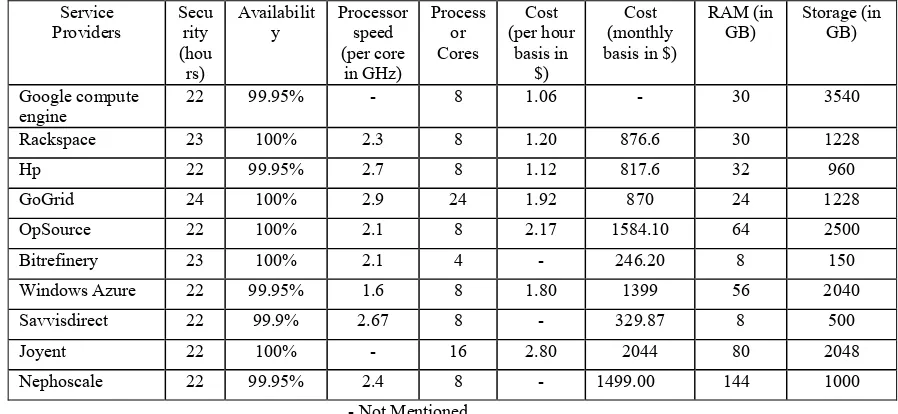
In this case study example, data has been collected from websites of ten different service providers namely Google compute engine, Rackspace, HP, GoGrid, Opsource, Nephoscale, Bitrefinery, Windows Azure, Saavisdirect, and Joyent. To find the service providers, which matches user requirements, consider the number of
requirement as R1 to R8
(R1,R2,R3,R4,R5,R6,R7,R8) and service providers are P1 to P10 (P1,P2,P3,P4,P5,P6,P7,P8,P9,P10).
215 expects is 20 hours and every provider that provides security either equal or above that value will be selected. However, $2000 means maximum cost that a user is willing to pay is $2000 and every cloud that offers service below the given cost will be selected.
To find eligible service providers, broker manager compares the requirement table of a user with service provider’s parameters table. If a service provider fails to provide the service for a user requirement even for a single parameter, that provider is considered as a non eligible service provider. Broker manager choose the set of service providers as eligible service providers and the resultant selected service providers are put into the SPL matrix.
[image:4.612.318.525.70.301.2]Requirement parameters given by a user X is
Table 3: User Requirement Parameters
User Id Securit
y (Ho urs) Avai labili ty Proc essor spee d (GH z) Pro cess or Cor es Cost ($) RAM
(GB ) Stor age (G B) User
X 20 97.5% 2.2 8 2500 20 600
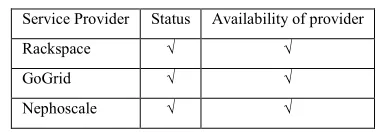
[image:4.612.90.302.321.405.2]Based on user requirement table and service providers table, broker manager choose the matched service providers and put into SPL matrix. Table 4 gives the SPL matrix of a given requirement.
Table 4:.SPL Matrix
Service Provider Status Availability of provider
Rackspace √ √
GoGrid √ √
Nephoscale √ √
√ - Eligible & Available
Let us consider another example of computation is done using the Quality of Service (QoS) data of three real cloud providers. The QoS data is collected from three Cloud providers: Amazon EC2, Windows Azure, and Rackspace. Assume that the unavailable data such as accountability and security are randomly assigned. The following table gives the values of the parameters of the three cloud service providers. Table 5 shows the QoS data of three cloud service providers.
Table 5: Case Study Example
Parameters CSP1 CSP2 CSP3 User requir ed Value Accountabi
lity 4 8 4 4 CPU 9.6 12.8 8.8 8.4
GHz Memory 15 14 15 10 GB Assurance 0.9995
(99.95 %) 0.9999 (99.99 %) 1 (100 %) 0.999 (99.9 %) Cost 0.68 0.96 0.96 <1
Dollar Performanc
e
80-120 520-780
20-200
60-120 Security 4 8 4 4
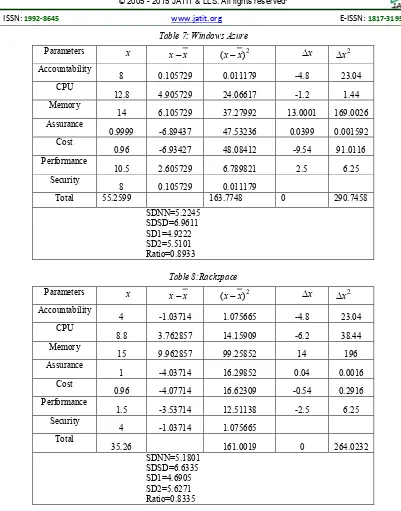
Calculation of ratio values of three service providers using Poincare plot method are exemplified above by means of table. Range values in the above table (performance) are converted into the form of average integer value. Since the performance indicated the response time, the average values of range is divided by minutes value (80+120/2=100; 100/60=1.6). Table 6, Table 7 and Table 8 shows the calculation method of ratio values of the three cloud service providers.
The ratios of the three cloud service providers such as Amazon EC2, Windows Azure, and Rackspace are
Ratio of Amazon EC2 = 0.8008
Ratio of Windows Azure = 0.8932
Ratioof Rackspace = 0.8335
The results clearly shows that service provider 1 (Amazon EC2) has the minimum deviation value (0.793673) than the remaining service providers i.e. CSP1 < CSP3 < CSP2. Hence broker manager selects service provider 1 (Amazon EC2) as the best cloud service provider for a user requirement and assigns the incoming user task to service provider 1.
5. CONCLUSION
[image:4.612.98.288.494.560.2]216 becomes very high, federated cloud mechanism helps to resolve these difficulties.
Now-a-days there are many service providers, providing services to user. Choosing the best service provider based on user requirement is very difficult task for broker manager. The proposed work provides a way to find the best service provider among the matched service providers. Mathematical based model in the proposed work is used to find the best service provider for the incoming request in an efficient manner.
To improve the scalability and performance of the proposed architecture parameters such as response time, throughput, task differentiation time must be considered in the ranking process. In future, the proposed ranking model should be improved to handle all the above mentioned parameters.
REFERENCES:
[1] R. Buyya, C. Yeo, S. Venugopal, J. Broberg, and I. Brandic, “Cloud computing and emerging IT platforms: vision, hype, and reality for delivering computing as the 5th utility”. Future Generation Computer Systems, Vol. 25, No. 6, 2009, pp. 599–616.
[2] S. K. Garg, S. Versteeg, and R. Buyya, “A framework for ranking of cloud computing services” Future Generation Computer Systems, Vol. 29, No. 4, 2012, pp. 1012-1023. [3] Z. Zheng, Z. Zhang, and R. Michael, “Cloud
Rank: A QoS driven component framework ranking for cloud computing”, IEEE International Symposium on Reliable Distributed Systems, New Delhi, India, Oct 31- Nov 3 2010. pp. 184-193.
[4] R. Buyya, R. Ranjan, and R. N. Calheiros, “InterCloud: Utility-oriented federation of Cloud computing environments for scaling of application services”, Proceedings of the 10th International Conference on Algorithms and Architectures for Parallel Processing, Busan, Korea, May 21-23, 2010, pp..13–31.
[5] F. Jrad, J. Tao, and A. Streit, “SLA based Service Brokering in Inter cloud Environments”, Closer 2012-2nd international conference on cloud computing and services science, Porto, Portugal, April 18-21, 2012, pp.76-81.
[6] A. C. Marosi, G. Kecskemeti, A. Kertesz, and P. Kacsuk, “FCM: An Architecture for Integrating IaaS cloud systems”, Second
International Conference on Cloud Computing Grids, and Virtualization Rome, Italy, Sep 25-30, 2011,pp.7-12.
[7] R. Buyya, S. K. Garg, and R. N. Calheiros, “SLA-Oriented Resource Provisioning for Cloud Computing: Challenges, Architecture, and Solutions”, Proceedings of the 2011 IEEE International Conference on Cloud and Service Computing, Hong Kong, China, Dec 12-14, 2011, pp.1-10.
[8] N. Rodrigo, A. Nadjaran Toosi, C. Vecchiola, and R. Buyya, “A coordinator for scaling elastic applications across multiple clouds”, Future Generation Computer Systems, Vol. 28, No. 8, 2012, pp.1350-1362.
[9] C. S. Rajarajeswari, and M. Aramudhan, “SLA Based Intercloud Operation Using Broker Architecture”, Proceedings of the International
Conference on Instrumentation,
Communication, Control and Automation, Kalasalingam University, Tamil Nadu, Jan 3-5 , 2013, pp. 20.
[10] N. Gururajan, A. Suresh Poobathy, S. Kumar, T. Ramkumar, and N. Sampath, “Effects of Yoga Training on Heart Patients using Nonlinear Poincare Plot Method”, International Journal of Pure and Applied Mathematical Sciences”,. Vol. 5, No. 1, 2011, pp. 65-72. [11] G. Preeti, and S. Sood, “Dynamic Ranking and
Selection of Cloud Providers using Service Level Agreements”, International Journal of Advanced Research in Computer Science and Software Engineering”, Vol. 3, No. 6,2013, pp. 93-101.
[image:6.612.102.551.120.327.2]
217
Table 2: Service Provider Parameters
Service
Providers Security (hou rs)
Availabilit
y Processor speed (per core in GHz)
Process or Cores
Cost (per hour
basis in $)
Cost (monthly basis in $)
RAM (in
GB) Storage (in GB)
Google compute
engine 22 99.95% - 8 1.06 - 30 3540 Rackspace 23 100% 2.3 8 1.20 876.6 30 1228 Hp 22 99.95% 2.7 8 1.12 817.6 32 960 GoGrid 24 100% 2.9 24 1.92 870 24 1228 OpSource 22 100% 2.1 8 2.17 1584.10 64 2500 Bitrefinery 23 100% 2.1 4 - 246.20 8 150 Windows Azure 22 99.95% 1.6 8 1.80 1399 56 2040 Savvisdirect 22 99.9% 2.67 8 - 329.87 8 500 Joyent 22 100% - 16 2.80 2044 80 2048 Nephoscale 22 99.95% 2.4 8 - 1499.00 144 1000
[image:6.612.128.508.251.560.2]- Not Mentioned
Table 6: Amazon EC2
Parameters x x−x ( )2
x−x ∆x ∆x2
Accountability
4 -1.09707 1.203566 -5.6 31.36 CPU
9.6 4.502929 20.27637 -5.4 29.16 Memory
15 9.902929 98.06799 14.0005 196.014 Assurance
0.9995 -4.09757 16.79009 0.3195 0.10208 Cost
0.68 -4.41707 19.51052 -0.92 0.5184 Performance
1.6 -3.52564 12.43013 -2.4 5.76 Security
4 -1.09707 1.203566
Total 35.8795 - 169.4822 0 262.9144 SDNN=5.3147
218
Table 7: Windows Azure
Parameters x x−x ( )2
x−x ∆x ∆x2
Accountability
8 0.105729 0.011179 -4.8 23.04 CPU
12.8 4.905729 24.06617 -1.2 1.44 Memory
14 6.105729 37.27992 13.0001 169.0026 Assurance
0.9999 -6.89437 47.53236 0.0399 0.001592 Cost
0.96 -6.93427 48.08412 -9.54 91.0116 Performance
10.5 2.605729 6.789821 2.5 6.25 Security
8 0.105729 0.011179
Total 55.2599 163.7748 0 290.7458 SDNN=5.2245
SDSD=6.9611 SD1=4.9222 SD2=5.5101 Ratio=0.8933
Table 8:Rackspace
Parameters x x−x ( )2
x−x ∆x ∆x2
Accountability
4 -1.03714 1.075665 -4.8 23.04 CPU
8.8 3.762857 14.15909 -6.2 38.44 Memory
15 9.962857 99.25852 14 196 Assurance
1 -4.03714 16.29852 0.04 0.0016 Cost
0.96 -4.07714 16.62309 -0.54 0.2916 Performance
1.5 -3.53714 12.51138 -2.5 6.25 Security
4 -1.03714 1.075665 Total
35.26 161.0019 0 264.0232 SDNN=5.1801
[image:7.612.103.504.63.574.2]