SEP-OCT, 2015, VOL-3/20 www.srjis.com Page 1149 PROFESSIONAL DEVELOPMENT OF ACADEMIC STAFF IN HIGHER
EDUCATION: IMPACT OF ORIENTATION PROGRAMMES Prof. Sanjeev A. Sonawane, Ph. D. & Sachin Sadashiv Surve, Ph. D.
The present paper emphasizes on the impact of the orientation programmes conducted by UGC-Human Resource Development Centres (Academic Staff Colleges) on professional development of the
Academic Staff in higher education. The study focuses on finding out whether the orientation
programmes have been successful in helping teachers in improving their professional skills and makes them a better teacher.
INTRODUCTION:
About the professional development of teachers in higher education, the Kothari Commission
report (in the year 1984-86), states that that, “A lecturer neither receives orientation to his
profession, nor is given time for adaptation to his job. He/she is satisfied or perhaps,
influentially satisfied to copy the methods adapted by his/her own teachers or senior
colleagues. The main resource of the colleges / university teacher has always been the
inspired lecture. it is wrong to expect a freshly appointed teacher to gain the art of teaching,
by merely emulating the superiors or by trial and error method. This has resulted in to
immense losses, eroding the academic standards both amongst the teaching community and
the students at large.”
The requirement for a suitable form of training and orientation to professionalize a lecturer
(Assistant Professor), thus became evident.
The National Policy on Education (1986), while dealing with reforms in the higher education
system, has stressed the requirement for improving status of the University and College
teachers in all the aspects. The National Policy on Education announced by the Central
Government in the year 1986 turned out to be a benchmark for quality improvement in
education. Therefore, it recognized the requirement for improving professional competence
as well as the communication skills of the teachers.
SEP-OCT, 2015, VOL-3/20 www.srjis.com Page 1150 The national policy on education (1986) in its Programme of Action highlighted the
important link between the motivation of the teacher and the quality of education. The
national policy on education acknowledged the need for improving the status of the teacher
and suggested to provide opportunities for their professional as well as their career
development, so that they could fulfill their role and responsibility within the educational
system in an effective manner.
The National Policy on education recommended the following for building the motivation
level of teachers:-
1. Design orientation programmes in teaching methodologies, pedagogy, and educational
psychology for all new candidates at the level of lectures. Implement these programmes.
2. Arrange for the refresher courses for serving teachers. It should be ensured that all the
teachers are covered once within a time span of 5 years.
3. Arrange orientation programmes by using the internal resources of universities and by
bringing a number of colleges together.
4. To encourage teachers to participate in seminar, symposia etc.
It was considered necessary to acquaint the teachers both at university and college, with the
modern developments and take care of their academic requirements, so that they discharge
their roles and responsibilities in most meaningful and remarkable manner for maintaining
high standard of higher education in India. For this, the Academic Staff Orientations Scheme
was introduced by University Grants Commission.
THEORETICAL BACKGROUND:
The Indian higher education system has grown and developed significantlyafter the
independence. This period witnessed enormous expansion of the system.From 20 plus
Universities, around 450 plus colleges, 15000 plus teachers and 9500 plus students in year
1951, the number has amplified to 677 plus Universities and university level institutions,
more than 35000 colleges, 13,90,000 plus teachers and 30 millionplus students at the end of
2014.
We have seen that a newly appointed teacher doesn‟t get any professional or induction
training while entering the teaching profession in higher education. He/she is simply expected
to go the classroom and start delivering. To be an effective teacher one needs to possess
several skills apart from the subject knowledge and also needs to keep himself/herself
updated from time to time. Considering this, the University Grants Commission introduced
Academic Staff Orientations Scheme, under which Academic Staff Colleges (presently
SEP-OCT, 2015, VOL-3/20 www.srjis.com Page 1151 expected to organise in service staff training programmes mainly for the academic staff of
higher education.
OPERATIONAL DEFINITIONS:- a. Academic Staff
Faculty or academicians are the academic staff of a university or college.
Professors of various ranks, lecturers and/or researchers are covered under this term.
The term faculty in this sense is most commonly used in this context in the United
States and Canada and generally includes professors of various ranks: adjunct,
assistant, associate etc.
The term „faculty development‟ is commonly used to describe activities and
programmes designed to improve instructions. More recently, the term „academic
development‟ has been used in some of the literature to refer to development activities
and programmes that more fully address the multiple roles of faculty (instructor,
researcher, citizen and scholar within departments, faculties and the wider university
community). This definition is based on a more holistic view of the higher education
faculty member within his or her institution. Centra (1989) has proposed four possible
types of development: personal (interpersonal skills, career development, and life
planning issues); instructional (course design and development, instructional
technology); organizational (ways to improve the institutional environment to better
support teaching); and professional (ways to support faculty members so that they
fulfill their multiple roles of teaching, research, and service).
b. Orientation Programme
The Orientation programme conducted by the UGC-Academic Staff Colleges is an
in-service training programme offered to new entrants of the teaching profession, with
the objective to help them to understand their role and discharge their duties in more
efficient manner. These programmes are funded by University Grants Commission
and are designed and run through the various Academic Staff Colleges all over the
country. These are inter-disciplinary programmes offered to teachers of all subjects
and faculties. Broad outline for contents of the programme are provided by University
Grants Commission.
c. Professional Development of academic staff
In education, the term professional development may be used in reference to a wide
variety of specialized training, formal education, or advanced professional learning
SEP-OCT, 2015, VOL-3/20 www.srjis.com Page 1152 professional knowledge, competence, skill, and effectiveness. When the term is used
in education contexts without qualification, specific examples, or additional
explanation, however, it may be difficult to determine precisely what “professional development” is referring to.
“Professional development is defined as development in an individual‟s skills,
knowledge, expertise and other characteristics to perform the professional duties in a
better manner. For a teacher or academic staff, the definition recognises that
development can be provided in many ways, ranging from the formal to the informal.
It can be made available through external expertise in the form of courses, workshops
or formal qualification programmes, through collaboration between institutions or
teachers.
NEED AND IMPORTANCE:
The teacher plays a key role in the development of the education system as a whole. The
number of graduates, post graduates and research degree holders coming out of the
institutions of higher learning have not only contributed to development in the industrial and
service sector but also have been critical inputs for education itself by providing teaching and
other academic personnel essential for it.
While the significance of these contributions and responsibilities cannot be doubted, a lot of
questions are being raised with regards to relevance and quality of higher education in
colleges and universities. A lot of issues pertaining to performance of teachers in the colleges
and universities are also being brought up. The in-service programmes offered by UGC are
the only opportunities for the teachers to improve themselves.Thus, it is necessary to study
the impact of orientation programmes offered by Academic Staff Colleges on professional
development of the academic staff. Hence, researcher has divided the importance of the study
into the elements like relevance, applicability and methods etc. which are as follows -
A) Relevance
The phenomenal growth in higher education has led to noteworthy changes in educational
patterns. As the need of higher education is constantly increasing, it becomes unavoidable to
study the changing patterns in educational system. Thus, it is felt relevant to assess the impact
the Orientation Programmes are having on the professional development of academic staff to
anticipate future challenges.
B)Applicability
Considering the above, it becomes imperative to have an exclusive analysis of the Impact of
SEP-OCT, 2015, VOL-3/20 www.srjis.com Page 1153 development of the academic staff. The present study is undertaken with the very purpose of
studying the impact of orientation programme on professional development of academic staff
in higher education.
OBJECTIVES:
Even though, the University Grants commission has provided broad outline for the
orientation programme, it is essential to understand the practices adopted by Academic Staff
Colleges in organising the orientation programmes, which are offered to the teachers who
have recently entered the teaching profession, with a view to improve their contribution to
teaching learning process.
At the same time, considering the changes and developments in the higher education system
as well as to tackle the changing demands of the students and society, it is felt that an Impact
Analysis of the orientation programmes conducted by Academic Staff Colleges needs to be
done in order:
1. To understand the topics offered, pertaining to various components of the Orientation
Programmes covered by Academic Staff Colleges and critically analyse them for
further improvement to help professional development;
2. To Analyze the personal and professional impact of the Orientation Programme on the
teachers;
RESEARCH METHODOLOGY:
The quantitative data were captured via surveys. Data were collected by questionnaires. For
study, researcher used developed self-administered instruments via an iterative process based
on the experiential learning, a review of the extensive literature on faculty
development,training analysis, training evaluation and staff development initiatives
considered by Academic Staff Colleges.
1) Population:
Teachers who have completed orientation programmes conducted by different Academic
Staff Colleges from three states i.e. Maharashtra, Gujarat & Goa. Total 9 Academic Staff
Colleges are there in the area, 5 in Maharashtra, 3 in Gujarat and 1 in Goa. Total number of
teachers attending the orientation is huge.
2) Sample size:
Interviews of 300 faculties are taken for the study. 35 samples from eachAcademic Staff
College from Gujarat and Goa and 32 participants from each Academic Staff College from
SEP-OCT, 2015, VOL-3/20 www.srjis.com Page 1154 3) Type of sampling:
Considering the sample size Purposeful random sampling method was chosen. For this
particular target groups like faculties, purposive random sampling, will substantially increase
the credibility of the results. Only purposefully full time permanent faculties from various
institutes are taken for the study.
DATA COLLECTION TOOLS
Data was collected through specially designed self-administered instrument (questionnaire),
which is designed using several questioning techniques.
DATA ANALYSIS TOOLS
Qualitative analysis was done on data generated through questionnaires.
RESULTS AND DISCUSSIONS
Table showing the ratings by the participating teachers about the contents covered during the orientation programmes that helped them for professional development.
Sr. No.
Points Ratings
Given
No. of faculty members
Percentage
1 Increase in knowledge 1 39 13
2 Increase in skills 2 33 11
3 Increase in abilities 3 30 10
4 Improvement in lecture delivery 4 28 9.33
5 Improvement in practical and
vocational skills
5 27 9
6 Improvement in contents of
teaching
6 24 8
7 Reading, writing and literature 7 23 7.67
8 Student evaluation and assessment
practice
8 21 7
9 Student and classroom management 9 20 6.67
10 Interdisciplinary subject 10 17 5.67
11 Knowledge of the curriculum 11 15 5
12 Teaching cross-curricular skills 12 11 3.67
[image:6.595.83.517.337.758.2]SEP-OCT, 2015, VOL-3/20 www.srjis.com Page 1155
14 Other 14 4 1.33
Total 300 100
Graphical Representation
Out of total sampled participating teachers 13% have agreed that the Orientation Program
helped them in increasing their knowledge level. 11% of the faculty members agreed that
increase in skills through the Orientation was achieved, 10% of the faculty members agreed
to the statement that the Orientation helped them to increase their abilitiesas a teacher, 9.33%
of the faculty members agreed to the statement that the Orientation helped them to improve
their lecture delivery skills, 9% of the faculty members agreed to the statement that
Orientation helped them to achieve improvement in practical and vocational skills, 8% of the
faculty members were positive about the statement that the Orientation helped them in
improving their contents of teaching, 7.67% of the faculty members agreed to the statement
that the Orientation helped them to increase their awareness about Reading, writing and
literature, 7% of the faculty members positively agreed that they could improve their skills
regarding Student evaluation and assessment practice through Orientation, 6.67% of the
faculty members agreed the statement that the Orientation helped them in improving their
Student and classroom management skills, 5.67% of the faculty members were positive about
the statement that the orientation helped them inimproving the interdisciplinary subject
knowledge, 5% of the faculty members agreed that increase in the knowledge of the
curriculumhappened through Orientation, 3.67% of the faculty members agreed to the
statement that the Orientation helped them in improving their skills of teaching
cross-curricular activities, 3.33% of the faculty members were positive aboutthe statement that
Orientation provided them information about the pedagogy, and only 1.33% of the faculty
0 5 10 15 20 25 30 35 40 45
Ratings Given
No. of faculty members
SEP-OCT, 2015, VOL-3/20 www.srjis.com Page 1156 members submitted that the Orientation helped them to improve other skills (not mentioned
above)through Orientation programme.
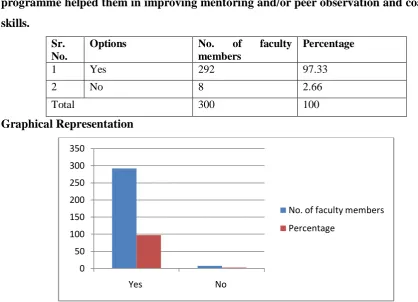
Table showing opinions of the faculty member about whether the orientation programme helped them in improving mentoring and/or peer observation and coaching skills.
Sr. No.
Options No. of faculty
members
Percentage
1 Yes 292 97.33
2 No 8 2.66
Total 300 100
Graphical Representation
Out of total sampled teachers 97.33% teachersagreedto the statement that the orientation
programme helped them in improving mentoring and/or peer observation and coaching skills.
CONCLUSION
The contents and organisation of the Orientation Programmes is of good standards
and the participating teachers have shown happiness about it.
It can be concluded from responses of the participating teachers that attending the
orientation programme does have a positive impact on the teachers with regards to
their professional development as it caters to the various needs and skills required to
be an effective teacher.
Faculty development through orientation programmes is an initiative designed to
improve faculty performance or enhance the quality of duties discharged by the
participating teachers as well as their own development and growth.
We can conclude that the Orientation Programmes conducted by different Academic
Staff Colleges are catering to the professional development needs of the academic
staff.
0 50 100 150 200 250 300 350
Yes No
No. of faculty members
[image:8.595.71.490.139.441.2]SEP-OCT, 2015, VOL-3/20 www.srjis.com Page 1157
It can also be seen that the Orientation Programmes are also helping the teachers to
improve their personality which intern helps their professional development also.
Thus, it can be concluded that the orientation programme makes a difference not only
to the participating teacher, but also to the education system at large and of course to
the most important component of the education system, i.e. students.
Thus, it can be concluded that participation in orientation programme is having