JULY-AUG 2016, VOL-4/25 www.srjis.com Page 2505 TECHNOLOGY ENABLED TEACHING LEARNING PROCESS AND
ENVIRONMENTAL PROTECTION
Poonam Chauhan1, Ph. D., Rachna Gihar2 & Kajal Sharma3 1
Associate Professor Department of Education Aligarh Muslim University Aligarh (UP)
2
Research Scholar Department of Education Aligarh Muslim University Aligarh (UP)
3
Ex Student M.Ed. MM College of Education Ambala (Haryana)
As we look around us, we see that our surroundings were originally a natural landscape such as a forest, a river, a mountain, a desert, or a combination of these elements. Most of us live in landscapes that have been heavily modified by human beings, in villages, towns or cities. But even those of us who live in cities get our food supply from surrounding villages and these in turn are dependent on natural landscapes such as forests, grasslands, rivers, seashores, for resources such as water for agriculture, fuel, wood and fish. Thus our daily lives are linked with our surroundings and inevitably affects them. We use water to drink and for other day – to – day activities. We breathe air, we use resources from which food is made and we depend on the community of living plants and animals which form a web of life, of which we are also a part. Everything around us forms our environment and our lives depend on keeping its vital systems as intact as possible. Our dependence on nature is so great that we cannot continue to live without protecting the earth’s environmental resources. Students’ environmental awareness is the most important indicator for displaying nation. The impact of videos and multimedia technologies in educational outcomes is a field of ongoing research civilization. Video combines many kinds of data (images, motion, sounds, text) in a complementary fashion; learning can be adjusted more easily than with other tools to the diverse learning styles and individual learning pace of students. In this study investigators have examined the impact of video technology on the awareness about the Environment among Primary level students.
Introduction
Over the past 200 years however, modern societies began to believe that easy answers to the
question of producing more resources could be provided by means of technological
innovations. For example, through growing more food by using fertilizers and pesticides,
developing better strains of domestic animals and crops, irrigating farmland through mega Scholarly Research Journal's is licensed Based on a work at www.srjis.com
JULY-AUG 2016, VOL-4/25 www.srjis.com Page 2506 dams and developing industry, led to rapid economic growth, the ill effects of this type of
development led to environmental degradation. Environment is the combination of living
things and closely related to the element of nature such as human, animals, as well as plants.
Through this connection, there are such doctrines and beliefs from the aspect of philosophy
regarding the emergence of this universe, and it has develop an awareness within humans self
towards their responsibility to take care the environment. (Hassan, et al, 2009)
The world today faces problems like global warming, green house effect, acid rain,
deforestation, overpopulation and so on, the authors over that Environmental education has
great importance as our lives to a large extent depend on our response to emerging problems
related to the environment (Chandra and Sharma, 2010). At individual level, it requires a
great positive commitment, and also an unwavering support from the community to keep
environment clean and unpolluted for future generations because it is our responsibility to
handover it to the next generation—as our forefathers handed over to us (Raval, 2015).
Since the primary school students are ardent followers of their teachers, they can be taught
efficiently to imbibe the environmental values. Environmental educators need to reintroduce
learners to their local area by exploring and experiencing it, by learning about it and
celebrating it. By doing so, environmental educators help learners develop a sense of wonder
and a sense of place (Athman et al, 2001). Research studies of Cimino (2005), Chawla
(2006), Arnold (2009), shows that empathy with, and love of, nature grows out of children‘s
regular contact with the natural world.
It is important that children and young people are taken to nature and using all their senses to
actively explore, experience, make sense of their environment, and have a sense of
independence. At the earliest stages of life, if the conducive classroom learning towards the
eco system is imparted, the child may easily grasp because of their keen understand ability of
nature.
Modern day classroom must be supplemented with adequate video based instructional
process which is having the following beneficial aspects to the new digital learner in the
primary schools.
First, [video-based contexts] provide rich sources of information with opportunities to
notice sensory images, dynamic features, relevant issues, and inherent problems.
Second, they give students the ability to perceive dynamic moving events and to more
easily form rich mental models. This advantage is particularly important for lower
JULY-AUG 2016, VOL-4/25 www.srjis.com Page 2507 The use of video is the needs of today‘s and tomorrow‘s learners. Videos can help educators
address the challenge of different learning styles and enhance the way in which today‘s
children and youth access, absorb, interpret, process and use information.
Objectives
The present study is based on the following objective:
1. To know the impact of videos on Environmental awareness of primary level students in
respect to their type of organization (Govt. and Public).
Hypotheses
The present study is based on the Following hypotheses:
There is no significant effect of videos on Environmental awareness of Govt. and Public
school primary level students.
Research Methodology
For present research work, the researcher has used Experimental Method (One group pre- test
and post – test Design) type of study.
Population
All the primary schools of Aligarh District of Uttar Pradesh constituted as the population for
this study.
Sample
For the present study, the sample was selected from different Primary level schools. To
collect the meaningful data, the researcher has used stratified random sampling technique. In
the first phase of sample selection, Aligarh district of Uttar Pradesh was selected. In the
second phase 10 primary level schools were selected out of all primary schools of Aligarh
district. Then in the third phase, a total 120 primary schools students were chosen as a sample
on the basis of their types of organization. Out of 120 students 80 Government and 40 Public
school students of primary level were selected as sample.
Tool Used
To collect the data investigators were used part B of Environmental Knowledge & Awareness Scale (EKAS). This scale has 24 items spread over five following dimensions: remedial measures of air pollution, water pollution, land pollution, noise pollution, and environmental problems.
Beside the above scale investigators were used some video films related to different
dimensions of environment to know the effect of videos on environmental awareness of
JULY-AUG 2016, VOL-4/25 www.srjis.com Page 2508 Table-1: Details of the Video films on Environmental Component Treated as Video
Packages in the Study
S. N o
Title of Video Film Producing
Agency
Duration Languag e
1. Environment Protection
(www.youtube.com/watch?v=MEn0oIL 3uoo) Environment Production: Gabriella Keresxies 7min 24sec English
2. Environmental Awareness
www.youtube.com/watch?v=dOJstdm1i OU L‘Education Environment 7min 47sec English
3. Science - Environment – Pollution
(https://www.youtube.com/watch?v=9j 56H0YrQlA)
Bodha Guru 10min
48sec
Hindi
Statistical Treatment
In order to make the inquiry exact, precise and scientific the collected data were analyzed
with the help of Mean, S.D, and ‗t‘ test.
Data Analysis
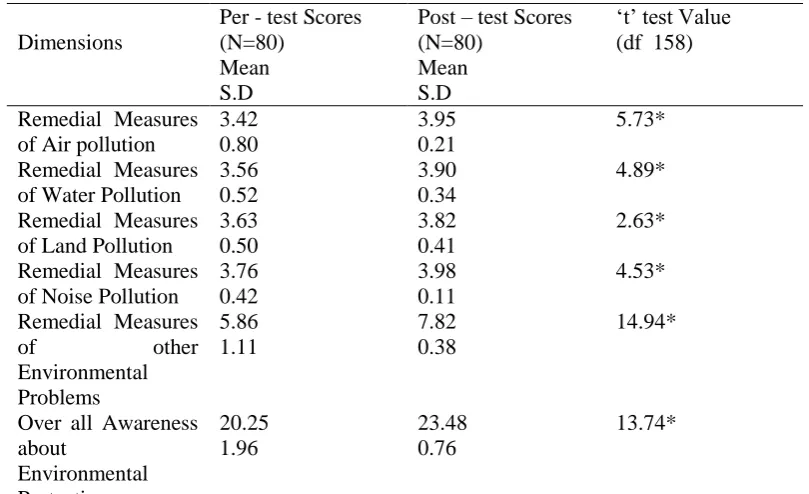
Table – 2: Pre – test and Post – test Mean and S.D Scores of Primary Level Students Studying in Government Schools on Different Dimensions of Environmental Knowledge
and Awareness Scale
Dimensions
Per - test Scores (N=80)
Mean S.D
Post – test Scores (N=80)
Mean S.D
‗t‘ test Value (df 158)
Remedial Measures of Air pollution
3.42 0.80
3.95 0.21
5.73*
Remedial Measures of Water Pollution
3.56 0.52
3.90 0.34
4.89*
Remedial Measures of Land Pollution
3.63 0.50
3.82 0.41
2.63*
Remedial Measures of Noise Pollution
3.76 0.42
3.98 0.11
4.53*
Remedial Measures
of other
Environmental Problems 5.86 1.11 7.82 0.38 14.94*
Over all Awareness about Environmental Protection 20.25 1.96 23.48 0.76 13.74*
[image:4.595.95.500.465.712.2]JULY-AUG 2016, VOL-4/25 www.srjis.com Page 2509 The analysis of data presented in table – 2, concludes that in case of primary level
government school students the environmental awareness influenced by the given videos on
different aspects of environment. Table-2 shows that government schools primary level
students found to be more aware about remedies measures of pollutions and overall
environmental protection on the different dimensions of Environmental Knowledge and
Awareness Scale (EKAS). The post – test mean values were found higher than the pre – test
mean values. It means Government schools primary school students learn more after teaching
[image:5.595.86.512.298.531.2]with videos.
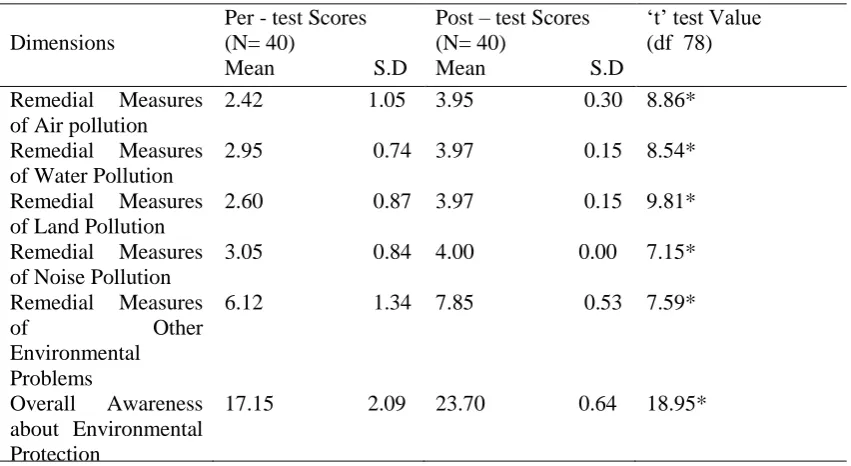
Table – 3: Pre – test and Post – test Mean and S.D Scores of Primary Level Students Studying in Public Schools on Different Dimensions of Environmental Knowledge and
Awareness Scale
Dimensions
Per - test Scores (N= 40)
Mean S.D
Post – test Scores (N= 40)
Mean S.D
‗t‘ test Value (df 78)
Remedial Measures of Air pollution
2.42 1.05 3.95 0.30 8.86*
Remedial Measures of Water Pollution
2.95 0.74 3.97 0.15 8.54*
Remedial Measures of Land Pollution
2.60 0.87 3.97 0.15 9.81*
Remedial Measures of Noise Pollution
3.05 0.84 4.00 0.00 7.15*
Remedial Measures
of Other
Environmental Problems
6.12 1.34 7.85 0.53 7.59*
Overall Awareness
about Environmental Protection
17.15 2.09 23.70 0.64 18.95*
*Significant at .01 Level of Significance
Table – 3, concludes that in case of the primary level students studying in public schools a
sharp variation were identified between pre – test and post – test mean scores on all the
dimensions of EKAS (Part – B). On all the dimensions of EKAS, post – test mean scores
were found significantly higher than the pre – test mean scores of primary level students
studying in public schools. It means videos influence the level learning of primary level
students.
Findings:
The null hypothesis is that ―there is no significant effect of videos on Environmental
awareness of govt. and public school primary level students‖ fully accepted on environmental
JULY-AUG 2016, VOL-4/25 www.srjis.com Page 2510 A significant effect of videos was seen on the level of learning of students that why their
awareness level was increased. This enhance was seen on remedial measures related to
air, land, noise pollution and environmental protection dimensions. Government and
public school students‘ environmental awareness was increased on all the dimensions of
EKAS (Part – B) after watching the videos.
Educational Implications
The world scenario is changing rapidly. If we keep our self struck to social conventions and
traditions, we can‘t march ahead with other nations. Our progress will remain segments and
our vision of development India will remain unfulfilled. The temperature of the earth is going
increase day – by – day. It makes effect to human beings and animals also. The present
research aims at determining the effect of videos on environmental awareness of primary
level students. The results of the study have significant contribution for the schools, their
administrators, headmasters and even for the parents and policy makers. On the basis of this
study policy maker can put practical (especially based on visual projection) part in the
curriculum of primary level schools. The output of this research indicates that technology
enabled learning is having nurture effect. As a teacher we should create technology enabled
learning environment in the classroom. So that we can safe our environment. It will also
encourage the students to make their environment clean and green.
References
Chandra, S. S. and Sharma, A. (2010). Significance of Environmental Education in Present Context, EDU TRAKS, Vol.19, No. 12.
Hassan, A., Juahir, H., and Jamaludin, N. S., (2009). The level of Environmental Awareness Among students to fulfill the Aspiration of National Philosophy of Education, Euro Journals publishing, Page - 53.
htt://www.eurojournal.com/ajer.htm
Raval. K. (2015).Environment and Law: Role of Indian Judiciary for Protection and Preservation of
Environment, International Journal of Education for Human Services, Vol. 5 No.2, pp. 21-30.
Arnold, H.E.; Cohen, F.G.; Warner, A. 2009: Youth and environmental action: perspectives of young environmental leaders on their formative influences. The Journal of Environmental Education, 40(3): 27–36.
Athman, J.; Monroe, M.C. 2001: Elements of Effective Environmental Education Programs. In A. Fedler (Ed.). Defining Best Practices in Boating, Fishing, and Stewardship Education. Washington DC: Recreational Boating and Fishing Foundation, pp. 37–48.
Chawla, L. 2006: Learning to love the natural world enough to protect it. Barn, 2: 57–78.