THE REGISTRATION ALGORITHM FOR HETEROGENEOUS
SPATIOTEMPORAL MEASUREMENTS IN MULTI-SENSOR
SYSTEMS
1 YE HONG, 2 YANG ZHAN-PING, 2 LI JUN, 2 LI SHI-LING 1
Research Assistant, Institute of Electronic Engineering, Caep
2 Researchers, Institute of Electrical Engineering, Caep
E-mail: [email protected]
ABSTRACT
Based on information fusion by multi-sensor tracking system, registration algorithm for heterogeneous spatiotemporal measurements is discussed. In the paper, principles of sensor registration for out-of-sequence measurement are introduced, the IMM based registration algorithm for multi-lag OOSM is proposed. The method that judging how old negative-time measurement could be used to retrodict the state is presented. On the condition of DAP (data association problem), the algorithm of how to obtain a strict chronological sequence of measurement is discussed. Finally, the conclusions and further works are addressed and some future problems are given.
Keywords: Heterogeneous Spatiotemporal Data, Multi-sensor System, Information Fusion, Registration Algorithm
1. INTRODUCTION
Compared with standalone sensor system, multi-sensor systems are with better performance, more wide coverage, better precision and reliability, but the advantages are limited by deficiencies of some key technologies, such as sensor bias registration. The resources of sensor bias [16] include range, azimuth, time, position of sensor platform and coordinate transformation, etc., in which the most effect on tracks is from the bias errors of range and bearing correlating with the report time of measuring, transmitting, accepting and processing. Therefore, the temporal and spatial alignment should be performed to gain the consistency of the measuring time and position of sensors.
In multi-sensor information fusion the time alignment must be completed firstly, that the measurement of the same target for various asynchronous sensors are synchronized by the same baseline of time or period, to ensure that incoming data fusion could implement correctly and effectively. The time alignment errors of the measurement from heterogeneous sensors include certain errors and uncertain errors, in which the certain errors introduced by time metric base, period of measurement and processing period of
various sensor, the latter introduced by the time delay of transmission and network jamming.
The error of time scalar is that the identical time difference introduced by various clock frequency of sensors. The time calibration provided by network communication system is for the alignment for this kind of time error with accurate clock as baseline. In multi-platform multi-sensor systems, each of radar could not equip with uniform clock, a highly precise clock baseline should be provided for all sensors of multi-platform. In general, the synchronization of sensors’ clock can be alignment with GPS time signal. In addition, for the time difference compensation measurement must be time-stamped.
For these reasons, such as transmitting delay, measuring period and communication jamming, there are lots of heterogeneous spatiotemporal data (the non-even temporal-spatial measurement, for example, negative-time data and missing data) in the practical systems.
On the condition that there is only the difference of scan periods for the various sensors, the usually registration algorithms of even spatiotemporal measurement include the least squares method based algorithm [4] [7] [8], interpolation and extrapolation based algorithm [1] [5] [6] [9] [14], Taylor expansion algorithm [10], curve fitting algorithm [11], state estimation based alignment algorithm [2] [13]. Furthermore, [3] proposed that the concept of alignment frequency and the frequency alignment method, [15] presented the combined time registration algorithm of adaptive
α β
−
and Lagrange interposition method.In practical systems, there are the lost, delayed and negative time measurement for the reason of communication link, and the time uncertainty of each accumulation when targets are lower SNR, the period of measuring data is not constant practically. For the delayed measurement of multi-sensor system, Hilton, Martin and Blair [21] proposed MMSE (Minimum Mean Square Error) registration algorithm. For the OOSM (out-of-sequence measurement) of multi-lag and multi-model, Mallick, Coraluppi and Carthel [22] presented the least square error estimate based IMM algorithm for the one-lag, and the algorithm for the multi-lag OOSM. Bar-Shalom [19] [20] proposed the filter registration algorithm for OOSM.
This paper mainly introduced the temporal registration algorithm in multi-sensor information fusion systems, and summarized the current status and the further work in the future. Firstly, the IMM (interactive multiple model) based registration algorithm for multi-lag OOSM is described in Section II and Section III. The method that judging how old negative-time measurement could be used to retrodict the state is presented in Section IV. On the condition of DAP (data association problem), the algorithm of how to obtain a strict chronological sequence of measurement is discussed in Section V. Finally, conclusions and further works are presented in Section VI.
2. MULTIPLE-MODEL MULTIPLE-LAG
OUT-OF-SEQUENCE FILTERING ALGORITHM
2.1 Principles of Out-of-sequence Measurement
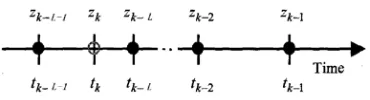
[image:2.612.329.506.367.418.2]In multi-sensor information fusion systems, measurements from the various sensors are transmitted to fusion center to process. With real fusion systems, data are delayed for the reason of communication link and various measuring period of sensors. The measurement can’t be received by processing center simultaneously. A number of researchers have presented the methods and algorithms for this problem [19] [20] [21] [22] when the OOSM is one-lag, as shown in Fig. 1. In [22], Mallick, Coraluppi and Carthel also proposed IMM based filtering algorithm for the one-lag out-of-sequence measurement and algorithm of the multi-lag out-of-sequence measurement with single model. The paper proposed the IMM based algorithm with multi-lag OOSM, as shown in Fig. 2 (2-lag) and Fig. 3 (
l
-lag,l
>2). [image:2.612.328.508.453.500.2]Figure 1. One-Lag Out-Of-Sequence Measurement
z
kFigure 2. Two-Lag Out-Of-Sequence Measurement
z
kFigure 3.
l
-Lag Out-Of-Sequence Measurementz
k [image:2.612.326.511.529.579.2]filtering performance [24]. At last, we extend to the OOSM case.
2.2 The OOSM Processing Algorithm
The multiple-lag single-model out-of-sequence measurement filter is expressed as the follows in [22], [24]:
x
j=
ϕ
( ,
j j
−
1)
x
j−1+
w j j
( ,
−
1)
(1)
z
j=
H x
j j+
v
j,
j
=
0,1...
(2)In which,
j
=
1, 2,...,
k
−
1,
v
j
N
(0,
R
j)
,( ,
1)
(0, ( ,
1))
w j j
−
N
Q j j
−
.Considering that the measurement between
1 1
(
t
k l− −,
t
k−)
, the l -step lag measurement ismeasured form the state before l-step, so
1
1
( 1, ) ( , ; 1)
( , 1; 1, )
l
j
w k k w k l k k
w k j k j k k
−
=
− = − − +
− − − −
∑
(3)Before the measurement
z
k is received att
k (1
k l k k l
t
− −< <
t
t
− ), thek
−
1
measurements have been received and processed, resulting in a conditional meanx
ˆ
k−1( )
+
and covarianceP
k−1( )
+
. The key is expressed the OOSMz
k withx
k−1, the measurement equation for the OOSMz
k is [24]:1
k k k k
z
=
A x
−+
e
(4)In which,
e
k:
=
v
k−
A w k
k(
−
1, )
k
and(0,
)
k
k e
e
N
P
.Let
x
ˆ( )
+
denote the measurement updated state estimate att
k−1 after the OOSMz
k is processed. An unbiased estimator forx
ˆ( )
+
is in [21], [22], and [25]:1 1
ˆ
k( )
ˆ
k( )
[
k kˆ
k( )]
x
+ =
x
−+ +
K z
−
A x
−+
(5)Where
K
is a gain to be determined in [22]. Compared with the optimal unbiased estimator [19], the estimator is slightly sub-optimal [22].The IMM (interactive multiple models) filter in [24] is based on a hybrid-state kinematical model whereby the discrete state determines the continuous state dynamical model. The discrete state is determined by a finite state Markov chain with transition probability matrix P. The IMM filter maintains a set of
r
state estimates; these are mixed with process the next measurement, under each of ther
possible models. The key benefit of IMM filter over the general multi-lag OOSM filter is that and onlyr
filters are maintained, and filtering performance is close to that achieved bymore complex filters that require
r
2 parallel filters to be maintained.When processing a multi-lag OOSM
z
k, each of ther
state estimates, along with the associated likelihood, must be updated. Each state estimate is based on the choice of a particular model over1
(
t
k l− −,
t
k l−]
. Thus, the measurementz
k is processed by the chosen model. The key step in extending the IMM filter to the OOSM is the recursive likelihood calculations. Before the measurementz
k is processed, the likelihood associated with each of the r models is denoted by(
1),
1,...,
j
k
j
r
µ
−
=
.The recursive probability
µ
j( )
k
is calculated as followed [22]:1
1 1
ˆ
(
1) (
( ),
)
( )
ˆ
(
1) (
( ),
)
j k k k z
j r
j k k k z
j
k
g z
A x
k
k
g z
A x
µ
µ
µ
−
− =
−
−
+ Σ
=
−
−
+ Σ
∑
(6)In which,
g
is the multivariate Gaussian distribution for a zero-mean variable with covarianceΣ
z[22].2.3 The Main Steps of the Process for OOSM
The algorithm consists of steps as follows.
1) Calculation about data association problem(only for the multi-target scenarios);
2) Justifying that the out-of-sequence measurement is whether too old or not(discussed in Section 4);
4) conditioned updates; Model-probability updates;
5) Update the state estimates and calculate the corresponding covariance.
3. THE REGISTRATION ALGORITHM
FOR MULTI-LAG OOSM
In [26], Conte and Helmick expressed the temporal algorithm in detail for two sensors on a common target. In Fig. 4, the measurement (or equivalent measurement) of
Sensor
2
at timet
5 is delayed for some reasons (communication delay or jamming), and received at timet
(t
8< <
t
t
9). In the context,t
ijdenotes that thejth
sensor is at theith
time step.3.1 The Difference between the Registration Algorithm for Multi-lag OOSM and Normal Measurement
Different form the temporal registration algorithm discussed in [26], we need to consider two problems:
(1) Can the measurement of
Sensor
2
at time (1)3
t
be predicted by the measurement ofSensor
2
at timet
4(2) and smoothed with the data of2
Sensor
at timet
6(2)?(2) Can the measurement of
Sensor
2
at time (1)5
t
be predicted by the delayed measurement of2
Sensor
at timet
5(2) or with the data of2
Sensor
at timet
8(2), and smoothed with the data ofSensor
2
at timet
9(2)?The first question is doubtlessly that we can
replace the delayed measurement at time
t
5(2) with the measurement at timet
6(2) to smooth the predicating statex
3(2) at timet
3(1).The solution for the second problem is that: we
predicate the system state
t
5'(2) ofSensor
2
at time (1)5
t
, then update the statet
5'(2) with the out-of-sequence measurementz
5(2) ofSensor
2
, and smooth the updated state at timet
5''(2) using the measurement ofSensor
2
at timet
9(2).3.2 The Main Steps of Registration Algorithm for Out-of-sequence Measurements
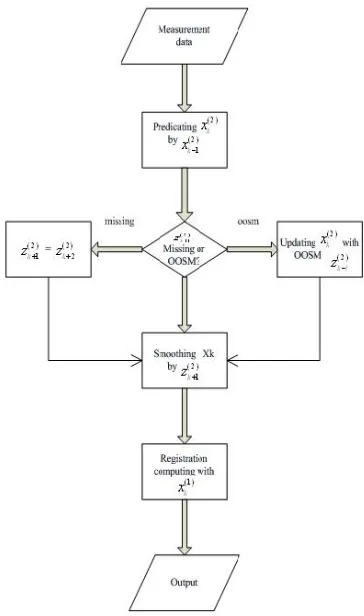
So, we can get the main steps of the temporal registration algorithm for the measurement containing out-of-sequence measurement. The algorithm proposed is shown as follows:
Figure 4. Time Sequence Of Measurements By Two
Sensors For A Single Common Target
Figure 5. The Flow Chart Of Heterogeneous
Spatiotemporal Measurements In Multi-Sensor Systems
1) Predicate the system state
t
5'(2) ofSensor
2
at timet
5(1);2) Update the state
t
5'(2) with the out-of-sequence measurementz
5(2) fromSensor
2
; [image:4.612.332.514.262.570.2]The flow chart of the algorithm proposed is shown as Fig. 5. In Fig. 5, the key step of the
algorithm is to judge that
z
k(2)+1 is missing or out-of-sequence measurement. If it is out-of-out-of-sequencemeasurement, the state estimation
x
(2)k should be updated with the OOSMz
k l(2)− using the algorithm proposed for out-of-sequence measurement, andsmoothed with
z
k(2)+1 (z
k l(2)− is al
-step lagged measurement). If the measurementz
k(2)+1 is missed (however, it isn’t true and datum is just delayed forl
-step), the statex
k(2) should be smoothed with (2)2
k
z
+ .3.3 Notations for the Registration Algorithm Proposed
• IMM method could be used to predicating the equivalent measurement of
Sensor
2
corresponding to the time point of1
Sensor
in the algorithm; IMM also could be applied to smooth the predicated equivalent measurement of2
Sensor
, which is discussed in detail in [26].• The measurement equation is for the system bias estimation and bias covariance estimation.
The processing of “missing data” could also be used for the really missed data. However, the algorithm framework for the missing data is proposed in [22].
4. METHOD OF OOSM SIZER
For old measurements (
l
-lag Out-of-sequence Measurementz
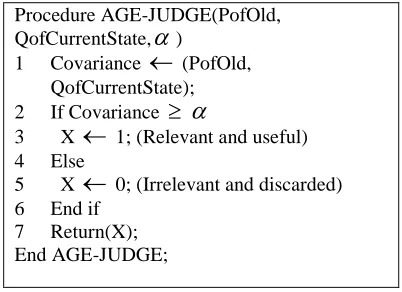
k ), we should process them necessarily or not? For example, the method of processing out-of-sequence measurement is just to drop them easily. In [19], Bar-Shalom noticed this problem, “In practical systems, because of the process noise the informational content of a measurement diminishes rapidly with its age-old data is irrelevant. Only if the measurement if not too old, it is relevant enough for an update.” However, the method for judging whether the old data should be processed or not is required. Based on the information relativity, we could judge the old data is too old or not, and processed it or not.The algorithm for judgment is proposed as follows. When the old data of
l
-step(
l
=
1, 2, 3, 4...)
lagged measurement is received, we computed the covariance about the old data and the current state estimate, firstly. Next, we set a valueα
as the threshold, and if the covariance computed is less thanα
, we could consider that the old data is too old, which is irrelevant with the state, and discard it. The pseudo code of the algorithm is shown in Fig. 6.Procedure AGE-JUDGE(PofOld, QofCurrentState,
α
)1 Covariance
←
(PofOld, QofCurrentState); 2 If Covariance≥
α
3 X
←
1; (Relevant and useful) 4 Else5 X
←
0; (Irrelevant and discarded) 6 End if [image:5.612.317.518.197.343.2]7 Return(X); End AGE-JUDGE;
Figure 6. Pseudo-Code For The Algorithm Of OOSM
Filtering
5. DATA ASSOCIATION PROBLEM
ABOUT MULTIPLE TARGETS
SCENARIOS
In multi-target multi-sensor systems, the association of the old data also is an important item. In [22], Mallick, Coraluppi and Carthel noticed that the data association relationship is preserved in the case. In fact, the association problem that the delayed measurement is belonged to which target’ track, is an important issue. The solution for the DAP of the old data is not especial case with data association in general. Only one point is that the OOSM is old data, which possibly have bad relationship with the current state. In another word, the DAP of OOSM is a problem of the association of point(s) and track(s). We plan to extend the IMM multiple lag registration algorithms to the multi-target scenarios in the future work.
6. CONCLUSION AND FURTHER WORK
platforms, data need be transmitted by data link of satellites and ground communication stations, by which the transmission delay is so high and uncertain that data may be lost and need be retransmitted. How to design multi-sensor temporal registration algorithm with real-time and highly precise characteristics to gain targets’ tracks close to real trajectory, to obtain the purpose of “one target one track”, and finally to get precisely, real-time global battle situation and threat assessment, is an important subject focused by researchers in the field of information fusion.
The paper proposed that the IMM based registration algorithm for multi-lag OOSM. The method that judging how old negative-time measurement could be used to retrodict the state is presented. On the condition of DAP (data association problem), the algorithm about how to obtain a strict chronological sequence of measurement is discussed. Simulation results have been deferred to a future work. Currently, in the research field of multi-sensor time registration several future works are presented as follows.
• Joint registration algorithm of temporal and spatial is a future work. Measurements form sensors of targets are the comprehensive representation of temporal and spatial characteristic of sensors and targets, the properties of time and space must be inseparable and be uniform. So, from the point of theory and implementation, to analyze and design the joint registration algorithm of temporal and spatial is an important subject and a challenge.
• From the point of networks, multi-sensor system is a network and time synchronization [23] is a key technology of sensor networks, so multi-sensor time alignment could be thought as the problem of time synchronization.
• The registration for the heterogeneous spatiotemporal measurement (such as negative-time data and lost measurements) will be extended to the field of multi-target scenarios, in which DAP should be considered in detail.
• The simulation and numerical results would be performed in the future work.
REFERENCES:
[1] YAN Chao-yi, Research on time alignment of system errors correction [J], Electronic Warfare Technology, 19 (4): 13217, 2004.
[2] CHEN Yan, Time-consistency in multi-platform multi-sensor data fusion [J], Fire Control and Command Control, Vol. 32, No. 11, Nov. 2007 [3] LI Lin, HUANG Ke-di, Research on time
alignment algorithm of centralized multi-sensor fusion system[J], Chinese Journal of Sensors and Actuators, Vol. 20, No. 11, Nov. 2007. [4] Zhou Rui, Shen Gongxun, Fang Jiancheng, Zhu
Shiping, Target tracking based on fusion of multi-sensor[J], Act a Aeronautica et Astronautica Sinica, Vol. 19, No. 5, Sep. 1998. [5] WANG Baoshu, LI Fangshe, The research on
multiple targets tracking based on the data fusion technique [J], Journal of Xidian University, Vol. 25, No. 3, Jun. 1998.
[6] GONG Feng-xun, Analysis on time-zero for multi-surveillance data fusion [J], Journal of Civil Aviation University of China, Vol.21, No.6, 2003.
[7] GAO Li-ping, Research on theory and application of signal detection and target tracking in multiple sensor [D], North-west Industry University, 1999.
[8] CHEN Fei, JING Zhong-liang, YAO Xiao-dong, Time and spatial registration and target tracking for multiple airbornemobile platforms and sensors[J], Control and Decision, Vol. 16 Suppl. Nov. 2001.
[9] Wang Qian, Yu Kai, Research on time alignment in radar network [J], Science Information of Heilongjiang, 2009, (31)
[10]PENG Yan, XU Yu, JIN Hong-bin, An analysis of time registration in multi-sensor data fusion system [J], Radar and Counter, 2005 (2): 16-19, 34.
[11]LIANG Kai, PAN Quan, SONG Guo-ming, ZHANG Xing-guo, ZHANG Zhen-long, The study of multi-sensor time registration method[J], Journal of Shanxi University of Science & Technology, Vol. 24, No. 6, Dec. 2006.
[12]LI Xueyong, ZHOU Jun, Real time registration of data time, Electronic Engineer, vol. 33, No. 11, Nov. 2007.
[13]ZHANG Miao, DOU Lihua, CHEN Jie, PENG Zhihong, The time alignment method based on state estimation in data fusion[J],
[15]LI Xue-yong, ZHOU Jun, A method of multi-sensor time registration[J], Journal of Air Force Radar Academy, vol. 21, No. 4, Dec. 2007. [16]M. P. Dana. Registration: a prerequisite for
multiple sensor tracking. In Multitarget-Multisensor Tracking: Advanced Applications [M], Y. Bar-Shalom Ed. Artech House, Norwood, MA, 1990
[17]Helmick, R.E., Hoffman, S.A., and Blair, W.D., “One-Step Fixed-Lag smoothers for markovain switching systems”[C], Proc.1994 American Control Conference, Baltimore, MD, 29 June-1 July 1994
[18]Conte, J. E., Helmick, R.E., Real-Time bias estimation and alignment of two asynchronous sensors for track association and fusion[M ], Naval Surface Warfare Center, Dahlgren, Virginia, NAVSWC TR 94-285, April 1995 [19]Yaakov, Bar-Shalom, Update with
out-of-sequence measurements in tracking: exact Solution [J], IEEE T-AES, Vol.38, No.3, July 2002
[20]Bar-Shalom, Y., and Li, X. R. (1995) Multitarget-Multisensor Tracking: Principles and Techniques [M]. Storrs, CT: YBS Publishing, 1995.
[21]Hilton, R. D., Martin, D. A., and Blair, W. D., Tracking with time-delayed data in multisensor systems [M]. NSWCDD/TR-93/351, Dahlgren, VA, Aug. 1993.
[22]Mallick, M. Coraluppi, S., and Carthel, C., Advances in asynchronous and decentralized estimation [C]. In Proceedings of the 2001 IEEE Aerospace Conference, Big Sky, MT, Mar. 2001.
[23]Tang Jian;Shi Haoshan;Hou Ronghui;Li XueSong, Time synchronization algorithm in sensor network based on Kalman filter[C], 2006 International Conference on Communication Technology, Nov. 27-2006 Nov. 30.
[24]Bar-Shalom, Y. and Li, X. Rong, Estimation and tracking: principles, techniques, and software, Artech House, 1993(reprinted by YBS Publishing, 1998).
[25]S. S. Blackman and R. Popoli, Design and analysis of modern tracking Systems. Artech House, Norwood, MA, 1999.