SERVICE DESCRIPTION OF DIGITAL HOME BASED ON
FUNCTIONAL CONCEPT ONTOLOGY
LEI GUO, XIPING TIAN
School of Computer and Information Engineering, Anyang Normal University, Anyang, China
ABSTRACT
Agent must clearly understand important concepts of digital home to accomplish task, so we constructed the ontology of digital home domain in this paper in order to realize service family retrieval based on functional semantic. First, a series of fundamental work were considered by analyzing the family environment, which provided a unified viewpoint to the refining classification of concepts. For example, the relevant concepts of services have been extracted, the relationships between them have been described, the upper ontology in the family field has been put forward, and so on. Then, the functional concept ontology has been constructed by classifying and systematizing the serve functions. Finally, the service registration and the selection mechanism based on the functional concept ontology have been described taking the gas security alarm system an example.
Keywords: Digital Home, Home Service Retrieval, Functional Concept Ontology, Domain Ontologies
1. INTRODUCTION
Digital home, which includes digital home service platform, smart terminal, and intelligent appliances [1], can provide more intelligent function than a single electrical appliance through automatically integrated services provided by different household appliances. A language with semantic used to tagging service must be developed in order to make Agent understand them to enhance the integrated automation degree. Ontology as explicit specification of conceptual model [2, 3] can provide formal semantic for services description, therefore, more and more scholars described services using ontology and created a number of ontology model for services.
Most service ontology mainly focus on related attribute description for service operation environment or quality of service (shorted for OoS)[4,5]. Experts with the former view thought service ontology of operation environment, thought description of relevant information for environment can help service understand environment and determine its operation mode in digital home. For service ontology based on QoS, formal descriptions were completed, such as execution cost, execution efficiency, accuracy, security, reliability, and other aspects about service, but functional descriptions were not provided. In contrast to same functional service, the system can find appropriate service using ontology based on QoS according to rules established by users and service quality. In this
model, devices were abstracted to service with specific function, and functions of device were defined to function of its service, but individual semantic descriptions were not provided for different services of devices. This model was suitable for function description of special devices which have single function, because devices were defined as unit of searching family services in which, and users can obtain services that call directly suitable device by retrieving function. If device have multiple functions, and functions of abstract service are diverse, you must use multiple function to label service. Take an example, functions of air-conditioning include cooling and heating, so its abstracted services should be described simultaneous using these two functions. However, it is not conducive to describe service function of general equipment by this way (such as computers, PDA,etc.).
In this paper, functional semantic of atomic services contained by device was described, and ontology service function was constructed from the view of device. Each service was referred to a logical device having specific function and operated by itself. If physical device can provide multiple services, it would be divided into multiple logical devices according to these services.
Operation-at-home ontology was constructed to unify description of related concept and label semantic for home services according to classifications of service provided by devices in Device-in-home ontology. However, the stability of ontology is poor according to this method. Take an example, if new appliance was appeared in home, it is necessary to list new operations of this appliance and to add these operations to Operation-at-home ontology, which would cause more frequent update of ontology and bring much inconvenience for sharing and managing ontology. In addition, the classification of concept is also not clear enough. Take another example, there is no distinction between needs and functions, which result different for service functions in different context environment. So it is very inconvenient to retrieve service without a clear semantic.
In this paper, a series of works have been finished to make important concept of family environment have a clear definition. First, the environment of digital home was analyzed, and the related concepts of family services were extracted and formalized. Second, based on theory of functional concept ontology, the upper ontology of digital home field (family service ontology) was build. Finally, the functional concept ontology was constructed to mark function semantics of family service.
2. THE SERVICE SEMANTIC OF DIGITAL
HOME
2.1 Analysis on Service Environment of Digital Home
Digital home service refers to an algorithm run on the computer (including PC, microcontroller, handhold machine, and so on), by which home appliance equipment can be operated and external environment can be changed to meet the needs of people. So we analyzed external environment of services to find out some important concepts related service in the field of digital home.
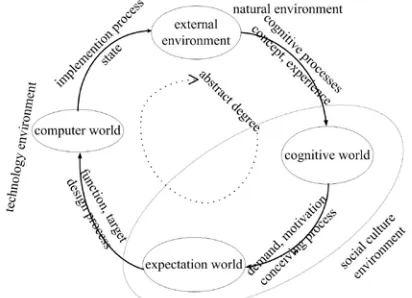
Gero et al [9] extended the functionality - behavior - structural framework and analyzed the relationship related with artificial products among social culture environment, technology physical environment and natural environment to improve the intelligence of mechanical manufacturing design system. Through the analysis they have divided external environment into three worlds and given he transforming relationship between the three worlds. Wei Moji et al [10] have thought carrier environment of services should be considered to analyze external environment of
[image:2.612.325.531.172.321.2]family services. So they have divided external environment of related services into four worlds: external world, cognitive world, expectation world and computer world, as shown in Figure 1. In this paper, the environment of family service would be analyzed based on these four worlds.
Figure 1 The Four Worlds Of External Environment
The external world describes the objective world of human and reflects current state the environment has reached.
The cognitive world refers to concept mapping formed in the minds of people cognitive by the processes the human percept, understand and process the state of external world. It is the abstract to various concepts of external world and full of much potential demand of people.
The expect world describes state of outside world after the needs of people was meet. At the same time, it clearly describes a variety of potential demand in the form of goals produced in the cognitive processes by people.
The computer world refers to collection of equipment tools developed by people according to targets they set the expectation world. It can meet the needs diverse needs of human beings by services operating equipment and realize the transformation from expectation world to external world.
designed various tools of the computer world according to these targets of the expected world, the process is refers to the design process. Finally, in the implementation process, service would change the stage of the external world to realize the demand of people by using devices of the computer world equipment.
2.2 Family Service Ontology
[image:3.612.115.300.316.417.2]Digital home service is a kind of algorithm belonged to the computer world, which has been designed to satisfy people's goals by operated devices of the computer world and could and implemented conversion from the expect world to the external world. The important concepts related to digital home would be involved through the analysis to four worlds of its services, which includes need, context, function, way, content, and service [10], as shown in figure 2.
Figure 2 Family Services Ontology
In the digital home field, all kinds of demands of people come from the feelings of their environment and were produced through the environment motivate them. As the environment is different, the demands of people are changing but can be met through the services provided by different devices. People will select a certain function which reflects basic intention hidden in the demand to meet them. The realization of these selected functions depends on the implementation of the service, so function reflects the goal of service. The entity of service execution refers to appliance equipment of home. Because people always design and manufacture appliance equipment according to their demands in a certain way, they could provide certain function to meet needs of people. The realization of function rely on a certain way, which has given explanation about the realization principle of function, and provided the principle for equipment design and the solution how to operate the equipment by service. Therefore, the function of equipment has realized in a particular way, and service has also accomplished by operating the equipment in compliance with the certain way. The same function could be realized in a variety of ways in accordance different with implementation principle, so various equipments with same function would be designed according to
different implementations; of course, the solution realized service of devices operation would be different. Such as, people have designed laser printers, inkjet printers and dot matrix printer according to the print principle, and their printer service would be different corresponding to because of different operation. However, only when certain equipment was persisted by people in their environment, its service could be executed. In home environment, services provided by the equipment would produce valid information by operating relevant data and presented them to home user in order to eventually satisfy demand generated by people in specific environment. Content refers to the object operated by service and is the carrier of information, so to meet demand must depend on specific content.
2.3 Service Semantic
The family service ontology unified perspective and provided a formal definition of the important concepts in the field of the family. It makes distinction for two concepts between function and needs. The function reflects the intent hidden under the demand, at the same time, with the environment changes it is not changes but needs maybe change. Using functions to annotate service make service semantic more clearly and realize service discovery and choice based on semantic.
Family service ontology defined the important concepts in the field of digital home, and formally described the relationship between these concepts. The ontology had a guiding significance to improve automation and intelligence of whole process from needs production to service realization. Family service ontology is upper ontology in a field, so the abstract degree of the concept is higher. If using concepts of this ontology annotate the semantic of specific service, it will make semantic granularity big and by difficult for users to achieve precise positioning services. So this paper concreted the concept and the function to reduce the their abstraction degree taking this ontology as a guide, labeled services in the field of family using the concept with lower degree of abstraction, and realized the accuracy of searching family services based on semantic.
3. FUNCTIONAL CONCEPT ONTOLOGY
3.1 Classification of Service Function
each function contains specific demand. Therefore, we and annotate service by constructing functional concept ontology taking the process of meeting demands as a guide. To meet demand depends on to access effective information, so when user puts forward a new demand, service must produce some information to meet this demand by operating related content. The process of meeting users’ demands is shown in Figure 3, information was generated at the source, transmitted though the channel, and finally presented to the user by sink.
Figure 3 The Process Of Meeting Demand
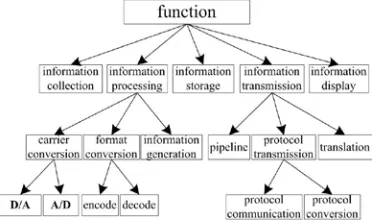
The functional concept ontology has been constructed by extracting the corresponding functional concepts according to the analysis of operation information experienced in the transformation process from the source to the sink. Five kinds of operations would be involved in the process of acquiring information, which refers to collection, processing, storage, transmission and display. So the functional concept ontology is divided into five categories: information collection, information processing, information storage, information transmission and information display, as shown in figure 4.
Figure 4 Sub-Concepts Of Functional Concept Ontology
3.1.1 Information processing function
In the five kinds of sub-functions, information processing function is responsible for processing the content. Content as the information carrier contains three parts: the types of carrier, encoding format and the semantic of content. The types of carrier are used to explain the carrier of information is digital signals or analog signals. Encoding format is used to describe how to encode for information, such as encoding format of the audio information
includes wav, midi, mp3, etc.. The semantic of content refers to information contained in content.
Therefore, according to operating content, information processing function can be divided into three types of sub-functions: carrier conversion function, format conversion functions, and information generating function. The carrier conversion function refers to the conversion specific format analog signal is converted to the specified digital signal (D/A conversion function) or specific digital signal is converted to the specified analog signals (A/D conversion function). Format conversion function is responsible for the encoding format of content, which can convert encoding format from one to another. Information generation function would finish transformation for semantic content, which can generate the output with new semantics by operating the input.
3.1.2 Information transmission function
Information transmission is responsible for the transmission of information between the two family services (logic device), according to transmission content which can be divided into three categories: pipeline, protocol transmission and translation.
Pipeline directly transfers content without any treatment, so there is no need to service support, that is any service is not corresponding with pipeline function. Pipeline is just a virtual device with the function with connecting services, so communication could directly run through it when two services are connected.
Service with protocol transmission function could establish communications for two sides to transmit information using a certain protocol. According to their communication protocols, protocol transmission function can be divided into two categories: protocol communication and protocol conversion. If communication protocols used by both parties are same, the system would use service with protocol communication to transfer information. When the protocols are different, it requires service with protocol conversion function to realize communication auxiliary.
[image:4.612.107.294.457.569.2]user-oriented services, the services with translation function must be used to translate transmission content.
The dictionary (semantic description metadata or ontology) provided by equipment provider must be used to realize the conversion of operation content between these two kinds of services, and then task would be finished through translation services according to this dictionary.
3.2 Refinement of Service Function
After the function is decomposed into five categories, the required functions transfer information from the source to the sink could be described and meet people's needs. However, the granularity of these sub-functions is still too high, so it is necessary to further refine the concept in order to achieve more accurate semantic annotation of service.
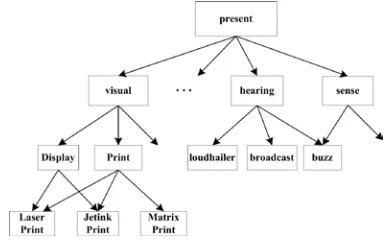
[image:5.612.102.294.577.703.2]From the definition of family services ontology, meeting people's needs depends on that operation to content by service with the specific function, but the realization of function relies on a certain way and way explains the principle of function realization. The same function may be realized by different ways according to the different principle of realization, and devices designed according to the different ways are not the same, so do services operating devices. Way provides the guiding principles for the design of device, but also provides a solution for the service of device. How many different ways there are many different types of device, accordingly how many services to provide solutions in such a way there are? Ways provides the basis for distinguishing different devices and services to achieve the same function, so the service function could be refined according to the different principle described by way to label accurately semantic of services. Take information display function for example, functional concept has been subdivided as shown in figure 5.
Figure 5 Sub-Concepts Of Information Display Function
In Figure 5, the information display function has been subdivided into a variety of different display modes, such as visual mode, hearing mode, sense mode, etc., so the corresponding functions has been divided into visual function, sense function, and tactile function etc.. According to the light source, the visual function can be divided into display function achieved by light emitted actively through controlling the light source and print function realized by light reflected on the outside through the generation material. Of course, print function and can be divided into Laser Print, Jetink Print, Matrix Print according to the printing principle.
In functional concept ontology, the degree of abstraction is higher and the generality of service is also stronger for upper function, while the degree of abstraction is lower and the generality of service is more single for sub-function. For example, print services prepared for laser printers and ink jet printers must deal with the operation details on the different printer. So their implementations of service solution are different, the system must use LaserPrint, and JetinkPrint to label their own function. Because operating system shield the different details of all printers, the service provided by operating system for logical printer can call different types of printers to realize print function. Therefore, different from the two former services, the implement of solution is more abstract and its universality is also stronger. We use Print with higher abstract granularity to label its function.
Similarly, the other functions (information collection, information processing, information storage, information transmission) in Figure 4 can be refined according to the analysis to realization mode of information display function.
4. SERVICE DESCRIPTION BASED ON
FUNCTIONAL CONCEPT ONTOLOGY
Function not only embodies the intention of demand, but also explains the goal of service, so it builds a bridge between demands and services. The appropriate service could be chosen the service according to the needs of people through semantic annotation to services made by functions. Now, take voice alarm of gas leakage in family security system example, we explain how to realize services description according to functional concept ontology
4.1 Scene Description
security system, the gas detection service(gasDetectiveServcie ( )) provided by gas security equipment always check the gas content of air and would output 1 to indicate danger when the content exceeds the limit of standard value.
Security system can note user by voice alarm when it detected danger, so it should search to service equipment providing audio broadcast in the home environment. Assuming there are three devices providing audio broadcast service in the current family environment, one is the gasAlarmServcie () provided by the buzzer built-in gas security equipment, one is the playServcie () provided by Bluetooth speaker, and one is the FMService () provided by the FM radio. When the gas leak, the system can automatically call the three services and note user by voice alarm of the appropriate equipment.
4.2 Service Description Based on Functional Concept Ontology
[image:6.612.334.514.557.692.2]Generally the service gateway is the center of digital home [11], as shown in Figure 6. All devices in the digital home network are directly or indirectly connected to the home gateway, and connected to the Internet through the home gateway. In the family network, User can send instruction to various appliances through the home gateway using the controller. Outside the family network, the instruction can be transferred via the Internet to the home gateway using various devices accessing the Internet, and then sent to the corresponding appliance by the home gateway. Home Area Net (shorted as HAN) taking the family gateway as the center constitutes the foundation of the network about digital home service. When device is connected to the home network, the service provided by it would be registered in service registry of home gateway, then the gateway would retrieve service registration library after it received instruction, and find the right service to call and execute. However, in the current all home gateways search and call services by matching grammar between the instruction and service name. In the scene described in section 4.1, the home gateway only find gasAlarmServcie () provided by the buzzer according to the analysis to gas leakage alarm instruction and cannot retrieve services provided by other devices with audio playback function
Figure 6 The Network Model Of Digital Home
In order to solve the above problem of grammar brought by retrieval based on keywords, make home gateway to be able to understand services and realize to automatically discover and call services, this paper added functional concept ontology to home gateway and extended the semantics of service registration to achieve the automation and intelligent of service discovery according to the user's requirements.
4.2.1 Service registration
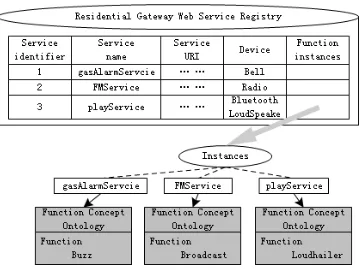
In the scene of Gas security, there are three devices: the buzzer, FM radio and Bluetooth speakers. When they are connected to home network, the services they provide must be registered in service registration library of home gateway. In the current, the table structure of storage mode is used to store service description in service registration library, and the service is selected by matching instruction and service names in retrieval. In order to add semantic information to the service, it is necessary to extend the service registry. So we have added Function instances to the original service registration library, and labeled service semantic using functional concept ontology, as shown in figure 7.
The above three services can achieve audio playback function, but their ways of realization are different. According to the principle used by them, you can use function with more fine-grained and more accurate semantic to mark service. In figure 7, three functions (Buzz, Broadcast and Loudhailer) were respectively used to label semantic of these three services through the analysis of device implementations. Namely service would be declared for the corresponding concept instance in the function of ontology concepts; actually the instance statement is as follows:
<Buzz rdf:id=”Buzz_GasAlarmService ”/> <Broadcast rdf:id=”Broadcast_FMService ”/> <Loudhailer rdf:id=”Loudhailer_PlayService”/> Then the URI address of ontology instances would be stored in item (Function instances)of service registry.
4.2.2 Service discovery
When the equipment of gas security detected gas leakage in the home environment, the alarm demand would be generated because of this stimulation. This demand depends on information display of gas leakage, so auditory function (hearing) can be chosen to display information through the analysis of the intentions of demand. In other words, the service with hearing function need be supported to broadcast alarm audio.
Because the semantic of service registration library has been extended by the functional concept ontology, the home gateway could search the instance of functional concept using the reasoning ability of ontology according to the requested function retrieval service. In the scene of gas security, the home gateway would search functional concept ontology to research instance of hearing concept. As shown in Figure 5, Buzz, Broadcast and Loudhailer are subclasses of Hearing concept, and the instances of sub-concept also all are the instances of his father concept according to the individual reasoning of ontology, so if the system search the instances of hearing concept, it would get simultaneously three services: gasAlarmService, FMService and playServcie.
If the alarm demand select information display with higher abstraction granularity as the function to achieve of the intention, through the retrieval of functional concept ontology, not only the above three services which display alarm information by audio can be gotten, but also a number of services display alarm information by video, stimulate the human perception and other ways can be achieved.
5. SUMMARY
In order to realize the automation process from user needs to service choice and call in the field of digital home, a series of works were finished in this paper. First, we analyzed the family environment and described relationships using family service ontology between environment, demands, functions, devices, services, content and way. Then we constructed functional concept ontology taking family domain ontology as guide and annotated the semantic for services. Finally the service was described taking gas security alarm service an example.
According to definition of family service ontology, in addition to functions, services have close relationship with contents and devices. Service selection can be further refined through analyzing the two concepts of contents and devices. Next we will analyze factors influencing retrieval contents and devices, construct ontology of content and equipment to provide more semantic information for service, and filter services with same function but different content operation and equipment to improve the accuracy of service retrieval.
REFERENCES:
[1] Hailong Liu, Chunhai Zhang, “Design and implementation of digital home remote control system”, Micro Computer Information,Vol.32, No.12, 2011,pp. 30-32.
[2] Junmin Luo, “Research on ontology and evolution of Fuzzy”, Microelectronics and
Computer, Vol.21,No.5, 2011,pp.140-143.
[3] Gruber T. R, “A translation approach to portable ontology specifications”, Knowledge acquisition, Vol.12, No.2,1993, pp.199-220. [4] Prudencio A. C, Willrich R, Diaz M, et. Al,
“Quality of service specifications: A semantic approach”, Network Computing and Applications, 2009. NCA 2009, Proceedings of
Eighth IEEE International Symposium, 8, 2009,
pp.219-226.
[5] Yi Jiang, “A semantic Web service ontology model based on QoS”, Microelectronics and computer,Vol.25, No.10, 2009, pp.189-192. [6] Diaz Redondo R. P, Vilas A. F, Cabrer M. R, et.
[7] Diaz Redondo R. P, Vilas A. F, Cabrer M. R, etal, “Enhancing residential gateways: OSGi service composition”, Consumer Electronics, Vol.36, No.1, 2007, pp.87-95.
[8] Mizoguchi R, Kitamura Y, “A functional ontology of artifacts”, The Monist; An International Quarterly Journal of General
Philosophical Inquiry, Vol.22, No.3, 2009,
pp.387.
[9] Gero J. S, Kannengiesser U, “The situated function–behaviour–structure framework”,
Design studies,Vol.31, No.4, 2004, pp.373-391. [10] Wei M,Xu J,Yun H,et. al,“Ontology-based home
service model”, Computer Science and
Information Systems, Vol.33, No.2, 2012,
pp.813-838.