CP/M-86'"
,CPIM-86™
System Guide
Copyr ight
©
1981Digital Research
P.O. Box 579
801 Lighthouse Avenue Pacific Grove, CA ·93950
(408) 649-3896
TfRX 910 360 50 0 1
Copyright
©
1981 by Digital Research. All riqhts reserved. No part of this publication may be reproduced, transmitted, transcribed, stored in a retrieval system, or translated into any lanquage or computer 1anguaqe, i.n any form or by any means, electronic, mechanical, magnetic, optical, chemical, manual or otherwise, without the prior written permission of Digital ~esearch, Post Office Box 57Q, Pacific Grove, California, 93950.This manual is, however, tutorial in nature. ~hus,
t he reader is granted permiss ion to include the example programs, ei_ther in whole or in part, in his own programs.
DISCLAIMER
Dig ita 1 Re sea r c h m a k e s nor e pre sen tat i () n s 0 r warranties with respect to the contents hereof and specifically disclai.ms any implied warranties of merchan tabi 1 i ty or f i tnes s for any part icular purpose. Fur ther, Dig i tal Research reserves the right to revise this publication and to make changes f rom time to time in the content hereof wi thout obligation of Digital Research to notify any person of such revision or changes.
TRADEMARKS
CP/M is a registered trademark of Digital Research. ASM-86, CP/M-86, CP/M-80, CP/NET, DDT-86, LINK-80, MP/M, and TEX-80 are trademarks of Digital Research.
Foreword
The CP/M-86 System Guide presents the system programming aspects of CP/~-86TM, a single-user o~eratinq system for the Intel 8086 and 8088 l6-bit microprocessors. The discussion assumes the reader is familiar with CP/M the Digital Research 8-bit operatinq system. To clarify specific differences with CP/M-86, this document refers to the 8-bft version of CP/M as CP/M-80™. Elements common to both systems are simply called CP/M features.
CP/M-80 and CP/M-86 are equivalent at the user interface level and thus the Digital Research documents:
• An Introduction to CP/M Features and Facilities • ED: A Context Bditor for the CP/M Disk System • CP/M 2 User~s Guide
are shipped with the CP/M-86 package. Also included is the CP/M-86
Programmer~s Guide, which describes ASM-86'rM and DDT-86T]\~, Diqital
Research~s 8086 assembler and interactive debugger.
Thi s System Gu ide presen ts an overv i e,~ of the CP /M-86 progr amming inter f ace conventions. It also descr ibes procedures for adapting CP/M-86 to a custom hardt.vare enviornment. This information parallels that presented in the CP/M 2 Interface G~ide and the CP/M
2 Alteration G~ide.
Section 1 gives an overview of CP/M-86 and summarizes its differences with CP/M-80. Section 2 describes the qeneral execution environment while Section 3 tells how to generate command files. Sections 4 and 5 respectively define the programming interfaces to the Basic Disk Operating Svstem and the Basic Input/Output System. Section 6 discusses alteration of the BIOS to support custom disk configurations, and Section 7 describes the loading operation and the organization of the CP/M-86 system file.
Table of Contents
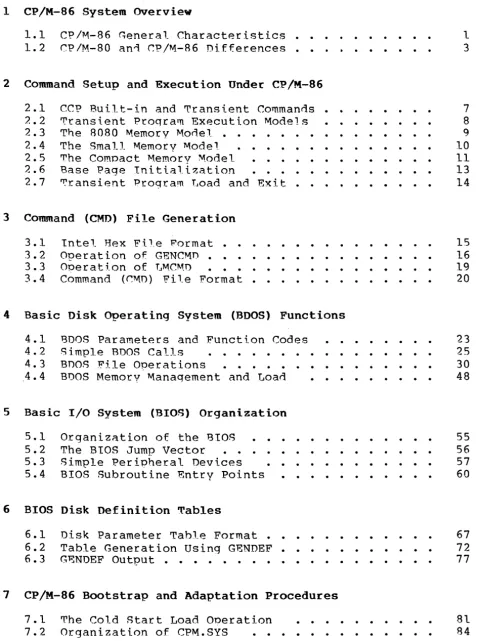
1 CP!M-86 System Overview
1.1 1.2
CP/M-86 ~eneral Charact~ristics .
CP/M-SO an-i r.P/M-R6 Differences • • .
2 Command Setup and Execution Under CP/M-86
2.1 2.2 2.3 2.4 2.5 2.6 2.7
CCP Built-in and ~ransient Comman~s •
~ransient Proqra~ Execution Models • . • • • The R080 ~emory Mo~el • • • • • . • • • • The Small Memory Model • . • • • . . • • The Compact Memory Model • . • . • • • • Base Page Initialization • • • • • •
~ransient Program Load and Exit .
3 Command (CMD) File Generation
1 3
7 8
9
10 11 13 14
3.1 Intel Hex Fi1.e Format. • • . . • • . . • . . • 15 3.2 Operation of GENCMD • . • • . . • . • • 16 3.3 Operation of LMCMD • • • . • • • • • • . . • • • • 19 3.4 Command u~~n) File Format. . • • • • . • . • • • • 20
4 Basic Disk Operating System (BDOS) Functions
4.1 BOOS Parameters and Function Codes • • • • • • 23 4.2 Simple BOOS Calls . . • . . • • • • . • • • . 25 4.3
Bnos
File Operations • . . . • . • • • • . • • • • 30 4.4 BDOS Memory Manaqement and Load • . . • . . . • • 485 Basic I/O System (BIOS) Organization
Organiz~tion of the BIOS • • • The BIOS Jump Vector
Simple Peripheral Devices 5.1
5.2 5.3
5.4 BIOS Subroutine Entry Points • • • • •
6 BIOS Disk Definition Tables
6.1 6.2 6.3
Disk Parameter Table Format • Table Generation Using GENDEF
G~NDEF Output • • • • • • •
.
. .
.
.
.
. .
. .
7 CP/M-86 Bootstrap and Adaptation Procedures
7.1 7.2
The Cold Start Load Ooeration Organization of CPM.SYS
55 56 57 60
67
72 77
[image:6.620.73.554.99.741.2]A Blocking and Deblockinq Algorithms
B
C
D
Random Acc~ss Sample Program
Listing of the Boot Rom
LDBIOS Listing
E BIOS Listing
F CSIOS Listing .
.
.
.
.
.
.
.
. .
8795
103
113
121
Section
1
CP/M-86 System Overview
1.1 CP/M-86 General Characteristics
CP/M-86 contains all facilities of CP/M-80 with additional features to account for increased processor address space of up to a megabyte (1,048,576) of main memory. Further, CP/M-86 maintains
file compatibility with all previous versions of CP/M. The file structure of version 2 of CP/M is used, allowing as many as sixteen drives with up to eight megabytes on each drive. Thus, CP/M-SO and CP/M-86 systems may exchange files without modifying the file format.
CP/M-86 resides in the file CPM.SYS, which is loaded into memory by a cold start loader during system initialization. The cold start loader resides on the first two tracks of the system disk. CPM.SYS contains three program modules: the Console Command Processor (CCP), the Basic Disk Operating System (BOOS), and the user-conf igurable Basic I/O System (BIOS). The CCP and BDOS portions occupy approximately 10K bytes, while the size of the BIOS varies with the implementation. The operating system executes in any portion of memory above the reserved interrupt locations, while the remainder of the address space is partitioned into as many as eight non-contiguous regions, as defined in a BIOS table. Unlike CP/M-80, the CCP area cannot be used as a data area subsequent to transient program load: all CP!M-86 modules remain in memory at all times, and are not reloaded at a warm start.
Similar to CP/M-80, CP/M-86 loads and executes memory image files from disk. Memory image files are preceded by a "header record," defined in this document, which provides information required for proper program loading and execution~ Memory image files under CP/M-86 are identified by a "CMD" file type.
Unlike CP/M-80, CP/M-86 does not use absolute locations for system entry or default variables. The BDOS entry takes place through a reserved software interrupt, while entry to the BIOS is provided by a new BOOS call. Two var iables maintained in low memory under CP/M-80, the default disk number and I/O Byte, are placed in the CCP and BIOS, respectively. Dependence upon absolute addresses is minimized in CP/M-86 by maintaining initial "base page" values, such as the default FeB and default command buffer, in the transient program data area.
utility programs such as ED, PIP, STAT and SUBMIT operate in the same manner under CP/M-86 and CP/M-80. In its operation, DDT-86 resembles DDT supplied with CP/M-80. It allows interactive debugging of 8086 and 8088 machine code. Similarly, ASM-86 allows assembly language programming and development for the 8086 and 8088 using Intel-like mnemonics.
The GENCMD (Generate CMD) utility replaces the LOAD program of CP/M-80, and converts the hex files produced by ASM-86 or Intel utilities into memory image format suitable for execution under CP/M-86. Further, the LDCOPY (Loader Copy) program replaces SYSGEN, and is used to copy the cold start loader from a system disk for replication. In addition, a variation of GENCMD, called LMCMD, converts output from the Intel LOC86 utili ty into CMD format. Finally, GENDEF (Generate DISKDEF) is J>rovided as an aid in producing custom disk parameter tables. ASM-86, GENCMD, LMCMD, and GENDEF are also supplied in "COM" file format for cross-development under CP/M-80.
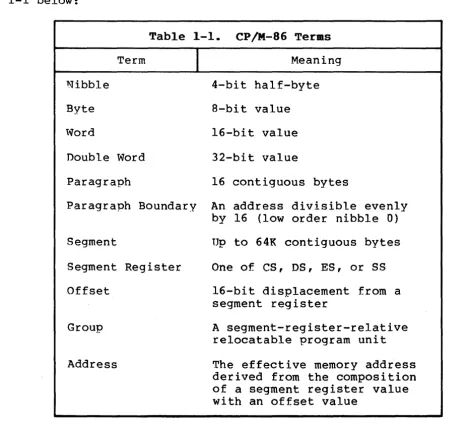
Several terms used throughout this manual are defined in Table 1-1 below:
Table 1-1. CP/M-86 Terms
Term
I
Meaning~ibble 4-bit half-byte
Byte 8-bit value
Word l6-bit value
Double Word 32-bit value
Paragraph 16 contiguous bytes
Paragraph Boundary An address divisible evenly by 16 (low order nibble 0)
Segment t~ to 64K contiguous bytes
Segment Register One of CS, DS, ES, or SS
Offset 16-bit displacement from a segment register
Group A segment-register-relative relocatable program unit
Address The effective memory address derived from the composition of a segment register value with an offset value
[image:9.617.67.537.228.653.2]CP/M-86 System Guide 1.1 CP/M-86 General Characteristics
CP/M-86 supports eight program groups: the code, data, stack and extra groups as well as four auxiliary groups. When a code, data, stack or extra group is loaded, CP/M-86 sets the respective segment register (CS, OS, SS or ES) to the base of the group. CP/M-86 can also load four auxiliary groups. A transient program manages the location of the auxiliary groups using values stored by CP/M-86 in the user~s base page.
1.2 CP/M-80 and CP/M-86 Differences
The structure of CP/M-86 is as close to CP/M-80 as possible in order to provide a familiar programming environment which allows application programs to be transported to the 8086 and 8088 processors with minimum effort. This section points out the specific differences between CP/M-80 and CP/M-86 in order to reduce your time in scanning this manual if you are already familiar with CP /M-80. The terms and concepts presented in this section are explained in detail throughout this manual, so you will need to refer to the Table of Contents to find relevant sections which provide specific definitions and information.
Due to the nature of the 8086 processor, the fundamental difference between CP/M-30 and CP/M-86 is found in the management of the various relocatable groups. Although CP/M-80 references absolute memory locations by necessity, CP/M-86 takes advantage of the static relocation inherent in the 8086 processor. The operating system itself is usually loaded directly above the interrupt locations, at location 0400H, and relocatable transient programs load in the best fit memory region. However, you can load CP/M-86 into any portion of memory without changing the operating system (thus, there is no MOVCPM utility with CP/M-86), and transient programs will load and run in any non-reserved region.
Three general memory models are presented below, but if you are converting 8080 programs to CP/M-86, you can use either the 8080 Model or Small Model and leave the Compact Model for later when your addressing needs increase. You~ll use GENCMD, described in Section 3.2, to produce an executable program file from a hex file. GENCMD parameters allow you to specify which memory model your program requires.
CP/M-86 itself is constructed as an 8080 Model. This means that all the segment registers are placed at the base of CP/M-86, and your customized BIOS is identical, in most respects, to that of CP/M-80 (with changes in instruction mnemonics, of course). In fact, the only additions are found in the SETDMAB, GETSEGB, SETIOB, and GETIOB entry points in the BIOS. Your warm start subroutine is simpler since you are not required to reload the CCP and BOOS under CP/M-86. One other point: if you implement the IOBYTE facility, you ~ll have to define the var iable in your BIOS. Taking these changes into accou'nt, you need only perform a simple translation of your CP/M-80 BIOS into 8086 code in order to implement your 8086 BIOS.
If you~ve implementedCP/M-80 Version 2, - you already have disk definition tables which will operate prope,rly with CP/M-86. You may wish to attach different disk drives, or experime.nt with sector ske* factors to increase performance. If so, you can use the new GENDEF utility which performs the same function as the DISKDEF macro used ·by MAC under CP/M-SO. You~ll find, however, that GENDEF provides you with more information and checks error conditions better than the DISKDEF macro.
Although generating a CP/M-86 system is generally easier than generating a CP/M-80 system, complications arise if you are using single-density floppy disks. CP/M-86 is too large to fit in the two-track system area of a single-density disk, so the bootstrap operation must perform two steps to load CP/M-86: first the bootstrap must load the cold start loader, then the cold start loader loads CP/M-86 from a system file. The cold start loader includes a LDBIOS which is identical to your CP/M-86 BIOS with the exception of the INIT entry point. You can simplify the LDBIOS if you wish because the loader need not write to the disk. If you have a double-density disk or reserve enough tracks on a single-density disk, you can load CP/M-86 without a two-step boot.
To make a BOOS system call, use the reserved software interrupt #244. The jump to the BOOS at location 0005 found in CP/M-80 is not present in CP/M-86. However, the address field at offset 0006 is present so that programs which "size" available memory using this word value will operate without change. CP/M-80 BDOS functions use certain 8080 registers for entry parameters and returned values. CP/M-86 BDOS functions use a table of corresponding 8086 registers. For example, the 8086 registers CH and CL correspond to the 8080 registers Band C. Look through the list of
Bnos
function numbers in Table 4-2. and you~ll find that functions 0, 27, and 31 have changed slightly. Several new functions have been added, but they do not affect existing programs.One major philosophical difference is that in CP/M-80, all addresses sent to the BDOS are simply l6-bit values in the range OOOOH to OFFFFH. In CP/M-86, however, the addresses are really just l6-bit offsets from the OS (Data Segment) register which is set to the base of your data area. If you translate an existing CP/M-SO program to the CP/M-S6 environment, your data segment will be less than 64K bytes. In this case, the DS register need not be changed following ini tial load, and thus all CP/M-SO addresses become simple DS-relative offsets in CP/M-86.
CP/M-86 System Guide 1.2 CP/M-80 and CP/M-86 Differences
You~ll find many new facilities in CP/M-86 that will simplify your programming and expand your application programming capabili ty. But, we~ve designed CP /M-86 to make it easy to get started: in short, if you are converting from CP/M-80 to CP/M-86, there will be no major changes beyond the translation to 8086 machine code. Further, programs you design for CP/M-86 are upward compatible with MP/M-86, our multitasking operating system, as well as CP/NET-86 which provides a distributed operating system in a network
environment.
Section 2
Command Setup and Execution Under CP/M-86
This section discusses the operation of the Console Command
Processor (CCP) , the format of transient programs, CP/M-86 memory
models, and memory image formats.
2.1 CCP Built-in and Transient Commands
The operation of the CP/M-86 CCP is similar to that of CP/M-80.
Upon initial cold start, the CP/M sign-on message is printed, drive
A is automatically logged in, and the standard prompt is issued at
the console.
CP/M-86 then waits for input command lines from the
console, which may include one of the built-in commands
DIR ERA
REN
TYPE
USER
(note that SAVE is not supported under CP/M-86 since the equivalent
function is performed by DDT-86) •
Alternatively, the command line may begin with the name of a
transient program wi th the assumed file type "CMD" denoting a
"conunand file." The CMD file type differentiates transient command
files used under CP/M-86 from COM files which operate under CP/M-80.
The CCP allows mul tiple programs to reside in memory, providing
facilities for background tasks. A transient program such as a
debugger may load additional programs for execution under its own
control.
Thus, for example, a background printer spooler could
first be loaded, followed by an execution of DDT-86. DDT-86 may, in
turn, load a test program for a debugging session and transfer
control to the test program between breakpoints.
CP/M-86 keeps
account of the order in which programs are loaded and, upon
encountering a CONTROL-C, discontinues execution of the most recent
program activated at the CCP level.
A CONTROL-C at the DDT-86
conunand level aborts DDT-86 and its test program. A second
CONTROL-C at the CONTROL-CCONTROL-CP level aborts the background printer spooler. A third
CONTROL-C resets the disk system.
Note that program abort due to
CONTROL-C does not reset the disk system, as is the case in CP/M-SO.
A disk reset does not occur unless the
CO~TROL-Coccurs at the CCP
command input level with no programs residing in memory.
When CP/M-86 receives a request to load a transient program
from the CCP or another transient program, it checks the
program~smemory requirements.· If sufficient memory is available, CP/M-86
assigns the required amount of memory to the program and loads the
program.
Once loaded, the program can request additional memory
from the BOOS for buffer space.
When the program is terminated,
CP/M-86 frees both the program memory area and any additional buffer
space.
2.2 Transient Program Execution Models
The initial values of the segment registers are determined by one of three "memory models" used by the transient program, and descr ibed in the CMD file header. The three memory models are summarized in Table 2-1 below.
Table 2-1. CP/M-86 Memory Models
Model
I
Group Relationships8080 Model Code and Data GrouT;>s Overlap
Small Model Independent Code and Data Groups
Compact Model Three or More Independent Groups
The 8080 Model supports programs which are directly translated from CP/M-80 when code and data areas are intermixed. ~he 8080 model consists of one group which contains all the code, data, and stack areas. Segment registers are initialized to the starting address of the region containing this group. The segment registers can, however, be managed by the application program during execution so that multiple segments within the code group can be addressed.
The Small Model is similar to that defined by Intel, where the program consists of an independent code group and a data group. The Small Model is suitable for use by programs taken from CP/M-80 where code and data is easily separated. Note again that the code and data groups often consist of, but are not restricted to, single 64K
byte segments.
The Compact Model occurs when any of the extra, stack, or auxiliary groups are present in program. Each group may consist of one or more segments, but if any group exceeds one segment in size, or if auxiliary groups are present, then the application program must manage its own segment reqisters during execution in order to address all code and data areas.
The three models differ primarily in the manner in which segment registers are initialized upon transient program loading~
CP/M-86 System Guide
2.3 The 8080 Memory Model
2.3 The 8080 Memory Model
The 8080 Model is assumed when the transient program contains
only a code group.
In this case, the CS,
DS,and ES registers are
initialized to the beginning of the code group, while the SS and SP
registers remain set to a 96-byte stack area in the CCP.
The
Instruction Pointer Register (IP) is set to 100R, similar to
cp/M-80, thus allowing base page values at the beginning of the code
group. Following program load, the 8080 Model appears as shown in
Figure
2-1,where low addresses are shown at the top of the diagram:
ss:
CCP
.sS
+SP:
CCP Stack
CS OS ES:
OS+OOOOH:
base
page
CS+OlOOH:
IP
=OlOOH
code
data
.
.
. .
code
data
Figure 2-1. CP/M-86 8080 Memory Model
The intermixed code and data regions are indistinguishable.
The
"base page" values, descr ibed below, are identical to CP
IM-80,allowing simple translation from 8080, 8085, or Z80 code into the
8086 and 8088 environment. The following ASM-86 example shows how
to code an 8080 model transient program.
eseg
org
100h
(code)
endcs
equ
$dseg
org
offset endcs
(data)
end
2.4 The Small Memory Model
The Small Model is assumed when the transient program contains both a code and data group. (In ASM-86, all code is generated following a CSEG directive, while data is defined following a DSEG directive with the origin of the data segment independent of the code segment.) In this model, CS is set to the beginning of the code group, the DS and ES are set to the start of the data group, and the SS and SP registers remain in the CCp's stack ~rea as shown in Figure 2-2.
ss:
SS + SP:
cs:
OS ES:
DS+OIOOH:
CCP
CCP Stack
IP = OOOOH code
base page
data
Figure 2-2. CP/M-86 Small Memory Model
The machine code begins at CS+OOOOH, the "base page" values begin at DS+OOOOH, and the data area starts at DS+OIOOH. The following ASM-86 example shows how to code a small model transient program.
cseg
(code) dseg
org 100h
CP/M-86 System Guide 2.5 The Com~act Memory Model
2.5 The, Compact Memory Model
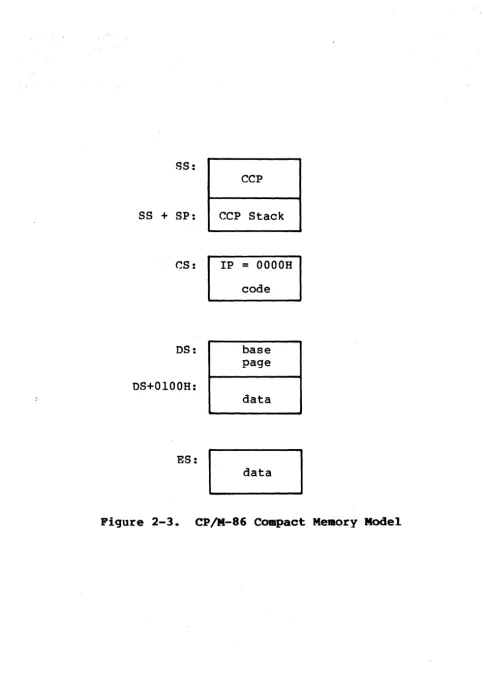
The Compact Model is assumed when code and data groups are present, a~ong with one or more of the remaining stack, extra, or auxiliary groups. In this case, the CS, DS, and ES registers are set to the base addresses of their respective areas. Figure 2-3 shows the initial configuration of segment registers in the Compact Model. The values of the various segment registers can be programmatically changed during execution by loading from the initial values placed in base page by the CCP, thus allowing access to the entire memory space.
If the transient program intends to use the stack group as a stack area, the SS and SP registers must be set upon entry. The SS and SP registers remain in the CCP area, even if a stack group is defined. A1 though it may appear that the SS and SP reg ister s should be set to address the stack group, there are two contradictions. First, the transient program may be using the stack group as a data area. In that case, the Far Call instruction used by the CCP to transfer control to the transient program could overwrite data in the stack area. Second, the SS register would logically be set to the base of the group, while the SP would be set to the offset of the end of the group. However, if the stack group exceeds 64K the address range from the base to the end of the group exceeds a l6-bit offset value.
The following ASM-86 example shows how to code a compact model transient program.
cseg
(code) dseg
org 100h
(data) eseg
(more data) sseg
(stack area) end
SS:
CCP
SS
+SP:
CCP Stack
CS:
IP
=
OOOOH
code
DS:
base
page
OS+OIOOH:
data
[image:19.623.55.539.52.728.2]ES:
I
data
...
----_
...
CP/M-S6 System Guide 2.6 Base Page Initialization
2.6 Base Page Initialization
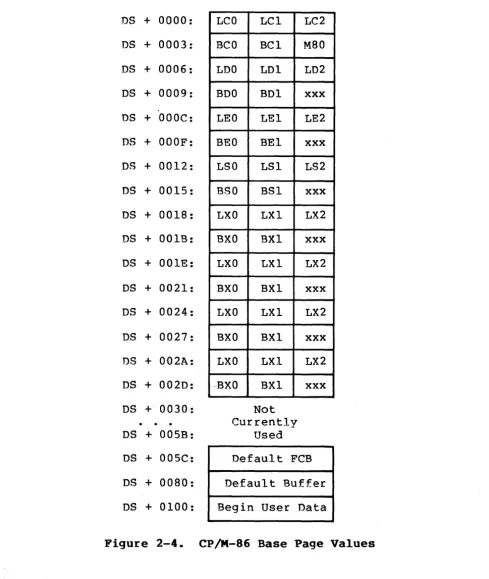
Similar to CP/M-SO, the CP/M-S6 base page contains default values and locations initialized by the CCP and used by the transient program. The base paqe occupies the regions from offset OOOOH through OOFFH relative to the DS reqister. The values in the base page for CP/M-S6 include those of CP/M-SO, and appear in the same relative positions, as shown i"n Figure 2-4.
OS + 0000:
DS + 0003:
DS + 0006:
OS + 0009:
OS + OOOC:
DS + OOOF:
OS + 0012:
DS + 0015:
DS + OOlS:
DS + 0018:
OS + OOlE:
OS + 0021:
OS + 0024:
OS + 0027:
DS + 002A:
DS + 0020:
os
+ 0030:. . .
os
+ 005B:DS + 005C:
OS + OOS"O:
OS + 0100:
LCO LCI
BCO BCl
LDO LOl
BOO BOI
LEO LEI
BEO BEl
LSO LSI
aso
BSILXO LXI
BXO BXI
LXO LXI
BXO BXl
LXO LXI
BXO BXl
LXO LXl
-BXO BXl
Not Currently
Used
LC2
MBO
L02
xxx
LE2
xxx
LS2
xxx
LX2
xxx
LX2
xxx
LX2
xxx
LX2
xxx
Default FCB
Default Buffer
Begin User Data
Figure 2-4. CP/M-86 Base Page Values
[image:20.618.68.557.164.743.2]Each byte is indexed by 0, 1, and 2, corresponding to the standard Intel storage convention of low, middle, and high-order (most significant) byte. "xxx" in Figure 2-4 marks unused bytes. LC is the last code group location (24-bits, where the 4 high-order bits equal zero).
In the 8080 Model, the low order bytes of LC (LCD and LCI) never exceed OFFFFH and the high order byte (LC2) is always zero. BC is base paragraph address of the code group (16-bits). LO and BD
provide the last posi tion and paragraph base of the data group. The last position is one byte less than the group length: It should be noted that bytes LOO and LOI appear in the same relative positions of the base page in both CP/M-80 and CP!M-86, thus easing the program translation task. The M80 byte is equal to 1 when the 8080 Memory Model is in use. LE and BE provide the length and paragraph base of the optional extra group, while LS and BS give the optional stack group length and base. The bytes marked LX and BX correspond to a set of four optional independent groups which may be required for programs which execute using the Compact Memory Model. The initial values for these descriptors are derived from the header record in the memory image file, described in the following section.
2.7 Transient Program Load and Exit
Similar to CP /M-8 0, the CCP parses up to two filenames following the command and places the properly formatted FCB's at locations DOSCH and 006CH in the base page relative to the DS register. Under CP/M-80, the default DMA address is initialized to 0080H in the base page. Due to the segmented memory of the 8086 and 8088 processors, the OMA address is divided into two parts: the OMA segment address and the DMA offset. Therefore, under CP!M-86, the default DMA base is initialized to the value of OS, and the default DMA offset is initialized to 0080H. Thus, CP/M-80 and CP/M-86 operate in the same way: both assume the default DMA buffer occupies the second half of the base page.
Section 3
Command (CMD) File Generation
As mentioned previously, two utili ty programs are provided wi th CP/M-86, called GENCMD and LMCMD, which are used to produce CMD memory image files suitable for execution under CP/M-86. GENCMD accepts Intel 8086 "hex" format files as input, while LMCMD reads Intel L-module files output from the standard Intel LOC86 Object Code Locator utility. GENCMD is used to process output from-'the Digital Research ASM-86 assembler and Intel~s OH86 utility, while LMCMD is used when Intel compatible developmental software is available for generation of programs targeted for CP/M-86 operation.
3.1 Intel 8086 Hex File Format
GENCMD input is in Intel "hex" format produced by both the Dig i tal Research ASM-86 assembler and the standard Intel OH86 utility program (see Intel document #9800639-03 entitled "MCS-86 Software Development utitities Operating Instructions for ISIS-II Users"). The CMD file produced by GENCMD contains a header record which defines the memory model and memory size requirements for loading and executing the CMD file.
An Intel "hex" file consists of the traditional sequence of ASCII records in the following format:
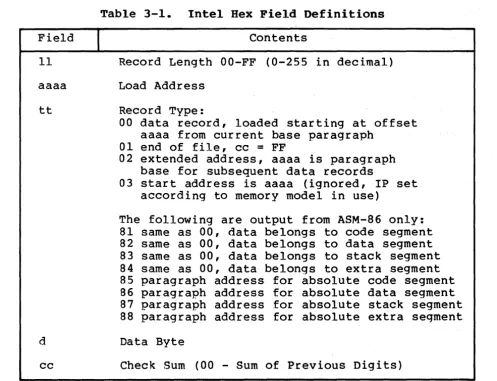
where the beginning of the record is marked by an ASCII colon, and each subsequent digit position contains an ASCII hexadecimal digit in the range 0-9 or A-F. The fields are defined in Table 3-1.
Field
I
11
aaaa
tt
d
cc
Table 3-1.
Intel Hex Field Definitions
Contents
Record Length OO-FF (0-255 in decimal)
Load Address
Record Type:
00 data record, loaded starting at offset
aaaa from current base paragraph
01 end of file, cc
=
FF
02 extended address, aaaa is paragraph
base for subsequent data records
03 start address is aaaa (ignored, IP set
according to memory model in use)
The following are output from ASM-86 only:
81 same as 00, data belongs to code segment
82 same as 00, data belongs to data segment
83 same as 00, data belongs to stack segment
84 same as 00, data belongs to extra segment
85 paragraph address for absolute code segment
86 paragraph address for absolute data segment
87 paragraph address for absolute stack segment
88 paragraph address for absolute extra segment
Data Byte
Check Sum (00 - Sum of Previous Digits)
All characters preceding the colon for each record are ignored.
(Additional hex file format information is included in the ASM-86
User~s
Guide, and in
Intel~sdocument #980082lA entitled "MCS-86
Absolute Object File Formats.")
3.2 Operation of GENCMD
The GENCMD utility is invoked at the CCP level by typing
GENCMD filename parameter-list
[image:23.618.56.553.50.431.2]CP/M-86 System Guide 3.2 Operation of GENCMD
The 8080 keyword forces a single code group so that the
Bnos
load function sets up the 8080 Memory Model for execution, thus allowing intermixed code and data within a single segment. The form of this command isGENCMD filename 8080
The remaining keywords follow the filename or the 8080 option and define specific memory requirements for each segment group, corresponding one-to-one with the segment groups defined in the previous section. In each case, the values corresponding to each group are enclosed in square brackets and separated by commas. Each value is a hexadecimal number representing a paragraph address or segment length in paragraph units denoted by hhhh, prefixed by a single letter which defines the meaning of each value:
Ahhhh Bhhhh Mhhhh Xhhhh
Load the group at absolute location hhhh The group starts at hhhh in the hex file
The group requires a minimum of hhhh
*
16 bytes The group can address a maximum of hhhh*
16 bytesGenerally, the CMD file header values are derived directly from the hex file and the parameters shown above need not be included. The following si tuations, however, require the use of G'ENCMD parameters.
• The 8080 keyword is included whenever ASM-86 is used in the conversion of 8080 programs to the 8086/8088 environment when code and data are intermixed within a single 64K segment, regardless of the use of CSEG and DSEG directives in the source program.
• An absolute address (A value) must be given for any group which must be located at an absolute location. Normally, this value is not specified since CP/M-86 cannot generally ensure that the required memory region is available, in which case the CMD file cannot be loaded.
• The B value is used when GENCMD processes a hex file produced by Intel~s OH86, or similar' utility program that contains more than one group. The output from OH86 consists of a sequence of data records with no information to identify code, data, extra, stack, or auxiliary groups. In this case, the B value marks the beg inning address of the group named by the keyword, causing GENCMD to load data following this address to the named group (see the examples below). Thus, the B value is normally used to mark the boundary between code and data segments when no segment information is included in the hex file. Files produced by ASM-86 do not require the use of the B value since segment information is included in the hex file.
• The minimum memory value (M value) is included only when the hex records do not define the minimum memory requirements for the named group. Generally, the code group size is determined precisely by the data records loaded into the area. That is, the total space required for the group is defined by the range between the lowest and highest da ta byte addresses. The data group, however, may contain uninitialized storage at the end of the group and thus no data records are present in the hex file which define the highest referenced data item. The highest address in the data group can be defined within the source program by including a "DB 0" as the last data item. Alternatively, the M value can be included to allocate the additional space at the end of the group. Similarly, the stack, extra, and auxiliary group sizes must be defined using the M value unless the highest addresses within the groups are implicitly defined by data records in the hex file •
• The maximum memory size, given by the X value, is generally used when additional free memory may be needed for such purposes as I/O buffers or symbol tables. If the data area size is fixed, then the X parameter need not be included. In this case, the X value is assumed to be the same as the M value. The value XFFFF allocates the largest memory region available but, if used, the transient program must be aware that a three-byte length field is produced in the base page for this group where the high order byte may be non-zero. Programs converted directly from CP/M-80 or programs that use a 2-byte pointer to address buffers should restrict this value to XFFF or less, producing a maximum allocation length of OFFFOH bytes.
The following GENCMD command line transforms the file X.H86 into the file X.CMD with the proper header record:
gencmd x code[a40] data[m30,xfff]
CP/M-86 System Guide 3.2 Operation of GENCMD
Assuming a file Y.H86 exists on drive B containing Intel hex records with no interspersed segment information, the command
gencmd b:y data[b30,m20] extra[b50] stack [m40] xl[m40]
produces the file Y.CMD on drive B,by selecting records beginning at address OOOOH for the code segment, with records starting at 300H allocated to the data segment. The extra segment is filled from records beginning at SOOH, while the stack and auxiliary segment *1 are uninitialized areas requiring a minimum of 400H bytes each. In this example, the data area requires a minimum of 200H bytes. Note again, that the B value need not be included if the Digital Research ASM-86 assembler is used.
3.3 Operation of LMCMD
The LMCMD utility operates in exactly the same manner as GENCMD, with the exception that LMCMD accepts an Intel L-module file as input. The primary advantage of the L-module format is that the file contains internally coded information which defines values which would otherwise be required as parameters to GENCMD, such the beginning address of the group .... s data segment. Currently, however, the only language processors which use this format are the standard Intel development packages, although various independent vendors will, most likely, take advantage of this format in the future.
3.4
Command (CND) File Format
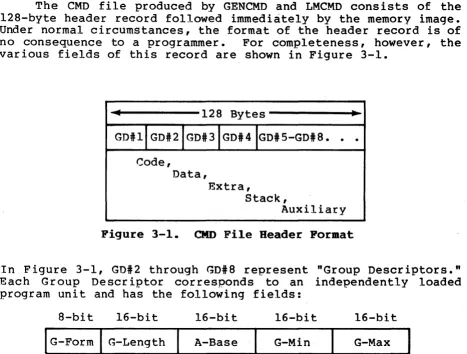
The CMD file produced by GENCMD and LMCMD consists of the
l28-byte header record followed immediately by the memory image.
Under normal circumstances, the format of the header record is of
no consequence to a programmer.
For completeness, however, the
various fields of this record are shown in Figure 3-1.
•
128 Bytes
~GD#1IGDi2IGD#3IGD#4IGD#S-GD#8.
. .
Code,
Data,
Extra,
Stack,
Auxiliary
Figure 3-1. CMD File Header Format
In Figure 3-1, GD#2 through GD#8 represent "Group Descriptors."
Each Group Descriptor corresponds to an independently loaded
program unit and has the following fields:
a-bit
l6-bit
16-bit
l6-bit
l6-bit
I
G-FormI
G-LengthA-Base
G-Min
G-Max
where G-Form describes the group format, or has the value zero if
no more descriptors follow. If G-Form is non-zero, then the 8-bit
value is parsed as two fields:
G-Form:
4-bit
4-bit
I
x x x x
I
G-Type
I
The G-Type field determines the Group Descriptor type. The valid
Group Descriptors have a G-Type in the range 1 through 9, as shown
[image:27.613.70.537.76.430.2]CP/M-86 System Guide 3.4 Command (CMD) File Format
Table 3-2. Group Descriptors
G-Type
1
2 3 4 5 6
7
8 9
10 - 14 15
I
Group TypeCode Group Data Group Extra Group Stack Group
Auxiliary Group #1 Auxiliary Group #2 Auxiliary Group #3 Auxiliary Group #4 Shared Code Group Unused, but Reserved
Escape Code for Additional Types
All remaining values in the group descriptor are given in increments of 16-byte paragraph units with an assumed low-order 0 nibble to complete the 20-bit address. G-Length gives the number of paragraphs in the group. Given a G-length of 0080H, for example, the size of the group is 00800H
=
2048D bytes. A-Base defines the base paragraph address for a non-relocatable qroup while G-Min and G-Max define the minimum and maximum size of the memory area to allocate to the qroup. G-Type 9 marks a "l?ure" cod.e group for use under MP/M-86 and future versions of CP/M-86. Presently a Shared Code Group is treated as a non-shared Program Code Group under CP/M-86.The memory model described by a header record is implicitly determined by the Group Descriptors. The 8080 Memory Model is assumed when only a code group is present, since no independent data group is named. The Small Model is implied when both a code and data group are present, but no additional group descriptors occur. Otherwise, the Compact Model is assumed when the CMD file
is loaded.
Section 4
Basic Disk Operating System Functions
This section presents the interface conventions which allow transient program access to CP/M-86 BDOS and BIOS functions. The BOOS calls correspond closely to CP/M-80 Version 2 in order to simplify translation of existing CP/M-80 programs for operation under CP/M-86. BDOS entry and exit conditions are described first, followed by a presentation of the individual BDOS function calls.
4.1
Bnos
Parameters and Function CodesEntry to the BOOS is accomplished through the 8086 software interrupt #224, which is reserved by Intel Corporation for use by CP/M-86 and MP/M-86. The function code is passed in register CL with byte parameters in DL and word parameters in DX. Single byte values are returned in AL, word values in both AX and BX, and double word values in ES and BX. All segment registers, except ES, are saved upon entry and restored upon exit from the BDOS (corresponding to PL/M-86 conventions). Table 4-1 summarizes input and output parameter passing:
Table 4-1. BDOS Parameter Summary
BDOS Entry Registers
I
BDOS Return Registers CL Function Code Byte value returned in ALDL Byte Parameter Word value returned in both AX and BX DX Word Parameter Double-word value returned with
DS Data Segment offset in BX and segment in 'ES
Note that the CP/M-80 BDOS requires an "information address" as input to various functions. This address usually provides buffer or File Control Block information used in the system call. In CP/M-86, however, the information address is derived from the current OS register combined with the offset given in the DX register. That is, the DX register in CP/M-86 performs the same function as the DE pair in CP/M-80, with the assumption that DS is properly set. This poses no particular problem for programs which use only a single data segment (as is the case for programs converted from CP/M-80) , but when the data'group exceeds a single segment, you must ensure that the DS register is set to the segment containing the data area related to the call. It should also be noted that zero values are
ret~rned for function calls which are out-of-range.
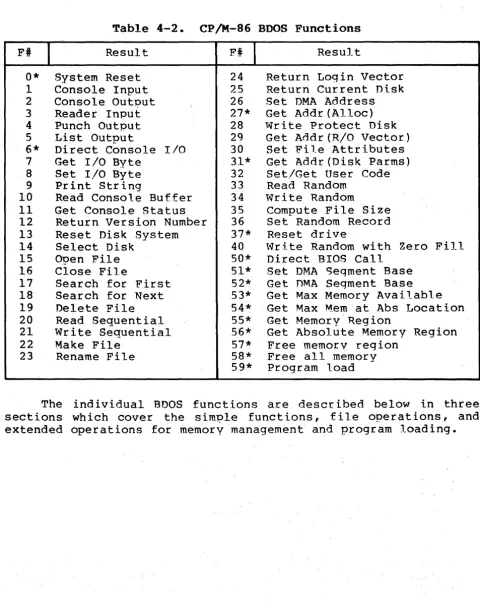
A list of CP/M-86 calls is given in Table 4-2 with an asterisK following functions which differ from or are added to the set of CP/M-80 Version 2 functions.
Table 4-2. CP/M-86 BnOS Functions
Fi
I
Result F#1
Result0* System Reset 24 Return Login Vector 1 Console Input 25 Return Current Disk 2 Console Out1?ut 26 Set DMA Address 3 Reader Input 27* Get Addr(Alloc) 4 Punch Output 28 write Protect Disk 5 List Output 29 Get Addr (R/O Vector) 6* Direct Console 110 30 Set File Attributes 7 Get I/O Byte 31* Get Addr(Disk parms) 8 Set I/O Byte 32 Set/Get User Code 9 Print String 33 Read Random
10 Read Console Buffer 34 Write Random
11 Get Console Status 35 Compute File Size 12 Return Version Number 36 Set Random Record 13 Reset Disk System 37* Reset drive
14 Select Disk 40 Nri.te Random with Zero Fill 15 Open File 50* Direct BIOS Call
16 Close File 51* Set DMA Segment Base 17 Search for First 52* Get nM.A Segment Base 18 Search for Next 53* Get Max Memory Available 19 Delete File 54* Get Max M.em at Abs Location 20 Read Sequential 55* Get Memory Region
21 Write Sequential 56* Get Absolute Memory Region 22 Make File 57* Free memory region
23 Rename File 58* Free all memory 59* Program load
[image:31.617.68.548.100.704.2]CP/M-86 System Guide 4.2 Simple BOOS Calls
4.2 Simple
Bnos
CallsThe first set of BOOS functions cover the range 0 through 12,
and perform simple functions such as system reset and single character I/O.
Entry
"-
,
Return•
•
CL:
OOH
FUNCTION 0DL: Abort
"
SYSTEM RESETCode
The system reset function returns control to the CP/M operating system at the CCP command level. The abort code in OL has two possible values: if DL
=
OOH
then the currently active program is terminated and control is returned to the CCP. If OL is aOIH,
the program remains in memory and the memory allocation state remains unchanged.Entry Return
CL: 01H FUNCTION 1 AL: ASCII Character
CONSOLE INPUT
,
The console input function re·ads the next character from the logical console device (CONSOLE) to register AL. Graphic characters, along with carriage return, line feed, and backspace (CONTROL-H) are echoed to the console. rt'ab characters (CONTROL-I) are expanded in columns of eight characters. The BOOS does not return to the calling program until a character has been typed, thus suspending execution if a character is not ready.
Entry Return
"'
CL: 02H FUNCTION 2
DL: ASCII '" CONSOLE OUTPUT Character
The ASCII character from DL is sent to the logical console. Tab characters expand in columns of eight characters. In addition, a check is made for start/stop scroll (CONTROL-S).
Entry
,~---~~ Return
•
CL: 03H FUNCTION 3 AL: ASCII Character READER INPUT
,'---~
The Reader Input function reads the next character from the logical reader (READER) into register ~L. Control does not return until the character has been read.
Entry Return
•
"
,
~CT.J: 04H FUNCTION 4
DL: ASCII
,
PUNCH OUTPUT CharacterThe Punch Output function sends the character from register DL to the logical punch device (PUNCH).
Entry
CL: OSH
DL: ASCII
Character
"
Return
FUNCTION S
LIST OUTPUT
CP/M-86 System Guide 4.2 Simple BDOS Calls
Entry Return
CL: 06H FUNCTION 6 AL: char or status
DL: OFFH (input), DIRECT CONSOLE I/O (no value) or
OFEH (status) or
char (outl;>ut)
Direct console I/O is supported under CP/M-86 for those specialized applications where unadorned console input and output is required. Use of this function should, in general, be avoided since it bypasses all of CP/M-86~s normal control character functions (e.g., CONTROL-S and CONTROL-P). Programs which perform direct I/O through the BIOS under previous releases of CP/M-80, however, should be changed to use direct I/O under the BOOS so that they can be fully supported under future releases of MP/M and CP/M.
Upon entry to function 6, register DL either contains (1) a hexadecimal FF, denoting a CONSOLE input request, or (2) a hexadecimal FE, denoting a CONSOLE status request, or (3) an ASCII character to be output to CONSOLE where CONSOLE is the logical console device. If the input value is FF, then function 6 directly calls the BIOS console input primitive. The next console input character is returned in .AL. If the input value is FE, then function 6 returns AL = 00 if no character is "ready and AL
=
FF otherwise. If the input value in DL is not FE or FF, then function 6 assumes that DL contains a valid ASCII character which is sent to the console.Entry Return
!\ "
CL: 07H FUNCTION 7 AL: I/O Byte Value
GET I/O BYTE
The Get I/O Byte function returns the current value of IOBYTE in register AL. The IOBYTE contains the current assignments for the logical devices CONSOLE, READER, PUNCH, and LIST provided the IOBYTE facility is implemented in the BIOS.
Entry
CL: OSH
DL: I/O Byte Value
,
Return
FUNCTION 8
SET I/O BYTE
The Set I/O Byte function changes the system IOBYTB value to that given in register DL. This function allows transient program access to the IOBYTE in order to modify the current assignments for the logical devices CONSOLE, READER, PUNCH, and LIST.
Entry Return
•
"
'\•
CL: 09H FUNCTION 9
DX: String
"-
PRINT STRING OffsetThe Print String function sends the character string stored in memory at the location given by DX to the logical console device (CONSOLE), until a "$" is encountered in the string. Tabs are expanded as in function 2, and checks are made for start/stop scroll and printer echo.
Entry
CL: O.1\H
DX: Buffer Offset
~~---'~
FUNCTION 10~ READ CONSOLE BUFFER
Return
Console Characters
CP/M-86 System Guide 4.2 Simple 8DOS Calls
The Read Buffer function reads a line of edited console input into a buffer addressed by reqister
ox
from the logical console device (CONSOLE). Console input is terminated when either the input buffer is filled or when a return (CONTROL-M) or a line feed (CONTROL-J) character is entered. The input buffer addressed byox
takes the form:DX: +0 +1 +2 +3 +4 +5 +6 +7 +8 +n
where "mx" is the maximum number of characters which the buffer will hold, and "nc" is the number of characters placed in the buffer. The characters entered by the operator follow the "nc" value. ~he
value "mx" must be set prior to making a function 10 call and mav range in value from 1 to 255. Settinq rnx to zero is equivalent to setting fiX to one. The value "nc" is returned to the user and may
range from 0 to mx. If nc < mx, then uninitialized positions follow the last character, denoted by"??" in the above figure. Note that a terminating return or line feed character is not placed in the buffer and not included in the count "nc".
A number of edi ting control funct lons are supported dur inq console input under function 10. These are summarized in Table 4-3.
Table 4-3. Line Editing Controls
Keystroke
I
Resul trub/del CONTROL-C CONTROL-E CONTROL-H CONTROL-J CONTROL-M CONTROI.-R CONTROL-U CONTROL-X
removes and echoes the last character reboots when at the beginning of line causes physical end of line
backspaces one character position (line feed) terminates input line (return) terminates i.nput line
retypes the current line after new line removes current line after new line backspaces to beginning of current line
Certain functions which return the carriage to the leftmost position (e.g., CONTROL-X) do so only to the column position where the prompt ended. This convention makes operator data input and line correction more legible.
'Entry
CL: 013H FUNCTION 11
GBT CONSOLE STA~U8
\.
Return
AL: Console Status
The Console Status function checks to see if a character has been typed at the loqical console device (CONSOLE). If a character is ready, the value OlH is returned in register AL. Otherwise a DOH value is returned.
Entry Return
"
CL: OCR FUNCTION 12 BX: Version Number
RETURN VERSION NUMBER
,
Function 12 provides information which allows version independent programming. A two-byte value is returned, wi th BH = 00 designating the ~P/M release (BB
=
01 for MP/M) , and BL=
00 for all releases previous to 2.0. CP/M 2.0 returns a hexadecimal 20 in register BL, with subsequent version 2 releases in the hexadecimal range 21, 22, through 2F. To provide version number compatibility, the initial release of CP/M-86 returns a 2.2.4.3
Bnos
File OperationsFunctions 12 through 52 are related to disk file operations under CP/M-86. In many of these operations,
nx
~rovides theCP/M-86 System Guide 4.3 BOOS File Operations
00 01 02
where
dr
08 09 10 11 12 13 14 15 16
drive code (0 - 16)
o
=> use default drive for file 1 => auto disk select drive A, 2 => auto disk select drive B,16=> auto disk select drive P.
fl ••• f8 contain the file name in ASCII upper case, with high bit = 0
t1,t2,t3 contain the file type in ASCII upper case, with high bit = 0
tl~, t2~, and t3~ denote the high bit of these positions,
tl~ = 1 => Read/Only file,
t2~ = 1 => SYS file, no OIR list
31 32 33 34 35
ex contains the current extent number, normally set to 00 by the user, but in range 0 - 31 during file I/O
sl reserved for internal system use
s2 reserved for internal system use, set. to zero on call to OPEN, MAKE, SEARCH
rc record count for extent "ex," takes on values from 0 - 128
dO •.• dn filled-in by CP/M, reserved for system use
cr current record to read or write in a sequential file operation, normally set to zero by user
rO,r1,r2 optional random record number in the range 0-65535, with overflow to r2, rO,rl constitute a l6-bit value with low byte rO, and high byte rl
For users of earlier versions of CP/M, i t should be noted in passing that both CP/M Version 2 and CP/M-86 perform directory operations in a reserved area of memory that does not affect write buffer content, except in the case of Search and Search Next where the directory record is copied to the current OMA address.
There are three error situations that the aDOS may encounter during file processing, initiated as a result of a BOOS File I/O function call. When one of these conditions is detected, the BOOS issues the following message to the console:
BOOS ERR ON x: error
where x is the dr i ve name of the dr i ve selected when the error condition is detected, and "error" is one of the three messages:
BAD SECTOR SELECT R/O
These er ror si tuatlons are trapped by the BOOS, and thus the executing transient program is temporarily halted when the error is detected. No indication of the error situation is returned to the
transient program.
The "BAD SECTOR" error is issued as the result of an error condi tion returned to the BOOS from the BIOS module. The BOOS makes BIOS sector read and write commands as part of the execution of BOOS file related system calls. If the BIOS read or wri te routine detects a hardware error, it returns an error code to the BDOS resulting in this error message. The operator may respond to this error in two ways: a CONTROL-C terminates the executing program, while a RETURN instructs CP/M-86 to ignore the error and allow the program to continue execution.
The "SELECT" error is also issued as the result of an error condi tion returned to the BOOS from the BIOS module. The BDOS makes a BIOS disk select call prior to issuing any BIOS read or write to a particular drive. If the selected drive is not supported in the BIOS module, it returns an error code to the BOOS resulting in this error message. CP/M-86 terminates the currently running program and returns to the command level of the CCP following any input from the console.
CP/M-86 System Guide 4.3 BDOS File Operations
Entry Return
CL: OOH FUNCTION 13
RESET DISK SYSTEM
,'---The Reset Disk Function is used to programmatically restore the file system to a reset state where all disks are set to read/write (see functions 28 and 29), only disk drive A is selected. ~his
function can be used, for example, by an application program which requires disk changes during operation. Function 37 (Reset Drive) can also be used for this purpose.
Entry Return
CL: OEH FUNCTION 14
DL: Selected,
Disk '---~ SELECT DISK
The Select Disk function designates the disk drive named in register DL as the default disk for subsequent file operations, with DL
=
0 for drive A, 1 for drive B, and so-forth through 15 corresponding to drive P in a full sixteen drive system. In addition, the designated drive is logged-in if it is currently in the reset state. Logging-in a drive places it in "on-line" status which activates the drive~s directory until the next cold start, warm start, disk system reset, or drive reset operation. FCB~swhich specify drive code zero (dr
=
OOH) automatically reference the currently selected default drive. Drive code values between 1 and 16, .however, ignore the selected default drive and directly reference drives A through P.Entry
CL: OFH
DX: FCB Offset
Return
FUNCTION 15 AL: F.eturn Code
OPEN FILE
,'---The Open File operation is used to activate a FCB specifying a file which currently exists in the disk directory for the currently active user number. The BDOS scans the disk directory of the drive specified by byte 0 of the FCB referenced by DX for a match in positions 1 through 12 of the referenced FCB, where an ASCII question mark (3FH) matches any directory character in any of these positions. Normally, no question marks are included and, further, byte "ex" of the FCB is set to zero before making the open call.
If a directory element is matched, the relevant directory information is copied into bytes dO through dn of the FCB, thus allowing access to the files through subsequent read and wr i te operations. Note that an existing file must not be accessed until a .successful open operation is completed. Further, an FCB not
activated by either an open or make function must not be used in BOOS read or wr i te commands. Upon return, the open funct ion returns a "directory code" with the value 0 through 3 if the open was successful, or OFFH (255 decimal) if the file cannot be found. If question marks occur in the FCB then the first match ing FCB is activated. Note that the current record ("cr") must be zeroed by the program if the file is to be accessed sequentially from the first record.
Entry Return
•
1\"
•
CL: 10H FUNCTION 16 AL: Return Code
DX: FCB
\ CLOSE FILE
Offset
The Close File function performs the inverse of the open file function. Given that the FCB addressed by DX has been previously activated through an open or make function (see functions 15 and 22), the close function permanently records the new FCB in the referenced disk directory. The FCB matching process for the close is identical to the open function. The directory code returned for a successful close operation is 0, 1, 2, or 3, while a OFFH (255 decimal) is returned if the fi Ie name cannot be found in the directory. A file need not be closed if only read operations have taken place. If write operations have occurred, however, the close operation is necessary to permanently record the new directory
CP/M-86 System Guide 4.3 aDOS File Operations
Entry Return
~
,
~ ~CL: llH FUNCTION 17 AL: Directory Code
DX: FCB SEARCH FOR FIRST Offset
"
Search First scans the directory for a match with the file given by the FCB addressed by DX. The value 255 (hexadecimal FF) is returned if the file is not found, otherwise 0, 1, 2, or 3 is returned indicating the file is present. In the case that the file is found, the buffer at the current DMA address is filled with the record containing the directory entry, and its relative starting position is AL
*
32 (i .e., rotate the AL register left 5 bits). Although not normally required for application programs, the directory information can be extracted from the buffer at this posi tion":An ASCII question mark (63 decimal, 3F hexadecimal) in any position from "fl" through "ex" matches the corresponding field of any directory entry on the default or auto-selected disk drive. If the "dr" field contains an ASCII question mark, then the auto disk select function is disabled, the default disk is searched, with the search function retu.t'ning any matched entry, allocated or free, belonging to any user number. This latter function is not normally used by application programs, but does allow complete flexibili ty to scan all current directory values. If the "dr" field is not a question mark, the "s2" byte is automatically zeroed.
Entry Return
~ I\.
"'
•
CL: l2H FUNCTION 18 AL: Directory Code
'-
SEARCH FOR NEXTThe Search Next function is similar to the Search First function, except that the directory scan continues from the last matched entry. Similar to function 17, function 18 returns the decimal value 255 in A when no more directory items match. In terms of execution sequence, a function 18 call must follow either a function 17 or function 18 call with no other intervening BOOS disk related function calls.
Entry Return
..
I'."
..
CL: 13H FUNCTION 19 AL: Return Code
DX: FeB
,
DELETE FILE OffsetThe Delete File function removes files which match the FCB addressed by
ox.
The filename and type may contain ambiguous references (i.e., question marks in various positions), but the drive select code cannot be ambiguous, as in the Search and Search Next functions. Function 19 returns a OFFH (decimal 255) if the referenced file or files cannot be found, otherwise a value of zero is returned.Entry Return
•
,
"'
..
CL: l4H FUNCTION 20 AL: Return Code
DX: FCB
,
READ SEQUENTIAL OffsetGiven that the FCB addressed by