ISSN: 1992-8645 www.jatit.org E-ISSN: 1817-3195
THE FACTORS OF INFLUENCING ACCEPTANCE OF
SOFTWARE AS A SERVICE MODEL, TOWARD SALES
FORCE AUTOMATION SYSTEM, ON PHARMACEUTICAL
COMPANY IN INDONESIA
1
A. SUHENDRA, 2A.B. MUTIARA, 3H.N. LAILY
1Assoc.Prof, Department of Informatics Engineering, Gunadarma University, Indonesia 2 Prof., Faculty of Computer Science and Information Technology, Gunadarma University, Indonesia
3
Alumni, Graduate Program in Information System, Gunadarma University, Indonesia E-mail: 1,2{adang,[email protected]}, [email protected]
ABSTRACT
One of the business models of Cloud Computing that provides internet-based applications, the so-called Software as a Service (SaaS), allows users to get an easy way because the infrastructure has already been provided by the application vendor. The many uses of SaaS model among others is on Sales Force Automation (SFA) application, which is widely used by companies to monitor the performance of the mobile team serving in the field in order to increase sales/service, and another one which is the focus of this thesis is the one used in pharmaceutical companies. However, the acceptance of SFA system with SaaS model on pharmaceutical companies in Indonesia is not too encouraging. Therefore, this study investigated factors that influence the SFA system with SaaS model on pharmaceutical companies in Indonesia, using the Technology Acceptance Model (TAM). The variables studied were Perception of Usefulness, Perception of Ease to Use, Perception of Risk, Perception of Price, Visibility, and Social Influence against the Attitude towards Using SFA System with SaaS Model. The study took samples from the decision makers of pharmaceutical companies in the Greater Jakarta and Bandung, with the number of valid questionnaires of 50 respondents. The results obtained with multiple regression is that the significant factors influencing the acceptance of SFA system with SaaS model is the Perception of Price factor and the Social Influence factor, with each test value for p-value Significant coefficients of 0001 and 0 (p-value <0.05). The test results also suggested that other factors studied do not significantly influence the attitude towards the use of the SFA system with SaaS model.
Keywords: Cloud Computing, SFA, SAAS, Acceptance Model
1. INTRODUCTION
SFA (Sales Force Automation) is one of the softwares that is widely used by pharmaceutical companies, in order to improve team performance by monitoring the course of the business field, especially in the process of marketing, sales, delivery, thus it may help to increase the sales and service of products to customers. Since the management has an up-to-minute information need, it is necessary to have a supporting technology, in this case using the Cloud Computing technology, which combines the use of computer technology with internet-based development. The concept of cloud computing services that support
internet-based software service is known as Software as a Service (SaaS).
In its development, SaaS business model has been used by various companies in different parts of the world in implementing their software. Even in 2006, information technology research institute in America, Gartner, Inc. provides predictions that by 2011, 25% of new business software will use the SaaS business model; as well as the big software developer company, Microsoft, which invested to build a SaaS system; even IBM predicts that all software will be delivered in the form of SaaS in the next 20 years. (Orth, 2010).
ISSN: 1992-8645 www.jatit.org E-ISSN: 1817-3195
widely used by companies in Indonesia in implementing their software. This is also proofed by author experience who is member of marketing and sales team for one of the SFA system products with the SaaS business model, which found many obstacles in doing sales of SFA system products with the SaaS business model to various pharmaceutical companies in Indonesia.
Among the various factors being a consideration in the use of SaaS model, which will be studied on this research are Perception of Usefulness factor,
Perception of Ease to Use factor, Perception of Risk factor, Perception of Price factor, Visibility
factor, and Social Influence factor. All these factors contribute to Attitude Towards Using SFA System with SaaS Model factor. Except Perception of Price factor, all of these factors are taken from the model used in The Technology Acceptance Model (TAM) filed by Davis (1989), based on The Theori of Reasoned Action (TRA) (Ajzen dan Fishbein, 1980) to explain the computer usage behaviour (Davis, 1989).
2. LITERATURE REVIEW
Cloud Computing is a technology that uses the Internet and a centralized remote server, to manage data and applications. This technology allows the use of the device much more efficient with centralized storage, memory, processing, and bandwidth. Thus, the users of cloud computing may use the application without doing the installation and may access the file in another place using the internet connectivity.
One of the services on cloud computing which application-based and called Software as a Service (SaaS) is a business model that uses the Internet as a service basis, requires no application installation on the user's computer, and ease of support and maintenance. Thus users are only pay for leasing fee to the application provider when using the application.
Variable investigated were Perception of
Usefulness, Perception of Ease to Use,
Perception of Risk, Perception of Price,
Visibility, and Social Influence, which all these
variables will be calculated each big role against attitude towards using SFA system with SaaS model with reference to Attitude towards Using
SFA System with SaaS Model variable.
Technology Acceptance Model (TAM) in Figure 1, built by Davis (1989) based on Reasoned Action Theory developed by Fishbein and Ajzen (1980), has been claimed as the most influenced model and
[image:2.612.316.547.167.280.2]has been used to predict the acceptance and use of various technology, where TAM has a strength in the theoretical basis and supported by empirical research that has been done before (Saga dan Zmud, 1994).
Figure 1. The Technology Acceptance Model (TAM) (Source : Davis F.D. (1989))
[image:2.612.329.509.374.595.2]Therefore, this study also adopted the TAM with some modifications to test the acceptance of using the SFA system with SaaS model on pharmaceutical company in Indonesia.
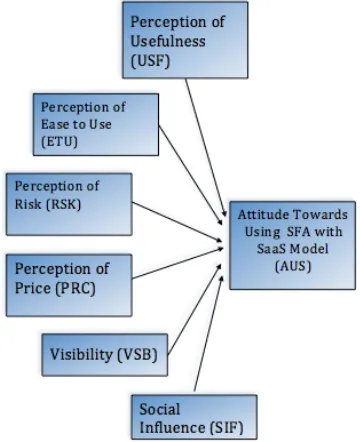
Figure 2. The Conceptual Model of SaaS Model Acceptance toward SFA System
ISSN: 1992-8645 www.jatit.org E-ISSN: 1817-3195
(ETU), which taken from TAM; Perception of Risk
(RSK) and Visibility (VSB), which taken from
Diffusion of Innovation Theory developed by Roger Clarke (1999); Perception of Price (PRC) which taken from Perception of Price Theory developed by Nagle & Holden (in Pepadri, I. 2002); and Sosial Influence (SIF) which taken from Theory of Reasoned Action developed by Ajzen and Fishbein (1980).
The purpose of TAM is to explain the deciding factor in technology acceptance generally, and TAM has the ability to explain the behavior between users of technology (SFA system with SaaS model) with the population of technology users (SFA system with SaaS model) itself (Davis, 1989), which could be presented that Perception of Usefulness and Perception of Ease to Use are the important factors that can determine the actual use of SaaS technology innovation. Based on this, a hypothesis that can be drawn:
H1 : The existence of significant effect between Perception of Usefulness against Attitude towards Using SFA System with SaaS Model.
H2 : The existence of significant effect between
Perception of Ease to use against Attitude towards Using SFA System with SaaS Model.
TAM also reviewed the additional factor that was developed by Roger Clarke (1999) in Diffusion of Innovation Theory which known to have an influence on an attitude that leads to the use of SFA systems with SaaS model. That factor is Perception of Risk factor which is a common obstacles encountered in adopting the technology of SFA systems with SaaS model. Furthermore, the hypotheses that can be retrieved is:
H3 : The existence of significant effect between
Perception of Risk against Attitude towards Using SFA System with SaaS Model.
Similarly, price is one of important factors for consumers in making a decision to conduct the transaction or not (Engel, Blackwell & Miniard and Kotler, 2006). Other theories explain the perception of price is given by Nagle & Holden (2002), that in fact the consumer in assessing the price of a product not only from nominal value in absolute terms, but also through their perceptions of price (Nagle & Holden, 2002). Likewise, for potential users when it will decide to use the SFA system with SaaS model, then the Perception of Price factor is preferred. Thus, the hypothesis can be drawn are:
H4 : The existence of significant effect between
Perception of Price against Attitude towards Using SFA System with SaaS Model.
Theory of Innovation Diffusion (Roger Clarke, 1999) is also a reference for Visibility factor. This is also strengthened by the definition of visibility by Drèze and Zufryden (2004) that is the presence of a range of brand or product in the customer environment. On the theory and understanding, the hypothesis can be drawn as follows:
H5 : The existence of significant effects between
Visibility against Attitude towards Using SFA System with SaaS Model.
According to Theory of Reasoned Action (Ajzen and Fisbein, 1980), intensity of a person's behavior is also influenced by social norms about a behavior. The social norms that lead to a social pressure to use performance person's behavior, which has an influence on a norm that is believed or trusted, and motivation to comply (Ajzen, 1991). In this study also examined the influence of social norms namely Social Influence factor, which provides an effect to use the SFA system with SaaS model. The next hypothesis is:
H6 : The existence of significant effects between
Social Influence against Attitude towards Using SFA System with SaaS Model.
3. RESEARCH METHOD
Data collection methods conducted in this research are surveys and literature study. Sampling method used in the survey is nonprobability sampling method by category purposive sampling. The survey was conducted in pharmaceutical companies in Indonesia, medium to large scale, both running as the Government Company (BUMN), National Company (PMDN), as well as Foreign Company (PMA), who had never used SFA system with SaaS model. The survey aimed for decision-makers within the company, namely Marketing Manager, Sales Manager, Delivery Manager, IT Manager, and Director.
ISSN: 1992-8645 www.jatit.org E-ISSN: 1817-3195
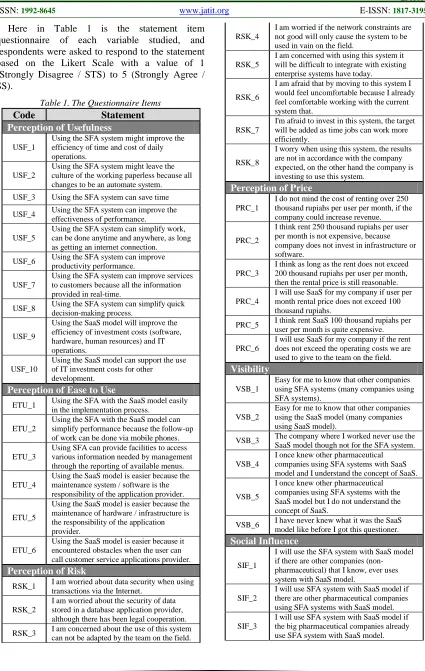
[image:4.612.94.519.71.742.2]Here in Table 1 is the statement item questionnaire of each variable studied, and respondents were asked to respond to the statement based on the Likert Scale with a value of 1 (Strongly Disagree / STS) to 5 (Strongly Agree / SS).
Table 1. The Questionnaire Items
Code Statement
Perception of Usefulness
USF_1
Using the SFA system might improve the efficiency of time and cost of daily operations.
USF_2
Using the SFA system might leave the culture of the working paperless because all changes to be an automate system. USF_3 Using the SFA system can save time
USF_4 Using the SFA system can improve the effectiveness of performance.
USF_5
Using the SFA system can simplify work, can be done anytime and anywhere, as long as getting an internet connection. USF_6 Using the SFA system can improve
productivity performance.
USF_7
Using the SFA system can improve services to customers because all the information provided in real-time.
USF_8 Using the SFA system can simplify quick decision-making process.
USF_9
Using the SaaS model will improve the efficiency of investment costs (software, hardware, human resources) and IT operations.
USF_10
Using the SaaS model can support the use of IT investment costs for other development.
Perception of Ease to Use
ETU_1 Using the SFA with the SaaS model easily in the implementation process.
ETU_2
Using the SFA with the SaaS model can simplify performance because the follow-up of work can be done via mobile phones.
ETU_3
Using SFA can provide facilities to access various information needed by management through the reporting of available menus.
ETU_4
Using the SaaS model is easier because the maintenance system / software is the responsibility of the application provider.
ETU_5
Using the SaaS model is easier because the maintenance of hardware / infrastructure is the responsibility of the application provider.
ETU_6
Using the SaaS model is easier because it encountered obstacles when the user can call customer service applications provider.
Perception of Risk
RSK_1 I am worried about data security when using transactions via the Internet.
RSK_2
I am worried about the security of data stored in a database application provider, although there has been legal cooperation. RSK_3 I am concerned about the use of this system
can not be adapted by the team on the field.
RSK_4
I am worried if the network constraints are not good will only cause the system to be used in vain on the field.
RSK_5
I am concerned with using this system it will be difficult to integrate with existing enterprise systems have today.
RSK_6
I am afraid that by moving to this system I would feel uncomfortable because I already feel comfortable working with the current system that.
RSK_7
I'm afraid to invest in this system, the target will be added as time jobs can work more efficiently.
RSK_8
I worry when using this system, the results are not in accordance with the company expected, on the other hand the company is investing to use this system.
Perception of Price
PRC_1
I do not mind the cost of renting over 250 thousand rupiahs per user per month, if the company could increase revenue.
PRC_2
I think rent 250 thousand rupiahs per user per month is not expensive, because company does not invest in infrastructure or software.
PRC_3
I think as long as the rent does not exceed 200 thousand rupiahs per user per month, then the rental price is still reasonable.
PRC_4
I will use SaaS for my company if user per month rental price does not exceed 100 thousand rupiahs.
PRC_5 I think rent SaaS 100 thousand rupiahs per user per month is quite expensive.
PRC_6
I will use SaaS for my company if the rent does not exceed the operating costs we are used to give to the team on the field.
Visibility
VSB_1
Easy for me to know that other companies using SFA systems (many companies using SFA systems).
VSB_2
Easy for me to know that other companies using the SaaS model (many companies using SaaS model).
VSB_3 The company where I worked never use the SaaS model though not for the SFA system.
VSB_4
I once knew other pharmaceutical companies using SFA systems with SaaS model and I understand the concept of SaaS.
VSB_5
I once knew other pharmaceutical companies using SFA systems with the SaaS model but I do not understand the concept of SaaS.
VSB_6 I have never knew what it was the SaaS model like before I got this questioner.
Social Influence
SIF_1
I will use the SFA system with SaaS model if there are other companies (non-pharmaceutical) that I know, ever uses system with SaaS model.
SIF_2
I will use SFA system with SaaS model if there are other pharmaceutical companies using SFA systems with SaaS model.
SIF_3
ISSN: 1992-8645 www.jatit.org E-ISSN: 1817-3195
SIF_4
I will use SFA system with SaaS model if my company have ever been using SaaS model for other systems.
Attitude Towards Using SFA with SaaS model
AUS_1
I will not use SFA with SaaS model because it is not beneficial and not beneficial to the company.
AUS_2
I probably will use SFA with SaaS model because it might be useful and might be profitable for the company.
AUS_3
I will use SFA with SaaS model because it will be useful and will be profitable for the company.
AUS_4
I will definitely use SFA with SaaS model because it is definitely helpful and definitely beneficial to the company.
[image:5.612.92.520.71.252.2]The instrument (questionnaire) is said to be able to measure what is valid if desired and can reveal the studied variable data appropriately, using the validity test which is done by correlating the score / value of each item with total score / value. Table 2 shows the results of testing of research data validity, and shows that all variables said that KMO MSA value is above 0.5 and significant value is below 0.05, which means that all variables used in this study are declared valid.
Table 2. Result of Validity Test
Variable Item
Quantity
Group Value
KMO-MSA Sig
Perception of
Usefulness 10 0.699 0.000
Perception of
Ease to Use 6 0.880 0.000
Perception of
Risk 8 0.783 0.000
Perception of
Price 6 0.692 0.000
Visibility 6 0.540 0.000
Social Influence 4 0.743 0.000
Attitude Towards Using SFA with SaaS Model
4 0.617 0.000
Reliability Test is an index showing the extent to which an instrument/gauges can be trusted or reliable (Singarimbun, 1989). Reliability testing is carried out to determine the internal consistency of data research by looking at cronbach alpha
coefficient, which the research instrument that has a cronbach alpha value greater than or equal to 0.6, then the statement in the instrument has adequate reliability or considered reliable (Hair, 2010). Table 3 shows the results of reliability test and all variables have cronbach alpha value above 0.6, which means that all the variables used in this study are considered reliable.
Table 3. Result of Reliability Test
Variable Item
Quantity
Cronbach Alpha
Perception of Usefulness 10 0.881 Perception of Ease to Use 6 0.945
Perception of Risk 8 0.906
Perception of Price 6 0.723
Visibility 6 0.689
Social Influence 4 0.818
Attitude Towards Using
SFA with SaaS Model 4 0.910
Data analysis method used by author is multivariate analysis with dependent model, which is having one dependent variable, and more than one independent variable, where the dependent variable is Attitude towards Using SFA with SaaS Model, and independent variabels are Perception of Usefulness, Perception of Ease to Use, Perception of Risk, Perception of Price, Visibility, and Social Influence. Calculation technique used is multiple regression technique and calculated with the help of SPSS software, version 16.0.
4. RESULTS AND DISCUSSION
Hypothesis testing is carried out to find out the positive influence of each independent variable on the dependent variable. The null hypothesis (Ho) and alternative hypothesis (Ha) are prepared as follows:
Hypothesis #N
HoN : The absence of significant effect between
the independent variable X1 on the dependent variable Y;
HaN : The existence of significant effect between
the independent variable X1 on the dependent variable Y; with N=1 dan X1 = Perception of Usefulness variable, and so on. Hypothesis test is carried out using multiple regression testing, ANOVA, and coefficients.
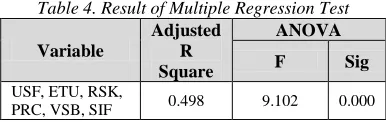
[image:5.612.96.293.393.568.2]As shown in Table 4 are Multiple Regression Test Results among the variables studied.
Table 4. Result of Multiple Regression Test
Variable
Adjusted R Square
ANOVA
F Sig
USF, ETU, RSK,
PRC, VSB, SIF 0.498 9.102 0.000
[image:5.612.321.514.591.652.2]ISSN: 1992-8645 www.jatit.org E-ISSN: 1817-3195
that the conceptual model in Figure 3 can be accepted.
Similarly to the results of ANOVA testing where the significant value is 0, which means the probability value is below the significant statistical reference value that is 0.05. Thus means that all independent variables together could influence the dependent variable.
[image:6.612.310.526.72.492.2]Results of Coefficients Testing in Table 5 can be seen that the results are diversed. Provided that the hypothesis is accepted if the significant value is below 0.05.
Table 5. Result of Coefficients Test
n = 50 Coefficients
Variable Unstandardized
Coefficients (ß) t Sig
USF -> AUS 0.088 0.668 0.508
ETU --> AUS 0.224 1.305 0.199
RSK --> AUS 0.251 1.734 0.090
PRC --> AUS 0.391 3.455 0.001
VSB --> AUS 0.242 1.340 0.187
SIF --> AUS 0.447 4.080 0.000
Thus the results of hypothesis testing, acceptable Ha is only on Perception of Price variabel and Social Influence variabel, which means that both factors are influencing significantly against Attitude towards Using SFA system with SaaS Model factor. While the results of hypothesis testing at the four other independent variables are not proven to fail rejected Ho, or can be said that others independent factors that are Perception of Usefulness, Perception of Ease to Use, Perception of Risk, and Visibility, are not influencing significantly against Attitude towards Using SFA system with SaaS Model.
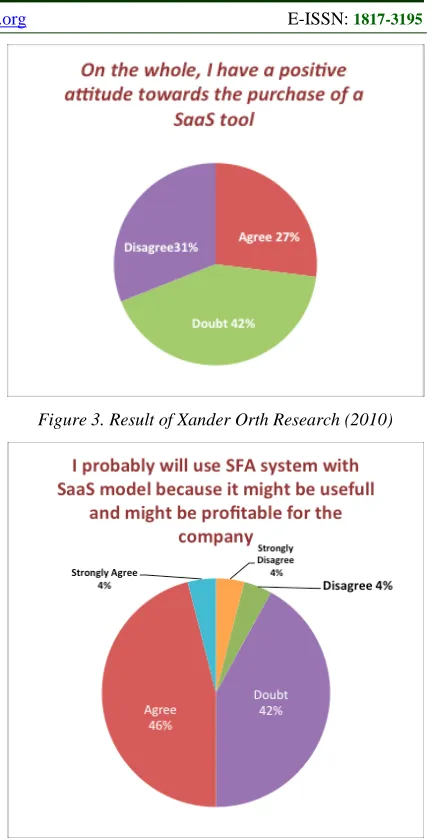
In a previous research by Xander Orth in cooperation with TopDesk consultancy agency established in Benelux - Europe, a survey of persons responsible for the use of IT in small and medium-scale firms (Small-Medium Business) in the Netherlands was conducted, to find out about decisions to buy the software (not specific to the SFA system) with SaaS model. However, the study did not specifically describe how much influence each of the factors that plays a role in the decision to buy software with SaaS model, but it aimed to find out how much the desire to buy a software product with SaaS model.
Figure 3. Result of Xander Orth Research (2010)
Figure 4. Result of Study Research (Source : Orth, 2010)
Comparison of results of Orth’s research to this research can be seen in Figure 3. Result of Xander Orth research and Figure 4. results of study research above.
[image:6.612.92.300.252.360.2]ISSN: 1992-8645 www.jatit.org E-ISSN: 1817-3195
Therefore, Orth study also claimed that the price factor is the biggest challenge for SaaS software provider companies to compete. Orth’s research results has the same results as this study has, where the price factor is an important factor for respondents in choosing to buy or use the software with SaaS model.
5. CONCLUSION
The test conducted on 50 respondents by using several independent variables in this research namely Perception of Usefulness, Perception of Ease to Use, Perception of Risk, Perception of Price, Visibility, and Social Influence against dependent variable Attitude towards Using SFA with SaaS Model showed diversed results. Test result on Perception of Usefulness variable, Perception of Ease to Use variable, Perception of Risk variable, and Visibility variable, showed that the four variables do not have a significant impact against Attitude towards Using SFA System with SaaS Model variable. The research result for Perception of Price variable and Social Influence variable is influencing significantly against Attitude towards Using SFA with SaaS Model variable.
Thus the purpose of this study obtained is as follows:
1. Perception of Usefulness factor does not significantly influence Attitude towards Using SFA System with SaaS Model, with significant value of Coefficients Test result of 0.508. In other words, respondents understand or realize the usefulness or benefits in using the SFA system with SaaS model.
2. Perception of Ease to Use factor does not significantly influence Attitude towards Using SFA System with SaaS Model, with significant value of Coefficients Test result of 0.199. In other words, respondents agree with ease implementation and maintenance in using the SFA system with SaaS model.
3. Perception of Risk factor does not significantly against influence Attitude towards Using SFA System with SaaS Model, with Significant value of Coefficients Test result of 0.090. In other words, respondents are not too worried about the risk of data security, user adaptation, and expectations of results in using the SFA system with SaaS model.
4. Perception of Price factor does significantly against influence Attitude towards Using SFA System with SaaS Model, with Significant value of Coefficients Test result of 0.001.
In other words, respondents object to accept if the rental price per user per month offered in using SFA systems with SaaS model is less competitive (more than one hundred thousand rupiahs – psychological number of respondents according to the results research), and tend to want the rental price to be not higher than the operational cost that they issued.
5. Visibility factor does not significantly influence Attitude towards Using SFA System with SaaS Model, with significant value of Coefficients Test result of 0.187.
In other words, respondents in using the SFA system with SaaS model are already familiar with and they understand the concept of SaaS model.
6. Social Influence factor does significantly influence Attitude towards Using SFA System with SaaS Model, with significant value of Coefficients Test result of 0.
In other words, the respondents using SFA system with SaaS model tend to see whether similar companies (especially larger companies) have been using the same business model or not. The more SFA system with SaaS model is used by large-scale company, the more the other company will increase interest in other (smaller scale) to use it. This is possible because Indonesian people tend to apply to imitate or follow the other party, in adapting something new.
The results of this study ought to be used as an input and consideration for companies that have business in providing services with SaaS model (SFA system in particular, and other software in general). In order to increase the number of customers who want to use SFA system with SaaS model, companies must be able to compete in wearing rents to prospective customers, because rents charged each month will be the burden of operational costs and they must be allocated each month by the customer.
Through competitive price of rental fee, many companies will start using SFA systems with SaaS model, so that the user portfolio of SFA system with SaaS model will be more and more. This is important considering the recommendations of the users in Indonesia have huge influence for other potential users, because the culture of Indonesian society is still considering familiarity.
ISSN: 1992-8645 www.jatit.org E-ISSN: 1817-3195
of proven product in the market and for applications provider / seller (vendor) of SFA system with SaaS model as a portfolio so that it helps to increase sales to other prospects.
REFERENCES:
[1] Ajzen, I. “The Theory of Planned Behaviour, Organizational Behaviour and Human Processes”, Vol.50. 1991, p. 179-211.
[2] Ajzen, I. and Fishbein, M., “Understanding Attitudes and Predicting Social Behaviour”, 1980, NJ. Prentice Hall.
[3] Clarke, R., “A Primer in Diffusion of Innovations”, 1999, The Free Press. New York. [4] Davis F.D., “Perceived Usefulness, Perceived
Ease of Use and User Acceptance of Information Technology”, 1989, Management Information Systems, Quarterly, 13:3, pp: 319 – 340.
[5] Drèze, X., & Zufryden, F., “The Measurement of Online Visibility and its Impact on Internet Traffic”, 2004, JOURNAL. OF INTERACTIVE MARKETING, 18 (1), 20-37
.
[6] Engel, J.F., Blackwell, R.D., & Miniard, P.W. , “Consumer Behavior”, 10th Edition, 2006, The Dryden Press International Edition.
[7] Hair, J.F., “Multivariate Data Analysis”, 7th Edition, 2010, Prentice Hall.
[8] Kotler, K.B., “Pricing: Making Profitable Decisions”, Second Edition. 1990, McGraw-Hill.
[9] Nagle, T.T. & Holden, K. R., “The Strategy and Tactics of Pricing: A Guide to Profitable Decision Making”, 2002, Prentice Hall International Inc.
[10]Pepadri, Isman. ,“Pricing is The Moment of Truth : All Marketing Comes to Focus in The Pricing Decision”, Tabloid Usahawan. No.10. Th XXXI., 2002.
[11]Orth, X. 2010. “Summary of SaaS Research”, TOPdesk Research. TOPdesk, 2010, Benelux. [12]Saga, V.L. & Zmud, R.W., “The Nature and
Determinants of It Acceptance, Routinization and Infusion”, IFIP Transaction: Computer Science and Technology. Vol.45, 1994, p.67-86.