©by Oldenbourg Wissenschaftsverlag, München
Oxidation–reduction reactions of simple hydroxamic acids and
plutonium(IV) ions in nitric acid
By M. J. Carrott1, O. D. Fox1, G. LeGurun1, C. J. Jones1, C. Mason1, R. J. Taylor1,∗, F. P. L. Andrieux2 and C. Boxall2
1
British Technology Centre, Nexia Solutions, Sellafield, Seascale CA20 1PG, UK
2 Centre for Materials Science, University of Central Lancashire, Preston PR1 2HE, UK
(Received June 4, 2007; accepted in revised form November 15, 2007)
Formohydroxamic acid / Acetohydroxamic acid / Advanced purex / Pu(IV)reduction / Hydrolysis / Electrochemistry / Actinide separations
Summary. Simple hydroxamic acids such as formo- and aceto-hydroxamic acids have been proposed as suitable reagents for the separation of either Pu and/or Np from U in modified or single cycle Purex based solvent extraction processes designed to meet the emerging requirements of advanced fuel cycles. The stability of these hydroxamic acids is dominated by their decomposition through acid hydrolysis. Kinetic studies of the acid hydrolysis of formo- and aceto-hydroxamic acids are reported in the absence and the presence of Pu(IV) ions. The slow reduction of these plutonium(IV) hydroxamate complexes to Pu(III) aquo-ions has been char-acterised by spectrophotometry and cyclic voltammetry. The reductions of Pu(IV) in the presence of FHA and AHA are consistent with a mechanism in which free hydroxamic acid in solution is hydrolysed whilst Pu(IV) ions remain fully complexed to hydroxamate ligands; then at some point close to a 1:1 Pu(IV):XHA ratio, some free Pu4+is released from the complex and reduction is initiated. Electrochemical and kinetic data suggest that the reductant is the hydroxamic acid rather than the hydroxylamine.
1. Introduction
Hydroxamic acids (XHA) are a particularly interesting class of organic ligands. They are O,O donor ligands of gen-eral structure [RCONHOR], and as such can be consid-ered as hard Lewis bases capable of interacting strongly with a range of metal ions [e.g. see 1–5]. As well as their complexing properties, hydroxamic acids are hydroxyl-amine derivatives and are easily oxidized by metal ions such as Np(VI) [6, 7]. Consequently, applications of sim-ple hydrophilic hydroxamic ligands (R=H or CH3) for the stripping of actinides in much simplified Purex solvent ex-traction flowsheets for advanced fuel cycles have been re-ported [8–11].
This paper describes aspects of the redox chemistry of formo- and aceto-hydroxamic acids (FHA, AHA) in the
*Author for correspondence
(E-mail: [email protected]).
presence of Pu(IV) ions. The influences of these hydroxamic acids on the solvent extraction chemistry of Pu(IV) ions are to be reported in a companion paper [12].
2. Experimental methods
2.1 Chemicals
A Pu(III) stock solution was generated electrochemically from the stable Pu(IV) stock solution in nitric acid and the purities of Pu stock solutions were checked spectropho-tometrically before use (Pu stock solutions used Magnox-derived plutonium nitrate solutions). Uranyl nitrate solution was prepared from the crystals and hydroxylamine nitrate by the addition of stoichiometric amounts of AgNO3to hy-droxylamine chloride. Fe(III) was prepared from crystals of Fe(NO3)·9H2O (Sigma-Aldrich). Analytical grade reagents were used where available. FHA (custom synthesis, Tocris Cookson) and AHA (Sigma-Aldrich) solutions were pre-pared from the solids, the purity of synthesised FHA was verified from1H-NMR in combination with analytical data. FHA and AHA crystals were stored in a refrigerator to min-imise decomposition and all solutions were made up in dis-tilled or deionised water when required.
2.2 XHA hydrolysis
2.3 Plutonium(IV) – XHA reduction experiments
Standard well established methods in plutonium chemistry and chemical kinetics were used throughout this part of our studies. Stock solutions were mixed in an optical cu-vette and equilibrated at the desired temperature. (N.b. a last set of 5 experiments were performed at a later date using a Zeiss UV/Vis spectrometer coupled via fibre optics to a dipping optrode for direct measurement of a reaction so-lution of 25 mL volume in a glovebox). The reducing agent (hydroxylamine nitrate (HAN), XHA) was added last, the solutions mixed and the absorption spectra recorded over time. A water jacket connected to a thermostatically con-trolled water bath was used to maintain specific reaction temperatures in the cuvette. The reduction reaction was fol-lowed over time using the growth of the Pu(III) absorption band at∼905 nm [17], because the intense Pu(IV)-XHA ab-sorption peaks [18, 19] vary slightly depending on the actual speciation. The procedures were checked initially by valida-tion against the well known Pu(IV)-HAN reacvalida-tion [20].
Certain difficulties encountered in these studies should be noted. In particular, obtaining reproducible and self-consistent sets of experimental data did not prove to be straightforward. Particularly, in some early experiments re-duction appeared to occur rather rapidly with FHA, often with no induction period. This was ascribed to two poten-tial problems in the procedures, (a) the use of ‘aged’ XHA crystals which may have deteriorated during storage and (b) the use of heating to accelerate dissolution of XHA in concentrated stock solutions. These early experiments were therefore disregarded and (a) new batches of FHA and AHA were obtained and (b) less concentrated stock solutions were prepared under mild ambient conditions only. Interestingly, these failed experiments, however, do indicate the sensitiv-ity of the system to XHA decomposition (hydrolysis), which will be discussed in detail in Sects. 3.1 and 3.2.
Ultimately, 78 useful kinetic experiments were per-formed; these can be described in categories according to the experimental parameters under investigation:
1. AHA experiments at ambient temperatures (∼20 or 25◦C) with (i) variable AHA and (ii) variable HNO3
con-centrations.
2. AHA experiments at elevated temperatures (40◦C) with (i) variable HNO3, (ii) increasing ionic strength (added
NaNO3), (iii) added U(VI) ions and (iv) varying initial
[Pu].
3. AHA experiments in 1 M HNO3at varying temperatures
(30–70◦C).
4. AHA experiments with variable initial concentrations of Pu(III) (40◦C).
5. FHA experiments at 20◦C with (i) variable HNO3, (ii)
in-creasing ionic strength (added NaNO3), (iii) added U(VI)
ions, (iv) varying initial [Pu], (v) varying FHA.
6. FHA experiments at an elevated temperature (50◦C) and constant [HNO3] with varying FHA.
7. FHA experiments in 1 M HNO3at varying temperatures
(5–65◦C).
8. FHA experiments with HAN initially present in the react-ing solution (40◦C).
9. A series of 4 FHA experiments in which the FHA con-centration was followed using the colorimetric sampling
method described previously rather than the Pu(III) ab-sorbance (experimental conditions as in Fig. 5).
2.4 Electrochemistry
Three stock solutions were prepared containing 5 M HNO3,
0.1 M AHA and 0.01 M Pu(IV), respectively. These were then used to prepare 25 mL aliquots of solutions contain-ing Pu(IV) for the electrochemical studies. Each of these solutions contained 0.001 M Pu(IV) but had varying acid-ity and AHA:Pu ratios between 1:2–20:1 ([AHA] = 0.0005–0.02 M;[HNO3] =0.1–3.5 M). A Pu only sample
at 0.1 M HNO3was also prepared.
Compared to the ca. 1 g/L concentrations more typical of Purex process solutions, 0.001 M Pu(IV) (0.24 g/L) so-lutions were used for the electrochemical measurements to give lower current densities. The electrochemistry of the so-lutions was investigated by cyclic voltammetry (CV) using an EG&G Princeton Applied Research (PAR) Potentiostat/ Galvanostat model 263A and a PAR three electrode cell in-corporating an Ag/AgCl reference electrode (SSCE) and a Pt auxilliary electrode. Vitreous carbon and Pt disc work-ing electrodes were used for the measurements although the carbon electrode generally showed less well defined waves than the Pt electrode. However, on carbon the accessible po-tential range extended to −0.8 V vs. SSCE whereas on Pt reductive solvent breakdown occurred at −0.2 V vs. SSCE. The electrochemical cell was fitted with an argon supply to allow solutions to be purged with Ar and maintained under an Ar atmosphere while measurements were made. Aliquots of K3[Fe(CN)6]solution were added at the end of the
meas-urements to provide an internal reference, noting that the po-tential of the[Fe(CN)6]3−/4−couple is dependent on the
na-ture of the supporting electrolyte, including its ionic strength and pH [21].
The waves in the cyclic voltammograms were described by:
i) the peak anodic and cathodic currents measured by the potentiostat with respect to the horizontal potential/
x-axis, ipaand ipcrespectively,
ii) the peak anodic and cathodic currents within the cyclic voltammogram i.e. the height of the peaks above their prevailing background currents, ida and idc respectively;
and
iii) the corresponding peak potentials Epa and Epc
respec-tively.
No compensation for internal cell resistance, R, was ap-plied during the measurement but plots of (Epa−Epc),∆Ep,
against (ipa−ipc),∆ip, or plots of Epaagainst ipawere used to
estimate R so that a correction for i R drop could be applied where necessary. Although the values of the peak potentials can be significantly affected by uncompensated cell resis-tance, the formal electrode potential, Ef given by (Epa+ Epc)/2 for reversible/Nernstian systems, is usually much
less sensitive. In the examples studied here uncompensated cell resistance might typically result in an overestimate of Ef
Elmer Lambda 900 spectrophotometer connected via fibre optics to the glovebox.
3. Results and discussion
3.1 XHA hydrolysis
Hydroxamic acid hydrolysis produces hydroxylamine and the parent carboxylic acid. It is an acid catalysed reaction and in acid solutions the hydroxylamine formed becomes protonated (Eq. (1)) [22]. This instability is a key feature of XHA chemistry that must be accounted for in any process flowsheet design [9]. Conversely, it is actually beneficial in the downstream decomposition of the ligand after separa-tion. It is also fundamental in understanding XHA redox and complexation chemistry.
RCONHOH+H2O+H+→RCOOH+NH3OH+ (1)
Miles and Temple [13] had previously shown that FHA hydrolysis was a 2nd order reaction overall, 1st order with respect to both FHA and HNO3. Our data confirmed this, with all experiments for both FHA and AHA conforming to Eq. (2), where a0= [FHA]0, b0= [HNO3]and x= [FHA]0−
[FHA]t[16]. Results are given in Tables 1–2 for both FHA and AHA.
1 a0−b0ln
b0(a0−x) a0(b0−x)
=kt (2)
The hydrolysis equation (Eq. (3)) was, therefore, deter-mined for both FHA and AHA where rate constants at 25.0◦C are 0.016±0.001 dm3mol−1min−1 for FHA and 0.00205 dm3mol−1min−1 for AHA and activation ener-gies were found to be 77.3±1.6 kJ mol−1
(FHA) and 79.9±2.9 kJ mol−1 (AHA) [19].1 The value for AHA is
close to that reported by Mane and Jagdale in HCl [24] (82.4 kJ mol−1). Note that this equation is only valid up to 3 M HNO3 as it is well known that at higher acidities a maximum rate is reached. For a more detailed review of the kinetics and mechanisms of the acid catalysed hydroly-sis of hydroxamic acids, the interested reader is referred to Ref. [22] and references therein.
−d[XHA]
dt =k[XHA][H
+] (3)
Little variation in the rate constants for AHA or FHA hydrolysis was found on introducing either nitrate (as NaNO3) or uranyl nitrate in to the solution (Table 2), al-though the nitrate data for FHA showed a weak depen-dency (∝[NO3−]∼0.2). This appears to be consistent with previous studies that showed a positive ionic strength ef-fect. See, for instance, the data of Mane and Jagdale [23, 24] where AHA and hexanohydroxamic acid hydrolysis rates at constant acidity show a chloride dependency of
1More accurately, the order with respect to acidity in the AHA
case was actually 0.9. This is consistent with apparent orders with respect to [H+] calculated from the data of Mane and Jagdale between 0–3.0 M acid concentrations for: hexanohydrox-amic acid [23] in HCl and H2SO4, isobutyrohydroxamic acid in
HCl and H2SO4[14] and aceto-, isobutyl- and hexyl- hydroxamic
[image:3.595.307.552.71.363.2]acids in H2SO4[24].
Table 1. Kinetic analyses of free AHA and FHA hydrolysis rates
([XHA] =0.05 M).
Acidity (M) Temperature (◦C) Rate constant (min−1)
AHA 0.5 50 0.0157
AHA 1 50 0.0245
AHA 1.5 50 0.0334
AHA 2 50 0.06
AHA 2 50 0.0516
AHA 3 50 0.0391
AHA 3 50 0.0721
AHA 3 50 0.0735
AHA 1 58 0.04807
AHA 1 56.2 0.03689
AHA 1 50.2 0.02541
AHA 1 46.8 0.01885
AHA 1 41.2 0.00977
AHA 1 37.6 0.00615
AHA 1 34.7 0.00435
AHA 1 31 0.00411
AHA 1 28.4 0.00243
AHA 1 25 0.00211
FHA 1 25 0.000267a
FHA 1 25.3 0.00025
FHA 1 30.4 0.00042
FHA 1 35.3 0.00075
FHA 1 40.2 0.00115
FHA 1 45 0.00186
FHA 1 49.7 0.00316
FHA 1 55.6 0.00455
FHA 1 59.6 0.00605
a: Miles and Temple [13].
ca. 0.1–0.2. Even less variation on the rate with added ni-trate ions was observed in the AHA case. For all cases between 1 and 7 M total nitrate the observed AHA hy-drolysis closely followed the calculated curves for Eq. (3) with the pseudo-1st order rate constant only increasing from 1.67×10⁻⁵
to 1.73×10⁻⁵ dm3
mol−1 s−1
across this range at 20◦C (Table 2). These findings differ from the conclu-sions drawn by Karraker [25], who observed a substantially decreased AHA half-life on introducing both NaNO3 and uranyl nitrate.
3.2 Plutonium(IV) reduction by simple hydroxamic acids
3.2.1 Experimental results
Table 2. Comparison of experimentally determined and calculated rate constants for FHA and AHA
hydrol-ysis with variable total nitrate and uranyl nitrate concentrations.
[XHA]0 X [NO3−] [U(VI)] [H+] T k(calc) k(expt)
(M) (M) (M) (M) (◦C) (dm3mol−1s−1) (dm3mol−1s−1)
0.04 F 1.6 0 0.8 40 0.00113 0.00106
0.0333 F 2 0 0.67 40.3 0.00117 0.00122
0.0286 F 2.86 0 1.14 40 0.00113 0.00117
0.0125 F 3.5 0 1 40 0.00113 0.00134
0.0333 F 1.00 0.165 0.67 24 0.00023 0.00018
0.0242 F 2.27 0.126 2.02 21.1 0.00017 0.00019
0.0395 F 1.81 0.099 1.61 21.1 0.00017 0.00018
0.00512 A 1.00 0 1.00 20 1.84×10⁻⁵ 1.67×10⁻⁵
0.00487 A 1.99 0 1.00 20 1.84×10⁻⁵ 1.66×10⁻⁵
0.00490 A 3.00 0 1.00 20 1.84×10⁻⁵ 1.67×10⁻⁵
0.00487 A 4.00 0 1.00 20 1.84×10⁻⁵ 1.68×10⁻⁵
0.00485 A 5.04 0 1.00 20 1.84×10⁻⁵
1.72×10⁻⁵
0.00502 A 6.00 0 1.00 20 1.84×10⁻⁵ 1.70×10⁻⁵
0.00485 A 6.99 0 1.00 20 1.84×10⁻⁵ 1.73×10⁻⁵
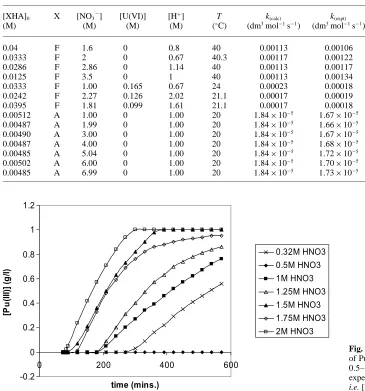
Fig. 1. Growth of Pu(III) from the reduction
of Pu(IV) (1 g/L; T=20◦C) by 1 M FHA in 0.5–2 M HNO3. Also shown is an additional
experiment at 0.32 M HNO3with 0.3 M FHA,
i.e.[FHA] ≤ [HNO3].
increasingly important, causing deviations from simple be-haviours expected on a concentration basis.
The reduction is characterised by a variable induction period followed by an apparent near zero-order growth in Pu(III) concentration, measured from the Pu(III) absorption peak at∼908 nm (example data for FHA at varying nitric acid concentrations is shown in Fig. 1). The length of this induction period is reduced with increases in acidity or tem-perature and decreases in FHA concentration. The addition of uranyl or nitrate (NaNO3) ions had little discernible effect on the induction periods in the FHA system but induction periods did appear to decrease in the AHA system. Inter-estingly, in the experiment (coded “P3X41”) where initially the concentration of FHA exceeded the nitric acid concen-tration ([HNO3] =0.5 M;[Pu(IV)]0=1 g/L;[FHA] =1 M; T =20◦C; filled diamond data points in Fig. 1), no reaction was observed over the duration of monitoring (>570 min). This is not a simple acidity effect as in another experi-ment at 0.32 M HNO3 reduction was observed. It appears to be related to the [FHA] : [HNO3] ratio. The induction period in these reduction reactions is most certainly related to the hydrolysis of the hydroxamic acid. As the excess (free, unbound) hydroxamic acid in the bulk solution is hydrol-ysed to hydroxylamine and the carboxylic acid (via Eq. (1)),
the Pu(IV) speciation changes and, when some threshold is passed, de-complexed Pu(IV) becomes available for re-duction (Eq. (4)). This was supported by later experiments (P5X1-4), where the ratios of Pu(IV) and AHA concentra-tions were varied between 3.5:1–1:2, and which showed very low inductions periods of a few minutes only.
Pu4+
aq +nXHA fast
←−−→Pu(XHA)n4−n H +, slow
←−−−→Pu(IV)
+XHA+NH3OH++XCOOH
XHA/NH3OH+, fast
−−−−−−−−→Pu3aq+ (4)
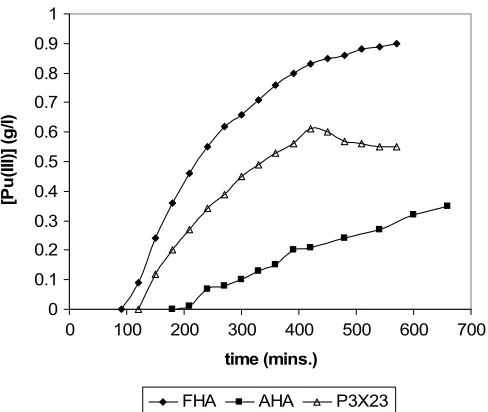
Fig. 2. Comparison of 0.1 M AHA and FHA reductions of 1 g/L Pu(IV) in 1 M HNO3(T=20◦C). Also shown is experiment P3X23
where some re-oxidation of Pu(III) is observed at long times ([Pu] = 1 g/L;[HNO3] =2 M;[AHA] =0.1 M; T=40◦C).
acid that accumulates in the solution as a product of the reac-tion. Pu(III) can only be stabilised in HNO3by interrupting this cycle of reactions using a reagent, such as hydrazine, that reacts rapidly with nitrous acid [26]. Hydroxylamine
Fig. 3. Pu(IV)-AHA reduction at low
mo-lar AHA:Pu ratios ([Pu] =1 g/L;[HNO3] =
[image:5.595.44.373.365.757.2]1 M;[AHA] =0.0042–0.001 M; T=25◦C).
Fig. 4. Temperature dependence (5–30◦C) of the Pu(IV)-FHA reaction ([Pu] =1 g/L; [FHA] = 1 M;[HNO3] =1 M).
and hydroxamic acids also ‘scavenge’ nitrous acid in this fashion so presumably visible Pu(III) re-oxidation only oc-curs at the point at which both AHA and hydroxylamine are removed from the solution and are no longer available to scavenge nitrous acid (Fig. 3). Temperature had a major ef-fect on reduction of Pu(IV) by both FHA and AHA as illus-trated in Fig. 4 which shows the FHA-Pu(IV) data between 5 and 30◦C. At higher temperatures the reaction is completed at even quicker timescales, with the induction period com-pletely disappearing around 50◦C (data not shown). This is most probably a combination of effects due to the increased rates of XHA hydrolysis and Pu(IV) reduction at higher tem-peratures and the increased generation of HNO2. Clearly, further specific experiments are needed to clarify the role that HNO2has, in particular at elevated temperatures and on the later stages of the reaction.
Fig. 5. The hydrolysis of FHA in HNO3at 20◦C.
Where: P4X19, [Pu(IV)] =0 g/L; [HNO3] =
1 M; [FHA] =0.5 M. P4X20,[Pu(IV)] =0 g/L;
[HNO3] =1 M;[FHA] =1 M. P4X21,[Pu(IV)] =
1 g/L; [HNO3] =0.5 M; [FHA] =1 M. P4X23,
[Pu(IV)] =1 g/L;[HNO3] =1 M;[FHA] =1 M.
remaining. This is presumably due to protonation of the hydroxylamine product causing a depletion of free acid-ity in the solution to the point where the FHA acid catal-ysed hydrolysis slows to negligible levels (i.e. see Eq. (1)). In the reverse situation where[HNO3] : [FHA] =2:1, the hydrolysis proceeds normally to completion (P4X19). Fi-nally, the similarity of all the FHA hydrolysis rate constants for experiments P4X19–21,23 suggests a reasonable self-consistency is attained in these experiments, although the actual mean value of 2.14×10⁻⁴dm3mol−1s−1is somewhat higher than the value calculated using the accepted kinet-ics, see Sect. 3.1 (1.51×10⁻⁴
dm3 mol−1
s−1
). These obser-vations explain the lack of Pu(IV) reduction observed in P3X41 when[XHA]>[HNO3], as the ‘switching off’ of the hydrolysis reaction means sufficient XHA always remains in solution to complex the Pu(IV) and the threshold at which de-complexed Pu(IV) becomes available for reduction is not reached.
The addition of up to 1 M hydroxylamine nitrate (HAN) solutions to the initial reaction mixture had little discernible effects (Fig. 6); this appears to agree with an observation made by Karraker [25]. It should be noted that Barney’s
Fig. 6. Effect of adding 0–1 M hydroxylamine nitrate to the
Pu(IV)-FHA reaction ([Pu] =1 g/L; [HNO3] =1 M; [FHA] =1 M; T=
20◦C).
Pu(IV)-HAN kinetics [20] could not be fitted to these runs with HAN added. So these experiments with HAN added to the Pu(IV)-AHA system appeared to suggest that not only is HAN probably not the reductant for Pu(IV) in this system but also in the presence of XHA it is actually pre-vented from reducing Pu(IV). It should be noted however that the HAN:Pu(IV)ratios probably present in this system at the end of the induction period are much higher than those studied by Barney [20].
[image:6.595.39.282.531.727.2]One other interesting observation made by Karraker [25] was that AHA added to Pu(III) causes formation of the Pu(IV)-AHA complex, but this apparent oxidising ability of AHA is difficult to rationalise. We, therefore, spectroscop-ically followed three different solutions with initial Pu(III) concentrations of 0.2, 0.5, 1.0 g/L (no Pu(IV) present) at an AHA concentration of 0.1 M ([HNO3] =1 M; T=25◦C). No reaction was observed with Pu(III) being stable for time periods of over 200 min. Similar experiments in the presence of 1 g/L Pu(IV) were difficult to analyse due to spectral in-terferences but again there was little real evidence for any oxidation of Pu(III). Fig. 3 shows Pu(III) re-oxidation can occur once the AHA and HAN are fully oxidized and no longer available in solution to scavenge HNO2.
[image:6.595.301.543.537.735.2]Fig. 8. Effect of variable FHA concentration (0.1–1.0 M) on the reduc-tion of 1 g/L Pu(IV) by FHA at 50◦C ([HNO3] =1 M).
Whilst most of the experimental runs showed a near lin-ear growth in Pu(III) which could be interpreted as apparent zero-order kinetics, some experiments at longer timescales and at low FHA concentrations showed clear deviations from this trend. Fig. 7 illustrates the experiments at variable FHA concentrations showing such changes in the Pu(III) growth curves between 0.6 and 1 M FHA. The effects of el-evated temperatures on the reduction, described previously, are further illustrated by the set of experiments with vari-able FHA concentration at 50◦C (Fig. 8). It is also seen from this figure that at low [FHA] the reduction appears to reach a steady state around 60% completion, presumably in these runs the reductant(s) quickly became exhausted either through hydrolysis and/or reaction with HNO2generated in-situ. Accordingly, it does seem clear from these data that the rate and extent of Pu(IV) reduction in the presence of XHA is not amenable to simple kinetic treatments (i.e. zero, 1stor 2ndorder kinetics).
3.2.2 Discussion
The potential complexity of this system which can in-volve hydrolysis of free and bound XHA, up to 4 Pu(IV)-AHA complexes, two reducing agents for Pu(IV) (XHA and HAN) and other ligands (XCOOH, NO3−) has been discussed previously [27]. A preliminary analysis of the reaction rates presented therein showed that ln – ln plots of the apparent zero order rate constants, determined from the kinetic runs, against [H+] at the end of the induction period and against [Pu(IV)]0 gave linear plots of gradi-ents ∼ +1.2 and ∼ +0.8 respectively, i.e. approximately unity. It was noted that the relationship between reaction rate and FHA concentration was difficult to interpret and that U(VI) and nitrate ions had little discernible effect on the reaction rates. An Arrhenius plot gave a reasonably linear relationship between ln kobs and 1/T , indicating an activa-tion energy of ∼90 kJ mol−1
and a pre-exponential factor of∼2.3×10⁹s−1. Taylor et al. [27] then calculated reac-tion half-lives and rate constants for FHA hydrolysis and compared these with experimental values for each kinetic
experiment, showing reasonable concordance between hy-drolytic and experimental values. It was proposed that this analysis, which was admittedly of a very basic and empirical nature, indicated that the reduction of Pu(IV) in the presence of a hydroxamic acid was controlled by the rate of hydrol-ysis of the free hydroxamic acid. This was based on the similarity of the activation energy and pre-exponential fac-tor, reaction half-lives and orders of reaction with respect to HNO3and initial Pu.
Qualitatively, the experimental data presented here is consistent with a situation in which Pu(IV) is strongly sta-bilised as the hydroxamate complex. Excess free hydrox-amic acid in the bulk solution is being continually depleted through acid hydrolysis. At some critical point the complex starts to dissociate, releasing a reducible form of Pu(IV) (most probably the free Pu4+ (PuNO
3
3+) ion). This is
rep-resented experimentally by the end of the induction period and the appearance of Pu(III) in solution as the ‘free’ Pu(IV) is rapidly reduced either by the hydroxylamine formed from XHA hydrolysis or the hydroxamic acid itself. A full kinetic analysis of the AHA data has now been completed and will be reported separately [28] but it is sufficient to note here that the detailed treatment is generally consistent with the overall scheme described herein.
3.3 Pu(IV)/Pu(III) redox potential shifts due to AHA complexation
3.3.1 Cyclic voltammetry
The previous section described the reduction of Pu(IV) ions by AHA and FHA. However, the nature of the actual reduc-tant is uncertain in that whilst hydroxamic acids are reducing agents, their hydrolysis product – hydroxylamine – is also well known as a good reductant for Pu(IV), particularly at low acidities [20, 29, 30]. Stoichiometric equations for HAN and XHA reduction reactions are given in Eqs. (5)–(8), with Eqs. (5) and (7) applying when the reductant (HAN, XHA) is in excess and Eqs. (6) and (8) applying when the oxi-dant (Pu4+) is in excess (n.b. the XHA equations are derived by direct analogy with HAN and accounting for our [12] and Karraker’s [25] observations of a 2:1 stoichiometry in the Ce(IV)+AHA reduction reaction when cerium is in ex-cess). The presence of an induction period might suggest that HAN is the reductant with reduction starting once HAN reaches a significant level. However, in this case experi-ments with HAN initially present in solution should have led to an elimination of the induction period. That they did not suggests that Pu(IV) is stabilised by XHA complexation either due to a consequent shift in the redox potential for Pu(IV)/Pu(III) that then thermodynamically prohibits reac-tion with XHA and/or HAN or because reduction may be kinetically hindered due to steric effects.
2Pu4++2NH
3OH+⇔2Pu 3++2H
2O+N2+4H+ (5) 4Pu4++2NH
3OH+⇔4Pu 3++H
2O+N2O+6H+ (6) 2Pu4++2XCONHOH⇔
2Pu3++
2XCOOH+N2+2H+ (7) 4Pu4++
2XCONHOH+H2O⇔ 4Pu3++2XCOOH+N
Table 3. Efvalues for solutions of 0.001 M Pu4+in 0.1 M HNO3with varying AHA concentrations.
AHA:Pu ratio 0 0.5 1 2 3 4 6 8 10 20
EfPu4+/3+ 733 731 646 645 625 610 621 603 598 598
(mV Ag/AgCl)
EfFe3+/2+ 400 373 401 440 412
(mV Ag/AgCl)
EfPu4+/3+ 733 652 609 581 591
(mV adjusted)a
a: EfPu4+/3+adjusted to correspond with an Efof 400 mV for[Fe(CN)6]3−/4−.
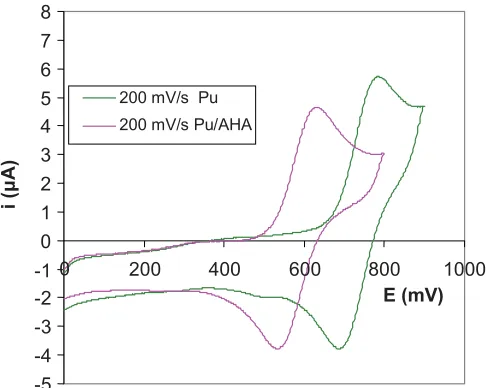
Cyclic voltammetry was used to investigate the shift in the Pu(IV)/(III) redox couple in the presence of AHA. In an initial trial experiment the cyclic voltammograms (CVs) of a solution containing 0.001 M Pu(IV) in 0.1 M HNO3were recorded using a Pt working electrode at scan rates of 50, 100 and 200 mV s−1
. Plots of measured peak currents, ipaand ipc, against the square root of the scan rate,ν1/2were linear indicating that the electron transfer was close to diffusion controlled. Peak potentials were invariant with ν indicat-ing that the reaction was electrochemically reversible under these conditions. The ratios of the peak currents ida/idcwere close to 1, again indicating that the process was chemically and electrochemically reversible at the scan rates used. After correction for internal cell resistance the value of Effor the Pu4+/3+ couple was found to be +0.733 V (vs. SSCE) or
+0.942 V (vs. NHE). This value lies between the values of
+0.885 and +0.966 V (vs. NHE) that we have calculated as the standard electrode potentials for the Pu(NO3)2
2+/Pu3+
and Pu(NO3)3+/Pu3+systems, respectively (see Fig. 12, vide infra). This suggests that the Pu(IV) is present as a mixture of Pu(NO3)3+and Pu(NO3)2
2+
species under the conditions studied.
Adding 0.1 M AHA solution (AHA:Pu=6:1) and scanning at 50, 100 and 200 mV s−1(Fig. 9) also gave linear plots of ipaand ipcagainstν1/2with a near zero intercept and current ratios (ida/idc) close to 1. Peak potentials were again invariant withν, suggesting that the system is behaving re-versibly under these conditions. After correction for internal cell resistance the value of Ef was found to be +0.581 V (vs. SSCE) corresponding to a shift on complexation by ace-tohydroxamate of 0.152 V from the value of Ef recorded for the Pu4+/3+ couple in 0.1 M HNO
3 (Fig. 10). A solu-tion of K3[Fe(CN)6]was added and the value of Effor the
[Fe(CN)6]3−/4− couple under these conditions was found to be +0.4 V (vs. SSCE).
A series of CVs with 0.001 M Pu4+ in 0.1 M HNO
3but with varying AHA:Pu ratios gave Ef (vs. SSCE) values for the PuIV/III
[image:8.595.303.544.197.385.2]couple given in Table 3. The value obtained for an AHA:Pu ratio of 6:1 is ca. 40 mV greater than that obtained in the preliminary experiment. However the Ef value for the [Fe(CN)6]3−/4− couple was also found to be ca. 40 mV greater suggesting that the difference is due to a junction potential or other changed feature of the experi-mental set up used. In some of the solutions the CV wave of the added[Fe(CN)6]3−did not give clearly defined peak potentials so that a similar adjustment could not be applied. Where the potential of the[Fe(CN)6]3−/4− couple could be determined, adjusted values for the Efof the PuIV/III couple
Fig. 9. CVs of a solution containing 0.001 M Pu4+and 0.006 M AHA
in 0.1 M HNO3.
Fig. 10. The shift in potential of the Pu4+/3+ couple on the
add-ition of AHA to Pu in a solution of 0.001 M Pu4+ in 0.1 M HNO 3
(AHA:Pu=6:1).
are also shown in Table 3. Despite the problems with the accuracy of the potential measurements, the general trend suggests that the potential of the PuIV/III
[image:8.595.302.545.426.620.2]Table 4. The variation in Ef with acidity for solutions containing
0.001 M Pu4+and 0.01 M AHA.
Acidity 0.1 0.5 1.0 1.5 2.0 2.5 3.0
Ef(mV)a 600 627 646 656 652 656 646
a: The Ef values (vs. Ag/AgCl) quoted here were not corrected for
i R drop and this is expected to result in a high bias of between 1
[image:9.595.45.290.71.111.2]and 5 mV in the values cited.
Fig. 11. Selected CVs of solutions containing 0.001 M Pu(IV) and 0.01 M AHA at varying acidities. Lines correspond to CVs at 0.1, 0.5, 1.0, 1.5 and 3 M HNO3(data at 2.0 and 2.5 M HNO3not included).
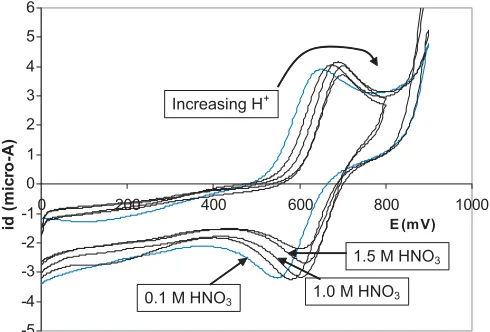
In order to assess the effect of acidity on the potential of the PuIV/III
couple in the presence of AHA a series of meas-urements was made on solutions containing 0.001 M Pu4+
and 0.01 M AHA in various concentrations of acid. Repre-sentative examples of the CVs obtained are shown in Fig. 11 and the numerical results in Table 4. Between 0.1 and 1.5 M HNO3there is a shift in the formal potential of the PuIV/III couple with increasing acidity towards the value found in the absence of AHA (i.e.+0.733 V vs. SSCE). This reflects decomplexation/speciation changes and correlates with the EAS which start to show the presence of small amounts of Pu(NO3)3+ (peak at ∼476 nm) from an acidity of 1.5 M HNO3upwards. Between 1.5 and 3 M HNO3there is no con-sistent change in potential, the values all being in the range 651±5 mV.
3.3.2 Discussion
Preliminary speciation diagram calculations indicate that, at 0.008 M total AHA, Pu(IV) exists predominantly as the 1:1 Pu:AHA complex at 1 M HNO3[28]. In the same system at 0.1 M HNO3, Pu(IV) exists as a mix of the 1:1 and 1:2 Pu:AHA complexes with the 1:1 complex being approxi-mately twice the concentration of the 1:2 complex [28]. By use of those equilibrium constants for formation of the 1:1 and 1:2 Pu(IV):AHA species in nitric acid derived from stability constant measurements in HClO4[12] and Pu(IV) nitrate complexation constants [31], it is possible through use of Eq. (9) and the standard electrode potential for the Pu4+/3+ couple [32], to calculate the standard electrode po-tentials for the Pu(AHA)3+/Pu3+ and Pu(AHA)
2 2+/Pu3+
couples:
EθPu(AHA)3+/Pu3+=EθPu4+/Pu3+−
RT
F ln K1 (9a)
EθPu(AHA)
22+/Pu3+=E θ
Pu(AHA)3+/Pu3+−
RT F ln K2
=EPuθ4+/Pu3+−
RT
F ln K1K2, (9b)
where K1and K2are the equilibrium constants for the fol-lowing systems:
AHA+Pu4+ K1
←−−→Pu(AHA)3++H+ (10a)
AHA+Pu(AHA)3+ K2
←−−→Pu(AHA)2 2++
H+. (10b)
This assumes that the complexes are labile and rapid lig-and dissociation accompanies reduction. The apparently re-versible character of the cyclic voltammograms obtained in the absence of AHA and at AHA:Pu ratios above 5:1 sug-gest that the ligand dissociation reactions are rapid on the cyclic voltammetry timescales studied here and do indeed involve highly labile species. From these calculated stan-dard potentials it is possible to estimate the formal poten-tial, Ef, of the Pu(AHA)3+/Pu3+and Pu(AHA)2
2+
/Pu3+
re-dox couples by writing the Nernst equation for each couple (incorporating the standard electrode potentials as deter-mined by Eq. (11) and setting [Pu4+], [Pu(AHA)3+] and
[Pu(AHA)2
2+] therein equal to 1 M). This gives:
EfPu(AHA)3+/Pu3+=
EθPu(AHA)3+/Pu3++
RT F ln
[H+]
[AHA]
(11a)
EfPu(AHA)2 2+/
Pu3+=
EθPu(AHA)
22+/Pu3++
RT F ln
[H+]2
[AHA]2
,
(11b)
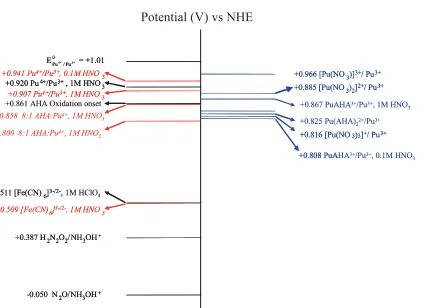
from which can be calculated values of +0.808 V and
+0.867 V (vs. NHE) for the reduction of the 1:1 complex in 0.008 M total AHA solutions at 0.1 and 1 M HNO3, re-spectively; and calculated values of+0.825 and +0.943 V (vs. NHE) for the reduction of the 2:1 complex in 0.008 M total AHA solutions at 0.1 and 1 M HNO3, respectively.
The measured and calculated formal potentials for the Pu4+/HNO
[image:9.595.44.289.163.329.2]Fig. 12. Schematic potential diagram showing the measured (measured numbers in italic are extracted from this work, those in normal font are from
published data) and calculated formal potentials for the Pu4+/HNO
3/AHA system.
Comparison of the experimentally determined formal po-tentials for the 8:1 AHA:Pu systems at 0.1 and 1 M HNO3 with the calculated formal potential values for those sys-tems (vide supra and the right hand side of Fig. 12) indicates that the experimentally determined values most closely cor-respond with the calculated values for the 1:1 complex at both nitric acid concentrations. This is in agreement with the preliminary speciation data cited at the beginning of this section.
Thermodynamically, hydroxylamine should reduce Pu(IV)-AHA complexes so the fact that it does not appear to do so in our experiments implies some kinetic hindrance perhaps due to steric constraints. The reductant for Pu(IV) ions in this Pu(IV)/AHA/HNO3 system therefore seems most likely to be the AHA. Whether this is a reaction be-tween de-complexed Pu4+(aq) and solution phase AHA or
whether it may be as a result of ‘internal’ electron transfer as a bound hydroxamate ligand hydrolyses in-situ is currently only speculation.
4. Conclusion
It is well known that simple hydroxamic acids such as FHA and AHA are unstable in acid solution undergoing acid hy-drolysis to form the parent carboxylic acid and hydroxy-lamine. We have determined the kinetic rate equations for these reactions, including activation energies and nitrate de-pendencies. These are consistent with the general literature
on hydroxamic acid hydrolysis. Pu(IV) forms strong com-plexes with these hydroxamate ligands even in acid solutions but these complexes are unstable with Pu(III) eventually being formed in solution. The reductions of Pu(IV) in the presence of FHA and AHA have been examined. They are consistent with a mechanism in which free hydroxamic acid in solution is hydrolysed whilst Pu(IV) ions remain fully complexed to hydroxamate ligands; then at some point close to a 1:1 Pu(IV):XHA ratio, some free Pu4+ is released
from the complex and reduction is initiated. Electrochemical and kinetic data suggest that the reductant is the hydroxamic acid rather than the hydroxylamine.
Acknowledgment. The authors wish to thank V. Hammel, J. Kay,
R. Cooke, G. Brown (Nexia Solutions) for assistance in the course of this work. This work was funded by BNFL and the Nuclear Decom-missioning Authority.
References
1. Chatterjee, B.: Donor properties of hydroxamic acids. Coord. Chem. Rev. 26, 281 (1978).
2. Raymond, K. N., Freeman, G. E., Kappel, M. J.: Actinide specific complexing agents: their structural and solution chemistry. Inorg. Chim. Acta 94, 193 (1984).
3. Anderegg, G., L’Eplattenier, F., Schwarzenbach, G.: Hydroxam-atkomplexe II. Die Anwendung der pH-Methode. Helvet. Chim. Acta 46, 1400 (1963).
5. Baroncelli, F., Grossi, G.: The complexing power of hydroxamic acids and its effect on behaviour of organic extractants in the re-processing of irradiated fuels-I. J. Inorg. Nucl. Chem. 27, 1085 (1965).
6. Colston, B. J., Choppin, G. R., Taylor, R. J.: A preliminary study of the reduction of Np(VI) by formohydroxamic acid using stopped-flow near-infrared spectrophotometry. Radiochim. Acta 88, 329 (2000).
7. Chung, D. Y., Lee, E. H.: The reduction of Np(VI) by acetohy-droxamic acid in nitric acid solution. In: Recent Advances in
Actinide Science. (Alvarez, R., Bryan, N. D., May, I., eds.) Royal
Society of Chemistry, Cambridge (2006), pp. 587–589.
8. Fox, O. D., Jones, C. J., Birkett, J. E., Carrott, M. J., Maher, C. J., Roube, C. V., Taylor, R. J:. Advanced PUREX flowsheets for fu-ture Np and Pu fuel cycle demands. In: Separations for the Nu-clear Fuel Cycle in the 21stCentury. (Lumetta, G. J., Nash, K. L.,
Clark, S. B., Friese, J. I., eds.) ACS Symposium Series 933, Amer-ican Chemical Society, Washington DC (2006), pp. 89–102. 9. Birkett, J. E., Carrott, M. J., Fox, O. D., Jones, C. J., Maher, C. J.,
Roube, C. V., Taylor, R. J., Woodhead, D. A.: Controlling neptu-nium and plutoneptu-nium within single cycle solvent extraction flow-sheets for advanced fuel cycles. J. Nucl. Sci. Technol. 44, 337 (2007).
10. Zilberman, B. Ya., Fedorov, Yu. S., Mishin, E. N., Sytnik, L. V., Shmidt, O. V., Kukharev, D. N., Goletsky, N. D., Glekov, R. G., Palenik, Yu. V., Sukhareva, S. Yu.: Superpurex as a TBP-compa-tible process for recovery and partitioning of long lived radionu-clides from NPP spent fuel. In: Proceedings of the International Symposium NUCEF 2001 – Scientific Basis for Criticality Safety, Separation Process and Waste Disposal. (Banba, T., Tsubata, Y., eds.) JAERI-Conf 2002-004, Tokai-Mura (2002), pp. 189–196. 11. Todd, T. A., Wigelund, R. A.: Advanced separation technologies
for processing spent nuclear fuel and the potential benefits to a geologic repository. In: Separations for the Nuclear Fuel Cycle in the 21st
Century. (Lumetta, G. J., Nash, K. L., Clark, S. B., Friese, J. I., eds.) ACS Symposium Series 933, American Chem-ical Society, Washington DC (2006), pp. 41–56.
12. Carrott, M. J., Fox, O. D., Maher, C. J., Mason, C., Taylor, R. J., Sinkov, S., Choppin, G. R.: Solvent extraction behaviour of pluto-nium(IV) ions in the presence of simple hydroxamic acids. Solv. Extr. Ion. Exch. 25, 723 (2007).
13. Miles, J. H., Temple, W.: An analytical method and hydrolysis data for a new U/Pu separating reagent. Unpublished report, AEA-FS-0178(H), Harwell (1993).
14. Mane, B. S., Jagdale, M. H.: Kinetics of the acid catalysed hydro-lysis of isobutyrohydroxamic acid. J. Ind. Chem. Soc. LIV, 615 (1977).
15. Taylor, R. J., Boxall, C., Andrieux, F., Mason, C.: Modelling the hydrolysis of actinide complexed hydroxamic acid ligands. In:
Recent Advances in Actinide Science. (Alvarez, R., Bryan, N. D.,
May, I., eds.) Royal Society of Chemistry, Cambridge (2006), pp. 626–628.
16. Laidler, K. J., Meiser, J. H.: Physical Chemistry. The Benjamin/ Cummings Publishing Company Inc., California (1982). 17. Cohen, D. J.: The absorption spectra of plutonium ions in
perchlo-ric acid solutions. Inorg. Nucl. Chem. 18, 211 (1961).
18. May, I., Taylor, R. J., Denniss, I. S., Wallwork, A. L., May, I.: Czech J. Phys. 49, 597 (1999).
19. Taylor, R. J., May, I.: The reduction of actinide ions by hydrox-amic acids. Czech J. Phys. 49, 617 (1999).
20. Barney, G. S.: A kinetic study of the reaction of plutonium(IV) with hydroxylamine. J. Inorg. Nucl. Chem. 38, 1677 (1976). 21. Bard, A. J., Parsons, R., Jordon, J.: Standard Potentials in
Aque-ous Solution. Marcel Dekker, New York (1985).
22. Ghosh, K. K.: Kinetic and mechanistic aspects of acid-catalysed hydrolysis of hydroxamic acids. Ind. J. Chem. 36B, 1089 (1997). 23. Mane, B. S., Jagdale, M. H.: Kinetics of the acid catalysed hydrol-ysis of hexanohydroxamic acid. Ind. J. Chem. 15A, 1086 (1977). 24. Mane, B. S., Jagdale, M. H.: Kinetics of the acid catalyzed hy-drolysis of hydroxamic acids. React. Kinet. Catal. Lett. 6, 417 (1977).
25. Karraker, D. G., Rudisill, T. S., Thompson, M. C.: Studies of the effect of acetohydroxamic acid on plutonium and neptunium by 30 vol.% tributyl phosphate. WSRC-TR-2001-00509, Westing-house Savannah River Company, http://www.osti.gov/bridge/. 26. Miles, J. H.: Separation of plutonium and uranium. In: Science
and Technology of Tributyl Phosphate, Volume III. (Schulz, W. W.,
Burger, L. L., Navratil, J. D., eds.) CRC Press Inc., Boca Raton (1990), pp. 11–54.
27. Taylor, R. J., Mason, C., Cooke, R., Boxall, C.: The reduction of Pu(IV) by formohydroxamic acid in nitric acid. J. Nucl. Sci. Tech-nol. Suppl. 3, 278 (2002).
28. Andrieux, F. P. L., Boxall, C., Taylor, R. J.: The hydrolysis kinet-ics of hydroxamic acid complexants in the presence of oxidising plutonium(IV). Inorg. Chem., under review (2008).
29. Koltunov, V. S., Zhuravleva, G. I.: Kinetics of actinide reduction by hydroxylamine. III. Plutonium(IV) reduction in nitric acid so-lution. Radiokhim. 20, 94 (1978).
30. Koltunov, V. S., Zhuravleva, G. I.: Kinetics of actinide reduction by hydroxylamine. IV. Plutonium(IV) reduction in perchloric acid solution. Radiokhim. 20, 661 (1978).
31. Clark, D. L., Hecker, S. S., Jarvinen, G. D., Neu, M. P.: Plutonium. In: The Chemistry of the Actinide and Transactinide
Elem-ents. (Morss, L. R., Edelstein, N. M., Fuger, J. R., eds.) 3rd
Edn., Springer, Dordrecht (2006), pp. 813–1265.
32. Bard, A. J., Faulkner, J. R.: Electrochemical Methods
Fundamen-tals and Applications. J. Wiley & Sons, New York (1980).
![Table 1. Kinetic analyses of free AHA and FHA hydrolysis rates([XHA] = 0.05 M).](https://thumb-us.123doks.com/thumbv2/123dok_us/7972353.754813/3.595.307.552.71.363/table-kinetic-analyses-free-aha-fha-hydrolysis-rates.webp)
![Fig. 5. The hydrolysis of FHA in HNO[1 M;Where:1 g3 at 20 ◦C.P4X19,[Pu(IV)] = 0 g/L;[HNO3] = [FHA] = 0.5 M](https://thumb-us.123doks.com/thumbv2/123dok_us/7972353.754813/6.595.39.282.531.727/fig-hydrolysis-fha-hno-pu-iv-hno-fha.webp)
![Fig. 8. Effect of variable FHA concentration (0tion of 1 g.1–1.0 M) on the reduc-/L Pu(IV) by FHA at 50 ◦C ([HNO3] = 1 M).](https://thumb-us.123doks.com/thumbv2/123dok_us/7972353.754813/7.595.45.289.42.243/fig-effect-variable-concentration-tion-reduc-fha-hno.webp)