N A N O E X P R E S S
Open Access
Attachment of Li[Ni
0.2
Li
0.2
Mn
0.6
]O
2
Nanoparticles to the Graphene Surface
Using Electrostatic Interaction Without
Deterioration of Phase Integrity
Min Ho Pyun and Yong Joon Park
*Abstract
In this article, we report a facile approach to enhance the electrochemical performance of Li-rich oxides with vulnerable phase stability. The Li-rich oxide nanoparticles were attached to the surface of graphene; the graphene surface acted as a matrix with high electronic conductivity that compensated for the low conductivity and enhanced the rate capability of the oxides. Our novel approach constitutes a direct assembly of two materials via electrostatic interaction, without a high-temperature heat treatment. The inevitable deterioration in phase integrity of previous composites between carbon and Li-rich oxides resulted from the reaction of oxygen in the structure with carbon during the heat-treatment process. However, our new method successfully attached Li-rich
nanoparticles to the surface of graphene, without a phase change of the oxides. The resulting graphene/Li-rich oxide composites exhibited superior capacity and rate capability compared to their pristine Li-rich counterparts.
Keywords:Nanoparticle, Graphene, Rate capability, Cathode, Li battery, Composition
Background
Recently, Li-ion batteries have been used as the main en-ergy storage system for electrical devices and electrical ve-hicles [1–5]. However, the energy densities of commercial Li-ion batteries using LiCoO2as a cathode cannot satisfy
the demand of many of these applications [6–10]; new high-capacity cathode materials are therefore required. The layered Li-rich materials in the Li-Mn-Ni oxide sys-tem, which have higher energy densities (~250 mAh g−1) than other cathode materials such as LiCoO2 [11–18],
have attracted significant attention as promising new cath-ode materials. However, major drawbacks such as poor rate capability owing to insufficient electronic and ionic conductivities [19–21] have prevented their use in com-mercial applications. Many attempts have been made to enhance the rate capability of the cathode-like Li-rich layered oxide. For example, compositing the oxide with carbon-based materials that have high electronic conduct-ivity has been used as a means of compensating for the
low conductivity of the cathode materials [22–25]. In fact, graphene comprising two-dimensional carbon sheets has been used as a novel matrix in cathode/carbon composites that have high rate capability and stable cyclic perform-ance; the use of graphene stems from its excellent elec-tronic conductivity and mechanical flexibility as well as high specific surface area [26–29]. However, compositing with carbon materials (such as graphene) requires high-temperature (greater than ~400 °C) heat-treatment pro-cesses that produce strong bonds between the cathode and carbon. Unfortunately, Li-rich layered oxides are sus-ceptible to phase changes and deterioration of the struc-tural integrity during processing; this deterioration results from the reaction of carbon with oxygen (at over 400 °C) and the consequent loss of oxygen from the structure of the oxides [28, 29]. Since most of the cathode materials, such as LiCoO2, LiFePO4, and LiMn2O4, are relatively
stable during the heating process [22–27], this susceptibil-ity to deterioration is attributed to the structural instabilsusceptibil-ity of the oxides.
To overcome this drawback, we propose a new method for the heat-treatment-free fabrication of composites * Correspondence:[email protected]
Department of Advanced Materials Engineering, Kyonggi University, San 94-6, Iui-dong, Yeongtong-gu, Suwon-si, Gyeonggi 443-760, South Korea
between graphene and unstable Li-rich layered oxides. Our novel strategy for the composition relies on the elec-trostatic interaction of the two species. As illustrated in Fig. 1, the graphene particles and Li-rich layered oxides can be negatively and positively charged, respectively, by controlling the pH of the solution. These inversely charged particles induce a self-assembly between the gra-phene and the oxides via electrostatic interactions. This method is especially attractive because the graphene/cath-ode composite can be prepared through a simple drying process, without a high-temperature heat treatment. As such, the loss of oxygen is prevented and the phase and structural integrity of the vulnerable Li-rich layered oxides are maintained. In this work, Li[Ni0.2Li0.2Mn0.6]O2
nanoparticles (a typical Li-rich layered oxide) attached to the graphene surface were prepared via electrostatic inter-action and tested as a cathode material for enhanced Li batteries.
Methods
Li[Ni0.2Li0.2Mn0.6]O2 nanoparticles were prepared via
the general combustion method using a dispersing agent to control the particle size of the cathode powder [21]. The prepared Li[Ni0.2Li0.2Mn0.6]O2 nanoparticles were
composited with graphene via electrostatic interactions. The commercial graphene (AMG Graphite/Graphit Kropfmühl) was immersed into the 1-N acidic solution (nitric acid/sulfuric acid = 3:1) for 2 h for surface modifi-cation and washed several times using distilled water. Then the Li[Ni0.2Li0.2Mn0.6]O2 and graphene particles
were dispersed in an ethanol-based solution by ultra-sonication; the weight % of the graphene to the Li[Ni
0.2-Li0.2Mn0.6]O2was controlled to amounts of 0.5, 2.0, and
5.0. The pH of the solution was adjusted to 4 using buf-fer solution (pH 4) in order to control the surface
potential of the graphene and the Li[Ni0.2Li0.2Mn0.6]O2
particles. After a 10-min stirring for homogeneous mix-ing, the solution was vacuum filtered and the resulting samples were dried at 200 °C for 2 h under an air atmosphere. X-ray diffraction (XRD) measurements were then performed on the samples with a Rigaku X-ray diffractometer using monochromatized Cu-Kα radiation
(λ= 1.5406 Å). In addition, the surface of the Li[Ni
0.2-Li0.2Mn0.6]O2 nanoparticle/graphene composite was
examined using a transmission electron microscope (TEM, JEOL-4010) and X-ray photoelectron spectros-copy (XPS, PHI 5000 VersaProbe, Ulvac-PHI). The C
content of the composites was determined via
thermogravimetric analysis (TGA, Q500 V20.13 Build 39) by heating from 200 to 750 °C under an air atmosphere.
For electrochemical testing, a cathode slurry was pre-pared by mixing Li[Ni0.2Li0.2Mn0.6]O2
nanoparticle/gra-phene composite (or pristine Li[Ni0.2Li0.2Mn0.6]O2
nanoparticles) and carbon black (Super P) with polyviny-lidene fluoride (PVDF) in a weight ratio of 80 (cath-ode):10 (super P):10(PVDF). After 24 h of ball-mill processing, the viscous slurry was coated onto an Al foil using a doctor blade and subsequently dried at 90 °C in an oven. A coin-type cell (2032) consisting of a
cath-ode, Li-metal anode, separator (25 μm, SK
Innovation), and an electrolyte (1 M LiPF6 in EC/
DMC (1:1 vol%)) was used. The cells were subjected to galvanostatic cycling in the voltage range of 4.8– 2.0 V and at various charge-discharge rates, using a WonATech voltammetry system. In addition, imped-ance measurements were performed by applying an AC voltage at an amplitude of 5 mV and a frequency range of 0.1 Hz to 100 KHz, using an electrochem-ical workstation (AMETEK, VersaSTAT 3).
[image:2.595.56.541.533.713.2]Results and Discussion
An appropriate pH value must be selected in order to directly assemble composites of graphene and Li[Ni
0.2-Li0.2Mn0.6]O2 nanoparticles via electrostatic interaction.
Therefore, the appropriate pH value of the surface charges of graphene and the Li[Ni0.2Li0.2Mn0.6]O2
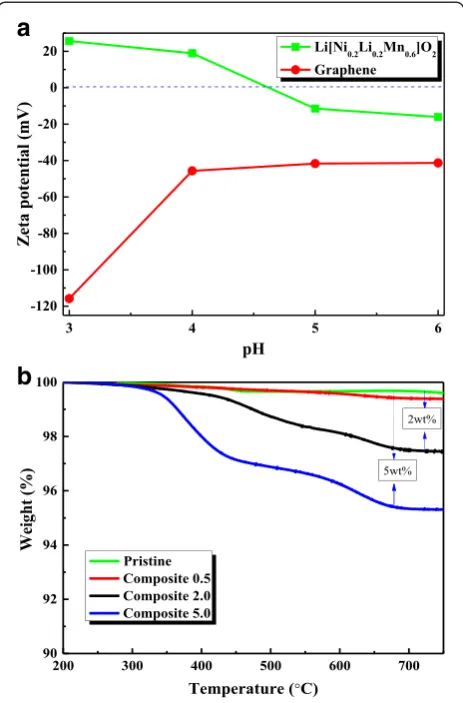
nano-particles was determined via zeta potential measure-ments. As Fig. 2a shows, the surface of graphene was negatively charged at pH values of 3–6. In contrast, the surface charge of the Li[Ni0.2Li0.2Mn0.6]O2 nanoparticle
switched from positive (over 20 mV) to negative (−20 mV) with increasing pH value. The graphene and Li[Ni0.2Li0.2Mn0.6]O2 nanoparticles should be oppositely
charged in order to trigger the mutual assembly via elec-trostatic interaction, and hence the pH value should be lower than 4. Figure 2a shows that the electrostatic interaction between the particles increased with decreas-ing pH value. However, the low pH resulted in reduced integrity of the nanoparticles owing to the vulnerable surface of the Li-rich oxide in the acidic environment.
As such, we determined that a pH value of 4 was appro-priate, because this was the highest value that allowed the formation of composites between the oppositely charged graphene and Li[Ni0.2Li0.2Mn0.6]O2nanoparticles.
[image:3.595.58.290.344.696.2]To determine the actual graphene content, the results of the TGA of the pristine and composite samples were measured and compared as shown in Fig. 2b. If the com-posite sample is prepared through a high-temperature heat treatment, then some of the graphene will evapor-ate during the process. However, our composite samples were dried at 200 °C without heat treatment, and hence the original amount of graphene was maintained during the fabrication process. As Fig. 2b shows, composite 0.5, composite 2.0, and composite 5.0 exhibit weight loss of ~0.5, 2.0, and 5.0 wt.%, respectively, when the samples are heated to 750 °C. This weight loss stems from the evaporation of carbon and is therefore an indicator of the carbon content of the composites.
Figure 3 shows SEM and TEM images of the pristine Li[Ni0.2Li0.2Mn0.6]O2 nanoparticles and composites of
the graphene and Li[Ni0.2Li0.2Mn0.6]O2 nanoparticles.
Hereafter, we refer to the Li[Ni0.2Li0.2Mn0.6]O2
nanopar-ticles attached to 0.5 wt.% graphene, 2.0 wt.% graphene, and 5.0 wt.% graphene (wt.% means weight percent of the Li[Ni0.2Li0.2Mn0.6]O2 nanoparticles) as composite
0.5, composite 2.0, and composite 5.0, respectively. The Li[Ni0.2Li0.2Mn0.6]O2 powder consists of
200~500-nm-sized nanoparticles (Fig. 3a, e). Figure 3b, f shows that composite 0.5 consists of Li[Ni0.2Li0.2Mn0.6]O2 particles
that are successfully composited with graphene; i.e., the particles cover most of the graphene surface. However, many of the particles were aggregated and did not have direct contact with graphene owing to its low (only 0.5 wt.%) surface area. In contrast, the graphene surface of composite 2.0 was appropriately covered with Li[Ni
0.2-Li0.2Mn0.6]O2nanoparticles, as shown in Fig. 3c, g. The
nanoparticles seemed to be strongly attached to graphene, which has a high electronic conductivity. Figure 3d, h shows the image of composite 5.0. As the figure shows, the Li[Ni0.2Li0.2Mn0.6]O2nanoparticles are
well-attached to, but only sparsely populate graphene; i.e., the surface area of the graphene far exceeded that of the nanoparticles
As mentioned previously, we expected the Li[Ni
0.2-Li0.2Mn0.6]O2particles in our composites to retain their
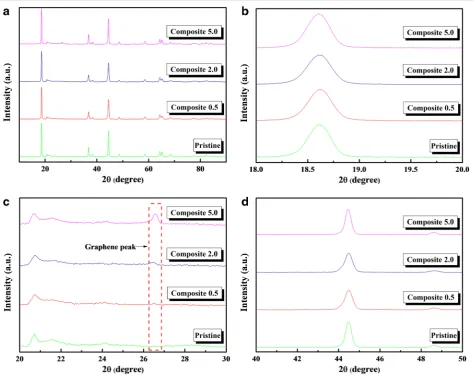
structural integrity and phase; this assumption was deemed reasonable since the composites were assembled via electrostatic interaction, without the use of a high-temperature heat-treatment process that leads to oxygen loss and phase changes. To determine the validity of this assumption, the pristine sample and composites were evaluated via XRD and XPS measurements. Figure 4a compares the XRD patterns of the samples. The patterns (Fig. 4a) from the pristine sample and the composites
a
b
Fig. 2aThe zeta potential of the graphene and Li[Ni0.2Li0.2Mn0.6]O2
were very similar and corresponded closely to that of the hexagonal α-NaFeO2structure (space group R-3m); the
peaks occurring at angles of 20°–25° are associated with superlattice ordering in the transition metal layers. The pattern was examined in further detail by enlarging the peaks occurring at angles of 18°–20°, 20°–30°, and 40°–50°. These peaks are associated with the (003),
superlattice ordering and graphene, and (104) and (105) reflections, which are shown in Fig. 4b–d, re-spectively. Previous studies [28, 29] have shown that the diffraction pattern of carbon/Li-rich oxide composites (prepared via a heat-treatment process) differed somewhat from that of the pristine sample. There, the (003) peaks were shifted and peaks
Fig. 3SEM images of theaLi[Ni0.2Li0.2Mn0.6]O2nanoparticle,bcomposite 0.5,ccomposite 2.0, anddcomposite 5.0; TEM images of theeLi[Ni0.2Li0.2Mn0.6]O2
[image:4.595.59.540.85.609.2]associated with the spinel-like phase occurred, owing to the effect of oxygen loss. However, in our work, the peaks corresponding to the pristine and compos-ite samples were almost identical, indicating that the method of electrostatic interaction prevented the phase change of the vulnerable Li-rich oxide (Li[Ni
0.2-Li0.2Mn0.6]O2). As shown in Fig. 4c, the peaks
corre-sponding to graphene are clearly detected in the patterns of the composites.
Figure 5 shows the XPS spectra of the O 1s, Li 1s, Mn 2p, and Ni 2p orbitals of the pristine and composite samples. The curves were all calibrated based on the C 1s (C–C bond) peak (284.5 eV). The XPS spectrum of the composite prepared via a heat-treatment process dif-fered significantly from that of the pristine sample [28]. Specifically, the intensity of TM-O (TM = transition metal such as Ni, Mn, Co) bond (~529.5 eV) was in-creased, and the intensity of Li 1s peak (~54.2 eV) was decreased. This indicates that compared to the pristine sample, the composites have higher and lower content
of transition metal and Li, respectively, on their surface. Furthermore, this result is attributed to the phase trans-formation of the surface layer to the spinel-like (−LiMn2O4) phase; this phase has a higher transition
metal (Mn) content and lower amounts of Li than the pristine Li-rich oxide (typically, the Li:Mn ratio is ap-proximately 1.2:0.8). However, this phase transition did not occur in the composites prepared by our method of electrostatic interaction. The peaks corresponding to the TM–O (TM=Mn and Ni) bond (~529.5 eV) of the sam-ples (Fig. 5a) exhibited similar intensities, although those of the C–O and C=O bonds increased with increasing C content of the composites. The peaks corresponding to the Li 1s (~54.2 eV) also exhibited (Fig. 5b) similar in-tensities in both the pristine and the composite samples. This indicates that the spinel-like phase did not form during the fabrication of the composites. Moreover, the peak corresponding to the Mn 3p and Mn 2p occurred in similar positions in both the pristine and composite samples, as shown in Fig. 5b, c. This indicates that the
[image:5.595.61.535.89.464.2]composites have similar Mn oxidation states as their pristine counterpart. Previous studies [28, 29] showed the Mn oxidation state of composites prepared via a heat-treatment process differed significantly from that of the pristine sample. The peaks related to Mn shifted, and the intensity of those was also changed due to composite-process. Therefore, the similarities observed in Fig. 5 are indicative of the phase integrity of our com-posites that are prepared by electrostatic interaction.
The effect of graphene as a matrix material was determined by evaluating the electrochemical properties of the pristine samples and the composites. Figure 6a shows the discharge capacities of the samples measured at current densities of 44, 110, 220, 660, and 1320 mA g−1, in a voltage range of 4.8–2.0 V. As the figure shows, the dis-charge capacities of the composites are all somewhat higher than that of the pristine sample. Composites 2.0 and 5.0 have, in particular, a higher discharge capacity and
superior rate capability compared with those of composite 0.5. Table 1 summarizes the discharge capacities and cap-acity retentions of the samples measured at various current densities (3rd, 6th, 11th, 21st, and 31st cycles of Fig. 6a). The capacity retention of the pristine sample at 1320 mA g−1 was only ~44 % of that measured at a current density of 44 mA g−1. In contrast, composites 2.0 and 5.0 exhibited superior capacity retention of ~53 %. These improved electrochemical properties stem from the effect of graphene acting as a matrix for the Li[Ni
0.2-Li0.2Mn0.6]O2nanoparticles; i.e., the high electronic
con-ductivity of the graphene matrix compensates for the low conductivity of the Li[Ni0.2Li0.2Mn0.6]O2 nanoparticles,
thereby leading to the enhanced electrochemical perform-ance of the composite.
Figure 6b shows the results of electrochemical imped-ance spectroscopy measurements performed prior to the electrochemical tests. The Nyquist plots composed of a
a
c
b
d
[image:6.595.61.538.90.473.2]broad semicircle, which may be overlapped two semicir-cles. Generally, a semicircle located in high-frequency range represents the impedance due to a solid electrolyte interface, and a semicircle in relatively low-frequency range represents the charge-transfer resistance at the electrode/electrolyte interface [9, 30]. The size of the semicircle is dependent upon the impedance value of the cell. As shown in Fig. 6b, the semicircles associated with the composites had smaller diameters than the semicircle corresponding to the pristine sample. This in-dicates that graphene-containing composites are effective in reducing the impedance value of the Li[Ni0.2Li0.2Mn0.6]O2
cathode. Furthermore, the enhanced rate capability (Fig. 6a) of the composites results from this reduced impedance. The impedance value of the composite 5.0 was somewhat higher than composite 2.0, which may due to large amount of graphene. Too much graphene can block Li+ transport between liquid electrolyte and cathode surface since Li+ cannot penetrate through the graphene layer.
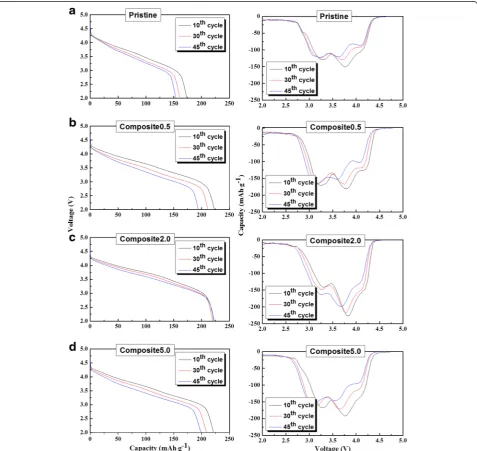
Figure 6c shows the cyclic performance of the samples measured at a current density of 110 mA g−1and a voltage range of 4.8–2.0 V. The discharge capacity of the compos-ites was somewhat higher than that of the pristine sample. However, the cyclic performance of the samples differed only slightly. The corresponding discharge profiles after various cycles (left in Fig. 7) reveal that the discharge cap-acities of the samples decrease gradually during cycling. More importantly, a double-plateau region did not form during cycling. These plateaus are indicative of the phase transformation from a layered structure of Li-rich oxides to a spinel-like structure, during cycling of the carbon/Li-rich oxide composite fabricated via a heat-treatment process [28, 29]. This transformation is attributed to the deterior-ation of phase integrity and the oxygen loss stemming from the reaction with C (graphene) during the fabrication process. However, the absence of these plateaus indicates that our composite, prepared by electrostatic interaction, maintained a stable phase during cycling; i.e., the composit-ing process did not reduce the phase integrity of the Li-rich oxide. This can be also confirmed by the dQ/dV plots in Fig. 7 (right side). The peaks in the samples shifted to the low potential during cycling. However, the sharp peak below 3.0 V, indicating the phase transformation to spinel [28, 29], was not growing during cycling. Therefore, the novel fabrication method described in this work constitutes an effective approach for maintaining phase integrity and enhancing the electrochemical performance of Li-rich ox-ides that consist of a vulnerable phase.
Conclusions
Li[Ni0.2Li0.2Mn0.6]O2 nanoparticles were successfully
composited on the surface of graphene using electrostatic interaction without a high-temperature heat-treatment process. Carbon/Li-rich oxide composites (prepared via a
a
b
c
Fig. 6aDischarge capacities of the pristine sample and the graphene/ Li[Ni0.2Li0.2Mn0.6]O2nanoparticle composites at current densities of 44, 110,
220, 660, and 1320 mA g−1in a voltage range of 4.8–2.0 V;bNyquist plots of the pristine sample and the graphene/Li[Ni0.2Li0.2Mn0.6]O2
nanoparticle composites before electrochemical testing;ccyclic performance of the pristine sample and the graphene/Li[Ni0.2Li0.2Mn0.6]O2
[image:7.595.58.292.86.628.2]Table 1Discharge capacity and capacity retention of the pristine and composite samples at various current densities
Current density 44 mA g−1 (mAh g−1)
110 mA g−1 (mAh g−1)
220 mA g−1 (mAh g−1)
660 mA g−1 (mAh g−1)
1320 mA g−1 (mAh g−1)
Retention rate (%)
Pristine 229 194 170 134 101 44.1
Composite 0.5 260 228 203 164 123 47.3
Composite 2.0 287 253 225 179 151 52.6
Composite 5.0 276 243 215 174 145 52.5
The percentages refer to the retention of the capacity at the 31st cycle compared with that at the 3rd cycle in Fig.6a
[image:8.595.60.538.250.701.2]heat-treatment process) are, in general, susceptible to phase changes and deterioration of the phase integrity; this deterioration results from the reaction of carbon with oxygen and consequent loss of oxygen from the structure of the vulnerable Li-rich oxide phase. However, we successfully fabricated graphene/Li[Ni0.2Li0.2Mn0.6]O2
composites using electrostatic interaction without deteri-oration of the phase integrity of the oxides, as confirmed by XRD and XPS analysis. The optimized graphene/ Li[Ni0.2Li0.2Mn0.6]O2 composites (composite 2.0)
exhib-ited higher discharge capacity and improved rate capabil-ity compared with those of pristine Li[Ni0.2Li0.2Mn0.6]O2.
This improvement is attributed to the high conductivity of graphene, which compensates for the low conductivity of the pristine Li[Ni0.2Li0.2Mn0.6]O2.
Acknowledgements
This research was supported by Basic Science Research Program through the National Research Foundation of Korea (NRF) funded by the Ministry of Science, ICT and Future Planning (No.2014R1A2A2A01003542) and by the National Strategic R&D Program for Industrial Technology (10043868), funded by the Ministry of Trade, Industry and Energy (MOTIE).
Authors’contributions
MH performed the synthesis and characterization in this study. YJ gave advice and guided the experiment. Both authors read and approved the final manuscript.
Competing interests
The authors declare that they have no competing financial interests.
Received: 20 April 2016 Accepted: 13 May 2016
References
1. Jin G, Qiao H, Xie H, Wang H, He K, Liu P, Chen J, Tang Y, Liu S, Huang C, Synthesis of single-crystalline octahedral LiMn2O4as high performance
cathode for Li-ion battery, (2014) Electrochim Acta 150:1
2. Najak PK, Grinblat J, Levi M, Aubach D, Electrochemical and structural characterization of carbon coated Li1.2Mn0.56Ni0.16Co0.08O2and Li1.2Mn0.6Ni0.
2O2as cathode materials for Li-ion batteries, (2014) Electrochim Acta 137:
556
3. Hutzenlaub T, Thiele S, Paust N, Spotnitz R, Zengerle R, Walchshofer C, Three-dimensional electrochemical Li-ion battery modelling featuring a focused ion-beam/scanning electron microscopy based three-phase reconstruction of a LiCoO2cathode, (2014) Electrochim Acta 115:139
4. Lee HJ, Park KS, Park YJ,Surface modification of Li[Ni0.3Co0.4Mn0.3]O2cathode
by Li–La–Ti–O coating, (2010) J Power Sources 195:6122
5. Philippe B, Mahmoud A, Ledeuil JB, Sougrati MT, Edström K, Dedryvère R, Gonbeau D, Lippens P-E, MnSn2electrodes for Li-ion batteries: Mechanisms
at the nano scale and electrode/electrolyte interface, (2014) Electrochim Acta 123:72
6. Rad MS, Danilov DL, Baghalha M, Kazemeini M, Notten PHL, Adaptive thermal modeling of Li-ion batteries, (2013) Electrochim Acta 102:183 7. Song HG, Kim JY, Kim KT, Park YJ, Enhanced electrochemical properties of
Li(Ni0.4Co0.3Mn0.3)O2cathode by surface modification using Li3PO4-based
materials, (2011) J Power Sources 196:6847
8. Dimov N, Nishimura A, Chihara K, Kitajou A, Gocheva ID, Okada S, Transition metal NaMF3compounds as model systems for studying the feasibility of
ternary Li-M-F and Na-M-F single phases as cathodes for lithium–ion and sodium–ion batteries, (2013) Electrochim Acta 110:214
9. Song HG, Kim JY, Park YJ, Enhanced electrochemical and storage properties of La2/3-xLi3XTiO3-coated Li[Ni-coatedLi[Ni0.4Co0.3Mn0.3]O2, (2011)
Electrochim Acta 56:6896
10. Lu Z, Dahn JR, Understanding the Anomalous Capacity of Li / Li [ NixLi(1 / 3−
2x / 3)Mn(2 / 3−x / 3)] O2Cells Using In Situ X-Ray Diffraction and
Electrochemical Studies, (2002) J Electrochem Soc 149:A815
11. Arunkumar TA, Alvarez E, Manthiram A, Chemical and structural instability of the chemically delithiated (1–z) Li[Li1/3Mn2/3]O2·(z) Li[Co1–yNiy]O2(0≤y≤
1 and 0≤z≤1) solid solution cathodes, (2008) J Mater Chem 18:190 12. Li J, Klöpsch R, Stan MC, Nowak S, Kunze M, Winter M, Passerini S, Synthesis
and electrochemical performance of the high voltage cathode material Li[Li0.2Mn0.56Ni0.16Co0.08]O2with improved rate capability, (2011) J Power
Sources 196:4821
13. Hong YS, Park YJ, Ryu KS, Chang SH, Kim MG, Synthesis and electrochemical properties of nanocrystalline Li[NixLi(1−2x)/3Mn(2−x)/3]O2prepared by a simple
combustion method, J. Mater. Chem., (2004) J Mater Chem 14:1424 14. Ates MN, Jia Q, Shah A, Busnaina A, Mukerjee S, Abraham KM, Mitigation of
layered to spinel conversion of a Li-rich layered metal oxide cathode material for Li-ion batteries, (2014) J Electrochem Soc 161:A290 15. Lee HJ, Park Y, Surface modification of Li[Li0.2Ni0.2Mn0.6]O2nanoparticles
with polydopamine-assisted MgF2coating,J (2014) Mater Res Bull 58:169
16. Ates MN, Mukerjee S, Abraham KM, A Li-Rich Layered Cathode Material with Enhanced Structural Stability and Rate Capability for Li-on Batteries, (2014) J Electrochem Soc 161:A335
17. Tran HY, Taubert C, Fleischhammer M, Axmann P, Kuppers L, Wohlfahrt-Mehrens M, Chemical Lithiation Studies on Combustion Synthesized V2O5 Cathodes with Full Cell Application for Lithium Ion Batteries, (2013) J Electrochem Soc 160:A1016
18. Cho DH, Yashiro H, Sun YK, Myung ST, Electrochemical Properties of Polyaniline-Coated Li-Rich Nickel Manganese Oxide and Role of Polyaniline Coating Layer, (2014) J Electrochem Soc 161:A142
19. Thackeray MM, Kang SH, Johnson CS, Vaughey JT, Benedek R, Hackney S, Li2MnO3-stabilized LiMO2(M = Mn, Ni, Co) electrodes for lithium-ion
batteries,A (2007) J Mater Chem 17:3112
20. Xu B, Fell CR, Chi MF, Meng YS, Identifying surface structural changes in layered Li-excess nickel manganese oxides in high voltage lithium ion batteries: A joint experimental and theoretical study, (2011) Energy Environ Sci 4:2223
21. Lee HJ, Park YJ, Synthesis of Li[Ni0.2Li0.2Mn0.6]O2nano-particles and their
surface modification using a polydopamine layer, (2013) J Power Sources 244:222
22. Lee JB, Kumar PS, Moudgil BM, Singh RK, Electrochemical enhancement of LiFePO4as a cathode material by incorporating Cu flakes for lithium ion
rechargeable battery, (2013) Solid State Ionics 231:18
23. Zhou J, Liu BH, Li ZP, Nanostructure optimization of LiFePO4/carbon aerogel
composites for performance enhancement, (2013) Solid State Ionics 244:23 24. Zang M, Jiao LF, Yuan HT, Wang YM, Guo J, Zhao M, Wang W, Zhou XD,
The preparation and characterization of olivine LiFePO4/C doped with
MoO3by a solution method, (2006) Solid State Ionics 177:3309
25. Kim CH, Park YJ, Electrochemical performance of polydopamine-assisted Li[Ni1/3Co1/3Mn1/3]O2/Ketjenblack cathodes, (2014) Solid State Ionics 268:210
26. Noh HK, Park HS, Jeong HY, Lee SU, Song HK, Doubling the capacity of lithium manganese oxide spinel by a flexible skinny graphitic layer, (2014) Angew Chem 53:1
27. Savut Jana S, Nurgul S, Shi X, Xia H, Pang H, Improvement of electrochemical performance of LiNi0.8Co0.1Mn0.1O2cathode material by
graphene nanosheets modification, (2014) Electrochim Acta 149:86 28. Song B, Lai MO, Liu Z, Liu H, Lu L, Graphene-based surface modification on
layered Li-rich cathode for high-performance Li-ion batteries, (2013) J Mater Chem 1:9954
29. Song B, Zhou C, Chen Y, Liu Z, Lai MO, Xue J, Lu L, Role of carbon coating in improving electrochemical performance of Li-rich Li(Li0.2Mn0.54Ni0.13Co0.
13)O2cathode, (2014) RSC Adv 4:44244
30. Fey GT-K, Muralidharan P, Lu C-Z, Cho Y-D, Surface modification of LiNi0.
8Co0.2O2with La2O3for lithium-ion batteries, (2005) Solid State Ionics 176:
![Fig. 1 Schematic showing the fabrication process of graphene/Li[Ni0.2Li0.2Mn0.6]O2 nanoparticle composites via electrostatic interaction](https://thumb-us.123doks.com/thumbv2/123dok_us/8854329.936133/2.595.56.541.533.713/schematic-showing-fabrication-graphene-nanoparticle-composites-electrostatic-interaction.webp)
![Fig. 3 SEM images of the a Li[Ni0.2Li0.2Mn0.6]O2 nanoparticle, b composite 0.5, c composite 2.0, and d composite 5.0; TEM images of the e Li[Ni0.2Li0.2Mn0.6]O2nanoparticle, f composite 0.5, g composite 2.0, and h composite 5.0](https://thumb-us.123doks.com/thumbv2/123dok_us/8854329.936133/4.595.59.540.85.609/nanoparticle-composite-composite-composite-nanoparticle-composite-composite-composite.webp)

![Fig. 6 aperformance of the pristine sample and the graphene/Li[Ni Discharge capacities of the pristine sample and the graphene/Li[Ni0.2Li0.2Mn0.6]O2 nanoparticle composites at current densities of 44, 110,220, 660, and 1320 mA g−1 in a voltage range of 4.8–2.0 V; b Nyquistplots of the pristine sample and the graphene/Li[Ni0.2Li0.2Mn0.6]O2nanoparticle composites before electrochemical testing; c cyclic0.2Li0.2Mn0.6]O2nanoparticle composites at a current density of 110 mA g−1](https://thumb-us.123doks.com/thumbv2/123dok_us/8854329.936133/7.595.58.292.86.628/aperformance-nanoparticle-composites-nyquistplots-nanoparticle-electrochemical-nanoparticle-composites.webp)