N A N O E X P R E S S
Open Access
Nanoparticle manipulation by thermal gradient
Ning Wei
1, Hui-Qiong Wang
1,2*and Jin-Cheng Zheng
1,3*Abstract
A method was proposed to manipulate nanoparticles through a thermal gradient. The motion of a fullerene molecule enclosed inside a (10, 10) carbon nanotube with a thermal gradient was studied by molecular dynamics simulations. We created a one-dimensional potential valley by imposing a symmetrical thermal gradient inside the nanotube. When the temperature gradient was large enough, the fullerene sank into the valley and became trapped. The escaping velocities of the fullerene were evaluated based on the relationship between thermal gradient and thermophoretic force. We then introduced a new way to manipulate the position of nanoparticles by translating the position of thermostats with desirable thermal gradients. Compared to nanomanipulation using a scanning tunneling microscope or an atomic force microscope, our method for nanomanipulation has a great advantage by not requiring a direct contact between the probe and the object.
Keywords:molecular dynamics simulation, thermal gradient, thermophoresis, manipulation, carbon nanotube,
mass transport
Background
Manipulation of atoms using a scanning tunneling microscope (STM) or an atomic force microscope (AFM) reveals the new era of nanotechnology or nano-design [1]. Atoms can now be arranged on demand. However, these approaches require a direct contact between the probe of STM/AFM and the object, which is of strong instrumental dependence and thus greatly restrains the manipulation. It is therefore desirable to seek new methods to manipulate nanoparticles without contact. In this work, we demonstrated that the mechanism of thermophoresis, in which case, atoms move opposite to the thermal gradient, could be utilized for nanoparticle manipulation.
Thermophoresis was actually discovered in the nine-teenth century [2] which was induced by thermodiffu-sion. It was originally used to provide driving forces for molecules to move in fluids or gases [3,4]. Recently, ther-mophoresis has been used for the manipulation and stretching of DNA [4,5]. Carbon nanotubes (CNTs) have been selected as ideal ‘transfer belts’ for transferring gases and liquids by thermophoresis due to their atomic-ally smooth surfaces and solid walls [6-11]. It is not until very recently that thermophoresis is found applicable on
large molecular clusters or nanostructures. Experimen-tally, driven by thermal gradients, short CNTs are found to move relative to coaxial, longer CNTs [12,13]; they can act as shuttles or capped capsules inside the longer CNTs [13] or as cargos attached to the outer walls of the longer CNTs [12]. These short CNTs move while con-fined and guided by the host CNTs, and the motions could be translational or helical depending on the chiral-ity of the CNTs [12]. These exciting experimental results have stimulated much theoretical research on thermo-phoretic transport. From the theoretical calculations, all nanoparticles enclosed in the CNTs, including short CNTs [14], fullerene [15], gold nanoparticles [16,17], and water droplets [10,11] are found to move opposite to the imposed thermal gradient, and the terminal velocities are linearly proportional to the gradient. In addition, Zambrano et al. [14] discovered that the magnitude of thermophoretic force was not only related to the tempera-ture gradient, but also dependent on the velocities of the transported molecules. At the same temperature gradient, the faster the motion, the smaller the thermophoretic force. Furthermore, thermophoresis is becoming one of the main approaches for cargo transport at nanoscale [18]. Nevertheless, in all these previous reports, thermophoretic force is basically used to provide driving forces for the transportation of molecular linear motors.
In this paper, we extend the study of thermophoresis on nanotechnology in the aspect that not only the * Correspondence: [email protected]; [email protected]
1
Department of Physics and Institute of Theoretical Physics and Astrophysics, Xiamen University, Xiamen, 361005, China
Full list of author information is available at the end of the article
motions, but also the physical positions of the nanopar-ticles can be manipulated. Based on the mechanism of thermophoresis, we propose a model in which a fuller-ene is placed inside a CNT and subjected to a eudi-pleural thermal gradient. The cold region is in the middle, and the hot regions are in both ends, with peri-odic conditions along the axial direction. The fullerene inside will then be pushed to the middle cold region by the thermophoretic forces. In this case, we create a potential valley based on the temperature gradient. When the potential barrier is high enough, the fullerene will be trapped inside the potential valley. More interest-ingly, the trapped fullerene can also move as the cold source is shifted. Our results indicate the feasibilities of manipulating nanoparticles utilizing thermophoretic forces. The application of thermophoresis can then be extended from the thermal driving of molecular linear motors to thermal restrain using potential valleys and to thermal nanomanipulation.
Methods
This C60-CNT system was modeled with adaptive inter-molecular reactive empirical bond order (AIREBO) potential [19], which deals with covalent carbon-carbon bonding interactions determined by the well-established REBO potential, while the nonbonded interaction between the carbon atoms of fullerene and those of CNT was described by the Lennard-Jones potential, as implemented in the LAMMPS package [20], which can be used to well describe the thermal properties of CNT [21], graphene [22], or graphene-nanotube 3D networks [23] or the mechanical properties of knitted graphene [24], with a time step 0.5 fs. Before the nonequilibrium simulation, the system temperature is set to 400 K by a Nosé-Hoover thermostat [25,26] for 500 ps with a cou-pling constant of 0.1 ps. After the system reaches equili-brium, heat flux is imposed by the thermostats, where the cold region is selected in the middle and the hot regions are in both ends of CNT. The heat flux is injected/subtracted from carbon atoms of the hot/cold regions of CNT [27], which are realized by rescaling velocities of carbon atoms according to:
vi=vT+α(vi−vT), (1)
where vi andviare the new and old velocities of ther-mostat atoms, respectively, vTis the velocity of the cen-ter of mass of the thermostat, and a is the rescaling factor:
α=
1± ε ER
, (2)
where ± Δε is the energy injected/subtracted from specified atoms. ERis the relative kinetic energy, which is defined as:
ER=
i 1 2mi(v
2
i −v2T). (3)
In our simulation, the heat flux is fixed as:
J= ε
2At, (4)
and the value is controlled byΔε. In order to calculate the temperature distribution in the outer CNT, the CNT is divided into 50 slabs along the axial direction. The temperature of each slab is computed by the fol-lowing:
Ti(slab) = 2 3NkB
i p2j
2m, (5)
where Ti(slab) is the temperature of theith slab,Nis the number of carbon atoms in this slab,kBis the Boltz-mann constant, andpjis the momentum of atomj. The nonequilibrium molecular dynamics (NEMD) simulation is performed under NEV ensemble for 5 ns.
Results and discussions
and oscillates within a range of△zabout ± 1.0 nm along the axial direction. When the thermostats shift along the tube axially, C60moves together with the cold one. The reason is that in the nonequilibrium system, the encap-sulated C60 cluster suffers the thermophoretic force in the direction opposite to that of the thermal gradient, pointing from the hot region (ends) to the cold region (middle). Hence, a one-dimensional potential valley is created inside the CNT by the thermal gradient. When the kinetic energy of the fullerene is less than the magni-tude of potential barrier energy, C60will be trapped and its motion will be confined inside the valley (the cold region). In our symmetrical thermal gradient simulations, the‘potential valley’is created by the thermophoretic force. Therefore, we manipulate the nanoparticle by uti-lizing the idea of potential valley by translating the corre-sponding thermal source locations.
In order to further examine our idea of the artificial potential valley by thermal gradient, several magnitudes of
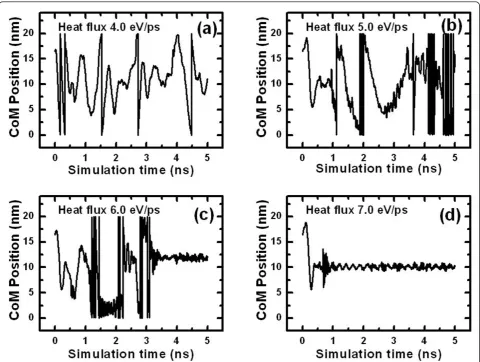
[image:3.595.58.540.87.399.2]heat fluxes, i.e., 4.0, 5.0, 6.0, and 7.0 eV/ps are considered, with the initial locations of thermostats marked at the background temperature of 400 K. The COMs of the C60 as a function of simulation time are shown in Figure 2. The C60cluster is bounced inside the CNT randomly, rather than doing a perfect harmonic oscillation. The main reason is that the driving force, thermophoretic force, is not uniform but is associated with the tempera-ture gradient. We can see that when subjected to heat fluxes of 6.0 and 7.0 eV/ps, C60is confined in a△zrange of around 1 nm within our simulation time of 5 ns. It is noticed that the capture time, from the beginning of the simulation to the moment when C60is confined by the thermal gradient, depends on the magnitude of heat flux. The greater the subjected heat flux, the sooner C60will be trapped, e.g., the time is 3.5 ns for the subjected heat flux of 6.0 eV/ps and 0.8 ns for 7.0 eV/ps. On the other hand, when the fullerene’s kinetic energy is larger than the potential barrier energy, the molecule can escape the valley
Figure 1Illustration of fullerene nanomanipulation inside CNT through the translation of cold and hot thermal sources. (a) Illustration of the simulation model. A fullerene is enclosed in a (10, 10) CNT which is 20.0 nm in length and subjected into a symmetrical thermal gradient, with the hot region at both ends and the cold region at the middle of CNT. Fullerene is placed at 5.0 nm away from the tube ends. (b) View of the cross section model. The closest distance between the carbon atoms of fullerene to the CNT wall is 3.4 Å, similar to the interlayer distance of graphite. (c,d) Nanomanipulation is achieved through the translation of cold and hot thermal sources, correspondingly. The initial position of C60was placed at one-fourth of the nanotube, middle of cold and hot sources. The translation of thermal sources was performed three times,
each to move about 1.2 nm along the nanotube, while keeping a fixed distance between cold and hot sources. The C60molecular is trapped
and move along the whole CNT, as shown in Figure 2. This is due to the fact that the thermophoretic force increases with the thermal gradient, which also increases with heat flux. It is worth pointing out that after the C60is trapped, the interaction between C60and CNT will be enhanced and thus will influence the temperature distribu-tion in CNT. The temperature of the cold region will become even lower, resulting in a greater thermal gradient. The thermophoretic force is calculated by integrating the interaction forces between the outer nanotube and each atom of C60. Since the thermophoretic force varies with the thermal gradient, which is thermal gradient-dependent, when calculating the thermophoretic force for a certain thermal gradient, the motion of C60is restrained along the nanotube’s axial direction. This is done by rescaling the momentum of atoms of C60, so their veloci-ties along the axial direction are zero. We record the inter-action force between the nanotube wall and C60within 1.0 ps upon the imposition of the thermal gradient for each
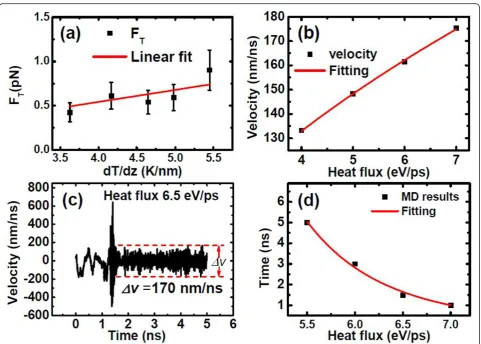
simulation. The interaction force between the outer nano-tube and each atom of C60has an anti-symmetry distribu-tion, and the net result is the thermophoretic force. An averaged value is obtained from five independent simula-tions. However, the thermophoretic force obtained by this approach is greater than that in the real case when the C60 molecule is moving instead of being restrained. This is because the thermophoretic force is not only related to the thermal gradient, but also velocity-dependent. A larger velocity of C60induces a smaller thermophoretic force [14]. The error bar of the thermophoretic force comes from the systemic thermal fluctuation. An approximate linear relationship of the magnitude of the thermophoretic
force (FT, in piconewton) and thermal gradient ( dT dz, in
kelvin per nanometer) was fitted to be
FT=kF
dT
[image:4.595.58.539.88.450.2]dz, (6)
where kF is 0.1356 (Figure 3a), which is consistent with those reported previously [10,11,32]. The magni-tude of the thermophoretic force of C60 is of the same order as in some literatures [10,11], while smaller than the values presented by Hou et al. [32]. Such discre-pancy could be due to the different lengths of host CNTs and the size of encapsulated cluster used in the calculations [32] compared with those of ours.
As seen from the above simulations, when the induced heat flux is large enough, e.g., larger than 6.0 eV/ps, C60 can be trapped by the thermal potential barrier in less than 5.0 ns. One might then wonder: at what velocity can C60escape from the one-dimensional potential val-ley after being trapped by the thermal gradient? Here, we define the escaping velocity as the minimum velocity required for C60 to escape from the bottom of the potential valley (cold region) to the top of the valley
(hot region). The energy of the one-dimensional poten-tial valley is calculated according to the thermal gradient profile and the relationship between thermal gradient and thermophoretic force, which are well described in Additional file 1. The escaping velocity vescape is thus obtained from the kinetic equation:
EV=
1 2mC60v
2
escape, (7)
whereEv is the potential valley’s energy, and mC60 is the mass of C60. A relationship between the escaping velocityvescape (in nanometers per nanosecond) and the applied heat flux J (in electron volts per picosecond) is also fitted to be:
[image:5.595.58.540.313.657.2]vescape =kv·Jbv, (8)
Figure 3The thermophoretic force, escaping velocity, and capture time of C60inside CNT. (a) Thermophoretic force as a function of the temperature gradient. The average system temperature is 400 K. An approximate linear relationship of the magnitude of the thermophoretic
force and the thermal gradient was observed as FT=kFdT
dz. (b) The escaping velocity of C60was evaluated by calculating the required energy
of C60from the cold bottom to the hot top according to the relationship of thermophoretic force and thermal gradient, which were clearly
wherekvis 67.35 and bv is 0.49 (Figure 3b). In order to further verify this power-law relationship, we conduct a new simulation with the CNT subjected to a heat flux of 6.5 eV/ps, and the velocity of C60 as a function of simulation time is shown in Figure 3c: C60was trapped by the thermal gradient potential valley in 1.5 ns, and the velocity of C60 after being trapped was about 170 nm/ns, well consistent with what is shown in Figure 3b. The relationship between the capture time Ttrap (in nanoseconds) of C60and the magnitude of imposed heat fluxJ (in electron volts per picosecond) can be fitted into a power-law curve as:
Ttrap=kT·JbT, (9)
where kT is 449,384.5 andbT is -6.68 (Figure 3d). It would have been desirable to find out the relationship between the capture time of C60 and the thermal gradi-ent, but this is difficult to obtain because of the position dependence of the thermal gradient. Note that the ther-mal gradients created in our NEMD simulations are higher than those used in the experiments [12,13], where the thermal gradient was created by Joule heating [12] and/or the electron beam of a transmission electron microscope [13], which was roughly in the range of 1 to 3 K/nm. In our NEMD simulations, it would be time-consuming to trap the molecule in such a low thermal gradient. Therefore, our simple power-law relationship as described above can be used to provide some theore-tical predictions for experimental exploitation, e.g., with a low thermal gradient of 1 to 3 K/nm as used in the previous experiments [12,13]; the capture time is esti-mated to be about 4.38 to 450.6μs.
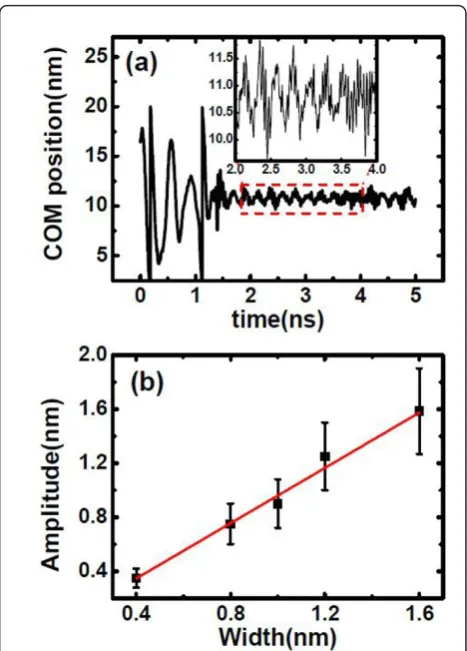
In our simulations, the oscillating motions in the Z-direction were observed when the C60 cluster was trapped by the thermal gradient, as shown in Figure 4a. In order to investigate the relationship of the amplitude of oscillation and the width of cold thermostat, we con-duct a series of simulations with various cold thermostat widths ranging from 0.4 to 1.6 nm. The calculated amplitudes are obtained by averaging the amplitudes of oscillation curves when the C60 cluster was trapped by the thermal gradient (see inset in Figure 4a). We can see that the magnitude of oscillation amplitude of the C60 cluster is almost the same as the width of the cold region, and an approximate linear relationship between the amplitude (A, in Ångström) and the width of the cold thermostat (Wc, in Ångström) was obtained:
A=kAWc, (10)
where kAis 1.02. Therefore, a narrower thermostat is preferable if we want to accurately control the nanopar-ticles by thermal gradient.
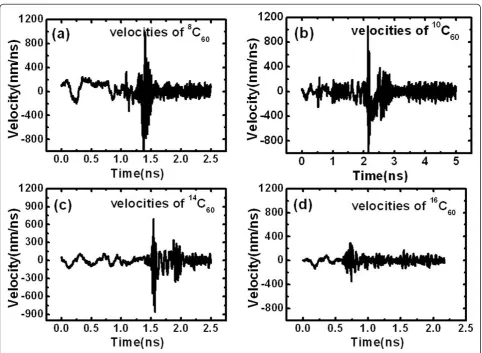
[image:6.595.305.539.87.413.2]The restraining of encapsulated molecular clusters with different masses by the thermal gradient is also considered by replacing carbon atoms in the C60cluster with various kinds of carbon isotopes. Here, the C60cluster is employed as a typical case of molecular cluster enclosed into CNT, and the C60clusters with different masses are applicable for the similar cases of molecules with various masses. According to the equation of the escaping velocity (Equa-tion 7), both mass and velocity of the molecule play an important role in the molecule’s escape from the thermal gradient potential valley. In order to further elucidate the relationship of the trapping time and the mass of molecu-lar cluster, C60clusters consisted of different carbon iso-topes, namely8C,10C,14C, and16C, are considered, and the results are shown in Figure 5. Generally, the C60 clus-ter can be trapped by thermal gradient induced by a heat flux of 6.5 eV/ps, and the trapping time is in the region of 1.5 to 2.0 ns for the cases of8C,10C,12C, and14C while
Figure 4The positions of COM and the averaged amplitude of oscillation of C60. (a) The positions of COM of C60as a function of
simulation time under heat flux of 6.5 eV/ps. The inset shows the detailed oscillation of C60in the Z-direction. (b) The amplitude of
less than 1.0 ns for the case of16C. We then plotted their velocity profiles from the simulations in Figure 6 to exam-ine whether they are coupled with the mass of C60. We can see that the larger the mass of the C60cluster, the smaller the velocity. For example, compared with the C60 clusters consisted of 8C,10C,12C, or14C, the thermo-phoretic force induces a much smaller velocity for the 16
C60cluster. Its maximum velocity is about 300 nm/ns, and its velocities after being trapped are reduced to about 100 nm/ns. This explains why it is easier to trap. We can also see that in the same conditions, it does not necessarily take longer for the heavier clusters to be trapped than the lighter ones if their initial velocities are induced by thermal fluctuation [33]. Nevertheless, for the clusters with the same velocities, it will be harder to trap the heavier clus-ters according to our escaping relationship.
Conclusions
[image:7.595.58.290.88.266.2]In summary, we propose a new approach to manipulate nanoparticles by imposing a thermal gradient on the
Figure 5Trapping time of C60as a function of carbon isotopes (in atomic mass). The unit of time is nanoseconds, and the unit of carbon isotopes is atomic mass.
[image:7.595.57.540.344.697.2]system. We extend the study of thermophoresis in nanotechnology from the continuous linear motion of nanoparticles that has been actively studied to the posi-tion restraining of nanoparticles by designing a one-dimensional thermal potential barrier. Nanoparticles will be pushed to the cold region by thermophoretic force and be restrained in the cold region with a small vibra-tion of ± 1.0 nm along the tube’s axial direction. More-over, we further extend the idea of nanoparticle restraining to nanomanipulation. When the nanoparticle is restrained by thermal gradient potential valley, nano-manipulation can be achieved by translating thermal sources, and the nanoparticle will move following the same trace of the cold source. A nanoparticle inside CNT can therefore be manipulated on demand by ther-mophoretic force without a contact with it. The study of thermophoresis by nanorestrain and nanomanipulation will lead to a much wider usage of thermophoresis in the nanosystem and reveal the great potential applica-tions of thermophoresis in nanodesign, mass transport, drug delivery, etc. Experimental work is thus called for to realize the thermophoretic utilization of nanomanipu-lation and nanodesign in potential applications.
Additional material
Additional file 1: Supporting information. In this supplemental information, we describe the method we used to evaluate the energy of one-dimensional potential valley, which is induced by the thermal gradient.
Acknowledgements
This work is supported by the Specialized Research Fund for the Doctoral Program of Higher Education (grant nos. 20090121120028 and
20100121120026), the Natural Science Foundation of Fujian Province, China (grant no. 2010J05138), and the Program for New Century Excellent Talents in University (NCET; grant no. NCET-09-0680)
Author details
1Department of Physics and Institute of Theoretical Physics and Astrophysics,
Xiamen University, Xiamen, 361005, China2Fujian Key Lab of Semiconductor Materials and Applications, Xiamen University, Xiamen, 361005, China3Fujian
Provincial Key Laboratory of Theoretical and Computational Chemistry, Xiamen University, Xiamen, 361005, China
Authors’contributions
NW carried out the molecular dynamics simulation and drafted the manuscript. H-QW participated in the organization of the project and discussion of the results, and revised the manuscript. J-CZ organized the project, analyzed the results, and revised the manuscript. All authors read and approved the final manuscript.
Competing interests
The authors declare that they have no competing interests.
Received: 2 September 2011 Accepted: 26 February 2012 Published: 26 February 2012
References
1. Eigler DM, Schweizer EK:Positioning single atoms with a scanning tunnelling microscope.Nature1990,344:524-526.
2. Ludwig C:Diffusion zwischen ungleich erwärmten Orten gleich zusammengesetzter Lösungen.Sitzungsber Akad Wiss Wien Math-Naturwiss Kl1856,20:539.
3. Iacopini S, Piazza R:Thermophoresis in protein solutions.Europhys Lett 2003,63:247-253.
4. Duhr S, Braun D:Why molecules move along a temperature gradient.
Proc Natl Acad Sci USA2006,103:19678-19682.
5. Jiang HR, Sano M:Stretching single molecular DNA by temperature gradient.Appl Phys Lett2007,91:154104-154106.
6. Holt JK, Park HG, Wang Y, Stadermann M, Artyukhin AB, Grigoropoulos CP, Noy A, Bakajin O:Fast mass transport through sub-2-nanometer carbon nanotubes.Science2006,312:1034-1037.
7. Zimmerli U, Gonnet PG, Walther JH, Koumoutsakos P:Curvature induced L-defects in water conduction in carbon nanotubes.Nano Lett2005, 5:1017-1022.
8. Majumder M, Chopra N, Andrews R, Hinds BJ:Nanoscale hydrodynamics: enhanced flow in carbon nanotubes.Nature2005,438:44.
9. Skoulidas AI, Ackerman DM, Johnson JK, Sholl DS:Rapid transport of gases in carbon nanotubes.Phys Rev Lett2002,89:185901-185904.
10. Shiomi J, Maruyama S:Water transport inside a single-walled carbon nanotube driven by a temperature gradient.Nanotechnology2009, 20:055708.
11. Zambrano HA, Walther JH, Koumoutsakos P, Sbalzarini IF:Thermophoretic motion of water nanodroplets confined inside carbon nanotubes.Nano Lett2009,9:66-71.
12. Barreiro A, Rurali R, Hernández ER, Moser J, Pichler T, Forró L, Bachtold A: Subnanometer motion of cargoes driven by thermal gradients along carbon nanotubes.Science2008,320:775-778.
13. Somada H, Hirahara K, Akita S, Nakayama YA:Molecular linear motor consisting of carbon nanotubes.Nano Lett2009,9:62-65.
14. Zambrano HA, Walther JH, Jaffe RL:Thermally driven molecular linear motors: a molecular dynamics study.J Chem Phys2009,131:241104. 15. Rurali R, Hernández ER:Thermally induced directed motion of fullerene
clusters encapsulated in carbon nanotubes.Chem Phys Lett2010, 497:62-65.
16. Schoen PAE, Walther JH, Arcidiacono S, Poulikakos D, Koumoutsakos P: Nanoparticle traffic on helical tracks: thermophoretic mass transport through carbon nanotubes.Nano Lett2006,6:1910-1917.
17. Schoen PSE, Walther JH, Poulikakos D, Koumoutsakos P:Phonon assisted thermophoretic motion of gold nanoparticles inside carbon nanotubes.
Appl Phys Lett2007,90:253116-253118.
18. Burghard M:A freight train of nanotubes for cargo transport on the nanoscale.Angew Chem Int Ed2008,47:8565-8566.
19. Brenner DW, Shenderova OA, Harrison JA, Stuart SJ, Ni B, Sinnott SB:A second-generation reactive empirical bond order (REBO) potential energy expression for hydrocarbons.J Phys: Condens Matter2002, 14:783-802.
20. Plimpton S:Fast parallel algorithms for short-range molecular dynamics.
J Comput Phys1995,117:1-19.
21. Xu Z, Buehler MJ:Strain controlled thermomutability of single-walled carbon nanotubes.Nanotechnology2009,20:185701.
22. Wei N, Xu LQ, Wang HQ, Zheng JC:Strain engineering of thermal conductivity in graphene sheets and nanoribbons: a demonstration of magic flexibility.Nanotechnology2011,22:105705.
23. Xu LQ, Wei N, Zheng YP, Fan ZY, Wang HQ, Zheng JC: Graphene-nanotube 3D networks: intriguing thermal and mechanical properties.
J Mater Chem2012,22:1435-1444.
24. Wei N, Fan ZY, Zheng YP, Xu LQ, Wang HQ, Zheng JC:Knitted graphene-nanoribbon sheet: a mechanically robust structure.Nanoscale2012, 4:785-791.
25. Nosé S:A unified formulation of the constant temperature molecular dynamics methods.J Chem Phys1984,81:511-519.
26. Hoover WG:Canonical dynamics: equilibrium phase-space distributions.
Phys Rev A1985,31:1695-1697.
28. Smith BW, Monthioux M, Luzzi DE:Encapsulated C60in carbon nanotubes. Nature (London)1998,396:323-324.
29. Smith BW, Luzzi DE:Formation mechanism of fullerene peapods and coaxial tubes: a path to large scale synthesis.Chem Phys Lett2000, 321:169-174.
30. Noya EG, Srivastava D, Chernozatonskii LA, Menon M:Thermal conductivity of carbon nanotube peapods.Phys Rev B2004,70:115416-115420. 31. Cummings A, Osman M, Srivastava D, Menon M:Thermal conductivity of
Y-junction carbon nanotubes.Phys Rev B2004,70:115405-115410. 32. Hou QW, Cao BY, Guo ZY:Thermal gradient induced actuation in
double-walled carbon nanotubes.Nanotechnology2009,20:495503.
33. Xu Z, Zheng QS, Chen G:Thermally driven large-amplitude fluctuations in carbon-nanotube-based devices: molecular dynamics simulations.
Phys Rev B2007,75:195445-195448.
doi:10.1186/1556-276X-7-154
Cite this article as:Weiet al.:Nanoparticle manipulation by thermal gradient.Nanoscale Research Letters20127:154.
Submit your manuscript to a
journal and benefi t from:
7Convenient online submission 7Rigorous peer review
7Immediate publication on acceptance 7Open access: articles freely available online 7High visibility within the fi eld
7Retaining the copyright to your article