BIROn - Birkbeck Institutional Research Online
Jenkins, Michael and Grubert, Anna and Eimer, Martin (2017) Target objects
defined by a conjunction of colour and shape can be selected independently
and in parallel. Attention, Perception, & Psychophysics 79 (8), pp.
2310-2326. ISSN 1943-3921.
Downloaded from:
Usage Guidelines:
Please refer to usage guidelines at or alternatively
1
Target objects defined by a conjunction of colour and shape can be selected
independently and in parallel
Michael Jenkins1*, Anna Grubert2, & Martin Eimer1
*Corresponding Author
1
Department of Psychological Sciences, Birkbeck, University of London,
Malet Street, London, WC1E 7HX, UK
2
Department of Psychology, Durham University
Queen’s Campus, Stockton-on-Tees, TS17 6BH, UK
Phone: 0044 20 76316522
Email: [email protected]
2
Abstract
It is generally assumed that during search for targets defined by a feature conjunction,
attention is allocated sequentially to individual objects. We tested this hypothesis by
tracking the time course of attentional processing biases with the N2pc component in tasks
where observers searched for two targets defined by a colour/shape conjunction. In
Experiment 1, two displays presented in rapid succession (100 ms or 10 ms SOA) each
contained a target and a colour-matching or shape-matching distractor on opposite sides.
Target objects in both displays elicited N2pc components of similar size that overlapped in
time when the SOA was 10 ms, suggesting that attention was allocated in parallel to both
targets. Analogous results were found in Experiment 2, where targets and partially matching
distractors were both accompanied by an object without target-matching features. Colour-
and shape-matching distractors also elicited N2pc components, and the target N2pc was
initially identical to the sum of the two distractor N2pcs, suggesting that the initial phase of
attentional object selection was guided independently by feature templates for target
colour and shape. Beyond 230 ms after display onset, the target N2pc became
superadditive, indicating that attentional selection processes now started to be sensitive to
the presence of feature conjunctions. Results show that independent attentional selection
processes can be activated in parallel by two target objects in situations where these objects
are defined by a feature conjunction.
3
The successful detection of a looked-for target object among irrelevant distractors in
a visual scene requires top-down attentional control. When some or all features of such a
target are known in advance, these features are represented internally as attentional
templates (Duncan & Humphreys, 1989; Desimone & Duncan, 1995). Activating such
templates during the preparation for visual search will prioritize the visual processing of
template-matching features, and can guide selective attention towards the location of
candidate target objects in the visual field (e.g., Wolfe, 2007; Olivers, Peters, Houtkamp, &
Roelfsema, 2011). The time course and nature of such template-guided attentional selection
processes remains a topic of lively debate. One important controversial issue concerns the
question whether these processes operate in a strictly sequential fashion, with serial shifts
of attention between successively selected objects, or whether attention can be allocated to
multiple objects simultaneously. Leading models of visual search (e.g., Treisman & Gelade,
1980; Wolfe, 1994, 2007) postulate that attentional object selection is a serial process,
particularly in situations when target objects are defined by a combination of features, and
some of the distractor objects in the search display also possess target-matching features
(conjunction search). In contrast, other models of attentional control (e.g., Desimone &
Duncan, 1995) and accounts of the role of attention in multiple object tracking tasks (e.g.,
e.g., Cavanagh & Alvarez, 2005; see also Niebergall, Khayat, Treue, & Martinez-Trujillo,
2011) assume that attention can be allocated in parallel to several objects in the visual field.
This debate about the parallel versus serial nature of attentional selection
mechanisms in visual search is closely linked to the question of how visual processing biases
in favour of possible target objects emerge in real time, and are difficult to resolve based on
behavioural measures alone. Because event-related brain potential (ERP) markers of
attentional selectivity track the emergence of such processing biases on a
millisecond-by-millisecond basis, they can provide more comprehensive insights into the temporal and
spatial properties of attentional selection processes. Many electrophysiological studies of
visual attention and visual search have measured the N2pc component, which is commonly
interpreted as marking the allocation of attention to candidate target objects that appear
among distractors in visual search displays (e.g., Luck & Hillyard, 1994; Eimer, 1996;
Woodman & Luck, 1999). The N2pc is an enhanced negativity that is elicited at posterior
electrodes contralateral to the visual field of such objects, typically emerges around 180-200
4
processing stream (Hopf et al., 2000). At the physiological level, the N2pc reflects the
presence of a spatially selective attentional bias of visual activity in retinotopic visual
regions that is triggered by task-relevant features at specific locations in a search display. At
the cognitive level, the emergence of such processing biases can be described as reflecting
the attentional selection of specific target features or objects (see Eimer, 2014, 2015, for
further details).
Most N2pc studies have used search displays that include just a single visual object
with target-defining features. To investigate the serial versus parallel nature of attentional
selection processes, search tasks are required where multiple possible target objects are
present in the same display. Because the N2pc is computed by comparing contralateral and
ipsilateral ERP waveforms to targets in the left versus right visual field, this component
cannot track one particular selection process in displays where several candidate target
objects appear simultaneously in both hemifields, as these objects will produce N2pcs of
opposite polarity that will cancel each other out. This methodological problem can be
overcome by utilizing the fact that non-lateralised target objects on the vertical midline do
not elicit N2pc components. In search displays where one candidate target object appears
above or below fixation and another candidate target on the left or right side, any N2pc
response will exclusively reflect the allocation of attention to the lateral target,
independently of any additional selection processes that are triggered by the vertical target
(see Eimer, Kiss, & Nicholas, 2011; Hickey, Di Lollo, & McDonald, 2009; Hickey, McDonald, &
Theeuwes, 2006; Woodman & Luck, 1999, 2003, for previous N2pc studies that employed
this logic).
In a recent series of experiments (Eimer & Grubert, 2014a; Grubert & Eimer, 2015;
Jenkins, Grubert, & Eimer, 2016), we used this horizontal/vertical target presentation
procedure to investigate the time course of attentional selection processes in tasks where
two target objects appeared in two successively presented displays that were separated by
a very short stimulus onset asynchrony (SOA). In one study (Eimer & Grubert, 2014a),
participants had to compare the identity of two colour-defined targets that were presented
together with a nontarget-colour item on the opposite side, either on the horizontal or
vertical midline. The horizontal display either preceded or followed the vertical display, and
these two types of trials were randomly intermixed. N2pc components of similar size were
5
between these N2pc components closely matched the objective SOA between the two
displays (which was varied between 10 ms and 100 ms). With short SOAs, these two N2pc
components also overlapped in time. Very similar N2pc results have been observed when
both target-colour objects were presented simultaneously in the same display (Grubert &
Eimer, 2016), and also when two successively presented targets differed in their colour
(Grubert & Eimer, 2015). These observations suggest that colour-guided attentional
selection processes can operate in parallel for multiple target objects at different locations,
with each selection process following its own independent time course. Such rapid and
apparently parallel attentional target selection processes are not confined to tasks where
attention is guided by colour, as very similar temporal patterns of N2pc components were
also found in a task with shape-defined targets, and even when targets were defined by
their alphanumerical category (Jenkins, Grubert, & Eimer, 2016).
These observations suggest that attention can be allocated rapidly and
independently to multiple target objects in tasks where these objects can be discriminated
from nontargets based on one particular feature. However, in real-world environments, it is
often not possible to distinguish a relevant object from irrelevant distracting objects on the
basis of a single feature. For example, search for large silver coins among small silver coins
and large bronze coins has to be based on two target-defining attributes from different
feature dimensions (colour and size). Behavioural studies have demonstrated that this type
of conjunction search is typically less efficient than search for targets that are defined by a
single feature (e.g., Treisman & Gelade, 1980). According to Feature Integration Theory
(e.g., Treisman, 1988), this is because feature search can operate in parallel for multiple
objects, whereas conjunction search requires serial shifts of spatial attention between
individual objects. Response times (RTs) in conjunction search tasks increase with the
number of distractor objects possessing one target-defining feature, but remains unaffected
by the number of nontarget objects without task-relevant features (Egeth, Virzi, & Garbart,
1984), suggesting that search can be restricted to the subset of objects with target features,
but that search within this subset is conducted serially. Others (e.g., Wolfe, 1998) have
argued that the serial/parallel dichotomy is misleading, and that search efficiency varies
continuously between different types of search tasks. According to the Guided Search
model (Wolfe, 1994, 2007), search performance depends on the efficiency with which
6
is controlled by a spatiotopic salience map where information about the location of
target-defining attributes is combined. Attention is then directed serially to those locations that
are most likely to contain a target object.
The goal of the present study was to investigate the speed with which attention can
be allocated to two target objects presented in rapid succession under conditions where
these targets are defined by a conjunction of features. We employed the same rapid
sequential presentation paradigm as in our previous studies of feature-guided attentional
selection processes (e.g., Eimer & Grubert, 2014a), except for the fact that targets were now
defined by a particular combination of colour and shape. In Experiment 1, targets were
always accompanied by a distractor object in the same display that either matched the
target colour or the target shape. Two target/distractor displays were presented
successively for 50 ms each, and were separated by an SOA of 10 or 100 ms (in different
blocks). The target/distractor pair was presented on the horizontal midline in one of these
displays and on the vertical midline in the other display (see Figure 1). The order in which
these two displays were presented (horizontal first or second: H1 or H2 targets) varied
unpredictably across trials. Participants had to attend to the two target objects defined by a
specific colour/shape conjunction (e.g., blue circles), and to report whether the gaps in their
contours were located on the same side or on opposite sides. To assess the time course with
which attention was allocated to the two conjunctively defined target objects, we measured
N2pc components, separately for H1 and H2 targets and for the two SOA conditions.
Because one target was accompanied by a colour-matching distractor and the other
by a shape-matching distractor on each trial, target selection could not be based on a single
search template for a particular feature. According to Feature Integration Theory (Treisman
& Gelade, 1980), the identification of these target objects will have to be based on the
integration of signals across the colour and shape dimensions, and this requires focal
attention that can only be allocated in a serial fashion to one object at a time. In the Guided
Search model, different features can guide attention independently and in parallel, but the
resulting feature-guided attentional selection of objects is assumed to operate in a serial
fashion (Wolfe, 2007). Both models predict that the selection of the target object in the
second display can only commence after attention is withdrawn from the first target. If
N2pc components mark the points in time when attention is allocated to H1 and H2 targets,
7
studies where these targets were defined by a single feature. It is possible that serial
attention shifts can take place within 100 ms. In this case, both H1 and H2 targets should
trigger N2pc components of similar size in blocks where the two displays are separated by
100 ms (SOA 100 condition), and their onset latency difference should match the objective
SOA between the two displays. Critically, qualitatively different results should be observed
in blocks with a 10 ms SOA between the two displays. In these blocks, the time required to
initiate a shift of attention from the first to the second target should be considerably longer
than the SOA between these targets. Given that each display was presented for only 50 ms,
this might make it difficult to allocate attention to the second target at all while it is still
perceptually available. As a result, N2pc components to H2 targets should be delayed,
attenuated, or perhaps even entirely absent in the SOA 10 condition of Experiment 1. In
addition, there should also be performance costs relative to the SOA 100 condition, where
more time is available to complete serial attention shifts.
The alternative possibility is that attention can be allocated independently and in
parallel to both target objects even when these targets are defined by a feature
conjunction. In this case, temporally overlapping N2pc components of similar size should be
elicited by H1 and H2 targets in the SOA 10 condition, as was observed previously with
feature-defined targets (e.g., Eimer & Grubert, 2014a). To preview the results, this was
indeed what was found in Experiment 1. The feature-based versus object-based nature of
these parallel attentional processing biases was investigated in Experiment 2.
Experiment 1
Methods
Participants
Fifteen participants were paid to take part in Experiment 1. Three of them were
excluded from analysis due to excessive eye movement activity. The remaining twelve
participants were aged between 20 and 41 (M = 30.25, SD = 6.52). Eight were female, three
were left-handed. All participants had normal or corrected-to-normal vision. This choice of
8
employed the effect size obtained from a previous N2pc experiment in our lab (Jenkins,
Grubert, & Eimer, 2016), in which the same sample size was used to compare N2pc onset
latencies across multiple displays and SOA conditions in response to rapidly presented
shape-defined target stimuli.1
Stimuli and Procedure
Stimuli were presented on a 22-inch Samsung wide SyncMaster 2233 LCD monitor
(resolution of 1280x1024 pixels, 100 Hz refresh rate; 16ms black-to-white-to-black response
time, verified using a photodiode). Participants were seated in a dimly lit cabin and viewed
the screen from an approximate distance of 100 cm. Stimulus presentation, timing, and
response recollection were controlled by a LG Pentium PC operating under Windows XP,
using the Cogent 2000 toolbox (www.vislab.ucl.ac.uk/Cogent/) for MATLAB (Mathworks,
Inc.). Stimuli were coloured outline shapes (circles, squares, or triangles; 0.2° line width),
subtending 1.1° x 1.1° of visual angle. There was a gap in the contour of each object, on the
left or right side. The size of this gap was 0.6°, and it was always centred between the top
and bottom of each shape (as illustrated in Figure 1). The possible stimulus colours were
blue (CIE colour coordinates: .185/.188), cyan (.212/.347), or green (.262/.572). All colours
were equiluminant (9.8 cd/m2). Stimuli were presented at an eccentricity of 3.0° from
central fixation against a black background. A central grey (.321/.352) fixation point (0.2° x
0.2°) remained continuously present for the duration of each experimental block.
On each trial, two successive stimulus displays were each presented for 50 ms. Each
stimulus display contained one target object (matching both the target shape and colour),
and a distractor on opposite sides. One of the two distractors in each trial matched the
target shape but had one of the two nontarget colours (shape-matching distractor). The
distractor in the other display on the same trial matched the target colour but had one of
the two nontarget shapes (colour-matching distractor). Nontarget colours and shapes were
randomly selected on each trial. One target/distractor pair was presented on the horizontal
meridian (left and right of fixation), and the other pair appeared on the vertical meridian
1
9
(above and below fixation). In half of all trials, the horizontal stimulus pair was presented
first (horizontal target first: H1 target). In the other half, the vertical target/distractor display
preceded the horizontal display (horizontal target second: H2 target). These two display
sequences were randomly intermixed in each block. The position of the two target objects
in the two displays (left/right; top/bottom), as well as the order in which the
shape-matching and colour-shape-matching distractors appeared, were randomly and independently
determined on each trial. There were two blocked SOA conditions. In SOA 10 blocks, the
onset of the first display preceded the onset of the second display by 10 ms (i.e., there was a
40 ms overlap between these two displays). In SOA 100 blocks, the onset of the two
consecutive displays was separated by 100 ms, and there was a 50 ms blank interval
between the offset of the first display and the onset of the second display. The interval
between the offset of the second display and the onset of the first display on the next trial
was 1900 ms.
Each participant was assigned a specific target-defining shape/colour conjunction
that remained constant throughout the experiment. Each of the three possible shapes
(circle, square, and triangle) and colours (blue, green, and cyan) served as target-defining
feature for four participants. Target colour and shape were selected independently, with the
constraint that each of the nine possible colour-shape conjunctions served as target for at
least one of the twelve participants (with three of these conjunctions each serving as target
for two participants). Participants were instructed to find the two target objects in the two
successively presented displays, and to report whether these objects had gaps on the same
side (both left or right) or on different sides (one left, one right) by pressing one of two
purpose-built vertically aligned response keys. The response-to-key mapping, as well as the
hand-to-key mapping, was counterbalanced across participants. Trials requiring a “same” or
“different” response were equiprobable and randomly intermixed in each block.
The experiment contained 12 blocks, with 64 trials per block, and 4 trials for each
combination of display sequence (H1 target, H2 target), position of horizontal target (left,
right), position of vertical target (top, bottom), and sequence of partially matching
distractors (shape-matching followed by colour-matching distractor, or vice versa). Each
SOA condition was run in 6 successive blocks, and the order of the SOA conditions was
counterbalanced across participants. Each of the two SOA conditions was preceded by one
10 EEG recording and data analyses
The continuous EEG was DC-recorded from 27 scalp electrodes at standard positions
of the extended 10/20 system, sampled at a rate of 500 Hz, and digitally low-pass filtered at
40 Hz. No other offline filters were applied. All channels were online referenced to the left
earlobe and re-referenced offline to the average of both earlobes. Trials contaminated with
artifacts (eye movements exceeding ±30 µV in the HEOG channels; eye blinks exceeding ±60
µV at Fpz; muscular movements exceeding ±80 µV in all other channels), and trials with
incorrect, anticipatory (faster than 200 ms), very slow (slower than 1500 ms), or missing
responses were excluded from EEG analyses. This led to an exclusion of an average of 12.3%
and 17.6% of all trials in the SOA 10 and SOA 100 conditions, respectively. For the remaining
trials, EEG was segmented into epochs ranging from 100 ms prior to 500 ms after the onset
of the first stimulus display, and was baseline corrected relative to the 100 ms interval prior
to the onset of the first display. EEG was averaged separately for each of the eight
combinations of SOA (10 ms, 100 ms), display sequence, and position of horizontal target.
N2pc components were quantified on the basis of ERP waveforms measured at
lateral posterior electrodes PO7 and PO8. N2pc onset latencies were measured based on
difference waveforms, computed by subtracting ipsilateral from contralateral ERPs at PO7
and PO8. Onset latencies were determined with a jackknife-based procedure (Miller,
Patterson, & Ulrich, 1998; Ulrich & Miller, 2001). Twelve grand-average difference waves
were computed for each experimental condition, each excluding one different participant
from the original sample. N2pc onset latency was defined as the point in time when each
subsample difference wave reached an absolute onset criterion of -1 µV.2 Differences in
N2pc onset latencies between H1 and H2 targets and between SOA conditions were
assessed with repeated-measures ANOVAs and t-tests, with F- and t-values corrected
according to the formulas described by Ulrich and Miller (2001) and Miller et al. (1998),
respectively. The corrected statistical values are indicated with Fc and tc, respectively. All t
-tests were two-tailed and Bonferroni corrected where necessary. To measure effect sizes,
2 A fixed onset criterion of -1 µV was chosen to avoid distortion of N2pc onset latency estimates by differences
11
Cohen’s d (Cohen, 1988) was computed for all t-tests, and partial eta-squared (labelled ηp2)
was computed for all ANOVAs. In order to correct individual group means and standard
deviations of jackknifed samples, the N2pc latency group means obtained through the
jackknife procedure were fed into repeated-measures ANOVAs from which the error
variance was corrected according to the formula described by Ulrich and Miller (2001). For
this reason, effect sizes from N2pc latency analyses are reported as ηp2c.
N2pc mean amplitudes were computed within 100 ms time intervals. For H1 targets,
a 200-300 ms time interval after the onset of the first display was employed for both SOA
conditions. For H2 targets, time windows were adjusted relative to the SOA between the
first and second display (210-310 ms after the onset of the first display for the SOA 10
condition; 300-400 ms for the SOA 100 condition).
Results
Behavioural performance
Reaction times (RTs) were measured relative to the onset of the second display on
each trial. Anticipatory or exceedingly slow RTs (faster than 200 ms or slower than 1500 ms)
were removed from analysis, resulting in the exclusion of less than 1% of all trials. A
repeated-measures ANOVA with the factors SOA (10 versus 100 ms) and display sequence
(H1 versus H2 targets) was run separately for RTs and for error rates. RTs were faster in the
SOA 10 than in the SOA 100 condition (682 ms versus 727 ms), but this difference was not
significant, F(1,11) = 4.06, p = .069, ηp2 = .27. There was also no main effect of display
sequence on RTs (705 ms versus 704 ms for H1 and H2 targets, respectively), nor any
interaction between these two factors, both F(1,11) = .01, p = .916, ηp2 = .00. For error rates,
a main effect of SOA was observed, F(1,11) = 22.21, p < .001, ηp2 = .67, with more errors in
the SOA 100 condition than in the SOA 10 condition (10.1% versus 4.4%). There was no
effect of display sequence on error rates (7.1% and 7.4% for H1 and H2 targets, respectively)
and no interaction between these two factors, both F(1,11) < 1.11, p = .745, ηp2 = .01.
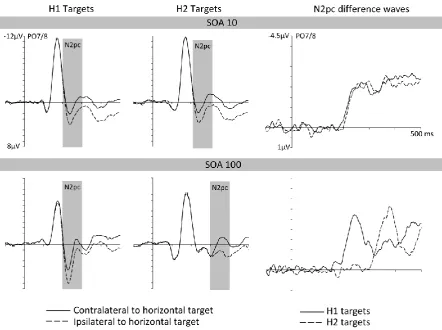
N2pc components
Figure 2 (left and middle panels) shows ERPs at posterior electrodes PO7/8
12
this target appeared in the first display (H1 targets) or in the second display (H2 targets).
The right panel of Figure 2 shows N2pc difference waveforms obtained by subtracting
ipsilateral from contralateral ERPs for H1 and H2 targets. ERPs are shown separately for the
SOA 10 (top) and SOA 100 (bottom) condition. In both SOA conditions, clear N2pc
components of similar size were elicited to both H1 and H2 targets. The onset latency
differences of the N2pc components to H1 and H2 targets reflected the objective SOA
between the two displays in the SOA 10 and SOA 100 conditions.
These observations were confirmed by analyses of N2pc mean amplitudes and onset
latencies. In a repeated-measures ANOVA of N2pc mean amplitudes with the factors display
sequence (H1 versus H2 targets), SOA (10 versus 100 ms), and laterality (electrode
contralateral versus ipsilateral to the side of the horizontal target), a main effect of
laterality, F(1,11) = 45.70, p < .001, ηp2 = .81, indicated that N2pc components were reliably
elicited by horizontal target objects. There were no reliable effects of SOA, F(1,11) = 1.11, p
= .315, ηp2 = .09, or display sequence, F(1,11) = 2.20, p = .183, ηp2 = .16, and no significant
interactions between these two factors and laterality, both F(1,11) < 1.32, p > .276, ηp2 <
.12, indicating that N2pc amplitudes did not differ systematically between SOA conditions,
or between H1 and H2 targets. Follow up t-tests comparing contra- with ipsilateral activity
separately for H1 and H2 targets and both SOA conditions confirmed that all four N2pc
components were reliably present, all t(11) > 5.34, p < .001, d > .31.
A repeated-measures ANOVA of N2pc onset latencies with the factors SOA and
display sequence revealed a significant interaction between these two factors, Fc(1,11) =
150.03, p < .001, ηp2c = .93, showing that N2pc latency differences between H1 and H2
targets were more pronounced in the SOA 100 condition. A paired t-test revealed that the
N2pc to H2 targets emerged 121 ms later than the N2pc to H1 targets in this condition, (324
ms versus 203 ms after the onset of the first display), tc(11) = 17.56, p < .001, ηp2c = .97. In
the SOA 10 condition, the N2pc onset latency difference between H1 and H2 targets (214
versus 219 ms) failed to reach significance, tc(11) = 1.29, p = .224, ηp2c = .13.
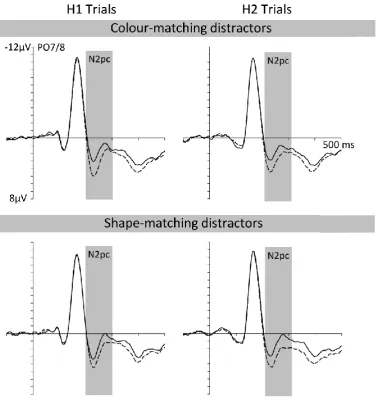
N2pc components to targets with colour-matching and shape-matching distractors
Although the N2pc results shown in Figure 2 suggest that two successively presented
colour/shape targets can be selected rapidly and independently, they do not yet provide
13
Target objects were accompanied either by a shape-matching or by a colour-matching
distractor, and it remains theoretically possible that target selection was controlled
exclusively by one of the two target-defining features, and thus operative only for one of
the two displays on each trial. For example, a purely colour-based attentional guidance
process would result in N2pc components only for displays with a horizontal target and a
shape-matching distractor on opposite sides, but not for displays with two target-colour
objects (the target and a colour-matching distractor). The N2pc components shown in
Figure 2 could reflect the average across these two types of displays. To rule out this
possibility, we computed N2pc components separately for targets accompanied by
colour-matching and shape-colour-matching distractors, separately for H1 and H2 targets and both SOA
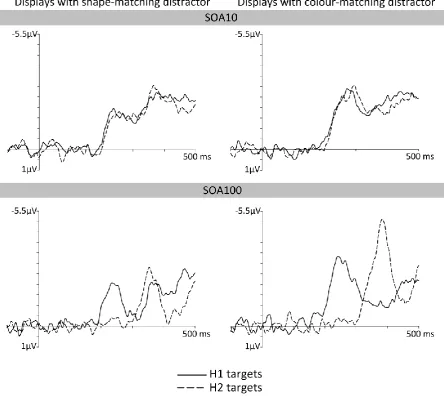
conditions. As can be seen in the resulting N2pc difference waveforms shown in Figure 3,
target N2pc components were not only present for horizontal displays that included
shape-matching distractors but also for displays where targets and colour-shape-matching distractors
appeared on opposite sides. Paired t-tests comparing contralateral and ipsilateral ERPs in
the N2pc time windows confirmed that reliable target N2pc components were present both
when targets were accompanied by colour-matching or by shape-matching distractors, for
each combination of SOA condition and display sequence, all t(11) > 3.93, p < .01, d > .27.
N2pc components were larger for targets accompanied by colour-matching distractors than
for those in displays with shape-matching distractors (see Figure 3). This was confirmed in a
repeated-measures ANOVA of N2pc mean amplitudes with the factors SOA condition,
display sequence, laterality, and the new additional factor distractor type (colour-match
versus shape-match). This ANOVA revealed a significant interaction between distractor type
and laterality, F(1,11) = 11.93, p < .01, ηp2 = .52, reflecting the fact that targets triggered
larger N2pcs when they appeared together with a colour-matching distractor than when
they were accompanied by a shape-matching distractor.
Discussion of Experiment 1
In Experiment 1, two targets defined by a conjunction of colour and shape appeared
in two displays that were presented in rapid succession, with SOAs of 100 ms or 10 ms. The
results obtained in this experiment provide no evidence that the allocation of attention to
14
temporal pattern of N2pc components to H1 and H2 targets was very similar to the results
of previous studies where target selection could be based on a single feature such as colour
or shape (e.g., Eimer & Grubert, 2014a). As in these earlier studies, N2pc components of
similar size were elicited by horizontal targets in the first and second display, and the onset
latency difference between these two N2pc components approximately matched the
objective SOA between the two displays. Critically, this was the case not only in the SOA 100
condition, where the interval between the two displays may have been long enough to
accommodate serial attention shifts between the two targets, but also in the SOA 10
condition. Here, the N2pcs to H1 and H2 targets were identical in size and overlapped in
time (see Figure 2, top panels). This observation is inconsistent with the hypothesis that the
attentional selection of two conjunctively defined targets always requires serial shifts of
attention, so that attention can only be allocated to the second target after it has been
withdrawn from its original location. This serial selection scenario would also predict
substantial performance costs for the SOA 10 relative to the SOA 100 condition. In fact,
participants were more accurate with shorter SOAs, and there was also a tendency towards
faster RTs in the SOA 10 condition. This pattern of behavioural results is most likely due to
the fact that in the SOA 10 condition, a sensory representation of the first target was still
available when a visual representation of the second target is generated, so that gap
locations of both targets could be directly compared. In the SOA 100 condition, the sensory
representation of the first target shape may have already faded when the percept of the
second target was created, and a stable working memory representation of this shape was
not yet available, resulting in performance costs (see Brockmole, Wang, & Irwin, 2002;
Dalvit & Eimer, 2011, for behavioural and ERP studies of perceptual and memory-based
comparison processes across successive displays and how they are affected by the SOA
between these displays).
The fact that N2pcs to H1 and H2 targets were present regardless of whether targets
were accompanied by shape-matching or by colour-matching distractors in the same display
(see Figure 3) demonstrates that target selection was not only based on one of the two
target-defining features, and confirms that both colour and shape were involved in the
parallel guidance of attention. The results of Experiment 1 thus provide clear evidence that
attentional biases in favour of two target objects presented in rapid succession can be
15
from distractors on the basis of a single visual feature, but are defined by a conjunction of
colour and shape. This raises the important question of how these spatially selective
processing biases were generated. One possibility is that they emerged as the result of
separate search templates for the target colour and the target shape that operated
independently and in parallel. In displays where a target was accompanied by a
colour-matching distractor on the opposite side, shape-based attentional guidance would result in
a lateralised spatial bias for the target location, resulting in a target N2pc. Colour-based
guidance would result in a bilateral bias, and two N2pc components over opposite
hemispheres that cancel each other out. If these two guidance processes operated in
parallel, their net result would be an N2pc contralateral to the target. An analogous pattern
can be predicted for displays where the target is presented together with a shape-matching
distractor. In this case, the N2pc components observed in Experiment 1 would reflect the
net spatial bias triggered by target objects due to the fact that they always possess both
template-matching features, whereas the distractor in the same display only has one of
these features. An alternative possibility is that attention was guided by a single target
object template that represents both target-defining features in an integrated fashion (e.g.,
“blue circle”). In this case, target objects will attract attention but partially matching
distractors will not, because they do not match the integrated target object template. The
N2pc components measured in Experiment 1 would therefore exclusively reflect the spatial
bias triggered by target objects. Because N2pc components reflect relative differences in
attentional biases between hemispheres, these two possibilities cannot be distinguished on
the basis of the N2pc results of Experiment 1, where targets and partially matching
distractors always appeared in the same display. To find out whether attentional allocation
processes during search for colour/shape conjunction targets are controlled by separate
feature templates for colour and shape or by an integrated object template, N2pc
components need to be measured independently for targets and for colour-matching and
shape-matching distractors. This was done in Experiment 2.
Experiment 2
As in Experiment 1, targets were defined by a specific colour/shape combination,
16
were randomly intermixed. The SOA between the two displays was always 10 ms. However,
some displays now contained a colour-matching or shape-matching distractor with a
nontarget object without target-matching features on the opposite side. These displays
were either preceded or followed by another display that contained a target and a
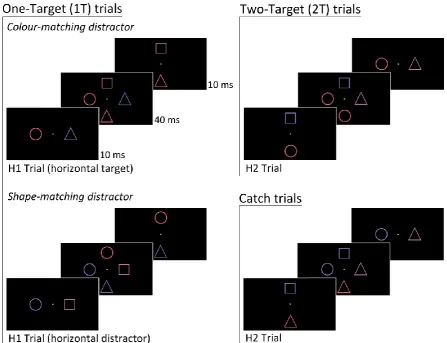
task-irrelevant nontarget object (see Figure 4). In addition to these one-target (1T) trials, there
were also two-target (2T) trials with two successive displays that contained a target and a
task-irrelevant nontarget object on opposite sides. Participants’ task was to report the
number of target objects. The temporal pattern of N2pc components to H1 and H2 targets
was expected to be similar to the results observed in the SOA 10 condition of Experiment 1.
The critical new question was whether horizontal shape-matching and colour-matching
distractors would elicit N2pc components in 1T trials when they were preceded or followed
by another display that included a vertical target. If attention was controlled by templates
that represent targets as integrated objects, these partially matching distractors should not
be able to attract attention and should therefore not trigger any N2pcs. If the allocation of
attention was guided in a strictly feature-based fashion by separate colour and shape
templates, N2pc components should not only be triggered by targets but also by
colour-matching and shape-colour-matching distractors. If colour-based and shape-based guidance
processes operated in an entirely independent non-interactive way, target N2pc
components should reflect the additive effects of the spatial biases triggered by target
colours and shapes, and should therefore be identical to the sum of the two N2pc
components triggered by colour-matching and shape-matching distractors.
Methods
Participants
Thirteen participants were paid to take part in Experiment 2. One of them was
excluded from analysis due to excessive eye movement activity. The remaining twelve
participants were aged between 20 and 38 (M = 29, SD = 5.39). Nine were female; four were
left-handed. All participants had normal or corrected-to-normal vision.
17
As in Experiment 1, stimuli were coloured outline shapes, but no longer included any
gaps. The possible stimulus colours were blue (CIE colour coordinates: .279/.265), purple
(.365/.299), or red (.470/.340). All colours were equiluminant (11.5 cd/m2). As in Experiment
1, each participant was assigned a specific target shape/colour conjunction that remained
constant throughout the experiment. In contrast to Experiment 1, each display now
contained only one object with target-matching features (either the target or a partially
matching distractor), which was always accompanied by a nontarget object without
target-matching features on the opposite side. The other main difference to Experiment 1 was that
trials could include either one or two target objects (see Figure 4). In one-target trials, one
of the two displays contained a target/nontarget pair, while the other contained a partially
matching distractor/nontarget pair. In two-target trials, the two successive displays both
contained a target/nontarget pair. There were also infrequent no-target catch trials, where
both displays contained a partially matching distractor/nontarget pair. Participants’ task was
to report the number of targets presented in each trial (one or two), and to refrain from
responding if no targets were detected (on catch trials).
Only the SOA 10 condition was tested in Experiment 2, which contained 24 blocks of
72 trials. In each block, there were 48 one-target (1T) trials, 16 two-target (2T) trials, and 8
catch trials, which were presented in a randomly intermixed fashion. Note that “one target”
responses were three times as likely as “two target” responses. Display sequence
(horizontal display first or second: H1 or H2 trials, with horizontal displays containing either
a target or a partially matching distractor), and the temporal and spatial position of targets
and partially matching distractors was randomly and independently determined on each
trial. Each display was presented for 50 ms, and the interval between the offset of the
second display and the onset of the first display on the next trial was 1500 ms. All other
aspects of procedure and stimulus presentation were identical to Experiment 1.
EEG recording and data analyses
All aspects of EEG recording and data analysis were identical to Experiment 1.
Rejection of trials contaminated with artifacts, very slow or anticipatory responses, or
incorrect or missing responses led to an exclusion of an average of 13.4% of all trials (12.4%
and 11.8% in 1T trials with a horizontal target or partially matching distractor, respectively,
18
for colour-matching and shape-matching distractor objects on the horizontal midline,
separately for H1 and H2 trials, and for 1T and 2T trials. The time windows used for N2pc
mean amplitude analyses were the same as in the SOA 10 condition of Experiment 1, and
jackknife-based N2pc latency analyses were also identical to Experiment 1.
Results
Behavioural performance
There were no anticipatory or very slow RTs in Experiment 2. A repeated-measures
ANOVA with the factors trial type (1T versus 2T trials) and display sequence (H1 versus H2
targets) was run separately for RTs and for error rates. For RTs, there was a main effect of
trial type, F(1,11) = 59.87, p < .001, ηp2 = .85, indicating faster RTs in the more frequent 1T
trials relative to the less frequent 2T trials (504 ms versus 567 ms). There was no effect of
display sequence (536 ms for both H1 and H2 trials) and no interaction between both
factors, both F(1,11) < 1.05, p > .834, ηp2 < .01. For error rates on target-present trials, a
main effect of trial type, F(1,11) = 27.70, p < .001, ηp2 = .72, indicated that error rates were
less frequent in 1T than in 2T trials (1.5% versus 9.0%). The main effect of display sequence
(3.9% and 3.6% for H1 and H2 trials, respectively) only approached significance, F(1,11) =
4.67, p = .054, ηp2 = .30, as did the interaction between both factors, F(1,11) = 4.06, p = .069,
ηp2 = .27. The False Alarm rate on target-absent catch trials was 3.6% where there was no
target present.
N2pc components to targets
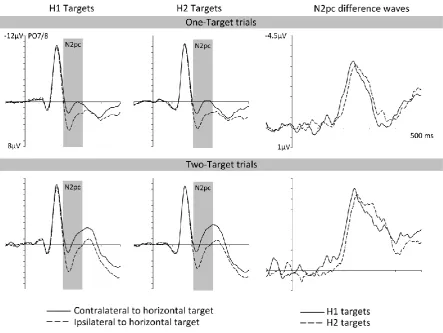
Figure 5 (left and middle panels) shows ERPs for target-horizontal trials in an
identical fashion to Experiment 1. Clear N2pc components were elicited by H1 and H2
targets on 1T as well as 2T trials, and N2pc latencies to H1 and H2 targets reflected the
objective 10 ms SOA between the two displays (as shown in the right panel of Figure 5
depicting difference waves obtained by subtracting ipsi- from contralateral ERPs). A
repeated-measures ANOVA of N2pc mean amplitudes with the factors trial type (1T versus
2T), display sequence (H1 versus H2 target), and laterality (electrode contralateral versus
ipsilateral to the side of the horizontal target), revealed a main effect of laterality, F(1,11) =
19
horizontal target items. There was a significant interaction between trial type and laterality,
F(1,11) = 13.87, p < .01, ηp2 = .56, as N2pc components were generally larger on 2T than on
1T trials (as shown in Figure 5). None of the interactions involving the factor display
sequence reached significance, all F(1,11) < .20, p > .665, ηp2 < .02. Follow up t-tests
comparing contra- with ipsilateral activity in response to H1 and H2 targets separately for 1T
and 2T trials, confirmed that all four N2pc components were reliably present, all t(11) >
6.86, p < .001, d > .55. For N2pc onset latency values, a repeated-measures ANOVA with the
factors trial type and display sequence revealed a main effect of display sequence, Fc(1,11) =
20.71, p < .001, ηp2c = .65, demonstrating that N2pc components to H2 targets were reliably
delayed relative to the N2pcs to H1 targets by about 15 ms (201 ms versus 185 ms for 1T
trials; 202 ms versus 188 ms for 2T trials).
N2pc components to partially matching distractors
Figure 6 shows ERPs measured on 1T trials that included a vertical target in one
display and a horizontal colour-matching or shape-matching distractor in the other display.
Clear N2pc components were elicited by both types of horizontal partially matching
distractors in the first and second display (H1 and H2 trials). A repeated-measures ANOVA
conducted on N2pc mean amplitudes with the factors distractor type (shape-match versus
colour-match), display sequence (H1 versus H2 distractor) and laterality (electrode
contralateral versus ipsilateral to the side of the horizontal distractor), revealed a main
effect of laterality, F(1,11) = 52.86, p < .001, ηp2 = .83, indicating that N2pc components
were reliably elicited in response to these partially matching distractors. There were no
reliable interactions between laterality and display sequence, F(1,11) = .00, p = .960, ηp2 =
.00, or between laterality and distractor type, F(1,11) = 1.50, p = .246, ηp2 = .12, suggesting
that N2pc amplitudes did not differ between H1 and H2 distractors, or between colour- and
shape-matching distractors. Follow up t-tests comparing contra- with ipsilateral activity
separately for H1 and H2 trials and both types of partially matching distractors confirmed
that all four N2pc components were reliably present, all t(11) > 4.41, p < .01, d > .23.
N2pc components to targets and partially matching distractors
Finally, we directly compared N2pc components to targets and to partially matching
20
shape-matching distractors in 1T trials, and target N2pc components observed in 2T trials,
because these two types of trials both contained a target object in the other (vertical)
display. N2pc components to targets were larger than N2pc components to partially
matching distractors (as is evident when comparing Figures 5 and 6). Repeated-measures
ANOVAs conducted separately for targets versus colour-matching or shape-matching
distractors on H1 or H2 trials confirmed that target N2pc amplitudes were significantly
larger than N2pc amplitudes to shape-matching or colour-matching distractors, all F(1,11) >
23.89, p < .001, ηp2 > .68.
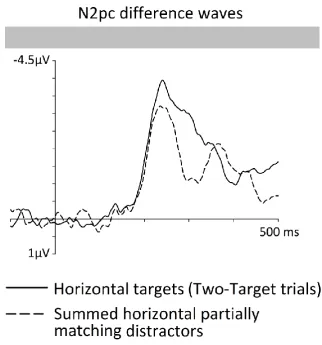
Do the N2pc components triggered by target objects simply reflect the additive
contributions of the N2pc components to colour-matching and shape-matching distractors,
or are target N2pc amplitudes larger than the sum of the two N2pcs to these two types of
distractors? To answer this question, we averaged N2pc components across H1 and H2 trials
(after aligning them temporally to the onset of the respective horizontal display, which was
10 ms later on H2 trials), separately for target objects on 2T trials and for colour-matching
and shape-matching distractors on 1T trials. Next, N2pc components triggered by
colour-matching and shape-colour-matching distractors were summed, and compared to the N2pc elicited
by target objects. The resulting N2pc difference waveforms obtained by subtracting
ipsilateral from contralateral ERPs are shown in Figure 7. The summed N2pc response to
colour- and shape-matching distractors was initially very similar to the target N2pc, up to
approximately 230 ms after display onset. Beyond this point in time, the N2pc to target
objects became larger than the summed N2pc to the two types of distractors (i.e.,
superadditive). We employed two procedures to formally test when the target N2pc
became larger than the summed contribution of the N2pcs to colour- and shape-matching
distractors. First, the summed N2pc difference waveform for partially matching distractors
was subtracted from the N2pc difference wave for targets, separately for each participant,
followed by a jackknife-based analysis of these double subtraction waveforms with an onset
criterion of -0.5 µV. This analysis showed that N2pc amplitudes to targets became larger
than the summed N2pcs to partially matching distractors at 232 ms after display onset. In an
independent second analysis, we conducted successive one-tailed paired t-tests comparing
individual N2pc difference waves for targets and summed partially matching distractors for
each consecutive 2 ms sampling point after display onset. A significant amplitude difference
21
subsequent sampling points (corresponding to 10 ms) in order to be interpreted as marking
the onset of a supperadditive target N2pc component. This procedure yielded an onset
estimate of 234 ms post-stimulus (with p values of .040, .029, .019, .014, and .014 in the 10
ms time period from 234 ms to 244 ms, respectively), which matched the result from the
jackknife-based analysis almost perfectly.
Discussion of Experiment 2
The N2pc results obtained in Experiment 2 rule out the hypothesis that the
attentional selection of targets defined by a conjunction of colour and shape is guided by
templates that represent targets as fully integrated objects. If this was the case,
colour-matching or shape-colour-matching distractors should not have been able to attract attention and
to trigger N2pc components. In fact, horizontal colour-matching and shape-matching
distractors elicited clear N2pc components on 1T trials where they were preceded or
followed by a vertical target in the other display (see Figure 6). The presence of N2pc
components to partially matching distractors shows that the attentional processing biases
triggered during colour/shape conjunction search are at least in part controlled by processes
that operate in a feature-specific fashion, irrespective of the presence or absence of the
other target attribute.
N2pc components to targets were larger than the N2pcs triggered by colour- and
shape-matching distractors, in line with the possibility that target N2pcs reflect the additive
effects of independently operating colour-based and shape-based guidance processes.
Direct comparisons between the sum of the N2pcs to these two types of partially matching
distractors to target N2pc amplitudes revealed that this was indeed the case for the early
phase of the N2pc, up to around 230 ms after display onset (see Figure 7). During this phase,
attentional processing biases were apparently generated in a local fashion by independent
feature-specific guidance processes. Beyond this time point, the target N2pc was larger than
the sum of the two N2pcs to partially matching distractors, suggesting that attentional
guidance was no longer exclusively feature-based (see below for further discussion).
In addition to the presence of N2pc components to colour- and shape-matching
distractors, Experiment 2 also revealed a pattern of target N2pc components that was
22
of similar size were triggered by H1 and H2 targets, both on 1T and 2T trials (see Figure 5).
The onset latency differences between N2pcs to H1 versus H2 targets (about 15 ms) closely
matched the objective 10 ms between the two displays. In contrast to Experiment 1, this
latency difference was significant, and target N2pc amplitudes were substantially larger in
Experiment 2 (compare Figures 2 and 5). As discussed below, these differences are likely to
reflect the fact that targets were accompanied in the same display by partially matching
distractor objects in Experiment 1, but by objects without template-matching features in
Experiment 2.
In line with the assumption that the two targets in the two successive displays were
selected independently and in parallel, there was no evidence that the presence of a vertical
target in the second display attenuated the N2pc to horizontal targets on 2T trials relative to
1T trials where only a single target was present. In fact, the opposite was the case, as target
N2pc components were larger on 2T trials as compared to 1T trials (Figure 5). The factors
responsible for this unexpected result are not clear. One possibility is that 1T trials were
much more frequent than 2T trials, which may have resulted in an increased attentional bias
towards targets when two target objects appeared unexpectedly in rapid succession.
Another possibility that needs to be investigated in future experiments is that the
near-simultaneous presentation of two identical target objects magnifies the attentional
response to both of them relative to trials where only a single target is present.
General Discussion
The current study measured N2pc components to track the allocation of attention to
two target objects in two displays that were presented in rapid succession. Previous studies
using similar rapid sequential presentation procedures with feature-defined targets have
shown that attention is allocated rapidly and in parallel to both target objects, with each
selection process following its own independent time course (Eimer & Grubert, 2014a;
Grubert & Eimer, 2015, 2016; Jenkins et al., 2016). In contrast to these earlier experiments,
target objects were now defined by a specific combination of colour and shape. According
to Feature Integration Theory (e.g., Treisman & Gelade, 1980; Treisman, 1988), the
23
dimensions, which requires focal attention that can only be allocated serially to one object
at a time. The Guided Search model (Wolfe, 2007) also assumes that attentional object
selection processes during conjunction search operate in a sequential fashion. If this was the
case, the temporal pattern of N2pc components elicited by the two target objects in the
present study should be different to the pattern found previously when targets and
nontargets could be distinguished on the basis of a single feature. In fact, the N2pc results
obtained in Experiment 1 were very similar to results found in these earlier studies, in spite
of the fact that targets were always accompanied by a colour-matching or shape-matching
distractor in the same display, and could therefore not be selected on the basis of a unique
target-defining feature. The observation that targets in the first and second display both
elicited N2pc components of similar size, and the fact that these two components
overlapped in time when the SOA between the two displays was 10 ms, shows that spatial
biases for both target objects developed rapidly and independently, in line with the
assumption that attention was allocated in parallel to both objects.
Experiment 2 investigated whether the parallel attentional processing biases for two
conjunctively defined target objects revealed in Experiment 1 were the result of a single
integrated object template, or of independent feature-specific search templates for colour
and shape. Horizontal colour-matching and shape-matching distractors that appeared
together with a nontarget in the same display both elicited reliable N2pcs, demonstrating
that they were able to attract attention. This observation rules out the possibility that
attentional selectivity was entirely controlled by search templates that represent target
features in an integrated object-based fashion. During the initial phase of the N2pc until
about 230 ms after display onset, the sum of the two N2pc components to partially
matching distractors was identical to the N2pc triggered by targets. During this time
window, the attentional processing biases reflected by the N2pc were generated entirely
independently by colour and shape templates, with target N2pcs reflecting the joint
contribution of these feature-specific guidance processes.
If attentional selection processes are initially guided exclusively in a feature-specific
fashion, thereby allowing partially matching distractors to attract attention and elicit N2pc
components, as shown in Experiment 2, this implies that the target N2pc components
observed in Experiment 1 do not exclusively reflect the attentional selection of these target
24
opposite hemispheres by targets and by colour-matching or shape-matching distractors in
the same display. In Experiment 2, targets were always accompanied by objects without any
target-matching features, and N2pc components to target objects will therefore reflect the
pure spatial bias triggered by these objects. If this is correct, target N2pc components
should be larger in Experiment 2 relative to Experiment 1. A comparison of N2pc
components to H1 and H2 targets elicited in the SOA 10 conditions of Experiment 1 (Figure
2, top panels) and Experiment 2 (Figure 5, top panels) shows that this was indeed the case.
A post-hoc analysis of target N2pc mean amplitudes in Experiment 1 (SOA 10 condition) and
Experiment 2, with laterality and display sequence as within-participant factors, and
experiment as between-participant factor, confirmed this observation. There was a
significant interaction between laterality and experiment, F(1,22) = 7.89, p < .05, ηp2 = .26,
reflecting the presence of attenuated N2pc components in Experiment 1 as compared to
Experiment 2. This provides additional support for the hypothesis that rapid parallel
feature-guided attentional biases were triggered concurrently in opposite hemispheres by targets
and partially matching distractors in Experiment 1.
In Experiment 2, target N2pc amplitudes became superadditive (i.e., larger than the
sum of the N2pcs to colour-matching and shape-matching distractors) beyond 230 ms. A
similar temporal pattern of N2pc amplitudes was observed in several of our previous studies
investigating visual search for conjunctively defined target objects. In these experiments,
search displays could contain a target, a distractor that matched one but not the other
target-defining feature, or both the target and a partially matching distractor. Targets were
defined by a combination of colour and shape (Eimer & Grubert, 2014b), a combination of
two colours (Berggren & Eimer, 2016), or a combination of colour and alphanumerical
category (Nako, Grubert, & Eimer, 2016). In all of these tasks, target N2pc amplitudes
initially equalled the sum of the N2pcs to the two partially matching distractors, and became
superadditive at some point between 220 and 250 ms after search display onset.
Interestingly, a very similar temporal pattern of additive, followed by superadditive ERP
modulations in response to target-defining features and feature conjunctions, was found in
a study by Anllo-Vento, Schoenfeld, & Hillyard (2004) for displays that contained only a
single stimulus at fixation. These stimuli were vertical or horizontal bar gratings that were
either orange or red, and participants had to attend to one specific colour/orientation
25
posterior selection negativity (SN), which is observed in non-search tasks where each display
contains a single object for objects with attended features (e.g., Anllo-Vento, Luck, &
Hillyard, 1998). Importantly, the SN elicited by target objects that matched both the
task-relevant bar orientation and colour was initially identical in amplitude to the sum of the two
SN components triggered by the colour-matching and orientation-matching nontargets.
Beyond 225 ms, SN amplitudes to targets became superadditive. This result was interpreted
by Anllo-Vento et al. as demonstrating that at this point in time, attentional selection
processes became sensitive to the presence of the target-defining feature conjunction. In
contrast to the N2pc, which reflects a lateralised bias of visual processing elicited by
task-relevant features or objects in the left or right visual field, the SN components reported by
Anllo-Vento et al. were not lateralised, due to the fact that they were triggered in response
to single objects at fixation. In spite of this difference, the observation that a superadditive
attentional bias for conjunctively defined target objects emerges at almost exactly the same
point in time for both components is intriguing, since it suggests that similar attentional
selection processes may be operative in single-stimulus and multiple-stimulus visual
displays. The onset of superadditive N2pc and SN components to conjunctively defined
targets may mark the point in time where attentional biases are no longer generated in an
entirely feature-specific fashion, but start to be affected by the joint presence of different
target-defining features in the same object. The fact that this superadditivity was observed
in the present Experiment 2 where the critical display was immediately preceded or
followed within 10 ms by another display that contained a vertical target object suggests
that such processing biases for feature conjunctions can be triggered in parallel for different
objects in the visual field.
In Experiment 2, the N2pc to horizontal targets was compared to the sum of the two
N2pc components to horizontal shape-matching and colour-matching distractors elicited on
trials where the other display contained a vertical target object (see Figure 7). A potential
problem with this approach is that by adding the N2pcs to partially matching distractors,
any impact of the vertical target object on these N2pcs is also included twice in the resulting
summed waveforms. The observation that the target N2pc initially equalled the sum of the
two N2pcs to partially matching distractors shows that up to about 230 ms post-stimulus,
vertical targets in the other display had no impact on the attentional biases triggered by
26
feature-based fashion. However, the presence of vertical targets in the other display may
have contributed to the reduction of summed N2pc amplitudes to these distractors beyond
this point in time. Although this possibility cannot be ruled out entirely, it is important to
note that previous N2pc studies of conjunction search (e.g., Eimer & Grubert, 2014b;
Berggren & Eimer, 2016) found analogous sequences of additive followed by superadditive
target N2pc components for displays where targets and partially matching nontargets
appeared without a potentially competing target-matching object on the vertical midline.
Furthermore, as described earlier, Anllo-Vento et al. (2004) found a nearly identical
temporal sequence of additive followed by superadditive SN components for conjunctively
defined target objects in single-stimulus displays. The similarity between these previous
findings and the results of the current Experiment 2 suggests that competitive influences
from vertical targets on N2pcs to partially matching distractors are unlikely to be the main
cause of the superadditivity of target N2pcs observed beyond 230 ms post-stimulus.
What are the general implications of the current results for the nature of attentional
mechanisms in conjunction search tasks? The current N2pc results demonstrate that
attentional biases for target features and objects can be triggered in parallel and
independently at different locations in the visual field. However, it could be argued that the
presence of such spatially selective processing biases does not provide sufficient evidence to
conclude that attentional selection operates in parallel during conjunction search. One
central finding of the current study was that these biases were initially triggered
independently and in parallel by target colours and target shapes, and contributed
additively to the early phase of the N2pc component in the present experiments. This is very
much in line with previous research on feature-based attention in humans and non-human
primates, which has demonstrated that currently task-relevant features trigger attentional
modulations of visual processing in a spatially global fashion across the visual field (e.g.,
Martinez-Trujillo & Treue 2004; Saenz, Buracas, & Boynton, 2002; Serences & Boynton,
2007), even when attention and eye gaze are directed elsewhere (Bichot, Rossi, &
Desimone, 2005). Visual processing modulations produced by feature-based attention can
occur simultaneously for multiple features in the visual field (Andersen, Hillyard, & Müller,
2008; Andersen, Müller, & Hillyard, 2015), as was the case for the parallel colour-based and
shape-based attentional biases found in Experiment 2. It is often assumed that