BIROn - Birkbeck Institutional Research Online
Grawemeyer, Beate and Mavrikis, M. and Holmes, W. and Gutierrez, Sergio
and Wiedmann, M. and Rummel, N. (2017) Affective learning: improving
engagement and enhancing learning with affect-aware feedback.
User
Modeling and User-Adapted Interaction - Special Issue on Impact of Learner
Modeling 27 (1), pp. 119-158. ISSN 0924-1868.
Downloaded from:
Usage Guidelines:
Please refer to usage guidelines at
or alternatively
(will be inserted by the editor)
Affective learning: Improving engagement and
enhancing learning with affect-aware feedback.
Beate Grawemeyer · Manolis Mavrikis ·
Wayne Holmes · Sergio Guti´errez-Santos ·
Michael Wiedmann · Nikol Rummel
the date of receipt and acceptance should be inserted later
Abstract This paper describes the design and ecologically valid evaluation of a learner model that lies at the heart of an intelligent learning environment called iTalk2Learn. A core objective of the learner model is to adapt forma-tive feedback based on students’ affecforma-tive states. Types of adaptation include
what type of formative feedback should be provided and how it should be presented. Two Bayesian networks trained with data gathered in a series of Wizard-of-Oz studies are used for the adaptation process. This paper reports results from a quasi-experimental evaluation, in authentic classroom settings, which compared a version of iTalk2Learn that adapted feedback based on students’ affective states as they were talking aloud with the system (the af-fect condition) with one that provided feedback based only on the students’ performance (thenon-affect condition). Our results suggest that affect-aware support contributes to reducingboredomandoff-task behavior, and may have an effect on learning. We discuss the internal and ecological validity of the study, in light of pedagogical considerations that informed the design of the two conditions. Overall, the results of the study have implications both for the design of educational technology and for classroom approaches to teaching, because they highlight the important role that affect-aware modelling plays in the adaptive delivery of formative feedback to support learning.
Beate Grawemeyer & Sergio Guti´errez-Santos
BBK Knowledge Lab, Birkbeck, University of London, London, UK E-mail:{beate,sergut}@dcs.bbk.ac.uk
Manolis Mavrikis
UCL Knowledge Lab, UCL Institute of Education, University College London, UK E-mail:{m.mavrikis}@ucl.ac.uk
Wayne Holmes
Institute of Educational Technology, The Open University, UK E-mail: wayne.holmes}@open.ac.uk
Michael Wiedmann & Nikol Rummel
Keywords Affective learning· Bayesian networks · Formative feedback ·
Learner modelling
1 Introduction
The aim of our research is to enhance a student’s learning experience and performance in a digital learning environment by providing intelligent sup-port that goes beyond cognitive aspects and takes into account the student’s affective state.
It is well understood that affect interacts with and influences the learning process (Kort et al., 2001; D’Mello et al., 2014; Baker et al., 2010). While positive affective states (such as surprise, satisfaction or curiosity) are known to contribute towards learning, negative affective states (including frustration and disillusionment) can undermine learning. For example, Woolf et al. (2009) describe how students can become overwhelmed (very confused or frustrated) during learning, which may increase their cognitive load (Sweller et al., 1998). In addition, Baker et al. (2010) found that certain types of affective states, such as boredom, were associated with poor learning and with gaming the system. However, when students are in a positive affective state, learning can be improved. For example, Csikszentmihalyi (1990) argues that students in a state of heightened engagement, that he calls in flow, are absorbed in the learning material and are thus primed for learning.
Any learning experience is typically full of transitions between positive and negative affective states. For example, while a student may be interested in a particular learning task, any misconceptions might lead to frustration or disillusionment as the student is forced to reconsider his or her existing understanding (in a process Piaget (1951) callsaccommodation). However, if this negative affective state is reconciled, the student might once again become deeply engaged with the task. D’Mello et al. (2014), for example, elaborate how confusion, which initially might be thought of as a negative affective state, is likely under certain conditions to promote learning. It is important therefore, to deepen our understanding of the role of affective states for learning, and to be able to move students out of states that inhibit learning.
Pekrun (2006) discusses achievement emotions, affective states that arise in a learning situation and that are linked to learning, instruction, and achieve-ment. In theiTalk2Learnproject, we focussed on a subset of these achievement emotions: enjoyment (which we extend toin flow, by which we mean highly engaged, after Csikszentmihalyi, 1990),surprise,frustrationandboredom. We also add confusion, which has been identified elsewhere as an important af-fective state during learning both for tutor support and for learning in gen-eral (Porayska-Pomsta et al., 2008; D’Mello et al., 2014).
formative feedback, text messages that the system sendsduring the learning experience (Shute, 2008; Hattie and Timperley, 2007) in response to student problem-solving actions (Vanlehn, 2006) or other interactions (rather than messages that only summatively acknowledge the outcome of the learning ex-perience).
Other research works, including our own (Mavrikis et al., 2008; Holmes et al., 2015a) and more recently that of Basu et al. (2017) in this issue, focus on how formative feedback in open-ended or exploratory environments can scaffold learners to perform a particular learning task. However, in addition to providing context-specific guidance, our formative feedback also aims to en-hance student affective states - i.e., to move students from nominally negative affective states (such as frustration or boredom) into nominally positive affec-tive states or to maintain posiaffec-tive affecaffec-tive states. In this context, we addressed Carenini’s latter two questions by means of two Bayesian networks: one to de-terminewhatthe feedback should contain (i.e. thetypeof formative feedback), the second for detectinghowthe formative feedback should be presented. Both networks were trained with data from a series of Wizard-of-Oz studies where we investigated the impact of feedback type and presentation on student af-fective states (c.f. Grawemeyer et al., 2015a,b). We learned that a student’s affective state can be enhanced when the feedbacktype is matched to the af-fective state of the student. For example, when students wereconfused, affect boosts and specific instructive feedback were most effective. In addition, adapt-ing thepresentationof the feedback according to the students’ affective state is also important, especially when the student is confused or frustrated. For these particular affective states,high-interruptive feedback (a pop-up window that has to be dismissed before the student can proceed) was more effective in enhancing the student’s affective state, especially as the cost of not viewing the feedback is likely to be a negative affective state. However, when students were in flow, low-interruptive feedback (a glowing lightbulb which indicates that feedback is available) was preferred by students (Mavrikis et al., 2013).
While most research to date in this area responds to a student’s affective state by adapting the feedback message (e.g. by including empathetic state-ments to motivate students (VanLehn et al., 2014; Forbes-Riley and Litman, 2011a; D’Mello et al., 2010), we instead adapt thetypeof feedback (whether it is, for example, instructional feedback or a reflective prompt), with the feed-back content being based on the student’s interaction (mainly their perfor-mance). In addition, instead of adapting the delivery of the feedback using for example an empathetic pedagogical agent (e.g. Conati and MacLaren, 2009; Rowe et al., 2009; Woolf et al., 2009), we adapthow interruptive the feedback is for the student (whetherlow-orhigh-interruptive).
earlier Wizard-of-Oz studies in which their predictive accuracy was tested. We subsequently built on that earlier work and incorporated the Bayesian networks in a comprehensive online system for the learning of fractions. In Rummel et al. (2016), we report on a summative evaluation of that system that focuses on learning efficacy. In this paper, we draw on elements of that summative evaluation to consider the potential of alearner model in relation to enhancing student affective states and learning. We evaluated the intelligent support and its learner model by comparing two conditions in real classroom settings. The first condition adapted feedback based on the student’s affec-tive state (theaffect condition), whereas the second condition used only the student’s performance (by which we mean the creation and manipulation of fractions representations) to provide feedback (thenon-affect condition).
In the next section, we provide an overview of related literature. Section 3 describes the development of the affect-aware intelligent support. Section 4 outlines the evaluation of the support. Results of the evaluation are reported in Section 5. A detailed discussion that highlights the importance of affect-aware learner modelling is provided in Section 6, while Section 7 concludes the paper.
2 Related work
Different computational approaches have been adopted in order to detect af-fective states in intelligent learning environments. These include speech-based approaches (e.g. Cowie et al., 1999; Vogt and Andr´e, 2005), using informa-tion from facial expressions (e.g. Kaliouby and Robinson, 2004), keystrokes or mouse movements (e.g. Epp et al., 2011), or physiological sensors (e.g. Lang et al., 1993; Vyzas and Picard, 1998; Nasoz et al., 2003). Recent research (such as D’Mello and Graesser, 2010; Paleari et al., 2009; W¨ollmer et al., 2010; Jiang et al., 2011) focuses on a combination of input stimuli to detect affective states. Other research has investigated how a student’s affective state or motiva-tion can be detected or taken into account when providing appropriate learn-ing material or motivational feedback. Early examples include del Soldato and du Boulay (1995) and Mavrikis et al. (2007) that look into a student’s level of confidence and how much effort the student puts into performing a learning task as detected by the interaction with the learning environment (such as help requests or task completion).
affec-tive states that were detected included boredom, surprise, confusion, and loss of motivation. Wizard-of-Oz studies were used to investigate how motivational feedback and recommendations could be adapted based on students affective states.
Conati and MacLaren (2009) developed a model of emotions (a dynamic Bayesian network) based on students’ bodily expressions in an educational game. The system used six emotional states: joy, distress, pride, shame, ad-miration and reproach. A pedagogical agent provided support according to students’ emotional state detected by the system and their personal goal (such as wanting help, having fun, learning maths, or succeeding by oneself).
Another example is Shen et al. (2009), which also reports the use of Bayesian networks to classify students’ affective states. Here biophysical sig-nals, such as heart rate, skin conductance, blood pressure, and EEG brain-waves, are used for the classification. The detected affective states (interest, engagement, confusion, frustration, boredom, hopefulness, satisfaction, and disappointment) are included in an affective learner model. The system draws on the affective learner model and uses recommendation rules to determine appropriate interventions, such as providing an example when the student is confused or delivering a video/music when the student is bored.
Woolf et al. (2009) developed an affective pedagogical agent which is able to mirror a student’s emotional state and alter the agent’s feedback by pro-viding for example, an empathetic message. These researchers used hardware sensors and facial movements to detect student emotions. This system dis-criminated between seven emotions: high/low pleasure, frustration, novelty, boredom, anxiety, and confidence. Different machine learning techniques were applied for the classification, including Bayesian networks and Hidden Markov models.
Similarly, Rowe et al. (2009) describe a narrative-centred learning environ-ment, Crystal Island, which takes into account students’ actions, locations, goals, and physiological information to detect their affective states. Na¨ıve Bayes, decision trees, and support vector machines were used for the affect detection. The learning environment included virtual agents, which were able to express empathy based on the student’s affective state. Another example is theAutoTutor tutoring system (D’Mello et al., 2005, 2010), which holds con-versations with students in computer literacy and physics courses. The system classifies emotions based on natural language interaction, facial expressions, and gross body movements. The focus is on three emotions: frustration, con-fusion, and boredom. The classification is used to respond to students via a conversation through an embodied pedagogical agent and to adapt both the dialogue and the facial expression of the agent according to the student’s af-fective state.
stu-dent uncertainty. Based on the stustu-dent’s performance and level of uncertainty, the dialogue-based feedback is adapted. To develop their system, Forbes-Riley and Litman (2011a) used a corpus collected from a wizarded version of a spoken dialogue computer tutor (Forbes-Riley and Litman, 2011b), where detection and natural language understanding was performed by a human in order to train a model to detect uncertainty. Our aim was to extend this approach to accommodate several affective states (as previously investigated by D’Mello et al., 2010).
Meanwhile, several researchers have investigated adapting feedback to stu-dents’ affective states. VanLehn et al. (2014) describe an affective meta tutor, which is able to determine what kind of motivational feedback should be pro-vided to students based on their affective states and log data. Physiological sensors (facial expression camera and a posture-sensing chair) and a regres-sion model are used to calculate whether a student is engaged, confused, or bored. A decision tree uses the current affective state of the student and log data to decide what motivational feedback message should be provided by an embodied pedagogical agent. In general, these adaptations tend to be focused on changing the text within a message (e.g. VanLehn et al., 2014) or chang-ing the dialogue (e.g. Forbes-Riley and Litman, 2011a; D’Mello et al., 2010) to include, for example, empathetic statements designed to motivate the stu-dents. Interestingly, research has shown that there is a gender difference in how empathetic feedback is perceived by students - for example, Burleson and Pi-card (2007) show that female students respond more positively to empathetic feedback than male students; while Vail et al. (2015) showed that female stu-dents were more engaged and less frustrated when provided with affect-aware support than male students. Other research (e.g. Conati and MacLaren, 2009; D’Mello et al., 2005, 2010; VanLehn et al., 2014; Woolf et al., 2009; Rowe et al., 2009) have altered how feedback is delivered to students, for example through the use of a pedagogical agent capable of expressing empathy.
Finally, as explained in D’Mello and Kory (2015), most affect-aware sys-tems up until now have been tested or evaluated only in lab-based contexts and very controlled settings.
In our research we extend the literature by (i) exploring how differenttypes
of feedback (e.g. reflective prompts or instructive feedback) can be adapted to a student’s affective state, (ii) how the presentation of feedback can be adapted to a student’s affective state by taking into account how interruptive that feedback is, and (iii) undertaking an ecologically-valid evaluation of an affect-aware learning environment in real classrooms.
3 The iTalk2Learn platform
fractions by providing activities that help develop conceptual knowledge, in an exploratory learning environment calledFractions Lab, which are interleaved with structured practice activities that help foster procedural knowledge, in an ITS called Whizz Maths (Mazziotti et al., 2015). The overall sequence of exploratory learning and structured practice activities is determined by a
Student Needs Analysis (SNA) component. The SNA sequences the tasks ac-cording to the student’s level of challenge, which is inferred from the student’s interaction using the amount of feedback provided as a key indicator, in order to avoid students being over- or under-challenged, which may trigger boredom or anxiety (as described by Acee et al., 2010). In Rummel et al. (2016), we elaborate on the importance of interleaving exploratory learning and struc-tured practice tasks and the potential of this interleaving for robust learning. In addition, in (Holmes et al., 2015a) we explore multiple dimensions of forma-tive feedback provided while students are undertaking the learning activities in our exploratory learning environment. In this paper, however, we focus on how that intelligent support can usefully be made affect-aware (in Section 4.3 we explain how the sequence of exploratory learning and structured practice tasks was configured to address the aims of the evaluation described in this paper).
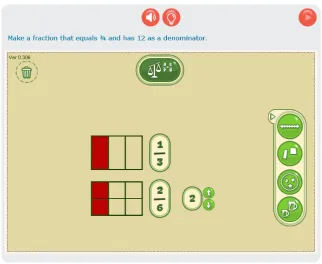
[image:8.595.79.402.361.625.2]Figure 1 shows theFractions Lab interface. Students are given a task (dis-played at the top of the interface) which they explore and attempt to solve by choosing fraction representations (from the right hand side menu) which the student then manipulates (in the work area at the centre of the interface) in order to solve the given task. The large button at the top of the work area provides access to a variety of tools (to compare, add and subtract fractions). Adaptive feedback (which is well-known to be essential in exploratory learning environments, Kirschner et al., 2006) is provided to students based on their interactions with the system and their affective states.
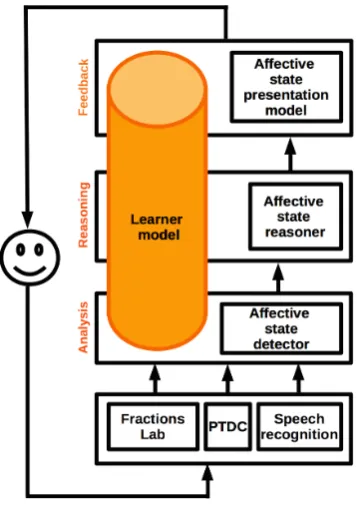
Figure 2 shows the architecture of the adaptive support. Drawing on our previous work (Guti´errez-Santos et al., 2012), the support comprises three main layers: the analysis layer, the reasoning layer, and the feedback generation layer.
Fig. 2 Architecture of the adaptive support.
[image:9.595.150.329.275.529.2]vari-ous inputs. The student’s detected affective state is then stored, together with the student’s interaction data, in the learner model.
Building on the analysis layer, the reasoning layer decides what feed-back should be provided. This layer contains an affective state reasoner, im-plemented as a Bayesian network which draws on information from the learner model, in particular the student’s affective state, to decidewhat type of feed-back should be provided to the student. The resulting feedfeed-back type is then stored in the learner model and provided to the feedback generation layer.
Thefeedback generation layer includes an affective state presentation model implemented as a second Bayesian network, which draws on the learner model to decide how the feedback should be presented to the student. The information that is accessed from the learner model includes the student’s affective state as well as interaction data. The Bayesian network decides if the feedback should be provided in alow-interruptiveor in ahigh-interruptive
way.
We incorporated two Bayesian networks in order to accommodate the main architecture of the intelligent support.
When the feedback is provided depends on the student’s interactions with the learning environment. If a student’s inactivity passes a threshold time (which currently, based on the outputs of Wizard-of-Oz studies (Grawemeyer et al., 2015a,b), is set at 4 seconds), the intelligent support starts the reasoning process, drawing on the learner model, and calculateswhat type of feedback andhow that feedback should be provided.
3.1 A hypothetical use case scenario
To illustrate the flow of information in the intelligent support, centred on the learner model, we next present a use case scenario.
Sarah, a primary school student who is learning about fractions, is using the iTalk2Learn system. Currently, she is working in Fractions Lab, explor-ing a task about the sum of two fractions, 12 and 13. She begins by creating a representation of 12, an interaction which (like all interactions with repre-sentations and tools in Fractions Lab) is logged in her learner model. Sarah moves the mouse to create another representation, remarking as she does so “I think this’s easy”. The speech recognition component has also been contin-uously monitoring, transcribing what Sarah says and providing the words to the analysis layer.Easy is a keyword that is classified with a high probability of beingin flow, and so the affect detection component classifies Sarah as in flow - more information that is saved in the learner model.
network (the affective state reasoner) calculates that there is a probability of 1.0 that a reflective prompt will keep her in flow). Accordingly, the system chooses areflective prompt, which asks her to reflect on her actions, “Why did you use this method?”
Next, again based on interaction and affect data stored in the learner model, the second Bayesian network (the affective state presentation model) calculates how the message should be presented. For Sarah, it determines that there is a 0.3 probability that providing feedback in ahigh-interruptive way will keep herin flow, whereas there is a probability of 0.7 that providing her feedback in alow-interruptiveway (as an illuminated light bulb that she might or might not choose to access) will do so. Accordingly, the light bulb starts to glow (indicating that feedback is available). However, Sarah ignores the glow-ing light bulb - perhaps because she is in flow. Instead, she creates another fraction, 25, suggesting that she has a misconception about how two fractions with different denominators are added together. Nevertheless, she puts all three representations into theFractions Lab addition tool to check her calcu-lation and then is confused to see that it is incorrect. She sighs, “This is so difficult. . . ”. Again, the speech recognition component provides the words to the analysis layer.Difficult is a keyword that is classified with a high proba-bility as confusion, and so the affect detection component classifies Sarah as
confused which again is saved in the learner model.
Meanwhile, Sarah continues to interact withFractions Lab, exploring other ways to solve the task but, when she has run out of ideas, she stops again, unsure what to do next. Once more, this lack of interaction is noticed by the intelligent support and triggers it to start to reason about the information that had been stored in the learner model. The learner model reveals that she did not view and did not follow the most recent feedback and that her current affective state is confusion. Again, the first Bayesian network (the affective state reasoner) calculates which feedback type has the highest probability of improving her affective state. It determines that there is a probability of 0.6 that anaffect boostwill enhance her affective state, while there is a probability of 0.7 that instructive feedback will do so. Accordingly, the system chooses
instructive feedback (instructing her to look at the denominators). Next, again based on interaction and affect data stored in the learner model, the second Bayesian network (the affective state presentation model) calculates how the message should be presented. It determines that there is a probability of 0.4 that providing feedback in a low-interruptive way will improve her affective state, whereas there is a 0.6 probability that providing feedback in a high-interruptiveway will do so. Accordingly, this time, Sarah’s instructive feedback message is presented in a high-interruptive pop-up window.
Student Needs Analysis component (Mazziotti et al., 2015), determines that Sarah should move to the Whizz Maths environment, where she engages in a series of related structured tasks to practise what she had just explored and learned (the importance of matching denominators when adding fractions).
The following sections provide detailed information about the different components of theiTalk2Learn platform.
3.2 Learner model
The learner model spans all three main components and can be seen as the heart of the intelligent support. It includes the following information about the current student:
– Feedback data
– The conditional probability table for the Bayesian network of the affec-tive state reasoner, which is used to determine whattype of feedback should be presented to students (please see Section 3.4 for more details). – The feedback messages that have been provided to the student. – Thetypeof feedback provided to the student (e.g.reflective prompts or
instructive feedback).
– How feedback that was provided to the student waspresented ( inter-ruptive ornon-interruptive).
– Student data
– The student’s affective state (based on the student’s speech and inter-action and calculated by the affective state detector).
– The student’s progress with the task (whether the student is still ex-ploring or has completed it).
– The student’s interactions with the learning environment (whether a representation has been created, selected or manipulated).
– Whether or not the feedback was viewed by the student. – Whether or not the student followed the feedback.
The learner model is constantly being updated with information about the student and the feedback that has been provided to the student. The learner model is used by the various components to determinewhat type of support should be provided to the student andhowthat support should be provided.
3.3 Analysis layer (affective state detector)
The student’s affective state is detected (inferred) from the student’s speech and interaction with Fractions Lab. Data gathered in several Wizard-of-Oz studies (Mavrikis et al., 2014; Grawemeyer et al., 2015a,b) were used as the basis for our affect detection, as follows:
used to detect keywords that are associated with a particular affective state. During the Wizard-of-Oz studies, we recorded what students said and used this to determine keywords that can provide some insight into the student’s affective state. The selection of keywords was based on how often a particular word was spoken by the participating students when in a particular affective state and how unique the word was for that affective state. For example, from detected words such as ‘that’s easy’, or ‘this is good’ the system infers the affective state ofin flow, whereas from detected words such as ‘this is hard’, or ‘tricky’ the system infersconfusion. The ‘Bag of Words’ method (e.g. Schuller et al., 2005) and a naive Bayes classifier was used to classify the student’s affective state (Grawemeyer et al., 2014). – What we call the perceived task difficulty classifier (PTDC), extracts prosodic features (such as ‘um’s and pauses) from the student’s speech and uses speech and pause histograms to infer whether the student is under-, appropriately or over-challenged (Janning et al., 2014, 2016). The prosodic features were extracted from the voice recordings of the Wizard-of-Oz stud-ies, based on two independent coders who classified a student’s level of challenge by taking into account the student’s speech and interaction with the learning environment.
– The student’s interaction with the platform is used to add evidence towards an affective state. For example, whether or not the student viewed and followed the most recent feedback is used to calculate whether the student seems to bein flow orconfused. For instance, if a student has viewed and followed the most recent feedback, the system infers that this student isin flow. However, if the student has viewed but not followed the most recent feedback, the system infers that the student is confused. In addition, the student’s interaction is used in combination with the output of the PTDC to classify students as either frustrated orbored.
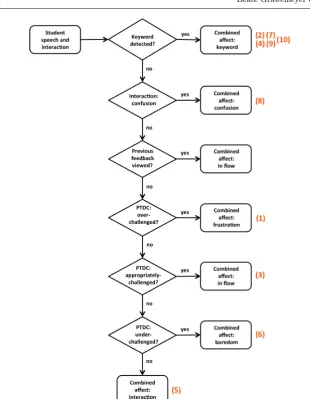
The affective state detector determines the student’s overall affective state using weights given to the different inputs. Based on what was learned in our Wizard-of-Oz studies, the highest weight is given to the keyword detection, followed by PTDC and then interaction. Figure 3 shows a flow diagram of how the overall combined affect is calculated. For example, when a student hasnot viewed the most recent feedback, we infer the following affective states:
– frustration: (1) if the student isover-challenged and the interaction clas-sification shows that the student is not confused (i.e. isin flow) and no keyword has been detected; or (2) if a keyword has been detected that is associated with frustration.
– boredom: (6) if the student is under-challenged and the interaction clas-sification classifies the student as not confused and no keyword has been detected; or (7) if a keyword has been detected that is associated with
boredom.
– confusion: (8) if the interaction classification identified the student as con-fused and no keyword was detected; or (9) if a keyword was detected that is associated with beingconfused.
– surprise: (10) only if a keyword was detected that is associated with sur-prise.
3.4 Reasoning layer (affective state reasoner)
The affective state reasoner uses the information from the student model to decidewhattype of feedback should be provided. We explore different types of feedback that are known from the literature (see Section 2) to support students in their learning and that fit our context: affect boosts, instructive feedback, other problem solving support, reflective prompts, talk aloud prompts, task sequence prompts, and affirmation prompts.
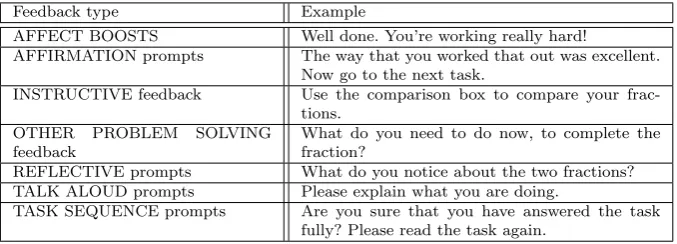
Table 1 shows an example feedback message for each feedback type. The following different feedback types are provided while the student is exploring the task:
– AFFECT BOOSTS. As described in (Woolf et al., 2009), affect boosts can help to enhance a student’s motivation to solve a particular learning task. Here, we included prompts that acknowledged that a task is challenging in order to encourage the student to keep trying. During the evaluation, affect boosts were provided only in theaffect condition.
– INSTRUCTIVE feedback. This feedback provided detailed instructions about what action to perform in order to solve the task.
– OTHER PROBLEM SOLVING feedback. This aimed to help students tackle a problem by challenging their thinking instead of specifying next steps (a subset of ‘Socratic’ formative feedback, Holmes et al., 2015a). – REFLECTIVE prompts. Reflecting on task performance and self-explanation
can be viewed as a tool to help students address their own misunderstand-ings (Chi, 2000) and as a ‘window’ into their thinking.
– TALK ALOUD prompts. These build on the hypothesis that automatic speech recognition can facilitate learning, which is based mostly on educa-tional research that has shown benefits of verbalization for learning (e.g. Askeland, 2012). During the evaluation, talk aloud prompts were provided only in theaffect condition.
When a student has finished the task, the following additional feedback is provided:
Fig. 3 Calculation of students affective state based on a combination of speech (keywords and prosodic features (PTDC)) and interaction.
– FINAL REFLECTIVE prompts that encourage students to reflect on a certain aspect of the task based on the students’ performance.
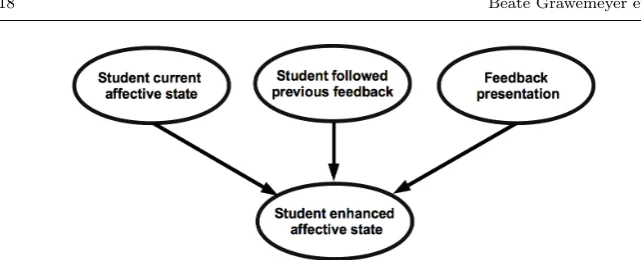
[image:15.595.80.391.72.472.2]Fig. 4 Bayesian network of the affective state reasoner.
[image:16.595.86.405.76.201.2]Based on the information from the learner model and the affective state reasoner, the system decides whattype of feedback should be provided to the student.
Table 1 Examples of feedback types
Feedback type Example
AFFECT BOOSTS Well done. You’re working really hard!
AFFIRMATION prompts The way that you worked that out was excellent. Now go to the next task.
INSTRUCTIVE feedback Use the comparison box to compare your frac-tions.
OTHER PROBLEM SOLVING feedback
What do you need to do now, to complete the fraction?
REFLECTIVE prompts What do you notice about the two fractions? TALK ALOUD prompts Please explain what you are doing.
TASK SEQUENCE prompts Are you sure that you have answered the task fully? Please read the task again.
The affective state reasoner is a Bayesian network based on data gathered in our Wizard-of-Oz studies (Grawemeyer et al., 2015b) that investigated the impact of the different feedback types on student affective states. In those studies, students were given a series of fractions tasks and were provided with feedback, of the types described above, by the researchers (the ‘wizards’) as if it was being provided by the system. The decision about what type of feedback to provide was based on a script. For more information, the reader is referred to Mavrikis et al. (2014).
[image:16.595.72.411.320.442.2]The affective state reasoner receives the current affective state of the stu-dent (based on the stustu-dent’s speech and interaction) as well as information about whether the student followed the most recent feedback. For each feed-backtype, the Bayesian network predicts whether the feedback type is able to improve a student’s affective state. For example, enhancing a student’s affec-tive state from frustration toconfusion, or fromconfusion toin flow. This is used to determine which feedbacktypewill be most effective at enhancing the affective state.
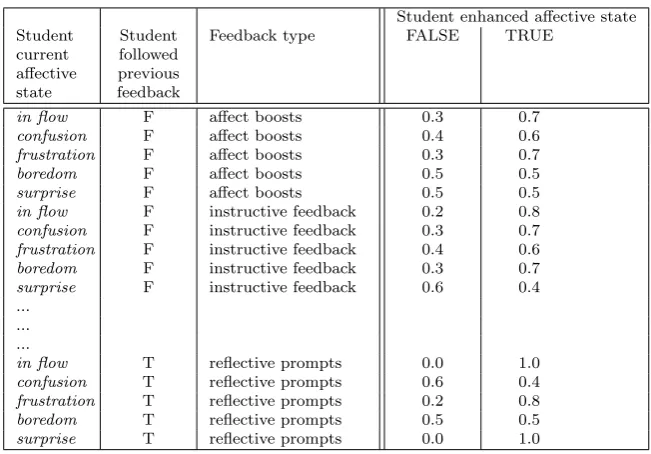
[image:17.595.77.403.254.481.2]Table 2 shows an extract of the conditional probability table (CPT) used by the affective state reasoner with example values. The CPT is stored in the learner model.
Table 2 Example extract of a CPT used by the affective state reasoner.
Student enhanced affective state Student
current affective state
Student followed previous feedback
Feedback type FALSE TRUE
in flow F affect boosts 0.3 0.7
confusion F affect boosts 0.4 0.6 frustration F affect boosts 0.3 0.7
boredom F affect boosts 0.5 0.5
surprise F affect boosts 0.5 0.5 in flow F instructive feedback 0.2 0.8 confusion F instructive feedback 0.3 0.7 frustration F instructive feedback 0.4 0.6 boredom F instructive feedback 0.3 0.7 surprise F instructive feedback 0.6 0.4 ...
... ...
in flow T reflective prompts 0.0 1.0 confusion T reflective prompts 0.6 0.4 frustration T reflective prompts 0.2 0.8 boredom T reflective prompts 0.5 0.5 surprise T reflective prompts 0.0 1.0
3.5 Feedback layer (affective state presentation model)
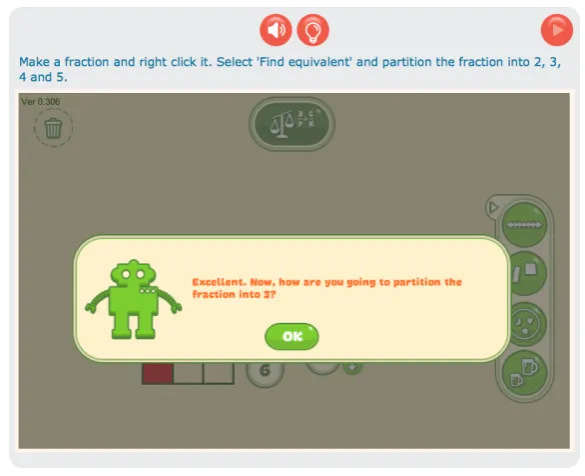
Fig. 5 Low-interruptive feedback. The light bulb at the top of the interface glowing in order to indicate that feedback is available.
[image:18.595.85.401.74.323.2] [image:18.595.93.386.356.594.2]Fig. 7 Bayesian network of the affective state presentation model.
We conducted a further Wizard-of-Oz study that investigated if there was a difference in a student’s affective state when the different types of feedback were either presented in thelow-interruptiveway, with the light bulb, or in the
high-interruptive way, with the pop-up window (Grawemeyer et al., 2015a). Two independent researchers used video and speech recordings to annotate the students’ affective states after the Wizard-of-Oz study (Kappa=.52, p<.001). The data from the study was used to train a Bayesian network that is able to predict whether the adaptation of thepresentation of the feedback can im-prove a student’s affective state. Figure 7 shows the Bayesian network of the affective state presentation model. This network is similar to the Bayesian net-work of the affective state reasoner (please see Figure 4), except that the node
feedback type is replaced by the nodefeedback presentation. The dataset con-tained 266 cases. Each comprised the student’s affective states that occurred before and after feedback was presented and the student’s interaction data (whether or not the most recent feedback had been followed). As before, with this data set and employing a 10-fold cross-validation, we have encouraging results (accuracy=82.38%; Kappa=0.53; recall true=0.65; false=0.87).
The affective state presentation model receives the affective state of the student as well as information about whether the most recent feedback had been followed. Based on this, the presentation of the feedback most likely to enhance the affective state of the student is inferred.
4 Evaluation
[image:19.595.73.394.70.200.2]included the affect-aware support (theaffect condition) with a version where the affect-aware support was switched off (thenon-affect condition).
We investigated the following sub-questions:
– Can a student’s speech and interaction be used effectively as inputs in the detection of students’ affective states?
– Is there a difference (between theaffect andnon-affect conditions) in how often feedback is accessed (based on the different feedback presentation
mechanisms)?
– Are students in more positive affective states when feedback is tailored to their affective state?
– Are students lessoff task when feedback is tailored to their affective state? – Do students have higher learning gains when feedback is adapted to their
affective state?
4.1 Participants
80 students took part in the summative evaluation, although for several reasons our final dataset comprises 77 students. These participants were all primary school students, aged between 8 and 10 years old, recruited from two schools in the UK (one in the north of England, one in the south). Parental consent, for students’ involvement in the study, was obtained for all participating students.
4.2 Conditions
The experimental condition (affect ornon-affect) determined the presence or absence of the affective learner model. In turn, this determined what evidence was available to the analysis, reasoning and feedback layers (as described in Section 3), and thetype of feedback and itspresentation.
Table 3 summarises the differences in theadaptationmechanism and feed-backpresentation between theaffect and the non-affect conditions. The dif-ference between the conditions will be discussed below.
4.2.1 Affect condition
In the affect condition, the student’s affective state was used to determine
what type of feedback should be provided and how that feedback should be presented, in order to improve that affective state.
Table 3 Feedbacktypeandpresentationin the affect and non-affect conditions
ADAPTATION MECHANISM FEEDBACK PRESENTATION FEEDBACK TYPE AFFECT CONDITION NON-AFFECT CONDITION AFFECT CONDITION NON-AFFECT CONDITION Talk aloud Delivered when
the student has not spoken for 30 seconds. n/a High-interruptive n/a Affect boosts Determined by the Bayesian model in the affective state reasoner.
n/a Determined by the Bayesian network in the affective state presentation model.
n/a
Instructive Rules take into account interaction and previous feedback Low-interruptive Other problem solving Reflective Reflective (final)
Delivered when the student
has completed the task. High-interruptive Affirmation
Task sequence
Delivered when the student presses the ‘next’ button but has not completed the task.
If students did not speak for 30 seconds, the system provided a TALK ALOUD prompt. This was always provided in a high-interruptive way as it was important in the affect condition that students talked aloud so that the system could detect the student’s affective states from their speech.
When students attempted to move on to the next task (by clicking the ‘next’ button) without having finished the current task, the system provided a TASK SEQUENCE prompt (as described in Section 3.4). This prompt also was provided in ahigh-interruptive way to improve the chance that the student did not miss it (a high-interruptive prompt has to be responded to before a student can continue).
When students finished the Fractions Lab task they received an AFFIR-MATION prompt and a final REFLECTIVE prompt. Both of those prompts were provided in a high-interruptive way in order to let the student know that the task is completed and to ask the student to reflect on their overall task performance.
4.2.2 Non-affect condition
In thenon-affect condition, a narrower range of message types were provided than in theaffect condition. In addition,how feedback was presented to stu-dents also differed.
the students to talk without them perceiving any benefit could have been found intrusive by some students (Mavrikis et al., 2014; Grawemeyer et al., 2015a,b).
In the non-affect condition, INSTRUCTIVE feedback, OTHER PROB-LEM SOLVING support, and REFLECTIVE prompts were provided in a
low-interruptive way, as research (Mavrikis et al., 2013) has shown that stu-dents can find it very disruptive when they are interrupted during a learning activity.
TASK SEQUENCE prompts were provided when students attempted to move on to the next task but had not yet finished the current task (this is the same as in the affect condition). This prompt was presented in a
high-interruptive way as a direct response to student’s clicking the ‘next’ button as described above.
In the same way as in the affect condition, AFFIRMATION and final REFLECTIVE prompts were provided when students finished the task. These prompts were provided in ahigh-interruptive way in order to let the students know that the task is completed and to ask them to reflect on their overall task performance.
4.3 Procedure
The participating students were roughly stratified, according to previous teacher assessments of the children’s mathematical ability, and then randomly allo-cated to two sub-groups (approximately equal in size, with each group having approximately the same number of high, middle and low achieving students). The first group (N=41) was assigned to theaffectcondition: the students were given access to the full iTalk2Learn system, which uses the student’s affective state to determine the type of feedback and its presentation, as described above. The second group of students (N=36) was assigned to the non-affect
condition: these students were given access to a version of the iTalk2Learn system in which feedback is based on the student’s performance only.
Two series of sessions, one for each condition, were undertaken over several days in each school (in the school computer rooms, each of which was equipped with around 30 individual computers) at a variety of times of day which were balanced as far as possible between conditions. At the beginning of each ses-sion, students completed an online questionnaire that assessed the students knowledge of fractions (the pre-knowledge test - see Section 4.4 below). This was followed by 40 minutes during which the students engaged with fractions tasks.
For the purposes of this evaluation (to ensure that each student experienced a variety of exploratory and structured practice tasks), the SNA was configured to deliver two Fractions Lab exploratory tasks followed by fourWhizz Maths
amount of feedback provided: the more feedback provided in the previous task, the worse the student’s performance was inferred to be). To enable students to proceed if they did not know what to do in a particular task, students were able to exit that task without finishing it but only after having been presented twice with aTASK SEQUENCE prompt that asked them to check and complete the task.
After the 40 minutes, students completed a second online questionnaire (the post-knowledge test) that again assessed their knowledge of fractions and also asked them about their experience using the system and emotional responses.
While students engaged with the system, a randomly allocated subset of students (affect condition: N=25; non-affect condition: N=22) sat at comput-ers in the centre of the computer room in a way that allowed researchcomput-ers to walk all around them, were monitored using the Baker-Rodrigo Ocumpaugh Monitoring Protocol (BROMP, Ocumpaugh et al., 2012). The researchers who undertook the coding, and who were trained in the BROMP method, recorded the student affective states and task behaviour data using the Human Affect Recording Tool (HART) Android mobile app.
The BROMP specifies strict guidelines for how affective states and task behaviour are detected. Each student is observed by a trained observer for up to 20 seconds. The student’s body posture, facial expression and engagement with the learning environment are interpreted to infer whether the student is
in flow, confused, frustrated,bored, surprised, ordelighted. At the same time, the student’s behaviour towards the task (whether the student isoff task, or
on task, or having an on task conversation, or having an on task reflection, or is gaming the system) is also monitored. At the end of the observation, the coder’s interpretation of the student’s affective state and behaviour is entered into the HART Android mobile app, and the researcher turns to the next student. The use of the app restricts the observers to the predetermined categories above (with the student being inin flowandon taskas the default). However, when the affective state of the student was unclear to the observer, they are able to apply an unknown state (a questionmark in the app). This process is continuously repeated, thus logging multiple data points for each student, for the duration of the session.
4.4 Knowledge tests
Fig. 8 Example extract from the pre- and post- questionnaires.
5 Results
5.1 Tasks provided to students
As described earlier, students were provided with a sequence of exploratory tasks (in the learning environmentFractions Lab) interleaved with structured practice tasks (in the learning environmentWhizz Maths). In theaffect condi-tion, students engaged in 263Fractions Labtasks (M=6.41, SD=2.61) and 416
Whizz Mathstasks (M=10.15, SD=4.60). In thenon-affectcondition, students engaged in 293Fractions Labtasks (M=10.15, SD=2.92) and 450Whizz Maths
tasks (M=12.50, SD=4.81). Independent t-tests revealed significant differences between the conditions in the number of Fractions Lab tasks (t(75)=-2.738, p=.008, d=-.63) and the number ofWhizz Mathstasks (t(75)=.-2.182, p=.032, d=-.50).
5.2 Affect detection
As described earlier, in theaffect condition, a student’s affective state was de-tected automatically by the system (henceforward, automatic-detection), by analysing the student’s speech and interaction. In addition, the student’s af-fective states were monitored and noted by two researchers using the BROMP method and HART mobile app (henceforward,human-detection). As described earlier, only a subset of students (affectcondition: N=25;non-affectcondition: N=22) were monitored in respect to their affective states.
The affective states that were both automatically and human-detected werein flow, confusion, frustration, boredom, andsurprise. An additional af-fective state, delight, was human-detected. During the human-detection, the researchers were restricted to these 6 affective states (with the student being
[image:24.595.72.410.76.243.2]Both sets of data (from the automatic and human detection) include time stamps, identifying when a particular affective state was detected. This allowed the two sets of data to be matched (within a 10 seconds window). There was a moderate agreement between the automatically-detected affective states and the human-detected affective states, Kappa=.522, p<.001.
The difference between automatic- and human-detection was partly due to the affective state (delight) that was detected by the researchers and annotated with the HART tool but not detected automatically by the system. In addition, we knew from our Wizard-of-Oz studies thatsurpriseandboredomare difficult to detect automatically. Excluding those affective states, there was a higher agreement between the automatically-detected affective states and the human-detected affective states, Kappa=.643, p<.001. However, this is lower than the commonly accepted Kappa threshold of .70 and it is important to note two caveats. First, ifdelight, surprise andboredom are excluded, we are ignoring some important aspects of human skills in affect detection. Second, the use of the BROMP protocol suggests that the annotated affective states may be less transient than they probably are. Nevertheless, given the authentic setting and our overall goal we consider this results acceptable but recognise that there is room for improvement. From a pedagogical point of view, we take into account that the effect of a misclassification will probably have a relatively low cost to a student’s learning (first, a misclassification does not always lead to feedback being delivered or seen by a student and, second, any inappropriate feedback is unlikely to have a long term detrimental effect).
Table 4 displays the number of automatically-detected students affective states that matched the human-detected affective states and (in parentheses) the ‘precision’ of each detector i.e. the percentage of automatically-detected states that agreed with the human-detection. In our interpretation of the re-sults we consider ‘recall’ (the percentage of correct detections of a state over the total number of cases in our dataset) even though this data is limited here because the ‘gold standard’ human-detected cases are sparse. Neverthe-less, recall can help us judge the relative contribution of each component in the combined classification as well as the relative completeness of the whole system.
As mentioned earlier, keywords were used to detect all five different af-fective states whereas the PTDC component uses prosodic features to clas-sify students as either under-, over- or appropriately challenged. The output from the PTDC were matched to the human-detected affective states as fol-lows: under-challenged was matched toboredom, appropriately challenged toin flow, and over-challenged toconfused. The interaction data included whether the student viewed the most recent feedback and whether the student followed that feedback. This information was used to calculate the probability that a student was eitherin flow or confused and, in combination with the PTDC, to determine whether students were frustrated or bored (as shown in Figure 3).
Table 4 Comparison of human- and automatically-detected student affective states. The figure in parentheses gives the precision of the automatic detectors, the percentage of the automatically-detected states that were correct (i.e., matched the human-detected affective state).
BROMP Automatically-detected
Affective state annotation Keywords PTDC Interaction Combined In flow 222 36 (100%) 139 (92.7%) 198 (82.5)% 187 (86.2%) Confused 91 58 (96.7%) 87 (48.9%) 73 (59.8%) 79 (67.9%) Frustrated 5 0 (0.0%) n/a n/a 4 (28.6%) Bored 37 0 (0.0%) 8 (36.4%) n/a 4 (80.0%)
Surprised 4 0 (0.0%) n/a n/a 0 (0.0%)
Unfortunately, however, as we further discuss in Section 6, keywords were not detected that often (recall in flow: 16.2%; recall confused: 63.7%). The detection ofin flow by the PTDC (based on prosodic features of speech) was satisfactory (precision: 92.7%; recall: 62.6%). The precision of the detection of in flow from the interaction data was not as high (82.5%), however, the recall ofin flow from the interaction data was high (89.2%). Combining the different sources did not lead to the highest precision or recall values for all of the different affective states, such asin flow (precision: 86.2%; recall: 84.2%). However, the combination of speech and interaction enabled the detection of
frustration (precision: 28.6%; recall: 80.0%) and boredom (precision: 80.0%; recall: 10.8%).
5.3 Adapting the feedbacktype
In the two experimental conditions, different approaches were used to deter-mine thetypeof feedback provided to the students. As described in Section 4.2, in the affect condition the feedbacktype was adapted based on the students’ affective states as they answered the task, while in thenon-affectcondition the feedbacktype was based on students’ performance. In addition, two feedback
types (AFFECT BOOSTS and TALK ALOUD prompts) were only provided in theaffect condition (please see Table 3).
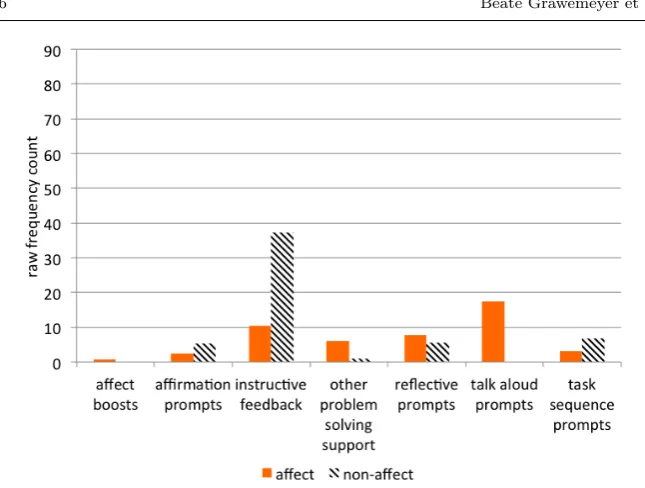
In theaffectcondition, a total of 1971 feedback messages were provided to students (on average 48.07 messages per student, SD=14.58, min=25, max=92). In thenon-affectcondition, a total of 2007 messages were provided to students (on average 55.75 messages per student, SD=11.77, min=34, max=88). Figure 9 shows the different feedbacktypes provided in each condition.
In order to investigate differences between the two conditions (affect and
non-affect), a multivariate ANOVA was conducted for the different feedback
types. Using Pillai’s trace, there was a significant effect of the condition on the number of differenttypesof feedback messages received, V=.929, F(5,71)=187.045, p=.000,η2
Fig. 9 Feedbacktypesprovided in theaffectandnon-affect condition.
AFFIRMATION prompts, INSTRUCTIVE feedback and TASK SEQUENCE prompts were provided less often in the affect condition than in the non-affection condition. In contrast, OTHER PROBLEM SOLVING support and REFLECTIVE prompts were provided more often in the affect condition than in the non-affect condition. As described earlier, AFFECT BOOSTS and TALK ALOUD prompts were only provided in the affect condition. See Table 5 for statistical details.
The reason why many more INSTRUCTIVE feedback messages were pro-vided in thenon-affect condition can be seen in the different aims of the two conditions. While the aim of thenon-affect condition is to support students to reach a solution (based on the student’s performance), the aim of theaffect
condition is not only to help student’s solve the task, but also to improve a stu-dent’s affective state. This can explain the larger amount of INSTRUCTIVE feedback messages in thenon-affect condition, as the student is supported to reach a solution (or to perform a particular sub-task for this solution) through instructive feedback.
[image:27.595.77.400.70.314.2]Table 5 Statistical details of the feedback types provided.
Mean Std. dev. Feedback type affect non
affect
affect non affect
t-test
AFFECT BOOSTS 0.80 0.0 1.40 0.0
-AFFIRMATION 2.51 5.33 2.09 2.41 t(75)=-5.50, p=.000, d=-1.25
INSTRUCTIVE 10.32 37.14 7.04 11.75 t(55.703)=-11.94, p=.000, d=-2.769
OTHER PROBLEM
SOLVING 6.05 0.97 2.55 2.21 t(74.991)=9.36, p=.000, d=2.129
REFLECTIVE 7.80 5.53 3.49 2.21 t(68.501)=3.46, p=.001, d=0.846
TALK ALOUD 17.46 0.0 5.92 0.0
-TASK
SEQUENCE 3.12 6.78 2.60 4.22 t(56.679)=-4.50, p=.000, d=1.044
5.4 Responses tolow-interruptive feedback
We were also interested in exploring whether there was a difference in the students’ behaviour when offered low-interruptive feedback (i.e. whether or not the student clicked the light bulb). In theaffect condition, students were provided with 389 low-interruptive messages (M=9.49, SD=3.551); while in the non-affect condition, students were provided with 1441 low-interruptive
messages (M=40.03, SD=12.098) (the difference being due to the way in which thelow-interruptive feedback was provided in the two conditions as explained in section 4.2). When feedback waslow-interruptive, students could ignore the light bulb and therefore not see the feedback. In theaffectcondition, students ignored 74 of thelow-interruptivefeedback messages (M=1.80, SD=2.076). In thenon-affectcondition, students ignored 448 of thelow-interruptivefeedback messages (M=12.44, SD=10.814). In percentage terms, the students in the
affect condition were more likely to view the low-interruptive feedback (81%) than students in thenon-affective condition (69%). A t-test showed that this difference was a medium effect size and was statistically significant, t(75)=2.40, p=.019, d=.55. However, the difference in the rate of viewing and ignoring low-interruptive feedback between the two conditions may result from the greater frequency of low-interruptive feedback in thenon-affect condition.
5.5 Affect and task behaviour
behaviour were annotated by researchers using the Baker-Rodrigo Ocumpaugh Monitoring Protocol (BROMP) and the Human Affect Recording Tool (HART) Android mobile app (Ocumpaugh et al., 2012). This human detected affect data was used for further analysis as described below.
[image:29.595.91.390.214.441.2]5.5.1 human-detected affect using BROMP
Figure 10 shows the different affective states that were annotated using the BROMP protocol.
Fig. 10 Affective states annotated using the BROMP protocol (during the evaluation ses-sions in both conditions).
A multivariate ANOVA using Pillai’s trace showed a significant effect of adaptive support on the affective statesoverall, V=.268, F(5,41)=3.006, p=.021,ηp2=.268. In both conditions, students were mainlyin flow. This was followed byconfusion andboredom. Only rarely were students frustrated, de-lighted, orsurprised. Follow-up t-tests showed that the effect of affect adapta-tion was statistically significant only forboredom (please see Table 6 for sta-tistical details, stasta-tistically significant results highlighted in bold font), which was only half as frequent in theaffectcondition as in thenon-affectcondition.
5.5.2 Task behaviour using BROMP
Table 6 Statistical details of students’ affective states.
Mean Std. dev. Affective
state
affect non affect
affect non affect
t-test
bored 9.74 20.38 14.01 12.41 t(45)=-2.739, p=.009, d=-0.81
confused 27.41 27.69 23.87 17.87 t(43.94)=-.046, p=.964, d=-0.01
delight 0.85 0.00 2.11 0.00 t(24.00)=2.011, p=.056, d=0.80
in flow 59.78 48.91 23.91 14.98 t(40.884)=1.891, p=.066, d=0.56
frustrated 1.48 2.67 2.81 4.66 t(45)=-1.075, p=.288, d=-0.32
surprised 0.74 0.35 1.52 1.64 t(45)=.843, p=.404, d=0.25
Fig. 11 Student task behaviour annotated using the BROMP protocol (during the evalu-ation sessions in both conditions).
A multivariate ANOVA using Pillai’s trace showed a significant effect of adaptive support on task behaviouroverall, V=.226, F(4,42)=3.071, p= .026, η2
Off task behaviour was only half as frequent in the affect condition as in thenon-affect condition. Please see Table 7 for statistical details (statistically significant result highlighted in bold font).
Table 7 Statistical details of students’ task behaviour.
Mean Std. dev. Affective state affect non
affect
affect non affect
t-test
gaming 0.67 0.12 2.31 0.55 t(24.00)=1.445, p=.161, d=0.58
off task 5.75 12.31 6.95 8.75 t(45)=-2.862, p=.006, d=-0.84
on task 81.87 80.67 14.92 10.65 t(43.268)=.320, p=.751., d=0.09
on task conversation 7.41 6.75 8.74 6.66 t(45)=.284, p=.778, d=0.08
on task reflection 4.31 0.27 12.29 1.25 t(24.568)=1.636, p=.115, d=0.60
5.6 Affect, task behaviour and performance
In the pre- and post-test questionnaire, students were scored according to how well they answered questions about fractions. In order to investigate if there was a relationship between affect, task behaviour and performance, we cor-related the variables from the human-detected affect data (annotated with BROMP) with the post-test scores, while controlling for pre-test scores. How-ever, there were no significant partial correlations of affect or task behaviour variables with the post-test scores.
5.7 Learning
Figure 12 shows the students’ performance when answering fractions tasks before (in the pre-test) and after (in the post-test) they used the learning environment in the different conditions.
In theaffectcondition, students increased their knowledge of fractions from M=2.49 (SD=1.65) to M=3.83 (SD=1.46). In the non-affect condition, stu-dents increased their knowledge from M=2.44 (SD=1.58) to M=3.33 (SD=1.71). A repeated measures ANOVA showed a statistically significant increase of knowledge in both conditions (F(1,75)=43.94, p=.000,η2
[image:31.595.72.439.169.309.2]However, the observed tendency of theaffectcondition to show higher learning gains is promising and warrants further investigation.
Fig. 12 Student learning gains in theaffectandnon-affect condition.
To explore a possible moderation effect of prior knowledge, we also calcu-lated the conditional effects of condition on the post-test scores at the mean and plus/minus one SD from the mean of the pre-test scores (as suggested by Hayes, 2013). As can be seen in Figure 13, the effect of adapting support to affect is largest for students with low scores on the pre-test. However, because of the small sample size, we do not formally test this moderation model.
6 Discussion
The aim of our research is to enhance a student’s learning experience and per-formance in a digital learning environment by providing intelligent formative feedback which takes into account students’ affective states. This section dis-cusses the results of our ecologically-valid evaluation in relation to our main research questions.
6.1 Can a student’s speech and interaction be used effectively as inputs in the detection of students’ affective states?
Fig. 13 Student post-test scores (y-axis) in the affect and non-affect condition for low, middle and high pre-test scores (x-axis).
of the automatically- and human-detected affective states (in flow, confusion, frustration, boredom, surprise, and the additional human-detected delight), the comparison revealed a medium agreement. The difference is mainly due to the quality of the automatic-detection, particularly in relation tosurprise
and boredom, which are difficult to detect automatically. This we knew from the Bayesian model’s initial training, as there were far fewer instances.
However, when keywords were recognised in the students’ speech, affect detection was very accurate (although unfortunately, in our ecologically valid setting, noisy real classrooms, keywords were recognised less often than in our previous lab tests). This is where speech recognition precision plays an important role and future research could aim to improve it.
As described earlier, the PTDC uses a student’s speech to extract prosodic features (such as ‘um’s and pauses) to infer whether the student was under-, appropriately-, or over-challenged. As this classifier was not trained to detect affective states, it is not surprising that the precision of its detection of con-fusion orboredom was not high. However, although the recall of beingin flow
from the PTDC module was only 62.6%, this module does provide useful in-put for the overall detection of students being in flow (for which the overall precision was very high: 92.7%).
to detect from speech only, such asfrustration or boredom. For example, the precision of detectingboredomwith the combined sources was 80.0%. However, the recall forboredom was only 10.8%. This is not surprising as we did learn from our earlier studies (as described in Section 5.2) thatboredom is difficult to detect. Combining speech and interaction to detectfrustration revealed a high recall (80.0%) but low precision (28.6%).
Nevertheless, overall, our analysis confirms the potential of the automatic-detection of affective states using information from speech (as identified in other work such as Forbes-Riley and Litman, 2011a) and that the combination of interaction data is promising and warrants further research.
6.2 Is there a difference (between theaffect andnon-affect conditions) in how often feedback is accessed (based on the different feedbackpresentation
mechanisms)?
There was a difference between the conditions in how often low-interruptive
feedback was accessed (by clicking the light-bulb). More feedback was ignored by students in thenon-affect condition (a result that was statistically signif-icant). The reason for this might be that students who were in a particular affective state, such asconfusion or frustration, might have not realised that feedback was available. Grawemeyer et al. (2015a) describe that when students are in a particular affective state, such asfrustration,low-interruptivefeedback might be ignored because of cognitive load. In contrast, the presentation of the feedback in theaffectcondition took students’ affective state into account. However, the relatively large number of low-interruptive feedback mes-sages in the non-affect condition compared to the affect condition (N=1441 vs N=389) might have had some additive effects such that, after a point, stu-dents became ‘immune’ and systematically disregarded the low-interruptive
feedback messages.
6.3 Are students in more positive affective states when feedback is tailored to the their affective state?
In both conditions students were mainly in positive affective states rather than negative affective states. Similar to Conati and MacLaren (2009), the reason might be the nature of the learning environment (in our case, the exploratory nature ofFractions Lab). However, there was a statistically significant differ-ence in how often students experidiffer-encedboredom, with the students in theaffect
condition being bored less often than students in thenon-affectcondition. The reason for this can be found in the way the feedback was adapted. Students in theaffect condition received feedback that varied more often than did those in the non-affect condition. In addition, the variation of the feedback types
(interruptiveornon-interruptive), students who are in negative affective states can be supported to move into a positive affective state. In contrast, when feed-back isnot adapted based on a student’s affective state, there is a risk that feedback is ignored (especially and perhaps more critically when students are in a negative affective state).
While there are probably individual differences in the effectiveness of emo-tional support (Santos et al., 2014), our trained Bayesian networks were able to enhance a student’s learning experience by reducing boredom. However, it would be interesting to explore whether there are individual differences in the effectiveness of our different feedback types on a student’s affective states and learning.
6.4 Are students lessoff task when feedback is tailored to their affective state?
Students in both conditions were mainly on task, which again might be ex-plained by the nature or novelty of the exploratory learning environment, which appeared to engage the students.
However, we found a difference between the conditions in off task be-haviour. Students in the affect condition were less off task than students in the non-affect condition, a result that was statistically significant. Here, the adaptations of the feedback type as well as the adaptation of the feedback’s
presentation based on the student’s affective state had an effect on their en-gagement with the task. As discussed in Baker (2007), off-task behaviour is likely to be related to affective states. Hence, adapting feedback to a student’s affective states can improve the student’s task behaviour.
In addition, results from Section 5.1 showed that students in theaffect con-dition encountered fewer exploratory (Fractions Lab) tasks and fewer struc-tured practice (Whizz Maths) tasks, results that were statistically significant. The results also show that students in the affect condition made fewer at-tempts to exit an exploratory task without finishing it (clicking the ‘next’ button and receiving a TASK SEQUENCE prompt, as described in Section 5.3), which again was statistically significant. This suggests that students in theaffectcondition were more engaged with the tasks and spent more time on solving the task instead of trying to move quickly on to the next task without finishing it. This also supports our result that students in theaffectcondition were lessbored and also lessoff task.
6.5 Do students have higher learning gains when feedback is adapted to their affective state?
given that our results show that students in both conditions were mainlyon task, might explain why students in both conditions improved their knowledge of fractions. Nevertheless, students in theaffect condition had slightly higher learning gains, which although not statistically significant is encouraging.
Our results support Forbes-Riley and Litman (2011a) who describe how the affect-aware version of ITSPOKE led to higher learning than a control condition, although the difference was only statistically significant for a subset of students (those who received the most uncertainty adaptations).
Our results also showed that the difference between the conditions in re-spect to learning gains was highest when students had low pre-test knowl-edge scores. This supports research from D’Mello and Graesser (2013), which showed that learning gains improved for students with low baseline knowledge when the system responded toconfusion.
As discussed above, the aim of our affect-aware support is to enhance a student’s affective state - to move them from negative to positive affec-tive states - in order to improve student learning. Interestingly, our findings suggest that students who had low pre-knowledge benefitted more from the affect-aware support. This is presumably because these low-attaining students experienced more negative affective states than those students who had high pre-knowledge, and thus there were more opportunities for the system to move them to a positive affective state. This warrants further investigation.
6.6 Limitations
The limitations of this study are due mainly to practical constraints and our decision to test the system in a setting as ecologically valid as possible.
The first two limitations are technical. First, we deliberately restricted our-selves to voice and limited interaction data only, our goal being to test how far these relatively straightforward and easily scalable modalities could be taken. Unlike physiological sensing (such as facial expression or galvanic skin responses monitoring), voice and interaction data are perceived by teachers and parents as less intrusive and require only basic technology in the class-rooms: voice data only requires a microphone, which are common in many schools, while the interaction data requires no additional client-side technol-ogy. In fact, given the promising results from our research (we were able to detect effectively students’ affective states automatically based on their voice and interaction data only), this limitation is also a strength.