Munich Personal RePEc Archive
Issues on Hedge Effectiveness Testing
Bunea-Bontaş, Cristina Aurora and Petre, Mihaela Cosmina
and Culiţă, Gica
11 October 2009
Online at
https://mpra.ub.uni-muenchen.de/18131/
Issues on Hedge Effectiveness Testing
Phd. Cristina Bunea-Bontas
Constantin Brancoveanu University, Pitesti [email protected]
Assistant PhD. Graduant Mihaela Cosmina Petre
Constantin Brancoveanu University, Pitesti [email protected]
Phd. Gica Culita
Constantin Brancoveanu University, Pitesti [email protected]
Abstract: The starting point for risk management and hedging lies in understanding a corporation’s exposure to different risks. Hedging is vital for corporate risk management, involving reducing the exposure of the company to particular risks. Hedge effectiveness testing permits firms to assess if they match the timing of the gains and losses of hedged items and their hedging derivatives. In principle, a hedge is highly effective if the changes in fair value or cash flow of the hedged item and the hedging derivative offset each other to a significant extent. This article reviews the concepts of accounting and economic hedging, and presents the requirements for testing the hedge effectiveness.
Keywords: hedge accounting, hedging effectiveness, hedging ineffectiveness, highly effective, effectiveness test
JEL Classification: G11, M41
1. Introduction
Earnings volatility can be a significant source of concern for a company, putting pressure on its capital base and share price. Prudent management of these risks typically involves hedging solutions. The exposure to a particular risk reflects how that risk affects performance. For example, the company’s exposure to currency risk will generally be through its foreign currency revenues, costs, capital expenditure, debt and/or assets. These exposures determine how foreign exchange volatility influences corporate performance in terms of cash flow, net income, balance sheet, debt covenants and the value of the firm.
According to Coughlan (2004), understanding the corporation’s exposure to different risks, and how this feeds through to performance, may lead to an appropriate risk management strategy and create value.
2. Hedging and Hedge Accounting
Generally, hedging is a tool for transferring price, foreign exchange or interest rate risk from those wishing to avoid it to those willing to assume it. Specifically, hedging is the act of taking a position in a hedging instrument, especially derivatives such as futures, forward, options or swap market, opposite to an actual position that is exposed to risk. Thus, results a decreasing of the risk of loss from adverse price or rate fluctuations that may occur in owning or owing items over a period. Hedging may limit the gain from favourable changes. Among the items hedged are:
Owned assets including financial instruments or commodities such as grains, metals and livestock;
Contractual (firm) commitments to buy or sell items such as commodities or financial instruments;
Anticipated, but not contractually committed transactions such as purchases or sales or the issuance or refinancing of debt.
Volatility in interest rates, foreign exchange rates and other prices has created a demand for instruments that could help borrowers, lenders, financial institutions, manufacturers and other industrial companies reduce their risks, that if not properly managed could threaten the very survival of their companies. This volatility, combined with increased internalisation, competition, global deregulation, technology, sophisticated analysis techniques and tax and regulatory changes, has promoted an almost unbelievable explosion of innovative financial instruments that may be used as hedging “vehicles”.
The need for some special accounting for hedges arises in part because of the historical cost, transaction-based accounting system. Under this system, the effects of price or interest rate changes on many existing assets and liabilities are not recognized in income until realized in a later transaction. If the gains or losses on the underlying assets or liabilities are reported in a different period from that of the losses and gains reported on the instruments used to hedge these assets and liabilities, the accounting result could be reporting related, offsetting accounts in income during different reporting periods. This reporting would tend to cause fluctuations in income, implying increased exposure to price or interest rate changes when, in fact, the exposure has been reduced.
Under traditional accounting, the unrealized gains or losses associated with future transactions may not be reflected in the financial statements until realized. The accounting challenges are to develop special or different accounting (hedge accounting) that addresses these issues and then to specify the conditions under which hedge accounting is appropriate.
Some authors illustrate a major difference between the concepts of “economic hedge” and “accounting hedge”, pointing out that the starting point for any risk management decision should be whether the proposed hedge is economically sensible. That is, “does the hedge reduce risk in economic terms at an acceptable cost?” (Coughlan, 2004).
Hedge effectiveness from an economic perspective is usually measured in terms of the amount of risk reduction achieved through the hedging relationship, with direct reference to a particular risk metric such as volatility or value-at-risk. For the effectiveness result to make any sense, the risk metric used must be a statistical measure, as risk essentially reflects the uncertainty of different outcomes. The economic effectiveness test involves comparing the risk associated with the underlying hedged item against the risk of the portfolio formed by the combination of the underlying and the hedging instrument. For a hedging relationship to be “highly effective” in economic terms, the risk of the portfolio must be considerably lower than the risk of the underlying. The actual degree of economic effectiveness achieved by a hedge will depend on the risk characteristics of the underlying and both the hedging instrument, as well as the correlation between them. In fact, for any given underlying and hedging instrument the level of hedge effectiveness can be maximised by carefully selecting the so called “hedge ratio”, as the amount of the hedging instrument that is used to hedge one unit of the underlying. In principle, accounting effectiveness should be evaluated in exactly the same way as economic effectiveness, and the accounting regulations provide scope for doing so. However, the reasons why accounting effectiveness is not always the same as economic effectiveness are related to three characteristics of the accounting standards:
■ Only certain types of hedge relationships are allowed to be designated as hedges under the standards;
■ The arbitrary choice of thresholds for hedges to be considered “highly effective”;
Economic effectiveness and accounting effectiveness should be evaluated in exactly the same way. Furthermore, unless the effectiveness thresholds are unreasonably high, the result of a properly designed accounting effectiveness test should be the same as that of the corresponding economic effectiveness test. Hence, corporations and auditors should be guided by economic effectiveness when designing appropriate hedge effectiveness tests.
As regards hedge accounting, it can be defined as a method of reflecting a commercially hedged position in the accounts, so that the revaluation of the derivative does not pass through Income Statement until the transaction concerned occurs (Lopes, 2006). Thus, hedge accounting can mitigate volatility when there are balanced positions – so that only real exposures give rise to income volatility. Hedge accounting is an exception to the usual accounting principles for financial instruments. Therefore, IAS 39 Financial Instruments: Recognition and Measurement requires hedge relationships to meet certain criteria in order to qualify for hedge accounting. The specific conditions are:
a) The hedging relationship and the entity’s risk management objective and strategy for undertaking the hedge must be formally designated and documented from the inception of the hedge. IAS 39 requires that hedge documentation includes the identification of the hedging instrument, the hedged item or transaction, the nature of the risk being hedged and how the entity will assess the hedging instrument’s effectiveness;
b) The hedge must be expected to be highly effective in achieving offsetting changes in fair value or cash flows attributable to the hedged risk and this effectiveness can be reliably measured;
c) The effectiveness of the hedge must be assessed regularly throughout its life.
Charnes, Berkman and Koch (2002) emphasize that it can be critical for businesses that use derivatives for risk management to qualify for hedge accounting treatment. Failure to qualify can have considerable tax consequences. Furthermore, without hedge accounting the mismatch in the timing of income recognition may induce income volatility that does not accurately reflect the underlying economics of the hedging relation. This income volatility can have a substantial impact on other managerial decisions and contractual obligations faced by the firm, and might influence the choice of the hedging instrument, or even the decision to hedge at all.
3. Hedge Documentation and Effectiveness Testing
The concept of hedge effectiveness is one that is crucial in determining whether hedge accounting treatment may be applied or not. Hedge documentation needs to be in place from the date at which the reporting entity wants to apply hedge accounting. Equally, a prospective assessment of hedge effectiveness must also be performed. This may appear straight-forward and merely an administrative matter (Keeping, 2003), but the consequences of making mistakes at the assessment stage are significant as hedge accounting may be denied and the volatility of the mark-to-market valuation of the hedging instrument will consequently impact the income statement.
The hedge documentation is generally straightforward. It is necessary to identify clearly the hedged item and hedging instrument and to document how the hedge complies with the company's risk management policy and objectives. Additionally, the hedged risk and the hedge effectiveness method that will be applied are decided up front. The potential obstacles here are threefold.
a. The Hedged Item and the Hedged Risk
Secondly, the hedged risk must be clearly defined in detail. "Interest rate risk" may be hedged but the reference to which curve must be mentioned.
b. The types of hedging relationship
When the objective is to cover the risk of changes in the fair value of: a) a recognised asset or liability, or
b) an unrecognised firm commitment, or
c) an identified portion of such an asset, liability or firm commitment,
that is attributable to a particular risk and could affect profit or loss, this hedge is a fair value hedge under IAS 39 terminology.
When the objective is to hedge the exposure to variability in cash flows that is attributable to: a) a particular risk associated with a recognised asset or liability (such as all or some future interest payments on variable rate debt), or
b) a highly probable forecast transaction,
that could affect the Income Statement, this hedge is a cash flow hedge according to IAS 39 terminology.
Both IAS 39 and FAS 133 (classified as FASB Accounting Standards Codification Topic 815 Derivatives and Hedging) and the accompanying implementation guidance treat fair value and cash flow hedges in considerable detail. For these types of hedges, effectiveness has two distinct but related meanings, revealed by Capozzoli (2001). These correspond to the following questions: 1) “Is the hedge highly effective? Does it qualify for hedge accounting?”, and 2) “What is the exact amount of hedge ineffectiveness?”
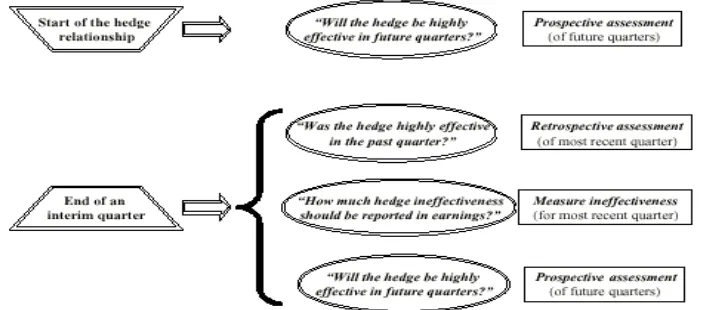
Answering the first question means providing a numerical basis, an assessment, of why it is expected the hedge to be highly effective. This numerical basis must be fixed in advance and becomes a hurdle that the hedge must clear in order to receive any special accounting treatment at all. In addition, it is required that this question be addressed at the initiation of the hedge and on an ongoing basis, at a minimum once a quarter. In advance of a quarter, the reporting entity must assess the hedge effectiveness for the coming quarter. At the end of a quarter, it must also assess the hedge effectiveness for the past quarter. These two assessments, which are going to be explained in detail, are called “prospective” and “retrospective”.
For the second question, the change in value of the hedged item due to the risk being hedged must be measured. For fair value hedges, this determines the amount of change in the hedged item's value that is accelerated and included in current income to offset changes in the derivative's value. For cash flow hedges, this will determine the amount of the change in fair value of the derivative that can be offset and thus not affect current income.
c. Assessing the hedging instrument’s effectiveness
IAS 39 requires two kinds of effectiveness tests, as it can be seen in Figure 1:
a) A prospective effectiveness test – this is a forward-looking test. At the inception of the hedge and in subsequent periods, the hedge is expected to be highly effective in future periods. The effectiveness test must be predetermined. It is not within either the requirements, or indeed the "spirit" of the standard to select the effectiveness measurement method at the reporting date, nor is it acceptable to find later the method that "works" (Keeping, 2003). It is sensible therefore to perform some scenario analysis ahead of designating the hedge in order to determine the most appropriate and effective way of measuring hedge effectiveness for the particular relationship.
b) A retrospective effectiveness test – this is a backward looking test. When the firm prepares its interim or annual financial statements, a test of whether a hedging relationship has actually been highly effective in a past period.
been widely recognized. A possible reason for this prospective failure, emphasized by Bodurtha (2004), is the FAS 133 short-cut method exception for certain interest rate hedges. IAS 39 does not provide this exception for interest rate risk hedges. The result is that many interest rate risk hedges that qualify for short-cut method under FAS 133 (and are deemed 100% effective hedges), fail the retrospective effectiveness test of IAS 39. This is inconsistent with FASB and IASB convergence objectives. Furthermore, Bodurtha argues that since interest rate risk is, by far, the most hedged risk, this inconsistency has been part of the motivation for EU Accounting Regulatory Committee to postpone adoption of certain portions of IAS 32 and IAS 39.
Figure 1. Prospective and retrospective effectiveness test (Capozzoli, 2001)
As it can be seen in the figure above, there is a clear distinction between a forward-looking approach to measure expected effectiveness as opposed to a backward-looking approach to measure realized effectiveness. We express the opinion that the key here is that a consistent method should be applied in both cases for similar instrument types. It is unclear how one can consistently apply a scheme based on comparing historical data to measure ex-ante hedge effectiveness, especially if no historical information exist at the inception of the trade-to-hedge relationship. The obvious inconsistency is that some instruments may have "proxy" data and others do not. The alternative is the consistent application of forecasted correlations based on a variance/covariance matrix calculated from observable historical data (Lee, 2000).
4. How to Measure “Highly” Effectiveness
A highly effective hedge substantially offsets the change in the fair value (or the cash flow) of the hedged item. That is, if the hedged item in a fair value hedge appreciates by €100, then there is some range of decline in values of the hedge that can be defined as substantially offsetting this change. Defining this range is a matter of subjective judgment (Finnerty and Grant, 2006). A highly effective hedge has been suggested as offsetting at least 80% of this change and no more than 125%. Then the acceptable range of the change in value for the derivative would be between –€80 and €125. This method of testing for effectiveness has the additional merit that it leads directly to the accounting treatment of the change in value of the derivative. Highly effective hedge substantially offsets risk associated with the change in the fair value (or the cash flow) of the hedged item. A widely accepted measure of risk is variance. Estimating variances requires multiple observations.
accountants admit that the practical development and interpretation of appropriate hedge effectiveness tests is far from clear-cut (JP Morgan, 2003). Furthermore, seemingly minor aspects in the design of the tests can have a significant impact on hedge effectiveness results. Corporations must therefore design their hedge effectiveness tests carefully to ensure that the economic reality of the hedging relationship is aligned as closely as possible with the accounting requirements.
In order to qualify for hedge accounting, and thereby avoid unwanted earnings volatility, a derivative must be formally designated as a hedge at inception and the effectiveness of the hedging relationship must be regularly evaluated and verified with a numerical effectiveness test. Generally, any hedging application follows a few steps (adapted from JP Morgan, 2003).
Step 1: careful definition and documentation of hedging objectives. This includes first defining the underlying hedged item and then the designated risk to be hedged. A clear specification of the designated risk is particularly important, involving four main elements: ■ Performance metric: e.g., fair value or cash flow;
■ Risk class: e.g., interest rate risk, foreign exchange risk, commodity, price risk, etc.;
■ Amount of the underlying being hedged: how much of the underlying exposure is being hedged;
■ Desired risk characteristics: this refers to the risk characteristics which are desired after hedging, e.g., for a fair value hedge of interest - rate risk, the desired risk characteristics might be 3 - month Libor, etc.;
Step 2: defining the hedging instrument and the hedge ratio. The hedge ratio determines how many units of the hedging instrument are used to hedge one unit of the underlying. Ideally, one should select the optimal hedge ratio, corresponding to the maximal reduction in risk.
Step 3: selecting the methodology for evaluating hedge effectiveness. This is in many ways the most important and challenging step, since an inappropriate choice of methodology can lead to spurious and misleading hedge effectiveness results.
Step 4: the implementation step, which means actually evaluating the effectiveness test, as defined by the methodology selected in the previous step. This step is conceptually very simple, but it is typically extremely time-consuming to perform. It involves first using historical data to generate scenarios for prospective and/or retrospective testing, then evaluating the changes in fair value in each scenario, and finally actually performing the test.
Step 5: interpretation. The effectiveness results need to be interpreted in the context of the hedging objectives set out in Step 1. This interpretation is usually facilitated by defining “effectiveness thresholds”, which provide an easy translation of the numerical results into a “pass” or “fail” signal. Different types of tests have different types of thresholds. Note, however, that the linkage between effectiveness thresholds and the true level of effectiveness of a given hedge is highly dependent on the effectiveness methodology, in particular, how much historical data is used, and what type of test is being performed. Hence, caution needs to be exercised in setting appropriate threshold levels for different tests in different hedging situations.
The specific method of how one is going to assess the effectiveness of a hedge must be detailed up front in the formal documentation. There are a number of potential methods for measuring hedge effectiveness, not all of which will be appropriate to each type of hedge, and hence it is necessary to give some consideration to which method will be applied as this could prove crucial when the test is performed. The most common methods used are:
a. Critical terms comparison
b. The dollar-offset method
Provides a strict test of whether the hedge fulfils the requirements of paragraph AG105 in the foregoing period. The test is effective but can easily disqualify a high quality hedge due to uncharacteristic behaviour in a single testing period.
This method consists of comparing the change in fair value of the hedging instrument with the change in fair value of the hedged item. This ratio, typically calculated as a percentage, should be within a range of 80-125% or 80-120%. Otherwise, the hedge is not highly effective, and it should be discontinued. In practice, many use the 80-125% range. This test can be performed either on a cumulative basis (with the comparison performed from the inception of the hedge), or on a period-by-period basis (with comparison performed from the last testing date), both being acceptable. The cumulative period is recommended since the dollar-offset ratio over a longer period should be more stable than the ratio over a shorter period and thus less likely to fall outside of the range (Wallace, 2003). There is a risk, particularly in complex interest rate hedging, that small changes in interest rates will cause small changes in the dollar-offset's numerator and denominator that will result in large numbers wildly outside the 80-125% range, even though the small changes are immaterial by themselves.
Finnerty and Grant (2006) emphasise that anyone choosing this test should be aware that researchers question its reliability because of its excessive sensitivity to small changes in the value of the hedged item or the derivative.
c. Regression analysis
This is the most common statistical method, according to Wallace (2003). Briefly, it allows regressing on price levels, rather than changes in prices, since one could have highly correlated prices but not highly correlated price changes. This method consists of measuring the strength of the statistical relationship between the hedged item and the hedging instrument. According to Lopes (2006), regression analysis is a means of expressing how one variable (the dependent) varies with changes in another variable (the independent). In the context of hedging effectiveness, the dependent variable reflects the change in the value of the hedging instrument and the independent variable the change in the value of the hedged item. Then, critical tests determine the effectiveness of the hedge. Market practice agrees that the R2
must be 80% or better to be considered highly effective. One important factor to consider is the period of time over which the regression analysis should be conducted. Clearly, one would want a period sufficiently long to “dampen” any current period volatility that could cause an R2
< 80% (Wallace, 2003).
d. Value-at-risk like approach
This is an alternative to regression analysis that is known either as the “volatility reduction method”, or as the “variance reduction method” (VRM). It calculates the reduction in the volatility after the hedge compared to the volatility of the hedged item alone. As with regression analysis, this statistic is calculated over an historic period using historic rates, consistent with how both changes are defined in the hedge documentation, which is generally going to be on a full market value basis. If this was greater than some agreed-upon parameter, say 80% (in other words, the volatility of the position has been reduced by the hedge by 80%), then the hedge relationship would pass this test.
Generally, it is better to use any kind of statistical test, rather than the dollar-offset method, for hedging relationships in which there is basis risk or relatively large imperfect matching of the critical terms or, especially, when there is portfolio hedging.
strategy.” The key concept introduced by both Statements is consistency with respect to the entity's risk management strategy (Lee, 2000). Any change of measurement method will need to be justified and the trade-to-hedge relationship will need to be designated anew. Moreover, “an entity should assess effectiveness for similar hedges in a similar manner; use of different methods for similar hedges should be justified.”
A hedge is regarded as highly effective only if both of the following conditions are met:
a) The hedge passes the prospective test. That is, at the inception of the hedge and in subsequent periods, the hedge is expected to be highly effective. This expectation can be demonstrated in various ways: a comparison of past changes in the fair value or cash flows of the hedged item that are attributable to the hedged risk, with past changes in the fair value or cash flows of the hedging instrument, or by demonstrating a high statistical correlation between the fair value or cash flows of the hedged item and those of the hedging instrument. In this test, IAS 39 does not require a hedge ratio one to one. In order to improve hedge effectiveness, the amount of the hedging instrument may be greater or less than that of the hedged position;
b) The actual results of the hedge are within a range of 80% –125%; for example: If actual results are such that the loss on the hedging instrument is €120 and the gain on the cash instrument is €100, offset can be measured by 120/100, which is 120%, or by 100/120, which is 83%. In this example, assuming the hedge meets the condition in a), the entity would conclude that the hedge has been highly effective.
The Discussion Papers (jointly developed by the IASB and a number of national standard setters) and the Exposure Drafts (the FASB and IASB each had their own version) originally intended to prescribe a specific hedge effectiveness test. The test was thought to be a straightforward measurement of the statistical correlation between the hedge and the hedged portfolio. Subsequently, such a position was reversed due to controversies over the difficulty of implementing such a measure and the lack of consensus over a "proper" measure of correlation. Since observed correlations are known to break down during volatile market circumstances, such a scheme can be seen as imposing artificial constraints on hedgers by encouraging hedges that may be biased in favour of accounting treatments instead of hedging economics (Lee, 2000). Furthermore, the fact that a hedge and its hedged portfolio may be highly correlated statistically does not necessarily immunize the portfolio from unexpected large fluctuations that the Statements intend hedging entities to recognize in earnings.
5. Recognition of realised ineffectiveness
The accounting standards regarding accounting for hedge require that all ineffectiveness in a hedging relationship is captured and reported immediately in earnings. The entity should be able to demonstrate the ineffectiveness, whether systems-based or manual. A further point is that where cash flow hedge accounting is being applied, the entity will need to ensure that the re-cycling from equity is taken to the income statement as and when appropriate.
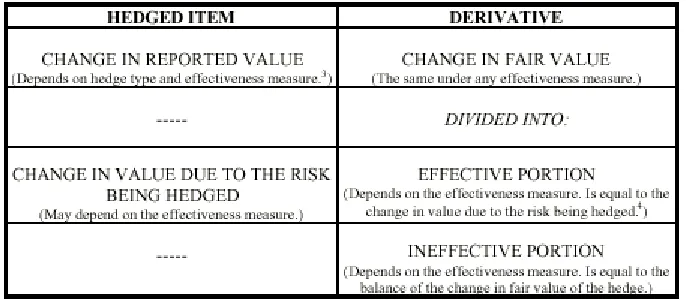
To assess the exact amount of hedge ineffectiveness, the corporation needs to define the risk being hedged and to describe the method to measure the change in value of the hedged item due to the risk being hedged. Once the amount of change in the underlying is known, the effective portion of the derivative's change in value can be calculated. Hedge ineffectiveness is then nothing more than the difference between the full change in fair value and the effective portion of that change (Capazzoli, 2001). Figure 2 illustrates this relationship.
6. Conclusion
We express the opinion that designing appropriate hedge effectiveness tests is a challenge.
practice is not straightforward for several reasons. First, the accounting standards provide considerable flexibility in how hedge effectiveness tests are designed and implemented. While this leeway is essential to align the test with the company’s risk management strategy, the lack of explicit implementation guidance provides insufficient direction for all but the most sophisticated corporations. Secondly, the high level of complexity attached to the standards, together with considerable uncertainties concerning implementation and interpretation, have made it difficult to identify hedge effectiveness methodologies that are consistent with the accounting standards and yet still sensible in economic terms. Third, it is easy to end up with inappropriate effectiveness tests by overlooking small, but significant, elements in the testing methodology.
Figure 2. Hedge effectiveness and ineffectiveness (Capazzoli, 2001)
Another problem is that reporting changes in the fair value of a derivative in earnings each quarter could create a matching problem. If the derivative is being used as an economic hedge, changes in the value of the derivative might increase (or decrease) reported earnings one period while the opposite change in the value of the hedged item affects earnings in a later period (Finnerty and Grant, 2002).
Hedges must be proved effective in advance and retrospectively, with the IASB insisting on "almost perfect offset" being proved at the outset. Failure means the net change in the value of the derivative is immediately and fully recorded in current earnings, with different treatments for the effective portions of cash flow and fair value hedges. More commonly, at least at the start of the compliance effort, treasurers are focused to qualify existing hedges, by any means necessary, but as soon as there are trades that don't fit, more “creative” assessment methodologies are tried. With both IAS 39 and FAS 133 demanding prospective as well as retrospective demonstration of hedge effectiveness, firms must declare in advance the methodologies they intend to use, constricting the treasurer's room for manoeuvre in the future. We conclude that it is very hard to state the procedures with sufficient specificity to qualify and yet to have flexibility to make the adjustments that might later be necessary.
Finally, we emphasise that, according to a survey made by Schraeder and Walterscheidt in Germany 2009, of the three financial risks examined - currency, interest and commodity price risks - the currency risk assumes on average the greatest importance for the interviewed companies. 62% of companies attribute to this risk considerable or extreme importance.
Interest risks are considered on average to be the second most important financial risks to which companies are exposed and commodity price fluctuation is considered the risk of least importance, but the assessment also showed that these results are dependent on the type of companies’ activities. Barely two thirds of all interviewed companies apply hedge accounting in accordance with IAS 39 to disclose their financial economic hedging activities.
securing activities, this proportion is reduced to just over one third (34.2%) in the case of smaller companies.
The most important influencing factors for the decision, concerning the use of hedge accounting, are the expected effectiveness of the securing methods, as well as the volatility of results which would be anticipated without the use of hedge accounting. A critical point, in addition to the lack of practicability, is the administrative expenditure incurred by application of IAS 39, which is considered excessive particularly by non-users in relation to the benefit derived from it.
In the real market environment, a hedge relationship is dynamically changing, as volatilities may change independent of each other - making adjustments necessary. Thus, a dynamic hedge optimization targets to optimally modify the contribution of hedging instruments and hedged items and to adjust this effectively according to their offsetting capabilities, in order to keep the hedge relationship stable. The conclusion is that in order to ensure the highly effectiveness of hedging strategy, the following are necessary: an optimal selection of the most effective hedging instruments that are offsetting the risk exposure of the hedged items is necessary, and an optimal selection of the hedged items that can be hedged by the available hedging instruments.
7. References
1. Akkizidis, I., 2006, Hedge optimization with IAS 39, B&F Banking Solutions, September, www.riskwhoswho.com/Resources/AkkizidisIoannis2.pdf
2. Bodurtha, J. N., Jr., 2004, Rev. 2005, Divergent FAS-133 and IAS 39 Interest Rate Risk Hedge Effectiveness: Problem and Remedies, http://faculty.msb.edu/bodurthj/research/Divergent_FAS-133_and %20IAS_39_Interest_Rate_Risk_Hedge%20Effectiveness.pdf
3. Capozzoli, A., 2001, What Is FAS 133 Effectiveness and When Does It Matter?, Bank of America Journal of Risk Analysis, February, http://www.gtnews.com/article/2701.cfm
4. Bunea-Bontas, Cristina Aurora, Basic Principles of Hedge Accounting (July 28, 2009). Economy Transdisciplinarity Cognition, 2009. Available at SSRN: http://ssrn.com/abstract=1440221
5. Charnes, J. M., Berkman, H., Koch, P., 2002, Measuring Hedge Effectiveness for FAS 133 Compliance, School of Business Working Papers, http://home.business.ku.edu/finance/doc/koch.pdf
6. Coughlan, G., 2004, Corporate risk management in an IAS 39 Framework, JP Morgan,
7. Finnerty, J. D., Grant, D., 2002, Alternative Approaches to Testing Hedge Effectiveness under SFAS No. 133, Accounting Horizons, Vol. 16, http://www.questia.com/googleScholar.qst
8. Finnerty, J. D., Grant, D., 2006, Testing Hedge Effectiveness Under SFAS 133,
http://www.nysscpa.org/cpajournal/2003/0403/features/f044003.htm
9. IASB, 2008, International Financial Reporting Standards (IFRSs), including International Accounting Standards (IASs) and Interpretations as approved at 1st January 2008, IASCF, http://books.google.com 10. JP Morgan, 2003, HEAT™: A framework for evaluating hedge effectiveness, http://www.jpmorgan.com/pages/jpmorgan/investbk/heat
11. Keeping, B., 2003, IAS-39 - A Challenge Today, Not Tomorrow - Part Two, Financial Instruments Tax and Accounting Review, July, http://www.gtnews.com/article/5087.cfm
12. Lee, B., 2000, A Consistent Approach to Measuring Hedge Effectiveness, Financial Engineering News, February, http://www.cs.trinity.edu/~rjensen/readings/EffectivenessByBernardLee.htm
13. Lopes, P. T., 2006, Accounting for electricity futures under IAS 39. A report by Faculty of Economics - University of Porto, October, http://www.omip.pt/conteudos/docs/
14. Schraeder, T., Walterscheidt, S., 2009, Hedge Accounting in accordance with IAS 39: Driving force or impediment to economically meaningful risk management?, Corporate Treasury in Germany, http://www.treasury-management.com/articles/4/1/TMIGermany09%20P20%20Hedge.pdf
15. Wallace, J., 2003, Made to Measure, Greenwich Treasury Advisors, April, http://www.gtnews.com/article/4959.cfm