http://dx.doi.org/10.4236/opj.2016.64008
How to cite this paper: Mirzaei, M., Behrouzinia, S., Sabaghi, M., Marjani, S., Khorasani, K. and Sajad, B. (2016) Experimen-tal Optimization of the Output Power of a Copper Vapor Laser Using Air as a Buffer Gas. Optics and Photonics Journal, 6, 53- 59. http://dx.doi.org/10.4236/opj.2016.64008
Experimental Optimization of the Output
Power of a Copper Vapor Laser Using Air as
a Buffer Gas
Mahboobeh Mirzaei1, Saeid Behrouzinia2*, Masoud Sabaghi2, Saeid Marjani3, Kamran Khorasani2, Batool Sajad1
1Department of Physics, Alzahra University, Tehran, Iran
2Laser and Optics Research School, Nuclear Science and Technology Research School, Atomic Energy Organization of Iran, Tehran, Iran
3Department of Electrical Engineering, Ferdowsi University of Mashhad, Mashhad, Iran
Received 4 March 2016; accepted 18 April 2016; published 21 April 2016
Copyright © 2016 by authors and Scientific Research Publishing Inc.
This work is licensed under the Creative Commons Attribution International License (CC BY).
http://creativecommons.org/licenses/by/4.0/
Abstract
In order to investigate the effect of the pressure buffer gas and frequency on the output power, a copper vapor laser with active medium length of 60 cm and bore of 16 mm has been operated and optimized using air as a buffer gas. The observed oscillatory behavior of the output power versus frequency is in good agreement with the previous reports. The measured results show the maxi-mum output power of ~1.6W at the optimaxi-mum pressure of 3.8 torr and frequency of 17 kHz. Abun-dance of the air and reduction of the system volume due to elimination of the gas handling system as well as the economically benefits are the advantages of the employing air as a buffer gas in the copper vapor laser operation.
Keywords
Experimental Optimization, Copper Vapor Laser, Air Buffer Gas
1. Introduction
The lasers are devices that emit light coherently through a process of optical amplification based on the stimu-lated emission of photons. There are many different kinds of lasers for different and specific uses [1]-[28]. One of the lasers with high average power in the visible region at 510.6 nm and 578.2 nm is the copper vapor laser
cuit [30]. In order to minimize the effect of inelastic electron collisions on the energy distribution function, the non-reactive inert gases with high excitation and ionization energies have been employed as the buffer gases such as He, Ne, Ar, Kr, Xe and their mixtures gases. He gives longer and lower discharge current pulses [30]. Neon enables laser oscillation at the highest gas pressure and obtained the highest output power among of them
[35]. The weak oscillations are provides with N2[36], H2, and CO2 buffers [37]. The Ne buffer gas with adding of H2 extremely improves CVL performance [38][39]. Recently, we reported the gold vapor laser with Heas a buffer gas to comparison output power and the stability [40]. In this work, a CVL has been operated using air as a buffer gas and the behavior of the laser output power versus discharge frequency and gas pressure have been investigated to obtain the optimum conditions. Furthermore, formed layer and pollutions on the tube laser has been analyzed by XRD instrument and FTIR spectrometer to find layer compositions. Affluence of the air and reduction of the system volume due to eliminating of the gas handling as well as the thriftily benefits are the ad-vantages of the using air as a buffer gas in the CVL operation in some researchers or educational cases. The pa-per is organized as follows: the expa-perimental setup is described in Section 2. Section 3 presents the obtained re-sults and discussion. The concluding remarks are given in Section 4.
2. Experimental Setup
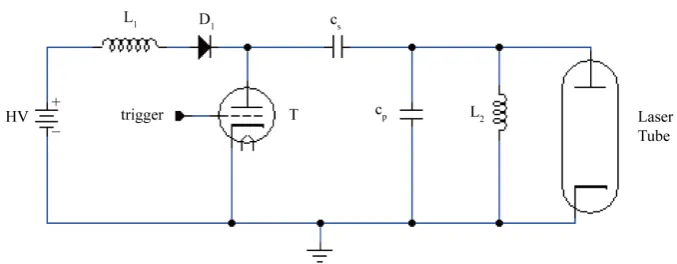
The material of discharge tube is Alumina that its inner diameter and active medium length are 16 mm and 60 cm, respectively. It surrounded by a fibrous alumina insulation covering with a Pyrex tube and an external stainless steel jacket. In order to discharging, two molybdenum cylindrical electrodes are used. The back and front mirrors are consist of the couple of flat-flat resonator with reflectivity of 98% and 4%, respectively. As il-lustrated in Figure 1, the standard driven circuit is coupled to the laser tube. By the discharge of a 1.65-nF main capacitor (Cs) through the TGI1-1000/25 Thyratron, the tube gas is excited. A 0.68-nF peaking capacitor (Cp) is
connected between the tube electrodes as well as the 0.15 mH inductance (L2).
The experimental characteristics of the laser output are measured by a TektronixTM oscilloscope; model TDS- 1250, a MolectronTM PM500D powermeter, and a semiconductor detector model pbx-65. A FTIR spectrometer and XRD instrument are exploited to determine the chemical elements level to study the composition of the formed layer at the ends of laser tube.
3. Results and Discussion
Figure 1. Schematic layout of standard driven circuit of CVL.
14 16 18 20 22 24
0.2 0.4 0.6 0.8 1.0 1.2 1.4 1.6 1.8
P=7.8 torr P=6.2 torr P=5.3 torr
P=3.8 torr
P=2 torr
Pou
t
(W
)
[image:3.595.195.432.241.415.2]F(kHz)
Figure 2.The output power versus frequency at some various air
pressures.
that the non-radiative deactivation vastly increases, when the excitation frequency is equivalent to the acoustic resonant mode of laser tube [41].
Figure 3 illustrates the behavior of the output power versus the pressure of air buffer gas at some frequencies.
At first, the output power increases by increasing the air pressure for all frequencies. After reaching to a maxi-mum value, it reduces at higher pressures. The reduction of the output power is due to increases in collision and relaxation of excited copper atoms. It is seen that the maximum output power at all frequencies occurs at ~3.8 torr of the air pressure. Compared with other buffer gases like He and Ne, the output power of CVL with air as buffer gas is decreased in the same discharge frequency due to exuberance of impurities in air, which alter the condition of population inversion. Meanwhile the optimum Ne pressure for this laser is about 25 torr that is 6 times more than that of air one. Furthermore, it is observed that the peak power is reduced from 1.6 to 1.27 W by increasing of frequency from 17 to 22 kHz due to the increasing in the inter pulse population of the lower la-ser level and the inter pulse electron density.
Abundance of the air and reduction in volume of the laser system due to elimination of the gas handling as well as the economic benefits are the advantages of the air where is using as a buffer gas in the CVL operation, in some research or educational specific cases. However, the laser tube is polluted after some operation such that some populace in red color are deposited at one of the tube end and a black color one is deposited at the other side, as shown in Figure 4. The Laser tube is polluted after some operation, which causes the lifetime of the tube would decrease the output power of CVL, and no effect on frequency operation. However, pollution can be eliminated by cleaning of tube through removal of pollutant.
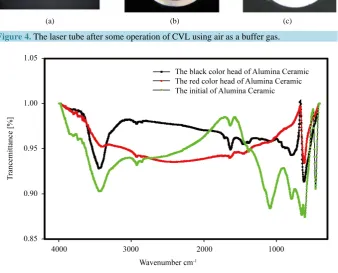
The deposited samples at each ends of the laser tube are analyzed by FTIR spectrum and XRD instruments to determine the component of composition. Figure 5 displays FTIR spectrum before and after some laser opera-tion.
0 2 4 6 8 0.0
0.2
[image:4.595.187.442.84.253.2]P(torr)
Figure 3. The output power versus air buffer gas pressures at some frequencies.
[image:4.595.145.487.281.387.2](a) (b) (c)
Figure 4. The laser tube after some operation of CVL using air as a buffer gas.
Figure 5. FTIR spectrum of the laser tube.
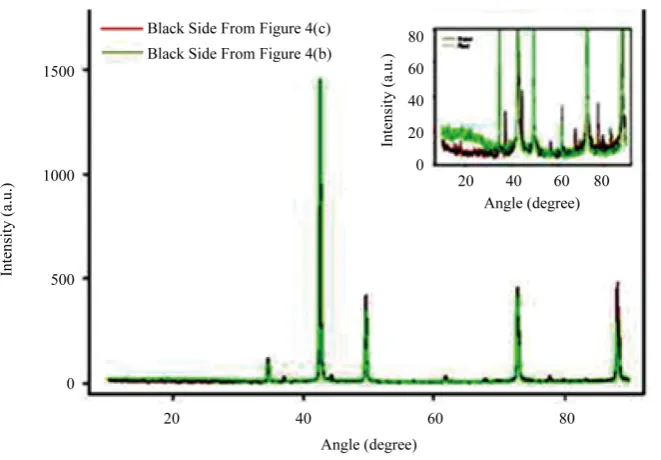
determined to be copper oxide in the red side and the copper oxide, the copper aluminum oxide and the copper sulfate hydroxide at the other one. It is emphasized by XRD spectrums, as shown in Figure 6.
4. Conclusion
[image:4.595.145.484.360.633.2]Figure 6.XRD spectrum of the laser tube. Black and redsides indicate copper oxide; and copper oxide and copper aluminum oxide and copper sulfate hydroxide, respectively.
in terms of the discharge frequency and gas pressure to determine the optimum condition. The oscillatory beha-vior of the output power versus frequency is observed which is in agreement with previous reports. The output power versus pressure is also studied to measure the maximum output power of ~1.6 W at the optimum pressure of 3.8 torr and at 17 kHz of frequency. Abundance and easy access of air as buffer gas and reduction of the weight volume of the laser system due to eliminating the gas handling as well as the economic benefits are the advantages of the air as a buffer gas for some research or educational specific cases. However, by using air as a buffer gas, the lifetime of the tube would be decreased.
References
[1] Marjani, S. (2013) Various Elements of Heat Sources within an Optimized Photonic Crystal Vertical Cavity Surface Emitting Laser: Influence of Hole Etching Depth. Asian Journal of Chemistry, 25, 4153-4156.
http://dx.doi.org/10.14233/ajchem.2013.13281
[2] Rafighi, F., Behrouzinia, S., Khorasani, K., Sabaghi, M. and Marjani, S. (2016) The Electrical Parameters Modeling and Experimentation of Copper Vapor Laser. Circuits and Systems, 7, 23-28. http://dx.doi.org/10.4236/cs.2016.71003
[3] Behrouzinia, S., Khorasani, K., Marjani, S., Sabaghi, M., Aeinehvand, M.E. and Mohammadpour Lima, S. (2016) Ex-perimental Study of Buffer Gas Flow Rate Effect on Output Power of a Copper Vapor Laser. Optics and Photonics
Journal, 6, 24-28. http://dx.doi.org/10.4236/opj.2016.62004
[4] Marjani, S. (2013) Optimization of an InGaAsP Vertical-Cavity Surface-Emitting Diode Lasers for High-Power Single- Mode Operation in 1550 nm Optical-Fibre Communication Systems. Asian Journal of Chemistry, 25, 4150-4152.
http://dx.doi.org/10.14233/ajchem.2013.13186
[5] Faez, R., Marjani, A. and Marjani, S. (2011) Design and Simulation of a High Power Single Mode 1550nm InGaAsP VCSELs. IEICE Electronics Express, 8, 1096-1101. http://dx.doi.org/10.1587/elex.8.1096
[6] Marjani, S., Faez, R. and Hosseini, S.E. (2013) Threshold Characteristics Analysis of InP-Based PhC VCSEL with Bu-ried Tunnel Junction. The 21st Iranian Conference on Electrical Engineering (ICEE), Ferdowsi University of Mashhad, Mashhad, 1-4. http://dx.doi.org/10.1109/iraniancee.2013.6599783
[7] Majdabadi, A., Marjani, S. and Sabaghi, M. (2014) Threshold Characteristics Enhancement of a Single Mode 1.55 μmInGaAsP Photonic Crystal VCSEL for Optical Communication Systems. Optics and Photonics Journal, 4, 296-303.
http://dx.doi.org/10.4236/opj.2014.410029
[8] Marjani, S., Faez, R. and Marjani, H. (2011) An Impact of the Hole Etching Depth within a Photonic Crystal VCSEL on Its Heat Sources. Australian Journal of Basic and Applied Sciences, 5, 766-770.
[14] Marjani, S. and Marjani, H. (2011) Analysis of Lattice Temperature Effects on a Long Wavelength InGaAsP Photonic Crystal VCSEL. Australian Journal of Basic and Applied Sciences, 5, 1374-1378.
[15] Marjani, S. and Marjani, H. (2012) Optimization of a Long Wavelength Vertical-Cavity Surface-Emitting Lasers by Employing Photonic Crystal. Asian Journal of Chemistry, 24, 3174-3176.
[16] Marjani, S. and Marjani, H. (2012) Self-Heating Effects in a Silicon Carbide Polymers (6H-SiC and 3C-SiC) Semi-conductor Laser. Asian Journal of Chemistry, 24, 3145-3147.
[17] Marjani, S. and Marjani, H. (2012) Effects of Hole Etching Depth in a Long Wavelength InGaAsP Photonic Crystal Vertical Cavity Surface Emitting Laser. Asian Journal of Chemistry, 24, 3194-3196.
[18] Marjani, S. and Marjani, H. (2012) Effects of Lattice Temperature on the Various Elements of Heat Sources in Silicon Carbide Polymers (6H-SiC and 3C-SiC) Semiconductor Laser. Asian Journal of Chemistry, 24, 3123-3125.
[19] Marjani, S., Faez, R. and Marjani, H. (2012) Analysis of the Various Elements of Heat Sources in Silicon Carbide Po-lymers (6H-SiC and 3C-SiC) Semiconductor Laser. Asian Journal of Chemistry, 24, 2333-2335.
[20] Marjani, S., Faez, R. and Marjani, H. (2012) Design and Modeling of a Semiconductor Laser by Employing Silicon Carbide Polymers (6H-SiC, 3C-SiC and 4H-SiC). Asian Journal of Chemistry, 24, 2177-2179.
[21] Marjani, S., Faez, R. and Hosseini, S.E. (2013) Analysis of Lattice Temperature Effects on a GaInP/6H-SiC Strained Quantum-Well Lasers. Asian Journal of Chemistry, 25, 4715-4717.
[22] Madadi, R., Marjani, S. and Faez, R. (2013) Silicon Carbide Polymers (6H-SiC, 3C-SiC and 4H-SiC) Semiconductor Laser: Influence of Self-Heating. The 3rd Iranian Conference on Optics and Laser Engineering (ICOLE), Isfahan, 8-10 October 2013, 1069-1072.
[23] Naeemi, M.A., Marjani, S. and Peiravi, A. (2014) Time to Failure Analysis of Single Mode Long-Wavelength In-GaAsP Vertical-Cavity Surface-Emitting Lasers. The 22st Iranian Conference on Electrical Engineering (ICEE), Te-hran, 20-22 May 2014, 43-47. http://dx.doi.org/10.1109/iraniancee.2014.6999500
[24] Khosroabadi, S., Keshmiri, S.H. and Marjani, S. (2014) Design of a High Efficiency CdS/CdTe Solar Cell with Opti-mized Step Doping, Film Thickness, and Carrier Lifetime of the Absorption Layer. Journal of the European Optical
Society, 9, 14052-1-14052-6. http://dx.doi.org/10.2971/jeos.2014.14052
[25] Sabaghi, M., Majdabadi, A., Marjani, S. and Khosroabadi, S. (2015) Optimization of High-Efficiency CdS/CdTe Thin Film Solar Cell Using Step Doping Grading and Thickness of the Absorption Layer. Oriental Journal of Chemistry, 31, 891-896. http://dx.doi.org/10.13005/ojc/310232
[26] Sabaghi, M., Majdabadi, A., Khosroabadi, S. and Marjani, S. (2015) A Novel Ultrathin CdS/CdTe Solar Cell with Conversion Efficiency of 31.2% for Nano-Area Application. Proceedings of the Progress in Electromagnetics
Re-search Symposium (PIERS), Prague, 6-9 July 2015, 1152-1155.
[27] Marjani, S., Khosroabadi, S. and Sabaghi, M. (2016) A High Efficiency Ultrathin CdTe Solar Cell for Nano-Area Ap-plications. Optics and Photonics Journal, 6, 15-23. http://dx.doi.org/10.4236/opj.2016.62003
[28] Sabaghi, M., Majdabadi, A. and Oskui, H.S. (2007) Intelligent Controlling on Diode Laser Wavelength Based Embed-ded System. The International Universities Power Engineering Conference (UPEC), Brighton, 4-6 September 2007, 387-391.
[29] Withford, M.J., Brown, D.J.W., Mildren, R.P., Carman, R.J., Marshall, G.D. and Piper, J.A. (2004) Advances in Cop-per Laser Technology: Kinetic Enhancement. Progress in Quantum Electronics, 28, 165-196.
http://dx.doi.org/10.1016/j.pquantelec.2003.12.001
[30] Little, C.E. (1999) Metal Vapor Lasers. John Wiley & Sons, Chichester.
[31] Huang, Z.G., Namba, K. and Shimizu, F. (1986) Influence of Molecular Gases on the Output Characteristics of a Cop-per Vapor Laser. Japanese Journal of Applied Physics, 25, 1677-1679. http://dx.doi.org/10.1143/JJAP.25.1677
[32] Grant, B. (1997) Lasers Improve Uranium Enrichment. Photonics Spectra.
[33] Behrouzinia, S., Sadighi, R. and Parvin, P. (2003) Pressure Dependence of Small-Signal Gain and Saturation Intensity of a Copper Vapor Laser. Applied Optics, 42, 1013-1018. http://dx.doi.org/10.1364/AO.42.001013
[34] Behrouzinia, S., Sadighi, R. and Parvin, P. (2004) Temperature Dependence of the Amplifying Parameters of a Copper Vapor Laser. Laser Physics, 14, 1050-1053.
[35] Lesnoi, M.A. (1984) Influence of Te Gas Mixture Composition and Cathode Material on the Output Power of Copper Vapor Laser. Soviet Journal of Quantum Electronics, 14, 142-148.
http://dx.doi.org/10.1070/QE1984v014n01ABEH004664
[36] Ferrar, C.M. (1974) Buffer Gas Effects in a Rapidly Pulsed Copper Vapor Laser. IEEE Journal of Quantum Electron-ics, 10, 655-657. http://dx.doi.org/10.1109/JQE.1974.1068371
[37] Bokhan, P.A. and Solomonov, V.I. (1974) Mechanism of Laser Action in Copper Vapor. Soviet Journal of Quantum
Electronics, 3, 481-486. http://dx.doi.org/10.1070/QE1974v003n06ABEH005640
[38] Withford, M.J., Brown, D.J.W., Coutts, D.W. and Piper, J.A. (1995) Copper Vapor Laser Unstable Resonator Oscilla-tor and OscillaOscilla-tor-Amplifier Characteristics. IEEE Journal of Quantum Electronics, 31, 898-902.
http://dx.doi.org/10.1109/3.375935
[39] Hayashi, K., Iseki, Y., Szuki, S., Watanabe, I., Noda, E. and Morimiya, O. (1992) Improvement in the Output Charac-teristics of a Large-Bore Copper Vapor Laser by Hydrogen. Japanese Journal of Applied Physics, 31, 689-697.
http://dx.doi.org/10.1143/JJAP.31.L1689
[40] Khorasani, K., Behrouzinia, S. and Salehinia, D. (2008) Air as a Buffer Gas in Metal-Vapor Lasers. Journal of Russian
Laser Research, 29, 599-603. http://dx.doi.org/10.1007/s10946-008-9047-9
[41] Zoghi, M., Parvin, P., Behrouzinia, S., Salehinia, D., Kharasani, K. and Mehravaran, H. (2009) Acoustic Effects of Metal-Vapor Lasers. Applied Optics, 48, 3460-3467. http://dx.doi.org/10.1364/AO.48.003460
[42] Kharasani, K., Salehinia, D., Behrouzinia, S., Sajad, B. and Parvizian, M. (2008) Frequency Dependence of the Output Power of Metal Vapor Lasers. Optics Communications, 281, 3799-3801.