Munich Personal RePEc Archive
Impact of Selectivity and Neutrality of
trade Policy Incentives on
Industrialization of Developing
Countries; Implications for NAMA
Negotiations
Shafaeddin, Mehdi
Institute of Economic Reaearch, University of Neuchatel
10 March 2009
Online at
https://mpra.ub.uni-muenchen.de/15037/
February2009
Impact of Selectivity and Neutrality
of Trade Policy Incentives on Industrialization of Developing Countries;
Implications for NAMA Negotiations
M. Shafaeddin*
---
Table of contents
Page
I. Introduction
II. Theoretical issues
1. Supply response to relative prices 2. The scarcity argument
3. Externality argument 4. Strategic trading
III. Historical evidence
1. Selectivity, the role of Government, market and enterprises; the case
of Republic pf Korea
2. The role of other factors 3. Other countries
4. Preconditions for selective intervention
IV. Recent empirical evidence 1. Methodology and data 2. Results
V. New forms of competition and the growing need for selectivity
1. New methods of production and competition 2. The role of FDI
IV. Conclusions and implications for negotiations on NAMA and other trade agreements
I. Introduction
In the Doha Declaration taking full account of the special needs and interests of
developing and least developed countries was a stated objective of the Doha Development Round
of trade negotiation on NAMA. In particular, developing countries were supposed to receive
special and differential treatments which according to Article XXVIIIbis (para 3.b) of
GATT/WTO included their need for “more flexible use of tariffs protection” (Shafaeddin, 2009).
The flexible use of tariffs would imply that the tariff structure of developing countries would be
such that it would allow discriminatory and dynamic trade policy. Discriminatory use of tariffs
means that different tariff rates could be applied to different industries in each point time;
dynamic trade policy would imply that the tariff rates and structure could change over time.
In practice during the negotiation on NAMA developed countries have been trying to
impose on developing countries changes in the tariffs contrary to the stated objectives and spirit
of the Round. Their proposals for tariff rates of developing countries for negotiation has four
main elements: drastic reduction in the level and dispersion of tariffs rates; binding of individual
tariffs lines at reduced (low) levels; zero tariffs for some products; applying the same principles
to all developing countries with a few temporary exceptions for least developed and “vulnerable”
countries. Therefore if agreed the tariff structure of developing countries would suffer not only
from low tariff rates, but more importantly from a tendency towards “uniformity”, “rigidity” and
“universality”. Uniformity would imply the tendency towards application of the same tariff rates
to all industries i.e. neutrality of tariff structure rather than selectivity. Rigidity means the lack of
flexibility in changing tariff rates over time for pursuing a dynamic trade policy. Universality
development and industrial capacity-although a few exceptions are envisaged on temporary basis.
I have explained the need for industrial policy and outline elsewhere the elements of a
dynamic and flexible trade and industrial policies (Shafaeddin, 2005.b and 2006.b). The purpose
of this study is two fold. The first is to argue for the need for selectivity of the tariff structure for
industrialization of developing countries. The second objective is to explain that the need for
selective incentive structure has increased during the last couple of decades due to changes in the
market structure and international context of industrialization and competition. Yet the means for
implementing such a strategy have been constrained by the conditionalities imposed on the
developing countries through international financial institutions, changes in international trade
rules through GATT/WTO and bilateral trade agreements between developing and developed
countries. Hence if the proposals of developed countries on NAMA are also agreed upon they
would lock production and trade structure of developing countries which are at early stages of
industrialization in primary products and resource-based products and at best in assembly
operation and labour intensive items. It also will create constrains for upgrading of the industrial
structure of those of them which have some industrial base and export capacity in manufactured
goods.
To precede, in the following section, we will shed some light on the theoretical
controversy on the implications of neutrality and non-neutrality of incentive structure for
industrialization. In sections III the historical evidence for the use of selectivity will be briefly
reviewed before providing some empirical evidence for more recent years in section IV.
Subsequently, in section V we will refer to changes in the methods of production and forms of
international competition and the increasing need for nurturing of domestic firms. The final
section will conclude the study.
literature in this respect. Trade neutrality is usually defined as a trade regime in which the
incentives given to the exports and imports as a whole are equal (Balassa, 1989). Neo-liberals
regard trade neutrality is synonymous with free trade, i.e. a situation where no incentive is
provided to either exports or imports. It should be mentioned, however, that the equality of
trade-based incentives for exports and imports can be reached at zero incentive (tariff) level or at
positive incentive (tariff) levels. In the first (restrictive) case free trade prevails, whereas in the
second (general) case export incentives offset import restrictions and other incentives given to
production for the home market. Applying the usual (restrictive) definition of trade neutrality
confuses a trade regime with high government intervention with that of free trade. Such
confusion has emerged, for example, in the case of studies on East Asian countries (Chen and
Devereoux, 1997). Note also that even when exports and imports on average may receive equal
incentives, each export and import item may receive different levels of incentives. Our definition
of neutral trade regime is the general one thus implying that a neutral trade regime may, or may
not, involve free trade.
II. Theoretical issues
The theoretical arguments pro and cons of selectivity of the incentive structure is the
extension of the argument in favour or against infant industry argument and other forms of
government intervention in trade and industrial development. The proponents of universal free
trade argue that selectivity contributes to price distortion and inefficiency because of the resultant
mis-allocation of resources. When the use of tariffs, or other forms of intervention, is accepted,
by some Neo-classical economists, for supporting infant industries, there is a bias in favour of a
uniform, and low tariff rates for all industries. For example,Haberler, the pioneer of modern
broad categories of such goods, is probably the best method of infant industry protection
(Haberler, 1959, 36). Similarly, Balassa (1975) recognizing the learning effects and externalities
involved in the promotion of new industries in developing countries, accepted temporary
protection of these industries. Nevertheless, he maintained that the tariff rates should be gradually
decreased to an across- the- board rate of about 10 per cent.
According to some economists the infant -industry case should be distinguished from the
protectionist argument. To handle special problems of infant industries, provision of selective
policy measures is acceptable. Nevertheless, these measures should address the problems directly
at their source rather than using import duties (Baldwin, 1969).
The argument on uniform tariff rates centres mainly on low administrative costs and
simplicity and easiness: as the government capacity in making and implementing decisions is
often limited in developing countries, it is easier to manage a simple and uniform incentive
structure, including tariffs, than a selective one. Moreover, it is also argued that the success of
East Asian countries is due to the provision of neutral incentives to exports and home markets
(Balassa, 1982). Even when the existence of selective intervention and incentive in the case of
East Asian countries is admitted, it is concluded that its application and emulation by other
countries can not contribute to their industrial development (World Bank, 1993). Furthermore, as
far as tariffs are concerned, it is argued that the WTO agreement makes the application of
discriminatory tariff rates often difficult.
The lack of capacity in decision making and implementation, however, should not be used
as an argument against non-neutrality of incentives. It is true that there is a positive correlation
between the decision making capability of the Government and the level of development. The
lower the level of development, the lower is the capacity of the Government machinery. The
against it as explained above. Moreover, the capacity of the government machinery can, and
should, be improved. In fact, the process of trial and error itself contributes to development of
such capacity building. It is true that mistakes may be made in the process, but if no decision is
made, or implemented, the capacity of the bureaucracy would be never enhanced. In other words,
the lack of government capacity is not an argument for lethargy. Whatever capacity exists should
be devoted to a limited number of industries on selective basis. By being active the
government may achieve its objective, or it may make mistakes. Both contribute to learning. By
being passive nothing would be achieved including gaining experience and improving its
capabilities of the government. In 1950s the Korean Government was regarded incompetent and
inefficient. Over time the managerial capabilities of the Government in all aspects of the
Governance has improved tremendously (Madsen, 1989).
The opponents of neo-liberal economists provide four main arguments in favour of
selectivity: supply response to relative prices, scarcity, externality and strategic trading.
1. Supply response to relative prices
Supply response to prices is much lower, particularly in developing countries, when all the
outputs of a sector are equally affected and stronger when relative prices increase only for one
good, or for a few goods (Streeten, 1987). Even in industrialized countries there is some evidence
that reallocation of resources from non-tradable to tradable sectors, and within tradables from
importables to exportables (and in the latter from traditional to new products), are more
responsive to targeted incentives than uniform price structure (Schydlowsky, 1982). These
general characteristics of the pricing system can be applied to relative prices of various goods
affected by tariff and non-tariff measures. As a result, if the differential prices of good A and
good B are affected by tariffs or subsidies in favour of good A, its supply will, cet. par, respond
2. The scarcity argument
The scarcity argument is complementary to the infant industry argument. Real and
financial resources, particularly foreign exchange and skilled labour are scarce in developing
countries. So is the decision making capabilities and the management capacity of the government
in developing countries at earl stages of their development. Hence, to spread resources in an
excessively diversified manner, without being able to accumulate in any sector the level
necessary to start a process of cumulative causation, is sub-optimal (Ocampo, 1986, 158).
The scarcity argument is linked with the dynamic comparative advantage theory. A
country can not by definition develop dynamic comparative advantage in all production lines.
Hence, it should concentrate on development of industries on selective basis. Specific industries,
however, require specific and specialized factors for attaining and upgrading competitive
advantage as generalized factors do not themselves provide an advantage in modern international
competitiveness. Development and upgrading of specialized and high skilled labour requires
government intervention for training in specific fields (Porter, 1990, 79) since knowledge and
skills are to a large extent industry-specific and firm specific and “occupation specific”(Lall,
2005, and Kambaourove and Manovsky,2007).
Hirschman (1958) argues that it is impossible for a truly LDC to leap forward on all
fronts simultaneously . The debate he started on the theory of unbalancedgrowth, vis-à-vis, the
theory of balanced growth was in fact a debate on selectivity verses uniformity in the general
context of development rather than trade and industrialization per se. The theories of balanced
and unbalanced growth have three main features in common. One is the belief in the market
failure and the need for government intervention. Another is the important role played by capital
accumulation in the process of development. The third feature is the importance given to
one important respect. According to the theory of balance growth, industrialization should start
on all front in a balance manner (Rosenstein-Rodan, 1943, Fleming, 1955 and Murphy, et. al,
1989). By contrast Hirschman argued that it was impossible to develop on all front
simultaneously mainly because of the scarcity of resources, particularly the decision making
ability in combining various factors of production. For this reason, he added: .. The fundamental
problem of development consists in generating and energizing human action in a certain
direction. (Ibid:25). To him, the scarcity of financial and physical resources and market
imperfection were not the only obstacles to development; imperfection in making development
decisions was a more important obstacle: The taking of development decisions is held back, not
by physical obstacles and scarcities, but by imperfection in the decision-making process (Ibid,
26). In other words, he argues, the ability to take decisions in the right time and in the right
manner is a scarce resource causing deficiency in the combining process and organization of
economic activities.Such scarcity exist both at the level of the government and firms.
To overcome this scarcity, Hirschman argues, the decision making should be induced.
One mechanism to induce investment decision making is to invest in strategic industries1 with the
highest forward and backward linkages, as various industries involve different linkages and spill-
over effects. Such industries are regarded as supply dynamic industries which contribute to
productivity at the industrial level (UNCTAD,2002) Industries with high linkages will push
development of other industries as a result of the unbalance created in the supply and demand
providing opportunities for further investment. The externalities created by forward and
backward linkages are an additional argument in investing in strategic industries as will be
explained shortly. Here, the inducement effects of investment decision making is emphasized. He
also regards dynamic industries, i.e. industries which enjoy growing demand, a source of
inducement to investment, particularly if they provide linkages. Industries with dynamic demand
in international market also have better prospects for exports.
Inducement of investment decisions is important because investment contributes to the
expansion of production capacity. Nevertheless, Hirschman also emphasises the need for
maintenance and efficient management of the established firms. The expansion of capacity is
necessary, but not sufficient. The established capacity should also be utilized efficiently, as most
developing countries suffer from the lack of the ability to use their existing industrial capacity
efficiently (see also Steiglitz, 1989 and X-efficeincy below). While there exist scarcity of
management at all levels , the principal scarcity at the firm level is, according to him, the ability
to maintain and run firms efficiently which is far more important than the ability to establish
them. Hence, there is a need for a mechanism to induce efficiency and growth within a new firm
(Hirschmann, op. cit, Chapter 8). To resolve this problem, it is not enough to invest in dynamic
industries which enjoy growing demand when running and maintaining firms are a problem. They
should also invest in a few industries where technology is complicated and must be maintained in
top working conditions. It is in these industries that the maintenance habit can be acquired and
from there spread to the rest of the economy. (Ibid, 142). Regarding efficient management of
established capacity, we will refer to the concept of X-efficiency shortly.
3. Externality argument
There are two types of externality argument for selective protection/trade liberalization.
in the production process2. The second is externalities related to the scarcity of resources. With
respect to the former, if external economies did not exist, or all industries were subject to similar
externalities, either there would be no need for government intervention or all industries could be
provided the same degree of incentives and support. In practice, some industries show more
dynamic externalities than others. In other words, the nature and the size of dynamic externalities
may vary from one sector to another and from one industry to another.
Technological change and learning effects are regarded an important source of dynamic
externalities (Stewart and Ghani, 1991). Some industries are subject to more and more rapid
technological change and learning effects than others thus involving more dynamic externalities.
There is usually an inverse relationship between the level of industrialization and the potential
technological change. In developing countries transfer and imitation of existing technology
provides opportunities for faster technological change as compared with industrialized countries.
In these countries technological change require changes in frontier technology. In developing
countries support for industries which involve high degree of technological change during the
phase of infancy is justified. It should be added that if externalities are international (Etier,1982)
i.e. and were transmitted from one country, or region, easily to another there would not be any
need for supporting specific industries even if they involved more externalities than others. This
would be case because the fruit of externalities created in other countries, would be also reaped
by an industry located in a specific country. In practice, however, most externalities are
nation-specific. They may even be mostly region- specific-benefiting from “collective efficiency”
(Smith, 1995) as is the case in the cluster of semiconductor industries in Silicon Valley in
2
California.
Whether or not a specific industry or activity, or a range of activities, should be supported
depends on the spill-over effect of externalities. If externalities are external to firms, but internal
to a specific industry, or country, (externality is nation-specific), that industry should be given
special support. But if all industries are subject to externalities of the same degree,
non-discriminatory industrial support is required. An example of the later type is learning
management techniques which could spill-over from any industry to all other industries. By
contrast, the technological change in the semiconductor industry is specific to this industry even
if its benefits spill over to all other industries. Hence, the nature of industry and externalises
involved is important (Steward and Ghani, 1991).
A somewhat similar approach is taken by the proponents of the technological capability
building theory (CBT). Accordingly, competitiveness is achieved at the firm level. To achieve
competitiveness, firms should develop their technological, production, investment and linkages
(production and technological links with other firms) capabilities. Development of such
capabilities do not takes place necessarily automatically. It requires two elements: an
environment that allows market forces to operate for most economic decision- making and
government intervention mainly where the market fails or where the motives are more social and
political than economic (Dahlman, et. al. 1987).
According to CBT not all market failures are generic calling for functional intervention
i.e. market friendly policies. Certain market failures are specific to an industry, or market thus
requiring specific interventions. Skills and technologies needed for industrial development
require activity- specific capabilities that have to be acquired (Lall and Latsch, 1996, 23). In
other words, development of technological capabilities by firms is costly and risky and is faced
their learning needs and externalities". Hence, to develop them requires selective intervention.
(Ibid, 24). Moreover:
... since all capabilities cannot be developed simultaneously, and since the accumulation
of any one capabilities takes time and experience, the sequence in which various
capabilities are developed is crucial. And the required capabilities change as a firm or
country matures, because of changes in existing capabilities and because of changes in
market conditions. Since everything cannot be done at once, selectivity is at the heart of
national policy for technological development (Dahlman, et.al., 1987).
Technological change is not the only a source of external economies requiring selective
intervention. Economies of scale and time are two other justifications for selective intervention.
Economies of scale are not present in all industries/firms or plants, or different industries may
involve different scale of production. When scale economies are a source of dynamic
comparative advantage in a specific industry, that industry may require assistant by the
government, at least temporarily, until it reaches a scale which it becomes cost competitive. One
condition for such support is that scale economies be external to the firm, or industry.
The opponents of selective intervention argue that the size of the domestic markets in
many developing countries is a hindrance to the exploitation of scale economies. Hence, outward
orientation policies should be pursued in order to break this bottleneck (Balassa, 1971). In this
respect, two points worth mentioning. First, outward orientation is regarded, by Balassa, and
most opponents of selectivity as neutrality of incentives for exports and imports through free
trade i.e. zero tariff rates. However, such neutrality can be attained also with positive tariff rates
(or other incentive measures) for both exports and imports as mentioned earlier.
Secondly, since development of export capabilities take time and require experience, to
prerequisite for penetration into the international markets in industries which involve economies
of scale (Krugman, 1984). Entering the international market requires competitiveness; an industry
subject to economies of scale cannot become competitive in the international market before a
minimum scale of production is reached. It should be added that the learning period in some
industries is in particular long. The engineering industry is, for example, a typical case because of
the technological complexities involved and its requirements for large scale of production. The
infancy stage in this industry is quite long reaching at least up to 20 years as is evident for the
successful case of Korea (Jacobsson, 1993). He argues that:
The performance of an infant industry is to be compared with what is necessary to
compete successfully within a strategic group of the international industry. The point at
which an infant industry changes into an adult would be defined by it fulfilling all the
demand in terms of resources and performance that are required for successful
competition within a particular strategic group (Ibid, 410).
In this sense there exist more than one type of infancy to acquire production and managerial
capabilities to compete in internal and international markets. There exists infancy periods in
production, technological learning, exportation, marketing in international markets, and
management in developing strategic advantages. In other words, the infant industry argument is
applicable not only to production for domestic market, but more importantly to production for
exportation.
Moreover, the faster is the technological change, the longer will be the learning period,
thus the higher will be and the higher will be the costs related to the learning process and the risk
involved in achieving dynamic competitiveness. Such risks have increased in recent years due to
the changes in the organization of firms and the nature of competition in the international market
Various industries may not be subject to similar external economies including economies
of time. Economies of time are defined as the positive impact of present production on the cost of
production in the future because of the experience gained through the production process.
Experience gained in various industries during the current period may have different impact on
current and future cost of production in other industries both at present and in the future. In such
cases support for specific industries, rather than all industries, is justified. Inter-sectoral
differences in learning are significant and they go beyond the obvious differences due to product
cycle considerations (Teubal, 1986, chap. 7). In other words, differences in the degree of
knowledge accumulated in different industries would imply that productivity do not increase
uniformly in all industries.
Finally, there is yet another type of externality argument which has implication for
selectivity. This is related to the diseconomies created for infant and other industries as a result
of consumption of imported luxury goods. In developing countries where there is a shortage of
foreign exchange, each dollar spent on these goods denies availability of that amount of scarce
foreign exchange to industries where the need for it may be great. (Shafaeddin, 1991, b: 94).
Hence, high tariffs on these products are justified in order to facilitate development of "selected"
industries by facilitating availability of supply of their imported inputs. Nevertheless, ways
should be found, e.g. through denying licenses that production of luxury items is not encouraged
behind high tariff walls.
4. Strategic trading theory
Another argument put forward in favour of selective intervention, targeting, is strategic
trading . The strategic trade theory is related to the existence of increasing return, imperfect
competition, dynamic learning economies and the power of governments. Some sectors may
generate external economies such as high-technology industry. Trade takes place in a strategic
environment where a small number of large governments and firms are active in international
trade. In particular firms make strategic moves to affect their rivals' actions. Accordingly, it is
advocated that the government should intervene in the industries which involve rent and/or
external economies(e.g. Spencer, 1986). According to him advantages from targeting depend on
“…the right choice of industry to target but…the nature of the targeting instruments…” (Ibid:
86). Another important issue is whether to “focus towards a single firm or product, or broadly
focussed towards an industry as a whole...”(Loc.cit).
In particular, when trade in a product is manipulated , managed, or targeted for support
by foreign competitors, the Government may intervene in the related industry. The aim is to
defend the domestic producers through eliminating, deterring or compensating for practices
which are not adequately regulated by multilateral trade rules (Tyson, 1992). Such argument is
even made in the case of developed countries. For example, Tyson argues in favour of such
intervention in the case of hi-tech products of the USA, particularly those which are widely used
as industrial inputs or face excessive market power by foreign suppliers, or are critical for
national security. There is, however, some controversy in the use of strategic trading. For
example Krugman (1987) argues that even though some industry may yield high return, either
directly, or through creating externalities, the theoretical support for strategic trade is weak about
designation of any sector as strategic. Krugman is concerned with developed countries, but
elsewhere (Krugman, 1987), clearly defends protection of industries subject of increasing return
in developing countries. No doubt industries subject to increasing return are among “strategic”
X-efficiency and external economies
The expansion of the supply capacity alone is not sufficient. As mentioned earlier the
maintenance of the existing capacity and its efficient operation is also important. To discuss the
importance of the efficient operation of the installed capacity, we need to explain the concept of
X-efficiency which is also related to external economies.
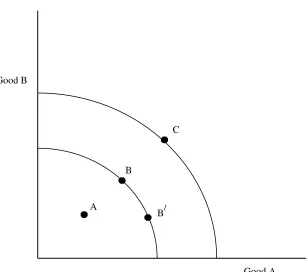
In technical terms a firm/economy is X-efficient if it produces on a production possibility
curve (B in Figure 1) rather than inside it (e.g. point A). Efficient allocation of resources
(allocative efficiency) is accompanied by a move on the production possibility curve. By contrast,
an improvement in X-efficiency leads to growth through movement from point A towards point
on curve B. Technical progress or expansion of resources (creative efficiency) will lead to growth
through movement from curve B to curve C. Allocative efficiency is concern of the theory of
static comparative advantage. Creative efficiency is in the realm of dynamic comparative
Figure 1 production possibility curve
Attention: pleas remove the heading above (figure 4.1…..) which is in picture and I could not
do it
B/
Good A Good B
A
B
[image:19.595.131.439.159.431.2]C
The utilization of existing inputs by a firm takes place outside market mechanism, i.e. within
firms, and is affected, inter alia by both organizational factors within the firm and institutional
factors outside the firm (Leibenstein 1980 and 1989). Moreover, an improvement in X-efficiency
may involve dynamic externalities. According to Arndt (1955), dynamic externalities related to
increasing return and complementarity of various lumpy activities may be due to the construction
of newequipment (investment), or due to the fuller utilization of existing equipment (which is a
type of X-efficiency). X-efficiency may not only spill over to other firms (through the learning
effect), but if it takes place in a number of firms/industries, it would involve dynamic pecuniary
externalities (see footnote 4); if the product produced is used as an input to other industries, the
reduction in its cost of production will benefit other industries.
Institutional factors also contribute to ex-efficiency. The organizational and institutional
factors also act similarly to infrastructure; in a sense one may refer to them as socio-economic
infrastructure. Both economic growth at the macro-level and profit of a firm at micro-level
depend on the availability and efficient use of resources once allocated, i.e., X-efficiency. Hence,
institutional and organizational deficiencies result in X-inefficiency.
In Figure 1, in order to move rapidly from point A to curve B in order to improve
competitiveness, or from curve B to curve C to expand production capacity, or to upgrade the
production structure, the development of capacity in organizational, institutional and
infrastructural factors as well as back-up services are required. In practice, developing countries
are characterized by underdeveloped organizational and institutional framework, particularly for
production and exports of manufactured goods. The market mechanism would not function well
if these factors act as constrains. And they will not be developed on their own. If their
since their development involves externalities, and is often lumpy, underinvestment would
prevail. Hence, the government ought to intervene in institutional build up, organizational
development and provision of other factors necessary for the operation of market forces and
enterprises3.
Incidentally, as far as the role of import is concerned Hirshman (1958), like F.List (1856)
considers the role of import differently at different stages of development. Before, an infant
strategic industry is established imports fulfil the very important function of demand formation
and demand reconnaissance for the country s entrepreneurs (Hirchman, Ibd.:123). He
recommends selective import restriction both before and after the establishment of an infant
industry. During this prenatal stage of an industry it is desired to prepare the ground for the
creation of a particular industry by allowing the inflow of import of the related product freely. In
the meantime, it might be advisable to restrict other imports so as to channel import demand
artificially toward the product whose eventual domestic production is to be fostered. (Ibid:
124).4
Trade liberalization should also be, like protection, selective and targeted. The impact of
trade liberalization on an industry and firm would depend on the level of development of
technological capabilities of the industry and the speed and degree of liberalization. A rapid and
neutral liberalization would for example, be detrimental to immature industries. By contrast, a
slow, gradual and targeted liberalization, which differentiates among activities according to their
technological capabilities and degree of their maturity, could not only benefit the industrial
3 While government might be able to improve some of the institutional and organization deficiencies, it will not be able to improve all market deficiencies, since some of the problems facing the government are similar to those facing the market. Such are imperfect knowledge, information, and insight (Stiglitz 1989).
4
development of the country, but is also essential.5 Otherwise, the industry in question becomes
inefficient behind prolonged protective walls. Before, subjecting an industry to foreign
competition, it should become subject of domestic competitive pressure (Shafaeddin, 2005.b).
Before ending this section, two points are worth mentioning. The first point is that there
are also some practical problems in implementing neutral trade policy. Unless there are zero tariff
rates on all imports, the introduction of a uniform tariff rate structure to various industries would
not provide a uniform effective rate of protection to those industries. A uniform effective rate of
protection requires non-uniform nominal tariff rates because various industries do not use the
same inputs which could be produced domestically, or imported. Even if they did, the input
-output coefficients as well as the import coefficients are different for various industries.
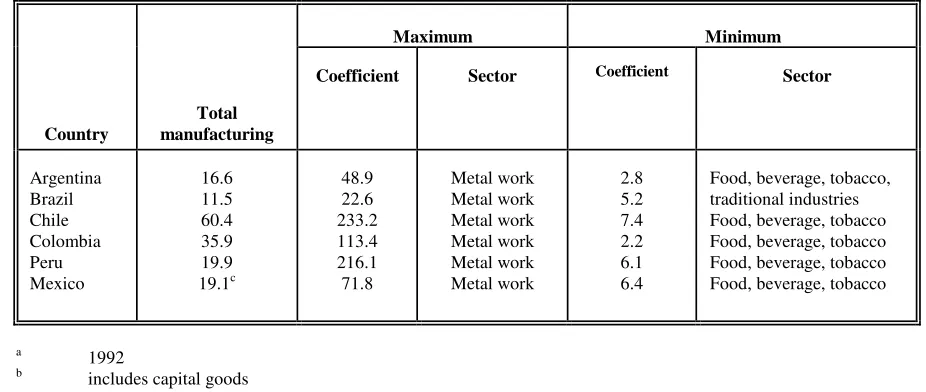
The import coefficient for specific industries is not readily available. Nevertheless, there
are some data available at the sectoral level. For example, the related data available for a few
Latin American countries for 1994 before the conclusion of the Uruguay round are shown in table
1. The table indicates that in each country there is a wide range import coefficients in different
industries. Accordingly, the ratio of maximum import coefficient to minimum coefficient for
various industrial groups range from 31 in the case of Peru to 4.3 in the case of Brazil.
Insert table 1 here
The second point is that an argument against selective incentive structure is that it creates
distortions in the price structure. Two points worth mentioning in this respect. First, the
international price structure even if it were not distorted, would not represent the domestic
production capacities and factor endowments of developing countries. It is further influenced by
monopolistic power of large TNCs and by government’s interferences in international trade.
Hence, it is already distorted. In the presence of such distortion in the international market, a
distorted domestic price structure is a second best policy. Second, when the objective is to attain
dynamic comparative advantage in certain industries, investment decisions can not be governed
by the current price structure. The current price structure is a more useful tool for current
production than for investment decisions (Scitovsky, 1954). Accordingly, there is a need for
distorting the current price structure in favour of selected industries to attain the objective of
attaining dynamic comparative advantage (see also Amsden, 1989).
III. Historical Evidence
I have shown elsewhere that all early industrializing countries, including UK, USA,
Germany; and Japan have pursued selective trade policy (Shafaeddin, 2005.c and change, 2002).
In the following pages I will concentrate on thecase of East Asian countries as they have been
often used by both proponents of neutrality of trade incentive (free trade) and selective
Government intervention to prove their point of view. For example, the proponents of free trade
attribute success of Republic of Korea (RK) and other East Asian countries in rapid
industrialization and export expansion to the operation of market forces (Krueger, 1981).
Moreover, even when the existence of selective intervention in the market of these countries is
admitted, it is concluded that selective intervention did not contribute to their success ( Benson
and Weinstein, 1994).Similarly, it is argued that selectivity in trade policy would be an
inappropriate tool to be employed in the case of other developing countries (e.g. World Bank,
1993). By contrast, the proponents of selective intervention attribute the success of East Asian
countries, inter alia, to selective intervention (Westphal, 1985, Amsden, 1989 and Wade 1990).
Two important points are worth emphasising in this section. First, selective intervention
contributed to the success of East Asian countries, but selective, and functional, intervention
enterprises together with government functional and selective intervention played a significant
role in industrialization of East Asian countries. However, the relative importance of the role of
government in relation to market forces and enterprises has changed over time. Second, to
succeed selective intervention requires some preconditions, and some other factors, than trade
policy, also play a role.
1. Selectivity, the role of Government, market and enterprises; the case of Republic pf
Korea
We will use the case of Republic of Korea (RK) as an example, in the following pages and
make a brief reference to other countries. The Government of RK pursued a dynamic policy
changing not only its industrial and trade policy, but also the role which it attributed to
government selective and functional intervention, market and enterprise over time.
In 1950s, the government intervention continued at three levels. The first was functional
intervention for development of infrastructure and institutions to strengthen the operation of
market forces and human resource development. The second was direct intervention in capital
accumulation through establishment of public enterprises. The third was intervention for
development of selected infant industries, basically for satisfying the domestic market.
A distinctive feature of the Korean industrial policy was, however, to switch rapidly, in
late 1950s, to promoting exports of products of "selected" industries which had been established
through infant industry protection. In the meantime, it embarked on development of some other
"selected" infant industries. In other words, beginning late 1950s, the Government followed a
policy mix of export promotion and import substitution. Attempts for export promotion was
initially a reaction to the balance of payments problems in 1958/9, but achievements in export
expansion led the government to continue its effort for export expansion while consolidating its
Thus, vigorous export promotion which started in late 1950s-early 1960s became
dominates government policies in the following decades. The exchange rate was devalued, the
tariff structure was changed, some imports were liberalized and export subsidies were introduced
(Hong, 1977 chap.3). In particular, imports of non-competitive capital goods and inputs were
liberalized. The import intensity of exports increased rapidly from 40 per cent in 1966 to 51 per
cent in 1969. With the implementation of policies for import substitution of intermediate inputs
in 1970s, the import intensity of exports started declining reaching 38 per cent in 1976 (Ibid,
table 3.8). In other words, despite the fact that emphasises was placed on export promotion, RK
did not abandon its import substitution policies. In 1960s it achieved considerable degree of
import substitution in cement, fertilizers, refined petroleum, textile yarn and fabrics. Some of
these products later on became major export items (Hong, 1977). While in early 1960s labour
intensive, low technology intensive products, in which the country had static comparative
advantage, constituted the major items of export, the capital and technology intensity of exports
gradually increased as the country developed products along its dynamic comparative advantage
based initially on import substitution (Ibid). In fact in mid-1980s it pushed rapidly into
production of capital and technology intensive products6. For example, the share of electric
machinery in total MVA which was 2 per cent in 1975 reached 15 per cent in 1985. Moreover,
the share of these products in total industrial exports reached over 19 per cent in 1986
(Lütkenhorst (1989, tables 2 and 5).
The Government of RK also operated a dual policy structure in its industrial policy in
another sense:
The duality is between industries in which Korea has a static comparative advantage and
those in which it does not. In the former sectors, market forces operating in response to
largely neutral incentives prevail; in the latter sectors, market forces are influenced by
selective promotional incentive policies and supplemented by instruments of direct
control and allocation (Pack and Westphal, 1986, 102).
As mentioned before, Scitovsky (1954) distinguishes between production decisions and
investment decisions. He argues that market prices are more useful tools for coordinating current
production decision. Investments tend to involve more externalities. As externalities create
divergence between private and social benefits, they require government intervention. Pack and
Westphal argue that the Government of republic of Korea practiced a different type of duality of
policies:
...the crucial duality is not between production and investment decisions. It is more
nearly between investment in established industries where there is a static comparative
advantage and investment in infant industries where there is the potential for dynamically
achieving a comparative advantage (Ibid, 125).
Such a dual policy framework has been applied by RK to attain two main objectives: to promote
export and to establish infant industries. First, a combination of free trade and provision of
incentives for exports of well- established industries were applied. The capital and intermediate
inputs used in export production were exempted from import duties and unitary exchange rate
was introduced. Further, relatively significant export subsidies were introduced through direct tax
reduction, preferential interest rates and access to import licences (Westphal, 1990). Note that
although export incentives were largely applied uniformly to all well-established industries, the
number of well-established industries- mainly textiles and several other light industries- were
limited. In other words, incentives were not provided to all products, but to all selected products.
level and structure of incentive over time. Not only the rate of protection varied for different
industries, but also varied for various products within an industry. For example, in 1982 the
effective rate of protection for the chemical products varied from 414 to - 6525. (Gunasekera,
1989, table, 1).
The second aspect of the dual industrial policy mentioned above was development of
infant industries, industries in which the country could develop dynamic comparative advantage.
For this purpose non-neutral policies were applied. Protection was the main incentive in most
industries, but fiscal and monetary incentive was also used. An important aspect of the industrial
policy applied to infant industries was that they were right from the beginning encouraged to
export a part of their production mainly through marginal cost pricing (ibid, 47-49).
The Government's role was not confined to the provision of incentives alone. It also relied
on and closely interacted with firms and market. In particular, it made the companies subject to
“performance requirements”; the incentive provided to them was in exchange for their
performance. In other words, it set certain performance standards and targets for production and
export by firms and envisaged sanctions in the case of non performance. Sanctions could consist
of withdraw of privileges, including import license, tax holidays, fund allocation, subsidy and
preferential interest rates, from firms including their closure (Westphal, op. cit, Amsden, op.cit.).
There was also a time pressure on industries to become efficient by fast reduction of import
duties after a certain period of protection. Thus the response of firms to the incentives would
take place initially not only through the market forces but also through the reaction to the set
targets and envisaged sanctions.
Nevertheless, the government followed a dynamic trade and industrial policies as far as
the role of government, market and the private sector is concerned. As time passed and
competition among enterprises increased and the importance of targeting and sanctions were
reduced. Moreover, as international competitiveness improved, the amount of subsidies was
gradually reduced. For example between 1963 and 1980 the rate of export subsidy was, on
average, declined from around 40 to 50 per cent, to around 20 per cent (Kim, 1994, 621). In other
words, over time, private enterprises felt more pressure from competition and market forces than
from the Government.
The Government and the private sector closely cooperated in setting and implementing
the targets, in exchanging information on the market prospects in removing the bottlenecks and in
finding solutions. Both the private sector and market played important roles in industrialization
of RK. For developing infant industries and promoting exports, the government helped
development of private enterprises, chaebols. Nevertheless, certain industries, particularly heavy
industries were initially developed directly through public enterprises. Public enterprises
established industries for which large investment was required and/or the private sector was not
prepared to take the related risks. Shipbuilding, chemicals and steel are examples of these
industries. Chaebols are large conglomerates which apart from their function as production
agents initially internalized some functions of the market because of the lack of supporting
infrastructure and institutions such as credit, trade, marketing, distribution, etc. at early stages of
development. For example, the private sector, dominated by Chaebols relied on internal sources
of finance within the firms for about half of their need in 1963-5. As the credit and financial
institution developed, however, this ratio declined to about 26 per cent in 1987-91 and the
reliance on these institutions increased to about 74 per cent (Amsden and Euh, 1993, table 1).
Over time, however, the relative role of large private enterprises, Chaebols, in production
2. The role of other factors
It would be a mistake to attribute Korea s success in acceleration of industrialization and
development solely to non-neutrality of the incentive structure alone. Many other factors such as
high saving rate, acceleration of investment in human and physical capital etc. were also very
important in the success of the country in acceleration of development and export expansion of
the country (Broadford, 1987). So was development of agriculture, human capital, and
infrastructure and market institutions.
Development of agriculture facilitates industrialization and competitiveness in two ways.
First, the traditional view is that increase in agricultural output and productivity improves the
income level of farmers thus contributing to the increased size of the domestic market. As a result
demand for industrial goods will increase allowing infant industries to exploit economies of scale
and eventually make transition to outward-orientation by becoming internationally competitive
(Grabowsky, 1994a and 1994.b). The existence of the resultant growing domestic market would
further increase the credibility of government s attempt to discipline the firms by threatening
them to withdraw protection and support because the firms see they have more at stake to lose if
the government withdraw its support (op.cit.).
The second and more important way in which the growth of agriculture could contribute
to development and competitiveness of the manufacturing sector is through the expansion of food
production. Availability of food products as basic (wage) goods contributes to non-inflationary
growth of a country easing the pressure on the balance of payments and helping to prevent wage
increases in the urban areas. Agriculture, however, is a supply determined activity the growth
institutional, e.g. credit facilities and agricultural support services; and infrastructural factors,
road and transport facilities. Hence, its development can not be left to the operation of market
forces alone. Moreover, the fact that international prices of main food items have been distorted
by agricultural protection and subsidies in developed countries particularly in post-war II period,
has made competitiveness of domestically produced items difficult.
One important contributory factor to the acceleration of industrial development, not only
in RK but also in other East Asian countries, is their special attention to the development of food
prior and during the period of industrial development. In Republic of Korea the emphasise was
placed on the development of this sector, particularly food, in the tariff and other incentive
structure and in general development policy (Kuznets 1997). In Japan important improvement in
agricultural development took place during Tokugawa period, i.e. before the Meiji revolution.
These efforts were intensified during the Meiji period and continued over time including the
post-world war II. Throughout these periods production of rice, as the main staple food, was
protected and heavily supported by the Government (Hayami and Ruttan, 1985). Similarly, both
Taiwan and Korea emphasized development of the agricultural sector during their industrial
development (Grabowski, 1994.a). In a more recent period the success of Indonesia in
non-inflationary development is attributed to a large extent to the channelling of oil revenues to the
development of rice production (Shafaeddin, 1989). Industrial development of Thailand and
Malaysia is also indebted to the development of food production.
As far as human capital, experience and know-how is concerned, it should be mentioned
that when RK started its industrialization in a vigorous manner i.e. after the Korean war of
1950-53; its industrial base was small then. The share of Manufacturing sector in GDP was only 6 per
cent in 1953 (Hong, 1977, table 2.5). Nevertheless, the country had experienced considerable
necessary for industrialization and institutional and infrastructural development. Even back in
1940 the share of manufactures in total value added was 15 per cent (Ibid, table 2.1). The
industrial base of the country was ruined during the war, but the country had a wealth of
experience and know- how, inherited from the Japanese colonial era and the Korean War
(Bruton, 1998). Moreover, both before and after the war the Government placed emphasize on
education, hence the general level of education of the country was relatively high in 1950s. The
percentage of population enrolled in schools in 1954 was 17 as against 7 for India, 9 for Brazil,
12 for Mexico, 13 for Germany, 15 for England and Wales, 16 for Argentina, 22 for the USA and
23 for Japan (Amsden, 1989, Table 9.1). In 1946 over half of the work force had primary
education. Moreover, secondary and college education was expanded rapidly in 1950s and 1960s.
For example, in 1946, 7.4 per cent of the workforce had secondary education. This ratio reached
33.9 in 1963 and the percentage of the workforce with college education increased from nil to 7.6
over the same period (Ibid, Table 9.3).
Furthermore, serious effort was made by the Government to develop infrastructure and
market institutions such as the banking and credit system, stock market, trading companies for
marketing and collection of information, saving institutions, etc. Significant attempt was made to
develop the capacity of bureaucracy to gather and analyse information, review targets, make
decisions and implement plans.
Selective intervention in RK was not without costs. These costs included not only the cost
of protection in general, but also the cost of making mistakes and corruptions (Amsden, 1989,
146). For example, it is argued that targeting of the automobile sector in mid 1970s was
premature because of the small size of the domestic market and underdevelopment of skilled
labour. Similarly, cost is believed to have occurred in the case of Taiwan (Auty, 1993).
change which limits the scope for exporting on a scale which Japan exported at a similar stage of
development of its car industry (Ibid). While the argument about premature development of the
industry may be valid, the argument about the long term-benefits of supporting the automobile
industry was not necessarily confined to the car industry and could apply to a lot of industries,
e.g. electronics and other industries where technological development is rapid. Further, the fact,
that technological development is rapid in an industry makes make targeting more relevant (see
below).
3. Other countries
While the case of RK was used for illustration, it should be mentioned that with the
exception of Hong Kong almost all early and late industrializes pursued their industrialization
and manufacture export expansion on selective basis. England started infant industry protection
with woollen and cotton products and moved later on to some other selected items. USA,
Germany and France pursued somewhat similar approaches (Shafaeddin, 1998 and 2005.a).
Japan started its infant industry development through so-called wild-geese- flying pattern
(Akamatsu, 1961 and Baba and Tatemato, 1968). In this model a product was chosen for a
successive pattern of imports, domestic production and experts. In other words, the policy was
not confined to import substitution, it stressed the continuity of import substitution while
pushing into and perusing export expansion (Yamazawa, 1990, p.xi). At the beginning cotton
yarns and machinery were imported and domestic production of cotton textiles was protected.
But exportation of cotton cloth began in early 1890s and import substitution of spinning
machinery began in late 1890s. Exportation of spinning machinery started in early 1920s and
Japan was the net exporter of these machinery in 1930s (Baba and Tatemoto, 1968). Hence, a
one industry, the Government chose some other industries and followed the same cycle of
industrial deepening through infant industry development and infant export expansion policy by
providing necessary incentives for exports through subsidization and other incentives.
In the case of Japan, there is overwhelming agreement that selective intervention has
contributed significantly to industrialization of the country. Nevertheless, some have argued that
the Government has made mistakes in choosing the industries. Some industries chosen during
1955- 90 for support were among slow-growth industries such as mining and processed food etc.
(Benson and Weinstein, 1994). In this respect, however, three points worth emphasizing. First,
the choice of industries and the degree of support has changed over time from one period to
another. So has the rate of growth of production and export during the course of the life cycle of
the industry. For example, while textile was a dynamic sector during early stages of
industrialization, later on its importance in the industrial structure declined in favour of other
industries. Secondly, dynamic growth was not the only criteria in choosing an industry for
support. Some industries were supported for their linkages and externalities, other were
supported because they were strategic (in the sense of the need for possessing some domestic
production capacity for security reasons). Examples are mining, coal and oil refining and food
processing. Some other industries were chosen for support because they were technological
leaders. Finally, whether or not one has made a mistake becomes clear only ex-post. To make
decisions is an ex-anti process involving trial and error. Making mistakes is not an argument for
the lack of intervention in all circumstances or for providing all industries the same incentives.
Taking action always involves risks of making some mistakes. The one, who does not act, does
not make many mistakes. Nonetheless, not to act itself is the worse mistake.
The experience of other developing countries also shows that non-neutrality of tariff rates
exports. For example, it has been shown that during 1960s till mid-1970s, 90 per cent of clothing
exports from developing countries originated in the few countries that allowed exporters access
to inputs at international prices (Chenery and Keesing, 1979). These countries protected their
domestic market at the time by imposing high rates of tariff on output but left imports of inputs
free. In the case of other newly industrialized countries also selective intervention has, inter alia,
contributedto their success (Dahlman, et. al.). Generally speaking, the empirical evidence does
not necessarily disprove the efficacity of selective infant industry protection during 1960s and
1970s even though it requires certain preconditions (Westphal, 1981).
4. Preconditions for selective intervention
The experience of East Asian countries indicates that success in selective intervention
requires a few important preconditions: government will and capacity of the bureaucracy for
decision making, designing and implementing policies. Moreover, it requires development of
human capital, infrastructure and institutions as mentioned earlier.
Government s strong determination for rapid industrialization and export expansion, and
indeed general development, is required to surmount bottlenecks and problems created on the
way of development of the selected sectors. The capacity of the Government s machinery is
important because decisions are to be made in correct manner and in right time and should be
implemented and reviewed efficiently. As far as Government will is concerned, it is crucial no
matter if a neutral or non-neutral incentive structure is perused as long as the objective is to
accelerate the course of development beyond what is feasible by the market forces.
While the design of policies is important, the policy instruments used in East Asian
countries have been similar to those applied in some other developing countries. The major
decisions] and monitoring [of their results] (Bruton, 1998, 924). Both in Japan and RK there was
no rigid blueprint for industrial policy. When a policy worked it was pursued, when it did not it
was changed. In other words, Government learning, not government minimizing, is the
objective. (Ranis, 1978 cited in ibid, 925). To implement its policies, while providing incentives,
the Government of RK also managed to enforce the discipline in the private sector in the manner
explained above. Many other developing countries provided incentives, but either did not require
performance, or did not discipline the private sector where the targets were not met.
IV. Some empirical evidence in recent decades
The historical evidence available on the question of selectivity is confined mainly to a few
countries located in East Asia. As the tariff structure of some other developing countries show
dispersion, even if they did not try purposefully and systematically to apply non- neutrality in
their trade policies, it would be interesting to examine how it has affected their export and output
performance.
1. Methodology and data
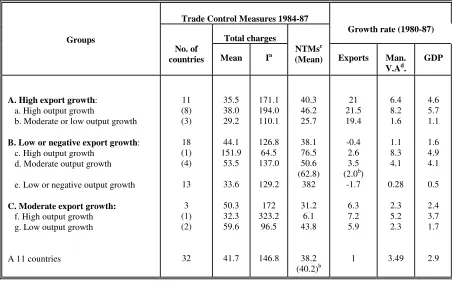
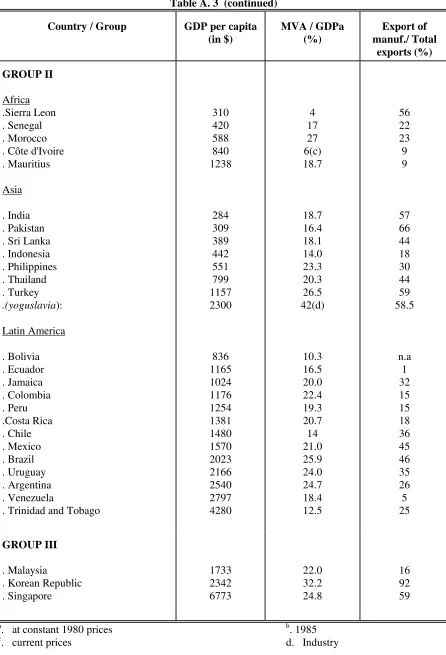
To do so, we have chosen 1980-87 periods and studied a sample of 32 developing countries.
There are two main reasons for our choice of the period. The first is availability of data.
UNCTAD started compiling data on trade control measure, although not on annual basis, for the
period beginning 1980. The second reason is that developing countries began trade liberalization
under the pressure from the World Ban and IMF through Structural Adjustment and Stabilization
Programmes from early 1980s after the emergence of economic downturn in the world economy
and appearance of balance of payments problems in developing countries. As time passed, their
average tariff rates declined and their structure of tariffs became more and more
due to the Uruguay Round trade agreement. In other words, there has been a trend toward
lowering tariffs and uniform tariff rates while non-tariff measures have been reduced to nil or to a
bear minimum in most cases. Thus, 1980-87 is a reasonable length of period during which still
some discriminatory tariff structure prevails in the sample countries before further changes. Since
then more and more countries have not only reduced their tariff and non-tariff measure
considerably but they also have reduced dispersion in their tariff rates as already mentioned.
Third, the choice of the sample is also drived, to a large extent, by the stage of
development of the manufacturing sector of the country. Two cut-off points were chosen to
exclude countries which did not have some manufacturing export capacity around mid-1980s.
The reason was that it was noticed that for a large number of countries data on manufacturing
exports included re-exportation or shipment of some equipment for repairing abroad. First, the
sample includes countries with minimum export of manufactured goods of 75 million dollars in
1986. Second, manufactured products should constitute at least 5 per cent of total exports of the
country in the same year. However, five countries for which one or both of the above two criteria
are not met were also included in the sample in order to have some low income countries with
small industrial base in the sample. These are Ghana, Nigeria, sierra Leon, Ecuador and Bolivia.
The sample includes countries from different regions, with different levels of development,
industrial base and also with different initial policy stance and varied attempt at trade
liberalization and exchange rate adjustments.
The data on exports and output are from World Bank sources which are, in turn, based on
the UNIDO s definition of manufactured goods which include both processed and semi-
processed products. Such inclusion may inflate growth of exports in cases value added in
processing is small and the weight of the processed and semi-processed goods in total exports has
that is, the increase in the import intensity of exports partly caused by trade liberalization. This is
particularly true in the case of countries where exports from export processing zones constitute a
significant proportion of total exports of manufactured goods, e.g. Mauritius, Malaysia and to
some extent Mexico. For example, in the case of Mauritius, the import intensity of EPZ s exports
rose from 56 per cent in 1982 to 68 per cent in 1986 (Shafaeddin, 1991).
Data on exports in real terms are used as an indicator of export volume. For calculating
exports in real terms the World Bank unit value indices for exports of manufactured goods of
countries concerned, which is the only index readily available for these products, are applied.
These indices seem to be estimates and hence should be regarded with certain degree of caution.
The data used for trade control measures are based on UNCTAD Directory of Import
Regimes, for the period 1984-1987. The use of data for the last 3 years of the period concerned
underestimates the degree of non-neutrality for the whole period as there has been a tendency
towards uniformity of tariff rates around mid-1980s. Hence, it will intensify the results as will be
shown shortly. The index of neutrality of tariffs (I) is calculated as follows:
R I= --- X
where R is the range and X is the average tariff rate for manufactured goods. R is the difference
between the maximum tariff rates and minimum tariff rates for (16) sub-groups of product
categories used by UNCTAD (see appendix A.1). The use of range for sub-groups was preferred
to that for individual products for two reasons. First, sub-groups represent various industries. As
one is more concerned with industries than specific products they are more suitable. Second, the
range for individual products may be extremely high because of extremely high tariffs on a few
luxury products or on some other products for revenue reasons.