Munich Personal RePEc Archive
Designing a Virtual Center for
E-Commerce
Banica, Logica and Rosca, Doina
University of PiteştI
13 March 2010
Online at
https://mpra.ub.uni-muenchen.de/27880/
Designing a Virtual Center for E-Commerce
Logica BĂNICĂ
[email protected] University of Pite tIDoina ROȘCA
[email protected] University of CraiovaAbstract
In the actual context of developing digital services, the promotion of a system that manages multiple e-commerce sites can be extremely valuable in increasing the economic effects for the companies.
This paper presents the current stage of the experimental system design and implementation, an open system website-based (called Single Way for E-Commerce - SWEC) having the goal to collaborate with many database servers of the companies that offer e-commerce sevices and also to interract with electronic payment and e-administration systems.
This new approach allows the clients, after them authentication, to navigate on e-commerce websites and search different products, grouping on domains, companies and geographic areas. SWEC System will offer to the customer the opportunity to visualize and compare similar products, to order and receive a single invoice for all the products he wants to buy.
Keywords: E-Commerce, Database-driven site, Open system, Server Side Programming
JEL code: L86, L81, M15
1. Introduction
In the actual context of developing digital services even now, during the mondial crisis, the promotion of a system that manages multiple e-commerce sites can be extremely valuable in increasing the economic effects for the companies. Companies needed nonstop functionality to establish a serious presence on the market by the commercial websites and customers request information on a large catalog of products, including pictures and documentation and also the possibility to compare the similar offers (Afuah & Tucci, 2003).
2. SWEC System – a Software to Unifying E-Commerce Multiple Platforms
In this chapter we present the architecture of a management system for e-commerce sites, its facilities and the techniques used for its development. The platform supposes a connection from the central website to the e-commerce company databases.
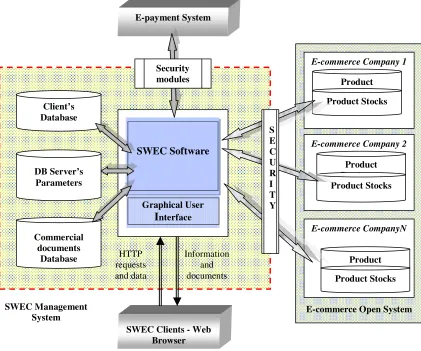
The main modules of the actual approach are represented in figure 1 – the SWEC system architecture. The project focuses on the left side of the architecture, launching the following functions:
1) Accessing the system interface by an web browser; 2) Identifying the clients and, just-in-case, their registration; 3) Establishing the connection to the company databases;
[image:3.612.93.514.210.561.2]4) Selecting a product formatted catalog and searching a product in order to buy it;
Figure 1: The SWEC system architecture
5) Formatting a single invoice for each client, after the order confirmation; 6) Updating Product Stock table;
7) Establishing the double way connection with e-payments system for transmitting the invoice and receiving the payment confirmation;
8) The periodically transfer of all accounts for sale products.
Figure 2 shows the Operating diagram of the system:
E-commerce Open System
E-commerce Company 1
Product
Product Stocks
E-commerce Company 2
Product Catalogues Product Stocks
E-commerce CompanyN
Product
Product Stocks
Information and documents HTTP
requests and data
SWEC Clients - Web Browser
SWEC Management System
Commercial documents
Database DB Server’s
Parameters Client’s Database
SWEC Software
Graphical User Interface E-payment System
Security modules
Level 4 Level 2 Level 1
Level 3
Level 5
Figure 2: the Operating diagram of the SWEC System
Updating Stock Product DB1
Switch among companies
Connect o the first company DB
SWEC System COMPANY Servers Main SWEC Interface Domain offers Domain choice Request Company list Select second company
Select n–th company Product Domains List of Companies Select a product domain Select first company Product information Compare products from chosen companies
Order all the chosen products from companies Product Basket Products order Invoice
Connect to the second company
DB CLIENT
Product Information Catalog
Select Company DB
Product Characteristics Interface List of Companies Interface
Updating Stock Product DB2
Authentication by username
and password Confirmation
Select products from
After the authentication (username and password at first level), the customer interacts with the graphical user interface of SWEC, viewing the domains of the accessible products (second level of diagram).
The next step offers the list of the companies involved in e-commerce for the chosen domain and their supply of products (at third level). We mention that the company link activation will not transfer the control to the web-page of the e-commerce site, but the connection to the server database, the product catalog.
All companies involved will be required a standard format for product catalogues, which includes: code, name, date of manufacture, thumbnail and sale price of each product (Barefoot, 2004). The client is able to see more product features by activating a hyperlink on the thumbnail (fourth layer). Without disconnect from current database, the user may read the information of many other companies, so he can compare performance and prices.
Technically, the solution for solving multiple accesses consists of keeping the addresses databases called and switching from one database to another by selection.
All selected products are stored in a product basket, until the customer firm order. At fifth level, the designed system completes and will forward the invoice for goods ordered.
The main advantage that we expect from SWEC system is providing a single access channel to an open system of the e-commerce companies, but also, integrating online commerce with order administration and e-payments (Curiac, 2005).
One of the key activities during this phase is to build security into the web application at the design stage itself. In fact, the team must identify the key information assets that the web application will be dealing with. These could include configuration information, user transaction details, session IDs, credit card numbers, etc. Once these risks are listed out, system countermeasures must be designed and if necessary the architecture itself may be modified. Countermeasures should also include strict input validation routines, use of open-source cryptographic standards, and other secure coding practices (Corbitt et al., 2003).
For most e-commerce sites, the digital product catalogues will need to be reviewed on a periodically basis. The project team considers that is easiest and more efficient to make the changes (to update the e-commerce company databases) at source level, and not to the central system level.
3. Some considerations about the techniques used for building the system
This paragraph will give an overview about the software tools used for the implementation of SWEC System which is a database driven website. This means that the web pages are connected to a database by code and the information is inserted into the documents each time they are loaded (Cullen, 2002). If the information stored in the database changes, the web page connected to the database will also change accordingly and automatically without human intervention.
There are a number of databases and software solutions to build data-driven websites. Typical databases used in dynamic websites are: MySQL, Oracle, Microsoft SQL Server. Most large companies use the Microsoft SQL Server database or MySQL database, which is the most popular database, because it almost has the power of Microsoft SQL Server but has the advantage of being free.
Common web programming languages used to access database information are:
• PHP programming language
• Microsoft Active Server Pages (ASP) • ColdFusion markup language
Database-driven sites can be built using several competing technologies, each with its own advantages. PHP is the most popular, especially since it is free and multi-platform. It’s often paired with the MySQL database (Welling& Thompson, 2007).
Database-driven web site programming is also called server side programming, because the operations that allow the web pages to connect to the database are taking place on the server. Each time a dynamic web page is about to be sent to the browser, the application server automatically executes the code within, extracts the required information form the database and sends a standard HTML page to the browser. A database-driven website allows some of its content to be read from a database and displayed dynamically. Updating web pages is then done through updating the database. For this purpose, MySQL and Microsoft SQL server are common databases used and PHP, ASP and ColdFusion are common languages used to access the database information and display it on the web pages.
Many applications have the capacity to interact with the users in order to perform operations like searching and updating information on database. Database-driven web sites have a wide variety of applications and possibilities, and one of them is e-commerce. It’s a fact that company websites can display impressive catalogs of products, giving the customers the possibility to choice one of them and to order by Internet (Roșca et al., 2004).
Given these software tools, a single HTML file with scripts (in PHP) can generate a huge number of more or less different web pages that are sent to the user of the website. There are several ways of obtaining this versatility (Ulman, 2004):
Most of the web page content displayed in the user's browser is taken from a database; the maintainer creates and modifies data in the database rather than in the file with web-oriented code.
In the web page displayed to the user there may be links that call the same file that was originally used to produce the page; this call, however, may be done with different values of the variables that may determine the behaviour of the scripts and may influence the production of the page.
The web pages include input areas where the user may enter a request, which sets values of variables that influence the production of other web pages.
The user has the possibility to complete input forms to send information that might automatically be validated and included in the database; since this solution raises some technical problems as well as security problems, it’s not discussed in this paper.
To allow the development and use of such a modern type of web site, the web server needs the relevant licensee software. The SWEC project is based-on the widespread WAMP system (Windows + Apache + MySQL + PHP), having the possibility to be adapted in a LAMP version (where L signifies Linux) (Williams & Lane, 2004).
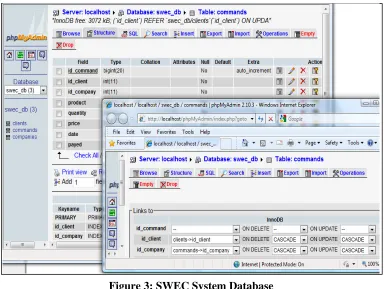
System software platform supposes a connection from the central website to the company databases. The system includes three MySQL databases:
the first one for clients;
the second for storing the e-commerce website parameters (IP address, user, password, and database name)
the third for commercial documents (invoices, payment orders, orders).
Figure 3: SWEC System Database
The built-in function mysql_connect establishes the connection with a MyqSQL database:
mysql_connect (address, username, password)
where address is the IP address or host name of the computer on which the MySQL server software is running ('localhost’ if it's running on the same computer as the Web server software), and the username and password are the same MySQL user name and password used to connect to the MySQL server.
A first problem for the project team was to find the correct answer to the question: it’s necessary to create a permanent or a temporary connection to a database during a user session? For two reasons the project team decides that a temporary connection is desirable:
1. considering the real system, hundreds of users may be connected to the system and some of them chooses the same company database that can be blocked by keeping an active connection for each of them;
2. the PHP language allows a permanent connection for multiple databases existing on same server, but it’s much more difficult to make this type of relation on different servers.
The mysql_connect function returns a number that identifies the connection that has been established (Welling & Thompson, 2007):
$no_db = mysql_connect('localhost', 'root', 'mypasswd');
Once a connection was established, the next step is to select the working database, as the user option. Suppose the database chosen was e1_website. Selecting that database in PHP is made by another function call:
mysql_select_db(' e1_website ',$no_db);
The solution adopted by the project team is to keep all database parameters into a global array,
$_SESSION ['databases'], and call a user function db_connect for launching a built-in functions mysql_connect and mysql_select each time the user option changes.
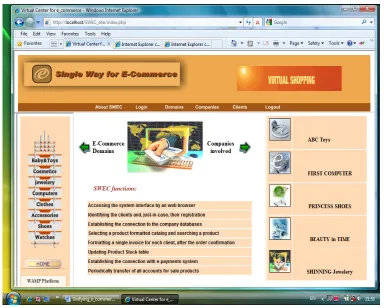
[image:8.612.121.505.143.451.2]SWEC system has a friendly and suggestive interface using menus with explained options that simplify the selection of the next branch (figure 4 - the main graphical user interface of the website).
Figure 4: The main graphical user interface of the website
The involved companies will use standard organized catalogues, covering their commerce areas (such as cosmetics, books, computers, accessories). The user has the possibility to search a product using a key (domain, name, category etc) and to display its characteristics before choosing to buy.
The goal of the SWEC project team is to offer the client the possibility to quickly swap from a database to another, only by selecting the same product from different catalogues of the implied companies. Finally, the client may choose to buy or not a product by adding it to a virtual shopping basket and making the order confirmation. The system will be able to establish a single invoice after the shopping session, no matter whom and how many are the suppliers.
4. Conclusion
This new approach of commerce which proposes a virtual center that manages multiple e-commerce sites allows companies to increase their sales and customers to simplify their purchase and payment method. The SWEC System goal is also to integrate personalized online commerce with order administration, sales support, and customer care in the contact center. The unified offer will accelerate browse products by category, company, price and other features, establishing a single command for the client and the opportunity to pay through a single channel. Building and ensuring the access to a virtual center for e-commerce means a large participation from public, private, and governmental bodies to determine common standards, management activities, and electronic product deliveries.
The current version of the research project SWEC achieves the following goals:
• the user identification;
• the connection to the multiple MySQL databases, placed on different servers;
• offering the end-user the opportunity to view and compare from different catalogues the
same products;
• filtering from the catalog the interesting products by name or code; • selecting product and adding in a basket having the purpose to by it; • ordering the products selected and establishing the invoice.
The system highlights:
• single channel to authenticate users and accessing the system; • centralized access to all involved e-commerce companies;
• the chance for the customer to compare how one product is taught in different
companies;
• the opportunity for user to buy multiple products from many companies by a single way,
and to pay a single invoice.
Known limits of the experimental system:
• one-point access failures can threat long-term availability; a backup infrastructure based
on real-time replication and load-balancing using two or more servers accessed transparently is recommended;
• for the moment, the only database available is the open-source MySQL, the future
versions being planned to work with other RDBMSs, like Microsoft SQL Server, Oracle.
5. References
1. Afuah, A., Tucci, C. (2003) Internet business models and strategies, McGraw-Hill, Boston 2. Barefoot, C. (2004) Revoluţia comerţului electronic, Editura Amaltea, Bucure ti
3. Corbitt, B., Thanasankit, T., Yi, H.(2003) Trust and e-commerce: a study of consumer perceptions, Electronic Commerce Research and Applications, 2
4. Curiac, D. (2005) Sisteme informatice pentru comerţul electronic, Editura Orizonturi Universitare, Timi oara
5. Cullen, K. (2002) PHP: An open source solution for Web programming and dynamic content, Information Technology and Libraries, 21 (3)
6. Ghilic-Micu, B., Stoica, M. (2002) eActivitatile în societatea informationala, Editura Economica, Bucuresti
7. Ro ca, I.Gh.,Bucur, C.M., Timofte-Stanciu, C. Paiu, O., Vi an, M. (2004) Comerţul electronic: concepte, tehnologii i aplicaţii, Editura Economică
8. Ulman, L. ( 2004) PHP for the World Wide Web, Editura Teora, Bucuresti
9. Welling, L., Thompson, L. (2007) PHP and MySQL Web development, 3rd Edition, Editura Teora, Bucuresti