Munich Personal RePEc Archive
Noncausal Vector Autoregression
Lanne, Markku and Saikkonen, Pentti
University of Helsinki, HECER
April 2010
Online at
https://mpra.ub.uni-muenchen.de/23717/
öMmföäflsäafaäsflassflassflas ffffffffffffffffffffffffffffffffffff
Discussion Papers
Noncausal Vector Autoregression
Markku Lanne
University of Helsinki and HECER
and
Pentti Saikkonen
University of Helsinki and HECER
Discussion Paper No. 293 April 2010
ISSN 1795-0562
HECER
Discussion Paper No. 293
Noncausal Vector Autoregression*
Abstract
In this paper, we propose a new noncausal vector autoregressive (VAR) model for non-Gaussian time series. The assumption of non-non-Gaussianity is needed for reasons of identifiability. Assuming that the error distribution belongs to a fairly general class of elliptical distributions, we develop an asymptotic theory of maximum likelihood estimation and statistical inference. We argue that allowing for noncausality is of particular importance in economic applications which currently use only conventional causal VAR models. Indeed, if noncausality is incorrectly ignored, the use of a causal VAR model may yield suboptimal forecasts and misleading economic interpretations. Therefore, we propose a procedure for discriminating between causality and noncausality. The methods are illustrated with an application to interest rate data.
JEL Classification: C32, C52, E43
Keywords: Vector autoregression, Noncausal time series, Non-Gaussian time series.
Markku Lanne Pentti Saikkonen
Department of Political and Economic Department of Mathematics and Statistics
Studies University of Helsinki
University of Helsinki P.O. Box 68 (Gustaf Hällströmn katu 2b) P.O. Box 17 (Arkadiankatu 7) FI-00014 University of Helsinki
FI-00014 University of Helsinki FINLAND FINLAND
e-mail: [email protected] e-mail: [email protected]
1
Introduction
The vector autoregressive (VAR) model is widely applied in various …elds of application
to summarize the joint dynamics of a number of time series and to obtain forecasts.
Espe-cially in economics and …nance the model is also employed in structural analyses, and it
often provides a suitable framework for conducting tests of theoretical interest. Typically,
the error term of a VAR model is interpreted as a forecast error that should be an
inde-pendent white noise process for the model to capture all relevant dynamic dependencies.
Hence, the model is deemed adequate if its errors are not serially correlated. However,
unless the errors are Gaussian, this is not su¢cient to guarantee independence and, even
in the absence of serial correlation, it may be possible to predict the error term by lagged
values of the considered variables. This is a relevant point because diagnostic checks in
empirical analyses often suggest non-Gaussian residuals and the use of a Gaussian
likeli-hood has been justi…ed by properties of quasi maximum likelilikeli-hood (ML) estimation. A
further point is that, to the best of our knowledge, only causal VAR models have
previ-ously been considered although noncausal autoregressions, which explicitly allow for the
aforementioned predictability of the error term, might provide a correct VAR speci…cation
(for noncausal (univariate) autoregressions, see, e.g., Brockwell and Davis (1987,
Chap-ter 3) or Rosenblatt (2000)). These two issues are actually connected as distinguishing
between causality and noncausality is not possible under Gaussianity. Hence, in order to
assess the nature of causality, allowance must be made for deviations from Gaussianity
when they are backed up by the data. If noncausality indeed is present, con…ning to
(misspeci…ed) causal VAR models may lead to suboptimal forecasts and false conclusions.
The statistical literature on noncausal univariate time series models is relatively small,
and, to our knowledge, noncausal VAR models have not been considered at all prior to this
study (for available work on noncausal autoregressions and their applications, see
Rosen-blatt (2000), Andrews, Davis, and Breidt (2006), Lanne and Saikkonen (2008), and the
references therein). In this paper, the previous statistical theory of univariate noncausal
autoregressive models is extended to the vector case. Our formulation of the noncausal
VAR model is a direct extension of that used by Lanne and Saikkonen (2008) in the
the distribution of the error term is assumed to belong to a fairly general class of
ellip-tical distributions. Using this assumption, we can show the consistency and asymptotic
normality of an approximate (local) ML estimator, and justify the applicability of usual
likelihood based tests.
As already indicated, the noncausal VAR model can be used to check the validity
of statistical analyses based on a causal VAR model. This is important, for instance,
in economic applications where VAR models are commonly applied to test for economic
theories. Typically such tests assume the existence of a causal VAR representation whose
errors are not predictable by lagged values of the considered time series. If this is not the
case, the employed tests based on a causal VAR model are not valid and the resulting
conclusions may be misleading. We provide an illustration of this with interest rate data.
The remainder of the paper is structured as follows. Section 2 introduces the noncausal
VAR model. Section 3 derives an approximation for the likelihood function and properties
of the related approximate ML estimator. Section 4 provides our empirical illustration.
Section 5 concludes. An appendix contains proofs and some technical derivations.
The following notation is used throughout. The expectation operator and the
covari-ance operator are denoted byE( )and C( )orC(; ), respectively, whereasx=d ymeans that the random quantities x and y have the same distribution. By vec(A) we denote a
column vector obtained by stacking the columns of the matrix A one below another. If
A is a square matrix then vech(A) is a column vector obtained by stacking the columns
of A from the principal diagonal downwards (including elements on the diagonal). The
usual notation A B is used for the Kronecker product of the matrices A and B. The
mn mn commutation matrix and then2 n(n+ 1)=2 duplication matrix are denoted
byKmn andDn, respectively. Both of them are of full column rank. The former is de…ned
by the relation Kmnvec(A) = vec(A0); where A is any m n matrix, and the latter by
2
Model
2.1
De…nition and basic properties
Consider then-dimensional stochastic process yt (t = 0; 1; 2; :::)generated by
(B) B 1 yt= t; (1)
where (B) =In 1B rBr (n n)and (B 1) =In 1B 1 sB s
(n n) are matrix polynomials in the backward shift operator B, and t (n 1) is a
sequence of independent, identically distributed (continuous) random vectors with zero
mean and …nite positive de…nite covariance matrix. Moreover, the matrix polynomials
(z) and (z) (z 2C)have their zeros outside the unit disc so that
det (z)6= 0; jzj 1; and det (z)6= 0; jzj 1: (2)
If j 6= 0 for some j 2 f1; ::; sg, equation (1) de…nes a noncausal vector autoregression
referred to as purely noncausal when 1 = = r = 0. The corresponding conventional
causal model is obtained when 1 = = s = 0. Then the former condition in (2)
guarantees the stationarity of the model. In the general set up of equation (1) the same
is true for the process
ut= B 1 yt:
Speci…cally, there exists a 1 > 0 such that (z) 1 has a well de…ned power series
rep-resentation (z) 1 =P1j=0Mjzj =M(z) for jzj< 1 + 1. Consequently, the process ut
has the causal moving average representation
ut=M(B) t =
1
X
j=0
Mj t j: (3)
Notice that M0 = In and that the coe¢cient matrices Mj decay to zero at a geometric
rate as j ! 1. When convenient,Mj = 0, j <0, will be assumed.
Write (z) 1 = (det (z)) 1 (z) = M(z), where (z) is the adjoint polynomial
matrix of (z)with degree at most (n 1)r. Then, det (B)ut = (B) t and, by the
de…nition of ut;
where wt = (det (B))yt. By the latter condition in (2) one can …nd a 0 < 2 < 1 such that (z 1) 1 (z)has a well de…ned power series representation (z 1) 1 (z) = P1
j= (n 1)rNjz j =N(z 1) forjzj>1 2. Thus, the processwt has the representation
wt=
1
X
j= (n 1)r
Nj t+j; (4)
where the coe¢cient matrices Nj decay to zero at a geometric rate as j ! 1.
From (2) it follows that the process yt itself has the representation
yt=
1
X
j= 1
j t j; (5)
where j (n n)is the coe¢cient matrix ofzj in the Laurent series expansion of (z) def
=
(z 1) 1 (z) 1
which exists for 1 2 < jzj < 1 + 1 with j decaying to zero at a
geometric rate as jjj ! 1. The representation (5) implies that yt is a stationary and
ergodic process with …nite second moments. We use the abbreviation VAR(r; s) for the
model de…ned by (1). In the causal case s = 0, the conventional abbreviation VAR(r) is
also used.
Denote byEt( )the conditional expectation operator with respect to the information setfyt; yt 1; :::g and conclude from (1) and (5) that
yt = s 1 X
j= 1
jEt( t j) +
1
X
j=s
j t j:
In the conventional causal case, s = 0 and Et( t j) = 0; j 1; so that the right hand side reduces to the moving average representation (3). However, in the noncausal case
this does not happen. Then j 6= 0 for some j < 0; which in conjunction with the
representation (5) shows that yt and t j are correlated. Consequently, Et( t j) 6= 0 for
some j <0, implying that future errors can be predicted by past values of the process yt.
A possible interpretation of this predictability is that the errors contain factors which are
not included in the model and can be predicted by the time series selected in the model.
This seems quite plausible, for instance, in economic applications where time series are
typically interrelated and only a few time series out of a larger selection are used in the
or the underlying economic model only contains the variables for which hypotheses of
interest are formulated.
A practical complication with noncausal autoregressive models is that they cannot be
identi…ed by second order properties or Gaussian likelihood. In the univariate case this
is explained, for example, in Brockwell and Davis (1987, p. 124-125)). To demonstrate
the same in the multivariate case described above, note …rst that, by well-known results
on linear …lters (cf. Hannan (1970, p. 67)), the spectral density matrix of the processyt
de…ned by (1) is given by
(2 ) 1 e i! 1 ei! 1C( t) e i! 0 1 ei! 0 1
= (2 ) 1h ei! 0 e i! 0C( t) 1 ei! e i! i 1:
In the latter expression, the matrix in the brackets is2 times the spectral density matrix
of a second order stationary process whose autocovariances are zero at lags larger than
r+s. As is well known, this process can be represented as an invertible moving average
of orderr+s. Speci…cally, by a slight modi…cation of Theorem 10’ of Hannan (1970), we
get the unique representation
ei! 0 e i! 0C( t) 1 ei! e i! =
r+s
X
j=0
Cje i!
!0
r+s
X
j=0
Cjei!
!
;
where the n n matrixes C0; :::;Cr+s are real with C0 positive de…nite, and the zeros of
det Prj+=0sCjei! lie outside the unique disc.1 Thus, the spectral density matrix of yt
has the representation (2 ) 1 Prj+=0sCjeij!
1 P
r+s
j=0Cje ij!
0 1
, which is the spectral
density matrix of a causal VAR(r+s) process.
The preceding discussion means that, even ifyt is noncausal, its spectral density and,
hence, autocovariance function cannot be distinguished from those of a causal VAR(r+s)
process. If yt or, equivalently, the error term t is Gaussian this means that causal and
noncausal representations of (1) are statistically indistinguishable and nothing is lost by
using a conventional causal representation. However, if the errors are non-Gaussian using
1A direct application of Hannan’s (1970) Theorem 10’ would give a representation with ! replaced
a causal representation of a true noncausal process means using a VAR model whose
errors can be predicted by past values of the considered series and potentially better …t
and forecasts could be obtained by using the correctly speci…ed noncausal model.
2.2
Assumptions
In this section, we introduce assumptions that enable us to derive the likelihood function
and its derivatives. Further assumptions, needed for the asymptotic analysis of the ML
estimator and related tests, will be introduced in subsequent sections.
As already discussed, meaningful application of the noncausal VAR model requires
that the distribution of t is non-Gaussian. In the following assumption the distribution
of t is restricted to a general elliptical form. As is well known, the normal distribution
belongs to the class of elliptical distributions but we will not rule out it at this point. Other
examples of elliptical distributions are discussed in Fang, Kotz, and Ng (1990, Chapter
3). Perhaps the best known non-Gaussian example is the multivariate t-distribution.
Assumption 1. The error process t in (1) is independent and identically distributed
with zero mean, …nite and positive de…nite covariance matrix, and an elliptical distribution
possessing a density.
Results on elliptical distributions needed in our subsequent developments can be found
in Fang et al. (1990, Chapter 2) on which the following discussion is based. To simplify
notation in subsequent derivations, we de…ne "t = 1=2 t where (n n) is a positive
de…nite parameter matrix. By Assumption 1, we have the representations
t d
= t 1=2 t and "t d
= t t; (6)
where( t; t)is an independent and identically distributed sequence such that t (scalar)
and t (n 1) are independent, t is nonnegative, and t is uniformly distributed on the
unit ball (and hence 0
t t = 1).
The density of t is of the form
f (x; ) = p 1
det ( )f x
for some nonnegative function f( ; ) of a scalar variable. In addition to the positive
de…nite parameter matrix the distribution of t is allowed to depend on the parameter
vector (d 1). The parameter matrix is closely related to the covariance matrix of
t. Speci…cally, because E( t) = 0 and C( t) =n 1In (see Fang et al. (1990, Theorem
2.7)) one obtains from (6) that
C( t) = E( 2
t)
n : (8)
Note that the …niteness of the covariance matrix C( t) is equivalent toE( 2
t)<1.
A convenient feature of elliptical distributions is that we can often work with the scalar
random variable t instead of the random vector t. For subsequent purposes we therefore
note that the density of 2
t, denoted by ' 2( ; ), is related to the functionf ( ; )in (7)
via
' 2( ; ) =
n=2
(n=2)
n=2 1f( ; ); 0; (9)
where ( ) is the gamma function (see Fang et al. (1990, p. 36)). Assumptions to be
imposed on the density of tcan be expressed by using the functionf( ; ) ( 0). These
assumptions are similar to those previously used by Andrews et al. (2006) and Lanne and
Saikkonen (2008) in so-called all-pass models and univariate noncausal autoregressive
models, respectively.
We denote by the permissible parameter space of and use f0( ; ) to signify the
partial derivative @f( ; )=@ with a similar de…nition for f00( ; ). Also, we include a
subscript (typically ) in the expectation operator or covariance operator when it seems
reasonable to emphasize the parameter value assumed in the calculations. Our second
assumption is as follows.
Assumption 2. (i) The parameter space is an open subset of Rd and that of the
parameter matrix is the set of positive de…nite n n matrices.
(ii) The function f( ; ) is positive and twice continuously di¤erentiable on (0;1) .
Furthermore, for all 2 , lim !1 n=2f( ; ) = 0, and a …nite and positive right limit lim !0+f( ; ) exists.
(iii) For all 2 ;
Z 1
0
n=2+1f( ; )d <1 and
Z 1
0
n=2(1 + )(f0( ; )) 2
Assuming that the parameter space is open is not restrictive and facilitates
exposi-tion. The former part of Assumption 2(ii) is similar to condition (A1) in Andrews et al.
(2006) and Lanne and Saikkonen (2008) although in these papers the domain of the …rst
argument of the function f is the whole real line. The latter part of Assumption 2(ii) is
technical and needed in some proofs. The …rst condition in Assumption 2(iii) implies that
E ( 4
t)is …nite (see (9)) and altogether this assumption guarantees …niteness of some
ex-pectations needed in subsequent developments. In particular, the latter condition implies
…niteness of the quantities
j( ) = 4
n=2
n (n=2)
Z 1
0
n=2(f0( ; )) 2
f( ; ) d = 4 nE
" 2
t
f0( 2
t; )
f( 2
t; )
2#
(10)
and
i( ) =
n=2
(n=2)
Z 1
0
n=2+1(f0( ; )) 2
f( ; ) d =E
" 4
t
f0( 2
t; )
f( 2
t; )
2#
; (11)
where the latter equalities are obtained by using the density of 2
t (see (9)). The
quan-tities j( ) and i( ) can be used to characterize non-Gaussianity of the error term t.
Speci…cally we can prove the following.
Lemma 1. . Suppose that Assumptions 1-3 hold. Then, j( ) n=E ( 2
t) and i( )
(n+ 2)2[E ( 2
t)]
2
=4E ( 4
t) where equalities hold if and only if t is Gaussian. If t is
Gaussian, j( ) = 1 and i( ) =n(n+ 2)=4:
Lemma 1 shows that assuming j( ) > n=E ( 2
t) gives a counterpart of condition
(A5) in Andrews et al. (2006) and Lanne and Saikkonen (2008). A di¤erence is, however,
that in these papers the variance of the error term is scaled so that the lower part of the
inequality does not involve a counterpart of the expectation E ( 2
t). For later purposes
it is convenient to introduce a scaled version ofj( ) given by
( ) =j( )E 2
t =n: (12)
Clearly, ( ) 1 with equality if and only if t is Gaussian.
It appears useful to generalize the model de…ned in equation (1) by allowing the
coe¢cient matrices j (j = 1; :::; r)and j (j = 1; :::; s)to depend on smaller dimensional
Assumption 3. The parameter matrices j = j(#1) (j = 1; :::; r) and j(#2) (j =
1; :::; s)are twice continuously di¤erentiable functions of the parameter vectors#1 2 1
Rm1 and #
2 2 2 Rm2, where the permissible parameter spaces 1 and 2 are open and such that condition (2) holds for all # = (#1; #2)2 1 2.
This is a standard assumption which guarantees that the likelihood function is twice
continuously di¤erentiable. We will continue to use the notation j and j when there
is no need to make the dependence on the underlying parameter vectors explicit.
3
Parameter estimation
3.1
Likelihood function
ML estimation of the parameters of a univariate noncausal autoregression was studied by
Breidt et al. (1991) by using a parametrization di¤erent from that in (1). The
parame-trization (1) was employed by Lanne and Saikkonen (2008) whose results we here extend.
Unless otherwise stated, Assumptions 1-3 are supposed to hold.
Suppose we have an observed time series y1; :::; yT. Denote
det (z) =a(z) = 1 a1z anrznr:
Then, wt =a(B)yt which in conjunction with the de…nition ut= (B 1)yt yields
2 6 6 6 6 6 6 6 6 6 6 6 6 4 u1 .. .
uT s
wT s+1 .. . wT 3 7 7 7 7 7 7 7 7 7 7 7 7 5 = 2 6 6 6 6 6 6 6 6 6 6 6 6 4
y1 1y2 sys+1
.. .
yT s 1yT s+1 syT
yT s+1 a1yT s anryT s nr+1 ..
.
yT a1yT 1 anryT nr
3 7 7 7 7 7 7 7 7 7 7 7 7 5
=H1 2 6 6 6 6 6 6 6 6 6 6 6 6 4 y1 ...
yT s
yT s+1 ... yT 3 7 7 7 7 7 7 7 7 7 7 7 7 5 or brie‡y
The de…nition of ut and (1) yield (B)ut= t so that, by the preceding equality, 2 6 6 6 6 6 6 6 6 6 6 6 6 6 6 6 6 6 6 6 6 6 4 u1 ... ur r+1 ... T s
wT s+1 ... wT 3 7 7 7 7 7 7 7 7 7 7 7 7 7 7 7 7 7 7 7 7 7 5 = 2 6 6 6 6 6 6 6 6 6 6 6 6 6 6 6 6 6 6 6 6 6 4 u1 ... ur
ur+1 1ur ru1
...
uT s 1uT s 1 ruT s r
wT s+1 ... wT 3 7 7 7 7 7 7 7 7 7 7 7 7 7 7 7 7 7 7 7 7 7 5
=H2 2 6 6 6 6 6 6 6 6 6 6 6 6 6 6 6 6 6 6 6 6 6 4 u1 ... ur
ur+1 ...
uT s
wT s+1 ... wT 3 7 7 7 7 7 7 7 7 7 7 7 7 7 7 7 7 7 7 7 7 7 5 or
z=H2x:
Hence, we get the equation
z=H2H1y;
where the (nonstochastic) matrices H1 and H2 are nonsingular. The nonsingularity
of H2 follows from the fact that det (H2) = 1, as can be easily checked. Justifying
the nonsingularity of H1 is somewhat more complicated, and will be demonstrated in
Appendix B.
From (3) and (4) it can be seen that the components of z given by z1 = (u1; :::; ur),
z2 = r+1; :::; T s (n 1)r , and z3 = ( T s (n 1)r+1; :::; T s; wT s+1; :::; wT) are
indepen-dent. Thus, (under true parameter values) the joint density function ofzcan be expressed
as
hz1(z1)
0
@
T s (n 1)r
Y
t=r+1
f ( t; )
1
Ahz3(z3);
where hz1( ) and hz3( ) signify the joint density functions of z1 and z3, respectively.
Using (1) and the fact that the determinant of H2 is unity we can write the joint density
function of the data vector yas
hz1(z1(#))
0
@
T s (n 1)r
Y
t=r+1
f (B) B 1 yt;
1
where the arguments z1(#) and z3(#) are de…ned by replacing ut; t, and wt in the
de…nitions of z1 and z3 by (B 1)yt, (B) (B 1)yt, and a(B)yt, respectively.
It is easy to check that the determinant of the (T s)n (T s)n block in the upper
left hand corner ofH1is unity and, using the well-known formula for the determinant of a
partitioned matrix, it can furthermore be seen that the determinant ofH1 is independent
of the sample size T. This suggests approximating the joint density of y by the second
factor in the preceding expression, giving rise to the approximate log-likelihood function
lT ( ) =
T s (n 1)r
X
t=r+1
gt( ); (13)
where the parameter vector contains the unknown parameters and (cf. (7))
gt( ) = logf t(#)0 1 t(#) ;
1
2log det ( ); (14)
with
t(#) = ut(#2)
r
X
j=1
j(#1)ut j(#2) (15)
and ut(#2) =In 1(#2)yt+1 s(#2)yt+s. In addition to # and the parameter
vector also contains the di¤erent elements of the matrix , that is, the vector =
vech( ). For simplicity, we shall usually drop the word ‘approximate’ and speak about
likelihood function. The same convention is used for related quantities such as the ML
estimator of the parameter or its score and Hessian.
Maximizing lT ( ) over permissible values of (see Assumptions 2(i) and 3) gives an
approximate ML estimator of . Note that here, as well as in the next section, the orders
randsare assumed known. Procedures to specify these quantities will be discussed later.
3.2
Score vector
At this point we introduce the notation 0 for the true value of the parameter and
similarly for its components. Note that our assumptions imply that 0 is an interior point
of the parameter space of . To simplify notation we write t(#0) = t and ut(#20) =u0t
when convenient. The subscript ‘0’ will similarly be included in the coe¢cient matrices
related to the data generation process (i.e. Mj0,Nj0, and j0). We also denote j(#1) = vec( j(#1)) (j = 1; :::; r) and j(#2) = vec( j(#2)) (j = 1; :::; s), and set
r1(#1) =
@ @#1 1
(#1) : :
@ @#1 r
(#1)
0
and
r2(#2) =
@ @#2 1
(#2) : :
@ @#2 s
(#2)
0 :
In this section, we consider@lT ( 0)=@ , the score of evaluated at the true parameter value 0. Explicit expressions of the components of the score vector are given in Appendix
A. Here we only present the expression of the limit limT!1T 1C(@lT ( 0)=@ ). The asymptotic distribution of the score is presented in the following proposition for which
additional assumptions and notation are needed. For the treatment of the score of we
impose the following assumption.
Assumption 4. (i) There exists a function f1( )such that
R1
0
n=2 1f
1( )d <1and, in some neighborhood of 0; j@f( ; )=@ ij f1( ) for all 0 and i= 1; :::; d.
(ii) Z 1
0
n=2 1
f( ; 0)
@ @ i
f( ; 0)
@ @ j
@f( ; 0)d <1; i; j = 1; :::; d:
The …rst condition is a standard dominance condition which guarantees that the score
of (evaluated at 0) has zero mean. The second condition simply assumes that the
covariance matrix of the score of (evaluated at 0) is …nite. For other scores the
corre-sponding properties are obtained from the assumptions made in the previous section.
Recall the de…nition ( ) = j( )E ( 2
t)=n where j( ) is de…ned in (10). In what
follows, we denote j0 =j( 0) and 0 =j0E 0(
2
t)=n. De…ne the n n matrix
C11(a; b) = 0
1
X
k=0
Mk a;0 0Mk b;0 0
and set C11( 0) = C11(a; b) 01
r a;b=1 (n
2r n2r)and, furthermore,
I#1#1( 0) =r1(#10)
0
C11( 0)r1(#10):
Notice that j01C11(a; b) = E 0 u0;t au
0
0;t b . As shown in Appendix B, I#1#1( 0) is the
#1 evaluated at 0: In what follows, the term information matrix will be used to refer to
the covariance matrix of the asymptotic distribution of the score vector@lT ( 0)=@ . Presenting the information matrix of #2 is somewhat complicated. First de…ne
J0 =i0E (vech( t 0t)) (vech( t 0t))
0 1
4vech(In)vech(In)
0 ;
a square matrix of order n(n+ 1)=2. An explicit expression of the expectation on the
right hand side can be obtained from Wong and Wang (1992, p. 274). We also denote
i0 = (#10), i = 1; :::; r, and 00 = In, and de…ne the partitioned matrix C22( 0) =
[C22(a; b; 0)]sa;b=1 (n2s n2s)where the n n matrix C22(a; b; 0) is
C22(a; b; 0) = 0
1
X
k= 1
k6=0
r
X
i;j=0
k+a i;0 0 0k+b j;0 0i0 01 j0
+
r
X
i;j=0
a i;0 10=2
0
i0 1=2
0 (4DnJ0D0n Knn) 10=2
0
b j;0
1=2 0 j0 :
Now set
I#2#2( 0) =r2(#20)
0
C22( 0)r2(#20);
which is the (limiting) information matrix of#2 (see Appendix B).
To be able to present the information matrix of the whole parameter vector#we de…ne
then2 n2 matrix
C12(a; b; 0) = 0
1
X
k=a r
X
i=0
Mk a;0 0 0k+b i;0 01 i0 +Knn 0b a;0 In
and the n2r n2s matrix C
12( 0) = [C12(a; b; 0)] = C21( 0)0 (a = 1; :::; r, b = 1; :::; s). Then the o¤-diagonal blocks of the (limiting) information matrix of # are given by
I#1#2( 0) =r1(#10)
0
C12( 0)r2(#20) = I#2#1( 0)
0 :
Combining the preceding de…nitions we now de…ne the matrix
I##( ) = I#i#j( ) i;j=1;2:
For the remaining blocks of the information matrix of , we …rst de…ne
I ( 0) = Dn0
1=2 0
1=2
0 DnJ0Dn0
1=2 0
and
I#2 ( 0) = 2
s
X
j=1
@ @#2 j
(#2)
r
X
i=0
j i;0 10=2 0i0 1=2
0 DnJ0Dn0
1=2 0
1=2 0 Dn
with I#2 ( )
0
=I #2( ). Finally, de…ne
I ( 0) =
n=2
(n=2)
Z 1
0
n=2 1
f( ; 0)
@
@ f( ; 0) @
@ f( ; 0) 0
d
and
I ( 0) = Dn0
1=2 0
1=2
0 Dnvech(In) n=2
(n=2)
Z 1
0
n=2f0( ; 0)
f( ; 0)
@
@ 0f( ; 0)d
withI ( 0)0 =I ( 0). Here the integrals are …nite by Assumptions 2(iii) and 4(ii), and
the Cauchy-Schwarz inequality.
The information matrix of the whole parameter vector is given by
I ( 0) = 2
6 6 6 6 6 6 4
I#1#1( 0) I#1#2( 0) 0 0
I#2#1( 0) I#2#2( 0) I#2 ( 0) 0
0 I #2( 0) I ( 0) I ( 0)
0 0 I ( 0) I ( 0) 3
7 7 7 7 7 7 5
:
Note that in the scalar case n= 1 and in the purely noncausal case r= 0 the expressions
of I#2#2( 0) and I#1#2( 0) simplify and I#2 ( 0) becomes zero (see equality (B.6) in
Appendix B). The latter fact means that in these special cases the parameters # and
( ; )are orthogonal so that their ML estimators are asymptotically independent.
Before presenting the limiting distribution of the score of we introduce conditions
which guarantee the positive de…niteness of its covariance matrix. Speci…cally, we assume
the following.
Assumption 5. (i) The matricesr1(#10) (rn2 m1)andr2(#10) (sn2 m2)are of full
column rank.
(ii) The matrix 2
4 I ( 0) I ( 0)
I ( 0) I ( 0) 3
5is positive de…nite.
Assumption 5(i) imposes conventional rank conditions on the …rst derivatives of the
in previous univariate models (see Andrews et al. (2006) and Lanne and Saikkonen
(2008)). Note, however, that unlike in the univariate case it is here less obvious that
this assumption is su¢cient for the positive de…niteness of the whole information matrix
I ( 0). The reason is that in the univariate case the situation is simpler in that the
parameters and are orthogonal to the autoregressive parameters (here #1 and #2).
In the present case the orthogonality of with respect to #2 generally fails but it is still
possible to do without assuming more than assumed in the univariate case. Note also
that, similarly to the aforementioned univariate cases, Assumption 5(ii) is not needed to
guarantee the positive de…niteness ofI ( 0). This follows from the de…nition ofI ( 0)
and the facts that duplication matrices are of full column rank and the matrix J0 is
positive de…nite even in the Gaussian case (see Lemma 4 in Appendix B).
Now we can present the limiting distribution of the score.
Proposition 1. Suppose that Assumptions 1–5 hold and that t is non-Gaussian. Then,
(T s nr) 1=2
T s (n 1)r
X
t=r+1
gt( 0)
d
!N(0;I ( 0));
where the matrix I ( 0) is positive de…nite.
This result generalizes the corresponding univariate result given in Breidt et al. (1991)
and Lanne and Saikkonen (2008). In the following section we generalize the work of these
authors further by deriving the limiting distribution of the (approximate) ML estimator
of . Note that for this result it is crucial that t is non-Gaussian because in the Gaussian
case the information matrix I ( 0) is singular (see the proof of Proposition 1, Step 2).
3.3
Limiting distribution of the approximate ML estimator
The expressions of the second partial derivatives of the log-likelihood function can be found
in Appendix A. The following lemma shows that the expectations of these derivatives
evaluated at the true parameter value agree with the corresponding elements of I ( 0).
For this lemma we need the following assumption.
Assumption 6.(i) The integral R01 n=2 1f0( ;
0)d is …nite, lim !1 n=2+1f0( ; 0)
(ii) There exists a function f2( ) such that R1
0
n=2 1f
2( )d < 1 and, in some neigh-borhood of 0; j@f0( ; )=@ ij f2( ) and j@2f( ; )=@ i@ jj f2( ) for all 0 and i; j = 1; :::;d.
Assumption 6(i) is similar to the latter part of Assumption 2(ii) except that it is
formulated for the derivative f0( ;
0). Assumption 6(ii) imposes a standard dominance condition which guarantees that the expectation of @gt( 0)=@ @ 0 behaves in the desired fashion. It complements Assumption 4(i) which is formulated similarly to deal with the
expectation of @gt( 0)=@ . Now we can formulate the following lemma.
Lemma 2. If Assumptions 1-6 hold then T 1E
0[@
2l
T ( 0)=@ @ 0] =I ( 0):
Lemma 2 shows that the Hessian of the log-likelihood function evaluated at the true
parameter value is related to the information matrix in the standard way, implying that
@gt( 0)=@ @ 0 obeys a desired law of large numbers. However, to establish the asymptotic normality of the ML estimator more is needed, namely the applicability of a uniform law
of large numbers in some neighborhood of 0; and for that additional assumptions are
required. As usual, it su¢ces to impose appropriate dominance conditions such as those
given in the following assumption.
Assumption 7. For all 0 and all in some neighborhood of 0, the functions
f0( ; ) f( ; )
2
; f
00( ; )
f( ; ) ;
1 f( ; )2
@ @ j
f( ; )
2
1 f( ; )
@ @ j
f0( ; ) ; 1 f( ; )
@2
@ j@ k
f( ; ) ; j; k= 1; :::;d,
are dominated by a1 + a2 a3 with a1, a2, and a3 nonnegative constants and R1
0
n=2+1+a3
f( ; 0)d <1.
The dominance means that, for example, (f0( ; )=f( ; ))2
a1+a2 a3 for and as speci…ed. These dominance conditions are very similar to those required in condition
(A7) of Andrews et al. (2006) and Lanne and Saikkonen (2008).
Theorem 1. Suppose that Assumptions 1–7 of hold and that t is non-Gaussian. Then
there exists a sequence of (local) maximizers ^ of lT ( ) in (13) such that
(T s nr)1=2(^ 0)
d
!N 0;I ( 0) 1 :
Furthermore, I ( 0) can consistently be estimated by (T s nr) 1@2lT(^)=@ @ 0.
Theorem 1 shows that the usual result on asymptotic normality holds for a local
max-imizer of the likelihood function and that the limiting covariance matrix can consistently
be estimated with the Hessian of the log-likelihood function. Based on these results and
arguments used in their proof, conventional likelihood based tests with limiting chi-square
distribution can be obtained. It is worth noting, however, that consistent estimation of the
limiting covariance matrix cannot be based on the outer product of the …rst derivatives of
the log-likelihood function. Speci…cally,(T s nr) 1PtT s=r+1(n 1)r(@gt(^)=@ )(@gt(^)=@ 0)
is, in general, not a consistent estimator ofI ( 0). The reason is that this estimator does
not take nonzero covariances between @gt( 0)=@ and @gk( 0)=@ , k 6= t, into account. Such covariances are, for example, responsible for the termKnn 0b a In in I#1#2( 0)
(see the de…nition of C12(a; b; 0)and the related proof of Proposition 1 in Appendix B).
For instance, in the scalar case n = 1 this estimator would be consistent only when the
ML estimators of #1 and #2 are asymptotically independent which only holds in special
cases.
4
Empirical application
We illustrate the use of the noncausal VAR model with an application to U.S. interest
rate data. Speci…cally, we consider the so-called expectations hypothesis of the term
structure of interest rates, according to which the long-term interest rate is a weighted
sum of present and expected future short-term interest rates. Campbell and Shiller (1987,
1991) suggested testing the expectations hypothesis by testing the restrictions it imposes
on the parameters of a bivariate VAR model for the change in the short-term interest rate
and the spread between the long-term and short-term interest rates. The general idea
forecasts can be considered as investors’ expectations. If these expectations are rational,
i.e., they do not systematically deviate from the observed values, this together with the
expectations hypothesis imposes testable restrictions on the parameters of the VAR model.
This method, already proposed by Sargent (1979), is straightforward to implement and
widely applied in economics besides this particular application. However, it crucially
depends on the causality of the employed VAR model, suggesting that the validity of
this assumption should be checked to avoid potentially misleading conclusions. If the
selected VAR model turns out to be noncausal, the estimates may yield evidence in favor
of or against the expectations hypothesis. In particular, according to the expectations
hypothesis, the expected changes in the short rate drive the term structure, and therefore,
their coe¢cients in the matrices should be signi…cant in the equation of the spread.
The speci…cation of a potentially noncausal VAR model is carried out along the same
lines as in the univariate case in Breidt et al. (1991) and Lanne and Saikkonen (2008).
The …rst step is to …t a conventional causal VAR model by least squares or Gaussian ML
and determine its order by using conventional procedures such as diagnostic checks and
model selection criteria. Once an adequate causal model is found, we check its residuals
for Gaussianity. As already discussed, it makes sense to proceed to noncausal models
only if deviations from Gaussianity are detected. If this happens, a non-Gaussian error
distribution is adopted and all causal and noncausal models of the selected order are
estimated. Of these models the one that maximizes the log-likelihood function is selected
and its adequacy is checked by diagnostic tests.
We use the Ljung-Box and McLeod-Li tests to check for error autocorrelation and
conditional heteroskedasticity, respectively. Note, however, that when the orders of the
model are misspeci…ed, these tests are not exactly valid as they do not take estimation
errors correctly into account. The reason is that a misspeci…cation of the model orders
makes the errors dependent. Nevertheless, p-values of these tests can be seen as convenient
summary measures of the autocorrelation remaining in the residuals and their squares. A
similar remark applies to the Shapiro-Wilk test we use to check the error distribution.
Our data set comprises the (demeaned) change in the six-month interest rate ( rt)
on U.S. zero-coupon bonds) from the thirty-year period 1967:1–1996:4 (120 observations)
previously used in Du¤ee (2002). The AIC and BIC select Gaussian VAR(3) and VAR(1)
models, respectively, but only the third-order model produces serially uncorrelated errors.
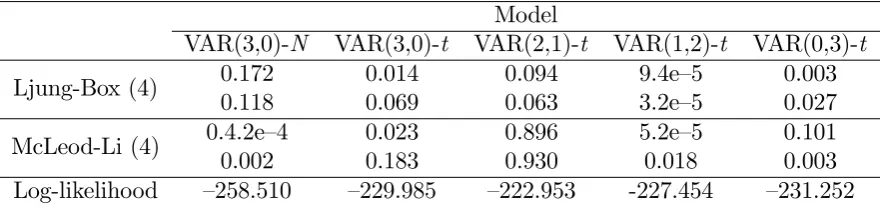
However, the results in Table 1 show that its residuals are conditionally heteroskedastic
and the Q-Q plots is the upper panel of Figure 1, indicate considerable deviations from
normality. The p-values of the Shapiro-Wilk test for the residuals of the equations of
rt and St equal 5.06e–9 and 7.23e–7, respectively. Because the most severe violations
of normality occur at the tails, a more leptokurtic distribution, such as the multivariate
t-distribution, might prove suitable for these data.
The estimation results of all four third-order VAR models witht-distributed errors are
summarized in Table 1. By a wide margin, the speci…cation maximizing the log-likelihood
function is the VAR(2,1)-t model. It also turns out to be the only one of the estimated
models that shows no signs of remaining autocorrelation or conditional heteroskedasticity
in the residuals. The Q-Q plots of the residuals in the lower panel of Figure 1 lend
support to the adequacy of the multivariatet-distribution of the errors. In particular, the
t-distribution seems to capture the tails reasonably well. Moreover, the estimate of the
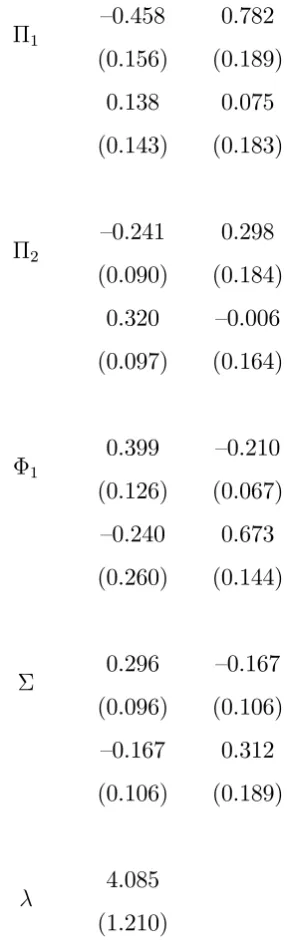
degrees-of-freedom parameter turned out to be small (4.085), suggesting inadequacy of
the Gaussian error distribution. Thus, there is evidence of noncausality.
The estimates of the preferred model are presented in Table 2. The estimated 1
matrix seems to have an interpretation that goes contrary to the implications of the
expectations hypothesis discussed above: an expected increase of the short-term rate has
no signi…cant e¤ect on the spread. Furthermore, an expected future increase of the spread
tends to decrease the short-term rate and increase the spread. This might be interpreted
in favor of (expected) time-varying term premia driving the term structure instead of
expectations of future short-term rates as implied by the expectations hypothesis.
The presence of a noncausal VAR representation of rt and St invalidates the test
of the expectations hypothesis suggested by Campbell and Shiller (1987, 1991). If
non-causality prevails more generally in interest rates this might also explain the common
rejections of the expectations hypothesis when testing is based on the assumption of a
5
Conclusion
In this paper, we have proposed a new noncausal VAR model that contains the commonly
used causal VAR model as a special case. Under Gaussianity, causal and noncausal VAR
models cannot be distinguished which underlines the importance of careful speci…cation
of the error distribution of the model. We have derived asymptotic properties of an
approximate (local) ML estimator and related tests in the noncausal VAR model, and
we have successfully employed an extension of the model selection procedure presented
by Breidt et al. (1991) and Lanne and Saikkonen (2008) in the corresponding univariate
case. The methods were illustrated by means of an empirical application to the U.S. term
structure of interest rates. In that case, evidence of noncausality was found, invalidating
the previously employed test of the expectations hypothesis of the term structure of
interest rates explicitly based on a causal VAR model.
While the new model appears useful in providing a more accurate description of time
series dynamics and checking for the validity of a causal VAR representation, it may
also have other uses. For instance, in economic applications noncausal VAR models are
expected to be valuable in checking for so-called nonfundamentalness. In economics, a
model is said to exhibit nonfundamentalness if its solution explicitly depends on the future
so that it does not have a causal VAR representation (for a recent survey of the relevant
literature, see Alessi, Barigozzi, and Capasso (2008)). Hence, nonfundamentalness is
closely related to noncausality, and checking for noncausality can be seen as a way of
testing for nonfundamentalness. Because nonfundamentalness often invalidates the use
of conventional econometric methods, being able to detect it in advance is important.
However, the test procedures suggested in the previous literature are not very convenient
and have not been much applied in practice.
Checking for causality (or fundamentalness) is an important application of our
meth-ods, but it can only be considered as the …rst step in the empirical analysis of time series
data. Once noncausality has been detected, it would be natural to use the noncausal
VAR model for forecasting and structural analysis. These, however, require methods that
are not readily available. Because the prediction problem in noncausal VAR models is
are not applicable and, due the explicit dependence on the future, the same is true for
conventional simulation-based methods. In the univariate case, Lanne, Luoto, and
Saikko-nen (2010) have proposed a forecasting method that could plausibly be extended to the
noncausal VAR model.
Regarding statistical aspects, the theory presented in this paper is con…ned to the
class of elliptical distributions. Even though the multivariate t-distribution belonging to
this class seemed adequate in our empirical applications, it would be desirable to make
extensions to other relevant classes of distributions. Also, the …nite-sample properties
of the proposed model selection procedure could be examined by means of simulation
experiments. We leave all of these issues for future research.
Mathematical Appendix
A
Derivatives of the log-likelihood function
It will be su¢cient to consider the derivatives ofgt( ) which can be obtained by
straight-forward di¤erentiation. To simplify notation we set h( ; ) = f0( ; )=f( ; ) so that
h0 t(#)0 1 t(#) ; =
f00
t(#)0 1 t(#) ;
f t(#)0 1 t(#) ;
f0
t(#)0 1 t(#) ;
f t(#)0 1 t(#) ;
!2
: (A.1)
Next, de…ne
et( ) =h t(#)0 1 t(#) ; 1=2 t(#) and e0t=et( 0): (A.2)
From (6) it is seen that
e0t=d th 2t; 0 t = th0 2t t; (A.3)
where the latter equality de…nes the notation h0( ) =h( ; 0).
First derivatives of lT ( ). From (14) we …rst obtain
@ @#i
gt( ) = 2h t(#)0 1 t(#) ;
@ @#i t
(#) 1
where, from (15),
@ @#1 t
(#) =
r
X
i=1
@ @#1 i
(#1) (ut i(#2) In) (A.5)
and
@ @#2 t
(#) =
r
X
i=0
s
X
j=1
@ @#2 j
(#2) (yt+j i 0i); (A.6)
with 0 = In = 00. We also set Ut 1(#2) = (ut 1(#2) In)0 (ut r(#2) In)0 0
and Yt+1(#1) = Pir=0(yt+1 i 0i)
0 Pr
i=0(yt+s i 0i)
0 0
. Then, using the notation
Ut 1(#20) = U0;t 1 and Yt+1(#10) = Y0;t+1,
@ @#1
gt( 0) = 2
r
X
i=1
@ @#1 i
(#10) (u0;t i In) 01=2e0t (A.7)
= 2r1(#10)0U0;t 1 01=2e0t
and
@ @#2
gt( 0) = 2
s
X
j=1
@ @#2 j
(#20)
r
X
i=0
(yt+j i 0i0) 1=2
0 e0t (A.8)
= 2r2(#20)0Y0;t+1 01=2e0t:
As for the parameters =vech( ) and ,
@
@ gt( ) = h t(#) 0 1
t(#) ; Dn0 1 1 ( t(#) t(#))
1 2D
0
nvec 1
= D0
n 01 01 t 10=2e0t+
1
2vec( 0) ; as = 0; (A.9)
and
@
@ gt( ) =
1
f t(#)0 1 t(#) ;
@
@ f t(#) 0 1
t(#) ; (A.10)
= 1
f 0
t 01 t; 0
@ @ f
0
t 01 t; 0 as = 0:
Second derivatives of lT ( ). First note that
@ @#0i
et( ) = h t(#)0 1 t(#) ; 1=2
@ @#0i
t(#) (A.11)
+2h0 t(#)0 1 t(#) ; 1=2 t(#) t(#)0 1
@
Using these expressions we now have
@2
@#1@#01
gt( ) = 2 r
X
i=1
ut i(#2)0 et( )0 1=2 Im1
@ @#01vec
@ @#1 i
(#1)
2
r
X
i=1
@ @#1 i
(#1) (ut i(#2) In) 1=2
@
@#01et( ); (A.12)
@2
@#2@#02
gt( ) = 2 s X j=1 r X i=0
y0t+j i et( )0 1=2 i Im2
@ @#02vec
@ @#2 j
(#2)
+2
s
X
j=1
@ @#2 j
(#2)
r
X
i=0
(yt+j i 0i) 1=2
@ @#0
2
et( ); (A.13)
and
@2
@#1@#02
gt( ) = 2 r
X
i=1
@ @#1
i(#1) In 1=2et( )
@ @#02
ut i(#2)
2
r
X
i=1
@ @#1 i
(#1) (ut i(#2) In) 1=2
@ @#0
2
et( ); (A.14)
where @ut i(#2)=@#02 = Ps
j=1(y0t+j i In)@ j(#2)=@#02: Next consider @2g
t( )=@ @ 0 and conclude from (A.9) that
@2
@ @ 0gt( ) = h t(#) 0 1
t(#) ; t(#)0 t(#)0 D0n (In Knn In)
1 1 vec 1 +vec 1 1 1 D
n
+h0
t(#)0 1 t(#) ; Dn0 1 1 t(#) t(#)0 t(#) t(#)0
1 1 D
n+
1 2D
0
n 1 1 Dn; (A.15)
and furthermore that (see(A.4))
@2
@#i@ 0
gt( ) = 2h t(#)0 1 t(#) ; t(#)0
@ @#i
t(#) (A.16)
1 1 D
n
2h0
t(#)0 1 t(#) ;
@ @#i
t(#) 1 t(#) t(#)0 t(#)0
1 1 D
For@2g
t( )=@ @ 0 it su¢ces to note that
@2
@ @ 0gt( ) =
1
f t(#)0 1 t(#) ;
2
@
@ f t(#) 0 1
t(#) ;
@
@ 0f t(#) 0 1
t(#) ;
+ 1
f t(#)0 1 t(#) ;
@2
@ @ 0f t(#) 0 1
t(#) ; (A.17)
whereas
@2
@#i@ 0
gt( ) = 2
@ @#i
t(#) 1 t(#)
@
@ 0h t(#) 0 1
t(#) ; ; i= 1;2; (A.18)
and
@2
@ @ 0gt( ) = D 0
n 1 1 ( t(#) t(#))
@
@ 0h t(#) 0 1
t(#) ; ; (A.19)
where
@
@ h t(#) 0 1
t(#) ; =
1
f t(#)0 1 t(#) ;
@ @ f
0
t(#)0 1 t(#) ;
f0
t(#)0 1 t(#) ;
f t(#)0 1 t(#) ;
2
@
@ 0f t(#) 0 1
t(#) ; :
B
Proofs for Sections 2 and 3
Proof of Lemma 1. For the former inequality, …rst consider the expectation
E 2
th 2t; = n=2
(n=2)
Z 1
0
n=2f0( ; )d = n
2; (B.1)
where the de…nition of the function h (see the beginning of Appendix A), density of 2
t
(see (9)), and Assumption 2(ii) have been used (see the discussion after Assumption 2).
The same arguments combined with the Cauchy-Schwarz inequality and the de…nition of
j( )(see (10)) yield
1 =
(
2 n=2
n (n=2)
Z 1
0
n=4 f0( ; ) p
f( ; )
n=4pf( ; )d )2
4 n=2
n (n=2)
Z 1
0
n=2(f0( ; )) 2
f( ; ) d
n=2
n (n=2)
Z 1
0
n=2
f( ; )d (B.2)
= j( ) E 2
Thus, we have shown the claimed inequality.
From the preceding proof it is seen that equality holds if and only if there is equality in
(B.2). As is well known, this happens if and only if n=4f0( ; )=pf( ; )is proportional
to n=4pf( ; ) or if and only if
f0( ; ) f( ; ) =
@
@ logf( ; ) = c for some c.
This implies f( ; ) = bexp ( a ) with a > 0 and b > 0. From the fact that f(x0x; ),
x2Rn, is the density function of
t t (see (6) and (7)) it further follows thatb= (a= ) n=2 and that t t has the normal density(2 )
n=2
exp ( x0x=2). Here the identity covariance
matrix is obtained because 2
t 2n, and hence from (8), C( 2t t) = In (cf. the corollary
to Lemma 1.4 and Example 1.3 of Fang et al. (1990), p. 23). Thus, t is Gaussian
as a linear transformation of t t. On the other hand, if t is Gaussian the equality
f0( ; )=f( ; ) =cclearly holds with c= 1=2and, because then 2
t 2n,E ( 2t) = n
and j( ) = 1: This completes the proof for j( ).
Regarding i( ), …rst notice that Z 1
0
n=2+1f0( ;
0)d = n=2+1f( ; )j10
n+ 2 2
Z 1
0
n=2f( ; )d
= n+ 2 2
(n=2)
n=2 E 2
t ;
where we have used Assumptions 2(ii) and (iii), and the expression of the density of 2
t
(see (9)). Proceeding as in the case of the …rst assertion yields
1 = 2
(n+ 2)E ( 2
t)
n=2
(n=2)
Z 1
0
n=4+1=2 f0( ; ) p
f( ; )
n=4+1=2pf( ; )d !2
2
(n+ 2)E ( 2t)
2 n=2
(n=2)
Z 1
0
n=2+1 f0( ; )
f( ; )
2
f( ; )d
n=2
(n=2)
Z 1
0
n=2+1f( ; )d
= 2
(n+ 2)E ( 2
t)
2
i( ) E 4
t
(see the de…nition of i( ) in (11)). This shows the stated inequality and the condition
for equality leads to the same condition as in the case of j( ). Finally, in the Gaussian
case, E ( 2
Proof of the nonsingularity of the matrixH1. To simplify notation we demonstrate
the nonsingularity of H1 when s = 2. From the de…nition of H1 it is not di¢cult to
see that the possible singularity of H1 can only be due to a linear dependence of its last
n(r+ 2) rows and, furthermore, that it su¢ces to show the nonsingularity of the lower
right hand corner H1 of order n(r+ 2) n(r+ 2). This matrix reads as
H(21 ;2) =
2 6 6 6 6 6 6 6 6 6 6 6 6 6 6 6 6 6 6 6 6 6 4
In 1 2 0 p 0
0 . .. . .. ... ... p ... ... . .. . .. ... ... . .. p ...
... 0 In 1 2 p 0 0
... 0 0 In 1 p 2 0
0 0 0 0 In p 1 2
anrIn a1In p In 0
0 anrIn p a1In In
3 7 7 7 7 7 7 7 7 7 7 7 7 7 7 7 7 7 7 7 7 7 5 def = 2
4 B11 B12
B21 B22 3
5;
where the partition is as indicated. The determinant of B11 is evidently unity so that
from the well-known formula for the determinant of a partitioned matrix it follows that
we need to show the nonsingularity of the matrixB11 2 =B22 B21B111B12. The inverse
of B11 depends on coe¢cients of the power series representation of L(z) = (z) 1 given
by L(z) = P1j=0Ljzj where L0 = In and, when convenient, Lj = 0, j < 0, will be
used. Equating the coe¢cient matrices of z on both sides of the identity L(z) (z) =In
yieldsLj =Lj 1 1 +Lj 2 2. Using this identity it is readily seen thatB111 is an upper triangular matrix withInon the diagonal andLj,j = 1; :::; nr 1, on the diagonals above
the main diagonal. This fact and straightforward but tedious calculations further show
that
B11 2 = 2
4 In
Pnr j=1ajLj
Pnr
j=1ajLj 1 2 Pnr
j=1ajLj 1 In
Pnr
j=2ajLj 2 2 3
5
=
2
4 In 0
0 In
3 5 nr X j=1 aj 2
4 Lj Lj 1 2
Lj 1 Lj 2 2 3
Next de…ne the companion matrix
=
2
4 1 2
In 0
3
5
and note that the latter condition in (2) implies that the eigenvalues of are smaller
than one in absolute value. Also, the matrices Lj and Lj 1 (j 0)can be obtained from the upper and lower left hand corners of the matrix j, respectively. Using these facts,
the identityLj =Lj 1 1+Lj 2 2, and properties of the powers j it can further be seen that
B11 2 =I2n nr
X
j=1
aj j =P I2n nr
X
j=1
ajDj
!
P 1;
where the latter equality is based on the Jordan decomposition of so that =PDP 1.
Thus, the determinant of B11 2 equals the determinant of the matrix in parentheses in
its latter expression. Because Dj is an upper triangular matrix having thejth powers of the eigenvalues of on the diagonal this determinant is a product of quantities of the
form 1 Pnrj=1aj j where signi…es an eigenvalue of . By the latter condition in (2)
the eigenvalues of are smaller than one in absolute value whereas the former condition
in (2) implies that the zeros ofa(z) lie outside the unit disc. Thus, the nonsingularity of
B11 2, and hence that ofH(21 ;2) and H1 follow.
We note that in the case s= 1 the preceding proof simpli…es because then we need to
show the nonsingularity of the matrix obtained fromH(21;2) by deleting its lastnrows and columns and setting 2 = 0. In place of B11 2 we then haveIn
Pnr
j=1aj j1 and, because now the eigenvalues of 1are smaller than one in modulus, the preceding argument applies
without the need to use a companion matrix.
Before proving Proposition 1 we present some auxiliary results. In the following
lem-mas, as well as in the proof of Proposition 1, the true parameter value is assumed, so
the notation E( ) will be used instead of E
0( ) and similarly for C( ). In these proofs
frequent use will be made of the facts that the processes t and t are independent and
that E( t) = 0 and E( t 0
k) equals0 if t 6=k and n 1In if t =k. The same can be said
about well-known properties of the Kronecker product and vec operator, especially the
C. This and other results of matrix algebra to be employed can be found in Lütkepohl
(1996). We also recall the de…nition "t = 01=2 t (see (6)) and, to simplify notation, we
will frequently write f( ; 0) = f0( )and similarly for f00 ( )and f000( ).
Lemma 3. Under the conditions of Proposition 1,
E(e0t) = 0 and C(e0t) = j0
4In; (B.3)
and
C("t; e0k) = 8 <
:
0; if t6=k
1
2In; if t=k
(B.4)
Proof of Lemma 3. By the de…nition of the functionh0( ) (see (A.3)) and the density
of 2
t (see (9)) we have
E h
2
t h0 2t
2i
=
n=2
(n=2)
Z 1
0
n=2(f00( )) 2
f0( )
d = n
4j0;
where the latter equality is due to (10). Thus, because E( t) = 0 and C( t) = n 1I
n,
the independence of the processes t and t in conjunction with (A.3) proves (B.3). The
same arguments and (6) yield
E("te0
0k) = E t kh0 2k E( t 0k);
where E( t 0
k) = 0 for t6=k. Thus, one obtains (B.4) from this and (B.1).
Lemma 4. . Under the conditions of Proposition 1,
C("t i e0t; "k j e0k) = 8 > > > > > > <
> > > > > > :
DnJ0D0n; if t=k; i=j = 0
0
4 In2; if t=k; i=j 6= 0 1
4Knn; if t6=k; i=t k; j =k t
0; otherwise.
Moreover, the matrix J0 is positive de…nite even when t is Gaussian.
Proof. First notice that (see (6) and (A.3))
"t i e0t d
Consider the case t=k and i=j = 0. Using (B.5) and independence of t and t yields
E("t e0t) = E 2
th0 2t E( t t) =
1
2Dnvech(In);
where the latter equality is due to (B.1) and E( t t) = vec(E( t 0
t)) = n 1vec(In).
By the same arguments we also …nd that
E[("t e0t)("t e0t)0] =Eh 4
t h0 2t
2i
E( t 0
t t 0t) =i0E( t 0t t 0t);
where the latter equality follows from the de…nition of i0 (see (11)). Because
E( t 0
t t 0t) = E[( t t) ( 0t 0t)] =DnE (vech( t 0t)) (vech( t 0t))
0 D0
n;
the stated result is obtained from the preceding calculations and the de…nition of the
matrix J0.
To show the positive de…niteness of the matrix J0, note …rst that J0 is clearly
sym-metric. From the de…nition of i0 and (B.1) we …nd that, even when t is Gaussian,
i0 >fE[ 2th0( 2t)]g
2
=n2=4where the inequality is strict because 2
t has positive density.
Now, let xbe a nonzeron 1vector and conclude from the preceding inequality and the
de…nition of J0 that
4x0J
0x > n2x0E (vech( t 0t)) (vech( t 0t))
0
x x0vech(I
n)vech(In)0x
= n2x0C(vech( t 0
t))x;
where the equality is justi…ed byE[vech( t 0
t)] = n 1vech(In):Because the last quadratic
form is clearly nonnegative, the positive de…niteness of J0 follows.
For the case t = k; i = j 6= 0 we have by independence E("t i e0t) = E("t i) E(e0t) = 0. Thus, by (B.5) and arguments already used,
C("t i e0t; "t i e0t) =E 2
t i E
h 2
t h0 2t
2i
E t i 0
t i E( t 0t) :
The stated result is obtained from this by using de…nitions and E( t 0
t) = n 1In.
In the case t6=k; i=t k;and j =k t we havei6= 06=j and, as in the preceding
Lütkepohl (1996)). As before, we now obtain
C("k e0t; "t e0k) = C("k e0t; Knn(e0k "t))
= E
k k th0 2t t kh0 2k
0
k t
0
t K
0
nn
= E 2
th0 2t
2
fE( k 0
k) E( t 0t)gK
0
nn
= 1 4Knn;
where the last equality follows from (B.1), the symmetry of the commutation matrixKnn;
and the fact E( t 0
t) =n 1In.
Finally, in the last case the stated results follows from independence.
Now we can prove Proposition 1.
Proof of Proposition 1. The proof consists of three steps. In the …rst one we show
that the expectation of the score of at the true parameter value is zero and its limiting
covariance matrix is I ( 0). The positive de…niteness of I ( 0) is established in the
second step and the third step proves the asymptotic normality of the score.
Step 1. We consider the di¤erent blocks of I ( 0)separately and, to simplify
nota-tion, we set N = T s nr. In what follows, frequent use will be made of the identity
f0 0
t 01 t; 0 =f 0t 01 t; 0 01 t= 01=2e0t (see (A.2)).
Block I#1#1( 0). From the de…nitions and (3) it can be seen that U0;t 1 and e0t are
independent. Thus, (B.3), (A.7), and straightforward calculation giveE(@gt( 0)=@#1) =
0 and, furthermore,
C 0
@N 1=2
T s (n 1)r
X
t=r+1
@ @#1
gt( 0) 1
A=r1(#10)0C11( 0)r1(#10) = I#1#1( 0):
Block I#2#2( 0). DerivingI#2#2( 0) is somewhat complicated. From the expression of
@gt( 0)=#2 (see (A.8)) it may not be quite immediate that the expectation of the score of
#2 is zero so that we shall …rst demonstrate this. Recall that (z) 1 =L(z) = P1j=0Ljzj
withL0 =Inand,Lj = 0,j <0. Similarly to the notationMj0,Nj0, and j0we shall also write Lj0 when Lj is based on true parameter values. Equating the coe¢cient matrices
below (5)) one readily obtains
r
X
i=0
j i;0 i0 = 8 > > > <
> > > :
0; j >0
In; j = 0
L j0; j <0;
(B.6)
where, as before, 00= In. To simplify notation we also denote
A0(k; i) = k0 10=2 0i0 1=2
0 and B0(d) =Md0 10=2
1=2 0 .
Notice that from (B.6) we …nd that
r
X
i=0
A0(a i; i)vec(In) =vec r
X
i=0
0
i0
0
a i;0 !
= 0; a 2 f1; :::; sg: (B.7)
Now recall that the matrix Y0;t+1 consists of the blocks Pr
i=0(yt+a i 0i0); a 2
f1; :::; sg, and consider the expectation
E
r
X
i=0
(yt+a i 0i0) 1=2 0 e0t
!
=
r
X
i=0
1
X
k= 1
E ( k0 t+a i k 0
i0 1=2 0 )e0t
=
r
X
i=0
1
X
k= 1
A0(k; i)E("t+a i k e0t);
where the former equality is based on (5) and the latter on the de…nition of A0(k; i) and
the de…nition "t = 01=2 t. By Lemma 3, the expectation in the last expression equals
zero if k 6=a iand 12vec(In) if k=a i. From this and (B.7) we …nd that
E
r
X
i=0
(yt+a i 0i0) 1=2 0 e0t
!
= 1 2
r
X
i=0
A0(a i; i)vec(In) = 0:
This in conjunction with (13) and (A.8) shows thatE(@lT ( 0)=@#2) = 0, and we proceed to the covariance matrix of the score of #2.
covari-ance matrix
C
r
X
i=0
(yt+a i 0i0) 1=2 0 e0t;
r
X
j=0
(yk+b j 0i0) 1=2 0 e0k
!
= 1
X
c;d= 1
r
X
i;j=0
A0(c; i)C(("t+a i c e0t);("k+b j d e0k))A0(d; j)0
= 0 4
1
X
c= 1
c6=0
r
X
i;j=0
A0(c+a i; i)A0(c+b j; j)01(t=k)
+1 4
r
X
i;j=0
A0(t k+a i; i)KnnA0(k t+b j; j)01(t 6=k)
+
r
X
i;j=0
A0(a i; i)DnJ0Dn0A0(b j; j)01(t =k):
Here the former equality is again obtained by using (5) and the de…nition of A0(k; i)
whereas the latter is justi…ed by Lemma 4. Summing the last expression over t; k =
r+ 1; :::; T s (n 1)r, multiplying by 4=N, and letting T tend to in…nity yields the
matrix C22(a; b; 0) (see (A.8) and the de…nition of I#2#2( 0)). Thus,
C22(a; b; 0) = 0
1
X
k= 1
k6=0
r
X
i=0
A0(k+a i; i)
r
X
j=0
A0(k+b j; j)0
+ 1
X
k= 1
k6=0
r
X
i=0
A0(k+a i; i)Knn r
X
j=0
A0( k+b j; j)0
+4
r
X
i=0
A0(a i; i)DnJ0Dn0 r
X
j=0
A0(b j; j)0: (B.8)
To see that the right hand side really equals the expression given in the main text, we
have to show that the second term vanishes when the range of summation is changed to
k = 0; 1; 2; :::, or that
1
X
k= 1
r
X
i;j=0
k+a i;0 10=2 0i0 1=2
0 Knn 10=2 0 k+b j;0
1=2
0 j0 = 0:
To see this, notice that( k+a i;0 10=2 0i0 1=2
0 )Knn =Knn( 0i0 1=2
can be written as
Knn
1
X
k= 1
r X i;j=0 0 i0 0
k+b j;0 k+a i;0 j0 = Knn
1
X
l= 1
r X j=0 r X i=0 0 i0 0
l+a+b j i;0 l;0 j0 !
= Knn
1
X
l= 1
r
X
j=0
L0
l a b+j;0 l;0 j0
= Knn
1 X k=0 L0 k;0 r X j=0
k+a+b j;0 j0 !
= 0:
Here the second and fourth equalities are obtained from (B.6) (because a,b > 0).
From (A.8), the de…nition of A0(c; i), and the preceding derivations it follows that the
covariance matrix of the score of #2 divided by N converges to I#2#2( 0).
Block I#1#2( 0). Let a 2 f1; :::; rg and b 2 f1; :::; sg. Using (3) and (5), and the
previously introduced notation A0(k; i)and B0(k) (B0(k) = 0 for k <0) we consider
C (u0;t a In) 1=2 0 e0t;
r
X
i=0
(yk+b i 0i0) 1=2 0 e0k
! = 1 X c=0 1 X
d= 1
r
X
i=0
B0(c)C(("t a c e0t);("k+b i d e0k))A0(d; i)0
= 0 4
1
X
c=a r
X
i=0
B0(c a)A0(c+b i; i)01(t=k)
+1 4
r
X
i=0
B0(t k a)KnnA0(k t+b i; i)01(t 6=k);
where the latter equality is based on Lemma 4. Summing over t; k = r + 1; :::; T
s (n 1)r, multiplying by 4=N, and letting T tend to in…nity yields the matrix
C12(a; b; 0) (see (A.7), (A.8) and the de…nition of I#1#2( 0)). Thus,
C12(a; b; 0) = 0
1
X
c=a r
X
i=0
B0(c a)A0(c+b i; i)0
1
X
c=a r
X
i=0
B0(c a)KnnA0( c+b i; i)0: (B.9)
It is easy to see that the …rst term on the right hand side equals the the …rst term on the