Desig
ABSTRAC
The human-co automatic doc movement is r signal is recor order to extrac mand. The de assistant tool f
Keywords: Su
1. Introduc
Nowadays, PC HCI method i with a mouse nient for disa themselves. T between the e change with th difference tim face electromy movement ca sEMG has bee engineering. A the sEMG ha with other bod is easier to c strength than for experimen thod needs lot experimenters fortable. The EMG experim
*This work is sup
61074113; Scient Chinese Scholar Project by Shang 12DZ1940903; S
gn of Re
and
1 De Ea 2 Key (East China UnCT
omputer intera cument control realized accord rded and conv ct the characte eveloped huma for disabled pe
urface Electrom
ction
C is widely u is usually ach or a touch scr abled people The research i electrodes stuck
he movement me and differen
yogram (sEM an be detected en widely used As a member o as its unique dy signals in a collect. Besid other signals a nters to use. T
ts of complex e s which alway
individuals ca ment always co
pported by Nation tific Research Fo rs, State Educati ghai Municipal Sc
hanghai Leading A
eal-Tim
Surface
Zhen W epartment of Au ast China Univer y Laboratory of A
niversity of Scie
action (HCI) i l technique wh ding to the sur veyed to a PC eristics of sEM an-computer in erson.
myography; H
used everywhe hieved with a reen. But it is
to use these indicated that, k to the skin o of muscle. Th nce movement G). All the sig d and recorded d in the field o of the family o advantages w application. Fir
es that, sEMG and sEMG has
he normal sEM electrodes link s make the us an’t move for l onsumes much
Nature Science F oundation for the on Ministry; Me cience and Techn Academic Discipl
me Docu
e Electr
Wang1,2, Bei utomation, Scho rsity of Science Advanced Contr ence and Techno Email: xyw
Recei
s now playing hich is based o rface electromy C terminal by u MG, recognize
nteraction tech
Human-Compu
ere. The norm keyboard alon
really inconv equipments b , the differenc of muscle woul he differences ts make the su gnals of musc d [1]. Recently
of rehabilitatio of body signal when compare rst of all, sEM G has strong s more channe MG collect m ked with PC an
ers feel uncom long time as th h time, and th
Foundation of Chi Returned Overse edical Cooperatio nology Commissio line Project B504.
ment C
romyog
i Wang1,2, Xi ool of Informatio
and Technology rol and Optimiz ology), Ministry [email protected]
ived May2013
g a great role i on the human h
yography (sEM using wireless
the waving m hnique can be
uter Interaction mal ng e- by ce ld at ur- cle y, on ls, ed MG er els e- nd m- he hat usually This sEMG link lin are col rearm. individu process The sta wireles convey nated b potentia compon the imp vented dispose The sy practica
2. Dat
The sub graduat age ag hand as are tota menter na eas on on .Control
graphy (
ingyu Wang1 on Science and E
y, Shanghai, 200 zation for Chemi y of Education, S du.cn
in computer te hand waving m MG). A collec s Zigbee. An a movements, and used as a new
n; Zigbee; Docu
y makes them v paper propo to PC wireles nes across rese lected by the The features o ual’s hand w sed first by a H ar topology of ss transmit netw yed to PC rapi
by the ECG, it ally yields m nent analysis pact of ECG. autonomously e the data and stem finally c al use.
ta Acquisiti
bjects of sEMG ted students (f
e is twenty-th s the strong ha al four series o ’s forearm. Th
Based o
(sEMG
1,2 Engineering, 0237, China ical Processes, Shanghai, 20023 echnology. Th movements. Thtor is set on th automatic algo d transmit to d w gallery for t
ument Control
very tired. ses a new m ssly, so there earchers and u instruments s of sEMG will ave up or do HPT in order to
f Zigbee was work. The sEM idly. Since EM t usually hamp misinterpretatio
method (ICA) A real-time y which can re transmit the d comes true wit
ion
G pick up expe five male, five hree. Eight stu and while two of sEMG data he sEMG sign
on Zigb
G)
*
37, China
his study introd he recognition he forearm. Th orithm is deve document contr
eaching, as w
l
method to con are no misce users. And all set on individu
be detected w own. The data
o eliminate the settled to bu MG signals ca MG is often c pers data anal ons. The inde
) is used to g control system eceive the sEM data to control
th stable, secu
eriment are ten e female) who udents use th
use the left on obtained from nals were rec
bee
duces an n of hand he sEMG eloped in rol com- ell as an
nvey the ellaneous
extensor carpi radialis muscle, flexor carpi radialis and extensor carpi ulnaris musculus according to anatomy. The actual electro position is shown in Figure 1.
The experiment uses an amplifier with a sampling fre- quency of 500 Hz, a sensitivity of 100 uV. The high-pass filter (HPF) frequency is 100 Hz while the notch filter is 50 Hz.
3. Wireless Zigbee
The Zigbee technology is famous for its advantage on low power consumption, concise, short distance and so on. Zigbee is becoming popular in our daily life. It has a particular advantage in the field of short distance and low consumption equipment transforms digital data wireless, especially during periodic and intermittent applications. It can work at the frequency of 2.4 Ghz (world wild scope), 868 Mhz (Europe scope) and 919 Mhz (America scope) allocate with the speed of 250 Kbit/s, 20 Kbit/s and 40 Kbit/s. The transport distance can range from 10 to 75 meters.
In this study, the Zigbee module works at the fre- quency of 2.4 GHz and the channel sets to 20 through MAC_RADIO_SET_CHANNEL(x) control command. The data will be transited in a periodicity method. Once the receiver Zigbee get into receiving status, the net-layer can receive sEMG signals through MAC service. Before the application layer receive the data, the hardware part has accomplished receiving the data and storing them in the buffer which the software can read data from buffer to achieve corresponding function [2]. The wireless transaction module performs its three functions in this system. First, it takes charge of the transformation be- tween SEMG and PC while making sure that the infor- mation is real-timing. Second, primary dispose sEMG signal is collected from forearm. Including amplify the feeble signal and filter for the first time. At last, trans- form sEMG signal to PC and store them in the buffer for display online.
4. System Structure
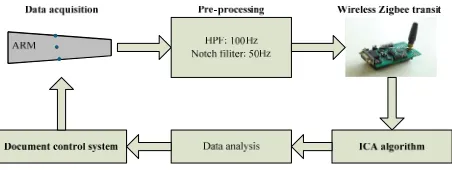
[image:2.595.311.537.85.170.2]The flow char of the system is shown in Figure 2. First of all, detect the sEMG plus through the electrodes fixed in forearm. Then pre-process the sEMG signal such as filtering, A/D transforming and amplifying with an am-
Figure 1. The actual electro position.
Figure 2. The flow chart of the system.
plifier. Third, transform them to PC with wireless Zigbee part, store them in the buffer memory and display them in an invented window. Fourth, deal with the digital data collected from forearm. An independent component analysis (ICA) arithmetic is put into use to digital filter- ing preliminary. Fifth, extract the hand wave movement, take clear of the exact movements and the number of them, output them as control signal. At last, stop and exit the system.
4.1. Independent Component Analysis
EMG recordings are often incorporated by the electro- cardiogram (ECG), which can disturb the classifications of hand movement and result in misinterpretations [3]. Independent component analysis (ICA) is widely used for a situation involving two signal sources [4]. The dia- gram to the operation of ICA is illustrated in Figure 3.
The mixtures X are generated by the operation
AS
X (1) In this case,
1
2 s S
s
,
1
2
x X
x
And the mixing matrix A is given by
11 12
21 22 a a A
a a
The aim is to estimate an unmixing matrix W that ena- ble the signal sources U to be obtained by
UWX (2) where
11 12
21 22
w w W
w w
,
1
2
u U
u
The ICA algorithm is performed by each iteration, the unmixing matrix W is updated until convergence is achieved. The algorithm stops training when the rate of change falls below a predefined small value.
The description of ICA can be referred to the book by LEE [5].
4.2. Hand Wave and Number of Clench Fist
[image:2.595.60.281.635.715.2]Figure 3. Diagram to illustrate the operation of ICA.
hands while the potential difference is much lower when there are no wave movements. A threshold will be de- fined to distinguish the hand waving movements. The data will set to zero when they are lower than the thre- shold while set to one when they are higher than the threshold. Then the hand wave movement and number of clench fist could be calculated exactly [6].
4.3. Control Flow Chart
The system normally operate flow the process which consist of six steps such as entering the system, selecting file list, confirming to play, documenting page up, do- cumenting page down and exiting or replaying the sys- tem. The detailed control flow is shown in Figure 4,
1) Enter the system: The experimenter can clench their fist three times to enter the system when he or she enters for the first time or after stop. The other clench has no means.
2) Select file list: After enter the system, the individual could wave his or her hand from up to down or reverse to choose which file to play. Citing wave down three times means choose the third item file to play. Of course, the file list could be updated manually.
3) Confirm to play: The individual could clench fist twice to confirm the chosen file to play.
4) Document page up: When the performer needs to control the document to page up he or she could wave his or her hand from right to left.
5) Document page down: When the performer needs to control the document to page down he or she could wave his or her hand from left to right.
6) Exit or replay: The individual could replay the whole system by clench fist twice or exit the system by disconnect the wireless Zigbee part.
5. Result
5.1. Data Analysis
[image:3.595.63.287.87.164.2]There are totally four series of sEMG data which indicate wave up, wave down, wave right, wave left and clench fist movement. According to anatomy, extensor carpi radialis muscle, flexor carpi radialis muscle and extensor carpi ulnaris muscle can generate electronic signals when individuals wave up or wave down and sEMG signal may change when they rotate their arm to wave right and
Figure 4. The detailed control flow chart.
wave left. It is also indicated that the sEMG signals are much stronger when individuals clench their fist than just wave their hand [7]. Depend on the above information, the correspond sEMG waveform is shown in Figures 5- 8 as follows.
In Figure 5, the sEMG data is normally under 0.3 when there is no wave movement produced. However, the sEMG data suddenly arrive to 0.5 - 1.5 when the in- dividuals move their hand. According to the threshold we set, we can distinguish the data to zero and one for con-venience of the output of control command. As in figure5, we can get that there are totally four times of wave up movement or wave right movement happened. Along with the rotate arm signals shown in Figure 7, there is rotate arm movement happened on the same time which indicate that the actual wave movement is wave right. The sEMG data is entirely rolling-over when individuals wave their hand down rather than wave up. The same as wave right and wave left. In Figure 8, we can see that the clench fist sEMG signal actually up to 2.0 - 2.5 which higher than other signals. So we can easily distinguish clench signals and wave hand signals.
5.2. Real-Time Control System
Figure 5. Wave up sEMG signals threshold analysis.
[image:4.595.63.286.416.548.2]Figure 6. Wave down sEMG signals threshold analysis.
Figure 7. Rotate arm sEMG signals threshold analysis.
Figure 8. Clench fist sEMG signals threshold analysis.
[image:4.595.308.540.474.616.2]ment control system. First, we could choose the file to play with wave hand. Second, after select the file we could control a document to display, such as page up and page down or close the document. The software is de- signed and executed successful on VB6.0 [8]. The MSCOM controller is used to connect with serial data from Zigbee. The HCI system is working as shown in Figure 9 [9].
6. Result
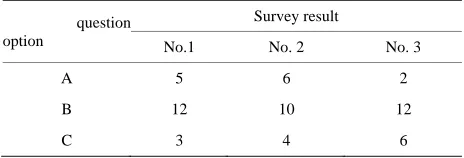
The gap of convenience is very common between differ- ent HCI methods. In order to get more information about the proposed HCI, a survey is made in different groups. Totally twenty students whose average age is 24 are asked to make this survey. The survey information is listed as follow. Take use of an online survey system, a valuable report is shown in table1 detailed.
Question 1:
Which is the most comfortable HCI pattern? A, mouse down; B, sEMG; C, voice Question 2:
Which action will you take to control a PPT? A, clench fist; B, wave hand; C, shake figure Question 3:
Which hand waving actions will you chose to generate useful signal?
a, left to right; b, right to left; c, front to back
As the result shown in Table 1, about 60% people tend to take use of sEMG as control signal; 50% people fa- miliar with wave hand to achieve document control; 60% people expect to enforce document by wave their hand
Figure 9. Document control system.
Table 1. Survey result report.
question option
Survey result
No.1 No. 2 No. 3
A 5 6 2
B 12 10 12
[image:4.595.61.285.581.718.2] [image:4.595.307.539.657.736.2]from right to left.
According to this survey result, it is convenient for many people to select hand wave movement as document control signal.
7. Conclusions
In this paper, we propose a new HCI system which has many innovations. First of all, the control command is produced through the analysis of sEMG signals. Besides that, the wireless data transition system along with a data transit network built by Zigbee. EOG signals are elimi- nated from sEMG with the ICA algorithm which enhances the accuracy of control command. A computer platform is built to deal with the wireless data transit module, the recognition of sEMG, the output of control command and so on.
This paper proposes a new application of sEMG along with Zigbee technology. An online survey system is used to make sure that the most acceptable movement of document control is wave hand. In addition, the direct body movement in a speech with PPT is very natural and comfortable because body movement is the instinct of oneself. The ICA arithmetic can combine with other arithmetic such as JADE and PCA in order to get more instinct control signal. In the future, the recognition algo- rithm can be improved with the development of technol- ogy. This system can be used in many aspects of the so- ciety such as teaching and disabled treatment.
REFERENCES
[1] K. Ando, K. Nagata, D. Kitagawa, N. Shibata, M. Ya- mada and K. Magatani, “Development of the Input Equip- ment for a Computer Using Surface EMG,” 28th Annual International Conference of the IEEE Engineering inMe- dicine and Biology, New York City, 2006, pp. 1331-1334. [2] X. Chen and Z. Jane Wang, “Pattern Recognition of Num- ber Gestures Based on a Wireless Surface EMG System,”
Biomedical Signal Processing and Control, Vol. 8, 2013, pp. 184-192.
http://dx.doi.org/10.1016/j.bspc.2012.08.005
[3] G. R Naik, D. K Kumar, S. P Arjunan, H. Weghorn and M. Palaniswami, “Limitations and Applications of ICA in Facial sEMG and Hand Gesture sEMG for Human Com- puter Interaction. Digital Image Computing Techniques and Applications,” 9th Biennial Conference of the Aus- tralian Pattern Recognition Society, Vol. 58, 2007, pp. 15-22.
[4] L. Vigon, M. R. Saatchi, J. E. W. Mayhew and R. Fer- nandes, “Quantitative Evaluation of Techniques for Ocu- lar Artefact Filtering of EEG Waveforms,” IEE Proceed- ings of Science, Measurement and Technology, Vol. 147, No. 5, 2000, pp. 219-228.
http://dx.doi.org/10.1049/ip-smt:20000475
[5] T. W. Lee, “Independent Component Analysis, Theory and Application,” Kluwer Academic Publishers, Boston, 1998.
[6] N. W. Willigenburg, A. Daffertshofer, I. Kingma and J. H. Dieen, “Removing ECG Contamination from EMG Re- cordings: A Comparison of ICA-Based and Other Filter- ing Procedures,” Journal of Electromyography and Kine- siology, Vol. 22, 2012, pp. 485-493.
http://dx.doi.org/10.1016/j.jelekin.2012.01.001
[7] K. Kiguchi and Y. Hayashi, “An EMG-Based Control for an Upper-Limb Power-Assist Exoskeleton Robot,” IEEE Transactions on System, Man, and Cybernetics-Part B:
Cybernetics, Vol. 42, No. 4, 2012, pp. 1064-1071. [8] J. U. Chu, I. Monn and M. S. Mun, “A Real-Time EMG
Pattern Recognization System Based on Linear-Nonlinear Feature Projection for a Multifunction Myoelectric Hand,”
IEEE Transactions on Biomedical Engineering, Vol. 53, No. 11, 2006, pp. 2232-2239.
http://dx.doi.org/10.1109/TBME.2006.883695