
Structural studies and conductivity of
[Fe(O
3
C
4
)(COO)]·H
2
O based H
4
btec
(H
4
btec = 1,2,4,5-benzenetetracarboxylic acid)
Manel Halouani
1*, Mohamed Abdelhedi
1, Mohamed Dammak
1, Nathalie Audebrand
2, Lilia Ktari
11Laboratoire de Chimie Inorganique, Faculté des Sciences de Sfax, Université de Sfax, Sfax, Tunisia
2Laboratoire de Matériaux Inorganiques: Chimie Douce et Réactivité, UMR 6226 Sciences Chimiques de Rennes, Université Rennes
1, Rennes, France
Email: *[email protected], [email protected], [email protected],
[email protected], [email protected]
Received 17 June 2013; revised 17 July 2013; accepted 24 July 2013
Copyright © 2013 Manel Halouani et al. This is an open access article distributed under the Creative Commons Attribution License, which permits unrestricted use, distribution, and reproduction in any medium, provided the original work is properly cited.
ABSTRACT
A new metal-organic hybrid compound
[Fe(O
3C
4)(COO)]·H
2O I has been hydrothermally
synthesized and characterized by single-crystal X-ray
diffraction. Rust crystals crystallize in the mono-
clinic system, space group I2/a,
a = 6.9651(2) Å, b
=
8.12630(10) Å, c = 19.4245(2) Å,
β
= 92.6600(10)˚; V =
1098.25(4) Å
3; Z = 2 and D
x= 3.63 g/cm
3. The refine-
ment converged into R = 0.042; R
w= 0.058. The
structure, determined by single crystal X-ray diffrac-
tion, consists of a network of FeO
6centers, octahedral
coordinated by btec (btec = 1,2,4,5-benzenetetracar-
boxylic acid) anions giving rise to a two-dimensional
sheet structure. In the compound I,
[Fe(O
3C
4)(COO)]·H
2O, the FeO
6group bridged by
the 1,2,4,5-benzenetetracarboxyl anion exist in a unit
cell, with each anion lying about an inversion centre.
One of the FeO
2a distance [1.965(2)] significantly cor-
responds to the shortest distance as the other and the
distances found in the axial direction of compound I.
Keywords:
Hydrothermal Synthesis; X-Ray Diffraction;
Crystal Structure
1. INTRODUCTION
During the past decade, the design and synthesis of
crystalline material constructed from molecular clusters
linked by extended groups have attracted great atten-
tion. Most notable fields are metal-organic frameworks
(MOFs), [1-7] in which polyatomic inorganic metal-con-
taining clusters are connected by polytopic linkers. The
direct driving forces originate not only from their fasci-
nating topological structures but also from their versatile
applications in gas adsorption and separation, catalytic
activities, optoelectronic material, luminescence, mag-
netism, and so on [8-19]. Thus, structural design or
modification of the coordination polymers has become a
very active field in crystal engineering [20-24]. In this
process, judicious selection of ligands as basic building
blocks is of great importance because slight structural
changes in the organic building blocks such as length,
flexibility, and symmetry can dramatically change the
structural motifs of coordination polymers. It is well
known that organic ligands play a rather important role
in the construction of MOFs, and multicarboxylate
ligands are frequently chosen owing to their rich coordi-
nation modes, coordinating to metal ions through com-
plete or partial deprotonation of their carboxy groups,
and their metal binding ability [25-30]. Especially inter-
esting are the complexes formed by H
2bdc and H3btc
having one-dimensional polymeric chain or brick-wall
structures and their selective guest binding abilities [31-
46].
In spite of the rich coordination chemistry exhibited
by H
2bdc and H
3btc (Chart 1) in the presence of auxiliary
ligands and coordinated solvents, barring a few sporadic
reports, which mainly concentrate on the direct interac-
tion between the metal ion and the ligand, there have
been no serious attempts to prepare metal-organic poly-
meric or supramolecular structures based on 1,2,4,5-
benzene tetracarboxylic acid (H
4btec) [47-65]. It may be
argued that, due to steric reasons, all the four carboxyl
groups of H
4btec are unlikely to take part in coordina-
tion to the metal. However, even the presence of free
-COOH groups (especially in the vicinity of coordinated
water molecules, donor solvents and added amines)
would lead to formation of new extended structures
aided by hydrogen bonding inter-actions. Moreover,
the presence of a large number of uncoordinated water
molecules within the lattice, may in turn lead to
interesting possibilities for the preparation of porous
solids. 1,2,4, 5-Benzenetetracarboxylic acid (H
4btec) has
been well known to be an ideal ligand to encapsulated
metal nodes, forming coordination compounds with unique
structures and interesting properties [66-70], which may
have the following advantages: 1) Higher symmetry of
the ligand may cause the generation of regular struc-
tures; 2) The rigidity of the ligand may reduce the
possibility of lattice interpenetration in the products
[71,72]; 3) The multidentate carboxylate is known to be
essential in chelating metal ions to form chain-like
units with M-O-M connectivity; 4) The four carboxy-
lic groups of this ligand may chelate to metal ions by
using various coordination modes to form fascinat-
ing multidimensional compounds. In consideration of
the varieties of topologies and properties, incorporating
functional moieties into MOFs is often a popular method
used in crystal engineering.
COOH
HOOC
H2BDC
COOH
COOH HOOC
H3BTC
HOOC COOH
COOH HOOC
H4BTEC
2. EXPERIMENTAL
2.1. Synthesis and Initial Characterization
The title compound was synthesized under hydrothermal
conditions in the presence of tetramethylammonium
nitrate.
In a typical synthesis, 0.1158 g of pyromellitic
acid (Acros Organics) was dispersed in 9 ml of H
2O. To
this, 0.1975 g of iron nitrate monohydrate (Prolabo) was
added under constant stirring. Finally, we add 0.062 g of
tetramethylammonium nitrate (Alfa Aesar) and the mix-
ture was homogenized for 15 min at room temperature,
was sealed in a 23-ml PTFE-lined stainless steel auto-
clave and
heated at 120˚C for 60 h. Then the product
obtained is filtered and washed with a small amount of
distilled water. The chemical purity of the product was
tested by EDAX measurements. [
Figure 1(a)
] presents
(a)
[image:2.595.80.516.362.704.2](b)
Figure 1. (a) Typical EDAX spectrum of [Fe(O3C4)(COO)]·H2O showing the presence of Fe, O and C; (b) Scanning electron
the EDAX spectrum of [Fe(O
3C
4)(COO)]·H
2O which
reveals the presence of all non-hydrogen atoms: Fe, C
and O. Elemental analysis give these results: for observed
we have C 34.10%, O 43.52%, Fe 2.38%; whereas for
calculated we find C 43.93%, O 47.08%, Fe 8.99%. The
amine used in this synthesis does not appear in the reac-
tion product and its role remains unexplained. The [
Figure
1(b)
] shows the photograph of scanning electron micro-
scopy (SEM) of the samples [Fe(O
3C
4)(COO)]·H
2O at
room temperature.
2.2. Single Crystal Structure Determination
The unit-cell dimensions were refined using X-ray dif-
fraction data collected with a Kappa CCD Enraf Non-
inus diffractometor using Mo K
α
radiation .The structure,
[Fe(O
3C
4)(COO)]·H
2O, was analyzed with the crystallo-
graphic CRYSTALS program [73]. The structure was
solved by conventional Patterson and difference-Fourier
techniques. The chemical crystal data, the parameters
used for X-ray diffraction data collection and strategy
used for the crystal structure determination and their re-
sults, are listed in
Table 1
.
Table 2
shows the atomic
coordinates and equivalent isotropic displacement. The
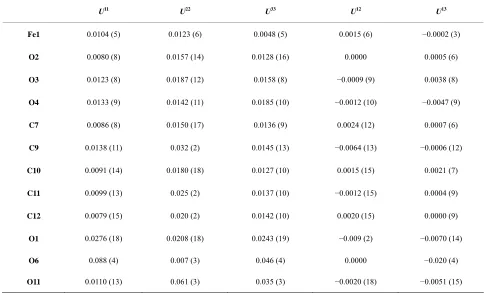
anisotropic displacement parameters are listed in
Table 3
.
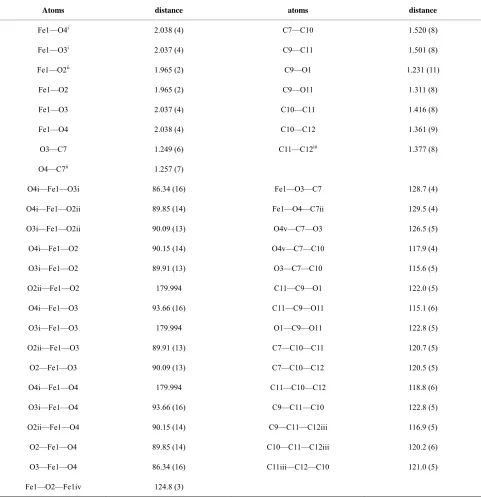
Selected bond distances and angles are given in
Table 4
.
Structural graphics were created by the DIAMOND pro-
gram [74]. The asymmetric unit is shown in (
Figure 2
).
3. RESULTS AND DISCUSSION
The structure of compound I is representatively de-
scribed in detail here. In an asymmetrical unit of 2, The
structure of [Fe(O
3C
4)(COO)]·H
2O , Compound I, is
formed of a network of octahedral coordination by Fe
carboxylate units btec. It also contains 11 non-hydrogen
atoms. The Fe atom is octahedrally coordinated by six
oxygen atoms from four different carboxylic groups. The
Fe-O distances are in the range 1.965(11) - 2.038(4)
(av.2.013 Å) and the O-Fe-O angles are in the range
86.34(16) - 179.994
°(av.102.856
°). Bond valence sum
calculations 23 indicated that the valence states of the Fe,
C and O in II were +2, +4 and
−
2 respectively. Their
selected bond lengths and bond angles are listed in
Table
4
.
The bonded oxygen atoms of the carboxylate groups
have C-O distances in the range 1.276(5) - 1.290(5)Å.
The O-C-O bond angles have an average value of
125.16
◦. The present compound adds another example to
[image:3.595.309.537.85.318.2]this family of compounds. The various structural pa-
rameters observed in the present compound are in
agreement with those observed before. The present
compoun d adds another example to this family of com-
pounds. The various structural parameters observed in
the present compound are in agreement with those ob-
Figure 2. Asymmetric unit of [Fe(O3C4)(COO)]·H2O. Thermal
ellipsoids are given at 50% probability.
Table 1. Crystallographic data for [Fe(O3C4)(COO)]·H2O.
Chemical formula [Fe(O3C4)(COO)]·H2O
Formula weight = 209.845 g·mol−1
Crystal system: Monoclinic
Space group: I2/a
a = 6.9651 (2) Å
b = 8.1263 (1) Å
c = 19.4245 (2) Å
β = 92.660 (1)˚
V = 1098.25 (4) Å3 Z = 2
2θ˚max = 27.5˚ with Mo Kα
T = 293 K
Dx = 3.631 Mg·m−3
−9 ≤ h ≤ 9
−10 ≤ k ≤ 10
−25 ≤ l ≤ 25
µ = 1.43 mm−1
Data collection instrument: Nonius Kappa CCD
diffractometerRadiation, monochromator graphite λ = 0.71073 Å
Measured reflections:17.777
Unique reflections : 8559
R = 0.050 and RW = 0.058
served before. The structure of [Fe(O
3C
4)(COO)]·H
2O,
[image:3.595.308.534.367.707.2]ters coordinated by the btec carboxylate units (
Figure 2
).
The connectivity between these units gives rise to a two
dimensional hybrid layered structure in the ac and bc
planes as shown in (
Figures 3
and
4
). The structure re-
Table 2. Fractional atomic coordinates and equivalent isotropic displacement for [Fe(O3C4)(COO)]·H2O.
x y z Uiso*/Ueq Occupancy
Fe1 0.5000 0.0000 1.0000 0.0092 1.000
O2 0.7500 −0.1120 (7) 1.0000 0.0122 1.000
O3 0.5712 (5) 0.1353 (5) 0.9167 (2) 0.0155 1.000
O4 0.3897 (5) −0.1677 (5) 0.9309 (2) 0.0155 1.000
C7 0.7342 (7) 0.1644 (7) 0.8953 (3) 0.0124 1.000
C9 1.0515 (8) 0.3736 (9) 0.8420 (3) 0.0201 1.000
C10 0.7395 (9) 0.2115 (7) 0.8197 (3) 0.0132 1.000
C11 0.8953 (8) 0.3027 (7) 0.7952 (3) 0.0161 1.000
C12 0.5959 (8) 0.1636 (7) 0.7741 (3) 0.0142 1.000
O1 1.0256 (5) 0.4966 (13) 0.87741 (17) 0.0245 1.000
O6 0.2500 0.4444 (8) 0.0000 0.0475 1.000
[image:4.595.54.544.442.735.2]O11 1.2191 (6) 0.3011 (8) 0.8392 (3) 0.0361 1.000
Table 3. Anisotropic displacement parameters (Å2).
U11 U22 U33 U12 U13
Fe1 0.0104 (5) 0.0123 (6) 0.0048 (5) 0.0015 (6) −0.0002 (3)
O2 0.0080 (8) 0.0157 (14) 0.0128 (16) 0.0000 0.0005 (6)
O3 0.0123 (8) 0.0187 (12) 0.0158 (8) −0.0009 (9) 0.0038 (8)
O4 0.0133 (9) 0.0142 (11) 0.0185 (10) −0.0012 (10) −0.0047 (9)
C7 0.0086 (8) 0.0150 (17) 0.0136 (9) 0.0024 (12) 0.0007 (6)
C9 0.0138 (11) 0.032 (2) 0.0145 (13) −0.0064 (13) −0.0006 (12)
C10 0.0091 (14) 0.0180 (18) 0.0127 (10) 0.0015 (15) 0.0021 (7)
C11 0.0099 (13) 0.025 (2) 0.0137 (10) −0.0012 (15) 0.0004 (9)
C12 0.0079 (15) 0.020 (2) 0.0142 (10) 0.0020 (15) 0.0000 (9)
O1 0.0276 (18) 0.0208 (18) 0.0243 (19) −0.009 (2) −0.0070 (14)
O6 0.088 (4) 0.007 (3) 0.046 (4) 0.0000 −0.020 (4)
Table 4. Main interatomic distances (Å) and bonds angles (deg).
Atoms distance atoms distance
Fe1—O4i 2.038 (4) C7—C10 1.520 (8)
Fe1—O3i 2.037 (4) C9—C11 1.501 (8)
Fe1—O2ii 1.965 (2) C9—O1 1.231 (11)
Fe1—O2 1.965 (2) C9—O11 1.311 (8)
Fe1—O3 2.037 (4) C10—C11 1.416 (8)
Fe1—O4 2.038 (4) C10—C12 1.361 (9)
O3—C7 1.249 (6) C11—C12iii 1.377 (8)
O4—C7ii 1.257 (7)
O4i—Fe1—O3i 86.34 (16) Fe1—O3—C7 128.7 (4)
O4i—Fe1—O2ii 89.85 (14) Fe1—O4—C7ii 129.5 (4)
O3i—Fe1—O2ii 90.09 (13) O4v—C7—O3 126.5 (5)
O4i—Fe1—O2 90.15 (14) O4v—C7—C10 117.9 (4)
O3i—Fe1—O2 89.91 (13) O3—C7—C10 115.6 (5)
O2ii—Fe1—O2 179.994 C11—C9—O1 122.0 (5)
O4i—Fe1—O3 93.66 (16) C11—C9—O11 115.1 (6)
O3i—Fe1—O3 179.994 O1—C9—O11 122.8 (5)
O2ii—Fe1—O3 89.91 (13) C7—C10—C11 120.7 (5)
O2—Fe1—O3 90.09 (13) C7—C10—C12 120.5 (5)
O4i—Fe1—O4 179.994 C11—C10—C12 118.8 (6)
O3i—Fe1—O4 93.66 (16) C9—C11—C10 122.8 (5)
O2ii—Fe1—O4 90.15 (14) C9—C11—C12iii 116.9 (5)
O2—Fe1—O4 89.85 (14) C10—C11—C12iii 120.2 (6)
O3—Fe1—O4 86.34 (16) C11iii—C12—C10 121.0 (5)
Fe1—O2—Fe1iv 124.8 (3)
Symmetry codes: (i) −x + 1, −y, −z + 2; (ii) x − 1/2, −y, z; (iii) −x + 3/2, −y + 1/2, −z + 3/2; (iv) −x + 3/2, y, −z + 2; (v) x + 1/2, −y, z.
sembles a 4-connected network in which each Fe atom is
connected to four btec anions and each btec anion is
linked to two Fe
2+ions. The water molecules also occupy
the interlamellar region.
4. CONCLUSION
In this work, we report a novel metal–organic complex
[Fe(O
3C
4)(COO)]·H
2O (I), which is prepared by the
hydrothermal synthesis route. It crystallizes in the mono-
Figure 3. The projection structure of [Fe(O3C4)(COO)]·H2O, in
the ac plane showing a single layer.
Figure 4. The projection structure of [Fe(O3C4)(COO)]·H2O, in
the bc plane showing a single layer.
ganic ligands.
5. ACKNOWLEDGEMENT
This work is supported by the minister of superior education and re- search.
REFERENCES
[1] O’Keeffe, M., Peskov, M. A., Ramsden S. J. and Yaghi O. M. (2008) The reticular chemistry structure resource (RCSR) database of, and symbols for, crystal nets. Ac- counts of Chemical Research, 41, 1782-1789.
http://dx.doi.org/10.1021/ar800124u
[2] Wang, Z. and Cohen, S.M. (2009) Postsynthetic modifi- cation of metal-organic frameworks. Chemical Society
Reviews, 38, 1315-1329. http://dx.doi.org/10.1039/b802258p
[3] Yaghi, O.M., O’Keeffe, M., Ockwing, N.W., Chae, H.K., Eddaoudi, M. and Kim, J. (2003) Reticular synthesis and the design of new materials. Nature, 42, 3705-3714. http://dx.doi.org/10.1038/nature01650
[4] Yang, W.B., Lin, X., Jia, J.H., Blake, A.J., Wison, C., Hubberstey, P., Champness, N.R. and Schröder, M. (2008) A biporous coordination framework with high H2 storage
density. Chemical Communications, 359-361. http://dx.doi.org/10.1039/b712201b
[5] Lee, Y.G., Moon, H.R., Cheon, Y.E. and Suh, M.P. (2008) A comparison of the H2 sorption capacities of isostruc-
tural metal-organic frameworks with and without acces- sible metal sites: [{Zn2(abtc)(dmf)2}3] and [{Cu2(abtc)
(dmf)2}3] versus [{Cu2(abtc)}3]. Angewandte Chemie In-
ternational Edition, 47, 7741-7745. http://dx.doi.org/10.1002/anie.200801488
[6] Liu, Y.L., Eubank, J.F., Cairns, A.J., Eckert, J., Kravtsow, V.C., Luebke, R. and Eddaoudi, M. (2007) Assembly of metal-organic frameworks (MOFs) based on indium-tri- mer building blocks: A porous MOF with soc topology and high hydrogen storage. Angewandte Chemie Interna- tional Edition, 46, 3278-3283.
http://dx.doi.org/10.1002/anie.200604306
[7] McManus, G.J., Wang, Z.Q., Beauchamp, D.A. and Za- worotko, M.J. (2007) A novel metal-organic ternary to- pology constructed from triangular, square and tetrahe- dral molecular building blocks. Chemical Communica- tions, 5212-5213. http://dx.doi.org/10.1039/b712905j [8] Perry IV, J.J., Perman, J.A. and Zaworotko, M.J. (2009)
Design and synthesis of metal-organic frameworks using metal-organic polyhedra as supermolecular building blocks.
Chemical Society Reviews, 38, 1400-1417. http://dx.doi.org/10.1039/b807086p
[9] Qiu, Y.C., Deng, H., Yang, S., Mou, J., Daiguebonne, C., Kerbellec, N., Guillou, O. and Batten, S.R. (2009) Syn- theses, crystal structures, and gas storage studies in new three-dimensional 5-aminoisophthalate praseodymium poly- meric complexes. Inorganic Chemistry, 48, 3976-3981. http://dx.doi.org/10.1021/ic8020518
[10] Li,B. K., Olson, D.H., Lee, J.Y., Bi, W., Yuen, T., Xu, Q. and Li, J. (2008) Multifunctional microporous MOFs ex- hibiting gas/hydrocarbon adsorption selectivity, separa- tion capability and three-dimensional magnetic ordering.
Advanced Functional Materials, 18, 2205-2214. http://dx.doi.org/10.1002/adfm.200800058
[11] Cheng, P., Yan, S.P., Xie, C.Z., Zhao, B., Chen, X.Y., Liu, X.W., Li, C.H., Liao, D.Z., Jiang, Z.H. and Wang, G.L. (2004) Ferromagnetic and antiferromagnetic poly- meric complexes with the macrocyclic ligand 1,4,7-tri- azacyclononane. European Journal of Inorganic Chemis- try, 2004, 2369-2378.
http://dx.doi.org/10.1002/ejic.200300791
[12] Liu, H.Y., Zhao, B., Shi, W., Zhang, Z.J., Cheng, P., Liao, D.Z. and Yan, S.P. (2009) A chiral metal-organic frame- work based on heptanuclear zinc cores. European Jour- nal of Inorganic Chemistry, 2009, 2599-2602.
[image:6.595.58.289.378.517.2][13] Janiank, C. (2003) Engineering coordination polymers to- wards applications. Dalton Transactions, 2781-2804. http://dx.doi.org/10.1039/b305705b
[14] Kitagawa, S. and Uemura, K. (2005) Dynamic porous properties of coordination polymers inspired by hydrogen bonds. Chemical Society Reviews, 34, 109-119.
http://dx.doi.org/10.1039/b313997m
[15] Shen, W.Z., Chen, X.Y., Cheng, P., Yan, S.P., Zhai, B., Liao, D.Z. And Jiang, Z.H. (2005) A structural and mag- netic investigation of ferromagnetically coupled copper(II) isophthalates. European Journal of Inorganic Chemistry, 2005, 2297-2305.
http://dx.doi.org/10.1002/ejic.200401022
[16] Zhao, X.Q., Zuo, Y., Gao, D.L., Zhao, B., Shi, W. and Cheng, P. (2007) Pillared 3d-4f frameworks with rare 3D architecture showing the coexistence of ferromagnetic and antiferromagnetic interactions between gadolinium ions. Crystal Growth & Design, 7, 851-853.
http://dx.doi.org/10.1021/cg060823l
[17] Zhao, B., Cheng, P., Dai, Y., Cheng, C., Liao, D.Z., Yan, S.P., Jiang, Z.H. and Wang, G.L. (2003) A nanotubular 3d coordination polymer based on a 3d-4f heterometallic assembly. Angewandte Chemie International Edition, 42, 934-936. http://dx.doi.org/10.1002/anie.200390248 [18] Wang, R.H., Hong, M.C., Luo, J.H., Cao, R. and Weng,
J.B. (2003) A new type of three-dimensional framework constructed from dodecanuclear cadmium(II) macrocy- cles. Chemical Communications, 8, 1018-1019.
http://dx.doi.org/10.1039/b212425d
[19] Vaidhyanathan, R., Natarajan, S. and Rao, C.N.R. (2002) Three-dimensional open-framework neodymium oxalates with organic functional groups protruding in 12-member channels. Inorganic Chemistry, 41, 4496-4501.
http://dx.doi.org/10.1021/ic020197r
[20] Cerdeira, A.C., Sim, D., Santos, I.C., Machado, A. and Pereira, L.C.J. (2008) (n-Bu4N)[Fe(cbdt)2]: Synthesis,
crystal structure and magnetic characterisation of a new FeIII bisdithiolene complex. Inorganica Chimica Acta, 361, 3836-3840.
http://dx.doi.org/10.1016/j.ica.2008.02.068
[21] Yamada, T. and Kitagawa, H. (2009) Protection and de- protection approach for the introduction of functional groups into metal-organic frameworks. Journal of the American Chemical Society, 131, 6312-6313.
http://dx.doi.org/10.1021/ja809352y
[22] Fang, M., Zhao, B., Zuo, Y., Chen, J., Shi, W., Liang, J. and Cheng, P. (2009) Unique two-fold interpenetration of 3D microporous 3d-4f heterometal-organic frameworks (HMOF) based on a rigid ligand. Dalton Transactions, 7765-7770. http://dx.doi.org/10.1039/b903737c
[23] Mavrandonakis, A., Klontzas, E., Tylianakis, E. and Frouda- kis, G.E. (2009) Enhancement of hydrogen adsorption in metal-organic frameworks by the incorporation of the sulfonate group and Li cations. A multiscale computa- tional study. Journal of the American Chemical Society, 131, 13410-13414. http://dx.doi.org/10.1021/ja9043888 [24] Manna, S.C., Zangrando, E., Ribas, J. and Chaudhuri,
N.R. (2007) Cobalt(II)-(dpyo)-dicarboxylate networks: unique H-bonded assembly and rare bridging mode of dpyo in one of them [dpyo = 4,4’-dipyridyl N,N’-dioxide].
Dalton Transactions, 1383-1391. http://dx.doi.org/10.1039/b617278d
[25] Wang, X. S., Ma, S., Sun, D. F., Parkin, S. and Zhou, H. C. (2006) A Mesoporous metal-organic framework with permanent porosity. Journal of the American Chemical Society, 128, 16474-16475.
http://dx.doi.org/10.1021/ja066616r
[26] Chung, H. T., Tsai, H. L., Yang, E. C., Chien, P. H., Peng, C. C., Huang, Y. C. and Liu, Y. H. (2009) A new man- ganese coordination polymer containing 1,2,4-benzenet- ricarboxylic acid. European Journal of Inorganic Chemis- try, 3661-3666.
http://dx.doi.org/10.1002/ejic.200900375
[27] Shekhah, O., Wang, H., Zacher, D., Fischer, R.A. and Woll, C. (2009) Growth mechanism of metal-organic frameworks: Insights into the nucleation by employing a step-by-step route. Angewandte Chemie International Edition, 48, 5038-5041.
http://dx.doi.org/10.1002/anie.200900378
[28] Ma, S., Simmons, J.M., Sun, D.F., Yuan, D.Q. and Zhou, H.C. (2009) Porous metal-organic frameworks based on an anthracene derivative: Syntheses, structure analysis, and hydrogen sorption studies. Inorganic Chemistry, 48, 5263-5268. http://dx.doi.org/10.1021/ic900217t
[29] Hong, S., Oh, M., Park, M., Yoon, J.W., Chang, J.S. and Lah, M.S. (2009) Metal-organic frameworks (MOFs) constructed from ZnII/CdII-2,2’-bipyridines and polycar- boxylic acids: Synthesis, characterization and micro- structural studies. Chemical Communications, 5397-5399. http://dx.doi.org/10.1039/b909250a
[30] Prajapati, R., Mishra, L., Kimura, K. and Raghavaiah, P. (2009) Metal-organic frameworks (MOFs) Constructed from ZnII/CdII-2,2’-bipyridines and polycarboxylic acids: Synthesis, characterization and microstructural studies.
Polyhedron, 28, 600-608.
http://dx.doi.org/10.1016/j.poly.2008.11.059
[31] Li, H., Eddaoudi, M., Groy, T.L. and Yaghi, O.M. (1998) Establishing microporosity in open metal-organic frame- works: Gas sorption isotherms for Zn(BDC) (BDC = 1,4- benzenedicarboxylate). Journal of the American Chemi- cal Society, 120, 8571-8572.
http://dx.doi.org/10.1021/ja981669x
[32] Reineke, T.M., Eddaoudi, M., Fehr, M., Kelley, D. and Yaghi, O.M. (1999) From condensed lanthanide coordi- nation solids to microporous frameworks having accessi- ble metal sites. Journal of the American Chemical Society, 121, 1651-1657. http://dx.doi.org/10.1021/ja983577d [33] Groeneman, R.H., MacGillivray, L.R. and Atwood, J.L.
(1998) Aromatic inclusion within a neutral cavitycontain- ing rectangular grid. Chemical Communications, 2735- 2736. http://dx.doi.org/10.1039/a807738j
[34] Groeneman, R.H., MacGillivray, L.R. and Atwood, J.L. (1999) One-dimensional coordination polymers based upon bridging terephthalate ions. Inorganic Chemistry, 38, 208- 209. http://dx.doi.org/10.1021/ic9807137
[35] Yaghi, O.M., Li, H. and Groy, T.L. (1999) Construction of porous solids from hydrogen-bonded metal complexes of 1,3,5-benzenetricarboxylic acid. Journal of the Ameri- can Chemical Society, 118, 9096-9101
[36] Yaghi, O.M., Li, G. and Li, H. (1995) Selective binding and removal of guests in a microporous metal-organic framework. Nature, 378, 703-706.
http://dx.doi.org/10.1038/378703a0
[37] Yaghi, O.M., Davis, C.E., Li, G. and Li, H. (1997) Selec- tive guest binding by tailored channels in a 3-d porous zinc(II)-benzenetricarboxylate network. Journal of the American Chemical Society, 119, 2861-2868.
http://dx.doi.org/10.1021/ja9639473
[38] Kepert, C.J. and Rosseinsky, M.J. (1998) A porous chiral framework of coordinated 1,3,5-benzenetricarboxylate: Quadruple interpenetration of the (10,3)—A network.
Chemical Communications, 31-32. http://dx.doi.org/10.1039/a705336c
[39] Platers, M.J., Howie, R.A. and Roberts, A.J. (1997) Hydrothermal synthesis and X-ray structural characteri- sation ofcalcium benzene-1,3,5-tricarboxylate. Chemical Communications, 893-894.
http://dx.doi.org/10.1039/a700675f
[40] Choi, H.J. and Suh, M.P. (1998) Self-assembly of mo- lecular brick wall and molecular honeycomb from nickel (II) macrocycle and 1,3,5-benzenetricarboxylate: Guest-de- pendent host structures. Journal of the American Chemi- cal Society, 120, 10622-10628.
http://dx.doi.org/10.1021/ja980504l
[41] Choi, H.J., Lee, T.S. and Suh, M.P. (1999) Self-assembly of a molecular floral lace with one-dimensional channels and inclusion of glucose. Angewandte Chemie Interna- tional Edition, 38, 1405-1408.
http://dx.doi.org/10.1002/(SICI)1521-3773(19990517)38: 10<1405::AID-ANIE1405>3.0.CO;2-H
[42] Yaghi, O.M. and Li, H. (1996) T-shaped molecular build- ing units in the porous structure of Ag(4,4‘-bpy)·NO3.
Journal of the American Chemical Society, 118, 295-296. http://dx.doi.org/10.1021/ja953438l
[43] Deakin, L., Arif, A.M. and Miller, J.S. (1999) Obser- vation of ferromagnetic and antiferromagnetic coupling in 1-D and 2-D extended structures of copper(II) tereph- thalates. Inorganic Chemistry, 38, 5072-5077.
http://dx.doi.org/10.1021/ic990400r
[44] St. Foreman, J.M.R., Gelbrich, T., Hursthouse, M.B. and Plater, M.J. (2000) Hydrothermal synthesis and characteri- zation of lead(II) benzene-1,3,5-tricarboxylate [Pb3BTC2]·H2O:
A lead(II) carboxylate polymer. Inorganic Chemistry Com- munications, 3, 234-238.
http://dx.doi.org/10.1016/S1387-7003(00)00064-2 [45] Li, H., Davis, C.E., Groy, T.L., Kelley, D.G. and Yaghi,
O.M. (1998) Coordinatively unsaturated metal centers in the extended porous framework of Zn3(BDC)3·6CH3OH
(BDC=1,4-benzenedi-carboxylate). Journal of the Ameri- can Chemical Society, 120, 2186-2187.
http://dx.doi.org/10.1021/ja974172g
[46] Chen, B., Eddaoudi, M., Reineke, T.M., Kampf, J.W., Keeffe, M.O. and Yaghi, O.M. (2000) Cu2(ATC)·6H2O:
Design of open metal sites in porous metal—Organic crystals (ATC: 1,3,5,7-adamantane tetracarboxylate). Jour- nal of the American Chemical Society, 122, 11559-11560. http://dx.doi.org/10.1021/ja003159k
[47] Robl, C. and Hentschel, S. (1991) On dicobaltpyromelli-
tate-octadecahydrate (Co2[C6H2(COO)4]·18H2O)—A com- pound with the novel chain-like polyanion Co(H2O)4
[C6H2(COO)4]2n-n. Materials Research Bulletin, 26, 1355-
1362. http://dx.doi.org/10.1016/0025-5408(91)90152-C [48] Poleti, D. and Karanovic, L. (1989) Structure of hexa-
aquacobalt(II) catena-tetraaqua [1,2,4,5-benzenetetracarbo- xylato(4-)]-cobaltate(II) 7.36-hydrate. Acta Crystallogra- phica Section C, 45, 1716-1718.
http://dx.doi.org/10.1107/S0108270189002489
[49] Ward, D.L. and Leuhrs, D.C. (1983) Hexaaquacobalt(II) dihydrogen 1,2,4,5-benzenetetracarboxylate, [Co(H2O)6]
[C10H4O8]. Acta Crystallographica Section C, 39, 1370-
1372. http://dx.doi.org/10.1107/S0108270183008550 [50] Robl, C. (1992) Water clustering in the zeolite-like chan-
nel structure of Na2Zn[C6H2(COO)4]·9H2O. Materials
Research Bulletin, 22, 99-107.
http://dx.doi.org/10.1016/0025-5408(92)90047-4
[51] Poleti, D., Stojakovic, D.R., Prelesnik, B.V. and Herak, R.M. (1988) Structure of binuclear hexaaqua[1,2,4,5- benzenetetracarboxylato(4-)]-bis(ethylenediamine)dinickel(II) tetrahydrate. Acta Crystallographica Section C, 44, 242- 245. http://dx.doi.org/10.1107/S0108270187009764 [52] Jessen, S.M. and Kuppers, H. (1990) The structure of
dilithium dihydrogen 1,2,4,5-benzenetetracarboxylate te- trahydrate (dilithium dihydrogen pyromellitate tetrahy- drate). Acta Crystallographica Section C, 46, 2351-2354. http://dx.doi.org/10.1107/S0108270190004863
[53] Chu, D., Xu, J., Duan, L., Wang, T., Tang, A. and Ye, L. (2001) Hydrothermal synthesis of a two-dimensional co- ordination polymer [Fe(phen)(μ6-bta)1/2]n (bta = ben- zene-1,2,4,5-tetracarboxylate, phen=1,10-phenanthroline).
European Journal of Inorganic Chemistry, 2001, 1135- 1137.
http://dx.doi.org/10.1002/1099-0682(200105)2001:5<113 5::AID-EJIC1135>3.0.CO;2-G
[54] Rochon, F.D. and Massarweh, G. (2001) Study of the aqueous reactions of metallic ions with benzenetetracar- boxylate ions: Part 2. Crystal structures of compounds of the type M(H2O)5(μ-C6H2(COO)4)M(H2O)5 (M=Mn and Co) and a novel mixed-metallic Mn-Co dimeric com- pound. Inorganica Chimica Acta, 314, 163-171. http://dx.doi.org/10.1016/S0020-1693(01)00307-3 [55] Plater, M.J., St. Foreman, J.M.R., Howie, R.A., Skakle,
J.M.S. and Slawin, A.M.Z. (2001) Hydrothermal synthe- sis of polymeric metal carboxylates from benzene1, 2,4,5-tetracarboxylic acid and benzene-1,2,4-tricarboxylic acid. Inorganica Chimica Acta, 315, 126-132.
http://dx.doi.org/10.1016/S0020-1693(01)00318-8
[56] Usubaliev, B.T., Shnulin, A.N. and Mamadow, H.S. (1982) Molecular and crystal structure of tetra-aquo- bis(pyridine)-tetra(p-nitrobenzoato)dicopper (II). Journal of Structural Chemistry September, 23, 760-764. [57] Robl, C. (1987) Komplexe mit aromatischen carbon-
säuren. I Darstellung und struktur von zinkpyromelli- tat-heptahydrat. Zeitschrift für anorganische und allge- meine Chemie, 554, 79-86.
http://dx.doi.org/10.1002/zaac.19875541109
complexes: A novel three dimension-network structure complex [(Cudien)2(Cudien·H2O)TCB (ClO4)2·H2O]n (TCB=
tetracarboxylatobenzene, dien=3-azapentane-1,5-diamine).
Polyhedron, 17, 1863-1869.
http://dx.doi.org/10.1016/S0277-5387(97)00524-X [59] Jessen, S.M. Kuppers, H. and Luehrs, D.C. (1992) Hy-
drogen-bonding in acid litetrabutylammonium, nitetrabu- tylammonium, tetrabutylammonium, and ammonium-salts of benzene-1,2,4,5-tetracarboxylic acid (pyromellitic acid).
Zeitschrift Fur Naturforschung Section B—A Journal of Chemical Sciences, 47, 1141-1153.
[60] Karanovic, L., Poleti, D., Bogdanovic, G.A. and Spaso- jevic-de Bire, A. (1999) Disodium hexaaquacobalt (II) bis [1,2,4,5-dihydrogénophosphate benzenetetracarboxylate (2-)] tétrahydraté. ACTA Crystallographica Section de Com- munications C—Structure Cristalline, 55, 911-913. [61] Zhang, B., Jin, Z.S., Wang, Y.L., Wei, G.C. and Chen,
W.Q. (1992) Syntheses and crystal structures of benzyl- and cyclopentyl-cyclopentadienyl sodium tetra-hydrofu- ranate complexes. Jiegou Huaxue, 8, 15-20.
[62] Chaudhuri, P., Oder, K., Wieghardt, K., Gehring, S., Haase, W., Nuber, B. and Weiss, J. (1988) Moderately strong intramolecular magnetic exchange interaction be- tween the copper(II) ions separated by 11.25 .ANG. in [L2Cu2(OH2)2(.eta.-terephthalato)](ClO4)2 (L = 1,4,7-tri-
methyl-1,4,7-triazacyclononane). Journal of the Ameri- can Chemical Society, 110, 3657-3658.
http://dx.doi.org/10.1021/ja00219a051
[63] Jaber, F., Charbonnier, F. and Faure, R. (1997) Crystal structure of a silver(I) complex with the 1,2,4,5-ben- zenetetracarboxylic acid (pyromellitic acid). Journal of Chemical Crystallography, 27, 397-400.
http://dx.doi.org/10.1007/BF02576473
[64] Chen, W., Heng Tioh, N., Zou, J.-Z., Xu, Z. and You, X.-Z. (1996) A Tetracarboxylatobenzene-Bridged Binu- clear Copper(II) Complex. Acta Crystallographica Sec- tion C, 52, 43-45.
http://dx.doi.org/10.1107/S0108270195010444
[65] Luehrs, D.C. and Day, C.S. (1988) The crystal structure of thallium(I) 1,2,4,5-benzenetetracarboxylate. Inorgani- ca Chimica Acta, 142, 201-202.
http://dx.doi.org/10.1016/S0020-1693(00)81560-1 [66] Vitillo, J.G., Regli, L., Chavan, S., Ricchiardi, G., Spoto,
G., Dietzel, P.D.C., Bordiga, S. and Zecchina, A. (2008) Role of exposed metal sites in hydrogen storage in MOFs.
Journal of the American Chemical Society, 130, 8386- 8396. http://dx.doi.org/10.1021/ja8007159
[67] Wang, Y.B., Zhuang, W.J., Jin, L.P. and Lu, S.Z. (2005) New lanthanide coordination polymers of 1,2,4,5-ben- zenetetracarboxylic acid and 4,4’-bipyridine with 1D channels. Journal of Molecular Structure, 737, 165-172. http://dx.doi.org/10.1016/j.molstruc.2004.10.062
[68] Cheng, D., Khan, M.A. and Houser, R.P. (2002) Novel sandwich coordination polymers composed of cobalt(II), 1,2,4,5-benzenetetracarboxylato ligands, and homopipe- razonium cations. Crystal Growth & Design, 2, 415-420. http://dx.doi.org/10.1021/cg025547z
[69] Ding, M.T., Wu, J.Y., Liu, Y.H. and Lu, K.L. (2009) Dissolution/reorganization toward the destruction/con- struction of porous cobalt(II)- and nickel(II)-carboxylate coordination polymers. Inorganic Chemistry, 48, 7457- 7465. http://dx.doi.org/10.1021/ic900037g
[70] Caskey, S.R. and Matzger, A.J. (2008) Selective metal substitution for the preparation of heterobimetallic mi- croporous coordination polymers. Inorganic Chemistry, 47, 7942-7944. http://dx.doi.org/10.1021/ic8007427 [71] Cheng, D., Khan, M.A. and Houser, R.P. (2003) Nickel(II)
and manganese(II) 1D chain coordination polymers with 1,2,4,5-benzenetetracarboxylato anions. Inorganica Chimica Acta, 351, 242-250.
http://dx.doi.org/10.1016/S0020-1693(03)00122-1 [72] Xiao, D.R., Wang, E.B., An, H.Y., Li, Y.G., Su, Z.M. and
Sun, C.Y. (2006) A bridge between pillared-layer and helical structures: A series of three-dimensional pillared coordination polymers with multiform helical chains.
Chemistry, 12, 2680-2691.
http://dx.doi.org/10.1002/chem.200501308
[73] Betteridge, P.W., Carruthers, J.R., Cooper, R.I., Prout, K. and Watkin, D.J. (2003) Software for guided crystal structure analysis. Journal of Applied Crystallography, 36, 1487. http://dx.doi.org/10.1107/S0021889803021800 [74] Brandenburg, K. and Berndt, M. (1999) Diamond. Crys-
tal impact Gb R, Bonn, Germany, Version 2.1.b. [75] Cao, R., Sun, D.F., Liang, Y.C., Hong, M.C., Tatsumi, K.,
Shi, Q. (2002) Syntheses and characterizations of three- dimensional channel-like polymeric lanthanide complexes constructed by 1,2,4,5-benzenetetracarboxylic acid. In- organic Chemistry, 41, 2087-2094.
![Figure 1. (a) Typical EDAX spectrum of [Fe(O3C4)(COO)]·H2O showing the presence of Fe, O and C; (b) Scanning electron micro-scopic image of the [Fe(O3C4)(COO)]·H2O](https://thumb-us.123doks.com/thumbv2/123dok_us/7882416.740574/2.595.80.516.362.704/figure-typical-spectrum-showing-presence-scanning-electron-scopic.webp)
![Figure 2. Asymmetric unit of [Fe(Oellipsoids are given at 50% probability. 3C4)(COO)]·H2O](https://thumb-us.123doks.com/thumbv2/123dok_us/7882416.740574/3.595.308.534.367.707/figure-asymmetric-unit-fe-oellipsoids-given-probability-coo.webp)
![Figure 4. The projection structure of [Fe(O3C4)(COO)]·H2O, in the bc plane showing a single layer](https://thumb-us.123doks.com/thumbv2/123dok_us/7882416.740574/6.595.58.283.84.340/figure-projection-structure-coo-plane-showing-single-layer.webp)
