A RELATIVISTIC
WINDOWED
FOURIER TRANSFORM
M. R. Karim', S. T. Ali2 and M. Bodruzzaman3
'Department of Mathematics, Fisk University, Nashville, TN 37208 Department of Mathematics & Statistics, Concordia University, Montreal, Canada
Department of Electrical & Computer Engineering, TSU, Nashville, TN 37209 2
3
Abstract
Drawing upon some earlier work on coherent states of the Poincare' group in 1-space and 1-time dimensions, we use these states to define a relativistic windowed Fourier transform, as relativistic extension of the usual windowed Fourier transform. We discretize the resulting transform and obtain conditions under which the discretized transform can be used to reconstruct arbitrary square integrable functions. We present some numerical and graphical exercises to illustrate the theory, as well as to compare the relativistic windowed Fourier transform with the orthodox windowed Fourier transform.
1.
Introduction
It is well known that the windowed Fourier transform (WFT), also called short-time Fourier transform or the Gabor transform [l], owes its origin to the coherent states (CS) of the Weyl- Heisenberg group. For a function
f
EL 2 ( R ) ,
its windowed Fourier transform iswhere
(I),
denotes the scalar productin
L 2 ( R )
and
q,,,
,
(4,p )
ER ' ,
are the coherent states of Weyl-Heisenberg group, built out ofq
:Thus the WET maps a function
f
E L'( R ) ,
to a function of two variables qandp ,
(which could be interpreted as time and frequency).Moreover, as a linear map
W v
:L' ( R )
+
L2 ( R 2
), is a Hilbert space isometry. Since the functionsq,,,
also appear asthe CS of the Galilei group [2] an analogous transform, using the CS of the Poincare' group in 1-space and 1-time dimensions could naturally be termed a relativistic windowed Fourier transform (RWFT). Large classes of such CS have been obtained earlier in [3] and for the Poincare' group in 3-space and 1-time dimensions in [4]. A standard problem in signal analysis is to take a continuous transform such as the function(q,
p )
H( W , f ) ( q ,
p )
and to discretize it, in other words, to construct algorithms for reconstructingWq
f
from aknowledge of its values at a discrete set of points
( q i ,
p j ) , i
=1,2,3,..
.In
this paper we address ourselves to this particular problem for the relativistic windowed Fourier transform. As just noted, this transform is built out of the CSof the Poincare' group PJ(1,l) in 1-space and 1 -time dimensions. A fairly general technique exists [2,5] for constructing families of coherent states of semi-direct product type groups, of which
F'J (1,l)
is an example. Given a group ofthe type
G
=R"
0S ,
where S is a closed subgroup of GL(n,R), one looks at orbits ofLet So be the stability subgroup of
k,,
so that0
z
S / So and letTk,O
be the tangent space of 0 atk,
.
The annihilator ofTCoO
inR"
is a subgroupN o
of the abelian groupR"
.
Thequotient space
r
=G
/H ,
whereH
=N o
0 So can be identified with an orbit ofG
under the coadjoint action. Suppose now that g !-+U ( g )
is a unitary irreducible representation (UIR) ofG ,
on a Hilbert spaceH,
which is induced from the representation%L,of
R"
OS,,
where for ( 2 , s ) ~R" OS,,
Here L is a UIR of So on some Hilbert space
x.
In order to construct CS one next looks forsections
a : r + G
and vectorsv i
E H,i =
1,2,3....
N ,
such thatwhere
q&,
=U ( o ( y ) > q ' ,
) Er,i
= 1,2,3....
N ,
(4)dv is the invariant measure on
I'
andA,
is a bounded linear operator onH
with bounded inverse. If such a section o and set of a vectorsv i
exists, the vectorsVity),
YE
r,i
=
1,2,3
...
N,
arethen
called coherent states for the representationU.
Equation (4) now guarantees that any vectorQ
EH
can be written as a linear combination of the vectorsv&,.
WhenG =
PJ
(1,l) =R 2
O
L:
(l,l), wheret
L+
(1,l) is the proper Lorentz group in 1-space and 1-time dimensions, one obtains in this manner relativistic CS. It turns out that now N = 1, and the functionis called the relativistic Fourier transform of the vector $ E
H.
We shall make the form of @more explicit later. Equation (4) is also known as the frame condition for the CS,r&,
.
In the special case whereA,
=AZ,
/z
ER ,
I is the identity operator onH,
the frame is said to be tight.The CS,
q&),
form an overcomplete set ofvectors in the Hilbert space
H,
and it then becomes interesting to find a discrete set of points, ) j , j = 1,2,3...,
such that the vectorsqk(yj)
still span the spaceH,
and which satisfy a discrete frame conditionwhere again both T and T-lare bounded operators on H. Once this is achieved, any vector
4
E Hcan be written in terms of the frame vectorsqbcY,,
in the manner(7)
Equation (7) is called a reconstruction formula. We derive such reconstruction formula for the RWFT's and as a practical application we
The two sets of reconstructed values of the function tum out to in close conformity.
We work with a class of sections, called affine sections, obtained by starting with the section
oo
r
-+
P
:
(i,i),2.
Notation and Formalism
7. 0 0
lj)
= ((0,4),A
p1,
Elements of the Poincare' group
P+
(1,l)
aredenoted by g =
(a;
A),
wherea
=(a,,
a') ER 2
P
=(JW,
PI,
is a space-time translation and A a Lorentz boost. Let
V,'
denote the forward mass hyperbola,and then defining a general section as
0
( B , P)
= 0 0 ( i j ,M f
(&P>,O>,
0,
(16)where f i s a smooth real-valued function of the tYPe
V,'
=b = ( P o m
R 2
I
P,"
- P 2
= m Z , p 0 > O ) (9)The matrix
A
is parametrized by a vectorfa
PI
=v(@)
+
@(li),
(17)where both
q
and 29 are real-valued functions of alone. With this,(10)
0(&F)=(4Jp),
(18)We work with the unitary irreducible
representation U of
PJ
(1,1), on the Hilbert4 0 =
Pof(4,li)
1
m,
4
= i j + j j f ( i j , p ) / m
Since
q
plays an inessential role for our present purposes, we setp
=0.
Let us rewrite (19) as spaceH
= L2( V i ,
dE Iko
), (1 1).p
for a given g =
(a; A
)EP+
(1,l)
, by( U ( g ) q ) ( k )
=eik'"q(A;k),
b ' q ~H,
(12)-
where
k - a
=koao
- k
.a^.Let
I'
=P:
(1,l)
/T ,
where T is the subgroup of time translations. Then has global coordinatization (Zj,P)
ER 2
in terms of which the left invariant measure isdij'clrp
[3]. Theaction of
P:
(1,l) onI?
in these coordinates is given byLet us also introduce the dual vector fields
r
The coherent states of
P+
(1,1),
for an arbitrary section U( i j ,
p ) ,
are now the set of vectorsIn terms of these CS, the relativistic Fourier transform Q r ( i j ,
p )
of a function4
ELz ( V i , d z
/k ,
) becomes (see (5)):@(q,
ii)
=l e x P [ ~ { i . 4 - ( A ; k ) , ~ p ) i j } I
v;x v ( A ; k ) @ ( k ) d k /
k ,
(29) where "-" indicates complex conjugation.3. Periodization of Compactly Supported
Functions
Let
Y
: R + C
be a compactly supported function, with support [a, b] and the length ofthe support
I = b - a < = .
Let? : R + C b e
a periodic function with period .t such thatF(x>
= Y(X),VXE [ a , b ] , (30)? ( X + e ) = f ( x ) , v x E
R
(31)Then
f
has the Fourier series decompositionw
f ( x )
= C C " e i Z - ' e, V X E
R ,
n=-
and
(33)
6 -
where, cn =
(1
/.t)J
Y (x)e-i2m'e
dx
(34) For j~ 2 (the set of all integers), letp j
=( p j , ,
j j j ) be a discretization of p. Then for an arbitrary section ~ ( i j ,p)
andl,
j E 2,we write the discretized version of the coherent states in (27) as
a
a(A;k),ij,,j
=A q j t
- i X , ( & b i t , ,a(,
j( k )
=e
(35) where
Aij
>
0
is to be fixed later,X
(z)
andA
are respectively the discretized forms ofX p
( E )
andAp.
Let a =(a,,
a') EV,'
andb =
(bo
, b ) ~
V,'
and suppose that~ ( k )
= 0 ifE E
[&GI,
i. e., the length of the support ofq ( k )
isb
-5.
Then the length of the support ofq ( A 7 k )
is[(bo
- a , ) p j +('-c)pjOl/m
(36)Let
V ( A 7 k )
=@(X
(C)).
Then the length of the supportL j
ofq(
X
( i ) )
is given byAfter discretization we can write the frame operator (6) and the relativistic Fourier transform in (29) in the following forms:
4. The Frame Operator and the
Reconstruction Formula
E , j=-
xTj'(A;'k')~(k')(dk
/ k,)(&'/k i )
(40) Letting
q ( A 7 k )
=q(X
(k))
, Aijj =2n / L i t
changing the variablesi'
+
X
( i )
and using the following relation of the Dirac delta functionwe obtain
Hence, defining T as the multiplication operator:
T ( k ) = (1/ L j ) ( k , -
(A;k)8(pj))
I
~ ( A y k )12,
(42) we see that the boundedness and invertibility and strict positivity of the function T(k). Fort,6j,6,,6,
E R , letk ,
=mcosh(t),
k'
=m
sinh(t),
p o = mcosh(Oj), p j = msinh(Oj), (43) a , =
m
cosh(8,
),5
=m
sinh(8,
), etc.we have,
T ( t )
=2sinh((6, -6,)/2)
2
{[cosh(((@,
+
8,2)
+
t ( j 8 0 ))I/j=-
[cosh(t
-
je,+
t(j8,
>)I
1
I
r(t - je0>1'
, (44) where we have written,6
=j 6 , ,
6,
>
0,
(fixed) we call it step size,
5
is an arbitrary real-valued function, which represents, for different values of its arguments, different sections. For example, {(x) = x, it represents GaZiEean section,
5
(x)
=0 ,
the Lorentz section and
<(x)
= (1/2)x, the symmetric section. For any compactly supported function7 ,
with length of support L, the sum in(44) contains at best
L / 6 ,
+lterms, i.e., it is a finite sum, We observe that each term in the sum is positive and bounded for any t ER
and consequently, the functionT ( t )
is strictly positive and bounded, hence T is bounded with bounded inverse. Thus the discretized version ofqE,
of the coherent states in (27) form a frame, more appropriately, a discrete frame. For the Lorentz and symmetric section and some other condition on the window functionq,
this frame could be tight.After discretization, the coherent states in (27) takes the form
rle,
(0
= rl(t - j 6 , )xexp[-i&{sinh(t
- j8,+
t ( j S , > ) } /{
sinh((8,
-
8, ) / 2)cosh((@,
+
8, ) /2
+
&je,>>}l
(45) Using (45) we can write scalar product in (39) as
ca
( q e , j
I @ )
=J'ex~[i&{sinh(t-j~, + t ( j O 0 ) > > }
/{
sinh((8,
-8,
) /2) cosh((8,
+
8,
) /2
+
KP,
>)HEW
- j o , ) @ W t-=U
(46) which we call the discretized relativistic windowed Fourier transform of the function @(t)for the window-function ~ ( t ) . Using (38) we can write
@(t> =
2
(%,
jp)[T(t)l-'
re,
j (t> (47)e , j=-
operator and the reconstruction formula to reconstruct some function in H numerically.
5,
Reconstruction of Functions
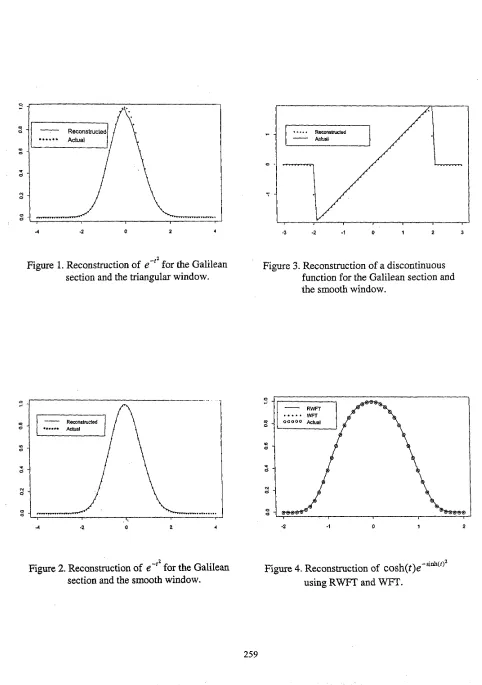
We here present some specific reconstruction results. As a prototype, we take the function
@ ( t )
=e-'*
and first reconstruct it for a triangular window functionl + t , i f - l I t < O
{
l-t,ifO
s
t
<
1.
m)
=Since [thesis] that the different sections play the more or less same role in the reconstruction scheme, here we just use the Galilean section.
For this reconstruction, we have retained the terms corresponding to
-50
5
e 550
in the reconstruction formula and took the step size6,
= 0.025.The reconstructed function along with the original one is shown in the Figure 1 from where we see that the accuracy of the reconstruction is not very high specially around the origin for the non smooth window function.Then we reconstructed the same function
@(t)
= e-f2 for a smooth window function( l - t 2 ) l 0 , i f -
6t
I 10, otherwise.
l?(t)
= (49)Here we have taken the same step size as in the case of non-smooth window function and retained the smaller range of terms, - 20 5
C
5 2 0 . The graph of the reconstructed function along with the original one is shown in the Figure 2. From the Figure 2, we observe that the reconstruction scheme goes very well with a smooth window function. We also reconstructed a discontinuous functiont,if -2 I t
I 2
0, otherwise
@ ( t ) =The graph of the reconstructed function and its original counter part are shown in the Figure 3. From this graph we see that in the vicinity of a
point
to
where#
( t )
is discontinuous, the reconstructed function starts oscillating and the accuracy of approximation deteriorates. In Fourier analysis, this fact is known as the Gibbs ' phenomenon [7]. We also observe that at anysuch point
t o , # ( t o )
converges to(@<to+
1
+$ ( t i
I>/
2,
where
@(to')
and@ ( t i )
are respectively theright- and left-hand limit of
# ( t )
att
= to.6. Comparison with the Windowed
Fourier Transform
As a final example, we discretize the coherent states of the Weyl-Heisenberg group and came up with the corresponding frame operator and reconstruction formula. The discretized version of the coherent states of the Weyl-Heisenberg is given by:
( 5 1) where
p o , q o
> O
andm,n
are integers andpa,
qo must satisfy the conditionv , , , ~
(x) =eimPoXq(x-
nq,
)Po ' 4 0 5 2n (52)
The condition (53) is necessary for
v ~ , ~ ( x )
to be complete and to form a frame [7,8,9]. For thepresent case, the frame operator and the reconstruction formula are give by:
ca
T ( x )
= P o )Cl
w -
W O1
I2
( 5 3 )V ( X > =
D / T ( ~ ) I
C
( q m , nI
w ) q m , n (XIn=- and
=a
m,n=-
(54)
Now we would like to reconstruct the function
f ( t )
=cosh(t)e-sinh2(t)
using RWFT and WFT. In this case, we took the step size6,
=0.01,
p , =n ,
q ,
=0.01
and4 2 0 2 4
0
r
w.
0
N
0
4 0
[image:7.614.56.538.65.750.2]3 2 1 0 1 2 3
Figure 1. Reconstruction of
e-''
for the Galilean Figure 3. Reconstruction of a discontinuous section and the triangular window. function for the Galilean section andthe smooth window.
...
...
-4 2 0 2 4
0
r
2
2
x
2
s
-2 1 0 1 2
-sinh(t)'
7.
Discussion
The illustrative computations presented in this paper do not necessarily establish the superiority, or otherwise, of the relativistic windowed Fourier transform over the conventional windowed Fourier transform. However, the RWFT demonstrates how transforms may be obtained using a large class of semi-direct product type groups and indeed, it points up the richness and variety of the transforms so available. Work presently underway attempts to adapt the transformation which is employed to analyze a particular signal, to geometry of the problem, as reflected in the symmetry group that is used for constructing the CS. Furthermore, such an analysis is expected to provide information on the classes of functions which could be analyzed most effectively using particular types of transforms.
8. References
1.2.
3.
4.
5.
D. Gabor, “Theory of Communications”, J.
Inst. Elec. Eng. (London), vol. 93, pp. 429 - 457,1946.
S. T. Ali, J-P. Antoine, J-P. Gazeau and U.
A. Mueller, “Coherent states and their generalization: A Mathematical review”, Rev, Math. Phys., vol. 7, pp. 1013
-
1104. 1995.S. T. Ali, J-P. Antoine and J-P. Gazeau, “Square integrability of Group group representations on Homogeneous spaces.
II.
Coherent states and quasi-coherent states. The case of the Poincare’ group”, Ann. Inst.
H.
Poincare’, vol.55, pp.
857- 890,1991.
S. T. Ali, J-P. Gazeau and M. R. Karim, “Frames, the
,b
-duality in Minkowski space and spin coherent states”, J. Phys. A: Math. Gen., vol. 29, pp. 5529-5549. 1996.S . De Bi&vre, “Coherent coherent states over symplectic homogeneous spaces”, J. Math. Phys., vol. 30. pp. 1401-1407, 1989.
6.
7.
8.
9.
M. R. Karim, The Coherent States of the Poincare’ Groupand Related Transforma- tions, Ph.
D.
thesis, Concordia University, Montreal, Canada, 1996.Papoulis, The Fourier Transform And Its Applications, New York, McGraw-Hill, 1962.
V. Bargmann, P. Butera, L. Girardello, and J. R. Klauder, “On the completeness of coherent states”, Rep. Math. Phys. Vol. 2, pp. 221-228, 1971.
I. Daubechies, A. Grossmann, and Y.
Meyer, “Painless non-orthogonal
expansions”, J. Math. Phys., vol. 27, pp. 1271-1283, 1986.