Journal of Criminal Law and Criminology
Volume 67 | Issue 3
Article 6
1977
Testing the Functions and Effect of the Parole
Halfway House: One Case Study
James A. II Beha
Follow this and additional works at:
https://scholarlycommons.law.northwestern.edu/jclc
Part of the
Criminal Law Commons,
Criminology Commons, and the
Criminology and Criminal
Justice Commons
This Criminology is brought to you for free and open access by Northwestern University School of Law Scholarly Commons. It has been accepted for inclusion in Journal of Criminal Law and Criminology by an authorized editor of Northwestern University School of Law Scholarly Commons.
Recommended Citation
Copyright 01977 by Northwestern University School of Law
TESTING THE FUNCTIONS AND EFFECT OF THE
PAROLE HALFWAY HOUSE: ONE CASE STUDY
JAMES A. BEHA, II'
The halfway house has become the basic model for many of the new programs encompassed by the label "community corrections." Of the more than 250 current programs in the International Halfway House Association, over half did not exist in 1965. Thus, it is hardly an exaggeration to speak of an "explosion" in the halfway house field. Yet little re-search has been done on the effectiveness of such programs. This paper reports on a study of a Boston halfway house's clients over a seven year period.
The paper begins with an analysis of background data on clients, including trends over time, and makes comparisons to parallel data on the general parolee and releasee populations, where available. The second section of the paper presents data on length of stay and mode of termination, and attempts to relate these variables to background factors.
The final section of the paper describes a follow-up of the client group to determine the overall recidivism rate, and a comparison of that rate to the rate that might have been "predicted" for the group by using appropriate base expectancy tables.
"Halfway houses" include residential facilities with capacities from two or three to over fifty, and which provide services and treatment ranging from simple shelter to intensive therapeutic community. They focus on a number of social problems, only one of which is the ex-offender's difficult transition from prison to the community. I The most recent directory for the International Halfway House Association lists programs aimed at ex-offenders, parolees, probation-ers, juveniles, "youths," narcotics addicts and
al-* M. A., J. D., Harvard University. Mr. Beha presently holds a Russell Sage Foundation Residency in Law and Social Science at Harvard University, and is a Research Associate at the Center for Criminal Justice, Harvard Law School.
This research was supported in part by funds from the Massachusetts Committee on Criminal Justice.
'Among the works which provide useful discussion of the halfway house in its criminal justice applications are E. DOLESCHAL, GRADUATED RELEASE (Public Health Service Pub. No. 2128, 1971), also in 1 INFORMATION REVIEW ON
CRIME AND DELINQUENCY 1 (1969); R. GOLDFARB & L.
SINGER, AFTER CONVICTION (1973); 0. KELLER & B.
ALPER, HALFWAY HOUSES: COMMUNITY CENTERED
COR-RECTION AND TREATMENT (1970).
coholics. In addition, the Association includes some mental health facilities. Programs dealing with alcoholics were extensively developed during the immediate post-World War II period,2 and mental health and personal "crisis" houses began shortly thereafter. Halfway house programs for addicts date from the early 1950's and were expanded in the early 1960's.
While these focused halfway programs, like the network of casual residential programs (for example, YMCA's and hospitals), will accept ex-offenders, such clients may be only a small portion of their population. For example, in 1972 programs not tailored to ex-inmates received 40 per cent of the parole residential placements made in Massachu-setts; yet none of these programs took more than five such placements during the full year.3 While it can be argued that these mixed population houses make
"reintegration" a fact from the start, they are
equipped to deal with their residents only in terms of the primary focus of their programs. The parole and correctional halfway programs, by contrast, take as their primary focus the fact that clients have been-and may still be-in trouble with the law.
Historically, the basic elements in the halfway house program for the adult ex-inmate were the resources of residence: the house would provide shelter and support to those who lacked it. Later, with the advent of parole, access to such a program could balance the absence of community ties and thus make early release a possibility. Nevertheless, post-prison residence seems an opportunity only to a limited portion of those in prison; it is therefore not surprising that only a small percentage of those re-leased from prison are served by halfway houses. To refer again to the Massachusetts experience: in 1972 only about 13 per cent of all parolees were re-quired to accept a residential placement of any kind (placements were fewer than available beds)4 and a
I Blacker & Kantor, Halfway House for Problem
Drink-ers, FED. PROBATION at 18 (June 1960).
'MAss. PAROLE BOARD, REPORT ON 1972 RELEASES TO PAROLE SUPERVISION FROM MASSACHUSETTS
CORREC-TIONAL INSTITUTIONS, (April, 1973). '!d.
JAMES A. BEHA, H
study that same year concluded that only about 5 to 10 per cent of future releasees would "need" the residential structure of a halfway house.'
Why, then, the wide interest in the halfway house model and experience? The answer seems to be that the halfway house provides both an historical tradi-tion and a model for a variety of programs now grouped as "community corrections", that is, pro-grams which serve as an alternative or as a supple-ment to the more intensive deprivations of freedom presently characteristic of the detention and correc-tion process.
Despite this widespread interest, the literature on halfway house programs-and particularly the eval-uative literature-is spotty at best. After a review of all the available information on halfway programs, this author decided to take a closer look at one
particular program which seemed a fair test of the parole halfway house concept, and which was plainly having a major impact as a model for state correc-tional programs. Explicitly, then, this program was chosen because it was atypical. Most important-and most unusual-was the willingness of the pro-gram's administrators to cooperate with a candid "impact evaluation" effort.
Brooke House, operated in Boston by Massachu-setts Halfway Houses, Inc., has been in existence since 1965. The house appears to be well-run, and has a national reputation for the high quality of the training which staff members receive. The operation-al philosophy of the House-reoperation-ality therapy-is much in vogue throughout the American correc-tional network. The parole program at Brooke House was well respected by the Parole Board, and was utilized almost competely for most of the period studied. ' For all these reasons, Brooke House would appear to be an appropriate example of the well-developed correctional halfway house model, and an appropriate test of the utility of the parole halfway house model, at least for programs with similar operating philosophies.
'Cohen, A Study of Community-Based Correctional Needs in Massachusetts (Massachusetts Dep't of Correc-tion, 1973).
'Beha, Halfway Houses in Adult Corrections: The Law, Practice, and Results, 11 GRIM. L. BULL. 434 (1975).
'The research here must be post hoc both because we
want to cover client flow from the start of the program in order to obtain an adequate number of cases (and in order to parallel the House's own research) and because Brooke House is now primarily a pre-release, rather than a parole, facility. To allow completion of the follow-up period, the sample stops with clients entering in 1972.
CONTEXT OF THE RESEARCH
Introduction to Brooke House
Since its inception in late 1965 Brooke House has taken placements from federal correctional institu-tions on pre-release status, as well as parolees from the state system. Referrals from other sources (county houses of correction and "the street") average about 15 per cent of total admissions.8 Financial support for the House's operation has come from federal and state contracts, private contributions, and the earn-ings of residents (a portion of which is applied toward room and board).
Throughout its existence Brooke House has uti-lized the modality known as "reality therapy."9 In contrast to some other techniques, reality therapy does not directly attack the client's norms, nor does it push for "insights" into past behavior and motiva-tions. Rather, the counsellor and client are expected to concentrate on specifying the client's set of current and potential life-needs and the possible non-crimi-nal avenues to their achievement. Brooke House particularly emphasizes job placement, work habits and sound financial planning. This latter point includes the proper use of savings; in this connection, Massachusetts Halfway Houses, Inc. operates.
the only Federal Credit Union ever chartered specifi-cally to serve ex-offenders. The major purpose of the Credit Union is to provide ex-offenders with an opportunity to re-establish a credit rating in the community.0
Brooke House's administrators report that "the program was designed for chronic offenders with long periods of incarceration and few community resources."'" As a result, the program begins in a highly structured format and moves toward greater freedom for the individual resident as the House staff concludes that he has accepted greater accountability and involvement.
The Present Research Effort
Brooke House has sponsored several "internal" studies of recidivism among former clients,12 in
8
MASSACHusETTs HALFWAY HOUSES, INC., ANNUAL REPORT (1972) [hereinafter cited as ANNUAL REPORTI.
9
W. GLASSER, REALITY THERAPY (1965).
"
0
ANNUAL REPORT, supra note 8.
" Interview with house director (Spring 1973).
"2MAssAcHusETTs HALFWAY HOUSES, INC., BROOKE
HOUSE RESEARCH: Two YEAR RECIDIVISM STUDY (May
1972); Runyan, Evaluation of a Correctional Halfway House, (unpublished study prepared for Brooke House,
September 1970); J. PLECK, S. SIMON, &J. B. RILEY,THE
EFFECTIVENESS OF A CORRECTIONAL HALFWAY HOUSE
(1969).
addition to annual reports which have included data on background and length of stay. Each of these reports has covered all types of House clients
(federal, state, county, and "street").
The focus of the present report is different in several respects. First, it is limited to clients who came directly to the House on parole from Massa-chusetts state correctional facilities. Second, for all information other than length of stay at the House and mode of termination, this study is based on data files maintained and verified by the Department of Correction and the Board of Paroles. " Last, the report covers seven full years of client-flow, provid-ing cumulative as well as period-specific analyses.
The first of these differences-limiting the re-port to parolees from Massachusetts state correc-tional institutions-requires further explanation. For analytical purposes, both this author and the research sponsors wanted to isolate the character and impact of the House as a parole halfway facility from its function as a pre-release center. Our con-cern was not merely with the logical aspect of this distinction, but also with the operational and selec-tion differences which were necessarily at work (for example, the difference between the direct cus-todial control possible at a pre-release stage and the much more indirect control which is predicated on
the ultimate threat of parole revocation). "' The second reason for this limitation was more pragmatic: an important part of the analysis was to be the evaluation of recidivism rates among former clients. But realistic appraisals only make sense as comparisons. The Massachusetts Department of Correction periodically prepares Base Expectancy Tables which, under proper constraints, may provide a standard of comparison for state parolees. No comparable tool exists for county parolees released prior to 1972, and the only tables available for the federal system at the time this study was undertaken were so old that one could not justify reliance on them in a research setting. "
Finally, data on individuals released from state institutions was accessible, albeit with effort. Files on county house of correction inmates are scattered, fragmented, and not always comparable. Background and follow-up data on federal placements is, unfortu-nately, very difficult to obtain.
11 Data was made available under a plan for maintaining confidentiality which was approved by the Criminal His-tory Systems Board. Thanks are due to a number of persons for their assistance; see note 30 and accompanying text.
14See Beha, Halfway Houses in Adult Corrections: The Law, Practice, and Results, 11 CRIMt. L. BULL. 434 (1975).
151d. at n. 99.
We have therefore limited the report to those incarcerated in the state system, "6although the house in operation is very much a "mixed bag." Internal research by the Brooke House staff indicates that the federal and state placements do in fact differ in sev-eral respects, such as age, and the staff suggests that the "leavening" effect of this mixture is a noticeable element in the therapeutic milieu.
THE BROOKE HOUSE CLIENT
It would be superfluous in a report of this scope to present all the background information analyzed for this study. But we should attempt a "modal profile" of the Brooke House state parole client:
The client is white, Catholic, unmarried, and from Boston. He has no military experience [if he does, he has an honorable discharge]. He is unskilled and worked irregularly; he has completed some high school. He was 16 at his first conviction, and has accumulated nine convictions, mostly for property crimes. He had been incarcerated three times before the current sentence, serving over two years, and has been on both juvenile and adult parole; he has also been on adult probation. He pled guilty to his present offense, for which he had no co-defendants, and served approximately 22 months for that offense. He was between 25 and 26 years old at release.
Over the time period studied in this report most of the background characteristics of the Brooke House population remained relatively constant. While there were some changes in the background of the clients served between the mid-1960's and those in the early 1970's, on only four background items was the change substantial and statistically significant. There was a decline in the number and length of prior adult incarcerations at the county (misdemeanor and minor felony) level, and a related increase in the proportion of clients who had experienced adult probation. (There were, however, no sizeable shifts in the total number of prior offenses or in the num-ber or length of incarcerations at the level of the state prison system.) Those in the program during 1971-1972 were less likely to have been returned to prison previously for the violation of a parole.
The proportion of participants who described themselves as Catholics showed a significant decline.
" 0
Finally-and most importantly in terms of the to understate the seriousness of the prior criminal operating milieu of the House-by 1971-1972 there record of Brooke House clients. On those few was a marked increase in the proportion of clients variables for which we have comparable data on whose records included arrests for narcotics parolees, Brooke House clients clearly show up as
offenses. having much more serious than average records. For
Our statistical analysis revealed that the likelihood example, the typical parolee had served less time in of recidivism among Brooke House clients was prison for his current offense before gaining his
related both to involvement with narcotics and to parole than had the Brooke House client, who had
the number of county incarcerations. Neither rela- gained a far more restricted release. Brooke House tionship is particularly strong and, since they oppose clients had also been incarcerated more often in the each other in terms of their significance for the past, particularly in juvenile and county-level adult changing character of the client population, it seems facilities.
safe to conclude that the 1971-1972 population was Despite these differences in criminal records, the quite similar to that of 1965-1968 in terms of their comparison between Brooke House and other re-"recidivism threat." leasee populations most clearly establishes that the We had available comparable data on 1971 releas- process by which inmates came to be conditionally ees from state correctional institutions for thirty- paroled to the House was primarily attuned to the five of our background variables and we had data on candidate's social background and to the character of 1972 parolees that were comparable on eleven items. his present offense, rather than to the details of his As a somewhat incomplete summary of the more prior criminal history. A straightforward concern extensive comparison available to us, that with the that the defendant would be arrested for a new crime
1971 releasee group, we note: after his release seems to have been less significant
The Brooke House client was less likely to be married, than a concern with the kind of offense involved and to have a skill or a stable work record, to be involved a perception that the delivery of social services and with narcotics, or to have been released from Walpole. structured support might be appropriate for this He was more likely to have been committed for a offender. (The fact that this somewhat limited data sex-related offense, or for a robbery that included the set is able to pick up distinctions consistent with this use of a weapon. The client had somewhat less analysis gives us some encouragement in employing a education. He was more likely to come from Boston, to statistical approach to "control" for these kinds of have a military record and an honorable discharge, biases when examining the client group's recidi-and to come from MCI Concord. vism.)
We should stress that since Brooke House drew PROGRAM PARTICIPATION
almost exclusively from the parolee, rather than The bulk of Brooke House state admissions were releasee, population, these mixed comparisons tend parolees (96 per cent), of whom 92 per cent
TABLE 1
TIME AT BROOKE HOUSE FOR PAROLEE CLIENTS 1965-1968 AND 1969-1972; BREAKDOWN BY WHETHER
"COMPLETED ". PROGRAM
Group Avg Time Std Deviation*
All Parolees (N = 235) 82.4 days 66.6
Parolees 1965-1968 (N = 86) 102.9 days 86.8
Parolees 1969-1972 (N = 149) 70.5 days 31.6
All Parolees "completing" (N = 115) 112.7 days 68.8 1965-1968 Parolees "completing" (N = 35) 155.1 days 104.9
1969-1972 Parolees "completing" (N = 80) 94.1 days 31.0
All Parolees "not complete" (N = 120) 53.4 days 49.4
1965-1968 Parolees "not complete" (N = 51) 67.2 days 63.9 1969-1972 Parolees "not complete" (N = 69) 43.2 days 32.3
* 68% of the sample cases fall within this range around the average.
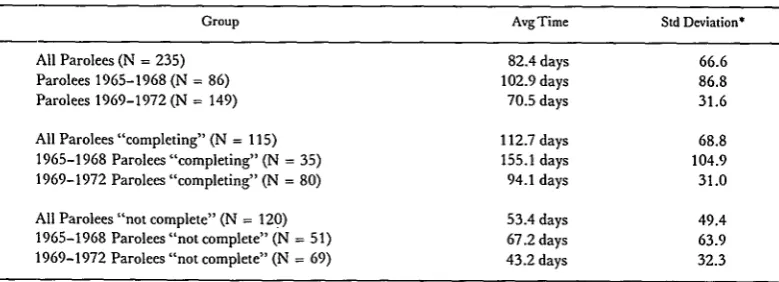
[image:5.454.43.433.465.606.2]remained at the House beyond the first week. About half of this group was reported as "completing" the program; that is, when they did leave, it was with the approval of the staff. Data on length of stay at Brooke House are presented in Table 1, where the data are broken down by time period and by whether or not the client was rep6rted as completing the program.
The author wanted to determine which back-ground variables distinguish those parolees who "split" at once from the program from those who remained for at least a week. A variety of differences were found which pointed to two underlying factors. First, the less extensive the parolee's prior involve-ment with the prison system, the more likely he was to remain. Second, but closely related, the less extensive the client's prior involvement with petty crime, the more likely he was to remain.
These same factors continued to be related to the likelihood that those who remained beyond the first week would eventually complete the program. These findings are consistent with a rather intriguing interpretation of the House process. Most Brooke House clients have had substantial prison experi-ence. What is significant, it would seem, is not the
length of imprisonment, but the number of times
imprisoned. Program administrators agree that the inmate who has done a few long stretches of "hard" time survives well in the structured Brooke House environment. The inmate who has been in and out of prison on a series of less serious offenses is less likely
ever to have adjusted to structuie, and is quite likely
to find the Brooke House environment unsatisfac-tory.
Our analysis revealed several important time trends concerning participation in the program and whether or not clients were rated as completing the program. These may be summarized as follows:
The average number of days spent in the program declined steadily over time-from 102 to 80 to 64. 17At
the same time, however, the rate at which clients were reported as having completed the program increased substantially in 1969-70, though it receded somewhat in 1971-72. A similar curvilinear trend was apparent for the proportion of clients completing at least a week at the program.
The fact that clients in the 1969-1972 period were surviving in the program, leaving on positive terms, and thereby retaining their parole beyond the
condi-"7The first of these drops reflects a conscious decision by the program administraters to limit a stay in the program to ninety days.
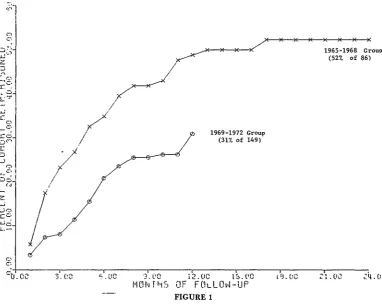
tional stage correlates with the fact that the later group was substantially more successful in avoiding a return to the state prison than were clients in the 1965-1968 group. Figure 1 gives the month-by-month results, and confirms the widely held per-ception that the first year of release is the critical period for recidivism. What this figure cannot tell us, of course, is whether the sharp drop in returns to prisor is connected to some element in the Brooke Hous, program, or was experienced by the general popr .ation of those released from the prison system. Ib ,r, of course, can these figures give us any indica-t.on whether these sorts of clients would not have hown about the same performance without the assistance of a halfway placement. The sections which follow attempt to respond to these concerns.
MEASURING PROGRAM IMPACT
Defining "Success"
"Success" for criminal justice programs is gener-ally defined in terms of a net effect on the crime rate. For correctional programs, the measure of success is typically narrowed to the recidivism rate for partici-pants although, in theory, correctional programs might also affect criminal behavior through the potential offender's perception of the type of punish-ment with which he is being threatened. Analyti-cally, an effect on recidivism is the product of the in-teraction between specific deterrence and rehabilita-tion. 18
Occasionally, other standards are introduced, in-cluding the "justness" (proportionality?) of a partic-ular treatment and the relation of a program to various civil rights-most frequently to "due process of law." Cost and operational control are also often considered. It remains true, however, that "effective-ness" is most frequently stated in terms of subsequent behavior patterns.
It is sometimes argued that recidivism is an inadequate standard because the correctional goal is properly one of rehabilitation-of which recidivism is but one element.'9 This position is, of course,
"Stated for the individual, rehabilitation of the actor occurs when an opportunity for a sustained noncriminal lifestyle is utilized; stated in program-action terms, rehabil-itation is the effect of programs in instigating and shaping individual change. Stated practically-given the research-er's access only to arrest and conviction information-what is perceived as rehabilitation may be a matured skill at avoiding apprehension.
"9E.g., Woodring, A Dilemma: Rehabilitation and Its Relationship to Recidivism, 22 YouTH AUTHORITY
JAMES A. BEHA, H [Vol. 67
Figure 1: Patterns of Recidivism for Brooke House Clients, 1965-1968 Group and 1969-1972 Group
1965-1968 Group
(52% of 86)
//
/ 1969-1972 Group
// (31% of 149)
-*'. 00
3 00 U '. O 12..I0 15. ('0MONH,'15
OF
FOLLOW-UPFIGURE 1
linked to the "professional treatment" model of
corrections perceptively critiqued by Francis Allen and more recently assessed in Struggle for Justice. 20
The point to be made in response to the social-rehabilitative approach is not that social services are
"oAllen, Criminal Justice, Legal Values, and the Reha-bilitative Ideal, 50 J. CRIM. L.C. & P.S. 228 (1959);
AMERICAN FRIENDS SERVICE COMMITTEE, STRUGGLE FOR
JUSTICE: A REPORT ON CRIME AND PUNISHMENT IN
AMERICA (1971). See also Lehman, The Medical Model of Treatment, 18 CRIME & DELINQUENCY 204 (1972); Shorer, "Experts" and Diagnosis in Correctional Agencies, 20
CRIME & DELINQUENCY 347 (1974). One important, though not logically essential, element in the critique of the rehabilitative approach to criminal conduct is the continu-ing inability of professional caseworkers to predict subse-quent individual criminality with any substantial accuracy.
Cf. N. MORRIS, THE FUTURE OF IMPRISONMENT 66-72 (1974); P. MEEHL, CLINICAL VERSUS STATISTICAL PRE-DICTION (1957); BUREAU OF REHABILITATION, REPORT ON
SHAw RESIDENCE, MARCH 1964-MARCH 1968 at 81
(1968), which noted "the lack of any correlation at all between the outcome and ratings of residents' chances for
success made by the interviewing caseworker . . .with the
full institutional file," [hereinafter cited as SHAW REPORT].
i i0 100 040
irrelevant to the reduction of recidivism nor that they should not be available for their own sake within correctional programs as well as elsewhere. Rather the terms of the criminal justice system's mandate must be stressed: the correctional process is necessar-ily and fundamentally intrusive and coercive, and the exercise of that intrusive power is justified in terms of the punishment and prevention of criminal behavior. It is inconsistent with that mandate to structure a "rehabilitation" regime which is not judged in terms of its effect on criminal behavior. The problem is not merely that such cross-purposes undermine and often unduly extend the correctional process (although they may),2' but that, fundamentally, no "right" has been-or can be-granted to exercise that kind of dominion.
This brief response can hardly do justice either to the complex arguments or to the depth of profession-al and ideologicprofession-al feelings which are involved in
21
Comment, Pretrial Diversion: The Threat of Expand-ing Social Control, 10 HARV. CIv. RIGHTs-CIv. LIB. L.
[image:7.454.40.423.62.366.2]determining what the function of criminal justice is to be. It should, however, explain why the present investigation is limited to a quantifiable, if far from perfect, measure of subsequent criminal behavior and why it does not report on "personal growth," "employability," or "response to peer pressure."
The Standard of Comparison Employed
There are a variety of technical reasons why it is rather difficult to evaluate the impact of halfway house programs on recidivism. The first of these is that researchers will have real problems defining and
following up an adequate comparison group. 22
Where a control group design is not available, there are a number of statistical techniques, such as matching, multiple regression, and successive dicho-tomization (base expectancy), which may be used to adjust comparisons between groups which, in fact, are not precisely comparable, for example, clients at Brooke House compared to all other Massachusetts parolees. These techniques rely on the data available for both groups, examine that data to discern relationships between background variables and re-cidivism, and then adjust the comparison for spe-cific differences known to be related to recidivism.
No matter how completely the available concrete data is adjusted, there can still remain some dynamic differences of uncertain consequence between the placements at the program and the general parolee group:
[R]esidents of a halfway house which is an
independ-ent agency . . .are by that very fact an
unrepresenta-tive group of offenders. They come to the program if they want to or because some one else makes the judgment that they need to.23
On the one hand, halfway house applicants might be expected to lack community and family ties-factors not directly assessed in the available background data
2 2
While the evaluator's clear preference will be for a random design ("controlled experiment"), he is extremely unlikely to get it, for several reasons: (1) a random design must be clearly constructed at the start of the program period and rigorously complied with throughout; (2) halfway houses are seldom so oversubscribed that they are prepared to turn away about half of the suitable applicants; and (3) most program personnel, like other social activists, see their programs as a definite improvement on the system and not as an experiment-they are unwilling to deny their programs to applicant, and they prefer to allocate scarce slots on the basis of perceived merit.
25
SHAW REPORT, supra, note 20.
files. On the other hand, halfway house selection processes may emphasize those who are perceived as "ready to change," another factor not likely to be available in the data base.2 4 While Brooke House screeners refused to accept those who showed no interest at all in active participation, they rarely turned away applicants on any other basis, except during those few short periods when the House was oversubscribed.
The present statistical analysis is based on the successive dichotomization, or base expectancy, technique. The Massachusetts Department of Cor-rection (D.O.C.) periodically studies the criminal
history records of those paroled from state institu-tions during particular years, in an effort to specify the rate and patterns of recidivism. 25 Such a study was done for those paroled in 1966, using a follow-up period of two years after release. A recent D.O.C. study has been completed which does a similar analysis for 1971 parolees, using a one-year follow-up. Chart 1 is an example of the result: for parolees released from Walpole in 1966, this chart most ac-curately describes the patterns of recidivism over the next two years. Further, once these predictive pat-terns have been traced out, there are no other
vari-2 Of course, whether either the parole boards or the houses are correct in a particular case-or even in the aggregate-is an empirical question; there is some evidence to suggest that their judgments do not improve on the base expectancy scores generated from the "hard" data.
Bereco-chea
& Sing, The Effectiveness of a Halfway House forCivilly Committed Narcotics Addicts, INTERNATIONAL JOURNAL OF ADDICTIONS (Spring 1972); see also the sources cited at note 20, supra.
2 5
See, e.g., LeClair, An Analysis of Recidivism Among Residents Released from Massachusetts Correctional In-stitutions During 1971 (Massachusetts Dep't of Correc-tions, May 1975); Graves, An Analysis of Recidivism Among Men Released from M.C.I. Norfolk During 1966
(Massachusetts Dep't of Correction, August 1972); Carney,
Predicting Recidivism in a Medium Security Correctional Institution: Base Expectancy Categories for M.C.I. Nor-folk (Massachusetts Dep't of Corrections, June 1966);
Metzner & Weil, Predicting Recidivism: Base Rates for Massachusetts Correctional Institution Concord, 54
J.
CRIM. L. C. & P.
S.
307 (1963). The technique presently in use essentially attempts to maximize the chi square of variables tabulated against recidivism, across all possibledichotomies for each independent variable. The variable with the greatest "predictive force" is chosen, and then the process is repeated within each new cell until no further significant chi squares will emerge. Cf. F. SIMON, PREDIC-TION METHODS IN CRIMINOLOnY (1971); D. GLASER, THE
EFFECTIVENESS OF A PRISON AND PAROLE SYSTEM (1969);
Babst, Gottfredson & Ballard, A Comparison of Multiple Regression and Configural Analysis Techniques for Devel-oping Base Expectancy Tables, 5 J. REs. CRIME &
JAMES A. BEHA, H
Chart 1
BAEEP~n* - ---. ±', - -.. L FRu WALPOE RETURN RATE
RESIDENCE PRIOR TO
COITMIITIENT OTHER THAN
BOSTON
N= 61
21.3% Return
RESIDENCE PRIOR TO
COIL4ITMENT BOSTON
N= 46
47.1% Return
SERVED IN ARMED
FORCES
N= 37
43.2% Return
NEVER SERVED IN
ARMED FORCES
N= 50
74.0% Return
SERVED IN
ARMED FORCES
NEVER SERVED
IN ARMED FORCES
2 OR FEWER
PRIOR ARRESTS FOR
PROPERTY OFFENSES
3 OR MORE PRIOR ARRESTS FOR
PROPERTY OFFENSES
3 OR FEWER PRIOR HOUSE OF CORRECTION
INCARCERATIONS
4 OR MORE PRIOR
HOUSE OF CORRECTION
INCARCERATIONS
33 OR OLDER
AT COMMITMENT
32 OR YOUNGER
AT COMMITMENT
N- 31
N= 30
N- 17
N- 29
6.5% CATEGORY I
36.7% CATEGORY II
29.4% CATEGORY III
58.6% CATEGORY IV
N- 21 28.6% CATEGORY V
N- 16 62.5% CATEGORY VI
N- 21 52.47. CATEGORY VII
N- 29 89.77 CATEGORY VIII
CHART 2
CALCULATION OF AN AGGREGATED "RISK FACTOR" FOR A HYPOTHETICAL SAMPLE FROM WALPOLE
Category* Category Weight Hypothetical Sample* "Risk Weight"
I .065 13 .845
II .367 15 5.505
III .294 8 2.352
IV .586 14 8.204
V .286 13 3.718
VI .625 10 6.250
VII .524 17 8.908
VIII .897 20 17.940
53.722 53.722 "Risk Weight" 53.7% expected
100 Men rate of recidivism
As you can see, this is a substantially higher recidivism rating than that for the Walpole population as a whole (45.4%).
* Refer to Chart 1 to determine the appropriate category, based on the stated background factors.
** The breakdown was artificially created; in a real calculation, of course, this would be defined by the data. [Vol. 67
TOTAL WALPOLE
RELEASEES
DURING 1966
N- 194
45.4%
Return
10 OR FEWER
PRIOR ARRESTS
N= 107
32.7%
Return
11 OR MORE
PRIOR ARRESTS
N= 87
60.9%
Return
i i
ables in the data file which will significantly im-prove the ability to specify patterns of recidivism.
In the analysis which follows, the Brooke House clients entering between 1965 and 1968 are com-pared to the two-year research on D.O.C. 1966 releasees, and the 1969-1972 clients are compared to the one-year follow-up research on 1971 releasees. While the use of two different comparisons adds a complication to the work (a complication com-pounded by the fact that each study requires a differ-ent follow-up period), it also avoids the troublesome issue of noncontemporary comparisons. As it turns out, this is a significant advantage, since Parole Board policy on revocations showed some clear changes between the 1966 and the 1971 release cohorts.
One can think of the recidivism rate attached to each pattern as a "predictor score" for individuals who fit the pattern; the scores for each member of a particular group of parolees can then be aggregated, and a "statistical risk factor" or "expected recidivism rate" achieved for that group. 26 One such hypotheti-cal hypotheti-calculation, for a "sample" of 100 men distrib-uted randomly among the various risk categories, is demonstrated in Chart 2.
A tailored baseline such as the one computed in Chart 2 can then be used as an adjusted, constructed ''comparison" against which the actual behavior of the sample can be assessed. Chi square or other standard tests may be used to interpret statistically the significance of any difference between the actual pattern observed and the pattern predicted on the basis of the expectancy table.
A second obstacle in the structuring of an "impact" evaluation comes in the specification of an appropri-ate indicator for recidivism. The problem is two-fold: one wants an indicator which one is confident is related to the underlying realities of criminal behav-ior; one also wants an indicator which will have the same meaning for both the comparison group and the sample being studied. The choice here was predeter-mined by the reliance placed on the Massachusetts Department of Correction's existing base expectancy research.
In its analyses, the Department of Correction de-fines recidivism as reincarceration for a period in ex-cess of thirty days, commencing during the follow-up period. This reincarceration can come from a new
"It must be remembered that these are really aggregate prediction tools; when used to assess a particular prisoner's chances for parole success, they have extremely high error factors. See generally, Ball, The Moment of Truth:
Proba-bility Theory and Standards of Proof, 14 VAND. L. R. 807, 810 (1961).
commitment, from a revocation of parole based on a new arrest, or from a revocation based on a "techni-cal" violation of parole. 27 One form of such technical
violation is the violation of a condition of parole; for example, leaving a residential placement without staff approval.
This is both a difficult aspect of analyzing program recidivism data and a significant issue, since 22 per cent of Brooke House reimprisonments were based on a technical violation. (This type of revocation was highest in the early years of the program, and had dropped substantially by the 1971-1972 period.) While a technical violation is not a new crime, it can hardly be assumed that those whose parole was re-voked on technical grounds would otherwise never have been reimprisoned. Further, absconding can be viewed as a form of "program failure"-at least, once the client has become a program participant. 28
The problems which the technical revocation creates for an analysis of the crime-reducing effect of a half-way house are handled in the discussion section by a series of alternate assumptions. As it turns out, none of those assumptions would alter the overall conclu-sion.
The third barrier faced in attempting to do re-search on program impact on recidivism is the ab-sence of data and the difficulty of obtaining existing data. The full cooperation of the program being studied is absolutely essential, and the author grate-fully acknowledges the cooperation of Brooke House and of Bryan Riley, the Director of Massachusetts Halfway Houses, Inc. But in order to get criminal histories and the critical comparison data-much more is necessary. The author is especially grateful, therefore, to the Department of Correction and its research staff both for allowing access to data,2 9 and for sharing the results of their own re-search on recidivism. 3 0
2
The imperfection of any measure of recidivism is clearly recognized throughout the literature; the author was
constrained here to adopt the measure used in the
recidi-vism tables, a measure which does have the virtues of accuracy and a focus on more serious violative conduct.
2 Five per cent of those paroled to Brooke House, however, remained there less than forty-eight hours.
29 Pursuant to a plan for preserving the confidentiality of information, approved by the state's Criminal History Systems Board, Department of Correction, and Parole
Board.
" Even cooperation is not enough: it took more than four
months after the research design was completed to obtain the necessary clearances for access to the data files.
TABLE 2
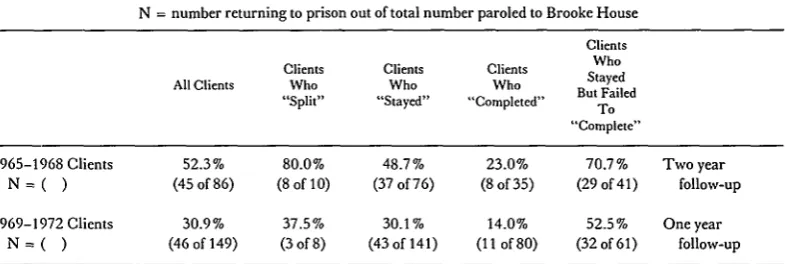
REIMPRISONMENT RATES FOR THOSE PAROLED TO BROOKE HOUSE N = number returning to prison out of total number paroled to Brooke House
Clients
Clients Clients Clients Who
All Clients Who Who Who Stayed
But Failed
"Split" "Stayed" "Completed" To
"Complete"
1965-1968 Clients 52.3% 80.0% 48.7% 23.0% 70.7% Two year
N = ( ) (45 of 86) (8 of 10) (37 of 76) (8 of 35) (29 of 41) follow-up
1969-1972 Clients 30.9% 37.5% 30.1% 14.0% 52.5% One year
N = ( ) (46 of 149) (3 of8) (43 of 141) (11 of 80) (32 of61) follow-up
Note: "Splitting" was defined as remaining at the program for less than one week. Whether or not the client had "completed" the program at the time he left was determined from notations in the program journal.
Patterns of Recidivism
Roughly half of the 1965-1968 clients were rein-carcerated during the two years they were followed; roughly a third of those in the 1969-1972 group were returned to prison during the year after their conditional parole to Brooke House (Figure 1). For those rated as completing the program the recidivism rates are much lower: 23 per cent of the two-year group and 14 per cent for the one-year group.
The first cohort also showed substantial differences in recidivism between those who stayed in the program for at least a week and those who "split" at once (Table 2). This pattern is not apparent for 1969-1972 clients, apparently because the Parole Board was no longer almost automatically revoking the parole of "early splits." (Remaining at Brooke House until rated a "completion" was, after all, the condition set for the parole.)
Our analysis found relatively few variables which discriminated between recidivists and nonrecidivists at Brooke House. The associations can be summa-rized as follows:
The individual admitted to Brooke House who is most likely to make a success of his parole is somewhat older, did a longer stretch (and was more likely to serve it at the State Prison); while he had more convictions as an adult (but not more overall time incarcerated at the state/federal level), he had less of a juvenile and county-level record. He is more likely to have been sentenced after a trial. He is perhaps more likely to come from outside Boston, to have been married at the time he was incarcerated, and to have had some military experience. He has a lower risk rating, spent more time at Brooke House, and is quite likely to have left as a "completion."
On all other background and institutional variables gathered by this study, the individual who was recarcerated did not differ substantially from the in-dividual who successfully finished out the follow-up period.
Many of these factors are relevant to recidivism because they are relevant to whether or not the client completes the program, and completing the pro-gram, in turn, is highly relevant to recidivism. If the focus is narrowed to consider only those parolees who completed the Brooke House program, a some-what different pattern of association can be dis-cerned:
The individual who completes the Brooke House program and then is more likely to make a success of his remaining parole [first, the stronger trends] did not have a record of drug use, and may have done some time in departmental segregation; moreover [weaker trends] he was more likely to have come from outside Boston, and to have held a job for a longer period of time.
Whether these particular variables define categories of offenders upon which the program has a "differen-tial impact," or whether they merely reflect relation-ships which exist among the general releasee popula-tion can be analyzed using the base expectancy technique outlined above to control the comparison between client recidivism and the recidivism patterns among the full releasee groups of 1966 and 1971.
The Comparative Results
Table 3 sets out the comparison between the ac-tual reimprisonment rates for the 1965-1968 and
[image:11.454.41.434.63.195.2]TABLE 3
RECIDIVISM RATES FOR BROOKE HOUSE CLIENTS COMPARED TO RATES PREDICTiD FOR THEM FROM DEP'T OF CORRECTION BASE EXPECTANCY TABLES
Rate Predicted Group's Recidivism
from B.E. Table Rate
1965-1968 Clients 53.4% 52.3% N = 86; two year follow-up
1969-1972 Clients 23.1% 30.1% N = 144*; one year follow-up
* Five cases were lost in the calculation of 1969-1972 base expectancy rates due to inadequate information on essential predictor variables. Two of these clients had been reimprisoned during the follow-up period, and three had not.
TABLE 4
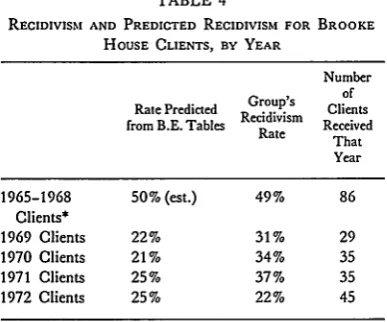
RECIDIVISM AND PREDICTED RECIDIVISM FOR BROOKE
HOUSE CLIENTS, BY YEAR
Number of
Rate Predicted Group's Clients from B.E. Tables Received
Rate That
Year
1965-1968 50% (est.) 49% 86
Clients*
1969 Clients 22% 31% 29
1970 Clients 21% 34% 35
1971 Clients 25% 37% 35
1972 Clients 25% 22% 45
* For the first year only; the predicted rate is based on
the proportion of Brooke House total two-year recidivism which had occurred by the end of one-year of follow-up.
1969-1972 Brooke House clients and the rates
which had been predicted for them. In a sample of this size, the sorts of differences displayed in Table 3 should be expected as a result of sampling fluctua-tions, and should not be attributed to any character-istic of the program.
One important result (Figure 1 and Table 4) is the sharp drop in the.level of recidivism between the 1965-1968 and the 1969-1972 sample groups, and the further dramatic drop for 1972 clients. The 1972 rate is significantly lower than that of clients in the three preceding years despite the fact that the predicted rate ("risk rating") for the group is actu-ally slightly higher. This drop is consistent with the informal perception of those within the Massa-chusetts system that the Parole Board's revocation practices have been steadily easing where only a
"technical" violation, and not a new arrest, is
in-volved. A particularly sharp shift came in late 1972 or early 1973, apparently as a response to over-crowding within the prison system. It is precisely these sorts of changes which limit the validity of any base expectancy model as a research comparison tool; had the 1966 model been used on the entire client group, a very strong "effect" would have been produced. Such a spurious "effect" would in fact be only a reflection of a change over time which oc-curred throughout the system and which affected both participants and nonparticipants equally. "
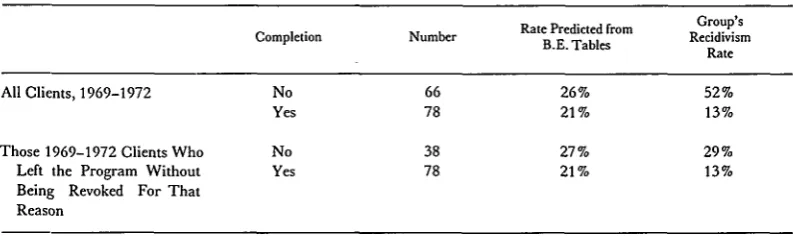
The fact that a client has been adjudged a "program completion" is, as previously noted, strongly related to his ability to survive the follow-up period without reimprisonment. This remains true even if the analysis eliminates all cases in which the parole of a noncompleting client was immediately revoked as a result of his having left the program. The effect is not dissipated when base expectancy ratings are factored in, as Table 5 demonstrates for the 1969-1972 group. The texture of this result is rather interesting: some of those who leave the program without permission have parole revoked at once; noncompleters who survive this point perform about as the expectancy tables might have predicted. Beyond the very real threat that parole will be revoked for a violation of the residential condition, there is no "failure effect" at Brooke House. There is, however, a distinct "success effect" for those who do complete the program. When the success effects
for both the 1965-1968 and 1969-1972 clients who
"1Thus, use of these tables to evaluate patterns of recidivism for releasees in 1972, 1973 and succeeding years will be increasingly suspect, and likely to generate an illusory "program effect." Cf LeClair, An Analysis of
Recidivism Among Residents Released from Boston State and Shirley Pre-Release Centers During 1972-73
[image:12.454.26.220.208.369.2]TABLE 5
RELATIONSHIP BETWEEN PROGRAM COMPLETION AND RECIDIVISM, 1969-1972 CLIENTS
Rate Predicted from Group's
Completion Number B.E. Tables Recidivism
Rate
All Clients, 1969-1972 No 66 26% 52%
Yes 78 21% 13%
Those 1969-1972 Clients Who No 38 27% 29%
Left the Program Without Yes 78 21% 13%
Being Revoked For That Reason
Note: Of the five 1969-1972 clients who were dropped from the base expectancy analysis because of insufficient
background data, two had completed the program and three had stayed but had not completed.
completed the program are pooled, the result is statistically significant (p < .05).
We must emphasize, however, that it is difficult to justify this kind of analysis in terms of the available methodology. The parolee samples which are used to generate the base expectancy score do not include a screen similar to the test of "in-program failure." Refocusing the analysis on completions only is a selection process of substantial importance, and one not really capable of statistical control within the base expectancy methodology. While the patterns of recidivism revealed by this analysis do suggest that a halfway program may provide a useful "screening stage" within the correctional system's release proc-ess, the program must nevertheless be judged in terms of its impact upon all those sent to it for assistance. Working with the best available data, we conclude that there is no evidence to suggest that recidivism among Brooke House clients is reduced by virtue of their being conditionally paroled to the program. This seems to be true even when the analysis is restricted to those clients who give the program at least "a try.,,
DiscussION
Dealing with Alternative Interpretations
There are two remaining plausible alternative explanations-potential reasons why this set of results might be considered "equivocal" rather than "definitive." Both these sources of reconsideration relate to the dynamic of the conditional placement.
The first of these, the problem of technical violations, may be conclusively dismissed after trying out some alternate assumptions. However, those alternative hypotheses which would attach some
unadjusted-for meanings to the Parole Board's insist-ence on a conditional placement cannot be totally rejected, although their plausibility seems very weak indeed.
1) Technical revocations. A significant portion of reimprisoned Brooke House clients were specifically returned to prison because they left the program without permission. Between a fifth and a quarter of Brooke House recidivism was of this sort. By definition, of course, the general releasee population does not face this particular risk.
This could become an operational dilemma for programs like Brooke House, which feel that the threat of revocation for leaving the program is important in keeping the individual at the House while he is dealing with the personal stresses of a changing lifestyle. The program's effect on recidi-vism is supposed to be brought about by a changing of lifestyle, but revocation of parole for leaving the program "inflates" the official recidivism rate.
Since we hardly can prophesy the "actual" rate of recidivism that such revokees would have had, had they remained on the street after leaving the pro-gram, we cannot accurately "discount" for this complication. We can, however, try out the relatively optimistic assumption that their "actual" rate would have been no higher than the predicted rate. The implications of this assumption for the basic recidi-vism comparison are not strong enough to alter the conclusion of this study. For the 1969-1972 group we ignored all clients whose revocation was premised on the fact that they had left the program without permission. Even this assumption does not alter the basic conclusion.
Finally, a client's going A.W.O.L., or never appearing at the House, or being expelled may be
[image:13.454.31.428.65.183.2]thought of as forms of "early warning" to the Parole Board that he is an extremely bad risk for the immediate future. In that case, reincarceration for the remainder of the period would "save" crime that would otherwise be committed. Since reducing crime, rather than reducing reimprisonment, is the goal of the correctional program, the data might be re-analyzed, a bit ingenuously, to give Brooke House "credit" for preventing new-crime recidivism in each case where an improper exit from the program was followed by parole revocation for that reason.
Even this version of the analysis does not produce a net positive effect for the program, although it does point to a further important characteristic of the client group's pattern of recidivism: many of those who are returned to prison are arrested while still in residence, for crimes they have committed while residents of Brooke House. That is what "in pro-gram failure" is all about, both at Brooke House and at pre-release programs. The difference is that the Brooke House program, because it operates at the parole stage, must take responsibility for this sort of failure by having it recorded as an instance of "recidivism." The pre-release program, by con-trast, dismisses such returns to prison as "in pro-gram failure," and insists that the propro-gram must be judged only in terms of those who are paroled from it; that is, who are program-completers. This study's analysis of Brooke House completions demonstrates that on such terms Brooke House is also a successful screening program. Why a crime which occurs im-mediately before a parole date should be denomi-nated a "screening success," while a crime which occurs the day after parole is called a "negative out-come," remains unexplained in current research on pre-release programs. 3 2
2) Unmeasured selection factors. The first section of this article sets out a number of differences between Brooke House clients and others who were given either parole or a straight release. The base expectancy methodology has been developed pre-cisely for the purpose of adjusting comparisons to account for such differences insofar as they are relevant to the dependent variable (here, recidivism). Once the base expectancy factors specified by the Department of Correction are taken into account, there are no other variables in the data set available
to us which would further affect the prediction of
recidivism. The fact that Brooke House clients differ from the general population in a number of known ways does not preclude the use of the general
"2Cf. LeClair, supra note 31. A. REiss, R. SARRI
&
R.VINTER, TREATING YOUTH OFFENDERS IN THE COMMUNITY
U.
Galvin ed. 1966).population's release experience in formulating a baseline against which the program's effect might be measured. 3
To the degree that the Parole Board was respond-ing to variables reflected in the data set in requirrespond-ing a conditional placement at Brooke House, this research design fully controls for the differences between the Brooke House and general parole populations. To the degree that the Board was responding to variables not adequately correlated with our data, the design is still methodologically sufficient except insofar as those additional factors are highly correlated with recidivism.
The methodology applied, however, cannot pre-clude the logical possibility that the Parole Board is responding to still other "soft" factors which (1) are not accounted for by the risk rating and (2) are not substantially correlated with any variable in our data set, insofar as they are substantially correlated with increasing recidivism. To the degree that this seems possible, it may still be argued that Brooke House clients are "specially handicapped" in some way not adjusted for by the base expectancy computation and that a recidivism rate which matches the predicted score is actually a very successful outcome. While that alternative interpretation has no substantive basis anywhere in this research, it is unlikely ever to be totally ruled out unless a random-control experi-ment is conducted. It is only fair to point out, however, that for the program to demonstrate a statistically significant effect on the 1969-1972 sam-ple, this unknown set of factors must be sufficiently powerful to almost double the predicted recidivism rate.
The Question of Differential Impact
A number of recent commentators have stressed the fact that programs are not "black boxes," to be tested solely in terms of output, but rather are intervention strategies based, to one degree or an-other, on theoretical assumptions."' Thus, the more
3 3
To double check, we considered the effect of these variables within our Brooke House sample on "recidivism
effectiveness," i.e., after factoring out the base expectancy ratings. Very small relationships without consistent direc-tion were found on military experience (negative reladirec-tion- relation-ship), job stability (positive), and absence of drug use (positive). Taken together, their effect on the recidivism rate is negligible.34
Glaser, Remedies for the Key Deficiency in Criminal
Justice Evaluation Research, 11 J. RES. CRIME & DEtUN-QUENCY 144 (1974); Glaser, Achieving Better Questions:
A Half Century's Progress in Correctional Research, FED. PROBATION at 3 (Sept. 1975); Palmer, Martinson
JAMES A. BEHA, H[
important question to be answered is held to be: can we learn from this program whether this modality is particularly appropriate for any particular kind of client? (What we have really been asking so far has been, in effect, a variation of that question: is there any evidence that this program is effective with the kinds of clients with whom the parole board wants it to be effective?)
As noted earlier, there are a number of back-ground factors which are related to lower recidivism rates among Brooke House clients, at least in part because they are related to the likelihood of program completion. The question 'remains whether this relationship was a special characteristic of the pro-gram modality or a general one for the releasee population. After factoring in the base expectancy scores the "net program impacts" for sets of back-ground characteristics can be estimated, and such a comparison was made for both the 1965-1968 and 1969-1972 groups. Several variables did show statistically significant effects, although in no case was the correlational relationship particularly powerful. When the 1965-1968 group was sorted through, for example, positive net impacts were shown for clients who did not come from Boston, who were not presently incarcerated as the result of a parole violation, who had low educational achieve-ment, and who had no co-defendants at their current trial.
While these characteristics would make sense in terms of the program focus, it must be recognized that "data dredging" of this sort ought to turn up
some "statistically significant" relationships as an
artifact of the statistical method. Moreover, none of these variables was significantly associated with positive program impact within the 1969-1972 client group. This latter fact strongly suggests that some of the selective impact that we might have felt called upon to "discover" for the program, had this study been limited to the first client group, would have been little more than a minor statistical illusion. This raises, of course, an unfortunate point which must be weighed against the emerging post hoc reinterpretation of correctional program research. The scientific method calls upon the researcher to make his predictions before assessing his data, and to design his research to test the hypotheses he has already set. If this research had stopped with the 1965-1968 clients, it would have been easy enough to look at the results, to "discover" groups within which the program was "having" an effect, and to then reconcile to "theory" post hoc each observed effect.
While this is a perfectly acceptable technique for generating new hypotheses to be tested, it is not a particularly appropriate model for "validating" the-ory. The reviewer who feels that this argument is unfair might ask himself how difficult it would be to "reconcile" other relationships which were not
found, or even the obverse of the relationships which were found. The recent review of the correctional program literature by Professor Glaser does a mas-terful job of reconciling the partial effects found in a variety of research attempts.3 But the bulk of the studies covered were not planned to test those effects directly, and few ever went on to repeat the research process with such new hypotheses in focus.
The two-phase structure of the present research allowed us to test those "emerging generalizations" hinted at in the 1965-1968 research, and the negative results of those tests forced us to recognize that such generalizations can prove illusory, transi-tory, or both. Thus chastened, we report here only one of the "impact factors" found for the 1969-1972 sample and only because it has critical implications for the Brooke House program. It was clear that those who had records of involvement with narcotics did substantially worse than their base expectancy scores would predict. It is also clear that an increas-ing proportion of Brooke House clients have such records. The program's administrators have been aware of these trends during recent years, and have taken steps to adapt the program to those with drug problems without surrendering the basic approach of reality therapy. They have not responded, as some programs might have, by avoiding those with drug records.
It is not clear whether these adaptations will be effective in reducing recidivism. But it is clear that the program's aggressive response to the challenge of dealing with drug offenders in a program that is not drug-abuse centered has met with favorable reaction among those evaluating Brooke House and its place in the Massachusetts correctional process.36
Conclusion
Even after all the appropriate methodological fallbacks are explored, the evidence on Brooke House discloses no net impact for the program in terms of reducing recidivism. This is consistent with other research on residential programs, whether
pre-3
See authorities cited in note 34 supra.
36Ohlin & Janvier, Report of the Massachusetts Adult Correction and Parole Project (Massachusetts Committee on Criminal Justice, October 1975).