Department of Public Enterprise
T e l e c o m m u n i c a t i o n s f o r e - B u s i n e s s
Page ii
Editorial Committee
Terry Ralph (Chairman) Informix Software (Ireland) Ltd/IBEC Telecommunications and Internet Federation
Dr George Young Commergy/Vice Chairman, IBEC Telecommunications and Internet Federation
William Poole Confederation of British Industry, Northern Ireland Aidan Ryan Department of Public Enterprise, Republic of Ireland
Tom O'Dwyer Forfás
Declan Hughes Forfás
Tommy McCabe IBEC Telecommunications and Internet Federation Noel Kelly IDA (Industrial Development Authority) Ireland
Dr Trevor Forsythe Industrial Research and Technology Unit, Northern Ireland
Authors
Introduction
In recent years the information and communications sector has changed dramatically.
The developments in information and communications technologies are defining new
ways of doing things for businesses, customers, governments and society in general and
are changing the ways in which they all interact. Indeed, we are now living in truly
global Information Age, and people, whether individually or collectively, can transact
and communicate at the touch of a button. The impact of these technological
developments is hardly surprising, as communication has always been the lynchpin of
co-operative human endeavour.
Both Governments have a facilitating role in all of these developments. In 1998, the
telecommunications market was liberalised in Ireland and new legislation will be
brought forward to enhance the regulatory framework in order to enable increased
competition. In addition, the recent enactment of the e-Commerce Acts, 2000 in Ireland
and the UK ensures that electronic agreements are undertaken in an environment of
trust and certainty. We have seen the Global Crossing international connectivity deal,
which places Ireland as a leader on the international broadband map. In Northern
Ireland initiatives such as the Information Age Initiative have shown there are
opportunities to be grasped by all in the Information, Communications and Technology
sector.
We are living in exciting times on the island of Ireland in light of the Belfast Agreement,
the Peace Process and the increase in North-South co-operation that stems from these.
We are delighted and welcome the initiative of industry to develop this guide in a
co-operative manner through their representative organisations North and South and with
the assistance of the industrial development agencies. We are certain that businesses
will benefit greatly from this guide. It is fitting that this joint North-South initiative comes
from our business people and focuses on communication. We firmly believe that through
greater communication results are achieved. This guide shows businesses how to make
greater use of information and communications technologies and will contribute to the
objective of making Ireland, North and South, a global centre for e-business.
We must ensure that all people can participate in the Information Society and avail fully
of its benefits. It is for this reason that the Governments and EU have provided
assistance for investment in e-commerce and communications infrastructure and
services. The focus of these investments will be to ensure that all regions can participate
in the Information Society in a fully inclusive way.
Mary O’Rourke, T.D. Sir Reg Empey, MLA
Minister for Public Enterprise Minister for Enterprise, Trade and Investment Sir Reg Empey, MLA
Minister for Enterprise, Trade and Investment
Mary O’Rourke, T.D.
Page iv
Preface
Forfás and the IRTU are pleased to present Telecommunications for Business: A User’s Guide.
This is the second edition of the Guide which was initiated in 1999 by Forfás and IBEC to provide
a comprehensive mapping of Ireland’s telecommunication infrastructures and to describe the
strategic and operational opportunities which this advanced infrastructure presents for business.
The success of the first Guide in achieving its objectives is evidenced by the publication of this
second edition, and the welcome inclusion of our new partners, North and South, to guide its
development. Through the inclusion of the telecommunication infrastructures in Northern Ireland
this year, the Guide presents, for the first time, detailed all-island maps of the telecommunications
infrastructures that are central to future economic development.
The information and communications technologies that underpin e-Business are now significant
drivers of economic and business growth. The development of the digital economy is well
advanced and the pace of change is set to accelerate as we move into the new Millennium. For
those businesses that are prepared to be pro-active, information and communication technologies
offer a competitive advantage but its exploitation will require the adoption of new skills and
technologies and a more flexible approach to work.
This guide will help those who wish to understand the technology and jargon used in the
information and communications technology arena. It highlights sources of further advice and
information to help small businesses exploit the business benefits and incorporate these
technologies into their business.
The guide also demonstrates that our communications networks and infrastructures on the island
of Ireland and the onward connections to the rest of the world are excellent. This demonstrates to
companies around the world that we on this island are well positioned to harness the full potential
of the opportunities presented in the move to a knowledge based economy . John Travers
Chief Executive Forfás
Jim Wolstencraft Chief Executive IRTU
Jim Wolstencraft Chief Executive, IRTU John Travers
Foreword
The telecommunications landscape is developing at a rapid pace. Telecommunications operators
in Ireland and Northern Ireland have continued to invest significant sums in developing
world-class broadband infrastructure. At the time of writing, there are over 200,000 fibre kilometers on
the island of Ireland, the availability of co-location space is forecast to grow by 700% in the next
18 months, and international connectivity into and out of the island is now described in terms of
Terabit and Petabit capacity.
As a result of this rapid rate of change in the market, IBEC and CBI have teamed up to produce
an updated report (the initial user guide in 1999 was developed by IBEC and Forfás) on the state
of the Irish telecommunications marketplace. The report has been produced with the full
involvement and co-operation of Forfás, the Industrial Research and Technology Unit (IRTU),
which is affiliated to Department of Enterprise, Trade and Industry (Northern Ireland), IDA Ireland
and the Department of Public Enterprise (Republic of Ireland). Mason Communications were
commissioned to carry out the research and author the report on behalf of the project participants.
This new report extends its coverage to the entire island of Ireland. As such, it represents the first
combined effort to produce a definitive guide to broadband infrastructure on the island of Ireland.
All parties are to be congratulated on the extent of their collaborative efforts.
In addition to providing a definitive guide to broadband infrastructure in Ireland, the report also
addresses the inter-relationship between broadband infrastructure and e-business. Hence the new
title: ‘Telecommunications for e-Business - A User’s Guide’. A user-friendly summary is provided
on how broadband technology and the Internet are impacting on day-to-day business and
government activities. Some case studies of real businesses are given.
Likewise, we are seeing the emergence of a whole new range of e-support services (web hosting,
ASPs, etc.) that were not in existence a few years back. The report gives an introductory overview
to these e-support services and explains how they are helping to create entirely new forms of
web-enabled infrastructure in Ireland, North and South.
It has been stated repeatedly by many leading influencers that the availability of world-class
broadband infrastructure is a critical success factor for the future of “Ireland Inc”. This User Guide
serves to paint the most up-to-date picture of our recent progress. Turlough O’Sullivan
IBEC
Nigel Smyth CBI Northern Ireland
Turlough O’Sullivan IBEC
Table of Contents
1
Digital Revolution and e-Business
11.1 The Impact of the Digital Revolution 1
1.2 Telecommunications for e-Business 1
1.3 What is the meaning of the phrase ‘Digital Revolution’? 2
1.4 What does your business have to do? 2
1.5 e-Business and the Opportunities 3
2
e-Business and e-Commerce
52.1 What is e-Business? 5
2.2 e-Commerce is One Component of the e-Business Concept 5
2.3 How is Business Changing? 5
2.4 The Internet – a new dimension to market access 6
2.5 Developing a European Centre for e-Business 7
2.6 Opportunities for Business 8
2.7 e-Business and the Challenges 8
2.8 What is e-Commerce? 9
2.9 Changing Commerce 10
2.10 How your Business can Benefit from e-Commerce 10
2.11 Business-to-Business e-Commerce 12
2.12 Business-to-Consumer e-Commerce 14
2.13 Web Portals 14
2.14 Training and Education 15
2.15 m-Commerce and t-Commerce 15
2.16 Government Initiatives 15
2.17 Electronic Commerce Bills, Security and Privacy 17
2.18 An incremental approach to e-Business 17
2.19 Summary 20
3
e-Government
233.1 The Vision 23
3.2 Transformation to an e-Government 23
3.3 e-Government Initiatives 25
3.3.1 Initiatives in Ireland 25
3.3.2 Initiatives in Northern Ireland 25
4
e-Business Support Services
294.1 Why Outsource? 29
4.2 e-Business Support for the SME Sector 29
Page viii
4.3.1 The Services Explained 32
4.4 Application Service Provider (ASP) Services 33
4.4.1 What is an ASP? 33
4.4.2 What services does a typical ASP have to offer? 34
4.4.3 What are the advantages of using an ASP? 35
4.4.4 Drawbacks to the ASP concept 35
4.4.5 The ASP Industry Consortium (www.aspindustry.org) 36
4.5 Commercial Support Services 36
5
Broadband Telecommunications Infrastructure
375.1 Building Infrastructure Capacity for e-Business 37
5.2 What is Broadband? 37
5.3 Why is it important to have a broadband network? 38
5.4 How is broadband provided? 40
5.5 Broadband network services 40
5.6 Broadband Networks 42
5.6.1 Backbone Networks 42
5.7 Local access networks 43
5.7.1 xDSL – Digital Subscriber Line 45
5.7.2 Wireless Local Loop (WLL) 45
5.7.3 Digital Television 46
5.8 Mobile Networks 47
5.8.1 WAP 48
5.8.2 ‘Interim’ Technologies 48
5.8.3 3rd Generation and UMTS 48
5.9 International links 49
5.9.1 Direct Global Terabit and Petabit Connectivity 51
5.10 Summary 52
6
Getting Started
676.1 Government Departments, North & South 67
7
Advertorials
718
Directory
1089
Glossary of Telecommunications
1
The Digital Revolution and e-Business
1.1
The Impact of the Digital Revolution
The 1999 edition of this Guide, the ‘Telecommunications for Business – A User Guide’, had as its
central theme the arrival of the ‘Digital Revolution’, and the emerging Digital Economy. It described
the challenges, opportunities and threats in this new business environment in Ireland. Rapid
progress has been made since then. The vision for an Information Society is being realised as a
result of the rapid development and the widespread, cost-effective, availability of Information and
Communications Technology (ICT.)
For the 2000 edition, the term ‘e-business’ has been added to the title, as the Digital Economy is
not so much emerging, but is already here. In addition, the guide now covers mobile access
technologies and ‘m-commerce’, in keeping with the technology developments that allow access
to services on the go.
There are high levels of awareness and access to new technology amongst businesses. Most
companies’ first venture on to the Web is a site providing information and contact details. The key
step toward success, in the increasingly competitive markets of the digital age, is to directly
interact(with customers, suppliers, etc.) through this Web presence. That is, to permit business interactions, which naturally follow-on from access to that information, to also take place through
that same electronic medium, independent of geographic location, international boundaries and
time zones.
1.2
Telecommunications for e-Business
This Guide is available on the Telecommunications for e-Business Web site: www.t4eb.com. The focus for this year’s guide is e-business. e-Business refers to all business processes that use
Internet technology to operate more efficiently. This guide is targeted at companies of all sizes,
across all sectors. It aims to:
explain the relevance of the digital revolution to businesses;
provide guidance on why and how companies should implement e-business processes;
provide a source of data for business-to-business linkages and the agency support to help
businesses to source the expertise necessary to set up new communications, e-commerce and
related systems;
provide the latest outlook on the deployment of broadband communications infrastructure –
Page 2
The Guide is divided into five sections covering the key topics relevant to the digital revolution in
Ireland, North and South:
e-Business and e-Commerce;
e-Government;
e-Business Support Services;
Broadband Telecommunications Infrastructure;
Getting Started.
Case studies throughout the Guide highlight ‘real world’ examples of how companies and the
Governments are successfully implementing e-business.
While not seeking to repeat the content of the 1999 Telecommunications User Guide, it is
worthwhile, first of all, to review the introduction to the digital revolution and recap on the
recommendations set out in this previous edition.
1.3
What is the meaning of the phrase ‘Digital Revolution’?
Information and Communications Technology (ICT) opens up enormous possibilities for
interactions – social, cultural and business – between people, companies, communities and
markets all over the world. The implications for business are immense. The important aspect is
notthe technology, but new services and ways of doing business that result from it. This is what is called the ‘Digital Revolution’.
The falling cost of communication services, the falling cost of computing power, together with the
technologies that combine computing and communications, herald the new age of global access
and interactions – the ‘Digital Age’.
1.4
What does your business have to do?
Take advantage of new technologies and develop an awareness of the implications of these
technologies and of the challenges facing your business in the future.
Invest in ICT to protect your existing markets, improve trading efficiency and exploit new
opportunities in the global market.
Examine new ways of doing business and the appropriate strategies to be formulated and
The key lesson to be learned from experience so far is that there must be a business strategy
behind building a Web site. This strategy should comprise:
an awareness of the benefits of the technology before progressing to e-business practices;
a plan as to how your Web presence can be utilised from a business perspective;
a clear understanding of how e-business practices will complement existing business
processes.
1.5
e-Business and the Opportunities
Excellent opportunities exist for indigenous companies and foreign companies to exploit the
potential of the Internet. These opportunities are founded on:
the open and supportive attitude to e-business;
rapidly improving telecommunications infrastructure;
English being commonly spoken, which is the language of the WWW;
a highly educated, enthusiastic, technology adept workforce;
the highly active software and Web content sector.
Companies of all sizes can benefit from e-business. The Government agencies are committed to
providing the necessary assistance and advice to all sectors to adopt e-business processes. The
agencies also run a number of programmes and schemes to encourage existing and new overseas
companies to establish e-business activities. Many of these companies are e-business leaders and
indigenous companies can learn from these best practice exemplars.
In summary, what can business leaders do?
Become aware. Awareness of the new technologies and their implications for business practice is essential at a time when international best practice for each business is rapidly
changing.
Evaluate all aspects of your business in the light of the changes occurring and the opportunities and threats they present.
Page 4
Formulate strategiesfor the company to take advantage of new opportunities and overcome potential threats.
Look for support from the agencies involved – state or business representative associations. Business leaders can use this guide to seek exemplars and discover sources of advice and
information.
A partnership approach between Government, service providers and business could ensure that
2
e-Business and e-Commerce
2.1
What is e-Business?
e-Business is the conduct of internal and external business through the application of Web technologies, not only buying and selling, but also servicing customers and collaborating with business partners.
2.2
e-Commerce is One Component of the e-Business Concept
e-Commerce should be viewed as one component of the overall e-business concept.
e-Commerce is the component of e-business that has the potential to involve monetary
transactions, and on this basis can be defined as:
The ability to market goods and services and to conduct financial transactions electronically, making use of computer networks such as the Internet to access both local and foreign markets.
2.3
How is Business Changing?
Developments in ICT are influencing a change in how industries are structured, how firms are
organised, how business interactions take place and how customers behave. New mindsets are
required, new measurements and new concepts.
The Internet can deliver a broad range of facilities and applications to business and consumer
alike. These services and facilities are new to the market place and the business vocabulary. New
ways to configure businesses, serve customers and organise companies are emerging.
Businesses are increasingly using the Internet to improve efficiency and productivity. Firms are
moving their supply networks and sales channels on-line, integrating these electronic systems within their business processes to improve service and gain efficiencies.
Potentially companies can reach customers anywhere in the world. Direct sales and
distributionwill play a far greater role in business practice, particularly where the service involves the supply of information or information surrounding exchange of goods. Physical
production and transportation of reports, contracts, tickets, etc. can be eliminated.
Page 6
New working patterns will emerge. Technology developments are enabling mobility and enabling employees to carry out their work more efficiently. Depending on their business,
people will be able to choose when and where they work, essentially making the office
increasingly location-independent.
Outsourcing (sourcing materials or services outside the company) is on the increase. Companies can benefit from the superior efficiency and economies of specialised suppliers.
Integrated business systems. Company systems will become more ‘open’ as direct exchange of information between buyer and seller becomes commonplace.
Business-client-supplier networks. These extended networks allow customers to have a direct input into a product or service from design to delivery. Similarly, suppliers can get an
inside view of the company’s inventories and production plans, with constant real-time
updates.
Expertise will become an increasingly valuable asset. Transfer of skills across borders and distance is becoming facilitated, and people with expertise will have customers all over the
world. Individuals who possess critical know-how will attract disproportionate returns.
2.4
The Internet – a new dimension to market access
The Internet is essentially a high-speed, high-bandwidth, low-cost Wide Area Network (WAN) that
businesses can use to deliver their services to a theoretically unlimited number of users.
Once on-line, access to the Internet is made at the cost of a local call, and in many cases it’s even
lower. After that, access to the millions of sites on the World Wide Web is free. This is a completely
new dimension of ‘market access’, whereby for little cost the market can access you.
The World Wide Web (WWW) is fast becoming critical as a business tool. For example:
the WWW gives the opportunity to all businesses to operate in the global marketplace;
the Internet is now a vast communications and trading centre where tens of millions of people
swap information or do deals around the world;
the Internet can be used to directly link suppliers, factories, distributors and customers;
the WWW enables businesses to save time spent in product design, speeding up the delivery
of components, tracking sales by the hour and getting instant feedback from customers – all
with the possibility of keeping inventories to a bare minimum.
The downside of the new era is upheaval across nearly every industry. In coming years, many
employees could find their jobs turned upside down as human tasks such as selling airline tickets
buyer-to-seller nature of the Internet. There are huge challenges to be faced and, in general, companies
that prosper will be those that are aware of the implications of the new era and adapt
appropriately.
Similarly, the regulatory environment has to adapt to keep pace with the rapid restructuring in the
global economies:
“Those countries with a communication regulatory environment, which facilitates abundant capacity at reasonable rates, will launch electronic economies much faster than countries that constrain such developments.”1
2.5
Developing a European Centre for e-Business
Ireland, North and South, has a tremendous opportunity to become a European centre for
e-Business. Already we are a European leader in telecommunications-based sectors such as
telemarketing and call centres. We can also become leaders in the field of e-business as we have
many advantages.
Many overseas companies are based here, including a number of leading US data-centric and
web-centric companies.
A number of indigenous companies have moved into the world of e-business (e.g. banks and
other financial institutions).
There is a significant software capability.
There are favourable corporate tax regimes in place. This low corporate tax regime is being
extended to all traded activities and will apply to e-businesses.
English, the language of the World Wide Web and Internet, is commonly spoken. In addition,
there are facilities for other languages.
Ireland is the only English-speaking nation using the euro.
Northern Ireland, using Pounds Sterling, is the only English-speaking country in Europe
sharing a land boundary with a European country using the euro.
There is a young population that easily adapts to the Information Age.
Page 8
2.6
Opportunities for Business
Traditionally, the island’s geographic position on the edge of Europe and its isolation from
continental Europe as a marketplace has posed a strategic challenge to businesses. e-Business
offers a new route to overcome this.
e-Business is leading to new business opportunities for all SMEs, which account for over 95% of
enterprises. The issues and challenges faced by SMEs are different to those faced by their larger
counterparts. In recognition of this, there are now a number of initiatives set up by agencies
focused on assisting the SME sector in implementing e-business. Details of these agencies are
provided in Section 6, ‘Getting Started’.
Internationally, e-business promises to significantly increase trade across all sectors of the
economy.
e-Commerce will allow producers and exporters access to a wider audience and increase their
international presence.
Companies will be selling on a wider world stage with increased market share and competition
from other traders.
e-Business will bring with it a strong impetus towards harmonisation of international
regulatory frameworks in areas such as licensing, security and reputation.
There are many hurdles to overcome, but the implementation of e-business promises to bring with
it huge cost savings and rewards.
2.7
e-Business and the Challenges
If the digital revolution is ignored and out-moded business practices and models are maintained,
businesses may lose competitive advantage to rival companies, who could inevitably increase
market share and improve trading efficiency. Only by becoming aware of the opportunities and
threats inherent in the new technologies and formulating appropriate strategies, will businesses
thrive.
All of the specific challenges in the following list have the potential to lead to losses for companies
in market share on national and international markets.
Companies that currently enjoy market leadership in Ireland, North and South, will come
under pressure from overseas competitors, and they need to have competitive strategies in
There must be sustained development of ICTsand continued investment in trainingin their
use. For example, with international retail chain stores, having compatible technologies is a
prerequisite for supplying into their international supply chains.
Accelerated trends in efficiency will put pressure on companies who do not have new strategies in place. In particular, the movement to outsourcing of specialist products and
services will challenge industries.
Regulatory controlis difficult to apply in the e-business world, and cross-border trading in electronic goods and services hard to monitor. Companies operating in highly regulated
markets could be disadvantaged. Entry to the marketplace of non-regulated goods will result
in a loss of competitiveness for the regulated product.
Companies must ensure that people with the required expertiseare retained and that the broad
range of creative and technical skills is available to support the target markets in the digital age.
2.8
What is e-Commerce?
e-Commerce in some form or other has been around for some time. The types of e-commerce that
most people use on a regular basis are e-mail and fax. Another form of e-commerce is the ability
to do on-line banking over the Internet, or to purchase financial products on-line. For example, it
is already possible to purchase motor insurance over the Internet in Ireland and the UK.
The many forms of e-commerce include:
e-tailing or ‘virtual storefronts’ on Web sites with online catalogues. These are sometimes
gathered into a ‘virtual mall’;
e-mail and fax and their use as media for reaching prospective and established customers, for
example, with newsletters;
business-to-business buying and selling (B2B);
business-to-consumer buying and selling (B2C);
the security of business transactions, including encryption and certification.
As a result of new broadband access technologies and channels through which e-commerce takes
place, we are now seeing new sub-sets of e-commerce emerging, such as:
m-commerce - mobile commerce, access to e-commerce services on the go;
Page 10
2.9
Changing Commerce
e-Commerce has caused a revolution in the way business is carried out. e-Commerce changes the
whole way business is conducted from ordering to tracing the order through each stage to delivery
and to the final invoicing and payment.
Businesses are improving internal networks and networking with other companies to:
– share marketing and distribution platforms;
– Link co-workers, suppliers, factories, distributors and consumers in strategic
partnerships, to speed up processes and eliminate tedious and repetitive tasks.
Companies can offer products or services to other companies regardless of location
- e-commerce has no geographic boundaries and time zones are irrelevant.
Marketers can be far more efficient in marketing to ‘affinity groups’2on the Internet, through direct marketing and advertising. These groups will become critical to businesses to tailor their
products and services more specifically to customer needs.
All businesses must consider adopting e-commerce as a way of doing business. Even the smallest
local retailer or service provider can use the Internet to buy and sell, deliver services and market
their products.
Those organisations that have chosen to embrace the principles of e-commerce and e-business
have a head start on their competitors and are developing a competitive advantage. Meanwhile,
their competitors are learning fast and hastening to catch up. The Internet with the WWW exists
today and it is developing rapidly. However, it is not the underlying technology that is important,
it is willingness to embrace its potential and the innovative nature of how business will use it that
determines the future success of the island in the Digital Age.
2.10 How your Business can Benefit from e-Commerce
A well-designed, user-friendly Web site increases the likelihood of repeat purchases and facilitates
the casual buyer. e-Commerce can be used to speed up the whole process chain to provide a
better service by:
streamlining distribution networks;
improving traceability;
enhancing the quality of the product;
building customer relationships and loyalty.
e-Commerce allows retailers to increase global sourcing as they force relentless price competition.
Similarly, it creates market opportunities on a global scale for high quality products sold at a
competitive price. The benefits that can be derived for business from utilising e-commerce
include:
providing instant access to information and self service to improve the quality of customer
service;
improving the information flow around an organisation;
extending the market reach of business for both sales and procurement purposes;
being able to understand clients’ buying behaviour and so tailor solutions to suit;
improving the time to market for new services and products by achieving faster and better
customer feedback.
Case Study 1 describes how Worldoffruit.com, whose headquarters are located in Dublin, successfully established their e-business enterprise. The company is owned by Fyffes, who opted
to launch their on-line service under a completely new brand name.
Case Study 1
WorldofFruit.com (www.worldoffruit.com)
Business Areas: worldoffruit.com is one of the first and fastest moving net marketplaces for the global fresh produce industry offering 24 hour secure trading. worldoffruit.com also provides the user with industry news and reports, message boards and other
value added services.
Sector:worldoffruit.com offers online trading and services to operators at all levels across the fresh produce supply chain. The targeted trading communities have been defined as importers/exporters, growers and retailers.
Technologies: Sun Solaris and Oracle 8i technology are the principal technologies behind the development of the system. The servers are hosted offsite.
Size:Currently worldoffruit.com has a team of 45 employees with sales offices in Spain, Italy, France and the Netherlands. Location:worldoffruit.com head office is located in Dublin, Ireland with a number of European sales offices in Spain, Italy, France, and the Netherlands. Ultimately, the aim is to have a series of sales office worldwide with the next offices opening soon in Asia,
South Africa and America.
Geographical Impact:worldoffruit.com is a truly global marketplace, which overcomes time zone difficulties. Registered users have instant access to customers and suppliers worldwide through an extensive customer database
The Business Opportunity: Fyffes plc, the leading European importer and distributor of fresh produce had been looking at e-business possibilities since 1998. Due to the perishable nature of fresh produce, the low margin that typify the sector and the
requirement for an efficient means to communicate with other traders, the need for an effective trading tool was recognised. A
prototype web-based system was developed, influenced by industry participants, and in Nov 1999 the company launched the
Page 12
2.11 Business-to-Business e-Commerce
Business-to-Business, or B2B, is the exchange of products, services, or information between
businesses. Companies are enabling access to a snapshot of their purchasing, supply chain
management, inventory management, customer relations and logistics via an interface provided
on the Internet to these systems.
B2B can take place via one of the following media:
Company Web sites. The target audience for many company Web sites is other companies and their employees. Therefore, a company web site is a round-the-clock mini-trade exhibit.
A company Web site can also serve as the entrance to an exclusive extranet available only to
customers or registered site users. Some company Web sites sell directly from the site to other
businesses.
Product supply and procurement exchanges. The company’s purchasing agent can shop for supplies from vendors, request proposals, and, in some cases, bid to make a purchase at a
desired price on-line.
Brokering sites. These act as an intermediary between someone wanting a product or service and potential providers. Equipment leasing is an example.
Information sites. These provide information about a particular industry for its companies and their employees; for example, these include specialised search sites and trade and industry
standards organization sites.
The Solution: The system is a scalable robust platform designed to facilitate 24x7 global fresh produce trading. Principal development partners, Computer Science Co-operation (CSC) and Zartis.com, have provided worldoffruit.com with their
considerable development knowledge in the building of the online trading system.
Success: Today worldoffruit.com has over 330 registered users from over 25 countries worldwide. As a net market place, worldoffruit.com will generate revenue by offering tailored solutions to operators at all levels of the fresh produce supply chain.
Revenues will flow from commissions charged as well as membership and advertising fees.
Lessons learned:worldoffruit.com has discovered that, in order to develop a successful trading system, it is essential to know the user and understand their needs. worldoffruit.com has been developed by the industry for the industry and therefore reflects a deep
understanding of the business and they are confident that they can provide all the tools required for successful trading. Surveys
carried out by worldoffruit.com conclude that the fresh produce sector is not afraid of embracing new technology and is ready to
take up the challenge of e-commerce.
The Future:The aim of worldoffruit.com is to move quickly to become the leading transactions engine in the fresh produce industry and capture a significant share of the global on-line business to business fresh produce market by 2004. With continued
investment in technological development, staff, marketing and innovation, worldoffruit.com will seek to develop, to the highest
B2B e-business opportunities exist in:
e-Procurement – the location, negotiation and purchase for requisites for an organisation through electronic means.
Electronic Bill Presentment and Payment (EBPP)– the distribution of invoices to customers and electronic payment processing with key drivers being reduced costs of sending invoices
and handling payments.
Customer Relationship Management (CRM)– a set of processes to support and enhance a company’s understanding of customer needs, expectations and behaviours enabling it to
dynamically respond to opportunity and change.
Web Services– Converging software (tools and applications) with professional services such as consulting.
e-Commerce software enterprises - software to build B2B Web sites. This includes site building tools and templates, databases, as well as software developing.
In Ireland, examples of B2B initiatives include:
iCommerce - the coming together of a number of partners namely, Business & Finance
magazine, Comit Gruppe and the Chambers of Commerce of Ireland. They have created
Ireland’s biggest B2B marketplace, iCommerce.ie. This will allow businesses to buy and sell
business products and services, and so far ensures the involvement for over 100,000
companies. (http://www.icommerce.ie)
Esat Telecom has introduced Marketplace, which is Ireland’s first B2B on-line auction facility.
(http://www.marketplace.ie)
In Northern Ireland, Trade UK, is enabling B2B success in global markets through a structured
and strategic approach to export and trade development.
TradeUK is Trade Partners UK’s Internet service for international buyers and UK exporters.
Trade Partners UK (which includes Trade International Northern Ireland) is the Government
network dedicated to building British business success overseas.
Using the latest information technology, Trade Partners UK has developed a free Internet
service to help overseas companies search for British suppliers or to deliver their purchasing
Page 14
2.12 Business-to-Consumer e-Commerce
Business-to-Consumer (B2C) is the electronic trading between business and consumer.
Europe is quickly catching up with the US with its on-line culture, as 49% of European consumer
spending power is now on-line.3In addition to this on-line spending through the PC, B2C will develop further through a number of new channels. These include digital TV and Internet-enabled
phones. Together, these will substantially increase Internet adoption rates in Ireland, North and
South, offering greater opportunities for business.
Opportunities exist in B2C e-commerce in a broad range of areas from contact (both information
and entertainment) and transactions to advertising. To date, enterprises have emerged in:
retail & grocery shopping;
financial services;
medical advice;
reservations and bookings across all activities from travel to cinema/theatre, restaurants.
The availability of Internet access, particularly for home use, has improved significantly over the
past twelve months. This has been aided by competition amongst operators offering Internet
access. An important aspect of this competition is the downward pressure on access costs. This
is making access more flexible, convenient and affordable and allowed people to spend more time
on the Internet. In turn, this opens up a multitude of e-commerce opportunities for businesses, as
not only is the number of consumers on-line increasing, but also these on-line users are becoming
more receptive to e-commerce services.
2.13 Web Portals
B2B and B2C commerce can be transacted through Web ‘portals’ or gateways. A portal is a
starting site on the Web for users when first connected or one that users tend to visit as a regular
site.
A number of large access providers offer portals to the Web for their own users. They include
Yahoo, Excite, and Netscape. Niche, or ‘vertical market’ portals, called ‘vortals’ also exist to serve
a particular affinity group. One such example is ‘Ireland.com’, the portal of the Irish Times, which
provides links to information sites in Ireland. Other examples of niche portals include Garden.com,
for gardeners and Fool.com, for investors.
2.14 Training and Education
There is an ongoing requirement for training in the Digital Age.
Training and education will no longer be so reliant on the physical presence of a trainer. Training
can be delivered on-line through multimedia and all the administration and finance completed
through the exchange of electronic documents.
Businesses can also use ‘Intranets’ (private Web services offered within an organisation) to provide
training facilities to their staff. It can also be a means for improved internal communication and to
make information available to staff that can help them improve their jobs.
2.15 m-Commerce and t-Commerce
Developments in mobile telephony technology are moving mobile phones from being a simple
auditory device to being a universal personal interface to information. These developments are
bringing access speeds to the mobile device compatible with the data-centric world of the Internet.
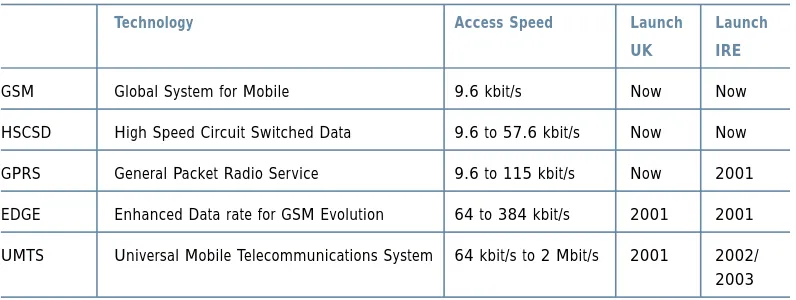
e-Commerce will continue to evolve and develop to utilise this mobility. For example, WAP, GPRS,
EDGE and UMTS technologies are expected to play a big part in the upsurge of on-line shopping
and other e-commerce services.
Analysts predict that mobile Internet access will herald big social and economic change. Hence
the latest addition to the e-business vocabulary: m-commerce. m-Commerce is the ability to
purchase goods anywhere through a wireless Internet-enabled device.
Digital TV will bring an access to the household through a very familiar appliance and so offer
Internet capability in a user friendly way. It has the potential to open up a whole range of business
services for the enterprise sector. Digital TV will be interactive and will effectively be a gateway to
the Internet in every home.
2.16 Government Initiatives
How are the Governments supporting and encouraging development towards e-business? In order
to help companies rapidly acquire knowledge and capabilities in e-business there are a number
of initiatives in place. Refer to Section 6: Getting Started for links to sources of practical advice
and support for management, marketing and skills development.
In Ireland, examples of the regulatory initiatives include:
the Irish Government produced an action plan for implementing the Information Society in
Page 16
the DPE and the European Commission assisted IBEC/Information Society Commission
Business Awareness Campaign under the Economic Infrastructure Operational Programme;
Enterprise Ireland’s Adapt Initiative (See Case Studies 3 and 4.);
Enterprise Ireland’s e-Business Learning Centre and ‘E-Work Business Campaign’.
Infrastructure-based initiatives include:
the DPE and the European Commission assisted 25 corporate infrastructure
demonstration-type projects under the Economic Infrastructure Operational Programme 1994-1999
(co-funded by ERDF);
network of ‘Webworks’ – a network of technology hubs planned by Enterprise Ireland. These
will house new companies in towns and cities around the country;
IDA Ireland’s strategy to make Ireland a European e-business hub, for example, the Irish
Government/IDA Ireland contract with Global Crossing, which will give Ireland practically
unlimited bandwidth connectivity to Europe and the rest of the world;
designating of City West as the National Digital Park. IDA Ireland is working with the private
sector on the development of this and other digital parks. IDA Ireland is working with the
private sector to develop an international telehouse for telecommunications and ISP
companies to exchange traffic at City West;
eircomEnnis Information Age Town project.
In Northern Ireland examples include:
The Information Age Initiative - a representative group from the private and public sectors with
a brief to develop a strategy framework and comprehensive action plan aimed at ensuring that
Northern Ireland takes maximum advantage of opportunities for e-business.
(www.leapfrog.gov.org);
The Department of Enterprise, Trade and Industry (DETI) is taking the lead in supporting the
Information Age Initiative and, through an extensive range of programmes, is encouraging the
development of the knowledge driven economy and e-commerce through client companies
and various organisations in the business sector;
the training scheme for business called ‘Training for Buttons’. (www.trainingforbuttons.com);
Local Enterprise and Development Unit (LEDU) has initiated a Connectivity Programme
targeting 1,000 small companies to provide them with website access and e-mail facilities.
The LEDU is a Government-funded agency in Belfast who assists small businesses within
2.17 Electronic Commerce Bills, Security and Privacy
Government in the UK and Ireland have realised that the laws need updating to cope with the
Internet. For example, when on-line trading becomes ubiquitous, it is essential that documents will
not be denied legal effect by virtue of being transported or stored electronically. Both Governments
have developed legislative frameworks – both entitled ‘The Electronic Commerce Act, 2000’ - for
the emerging world of e-commerce and on-line communications. These allow the legal and
administrative systems to give equivalence to written and digital documents and signatures
These legislative frameworks add trust and certainty to e-business systems and electronic
agreements. The legislation is designed to give a key advantage in what is a very competitive
market and also to ensure that the island remains an attractive location and environment for
dot.coms and e-enabled businesses and activities.
In Ireland, the Chambers of Commerce Ireland (CCI) has shown an interest in becoming a
certification authority for e-commerce in Ireland and An Post recently became a certification
authority. The CCI will offer a service named ChamberCERT to issue digital certificates to member
organisations for secure authenticated Internet business. Other certification authorities are also
likely to emerge shortly.
In Northern Ireland, the Post Office in the UK has a certification scheme available, called
‘Viacode’. (www.royalmail.co.uk).
2.18 An incremental approach to e-Business
A popular approach to bringing e-business methods into a company is for the company to
introduce new processes on a small scale, and to use this as a base from which to ramp up their
e-business capabilities. The second of our Case Studies illustrates how Delap and Waller,
mechanical and electrical consulting engineers, have used non-Web-based e-commerce to
increase its turnover. In this case, the company did not opt for an overhaul in its business
processes from the outset, but instead have achieved a good pay back from well-planned use of
limited e-business techniques.
Case Study 2
Delap and Waller (www.delap-and-waller.com)
Business Areas:Operations, Design & Production, Customer Service Sector: Engineering (electrical, mechanical, process) Technologies:Video conferencing, networks, e-mail Size:54 employees
Location:Londonderry Geographical Impact: National (Belfast, Dublin, Cork), International (London)
Page 18
E-commerce is not restricted by time zones. The concept of “open all hours” is truly alive in terms
of on-line transactions. As illustrated in Case Study 3, for example, a customer from the US can
order a sweater from an Irish manufacturer at 3 am if they so wish.
The Business Opportunity:Delap and Waller recognised that through technology it could share information better between staff in its different offices and with customers in order to streamline its business processes and provide a more efficient service for its
clients.
The Solution:The Company installed a Wide Area Network (WAN) to link its computers and telecommunication systems in different offices to improve staff communication and allow information to be shared. They also installed desktop and video conferencing.
The investment in technology cost approximately £150,000.
The Success:Internally, the use of e-mail, digital telephone systems and desktop and video conferencing systems has streamlined operations and allows all the sites to work together, sharing information and resources. Delap and Waller form virtual teams from
across its offices and wider within its sector when bidding for new work.
Externally, the company has improved the way it communicates with customers. It uses conferencing technologies on a daily basis
for discussions with its clients. It can send them documents instantaneously by file transfer.
Integrating technology throughout the business was responsible in part for a £600,000, almost 15% increase in turnover despite
the strong pound. The company anticipates that the figure will rise again in the following financial year.
The Future: Delap and Waller intends to continue to upgrade its IT and telecommunications systems by installing remote access and teleworking facilities. It also plans to install more video conferencing systems into its offices.
Liam O’Hagan, MD of Delap and Waller, explains, “This will allow us to offer better service to our customers and also liaise more
closely with project partners and the supply chain”.
Advice for other companies:Liam O’Hagan advises other companies thinking about incorporating technology into their business “Don’t try to do everything at once – stage the introduction of e-commerce. This will give time for staff to accept and learn the
technology and also for your business to adapt to using it. I’d also recommend other companies to seek independent advice and
Case Study 3
Magee Weaving ([email protected], http://www.mageeshop.com)
Business Areas:Magee Weaving is based in Donegal in the North West of Ireland. Magee Clothing is the largest manufacturer in Ireland of clothing with factories in Donegal and Antrim. Magee of Donegal is a large retail outlet in Donegal Town, with other
complementary brands of quality clothing. Magee Weaving maintains the unique hand-weaving tradition in Donegal but also
weaves on technically advanced Rapier looms.
Size:280 employees Location:New Row, Donegal
Geographical Impact:Donegal, Antrim Background:Established 1866
The Business Opportunity:Magee want to develop a top-class online shopping presence for hand-woven suits and jackets, and in particular to expand their online retail presence in the Irish American US market.
The Solution:
Magee launched their online store in November 1999. Given Magee’s current market share in their home market they were not
keen to target the Irish market for fear of cannibalising their current distribution. They plan on attracting most of their custom
from the US market, where they have targeted their campaign, including the registering a .com domain name.
Enterprise Ireland, through the Adapt programme, helped in the marketing of the website and its design. Kratos, an Internet
development and Marketing Company operating in Dublin, gave advice on all aspects of the site. They made recommendations for
promoting the site by online and offline methods and gave advice on the navigational structure.
Instead of the traditional Internet ‘brochure’ concept, Magee chose to focus on its customers’ needs, they added a secure shopping
cart that allows for a fully integrated solution. A customer can also choose from a selection of cloths, the cloth image can be
magnified many times to show the quality and texture.
The Internet is the most powerful marketing tool available today. But in order to promote a new site, the more traditional methods
of marketing and advertising cannot be abandoned. Kratos advised on incorporating the mageeshop.com domain name onto all
corporate stationery, company communications and any further offline advertising.
The Success and Lessons Learnt
There has been an increase in customer enquiries using email. The shopping cart has allowed a safe and secure medium for
Internet transactions. Customers can avail of special discounts and fast delivery through their international delivery network.
Magee offers a 5% discount for 3 or more items bought. Magee now have the option of integrating the Internet into all their
business operations.
The Future:
Over a number of years they have accumulated a considerable amount of contact (name and addresses, emails). It is expected
Page 20
e-Business can be successfully implemented across all sectors and industries, and does not
necessarily have to involve the buying and selling of goods. The example documented in Case
Study 4outlines how an SME, with the help of Enterprise Ireland’s Adapt funding, has identified the ways in which a Web presence could increase their business opportunities in terms of
increased audience and streamlined business processes.
2.19 Summary
Doing business in a world of plentiful and cheap interactions will clearly require new skills and a
new mindset. No firm or sector will be left unaffected. Those who anticipate and understand the
fundamental nature of the changes ahead and reshape their business models will be best placed
to exploit the opportunities.
e-Business is a multi-billion dollar industry that offers, like never before, the opportunity for
business in Ireland, North and South, to trade in every part of the globe. It is therefore imperative
that businesses adapt their trading techniques to come in line with this new technology.
Case Study 4
Abacus (http://www.abacus-communications.com/)
Business Areas: Abacus Communications designs, produces and sells computer-based language training programmes. The software programmes are aimed at learners who want to improve their level of language proficiency using a highly motivating
medium.
The Business Opportunity:Web site development.
Adapt funding has helped Abacus to research all aspects of their online business and set a strategy for the coming months. The
Web site will become the cornerstone of Abacus’ marketing effort. The aims of the introduction of the Web site are to facilitate
communication with resellers and potential customers, to enable Abacus to make contact with a greater audience and to generate
a database of clients.
The project aims to reduce overheads such as postal and telephone support charges, and generate a higher turnover with less effort
on the part of Abacus personnel. For example, the Web site will save Abacus personnel time in addressing customers queries.
For Abacus, the site will become an asset in itself, and for its customers it will be valued as part of the service. The criteria for the
new Web site were: simplicity, ease of use, easily updated and easily navigated.
The Success:Abacus has certain technology skills but the Internet was new to the management team. The Adapt programme helped the management team come to a better understanding of the opportunities available in this domain. Non-technical staff
benefited from the practical introductory Internet training sessions. The value of the programme for senior management had more
to do with generating the discipline of thinking about the marketing and sales issues related to this domain at regular times. This
e-Business is one of the biggest challenges to businesses and is still a very new concept to many.
The most recent surveys indicate that across all businesses, those that have e-mail addresses and
that have their own web site are still relatively low. Of those that have a Web presence, many
report to having little or no sales revenue from this Internet site.4
Many companies have had a Web page built to have a presence on the Web but had no plan as
to how this presence could be utilised from a business perspective. Often, it is not possible to
simply transcribe existing business to the Web, a new business model is required to properly
exploit its potential. The key lesson to be learned from experience so far is that there must be a
business strategy behind building a Web site. Overall, the key messages for business are to:
explore internal and external opportunities in ICT, no matter how small the change;
take advantage of new technologies;
develop an awareness of the challenges facing your business in the future;
examine new ways of doing business and the appropriate strategies to be formulated and
implemented to fully exploit the new fixed and wireless technologies and services.
To become the European centre for e-business, all companies and Government organisations in
Ireland, North and South, will have to adopt new electronic methods as a way of doing business,
and find a way of integrating these with existing traditional business processes. It will also involve
attracting new overseas companies and developing indigenous companies, based on e-business.
It is ambitious, but with proper planning, adequate time and resources, it is a real, achievable,
3
e-Government
3.1
The Vision
e-Government uses Internet technology to conduct internal and external Government processes. The Internet is transforming the way in which Governments work and trade, and is improving access to their public services.
The Governments in both parts of Ireland are adopting new models of information and delivery
and customer service to citizens and businesses using a single point of access. The aim is to
enable the people who live or work in Ireland, North and South, to access the local and public
services they need, when and where they want to.
The Governments in UK and Ireland are ensuring that appropriate support is in place to encourage
the development of e-business and that they are in line with best practice in the rest of the world.
Much of this guidance provided by the Government bodies is directly relevant to their own
processes and operations, and the Governments themselves should be major beneficiaries of the
Digital Revolution. The Governments recognise that they need to think of themselves in ‘e’ terms
and take the lead on e-business initiatives.
3.2
Transformation to an e-Government
Governments are aiming to facilitate quicker access to services around the clock, providing access
to public services wherever Web access is available.
The ‘Citizen as a Customer’ concept envisages citizens being able to ask for services or products
on line, whenever they want. The aim is to provide 24 hour access to information through electronic media, i.e. the flexibility to make the Government ‘open all hours’.
Governments can potentially offer all of the services listed below electronically:
Advice on a range of subjects including income tax, local authority benefits, and employment
benefits.
Public services - enquiries and complaints, planning applications, voting, social issues.
Payment of social welfare benefits.
Education - access to shared resources, remote training, distance learning.
Property - availability, repairs, commercial & residential building standards, land registry.
Page 24
Applying for driving tests, and even sitting the theory test on-line.
Payment and collection of rent and taxes.
The focus on service delivery is changing to place the emphasis firmly on what the customer wants
and to deliver a service to meet these expectations. In this case, the public are the customers.
The entire Government information system will be integrated to deliver services via a number of
different methods including telephony, Internet, traditional hard copies and information kiosks.
The concept of ‘Joined-Up’ Government requires the public sector organisations to interwork
closely so that the public see the local or central Government as one single unit. This concept is
borne out through the ‘Electronic Services Broker’ or eBroker service in Ireland, described in Case
Study 5.
Case Study 5
The Government of Ireland Reach Initiative (http://www.reach.ie)
Area:Government Sector:Economic Development Technologies: e-Government Geographical Impact:Regional The Business Opportunity:e-Broker Service
The broker is intended to act as an intermediary between the citizen and the public service. It will establish and operate a standard
common authentication service for citizens in accessing public services. It is intended for use in all citizen/public service contacts,
regardless of access channel, i.e., it can be used in face to face and telephone contacts as well as remote self-service contacts over
a network.
The Solution:The Government has committed to delivering electronic public services through an eBroker model. The “electronic broker” will act as agent for the client using state of the art technologies to meet the requirements of the client, and to ensure that
their expectations of quality service are met. It will basically amount to a virtual corporation delivering quality services on the basis
of client needs and increasing the level of efficiency and service throughout the public service.
The eBroker will be used for personal events like birth registration and for business events like filling tax returns.
An important feature of the broker will be personal “data vaults” where citizens can store additional personal information or profiles,
which can be voluntarily released for enhanced service levels.
Another important feature of the broker will be the development of a common transaction or episode management system. This
will involve the development of interfaces giving access to groupings of services related to particular episodes in the life of the
citizen. Citizens’ requests for services coming through these episode interfaces will be presented to the various public service
agencies in a standard format. The service agencies will be expected to redevelop their own systems to support these standard
interfaces. While the idea of personal data being held under the personal control of the citizen is central to the operation of the
e-broker, there is also the requirement to share a basic data set across the service agencies. The purpose of this requirement is to
improve service levels to the customer by eliminating the necessity for repeated form filling and affirmations of identity at each
point of contact with the public service. The extension of the use of the Personal Public Service number (PPS No.) across the public
3.3
e-Government Initiatives
The change from the current system to a system where all information is readily available on-line
or through other electronic media may seem like a monumental task, but the first steps have
already been taken. There is already a huge amount of Government-produced information
available on-line, and many initiatives in place. To enable these initiatives, local service providers
will work together with local and central Government using the telecommunications technologies
to deliver services in the most cost-effective and simple way.
3.3.1 Initiatives in Ireland
Information is available from www.irlgov.ie.
The report ‘Modernising Government, the Challenge for Local Government’ assesses the success
of the Government’s strategy and the future direction within local government. In addition,
initiatives in Ireland to support the electronic delivery of Government services include:
A next generation VPN Government network:For example, GPs could use this as an extranet service as they need to be in contact with various public departments. End consumers could
use it for transactions with the public service, for example for paying motor tax.
The ‘Reach’ Initiative:A public sector initiative to foster more streamlined public services through greater sharing of information by public bodies. It will encourage and support the
development of more integrated services, including the eBroker initiative.
The Government’s Information Society Action Plansets out a coherent framework for the development of e-government.
Electronic Commerce Act – this provides a framework for the electronic delivery of Government services.
The launch of ‘ChamberSEAL’ by the Chambers of Commerce. This provides a listing of
companies including name, location and tax registration information and, on a general level,
the creation of homepages for all Government departments, both local and central.
3.3.2 Initiatives in Northern Ireland
UK Government information is available from www.open.gov.uk. The Northern Ireland Executive
Web site is www.nics.gov.uk.
In the UK, a strategy published in April 2000 established the framework for achieving the
Government’s targets for getting e-government services online. In response to the ‘Modernising
Government’ White Paper, it presents a strategy for Information Age Government in the UK. Its
focus is on providing better services for citizens and businesses and more effective use of the
Government’s information resources.
Page 26 In addition, local Government initiatives include:
an intranet for the country’s local authorities;
electronic procurement system;
planning application based on GIS and Internet technologies.
Northern Ireland Government departments are actively pursuing knowledge-driven economy
issues arising from the Competitiveness White Paper and associated initiatives - Modernising
Government, Electronic Government and the Information Society. For example, the Office of
Government Commerce, OGC, will oversee the purchasing activity of some 200 Government
departments and agencies across the UK. Also, the Government Purchasing Agency Credit Card
has been introduced in Northern Ireland.
Case Study 6 presents an e-government success story from IRTU in Northern Ireland, who have
Web-enabled a number of Government services. Further evidence of progress is the launch of