
104
Chapter 14
Characterization of Methyl Ester Obtained from Nanochloropsis Occulata and
Tetraselmis Chuii by using In-situ and Conventional Method
Elida Purba1,a, Raysa Anindya1,b, Reo Aditya Mahesa1,c 1
Chemical Engineering Departement, Lampung University, Bandar Lampung 35145, Indonesia
a
[email protected],[email protected],[email protected]
Abstract. Maximum Fatty Acid Methyl Ester (FAME) yield of Nannochloropsis oculata and Tetraselmis chuii using variation of catalyst concentration was investigated. Research began with culturing microalgae and then was proceeded with oil extraction to obtain 60 grams of dried microalgae. Three variations of NaOH catalyst concentrations have been applied for each method, they are 1.5, 2.0, and 2.5% of microalgae oil weight in transesterification process. Yield of FAME in each microalgae species from in-situ method was not been determine because of impurities content in the product. In conventional method, yield of FAME was 88.50% with 2% NaOH catalyst concentration on Nannochloropsis oculata and 82.31% with 2% NaOH catalyst concentration on Tetraselmis chuii. The highest content of the methyl esters is undecanoic acid methyl ester in Nannochloropsis oculata and palmitic acid methyl ester in Tetraselmis chuii.
Keywords: FAME, Nannochloropsis oculata, Tetraselmis chuii, transesterification, yield
I.
Introduction
Energy plays a vital role in our everyday lives and recording the decline in energy sources. Therefore, there are a lot of efforts to find other sources of energy especially the renewable sources. Then we talked about biofuels, their different classifications and types showing their advantages and disadvantages[1]. Biodiesel as a promising alternative energy source is receiving increased attention from energy experts. The high price of vegetable oil and land use competition between biodiesel feedstock and food production requires the existence of an alternative solution to produce cheaper biodiesel [2]. One of the solution to overcome this problem by producing biodiesel using microalgae raw materials. With the lipid content about more than 30% and productivity of microalgae 200 times more than other vegetable sources, microalgae have the potential to be used as an alternative source of biodiesel [3].
The commercial production of biodiesel derived from microalgal is still in the research and development stages, mainly due to the current prohibitive high costs associated with the biomass production and fuel conversion process. The schemes of research and development is optimization parameters of operation such as the reaction time, the ratio of alcohol and microalgae lipid, catalyst concentration, and reaction temperature.
In conventional transesterification, the extraction of microalgae lipid was carried out by percolation method using a mixture of polar and non-polar solvents, such as methanol and chloroform. The boiling point of the solvent is quite low and has approached the polarity of oil[4]. Oil that has been established, then processed using the batch method with agitator on the reaction conditions previously set.
105
developed , namely the in-situ method or transesterification of biodiesel without the extraction step. In this research, the experiment was carried out not only about the potensial of microalgae species, but also catalyst concentration on in-situ and conventional transesterification method.II.
Research Methods
2.1. Materials
Samples of Nannochloropsis oculata and Tetraselmis chuii were collected from The great laboratory of mariculture development, Lampung, Indonesia. Microalgae was extracted using soxhlet method with kloroform:methanol and n-hexane as solvent [5]. Sodium hydroxide used for transesterification process as catalyst and sulfuric acid for esterification process as catalyst.
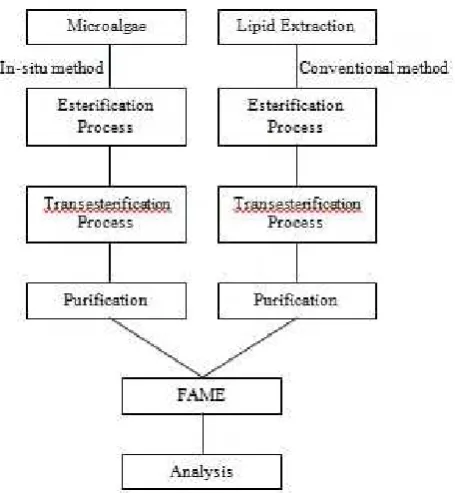
2.2. In-situ transesterification method
Microalgae and methanol in ratio of 1:8 was applied into a three-neck flask and stirred at 60°C and 600 rpm [7]. In-situ esterification reaction lasted for 90 minutes with the addition of 1% weight H2SO4 of microalgae lipid [1]. Before proceeding with in-situ transesterification reaction, the water formed from the esterification reaction was separated. Then, in-situ transesterification reaction took place for 60 minutes in the presence of NaOH, 1.5, 2.0, and 2.5% weight of microalgae lipid. Biodiesel product was collected and separated from the solvent.
2.3. Conventional transesterification method
[image:2.595.191.419.471.718.2]20 grams of dried microalgae extracted by using Soxhlet. Solvent was put into the flask at the bottom of the extractor as much as 500 ml. The temperature applied was 70°C which exceeds the boiling point of the solvent. Extraction was carried out for 8 hours. Microalgal oil and solvents mixture was separated by using the vacuum evaporator for 15 minutes [1]. Furthermore, esterification and transesterification reactions was caaried out with process the same as in-situ method.
106
2.4. Yield CalculationsYield is the amount of FAME product divided by the amount of initial mass of reactants.
Yield = MassofFAME × 100% (1)
Mass of Reactants
Mass of FAME = The mass of FAME as product after purification (gram) Mass of Reactants = mass lipids extracted as raw material transesterification (gram)
2.5. Fame Analysis
Analysis of methyl esters was carried out with GC-MS Shimadzu. FAME samples from the results of the transesterification reaction was injected into the GC column by using the autosampler. Separation was performed using a column AGILENTJ% W DB-5, 30 mx 0.25 mm ID, with helium carrier gas, injector temperature 300oC, the temperature of the column 50°C, flow rate of 0.54 ml/min. The results of the analysis in the form of a mass spectrum compared with a known reference of 229 Willey and NIST 62 to determine the composition of fatty acids contained in the sample.
III.
Results and Discussions
3.1. In-situ transesterification method
[image:3.595.185.421.442.567.2]In the in-situ transesterification process, extraction was carried out for 15 minutes before adding methanol on sulphuric acid. Methanol is a polar solvent, while lipids are non polar compounds. This is caused the amount of lipid extracted as slightly as the amount of lipids that can be converted into methyl esters. In addition, chlorophyll also extracted together with oil and it is difficult to separate from the oil [8].
Fig. 2. GC-MS analyzer results for Nannochloropsis oculata
[image:3.595.186.421.628.757.2]107
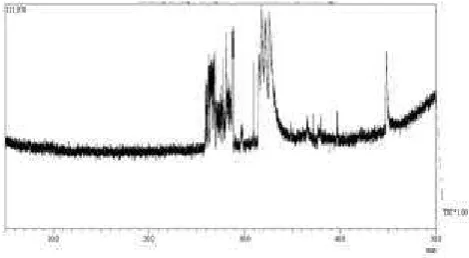
Y ie ld (% )Fig. 2 and 3 show the results of GC-MS analysis of the in-situ transesterification products for both microalgae. The Fig. shows that the spectrum of the results of GC-MS analysis was not able to analyze the sample, so that the composition of the methyl ester in the results of in-situ transesterification reaction can not be determined. The impurity causes the difficulty in analysis.
3.2. Conventional method
Suppliers approval list are needed to be documented as this process was came after initial assessment as part of supplier selection. Mostly in food industry the list of food supplier was categorized into high risk food supplier, medium risk food supplier or low risk food supplier. High risk supplier were mostly for frozen products, meat, fish, poultry and ready to eat foods (RTE), example of medium risk food is dry food, grain, flour,etc. In fact high risk food supplier were listed to be the most supplier that need to be controlled wither in the initial assessment or during delivery processed/incoming process. Through this list also we have to know whether they have food safety program or any appropriate quality control system
[image:4.595.202.405.315.377.2]In the conventional method, lipids which resides in microalgae cells was extracted before the reaction process. Lipid was extracted from microalgae by using soxhlet.
Table I. Lipid Content Extracted From Microalgae
Run Nannochloropsis oculata Tetraselmis chuii 10.3% 10.0% 10.0% I II III 11.0% 13.0% 12.5%
Cultivation and harvesting processes affect the difference in the results of lipid extraction. It can be seen from the Table above. In the beginning, we used dry microalgae from Lampung great laboratory of mariculture development, but oil extracted from microalgal was limited less than 5% of microalgal weight. Cultivation process is not performed at the optimum condition for the preparation of raw material for biodiesel which limited amount obtained. In addition, the possibility of errors in the harvesting of microalgae cells leads to reduced levels of lipid extracted. Then we cultivated microalgae in our lab. The oil extracted from microalgal more than 10% of microalgal weight, so optimum condition of microalgae cultivation affects the amount of oil extracted.
Reaction occurs in two stages which are esterification and transesterification. The extracted oil was evaporated under vacuum to release the solvent using rotary evaporator. Then, the oil produced from each algal species was mixed with a mixture of catalyst and methanol with stirring. Esterification must be carried out due to high content of fatty acid, that is more than 5%. Certain amount of algal biomass of each species was applied to
produce oil and biodiesel.
Nanochloropsis occulata Tetraselmis chuii
[image:4.595.167.440.593.713.2]Catalyst concentration (%)
108
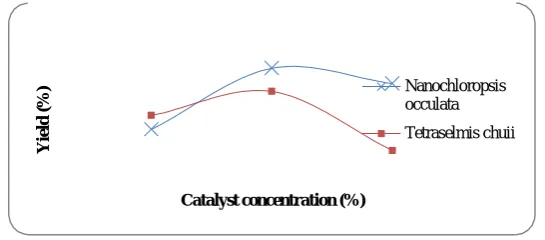
As can be seen from Fig. 4, yield of methyl ester increase with increasing of catalyst concentration up to 2,0%. The concentration of catalyst in this state is able to optimally break the bond on lipids and exchange with methanol, thus forming FAME and glycerol. The mechanism of reaction can be seen from Fig. 5.Fig. 5. The mechanism of transesterification reaction with base catalyst [6].
It can be seen from the picture the mechanism of the transesterification reaction. First step, NaOH catalyst will bind to alcohol and wait for the contact with triglycerides. After contact between alcohol and triglycerides, the Na + ions help break the bond contained triglycerides. Ties that have been disconnected react with alcohol and Na + ions back to form a compound NaOH.
It also occurs in the second step, in order to obtain the compound of alkyl esters (biodiesel). In the third Step H + ions resulting from the breakup of alcohol will bind to O--, thus forming glycerol. Limited amount of lipids formed into glycerol showed that the catalyst concentration is also appropriate and not excessive amount.
At a concentration of 1.5% catalyst, methyl ester produced is minimum. Less the amount of catalyst is not been able to optimally promote the lipid break the bond, so the reaction is slow. Thus the amount of lipids formed into methyl esters was not optimal. It takes a little longer to achieve optimum yield point. But it is not recommended as it will require more energy to grow over time, so it is not economical.
Another case in catalyst concentration of 2.5%, methyl ester produced much less than others. Excess catalyst reacts with lipids produce glycerol, so when washing the product with warm water much missing. Another possibility is minimum amount of free fatty acids converted in the esterification reaction. However, this is unlikely to happen because the two previous reactions do not happen.
The highest yield in both microalgae is obtained in the catalyst concentration of 2%, i.e. 88.5% in microalgae Nannochloropsis oculata and 82.3% in microalgae Tetraselmis chuii. Maximum yield of FAME obtained from Nannochloropsis oculata is slightly higher than Tetraselmis chuii.
3.3. Identification of biodiesel by GC-MS
The biodiesel produced from Nannochloropsis oculata and Tetraselmis chuii were analyzed and compared with standards of fatty acids and methyl ester by gas chromatography analyzer.
109
Fig. 6. GC-MS result for Nannochloropsis oculata FAMEFig. 7. GC-MS result for Tetraselmis chuii FAME
The results indicates that, the peak at R. time 31.390 corresponding to the presence of undecanoic acid methyl ester by 55.42% and at R. time 44.620 corresponding to the presence of glyceryl - 1,2–isopropylidene–3 - laurin by 44.58%.
GC-MS analysis result of Tetraselmis chuii methyl ester is shown in Fig. 7The first peak appeared at R. time 32.165 minutes. Based on the data bank of methyl ester, it shows that the peak is dodecanoic acid methyl ester by 18.42%. The second peak that appeared at the time R. 44.750 minutes corresponding to the presence of palmitic acid methyl ester by 81.58%.
IV.
Conclusions
In the current study, both of algal species were used to extract oil and converted it into biodiesel. Oil extracted was transesterified to biodiesel using sodium hydroxide as a catalyst. The results of in-situ transesterification method cannot be identified. On the other hand, conventional method showed a better performance than in-situ for biodiesel production. Both of microalgae obtained maximum yield at 2% catalyst concentration. Nannochloropsis oculata gives highest yield that is 88.5%. The highest content of methyl ester from Nannochloropsis oculata is undecanoic acid methyl ester by 55.42% and the result from Tetraselmis chuii is palmitic acid methyl ester by 81.58%.
References
[1]. D. A. El-Maksoud, M. A. El-Shafie, N. N. Saad, R. M. Salah, S. S. Ahmed, ”Production of Biodiesel from Algae,”B.Sc. thesis, Dept. Chem. Eng., Cairo Univ., Cairo, Egypt, 2012.
[2]. Direction Production et Energies Durables (ADEME), “Life cycle assessments applied to first generation biofuels used in france,” The French Environnement and Energy Management Agency, France, 2010.
[3]. Y. Christi,“Biodiesel from Microalgae,” Biotechnology Advances 25, 2007, pp. 294 -306.
110
[5]. E. Purba, D. Saragih, K. Ranti, ”Ekstraksi Minyak Alga dari Alga Kering Nannochloropsis oculatadan Tetraselmis chuii Menggunakan Etanol dan N -Heksana,” Proceedings of the 3rd national seminar on science and technology, Lampung Univ., Bandar Lampung, Indonesia, 201.
[6]. S. P. Singh, D. Singh, “Biodiesel Production Through The Use of Different Sources and Characterization of Oils and Their Esther and Substitute of Diesel,” Renewable and Sustainable Energy Reviews 14, 2010, pp. 200-216.
[7]. X. Ma, “Biodiesel Production from Algae through In Situ Transesterifikasi Technology,” M.Sc. thesis, Minnesota Univ., Minnesota, USA, 2012.
![Fig. 5. The mechanism of transesterification reaction with base catalyst [6].](https://thumb-us.123doks.com/thumbv2/123dok_us/8801500.914224/5.595.195.422.106.234/fig-mechanism-transesterification-reaction-base-catalyst.webp)

