Threshold Concepts in Language Teacher Knowledge:
Practice
versus
Policy
Introduction
This paper presents a study with practicing language teachers in Ireland, within the framework of Threshold Concepts (Meyer, Land et al. 2010), to identify the core but troublesome knowledge and practices of language teaching and the conditions that facilitate the integration of these concepts over a teaching career. The project draws on the voice of professionals in the two jurisdictions, North and South, articulating key points of learning in their careers. Qualitative analysis of participant interviews suggests that, while the threshold concepts identified are quite consistent across both jurisdictions, their articulation and implementation are contingent upon the local and broader policy context in which teachers work. The concepts are expressed as a belief system where contextual factors mediate the degree to which teachers can teach in accordance with their beliefs.
Theoretical Framework
Threshold Concepts (TCs) have emerged over the last ten years as a useful metaphor and tool for curriculum design and research with work conducted in higher education settings in the UK and USA (Meyer, Land et al. 2010). TCs are defined as those without which it is not possible to engage in the practices and discourse of a discipline, such as for example, “opportunity cost” in economics or “care” in nursing. Often, these concepts constitute troublesome knowledge that when integrated has a transformational and potentially irreversible effect on the learner and their world view, integrating existing knowledge to open up new horizons of thought:
“... akin to a portal, opening up a new and previously inaccessible way of thinking about something. It represents a transformed way of understanding, or interpreting, or viewing something without which the learner cannot progress.” (Meyer and Land 2003, p. 414)
Methodology
The study was conducted as an exploratory qualitative case study in 2013 with practicing language teachers in Ireland, both North and South. The key research questions outlined below derive from previous work carried out by the authors on threshold concepts in teacher education and are a response to a competencies-based approach to teacher education and knowledge:
What do experienced teachers articulate as threshold concepts (TCs) underlying good language teaching?
Are these concepts dependent on the policy context within which teachers work?
What are the conditions and encounters that facilitate or challenge the integration and practice of these TCs?
In order to address these questions, participant language teachers took part in interviews to elicit their understanding of what knowledge underlies good language teaching in the context of their personal narratives as teachers and learners of language. There were 17 mid to late career language teacher participants in total: 9 teachers in Northern Ireland and 8 teachers in the Republic of Ireland. The sampling for this study was purposeful drawing from teachers with at least 5 years experience teaching in different school types (selective vs. non-selective, high vs. low socio-economic status) and teaching one of the main languages taught in both jurisdictions (Irish, French, German and Spanish). The sample size is in line with indications of appropriate theoretical sampling for qualitative research with expert participants (Guest, Bunce et al. 2006). Interviews were transcribed and a thorough thematic analysis of participant interviews was conducted to address the project research questions. The analysis was driven by a priori themes derived from the literature on language teaching methodologies (e.g. Long and Doughty 2009) and on threshold concepts and but was also open to themes identified in the data.
Findings
Two core principles were identified in the data as critical to the practice of good language teaching. In some cases these principles had had a transformative and/or reconstitutive effect on the participant. These two core principles could be classified as threshold concepts of language teacher education.
Real Language Use
The first of these concepts relates to facilitating authenticity of communication for language learners, summarised by a number of teachers as “real language use”.
(MET) recounted the transformative experience during Initial Teacher Education (ITE) of coming to believe that using the target language in the classroom could work:
MET: But it was an amazing experience to watch somebody teach a very unusual language to a group of people and have them speak it within an hour
AMD: And what did you get out of that?
MET: Oh it completely transformed my way of thinking about languages. I would speak the language, but I didn’t really believe that you could teach a language through the target language at that stage
AMD: And how did that affect how you taught? MET: It radically changed it!
For another teacher (LBA), this principle was based on a core belief, not related to teaching:
LBA: I should say that, this was for me sort of holy cause because I am a great believer in the necessity for the Irish language … and the implication of that was that in teaching in the classroom I would never, almost never use English.
A number of language teachers identify teaching English as a foreign language (TEFL) as the site of integration of the concept and practice of TL use.
The majority of teachers in the South expressed maximal TL use as an article of faith. Teachers in the North, on the other hand, indicate that while optimal or maximal TL use is desirable, they take a more pragmatic approach to use the TL, reflecting the difference in policy on TL use in the two jurisdictions.
Fostering Learner Autonomy
The second concept relates to empowering learners to manage and develop their own learning, summarised as “learner autonomy” by a number of participants. The sub-themes here include building learner confidence and motivation, fostering error tolerance, scaffolding learners’ strategy use, target setting. One participant identified a transformative experience on a Master’s programme during which she encountered the theory, put it into practice and integrated this concept.
MFE: And I studied the work of Leni Dam in Denmark and I suppose that was a huge moment for me because eh I hadn’t heard of the concept of the autonomous learner before that. And it was something, because while I was studying I was also teaching at the same time, I tried to introduce, you know, some of the methods that she spoke about. And I think that is crucial to have an autonomous learner.
Another expressed integrating this concept from a different perspective, a revised understanding of her role as facilitator rather than sole transmitter of knowledge:
MET: one of these colleagues… said to me “MET the day I became a good teacher was the day that I stopped being afraid of saying I don’t know.” And that was real, that was an amazing moment … I’m much better at saying it now and I’ll go … “I need to go and research that and by the way, so do you”
Mediating Threshold Concepts and Beliefs
for change might be external, this stimulus is reinforced by direct observation of the effect of a practice, as in the example above on learner autonomy.
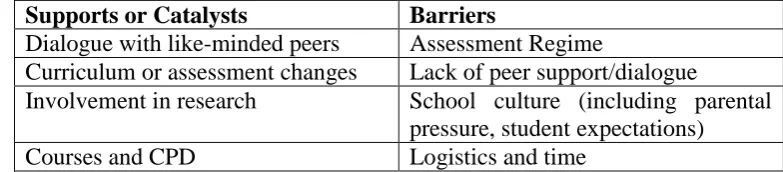
In many cases participants express tensions between what they believe and what they are constrained or empowered to do by contextual factors (see Table 1). Primary among the contextual supports is dialogue with like-minded or inspirational peers:
RMG: I think they [these concepts] are with you forever, I think they are there, but I think that this whole thing of,… that they’re there and I think you need to be with other like-minded people to get that buzz and to get that energy and to like, maybe build them further
The main contextual barrier was an interaction between assessment policy and local school culture:
RMG: In a school like ours, like that it’s almost, it’s just some people are just interested about the exam results.
Interestingly, education policy is viewed by teachers as a positive catalyst for change. For example, impending curriculum changes in the South are currently perceived as a validation of teachers’ beliefs about good teaching and policy changes in the North in relation to assessment for learning are identified as a causal factor in successful facilitation of learner autonomy.
Supports or Catalysts Barriers
Dialogue with like-minded peers Assessment Regime
Curriculum or assessment changes Lack of peer support/dialogue
Involvement in research School culture (including parental pressure, student expectations)
[image:4.595.98.490.351.437.2]Courses and CPD Logistics and time
Table 1: Supports or Barriers to Implementation of Beliefs (in descending order of frequency)
Revisiting the Liminal Space
Within the framework of Threshold Concepts, concepts are characterised as irreversible, once an individual has passed through the creative and potentially frustrating liminal space within a “threshold” and gone over to where new knowledge has been fully integrated there is no turning back (Land 2012). The tensions between knowledge, beliefs and practice identified here and in the literature suggest that knowledge must be sustained and validated by practice. In the absence of this, the teachers experience frustration and possibly even a sense of impostorship where there is a gulf between idealised and actual practice (Brookfield 2006). Taking the threshold metaphor, they re-experience the liminal, pre-threshold space with its characteristics of frustration, limitation and mimicry, using the discourse but not following through in action. In this sense, concepts may be irreversible but their associated practices are not.
Conclusions
concepts in teacher education. The findings however suggest that the notion of threshold concepts as irreversible may be too simplistic in the context of professional learning where concepts must be put into practice within specific local and policy contexts.
References
Atherton, J., P. Hadfield, et al. (2012). Troublesome Thresholds and Limiting Liminality: Issues in Teaching in Vocational Education. 4th Bienniel Conference on Threshold Concepts: From personal practice to communities of practice, Trinity College, Dublin.
Borg, S. (2006). Teacher Cognition and Language Education: Research and Practice. Loindon, Continuum.
Brookfield, S. (2006). The Skillful Teacher: On Technique, Trust, and Responsiveness in the Classroom. San Francisco, CA, Jossey-Bass.
Carey, S. (1999). Sources of conceptual change. Conceptual development: Piaget’s legacy. E. K. Scholnick, K. Nelson and P. Miller. Mahwah, NJ, Lawrence Erlbaum Associates: 293-326.
Cove, M., J. McAdam, et al. (2008). Mentoring, teaching and professional transformation. Threshold Concepts within the Disciplines. R. Land, J. Meyer and J. Smith. Rotterdam: Netherlands, Sense Publishing: 197-211.
Guest, G., A. Bunce, et al. (2006). "How Many Interviews Are Enough?: An Experiment with Data Saturation and Variability." Field Methods 18: 59-82.
Heifetz, R., A. Grashow, et al. (2009). The practice of adaptive leadership : tools and tactics for changing your organization and the world Boston, Mass. ,
Harvard Business Press.
Land, R. (2012). Keynote: A Closer Look at Liminality: incorrigibles and threshold capital. 4th Biennial Conference on Threshold Concepts. Dublin, Ireland.
Long, M. H. and C. J. Doughty, Eds. (2009). The Handbook of Language Teaching. Chichester, UK, Wiley-Blackwell.
Meyer, J. H. F. and R. Land (2003). Threshold concepts and troublesome knowledge: linkages to ways of thinking and practising. Improving Student Learning - Theory and Practice Ten Years On. C. Rust. Oxford, Oxford Centre for Staff and Learning Development (OCSLD): 412-424.
Meyer, J. H. F., R. Land, et al. (2010). Threshold Concepts and
Transformational Learning. Rotterdam and Taipei: , Sense Publishers.
Phipps, S. and S. Borg (2009). "Exploring tensions between teachers' grammar teaching beliefs and practices." System 37: 380-390.
Wenger, E. (1998). Communities of practice : learning, meaning, and identity. Cambridge, Cambridge University Press.