Journal of Criminal Law and Criminology
Volume 52
Issue 3
September-October
Article 7
Fall 1961
Reports and Announcements
Follow this and additional works at:
https://scholarlycommons.law.northwestern.edu/jclc
Part of the
Criminal Law Commons
,
Criminology Commons
, and the
Criminology and Criminal
Justice Commons
This Note is brought to you for free and open access by Northwestern University School of Law Scholarly Commons. It has been accepted for inclusion in Journal of Criminal Law and Criminology by an authorized editor of Northwestern University School of Law Scholarly Commons.
Recommended Citation
REPORTS AND ANNOUNCEMENTS
held in contempt for refusing to answer questions. On appeal, he contended that the trial court erred in denying his request for a ruling that a witness cannot be held in contempt for refusing to answer questions unless it is perfectly clear to the court that his answers would not tend to incriminate him. The Supreme Court reversed and remanded, holding that although the trial court's denial of defendant's request was correct, since the proper test is whether, in light of all the circumstances of the case and the evidence which the witness is called to give, there is a reasonable possibility of real and appreciable danger of incrimination, the trial court erred in excluding evidence offered by defendant to show that such a reasonable possi-bility existed. In adhering to the "reasonable pos-sibility" rule, based on Mason v. Unied States, 224 U.S. 362 (1917), the Supreme Court of Massachu-setts rejected the "perfectly dear" rule of Hoffman
v. United States, 341 U.S. 479 (1951), reasoning
that the latter makes a witness the sole judge of whether the question will incriminate him, so that imaginary rather than real danger might suffice, while the former allows the court to judge the criminatory nature of the question and at the same time does not require a witness to incriminate him-self in the process of demonstrating the "reasonable possibility" of danger.
Self-Incrimination -Lee v. State Highway Comm'n. Motor Vehicle Dep't, 358 P.2d 765 (Kan.
1961). See Police Power, supra.
Sex Crimes-Rittenour v. District of Columbia, 163 A.2d 558 (D.C. 1960). See Entrapment, supra.
Withdrawal of Plea of Guilty-People v.
Spitaleri, 173 N.E.2d 21 (N.Y. 1961). Defendant's
conviction for possessing narcotics with intent to sell was affirmed by the Appellate Division. On appeal by permission, he contended that the trial court's admission as evidence of his guilt of an earlier plea of guilty of attempting to commit the crime, which he had withdrawn with the court's permission and for which he had substituted a plea of not guilty, was reversible error. The Court of Appeals reversed, holding that a plea of guilty is conclusive proof of guilt; that the trial court in its discretion properly gave defendant leave to with-draw and substitute a plea of not guilty if it con-sidered such action to be fair and just; that the effect of allowing withdrawal was to adjudge that the plea of guilty be held for naught, and be out of the case for all purposes; and that since use as evidence of defendant's withdrawn plea destroyed the effect of the privilege of withdrawal, the trial court erred in admitting the plea.
REPORTS AND ANNOUNCEMENTS
Juvenile Recidivism-A Reassessment-This report is a follow-up on a study noted in the May-June, 1960, issue of the Journal (Vol. 51, No. 1, pp. 77-79).
Background and the Initial Study
One of the most disquieting problems in dealing with youthful law violators is the alarming num-ber of youths who return to criminal patterns of behavior upon release from their first experience in a correctional institution. Research on the etiology of juvenile recidivism has nearly run the gamut, ranging from the examination of classic problem areas such as the home, school, and gang, to prevalent psychological inquiries into such factors as personality and the effects of institu-tional programming on tendencies toward recidi-vism.
In a recent study," the authors explored the possibility that a major factor in predisposing a youth to repeat criminal activity after his insti-tutional experience was the extent of his pre-incarceration experiences with the court. It was observed that sixty-five per cent of all delinquent boys brought into court are given suspended sentences with probation,2 and that parole super-vision of youths so dealt with is appallingly inadequate.3
These facts suggested that such dis-position might act as an unexpected, undesirable learning experience for delinquents. This view rested on these considerations:
, CLAYSON & TwAJN, Juvenile Rcidivism, 51 J.
Cami. L., C. & P.S. 77 (1960).
2 S. & E. GLUEcK, UNRAVELING JUVENILE DELIN-QUENCY C. 3 13, p. 28 (1957).
BLOCK & FLYNN, DELINQUENCY C. 13 (1956).
REPORTS AND ANNOUNCEMENTS
First, releasing the delinquent may reinforce a typical view of these youths that authorities are inconsistent.
Second, suspending the law on a boy's behalf may encourage in him an expectation of further such suspensions, both in and out of the court situation.
Third, release by the court may easily be taken by the boy as expedient "indifference" on the part of the court towards taking any active part in helping him with his adjustment problems. This dismissal by the court may simply be supplying the delinquent additional time in which to expand and solidify his recalcitrant tendencies.
The present paper reports on a follow-up study to that research. The hypothesis expressed in the first study was that boys who, before initial com-mitment, know a greater number of court experi-ences involving immediate probation or charges dropped at intake will tend toward recidivism more than those with fewer such experiences.
This proposition was examined by evaluating the relationship between the number of probations and/or charges dropped at intake and the rate of recidivism after initial commitment to any one of several institutions for adolescent offenders. Negro boys from the District of Columbia provided the population sampled. The records of these youths were drawn from the files of the National Training School for Boys where all had known commitment during the years 1952, 1953, or 1954. Approxi-mately half of these boys had been in other institu-tions prior to this time. The sample was divided into two categories: recidivist and non-recidivist. Those who had been arrested since their initial release were placed in the former category while those who had not were placed in the latter.
By means of Chi2, it was determined that there was no significant difference in the recidivism of boys incarcerated on an early offence and those repeatedly "let off" before their first institutionali-zation. Thus it appeared that for a boy incarcerated on the first offense the chances of getting into
trouble again when he was released were about the same as those for a boy let off as many as four times before being sent to an institution.
Two factors were noted, however, which led to the present research. First, an unexpectedly high recidivism rate was found (higher than would be predicted by delinquency statistics during the same period of time). In considering this finding, the authors concluded that the corrective worth of
the "part-time" (i.e., some institutions involved permitted boys occasional weekends at home), "short-term" incarcerations experienced by some of the boys at several institutions was probably substantially less than the corrective worth of the longer incarcerations experienced by others at more restrictive institutions.
This being the case, the speculation was made that by combining boys serving their first institu-tional sentence at the Nainstitu-tional Training School for Boys with boys who had known imprisonment earlier at less stringent institutions, for generally shorter periods of time, one was introducing a bias into the sample.
The second factor noted was that not one boy of the 152 in the sample, let off more than four times prior to incarceration, avoided becoming a repeater. This sharp break-off of non-recidivism led to the second speculation, viz., that there may be a critical area in a boy's relationship with the court in which the manifest ability or desire to ad-just to society's rules following a non-incarcerat-ing court action will significantly diminish.
Design of the FoUow-uP Study
In order to evaluate the first speculation of the initial study, that commitment to different type of institutions for different lengths of time might produce different results, and the second, that a critical area in the court's relationship with the boy may exist, a second sample of Negro boys from the District of Columbia was taken from the population employed in the first study. Once again, the records of the National Training School for Boys were used. For the purposes of this study, it was necessary to examine histories of boys from both before and after their initial commitment In this instance, as before, records were placed in two categories, recidivist and non-recidivist. Any boy who had been arrested within a year after his first institutional release was listed in the former category, while those who had not were listed in the latter. Again, only delinquents entered in the source files during the years 1953, 1954, or 1955 were used.
REPORTS AND ANNOUNCEMENTS
these criteria, 150 boys were drawn by random sampling. Seventy-five of these were youths whose frst incarceration was at the National Training School for Boys (hereinafter referred to as the N.T.S. group) and seventy-five had known in-carceration earlier at some other institution (here-%fter referred to as the Pre-N.T.S. group). Care v taken to
see
that no bias existed as a result of weighting with one or more types of crime. Re-ddivists from both groups approximated the same Nruportion in categories of crime as those pub-Nhed by the Federal Bureau of Prisons for de-kquents during the same period of time. The hypothesis tested was the same as that of the first study, viz., boys who before initial commitment know a greater number of court experiences in-volving immediate probation or charges dropped at intake will tend toward recidivism more than those with fewer such experiences.Resuks
Recidivistic tendencies of boys incarcerated on the first or later arrest (up to as high as the ninth) were evaluated for both the N.T.S. and Pre-N.T.S. groups by means of Chii. The results of the N.T.S. group showed a significant increase in boys' recidivistic tendencies as the number of pre-incarceration probations or charges dropped at intake increased. Chi2 for the N.T.S. group was significant at the .03 level. The results of the Pre-N.T.S. group showed no significant relation-ship between the number of court experiences be-fore initial incarceration and the tendency toward recdivism afterwards. As observed in the initial study, not a single boy in the N.T.S. group let off more than four times before commitment was able to avoid recidivism upon release. Similarly, no boy in the Pre-N.T.S. group let off three times before incarceration avoided further ariests after release.
Of the N.T.S. group, somewhat less than six in ten had become recidivists within the first year of release. More than seven in ten of the Pre-N.T.S. group had become repeaters within the same period of time. At the time of their first incarceration, the mean age of the boys in the N.T.S. group was sixteen years, four months, while that of boys in the Pre-N.T.S. group was thirteen years, eight nxmths. The average length of initial time served was nineteen months for the N.T.S. group and eight months, two weeks for the Pre-N.T.S. group.
Discussion
It may be concluded for the N.T.S. group that the chances of a boy becoming a recidivist are significantly lessened the fewer the number of arrests he has known before incarceration. How-ever, the data suggest that for the Pre-N.T.S. group, the chances of a delinquent boy becoming a recidivist after his first commitment are nearly the same for those committed on the first offense as for those given several times to "prove" them-selves. These findings dearly show the results of the first study to have been biased by the inclusion of the subjects who were initially incarcerated at institutions other than the National Training School.
Support of the hypothesis by the N.T.S. group but not by the Pre-N.T.S. group may be inter-preted as good evidence that not only is early incarceration crucial in arresting a delinquent's criminal tendencies, but also placement in an institution similar in rigor to the National Train-ing School for Boys is important. It appears very reasonable to doubt that the first institutional experience of many boys in the Pre-N.T.S. group was successful in effecting significant changes in the behavior of these youths afterwards. The specific factors which constitute the apparent dif-ference in institutions remain to be clarified.
The appearance of a sharp cut-off point in the number of pre-incarceration arrests where one hundred per cent recidivism occurs affirms the indications in the first study which pointed to a critical area in a boy's relationship with the court. It is strongly implied that the court may, in fact, be doing a boy a grave disservice by continuing to grant him probations or dropping the charges against him at intake, beyond three or at most four times before placing him in an institution. That is to say, if a boy is going to adjust his behavior to society's rules with the aid of legal clemency and/or probational supervision, he will do so before three or four (or less) such occasions have elapsed. If by then he has not so adjusted, such tactics on the court's part will be predictably of no significant value in future dealings with the youth. It may well be observed that boys who get into a good deal of trouble, even after eventual hard and lengthy confinement, can be expected to continue in this behavior'because nothing was really done about this behavior early enough in their de-linquent careers.
A noteworthy factor in the comparison of the
REPORTS AND ANNOUNCEMENTS
N.T.S. and Pre-NoT.S. groups is the difference in the mean lengths of time served. The fact that boys in the N.T.S. group spent more than twice as much time in the institution on the first incar-ceration may well show that not only an "ade-quate" institution is requisite for helping a boy, but also an adequate length of time within that institution is required. What is meant by "ade-quate length of time" cannot be precisely defined at present except to note from the findings that boys kept in an institution for a near average of nine months (the Pre-N.T.S. group) showed no statistical lowering of delinquent behavior as a result of the experience, while those kept an aver-age of more than a year and a half (the N.T.S. group) did.
The significance of the differences in age between the N.T.S. and Pre-N.T.S. groups is not easily assessed. One might propose, as done in the first study, that the older a boy is, the more solid will be his recalcitrant tendencies, and thus the more difficult will be the task of changing him. Thus it would be expected that the younger he is when delinquent behavior is arrested, the less sophisti-cated in delinquency he will be and the more pliable and sensitive he will be to the actions of authorities.
The results of this study appear at first glance to suggest just the opposite, in that the N.T.S. group showed more responsiveness to a major act of authority, viz., incarceration, than did the younger Pre-N.T.S. group. This is interpreted, however, to be a function of the "tougher" insti-tution to which the older boys were sent and the greater length of time they were required to spend there. Hence, one might still hold that younger boys would be more responsive to institutionaliza-tion (as well as to probainstitutionaliza-tional supervision) if the experience were made as meaningful in time and rigor as for the older boys.
Summary
The relationship between the number of proba-tions and/or charges dropped at intake and re-cidivism within a year of release from their first incarceration was evaluated for a sample of 150 delinquent Negro boys from the District of Co-lumbia. They were randomly selected from a iopulation having approximately the same age, intelligence, and education. Seventy-five of the boys were incarcerated for their first time at the National Training School for Boys (N.T.S. group),
while seventy-five were first incarcerated at other, less stringent institutions for noticeably shorter periods of time (Pre-N.T.S. group).
The N.T.S. group showed a significant increase in boys' recidivistic tendencies as the number of pre-incarceration probations or charges dropped at intak; increased. The Pre-N.T.S. group showed no significant relationship between the number of court experiences before initial incarceration and the tendency toward recidivism afterwards. Boys in the N.T.S. group spent an average of more than twice as long on initial sentences than did boys in the Pre-N.T.S. group. No boy in either group, let off more than four times before initial incarcera-tion, avoided becoming a repeater.
It was concluded that incarceration on an early arrest, placement in a relatively rigorous institu-tion (The Nainstitu-tional Training School for Boys was cited as one such institution), and an adequate length of time in that institution are all requisite to altering a boy's chances of becoming a recidivist after his first institutional experience. It was further noted that a critical area in the relation-ship between the court and delinquent youths is found to center around the third or fourth pre-incarcerating court experience. Beyond this area (in terms of additional non-incarcerating court appearances) the manifest ability or desire of these youths to adjust to society's regulations is seen to lessen significantly.
M. DAvID CLAYsoN The George Washington University
A Validation of the Kvaraceus KD Verbal Proneness Scale with Matched White Male Sub. jects-In 1950, William C. Kvaracens first pub-lished his KD Proneness Scale for purposes of predicting juvenile delinquent behavior. Since then there have not been enough studies conducted to validate the scale, although one large study was done in 1956 by Balogh and Rumage.j It was the purpose of this study to utilize both a small experi-mental white male delinquent group and two white male non-delinquent control groups in the ages thirteen through seventeen. The Kvaraceus Verbal Proneness Scale2 was used to measure the degree of proneness to or away from juvenile delinquent behavior as defined by state law. The hypothesis, stated in null form, was that there would be no
BRALoGH & RUMAGE, JuvEmNE DELiNQuENcY
PRoNzwiss: A STUDY or THE KvARAcEUs ScALE (1956). 2KvARAcEU, MAuAL or DmcrioNs: KD
REPORTS AND ANNOUNCEMENTS
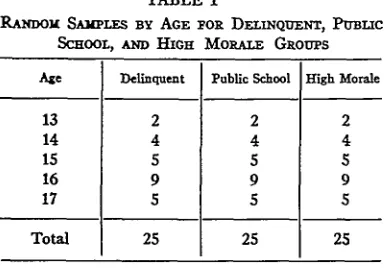
TABLE I
RANDOM SAMPLES BY AGE FOR DELINQUENT, PUBLIC
SCHOOL, AND IGhH MORALE GROUPS
Age Delinquent Public School High Morale
13 2 2 2
14 4 4 4
15 5 5 5
16 9 9 9
17 5 5 5
Total 25 25 25
significant difference among the three groups as indicated by their scale scores.
Mdhodology
The Kvaraceus KD Verbal Proneness Scale was administered by a high school guidance counsellor in three different sittings to seventy-five subjects in the public schools of an industrialized com-munity in north-western Ohio. These three groups comprised juvenile delinquent, public school, and high morale white male subjects. There were twenty-five subjects in each of the three groups. All of the subjects were selected randomly and matched according to age, race, sex, religion, intelligent quotients, socio-economic level, non-broken home, and education of parents.
The juvenile delinquent group was comprised of boys who had a juvenile court record for any reason other than being a dependent of a parent charged with neglect or being a traffic offender. The public school group was comprised of boys who had no court record other than being a traffic offender or being a dependent of a parent charged with neglect. The high morale group was comprised of boys who were rated superior in school citizenship, worked up to capacity although not necessarily on the honor roll, and who were exceptionally well thought of by all their teachers. As previously stated, the juvenile delinquent group served as the experimental group and the public school and high morale groups served as controls. A positive score on the scale indicated proneness towards delinquent behavior and a negative score indicated non-proneness towards delinquent behavior.
Results
Table II shows the distribution of scale scores for both the experimental and control groups. The distribution profile shows that the two control
TABLE H
DISRIBUTON OF ScALE ScoREs FOR WHITE MALE DEINQUENT AND WHITE MALE
NON-DEiNQUENT GROUPS ON THE KD PRoNENESS ScALE
Total Scale Score Delinquent Public High Morale Boys School Boys Boys
21- 23
18- 20 1
15- 17
12- 14 2
9- 11
6- 8 1
3- 5 2
0- 2
-3- -1 2 3
-6- -4 4 6 1
-9- -7 5 3 3
-12--10 4 3
-15--13 3 5 7
-18--16 1 4 4
-21--19 5
-24---22 1 4
-27--25
-30--28 1
N=25 N=25 N=25
groups, namely public school and high morale subjects, achieved negative scale scores while ihe experimental or delinquent group shows that six subjects or twenty-four per cent of the total achieved positive scale scores. Stating it in another way, approximately seventy-six per cent of the delinquent subjects achieved scale scores indicat-ing non-proneness towards delinquent behavior.
Table III shows the mean, median, quartiles
three and one, standard deviation and the stand-ard error of the means. In comparing the means of
the delinquent group with the means obtained for the KvaraceusO and Balogh and Rumage4 studies, one finds negative means for both this and the Balogh and Rumage studies, while the
Kvaraceus report shows a positive mean scale score. As can be seen, the means for all three groups are negative. This same observation holds for the
Balogh and Rumage study. However, the Kvara-ceus report shows negative means for the control groups only. It would appear that the means ob-tained for the two control groups in the three
3 BALOGH & RUMAGE, op. cit. supra note 1, at 18.
4 Ibid.
[image:6.505.27.220.97.232.2]REPORTS AND ANNOUNCEMENTS
TABLE fI
STATISTICAL PROCEDURES FOR DELINQUENT, PUBLIC SCHOOL, AND HIGH MORALE GRouPs
Statistical Procedures
Group
Mean Median Quartile 3 Quartile 1 Standard Standard Error Deviation of Mean
Delinquent -4:28 -7.8 -1.86 -11.82 16.70 3.4
Public School -10.16 -11.6 -6.22 -15.75 5.67 1.15
High Morale -16.64 -17.61 -13.46 -21.75 4.58 .93
TABLE IV
STANDARD ERROR OF THE DIFFERENCE BETWEEN THE MEANS Am) t-TEsTs FOR DELINQUENT, PUBLIC
SCHOOL, AND HIGH MORALE GRowps Statistical Procedures Groups t-Tests
dM
t P
Delinquent and Public 3.6 1.63 .11
School
Delinquent and High 3.3 3.75 .01 > < .02 Morale
Public School and High 1.5 4.32 .001
Morale
studies indicate some degree of prediction in the desired direction. In other words, the Kvaraceus Scale appears to discriminate significantly for both public school and high morale subjects. This re-port also shows that all of the Q3s are negative but the Kvaraceus and Balogh and Rumage studies show plus Q3s for the delinquent group. Upon further examination of Table III, the sigma for the delinquent group is 16.70; for the public school group, 5.67; and for the high morale group, 4.58. The standard error of the mean for the ex-perimental group is 3.4; for the public school group,
1.15; and for the high morale group, .93.
Table IV shows that the standard error of the difference between the means for the delinquent and public school groups is 3.6; for the delinquent and high morale groups, 3.3; and for the public school and high morale groups, 1.5. The t for the delinquent and public school groups is 1.63 with a P < .11; the t for the delinquent and high morale groups is 3.75 with a P > .01 < .02; and the t for the public school and high morale groups is 4.32, with a P < .001. The null hypothesis is re-jected for both the delinquent and high morale
and the public school and high morale groups at well beyond the accepted .05 confidence level; however, the null hypothesis is accepted for the delinquent and public school groups.
Summary
1. Although statistical significance was attained for both the delinquent and public school as well as the delinquent and high morale groups, generali-zations cannot be made beyond the scope of this study.
2. Results in both this and the Balogh and Ru-mage studies show that quite a few delinquent subjects achieved negative scale scores. This fact would tend to raise some questions regarding the validity of the Kvaraceus KD Proneness Scale.
3. Although all three studies are in general agreement as far as the public school and high morale groups are concerned, the present report tehds to corroborate more nearly the findings of the Balogh and Rumage study with respect to the experimental or delinquent group.5
JOSEPH K. BALoGH*
Bowling Green State University Bowling Green, Ohio
Harney Criticizes Cantor Narcotics Article-An article by Donald J. Cantor entitled The Criminal
Law and the Narcotics Problem appeared in the
January-February, 1961, issue of the Journal (Vol. 51, No. 5, pp. 512-27). The Journal has re-ceived the following letter from Malachi L.
6 For other writing in this area, see Balogh, Jun/ile Ddinquency Proneess: A Shudy of Predice Factors Involved in Ddinqrnt Phenomena, 48 J. C am L., C. &
P.S. 615 (1958), and BArOGH, A SuRv-zY or JuvEN LE
DELINQUENCY IN HII.SDALE COUNTY, MICHIGAN, iot
THE YEARS 1935-1950: A COMPARATIVE STUDY (1952).
* This study was supported by a grant from the Scholarly Advancement Committee of Bowling Green
REPORTS AND ANNOUNCEMENTS
Harney* of Washington, D.C., criticizing certain portions of the article:
"I have read Mr. Cantor's article with a great deal of interest.
"Mr. Cantor makes an extended summary of our criminal narcotic laws. A specialist in the field might note some small omissions and that some of the information is outdated. Certainly one might disagree with Mr. Cantor's interpretation of the impact of some court decisions. Nevertheless, the author has done the good and comprehensive job to be expected of one learned in the law. A strange note of carping at the Bureau of Narcotics adds nothing to the summary.
"However, when Mr. Cantor ventures to advise us on the problem of narcotic addiction in the United States he goes astray and, in my impression, into unfamiliar territory.
"To lead us up to his recommendation that we open some sort of narcotic feeding station for addicts he seeks to prove the present punitive program (which also includes the finest narcotic hospitals in the world) has failed. Those of us with access to the facts are convinced that there has been a great overall reduction of opiate addiction in this country. (There should be no confusion. These figures refer to opiate addiction only.) All of the available evidence indicates that country-wide opiate addiction has been reduced from an incidence of about I in 400 to about 1 in 4,000 and the daily intake per addict reduced almost in that proportion also. This has been accomplished since the enactment of the Harrison Law. Every indi-cium supports that claim. Numerous surveys, the contemporary files day to day and year to year since the beginning of Federal narcotic law en-forcement, the amount of drugs legally imported before law enforcement began, the size and num-ber of seizures of narcotics from year to year, the price and dilution of illicit drugs on the market, the relative rate of military draft rejectees for addiction for World War I as compared to World War II, the admission figures of the United States narcotic hospitals, and many similar signs point invariably in one direction. Of course there was a resurgence of addiction post-World War II, but it never approached original levels. Since the enactment of the Boggs Act, the Bureau of
Nar-* Mr. Harney formerly held the positions of Superin-tendent, Illinois Division of Narcotic Control; Assistant to the U. S. Commissioner of Narcotics; and Assistant to Secretary, U. S. Treasury, for Law Enforcement.-EDITOR.
cotics has closed more than 50 field offices for lack of 'business.' Of course this is small comfort to the few special communities where there is still concentrated our addiction evil. But the fact certainly suggests that we go slow in modifying something which has held the line so well. Let those who say there are serious omissions in the Federal Bureau of Narcotics addiction count produce some evidence. No police statistics of this type can be absolute but it has amazed some people making independent checks to find how inclusive the Bureau files are of addict names which they had obtained independently.
"Mr. Cantor proceeds to argue, apparently seriously, that punitive measures do not deter. Not only does he impeach much of the basis for our criminal codes, but he does this in an atmos-phere where we are spending around 40 billion for defense based on the theory that the threat of retaliation may be deterrent. The threat of the firing squad permits a few 'goons' to turn the fine people of Cuba against their best friend.
"Unreal, in my opinion, is Mr. Cantor's reason-ing that because Red China helps supply. our addiction with drugs we should accommodatingly roll over dead and proceed to poison our own people. Carried to its logical conclusion, this would presuppose that we not wait for Krushchev's conquest .of our grandchildren, but should now invite Chou En-lai into the parlor.
"We should never overlook the simple fact that 'legally' supplying drugs to addicts is nothing but a euphemism for substituting a state instrumen-tality for the dope peddler. This is so axiomatic that ordinarily it would require no discussion. However, the situation has been completely con-fused by the constant repetition that some such operation actually works in Britain toward curing addiction. This myth persists despite the fact that British officialdom has characterized it as an 'invention of certain Americans.' In British Hong Kong about I out of every 12 persons is a narcotic addict.
"Instead of abandoning hard-won gains, we need to hew to the line and to supplement our al-ready extensive efforts by some additional concen-tration on taking the addict off the street to give him the benefit of whatever medicine and con-structive social work can do to rehabilitate him."
In reply, Mr. Cantor offers the following com-ments:
REPORTS AND ANNOUNCEMENTS
"Mr. Harney apparently reads my article as being an argument that 'punitive measures do not deter.' This is false. The last section of my article made it abundantly clear that I favored the re-tention of strict penalties against all those who deal in the illicit narcotics traffic with the sole exceptions of persons who are addicted to opiates. My article is not an argument against punish-ments or their effects; it simply states what should be obvious-that punishments cannot be effective deterrents against persons who are not rational. The addict is not a rational person when under the compulsions of his craving; he, therefore, cannot be deterred by punitive legislation.
"Mr. Harney's summation of the British ex-perience in narcotics seems to me to be frivolous. His implied assertion that the British experiment has not work is backed up by nothing other than his statement that this is so. It need hardly be said that there is much authority to the contrary. Moreover, statistics for Hong Kong are hardly relevant.
"As far as Mr. Harney's general contention to the effect that the present punitive legislation has been proven to have worked, I can only repeat what I said in my article-no one really knows how effective it has been.VWe do know, and Mr. Harney does not deny it, that the problem is still very much alive. He seems to think that a solution which has not been able to reduce the problem to negligi-ble proportions after more than 40 years should nonetheless not be questioned. I differ and I do do so because it seems to me that the problem can never be solved or even largely solved until such time as the addict is removed from the illicit narcotics market.
"As to Mr. Harney's remarks about Communist China, they simply are not responsive to my article. The fact that Communist China figures in the narcotics traffic, of course, does not require us to 'accommodatingly roll over dead.' But the fact that they are a large supplier reflects greatly on the ability of our law to deter persons who supply our native market with drugs. It is simply another factor which reflects upon the inability of our
de-terrent legislation to stop the narcotics trade."
New Clearing House Announced for Cuirent Research and Practical Projects to Control Crime and to Prevent Juvenile Delinquency-The Na-tional Council on Crime and Delinquency recently released the following announcement:
"The National Research and Information Center on Crime and Delinquency of the National Council on Crime and Delinquency which was recently established as an idea center in the field with grants from the Rockefeller Brothers Fund and the National Institute for Mental Health of the Department of Health, Education, and Wel-fare, will act as a clearing house for current pro-jects on adult crime and juvenile delinquency. The Center is located at 44 E. 23rd Street, New York 10, N. Y.
"At the present time, it is practically impossible for anyone to get a full picture of what is going on in all phases of treatment, prevention and control of crime and delinquency, according to a recent informal survey undertaken by the Council among researchers and practitioners. Indications are that significant materials are frequently neglected because they are scattered in more than 225 periodicals. Many studies remain unpublished. Numerous practical innovations and develop-ments are never described. Problems are not drawn to the attention of those responsible. The results of all these handicaps are needless duplica-tion, poor communications, wasted efforts, planned attacks on the problems, adoption of un-productive programs and invaluable materials lying fallow.
"The National Research and Information Center on Crime and Delinquency will collect and dis-seminate information not only on research in the strict sense, but also on all kinds of programs in institutions and services, experiments, innovations, developments and demonstrations. Dr. Hyman H. Frankel, Director of the Center, needs information on projects that are underway, unpublished, or published in places where they may escape the full attention of those interested in the preven-tion, control and treatment of crime and delin-quency. Communication should be directed to the Center."