http://www.scirp.org/journal/ojdm ISSN Online: 2161-7643 ISSN Print: 2161-7635
On the 2-Domination Number of Complete Grid
Graphs
Ramy Shaheen, Suhail Mahfud, Khames Almanea
Department of Mathematics, Faculty of Science, Tishreen University, Lattakia, Syria
Abstract
A set D of vertices of a graph G = (V, E) is called k-dominating if every vertex v V∈ −D is adjacent to some k vertices of D. The k-domination number of a graph G, γk
( )
G , is the order of a smallest k-dominating set of G. In this paper we calculate the k-domination number (for k = 2) of the product of two paths Pm × Pnfor m = 1, 2, 3, 4, 5 and arbitrary n. These results were shown an error in the paper
[1].
Keywords
k-Dominating Set, k-Domination Number, 2-Dominating Set, 2-Domination Number, Cartesian Product Graphs, Paths
1. Introduction
Let G=
(
V E,)
be a graph. A subset of vertices D⊆V is called a 2-dominating set ofG if for every v V∈ , either v∈D or v is adjacent to at least two vertices of D. The 2-domination number γ2
( )
G is equal to min{
D D: is a 2−dominating set of G}
.The Cartesian product G × H of two graphs G and H is the graph with vertex set
(
)
( )
( )
V G×H =V G ×V H , where two vertices
(
v v1, 2)
,(
u u1, 2)
∈ ×G H are adjacentif and only if either v u1 1∈E G
( )
and v2=u2 or v u2 2∈E H( )
and v1=u1.Let G be a path of order n with vertex set V G
( ) {
= 1, 2,,n}
. Then for two paths oforder m and n respectively, we have Pm×Pn =
{
( )
i j, :1≤ ≤i m,1≤ ≤j n}
. The jth col-umn of Pm×Pn is Kj={
( )
i j, :i=1,,m}
. If D is a 2-dominating set for Pm×Pn,then we put Wj= ∩D Kj. Let sj=Wj . The sequence
(
s s1, 2,,sn)
is called a 2-dominating sequence corresponding to D. For a graph G, we refer to minimum and maximum degrees by δ( )
G and ∆( )
G , and for simplicity denoted those by δ and Δ,respectively. Also, we denote by V and E to order and size of graph G,
respec-tively.
How to cite this paper: Shaheen, R., Mah- fud, S. and Almanea, K. (2017) On the 2-Domination Number of Complete Grid Graphs. Open Journal of Discrete Mathe-matics, 7, 32-50.
http://dx.doi.org/10.4236/ojdm.2017.71004
Received: November 22, 2016 Accepted: January 20, 2017 Published: January 23, 2017
Copyright © 2017 by authors and Scientific Research Publishing Inc. This work is licensed under the Creative Commons Attribution International License (CC BY 4.0).
2. Notation and Terminology
Fink and Jacobson [2][3] in 1985 to introduced the concept of multiple domination. A subset D⊆V is k-dominating in G if every vertex of V–D has at least k neighbors in D. The cardinality of a minimum k-dominating set is called the k-domination num-ber γk
( )
G of G. Clearly, g G1( )
=g G( )
. Naturally, every k-dominating set of a graphG contains all vertices of degree less than k. Of course, every
(
k+1)
-dominating set isalso a k-dominating set and so γk
( )
G ≤γk+1( )
G . Moreover, the vertex set V is the only(
∆ +1)
-dominating set but evidently it is not a minimum ∆-dominating set. Thusevery graph G satisfies
( )
1( )
( )
1( )
k G k G G G V
γ ≤γ + ≤≤γ∆ <γ∆+ = .
For a comprehensive treatment of domination in graphs, see the monographs by Haynes et al. [4]. Also, for more information see [5][6]. Fink and Jacobson [2], intro-duced the following theorems:
Theorem 2.1 [2]. If k≥2, is an integer and G is a graph with k≤ ∆
( )
G , then( )
( )
2k G G k
γ ≥γ + − .
Theorem 2.2 [2]. If T is a tree, then 2
( )
1 2 T T
γ ≥ + .
In [6], Hansberg and Volkmann, proved the following theorem.
Theorem 2.4 [6]. Let G=
(
V E,)
be a graph of order n and minimum degree δ andlet k∈N. If
(
1)
2ln 1 k
δ δ
+ ≥
+ , then
( )
(
)
(
)
1
1 0
ln 1
1 ! 1
i k
k k
i V
G k
i δ
γ δ
δ δ
−
− =
≤ + +
+
∑
+ .Cockayne, et al. [7], established an upper bound for the k-domination number of a graph G has minimum degree k, they gave the following result.
Theorem 2.3 [7]. Let G be a graph with minimum degree at least k, then
( ) ( )
1 kk V G
k
γ ≤
+ .
Blidia, et al. [8], studied the k-domination number. They introduced the following results.
Theorem 2.5 [8]. Let G be a bipartite graph and S is the set of all vertices of degree at most k– 1, then
( )
2 k
V S
G
γ ≤ + .
Favaron, et al. [9], gave new upper bounds of γk
( )
G .Corollary 2.6 [9]. Let G be a graph of order n and minimum degree δ. If k≤δ is
an integer, then
( )
.2 1
k G V
k δ γ
δ
≤
+ −
In [4], Haynes et al. showed that the 2-domination number is bounded from below by the total domination number for every nontrivial tree.
Theorem 2.7 [4]. For every nontrivial tree, γ2
( )
T ≥γt( )
T . Also, Volkmann [10] gave the important following result.Theorem 2.8 [10]. Let G be a graph with minimum degree δ ≥ +k 1, then
( )
( )
1 .
2 k k
V G
G γ
γ + ≤ +
an upper and lower bounds. Also, in [12], he introduced the following results. Theorem 2.9 [12].
1) γ2
( )
Cn = n2.2) γ2
(
C3×Cn)
=n n: ≡0 mod 3(
)
,(
)
(
)
2 C3 Cn n 1:n 1, 2 mod 3
γ × = + ≡ .
3) γ2
(
C4×Cn)
= +n n 2 : n≡0, 3, 5 mod 8(
)
,(
)
(
)
2 C4 Cn n n 2 1:n 1, 2, 4, 6, 7 mod14
γ × = + + ≡ .
4) γ2
(
C5×Cn)
=2n.5) γ2
(
C6×Cn)
=2 :n n≡0 mod 3(
)
,(
)
(
)
2 C6 Cn 2n 2 :n 1, 2 mod 3
γ × = + ≡ .
6) γ2
(
C7×Cn)
=5n2 : n≡0, 3,11 mod14(
)
,(
)
(
)
2 C7 Cn 5n2 1:n 5, 6, 7, 8, 9,10 mod14
γ × = + ≡ ,
(
)
(
)
2 C7 Cn 5n 2 2 :n 1, 2, 4,12,13 mod14
γ × = + ≡ .
In this paper we calculate the k-domination number (for k = 2) of the product of two paths Pm×Pn for m = 1, 2, 3, 4, 5 and arbitrary n. These results were shown an error
in the paper [1]. We believe that these results were wrong. In our paper we will provide improved and corrected her, especially for m = 3, 4, 5.
The following formulas appeared in [1],
( ) (
)
(
)
(
)
(
)
2 Pn n 1 2 2 P2 Pn n 2 P3 Pn 2n n 2 2 P4 Pn 2 .n
γ = + ⋅γ × = ⋅γ × = − ⋅γ × =
(
)
(
) (
)
2 P5 Pn 3n n2 2 P2k1 Pn k 1 n n2 .
γ × = − ⋅γ + × = + −
(
)
(
)
(
)
(
)
2
2
2 2 : 1 mod 2 ,
2 : 0 mod 2 .
m n
m n
P P m n n m
P P m n m
γ γ
× = − ≡
× = ≡
In this paper, we correct the results in [1] and proves the following:
( ) (
)
(
)
(
)
2 Pn n 1 2 2 P2 Pn n 2 P3 Pn n n 3 .
γ = + ⋅γ × = ⋅γ × = +
(
)
(
)
(
)
(
)
2 4
2 4
2 4 : 3, 7 mod 8 ,
2 4 1: 0,1, 2, 4, 5, 6 mod 8 .
n
n
P P n n n
P P n n n
γ γ
× = − ≡
× = − + ≡
(
)
(
)
(
)
(
)
2 5
2 5
2 7 : 1, 2, 3, 5 mod 7 ,
2 7 1: 0, 4, 6 mod 7 .
n
n
P P n n n
P P n n n
γ γ
× = + ≡
× = + + ≡
3. Main Results
Our main results here are to establish the domination number of Cartesian product of two paths Pm and Pn for m = 1, 2, 3, 4, 5 and arbitrary n. We study 2-dominating
sets in complete grid graphs using one technique: by given a minimum of upper 2-dominating set D of Pm×Pn and then we establish that D is a minimum 2-domi-
nating set of Pm×Pn for several values of m and arbitrary n. Definitely we have
(
)
2 Pm Pn D
γ × = .
Let G be a path of order n with vertex set V G
( ) {
= 1, 2,,n}
. For two paths of orderm and n respectively is:
( )
{
, :1 ,1}
m n
P ×P = i j ≤ ≤i m ≤ ≤j n . The jth column Pm×Pn is
( )
{
, : 1, ,}
j
K = i j i= m .
sequence
(
s s1, 2,,sn)
is called a 2-dominating sequence corresponding to D. Always we have s s1, n≥ m 3. Suppose that sj =0 for some j (where j ≠ 1 or n). Thevertic-es of the jth column can only be 2-dominated by verticvertic-es of the (j − 1)st columns and (j + 1)st columns. Thus we have sj−1+sj+1=2m, then sj−1=sj+1=m. In general
1 4 1 2
j j j
s− + s +s+ ≥ m.
Notice 3.1.
1) The study of 2-dominating sequence
(
s s1, 2,,sn)
is the same as the study of the 2-dominating sequence(
s sn, n−1,,s1)
.2) If subsequence
(
s sj, j+1,,sj k+)
is not possible, then its reverse(
sj k+ ,,sj+1,sj)
is not possible.3) We say that two subsequences
(
sj,,sj q+) (
, sj q+ +1,,sj r+)
are equivalent, if the sequence(
sj,,sj q+ ,sj q+ +1,,sj r+)
is possible.We need the useful following lemma.
Lemma 3.1. There is a minimum 2-dominating set for Pm×Pn with 2-dominating
sequence
(
s s1, 2−,,sn)
such that, for all j=1, 2,,n, is m 4≤sj≤3m 4. Proof. Let D be a minimum 2-dominating set for Pm×Pn with 2-dominatingse-quence
(
s s1, 2−,,sn)
. Assume that for some j, sj is large. Then we modify D by mov-ing two vertices from column j, one to column j − 1 and another one to column j + 1, such that the resulting set is still 2-dominating set for Pm×Pn. For 1≤ ≤i m and 1≤ ≤j n, let W = ∩D{
( ) (
i j, , i+1,j) (
, i+2,j) (
, i+3,j)
}
. If W =4, then we define(
) ( ) (
{
) (
) (
)
}
1 – , , 1, 1 , 2, 1 , 3,
D = D W ∪ i j i+ j− i+ j+ i+ j , see Figure 1. We repeat this
process if necessary eventually leads to a 2-dominating set with required properties. Also, we get D1 is a 2-dominating set for Pm×Pn with D = D1. Thus, we can assume
that every four consecutive vertices of the jth column include at most three vertices of D. This implies that sj≤ 3m 4, for all 1 ≤ j ≤ n.
To prove the lower bound, we suppose that Kj∩D is be a maximum, i.e.,
3 4
j
s = m . Then for each
( )
i j, ∉D, we have(
) (
) (
)
{
i−1,j+1 , ,i j+1 , i+1,j+1}
∩D ≥1. When sj= 3m 4, there at must3 4 4
m− m = m vertices does not in Kj∩D. This implies that sj+1≥ m 4. So,
the same as for sj−1≥ m 4. □
By Lemma 3.1, always we have a minimum 2-dominating set D with 2-dominating sequence
(
s s1, 2,,sn)
, such that m 4≤sj≤3m 4, for all j=1, 2,,n.Lemma 3.2. 2
( )
1 2
n
n P
γ = +
.
Proof. Let
(
2 1 ;1)
2 n D= k− ≤ ≤k
.
We have D is a 2-dominating set of Pn for n≡1 mod 2
(
)
with 1 2 n D = + , also
( )
{ }
D∪ n is a 2-dominating set of Pn for n≡0 mod 2
(
)
with{ }
( )
1 2 n D∪ n = + . Let D1 be a minimum 2-dominating set for Pn with V P
( ) {
n = x x1, 2,,xn}
. Since( )
1 n n
x x ∉E P , we need to x x1, n∈D1, also if xj∉D1 then xj−1,xj+1 are belong to D1,
this implies that x2j−1∈D1 for 2
2 n j
≤ ≤ . Thus implies that
1
1
2 1
2 2
n n
D ≥ + − = +
. We result that 2
( )
1 2
n
n P
γ = +
. □
Theorem 3.1. γ2
(
P2×Pn)
=n.Proof. Let a set
(
1, 2 1 :1)
(
2, 2)
:12 2
n n
D= k− ≤ ≤k ∪ k ≤ ≤k
.
It is clear that D =n. (1)
We can check that D is 2-dominating set for P2×Pn, see Figure 2. Let D1 be a minimum
2-dominating set for P2×Pn with dominating sequence
(
s1,,sn)
. If si ≥1 for all1, ,
j= n, then 1 1
n
j j
D s n
=
=
∑
≥ . (2)Let sj =0 for some j, then sj−1=sj+1=2, also we have s1≥1 and sn≥1. Now we define a new sequence
(
s1′,,sn′)
, (not necessarily a 2-dominating sequence) asfollows:
For sj=2, if j=1 or n, we put s′ =j sj – 1, s2′ =s2+1 2 and sn′ =−1 sn−1+1 2.
If j≠1 or n, we put s′ =j sj – 1, s′ =j−1 sj−1+1 2 and s′ =j+1 sj+1+1 2. Otherwise s′ =j sj.
We get a sequence
(
s1′,,sn′)
have property that each s′ ≥j 1 with1 1
n n
j j
j j
D s s n
= =
′
=
∑
=∑
≥ . (3)By (1), (2) and (3) is γ2
(
P2×Pn)
=n. This completes the proof of the theorem. □Theorem 3.2. 2
(
3)
3
n
n
P P n
γ × = +
.
Proof. Let
(
)
(
)
(
) (
)
2, 3 2 :1 2, 3 :1
3 3
1
1, 3 1 , 3, 3 1 :1
3
n n
D k k k k
n
k k k
= − ≤ ≤ ∪ ≤ ≤
−
∪ − − ≤ ≤
[image:5.595.189.552.94.343.2] [image:5.595.199.547.410.719.2].
(
) (
)
(
)
(
)
1
1, 3 2 , 3, 3 2 :1 2, 3 1 :1
3 3
2, 3 :1
3
n n
D k k k k k
n
k k
−
′ = − − ≤ ≤ ∪ − ≤ ≤
∪ ≤ ≤
.
We have
3 n D = + n
and 3
n D′ = + n
. (4) By definition D and D′ we note that
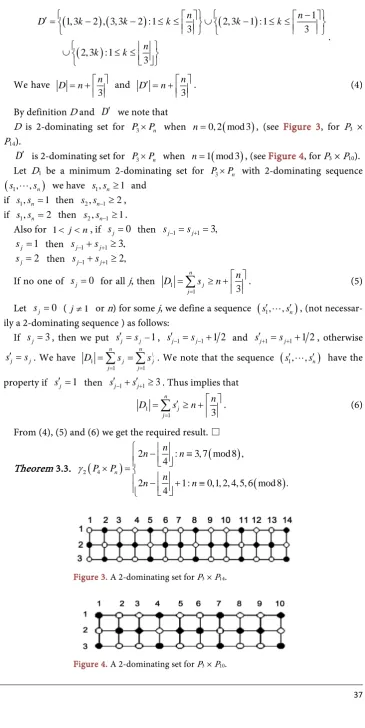
D is 2-dominating set for P3×Pn when n=0, 2 mod 3
(
)
, (see Figure 3, for P3 ×P14).
D′ is 2-dominating set for P3×Pn when n=1 mod 3
(
)
, (see Figure 4, for P3 × P10).Let D1 be a minimum 2-dominating set for P3×Pn with 2-dominating sequence
(
s1,,sn)
we have s s1, n≥1 andif s s1, n=1 then s s2, n−1≥2,
if s s1, n=2 then s s2, n−1≥1.
Also for 1< <j n, if sj =0 then sj−1=sj+1=3, 1
j
s = then sj−1+sj+1≥3, 2
j
s = then sj−1+sj+1≥2,
If no one of sj =0 for all j, then 1
1 3
n
j j
n
D s n
=
= ≥ +
∑
. (5)Let sj =0 ( j≠1 or n) for some j, we define a sequence
(
s1′,,sn′)
, (not necessar-ily a 2-dominating sequence ) as follows:If sj =3, then we put s′ =j sj – 1, s′ =j−1 sj−1+1 2 and s′ =j+1 sj+1+1 2, otherwise
j j
s′ =s . We have \
1
1 1
n n
j j
j j
D s s
= =
=
∑
=∑
. We note that the sequence(
s1′,,sn′)
have theproperty if s′ =j 1 then s′j−1+s′j+1≥3. Thus implies that
1
1 3
n
j j
n
D s n
=
′
= ≥ +
∑
. (6)From (4), (5) and (6) we get the required result. □
Theorem 3.3.
(
)
(
)
(
)
2 4
2 : 3, 7 mod 8 ,
4
2 1: 0,1, 2, 4, 5, 6 mod 8 .
4 n
n
n n
P P
n
n n
γ
− ≡
× =
− + ≡
[image:6.595.189.555.64.793.2]Figure 3. A 2-dominating set for P3 × P14.
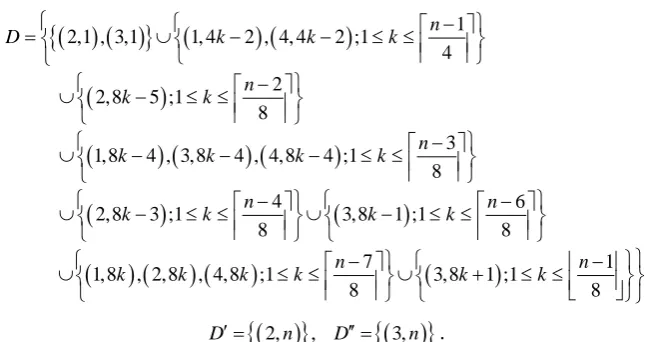
Proof. Let a set D defined as follows:
( ) ( )
{
}
(
) (
)
(
)
(
) (
) (
)
(
)
(
)
1
2,1 , 3,1 1, 4 2 , 4, 4 2 ;1
4
2
2,8 5 ;1
8
3
1,8 4 , 3,8 4 , 4,8 4 ;1
8
4 6
2,8 3 ;1 3,8 1 ;1
8 8
n
D k k k
n
k k
n
k k k k
n n
k k k k
−
= ∪ − − ≤ ≤
−
∪ − ≤ ≤
−
∪ − − − ≤ ≤
− −
∪ − ≤ ≤ ∪ − ≤ ≤
(
) (
) (
)
7(
)
11,8 , 2,8 , 4,8 ;1 3,8 1 ;1
8 8
n n
k k k k k k
− −
∪ ≤ ≤ ∪ + ≤ ≤
( )
{
2,}
,{
( )
3,}
D′= n D′′= n .
We can check that the following sets are 2-dominating set for P4×Pn (see Figure 5,
for P4×P11) as indicated:
D is 2-dominating set for P4×Pn when n≡0, 4 mod 8
(
)
.D∪D′ is 2-dominating set for P4×Pn when n≡1, 2, 7 mod 8
(
)
.D∪D′′ is 2-dominating set for P4×Pn when n≡3, 5, 6 mod 8
(
)
.We have
(
)
(
)
(
)
2 1: 3, 7 mod 8 ,
4
2 : 1, 2, 5, 6 mod 8 , 4
2 1: 0, 4 mod 8 .
4 n
n n
n
D n n
n
n n
− − ≡
= − ≡
− + ≡
Let D1 be a minimum 2-dominating set for P4×Pn with 2-dominating sequence
(
s1,,sn)
we shall show that(
)
(
)
1
2 : 3, 7 mod 8 ,
4
2 1: 0,1, 2, 4, 5, 6 mod 8 .
4 n
n n
D
n
n n
− ≡
=
− + ≡
By Lemma 3.1, we have 1≤sj≤3. Thus If sj =1 then sj−1+sj+1≥5.
If sj=2 then sj−1+sj+1≥2. If sj =3 then sj−1+sj+1≥2.
[image:7.595.210.536.87.258.2]Also, we have s s1, n≥2. If s s1, n=2 then s s2, n−1≥2, and if s s1, n=3 then
2, n1 1
s s− ≥ .
We define a new set D1′ with sequence
(
s1′,,sn′)
, (not necessarily a 2-dominatingsequence) as follows: if sj ≥2, let 7
4
j j
M =s − . Now, for j=2 to j= −n 1, if
2 j
s ≥ , then we put
j j j
s′ = −s M , 1 1
2 j
j j
M
s′ =− s− + and 1 1
2 j
j j
M s′ =+ s+ +
Thus, for 3≤ ≤ −j n 2, we have 7
4 j
s ≥ . Since if sj ≥2 then 7 4 j
s′ ≥ and if
1 j
s = , then sj−1+sj+1=5 this implies that 1 1
14 6
5
4 4
j j
M − +M + = − = , which implies
that 1 1 3 7
1 .
2 2 4 4
j j
j j
M M
s′ = +s − + + = + =
We have three cases:
Case 1: s s1, n≥2, then s s2, n−1≥2, these implies that 1 1
1 8
s′ ≥ +s and 1
8
n n
s′ ≥ +s also
(
)
1
1 1
1 1 2
7 2
1 1 7 3
2 2
8 8 4 4 4
n n n
j j n j
j j j
n n
D s s s s s
−
= = =
−
′ ′ ′ ′
=
∑
=∑
= + +∑
≥ + + + + = + .Case 2: s s1, n =3 then s s2, n−1≥2. Thus implies that s s1′ ′ =, n 3 and
2 1
1
, 1 .
8 n
s s′ ′ ≥ +− Then
2
1 1 2 1
1 1 2
1 1 7 7 5
3 1 3 1
8 8 4 4 4
n n n
j j n n j
j j j
n
D s s s s s s s
−
−
= = =
′ ′ ′ ′ ′ ′
=
∑
=∑
= + + + +∑
≥ + + + + + + = +Case 3: s1=2, 3sn = and s2≥2, sn−1≥1 or s1=3, sn=2 and s2≥1, 2sn−1≥ .
Two cases are similar by symmetry. We consider the first case:
1 2, 22
s = s ≥ and sn =3, 1sn−1≥ , this implies that
1 2 1
1 7 1
2 , , 3, 1
8 4 n n 8
s′= + s′= s′ = s′− = + and
(
)
2
1 1 2 1
1 1 3
1 7 1 7 7
2 3 1 4 1
8 4 8 4 4
n n n
j j n n j
j j j
n
D s s s s s s s n
−
−
= = =
′ ′ ′ ′ ′ ′
=
∑
=∑
= + + + +∑
≥ + + + + + + − = +But, we have the 2-domination number is positive integer number, also we have
7 3
2
4 4 4
n n
n− = +
for n≡3, 7 mod 8
(
)
,(
)
(
)
(
)
7
1 For 0, 4 mod 8 ,
4
7 5
2 1 For 1, 5 mod 8 ,
4 4 4
7 6
For 2, 6 mod 8 ,
4 4
n
n
n n
n n
n
n
+ ≡
− + = + ≡
+ ≡
Thus implies that
(
)
(
)
1
2 ; 3, 7 mod 8 ,
4
2 1; 0,1, 2, 4, 5, 6 mod 8 ,
4 n
n n
D
n
n n
− ≡
≥
− + ≡
Finally, we get
(
)
(
)
(
)
(
)
2 4
2 4
2 : 3, 7 mod 8 ,
4
2 1: 0,1, 2, 4, 5, 6 mod 8 , 4
n
n
n
P P n n
n
P P n n
γ
γ
× = − ≡
× = − + ≡
This complete the proof of the theorem. □
Theorem 3.4.
(
)
(
)
(
)
2 5
2 : 1, 2, 3, 5 mod 7 ,
7
2 1: 0, 4, 6 mod 7 .
7 n
n
n n
P P
n
n n
γ
+ ≡
× =
+ + ≡
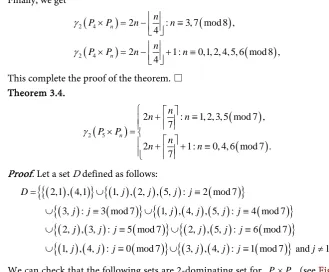
Proof. Let a set D defined as follows:
( ) ( )
{
}
{
( ) ( ) ( )
(
)
}
{
( )
(
)
{
}
{
( ) ( ) ( )
(
)
}
( ) ( )
(
)
{
}
{
( ) ( )
(
)
}
( ) ( )
(
)
{
}
{
( ) ( )
(
)
}
}
2,1 , 4,1 1, , 2, , 5, : 2 mod 7
3, : 3 mod 7 1, , 4, , 5, : 4 mod 7
2, , 3, : 5 mod 7 2, , 5, : 6 mod 7
1, , 4, : 0 mod 7 3, , 4, : 1 mod 7 and 1
D j j j j
j j j j j j
j j j j j j
j j j j j j j
= ∪ ≡
∪ ≡ ∪ ≡
∪ ≡ ∪ ≡
∪ ≡ ∪ ≡ ≠
We can check that the following sets are 2-dominating set for P5×Pn (see Figure 6,
for P5×P23) as indicated:
{
}
{
}
{
( ) ( ) ( )
}
(
)
( )
{
}
(
)
(
)
{
}
{
}
{
( ) ( )
}
(
)
{
}
{
}
{
( ) ( ) ( )
}
(
)
2, , 3, , 5, : 1 mod 7 .
2, : 0, 4 mod 7 .
: 2 mod 7 .
2, , 4, : 3, 5 mod 7 .
1, , 3, , 5, : 6 mod 7 .
n
n
n
D K D n n n n
D n n
D n
D K D n n n
D K D n n n n
− ∩ ∪ ≡
∪ ≡
≡
− ∩ ∪ ≡
− ∩ ∪ ≡
We have 2
7 n D≤ n+
and
(
)
(
)
(
)
2 5
2 : 1, 2, 3, 5 mod 7 ,
7
2 1: 0, 4, 6 mod 7 .
7 n
n
n n
P P
n
n n
γ
+ ≡
× ≤
+ + ≡
This complete the proof of the theorem. □
Lemma 3.3. The following cases are not possible: 1) (1, 2, 3, 1).
[image:9.595.195.525.80.352.2]2) (1, 2, 1). 3) (1, 4, 1, 1).
4) (1, 3, 1, 3, 1, 3). 5) (2, 1, 3). 6) (2, 2, 2, 2, 2, 2).
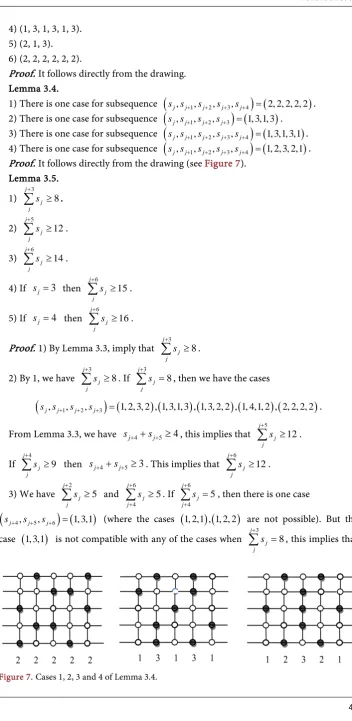
Proof. It follows directly from the drawing. Lemma 3.4.
1) There is one case for subsequence
(
s sj, j+1,sj+2,sj+3,sj+4)
=(
2, 2, 2, 2, 2)
.2) There is one case for subsequence
(
s sj, j+1,sj+2,sj+3)
=(
1, 3,1, 3)
.3) There is one case for subsequence
(
s sj, j+1,sj+2,sj+3,sj+4)
=(
1, 3,1, 3,1)
.4) There is one case for subsequence
(
s sj, j+1,sj+2,sj+3,sj+4)
=(
1, 2, 3, 2,1)
.Proof. It follows directly from the drawing (see Figure 7). Lemma 3.5.
1) 3 8
j
j j
s
+ ≥
∑
.2) 5 12
j
j j
s
+ ≥
∑
.3) 6 14
j
j j
s
+ ≥
∑
.4) If sj =3 then
6
15 j
j j
s
+ ≥
∑
.5) If sj=4 then
6
16 j
j j
s
+ ≥
∑
.Proof. 1) By Lemma 3.3, imply that 3 8
j
j j
s
+ ≥
∑
.2) By 1, we have 3 8
j
j j
s
+ ≥
∑
. If 3 8j
j j
s
+ =
∑
, then we have the cases(
s sj, j+1,sj+2,sj+3)
=(
1, 2, 3, 2 , 1, 3,1, 3 , 1, 3, 2, 2 , 1, 4,1, 2 , 2, 2, 2, 2) (
) (
) (
) (
)
.From Lemma 3.3, we have sj+4+sj+5≥4, this implies that 5
12 j
j j
s
+ ≥
∑
.If 4 9
j
j j
s
+ ≥
∑
then sj+4+sj+5≥3. This implies that 612 j
j j
s
+ ≥
∑
.3) We have 2 5
j
j j
s
+ ≥
∑
and 64
5 j
j j
s
+
+ ≥
∑
. If 64
5 j
j j
s
+
+ =
∑
, then there is one case(
sj+4,sj+5,sj+6)
=(
1, 3,1)
(where the cases(
1, 2,1 , 1, 2, 2) (
)
are not possible). But thecase
(
1, 3,1)
is not compatible with any of the cases when3
8 j
j j
s
+ =
[image:10.595.194.547.51.774.2]∑
, this implies that3
9 j
j j
s
+ ≥
∑
. Then 6 14j
j j
s
+ ≥
∑
(where the case(
1, 3,1, 3,1, 3)
is not possible). If6
4
6 j
j j
s
+
+ ≥
∑
then 6 3 64
8 6 14
j j j
j j j
j j j
s s s
+ + +
+
= + ≥ + =
∑
∑
∑
.4) We have sj ≥3, then from 2 is
6
15 j
j j
s
+ ≥
∑
.5) We have sj ≥4, then from 2 is
6
16 j
j j
s
+ ≥
∑
. This complete the proof of the Lemma. □Lemma 3.6. If 6 14
j
j j
s
+ =
∑
, then sj =1 or sj+6 =1.Proof. We suppose the contrary s sj, j+6≥2. From Lemma 3.5, s sj, j+6<3, else 6
15 j
j j
s
+ ≥
∑
. Now, we must study the case sj=sj+6=2. We have 52
10 j
j j
s
+
+ =
∑
, by Lem-ma 3.3, the case
(
2, 2, 2, 2, 2, 2)
is not possible, this implies that not all elements of thesubsequence
(
sj+1,,sj+5)
are equal to the value 2. If sj+1,sj+2,sj+3,sj+4,sj+5≥2where at least one of them is equal or greater than 3, then 6 15 j
j j
s
+ ≥
∑
, this is acontra-diction with 6 14
j
j j
s
+ =
∑
. Now, we have 5 10j
j j
s
+ =
∑
, where one of the subsequence ele-ment
(
sj+1,,sj+5)
is at most equal the value 1 (where 1≤sj ≤4). We consider thecases sj =1 for j+ ≤ ≤ +1 j j 5:
1) sj+1=1 or sj+5 =1 (where two cases are similar), we study the case sj+1=1
then sj+2=4, these implies that sj+sj+1+sj+2=7 . By Lemma 3.5, we have 6
3
8 j
j j
s
+
+ ≥
∑
then 6 15j
j j
s
+ ≥
∑
, this is a contradiction.2) sj+2=1 or sj+4=1 (where two cases are similar), we study the case sj+2=1
then sj+1≥3, (because the case
(
2, 2,1)
is not possible). If sj+1=3 then sj+3≥3and we have sj+6=2 then 5
4
4 j
j j
s
+
+ ≥
∑
(because two cases(
1, 2, 2 , 2,1, 2) (
)
are notpossible). Thus implies that 6 2 3 1 3 4 2 15
j
j j
s
+
≥ + + + + + =
∑
, this is a contradiction.3) sj+3=1, then we have two subcases results from sj+2+sj+4 ≥6:
Subcase 1: sj+2 =sj+4 =3 then sj+1,sj+5≥2 (because two cases
(
s sj, j+1,sj+2)
=(
2,1, 3)
and(
sj+4,sj+5,sj+6)
=(
3,1, 2)
are not possible). Thus impliesthat 6 15
j
j j
s
+ ≥
∑
, this is a contradiction.Subcase 2: If sj+2 =2, 4sj+4 = or conversely (two cases are similar in studying), so
we will study case sj+2=2, 4sj+4= then sj+5≥1, if sj+5≥2, then 6
15 j
j j
s
+ ≥
∑
,be-cause sj+4+sj+5+sj+6≥8, we have 3
8 j
j j
s
+ ≥
∑
. Then 6 15j
j j
s
+ ≥
∑
, this is a contradiction).If sj+5=1, then sj+4+sj+5+sj+6 =7 . We have 3
8 j
j j
s
+ ≥
6
15 j
j j
s
+ ≥
∑
this is a contradiction.Finally, we get if 6 14
j
j j
s
+ =
∑
, then sj =1 or sj+6 =1. This completely the proof. □Result 3.1. If 6 14
j
j j
s
+ =
∑
, then from Lemma 3.6, we have the cases for subsequence(
s sj, j+1,sj+2,sj+3,sj+4,sj+5,sj+6)
:(
)
(
)
(
)
(
)
(
)
(
)
(
)
(
)
(
)
1 2 3
4 5 6
7 8 9
10
: 1, 2, 3, 2,1, 4,1 , : 1, 2, 3, 2, 2, 2, 2 , : 1, 2, 3, 2, 2, 3,1 ,
: 1, 2, 3, 3,1, 3,1 , : 1, 3,1, 3,1, 4,1 , : 1, 3,1, 3, 2, 2, 2 ,
: 1, 3,1, 3, 2, 3,1 , : 1, 3,1, 3, 3, 2,1 , : 1, 3,1, 4,1, 3,1 ,
: 1, 3, 2, 2, 2, 2
a a a
a a a
a a a
a
(
)
(
)
(
)
(
)
11(
)
12(
)
13 14 15
, 2 , : 1, 3, 2, 2, 2, 3,1 , : 1, 3, 2, 2, 3, 2,1 ,
: 1, 3, 2, 3,1, 3,1 , : 1, 4,1, 2, 3, 2,1 , : 1, 4,1, 3,1, 3,1 .
a a
a a a
It is 15 cases (where sj =1 with
6
14 j
j j
s
+ =
∑
). We have three cases with sj+1=2,1 3
j
s+ = and sj+1=4.
Case 1: sj+1=2 (including the cases sj=1 and sj+1=2 or sj+6=1 and sj+5=2).
We have these cases are a a a a a a1, 2, 3, 4, 8, 12,a14 and comes before these cases, sj−1=4
or comes after these cases sj+7=4, i.e., if sj=1, 2sj+1= then sj−1=4 and if
6 1, 25
j j
s+ = s+ = then sj+7=4.
Case 2: sj+1=3, 4sj+1= and these are the 8 remaining cases. We will study these
cases after rejecting isomorphism cases when there is two cases or more, where
(
sj,,sj+6) (
= sj+6,,sj)
, then we will study only one case. We have 8 cases asfol-lows:
(
)
(
)
(
)
(
)
(
)
(
)
(
)
(
)
5 6 7 9
10 11 13 15
: 1, 3,1, 3,1, 4,1 , : 1, 3,1, 3, 2, 2, 2 , : 1, 3,1, 3, 2, 3,1 , : 1, 3,1, 4,1, 3,1 ,
: 1, 3, 2, 2, 2, 2, 2 , : 1, 3, 2, 2, 2, 3,1 , : 1, 3, 2, 3,1, 3,1 , : 1, 4,1, 3,1, 3,1 .
a a a a
a a a a
We note that two cases a a5, 15 are similar where one of them is contrary to the
oth-er one, so we study the case a5. Also, two cases a a7, 13 are similar, so we study the
case a7. Then we study these cases: a a a a a5, 6, ,7 9, 10,a11. □
Notice 3.2. We note that all the possible cases in Result 3.1, do not begin or end with 3 or 4 and it do not begin or end with sj+sj+1≥5 or sj+5+sj+6≥5 such that
2 j
s = or sj+6=2, and sj+1=3 or sj+5=3. Thus implies that if sj=2, 3sj+1= ,
then 6 15
j
j j
s
+ ≥
∑
. Also, we note cases a a a5, 6, 7 are beginning with (1, 3, 1, 3), but fromLemma 3.4, we get sj−1=4. Now, remains our three cases for studying by the
follow-ing lemma are:
(
)
(
)
(
)
9: 1, 3,1, 4,1, 3,1 , : 1, 3, 2, 2, 2, 2, 2 , : 1, 3, 2, 2, 2, 3,1 .10 11
a a a □
Result 3.2. If sj+1=3, 1sj= where kj∩ =s
{
( )
1,j}
or kj∩ =s{
( )
2,j}
then1 4
j
s− = , also for kj∩ =s
{
( )
4,j}
or kj∩ =s{
( )
5,j}
because it are similar to twocases kj∩ =s
{
( )
2,j}
or kj∩ =s{
( )
1,j}
, respectively. □Lemma 3.7. If 6 14
j
j j
s
+ =
∑
, such that sj+5=3, 1sj+6= , then 137
15 j
j j
s
+
+ ≥
if 13 7 15 j j j s + + =
∑
then 2014 15 j j j s + + ≥
∑
.Proof. By Result 3.2, if kj+6∩ =s
{
(
1,j+6)
}
, kj+6∩ =s{
(
2,j+6)
}
,(
)
{
}
6 4, 6
j
k+ ∩ =s j+ or kj+6∩ =s
{
(
5,j+6)
}
then sj+7=4. From Lemma 3.5, we get 137 16 j j j s + + ≥
∑
.Assume kj+6∩ =s{
(
3,j+6)
}
then we have two cases for kj+5∩s:Case 1. kj+5∩ =s
{
(
1,j+5 , 3,) (
j+5 , 5,) (
j+5)
}
. Then sj+7=4, by lemma 3.5, 13 7 16 j j j s + + ≥∑
.Case 2. kj+5∩ =s
{
(
1,j+5 , 2,) (
j+5 , 5,) (
j+5)
}
or(
) (
) (
)
{
}
5 1, 5 , 4, 5 , 5, 5
j
k+ ∩ =s j+ j+ j+ and both cases are similar, so we will consider
the first case. We have 3≤sj+7≤4 then by Lemma 3.5, 13 7 15 j j j s + + ≥
∑
. If sj+7=4 then 13 7 16 j j j s + + ≥∑
. Assume sj+7 =3, if13 7 16 j j j s + + ≥
∑
the proof is finish. Assume 137 15 j j j s + + =
∑
then we have cases sj+8=1, 2, 3 or 4.
Subcase 2.1. If sj+8=4 then sj+9 ≥1. This implies that
13 13
7 10
3 4 1 8 8 16
j j j j j j s s + + + + ≥ + + + = + =
∑
∑
{By Lemma 3.5, 3 8
j j j s + ≥
∑
}.Subcase 2.2. If sj+8=3 then 13 9 9 j j j s + + ≥
∑
. If 139 9 j j j s + + >
∑
then 137 16 j j j s + + ≥
∑
. Assumethat 13
9 9 j j j s + + =
∑
then we have only one case(
sj+9,,sj+13)
=(
1, 3,1, 3,1)
or(
sj+9,,sj+13)
=(
1, 2, 3, 2,1)
. For any case we have sj+8=4. So, we get 13 9 9 j j j s + + >∑
.Which implies that 13
7 16 j j j s + + ≥
∑
.Subcase 2.3. If sj+8 =1 then sj+9=4 {because the case
(
sj+5,sj+6,sj+7,sj+8,sj+9)
=(
3,1, 3,1, 3)
is not possible, by Lemma 3.3}. Then13 13
7 10
3 1 4 8 8 16
j j j j j j s s + + + + ≥ + + + ≥ + =
∑
∑
.Subcase 2.4. If sj+8=2 then sj+7=3, 2sj+8= , we have the following cases:
2.4.1. sj+9≥3 then
13 13
7 10
3 2 3 8 8 16
j j j j j j s s + + + + ≥ + + + ≥ + =
∑
∑
.2.4.2. sj+9≠1 {because there is only one case for
(
sj+7,sj+8,sj+9)
=(
3, 2,1)
suchthat
{
Kj+7∪Kj+8∪Kj+9}
∩ =S 2,{
(
j+7 , 3,) (
j+7 , 4,) (
j+7 , 1,) (
j+8 , 5,) (
j+8 , 3,) (
j+9)
}
But according to distribution vertices kj+5∩S and kj+6∩S we have(
) (
) (
)
{
52,7 7 , 3, 7 , 4, 7}
j
k
j j j
+ ∩
≠ + + + .
(
sj+7,sj+8,sj+9)
=(
3, 2, 2)
. We will study the cases that leads to 13 7 15 j j j s + + =∑
, i.e.,13 10 8 j j j s + + =
∑
, {because the cases which leads to 137 16 j j j s + + ≥
∑
the proof will be done}. Now,we have the fixed case
(
sj+7,sj+8,sj+9)
=(
3, 2, 2)
We will consider the vertices10
j
k+ ∩S which imply the following:
2.4.3.1. If sj+10=4 then
(
3, 2, 2, 4,sj+11,sj+12,sj+13)
, this implies that13 11 4 j j j s + + =
∑
and
(
sj+11,sj+12,sj+13)
=(
1, 2,1)
is not possible.2.4.3.2. If sj+10 =3 then
(
3, 2, 2, 3,sj+11,sj+12,sj+13)
and13 11 5 j j j s + + =
∑
which implythat
(
sj+11,sj+12,sj+13)
=(
2,1, 2 , 2, 2,1 , 1, 2, 2) (
) (
)
or (1, 3, 1), and the only possible caseis (1, 3, 1). Thus implies that
(
sj+7,,sj+13)
=(
3, 2, 2, 3,1, 3,1)
. By Lemma 3.4 andLemma 3.5 is sj+14 =4, these implies that 20 14 16 j j j s + + ≥
∑
.2.4.3.3. If sj+10=2 then
(
3, 2, 2, 2,sj+11,sj+12,sj+13)
, i.e.,13 11 6 j j j s + + =
∑
. We have11 1
j
s+ ≠ {because the case
(
2, 2,1)
is not possible}. Then we have the following casesfor sj+11,sj+12,sj+13:
1). If sj+11=4 then sj+12=1 and sj+13=1, but the case
(
4,1,1)
is not possible.2). If sj+11=3 and sj+12=1 then sj+13=2, also the case
(
3,1, 2)
is not possible.3). If sj+11=3, sj+12=2 and sj+13=1 then
(
sj,,sj+6)
=(
3, 2, 2, 2, 3, 2,1)
whichgets sj+7=4 and 13 7 16 j j j s + + ≥
∑
.4). If sj+11=2 and sj+12 =2 then sj+13=2, but the case
(
3, 2, 2, 2, 2, 2, 2)
is notpossible. If sj+11=2, sj+12 =3 and sj+13=1 then we gets
(
sj,,sj+6)
=(
3, 2, 2, 2, 2, 3,1)
During the proof of Lemma, we notice that if sj =3and sj+1=1, then 8 2 15 j j j s + + ≥
∑
. This complete the proof. □Result 3.3. Based on the Lemma 3.6, and the other Lemmas and results precede it.
We see that when we have case of 6 14
j j j s + =
∑
, then the only case that comes after it, is13 7 15 j j j s + + =
∑
such that(
sj+7,,sj+13)
=(
3, 2, 2, 2, 2, 3,1)
which continues in the sameway or it is followed by 7 columns contain 16 vertices from S {by Lemma 3.6,
20 14 15 j j j s + + ≥
∑
, because sj+12 =3, sj+13=1}. When this case is repeated then 6 15 n j j n s = − ≥∑
and then when the case 6 14
j j j s + =
∑
it is necessary, the case 6 1 76
16 j q r
j j q s + + − + + + ≥
∑
exists aswell {where j+ + − +6 q 1 7r≤n} these implies that
1 15 7 n j j n s = ≥
∑
then(
)
2 5 1 2 7 n n j j nP P s n
γ = × = ≥ +
∑
. □1) s1≥2 and s1+s2≥4
(
sn−1+sn≥4,sn≥2)
.2) If s1+s2 =4 then s1+s2+s3=8 (sn−1+sn=4 then sn−2+sn−1+sn =8).
3) s1+s2+s3≥6
(
sn−2+sn−1+sn≥6)
.4) 4
1 3
9 9
n
j j
j j n
s s = = − ≥ ≥
∑
∑
.5) 5
1 4
10 10
n
j j
j j n
s s
= = −
≥ ≥
∑
∑
and if 51 10 j j s = =
∑
then 61 14 j j s = ≥
∑
, also if4 10 n j j n s = − =
∑
then 5 14 n j j n s = − ≥∑
6) 6
1 5
13 13
n
j j
j j n
s s = = − ≥ ≥
∑
∑
.7) 7
1 6
15 15
n
j j
j j n
s s = = − ≥ ≥
∑
∑
.8) If s1+s2 =5 then either 5 1 11 j j s = ≥
∑
or 61 14 j j s = ≥
∑
, also if sn−1+sn =5 thenei-ther 4 11 n j j n s = − ≥
∑
or5 14 n j j n s = − ≥
∑
.Proof. The study of dominating sequence
(
s s1, 2,,sn)
is the same as the study of the dominating sequence(
s sn, n−1,,s1)
, so we study one case(
s s1, 2,,sn)
. Also, the study of 1 r j j s =∑
is the same as the study of1
n
j j n r
s
= − +
∑
.1) We have s1≥2, if s1=2 then s2≥3 thus, s1+s2≥5 if s1≥3 then
(
)
2 1 1 j 4
s ≥ ≤s ≤ these implies that s1+s2 ≥4.
2) If s1+s2 =4, then we have only one the case k1∩ =s
{
( ) ( ) ( )
1,1 , 3,1 , 5,1}
theseimplies that k2∩ =s
{
( )
3, 2}
and s3 =4 then s1+s2+s3=8.3) If s1+s2≥5, then 3 1 6 j j s = ≥
∑
{because 1≤sj ≤4} and if s1+s2=4 then by 2,is 3
1 8 j j s = =
∑
.4) If s1+s2 =4 then 4 1 8 j j s = =
∑
these implies that 41 9 j j s = ≥
∑
and if s1+s2 ≥6then 4
1 9 j j s = ≥
∑
{because s3+s4 ≥3}. Assume that s1+s2 =5, then we have threecases:
4.1) s1=2, 3s2= then s3+s4≥4, because the case
(
s s s2, 3, 4) (
= 3,1, 2)
is notpossible. Also the case
(
s s s2, 3, 4) (
= 3, 2,1)
is not possible, else when( ) ( ) ( )
{
}
2 2, 2 , 3, 2 , 4, 2
k ∩ =s and this is not possible.
4.2) s1=3, 2s2 = then s3+s4≥4 because the cases
(
s s s2, 3, 4) (
= 2, 2,1)
,(
s s s2, 3, 4) (
= 2,1, 2)
are not possible.4.3) s1=4, 1s2= then s3+s4≥4, because the cases
(
s s s s1, 2, 3, 4) (
= 4,1, 2,1)
,(
s s s s1, 2, 3, 4) (
= 4,1, 2, 2)
are not possible. Thus implies that we have5) By Lemma 3.4, we have two cases for 4 1 9 j j s = =
∑
and these two cases are(
1, 2, 3, 2,1 , 1, 3,1, 3,1) (
)
, furthermore these cannot be shown here because s1≥2. Thus implies that we 51 10 j j s = ≥
∑
.6). If s1+s2≥5 then
6 6
1 2
1 3
5 8 13
j j
j j
s s s s
= =
= + + ≥ + =
∑
∑
.(where by Lemma 3.5, we have 3 8
j j j s + ≥
∑
). Let s1+s2 =4 then 3 1 8 j j s = =∑
theseim-plies that 6 6
1 4 8 j j j j s s = = ≥ +
∑
∑
. Thus implies that 61
8 5 13 j
j s
=
≥ + =
∑
{because 2 5j j j s + ≥
∑
}.7) If s1≥3 then from Lemma 3.5, 7 1 15 j j s = ≥
∑
. Let s1=2 {because s1>1} then2 3
s ≥ . This implies that
7 1 15 j j s = ≥
∑
{by Notice 3.2}.8) If s1+s2 =5 then either 5 1 11 j j s = ≥
∑
or 61 14 j j s = ≥
∑
. We have s1+s2 =5, thenwe have three cases:
8.1) s1=4, 1s2= , then s3+ +s4 s5≥7 because the cases
(
s s s s s1, 2, 3, 4, 5) (
= 4,1, 2, 2, 2 , 4,1, 3, 2,1 , 4,1, 2, 3,1 or 4,1, 3,1, 2) (
) (
)
(
)
are not possible.Thus implies that 5
1 11 j j s = ≥
∑
.8.2) s1=2, 3s2 = , then 5 1 10 j j s = ≥
∑
and if 51 10 j j s = =
∑
then(
s s s s s1, 2, 3, 4, 5) (
= 2, 3,1, 3,1)
. By Lemma 3.4, s6 =4. Thus implies that 6 1 14 j j s = ≥∑
.8.3) s1=3, 2s2 = , then
(
s s s s s1, 2, 3, 4, 5)
it has minimal numerals in the followingcases
(
s s s s s1, 2, 3, 4, 5) (
= 3, 2, 2, 2, 2 , 3, 2,1, 4,1 or 3, 2, 3,1, 3) (
)
(
)
and for the case(
s s s3, 4, 5) (
= 1, 3,1)
is not compatible with the case(
s s1, 2) ( )
= 3, 2 . Thus implies that5 1 11 j j s = ≥
∑
. This completes the proof. □Theorem 3.5.
(
)
(
)
(
)
2 5
2 : 1, 2, 3, 5 mod 7 ,
7
2 1: 0, 4, 6 mod 7 .
7 n n n n P P n n n γ + ≡ × = + + ≡
Proof. By Result 3.3, we have 2
(
5)
1 15 7 n n j j np p s
γ
=
× = ≥
∑
. By Theorem 3.4, we get(
)
(
)
2 5 2 : 1, 2, 3, 5 mod 7 .
7
n
n
p p n n
γ × = + ≡
Now, for n≡0, 4, 6 mod 7
(
)
, by Theorem 3.4, we have 2(
5)
2 17
n
n
p p n
γ × ≤ + +