ISSN Online: 2153-1293 ISSN Print: 2153-1285
De-Noising of ECG Signals by Design of an
Optimized Wavelet
Vahid Makhdoomi Kaviri
1, Masoud Sabaghi
2*, Saeid Marjani
31Department of Electrical Engineering, Islamshar Branch, Islamic Azad University, Tehran, Iran
2Laser and Optics Research School, Nuclear Science and Technology Research School, Atomic Energy Organization of Iran, Tehran, Iran 3Department of Electrical Engineering, Ferdowsi University of Mashhad, Mashhad, Iran
Abstract
In this paper, a different method for de-noising of ECG signals using wavelets is pre-sented. In this strategy, we will try to design the best wavelet for de-nosing. Genetic algorithm tests wide range of quadrature filter banks and the best of them will be chosen that minimize the Signal-to-Noise Ratio (SNR). Furthermore, the wavelet function and scaling function related to these filters are reported as the best wavelet for de-noising. Simulation results for de-noising of a noisy ECG signal show that us-ing obtained wavelet by proposed method improves the SNR of about 2.5 dB.
Keywords
Wavelets, De-Noising, Genetic Algorithm, ECG Signals
1. Introduction
There are many methods to de-noise a signal. De-noising is so important in signal processing, particularly for biomedical signals. Discrete Wavelet Transform (DWT) is currently used in a wide variety of signal processing applications, such as audio and video compression, removal of noise in audio, and the simulation of wireless antenna distribution. The wavelet transforms have good properties such as the time-frequency localization, energy compaction and sub-band coding. Wavelet transform is one of the most powerful mathematical tools for digital signal processing [1], such as compression and de-noising.
Genetic algorithm (GA) is an optimization technique based on the “survival of the fittest” [2]. In this method, a wide range of inputs are checked and the best one of them is chosen. Genetic algorithm calculates the fitness of the solution according to fitness
How to cite this paper: Kaviri, V.M., Sa- baghi, M. and Marjani, S. (2016) De-Noising of ECG Signals by Design of an Optimized Wavelet. Circuits and Systems, 7, 3746-3755.
http://dx.doi.org/10.4236/cs.2016.711314
Received: April 30, 2016 Accepted: May 25, 2016 Published: September 16, 2016 Copyright © 2016 by authors and Scientific Research Publishing Inc. This work is licensed under the Creative Commons Attribution International License (CC BY 4.0).
http://creativecommons.org/licenses/by/4.0/
function by search approximately all of the possible inputs. Discrete wavelet transform is implemented by digital FIR filters.
When the voltage of the ECG waveform is at least larger than 75% of the peak value of the ECG in the comparator stage (digital-comparator) [3]-[5] of the peak detector, it allows oscillation generator to be fed into speaker for beeping. Digitizing ECG signals carry out using successive approximation ADC control system [6] [7] or delta-sigma analog to digital converter (decimation filter) [8]-[12]. In order to generate an error signal, a subtractor configures to subtract the filtered ECG signal that is generated by the adder [13] from the ECG signal input to the inputter. After proper amplification and filtration of the ECG signal, it is given to a voltage controlled oscillator (VCO) [14]. The ECG signal is a reference signal for pulse wave delay using photoplethysmo- graphic signal and Laser-Doppler (LD) measurements. The basis of the registration is the selfmixing in the diode lasers cavities [15]-[25]. Also, the ECG signals are going to be transmitted into laser beam such as VCSELs [26]-[38] to stablish communication between the ECG and the medical center.
In this paper, the best coefficients of filters will be obtained using genetic algorithm. GA searches several coefficients and thresholds to reach the best output SNR. The pa-per is organized as follows: in Section 2, de-noising using wavelet implementation is presented. In Section 3, genetic algorithm is introduced and then the proposed method is developed. Simulation results are presented in Section 4. Finally conclusion is given in Section 5.
2. Wavelet Based De-Noising
The process of removing the noise, e n
[ ]
, from a signal, x nˆ[ ] [ ] [ ]
=x n +e n is called“de-nosing”. For example, e n
[ ]
may be a Gaussian white noise process, which issta-tistically independent of x n
[ ]
. A method for de-noising is the applying a nonlinearoperation to a representation of x nˆ
[ ]
, like fourier transform or wavelet transform. Inthis work, wavelet transform is chosen. The de-noising procedure is as follows: First, the signal x nˆ
[ ]
is decomposed using a filter bank, thus performing discrete wavelettransform. Then, the wavelet coefficients are manipulated in order to remove the noise component. Two approaches known as hard and softthresholding have been proposed for this purpose. In hard thresholding, coefficients that their absolute values are smaller than a specific threshold, are replaced with zero. The idea of thresholding is that x n
[ ]
can be represented via a number of wavelet coefficients, while the noise has wideband characteristics and spreads out on all coefficients. Thus, it provided the threshold 𝜀𝜀is chosen appropriately, the signal constructed from the manipulated wavelet coefficients will contain much less noise than x nˆ
[ ]
does [39][40]. On the other hand, thewave-form of used wavelet is so important for de-noising (or compression). In [41][42], sev-eral de-noising methods using wavelets are compared.
3. Wavelet Design Using Genetic Algorithm
analysis and the efficient realization of the discrete wavelet transform based on mul-ti-rate filter banks are presented. Then, the proposed method is discussed.
3.1. Genetic Algorithm (GA)
Genetic Algorithm is used to introduce computer-based problems solving systems, which use computational models of evolutionary processes. Different algorithms have been proposed in literature, such as: GAs, evolutionary programming, evolution strate-gies, classifier systems, and genetic programming. Via processes of selection, mutation and reproduction, these algorithms present a common conceptual base. The genetic algorithms are based on reproduction, fitness, crossover and mutation. The standard procedure of genetic algorithms is as follow:
1) Candidate solutions to a problem have been started with a randomly generated population of n 1-bit strings.
2) Fitness function f(x) of each string in the population is calculated. 3) Until n new strings have been created, the following steps have to repeat:
a) From the current population, a pair of parent strings is selected where probability of selection being an increasing function of fitness.
b) In order to form two new strings, cross over the pair at a random point with the crossover probability.
c) With the mutation probability, the two new strings obtained from previous step mutate at each locus. Then they place the resulting strings in the new population.
4) The current population has to replace with the new population. 5) Go to step 2.
3.2. Multi-Resolution Analysis for Design of an Appropriate Wavelet for
De-Noising
The main concept of wavelet transform based on multi-resolution analysis are pre-sented in this section. This framework has been developed by Meyer, Mallat and Dau-bechies mainly, for the orthonormal cases [43][44]. Design procedure is generally per-formed by designing a Quadrature Mirror filter Bank (QMFB) with Perfect Reconstruc-tion (PR) condiReconstruc-tions [40]. Figure 1 shows the analysis and synthesis filters.
If the output signal be a delayed version of the input signal, perfect reconstruction is obtained. PR conditions for the filter bank that is shown in Figure 1 are:
( ) ( )
( ) ( )
1 1 2 2 0
H −z F z +H −z F z = (1)
( ) ( )
( ) ( )
1 1 2 2 2
d
H z F z +H z F z = z− (2)
Figure 1. Quadrature mirror filter bank (QMFB).
procedure. A proper set of conditions used vastly in wavelet design are:
( )
( )
12 1
l
H z = −z H− −z− (3)
( )
( )
1 2
F z =H −z (4)
( )
( )
2 1
F z = −H −z (5)
Note that the H1
( )
z is analysis low-pass filter. These conditions meet the Equation (1). Therefore, it is enough to find the filters that can satisfy Equation (2) exactly, or approximately. When the number of wavelet levels is not exceeded from 3 or 4, a near- PR filter bank is sufficient and gives good results. In this work, we use 3-level decom-position and reconstruction.One chooses the coefficients of a PR two-channel filter bank in such a way that the wavelets and scaling functions associated with these filters have the desired properties. For constructing wavelets, we use two equations called two-scale relations [40]:
( )
1[ ]
2(
2)
n
t f n t n
φ =
∑
φ − (6)( )
2[ ]
2(
2)
n
t f n t n
ψ =
∑
φ − (7)( )
tφ and ψ
( )
t are called “scaling function” and “waveletfunction”, respectively.The starting point to constructing scaling functions is the first part of the two-scale re-lation. In this manner, first we must select coefficients of reconstruction low pass filter,
[ ]
1
f n , appropriately. To construct biorthogonal and orthonormal scaling functions
and wavelets, the coefficients of PR two-channel filter banks are required. Since the scaling function, φ
( )
t , is supposed to be a low-pass impulse response, generally, itin-troduces the normalization [40]:
( )
( )
Φ 0 =
∫
−∞+∞φ t dt=1 (8)where, Φ
( )
ω is fourier transform of scaling function. By integrating from φ( )
t and( )
tψ in Equations (6) and (7), and this fact that
∫
−∞+∞ψ( )
t =0 , we will obtain:[ ]
1 2
nf n =
∑
(9)[ ]
2 0
nf n =
∑
(10)If F1
( )
− =1 0, a low-pass behavior for F z1( )
is achieved. Therefore:( )
1 1[ ]
0n
n − f n =
∑
(11)From (3), (4), (5), 2
[ ]
( )
1 1[ ]
nsatisfied. A simple way to have zeros in z = −1 is to use a Type-II symmetric linear phase FIR filter for f n1
[ ]
. An suitable set of coefficients can be realized when condi-tion (2) is satisfied. φ( )
t and ψ( )
t should possibly have been several continuousderivatives. A test that can check the regularity of the product is introduced by Daube- chies. Assuming that F z1
( )
has N zeros in z = −1, F z1( )
can be written as [40]:( )
( )
(
1)
1
1 2
2
N
N
z
F z R z
−
+
= (12)
In order to achieving smooth wavelets with continuous derivatives, three zeros in z = −1 are considered. Then, Equation (12) can be written as:
( )
( )
(
1 2 3)
1
2
1 3 3
8
F z = R z + z− + z− +z−
(13)
As seen from Equation (9), R
( )
1 =1. Therefore, R z( )
can be considered as apo-lynomial of z−1, with
[ ]
1nr n =
∑
. If f n1[ ]
is a low-pass filter with 8 coefficients and three zeros in z = −1, R z( )
is a FIR system with five coefficient where its summationis equal to 1.
3.3. GA Strategy for Design Optimum Coefficients to Minimize the SNR
In this work, a 3-level wavelet decomposition is implemented. The FIR filters have 8- coefficients. Then, thresholding and reconstruction are performed on sub-bands to ob-tain the de-noised signal. The strategy is as follows: Fur coefficients of r n[ ]
is arbitrarychosen as first population for genetic algorithm. The 8 coefficients that constructing low-pass filter, F z1
( )
, are made according to realization of the discrete wavelet trans-form based on multi-rate filter banks. Figure 2 shows a 3-level thresholding and recon-struction to attain the de-noised signal. In GA technique, thresholds also considered for all sub-bands to finding the best filter coefficients (used wavelet) and thresholds which minimize the SNR.4. Simulation Results
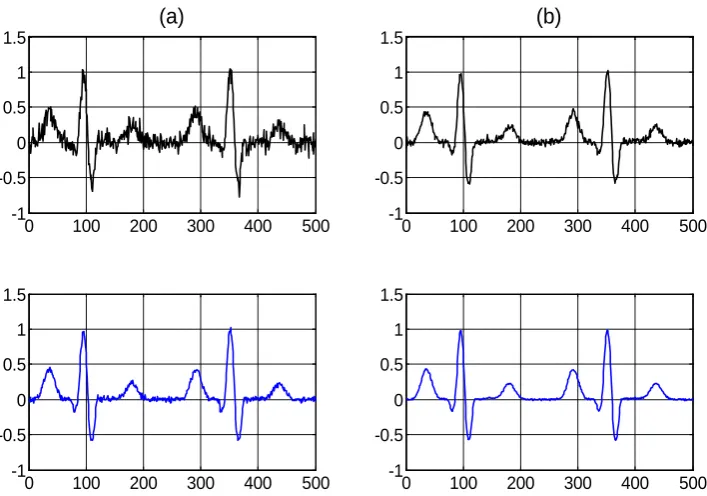
We consider a smooth and noiseless ECG signal as a reference to calculate SNR. A Gaussian White Noise (GWN) is added to this pure signal to make a noisy ECG with a defined SNR. Then, the proposed algorithm is applied on this noisy signal and results are compared with other wavelets de-noising from a SNR point of view. Obtained filter coefficients define a wavelet function and a scaling function, which also will report. Si-mulation results are presented in Table 1: the wavelet that introduced by the proposed method improve the output SNR about 2.5 dB more than other wavelets implemented by means of filters which have 8 coefficients.
Figure 2. 3-level wavelet implementation. (a) Decomposition; (b) Reconstruction.
Figure 3. (a) The noisy and de-noised signal using proposed method (input SNR = 36.7 dB and output SNR = 48.7 dB) and (b) noisy and de-noised signal using proposed method (input SNR = 45.2 dB and output SNR = 59.2 dB).
Table 1. Output and input SNR for different wavelets.
Wavelet name Input SNR (dB) Output SNR (dB) Improve (dB) Bior3.3 36.7 46.57 9.87
Db. 4 36.7 46.19 9.49 Sym. 4 36.7 46.26 9.56 Proposed method 36.7 48.7 12
0 100 200 300 400 500
-1 -0.5 0 0.5 1 1.5
(a)
0 100 200 300 400 500
-1 -0.5 0 0.5 1 1.5
0 100 200 300 400 500
-1 -0.5 0 0.5 1 1.5
(b)
0 100 200 300 400 500
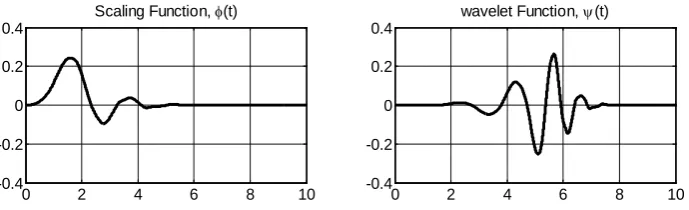
[image:6.595.193.556.612.704.2]Figure 4. Optimized wavelet function and scaling function.
shows the wavelet function and scaling function constructed from 8-coefficcient filters found by Genetic Algorithm, respectively.
5. Conclusion
A new algorithm for de-noising of ECG signals is presented. The method is based on making a specific wavelet function for minimizing the SNR. By using genetic algo-rithms, the coefficients of wavelet filter bank alter smoothly until the best SNR for out-put signal achieved. We used this method and de-noised a noisy ECG signal with 3-level wavelet structure that used 8-coefficient-filters and the results were improved in comparison by typical wavelets such as Daubechies 4, Symlet4 and Bior 3.3.
References
[1] Miao, S.G., Yen, H.L. and Lin, C.H. (2002) Wavelet-Based ECG Compression Using Dy-namic Vector Quantization with Tree Code Vectors in Single Code Book. IEEE Transac-tions on Biomedical Engineering, 49, 671-680.
http://dx.doi.org/10.1109/TBME.2002.1010850
[2] Jones, E., Runkle, P., Dasgupta, N., Couchman, L. and Carin, L. (2001) Genetic Algorithm Wavelet Design for Signal Classification. IEEETransactions onPatternAnalysisand Ma-chineIntelligence, 23, 890-895. http://dx.doi.org/10.1109/34.946991
[3] Dashtbayazi, M., Sabaghi, M. and Marjani, S. (2015) Dynamic Comparator with Using Negative Resistance and CMOS Input Pair Strategies in FS = 4 MHz - 10 GHz. Journalof ElectricalandElectronicEngineering, 3, 93-96.
http://dx.doi.org/10.11648/j.jeee.20150304.15
[4] Dashtbayazi, M., Marjani, S. and Sabaghi, M. (2015) A 4 MHz - 10 GHz, 10-ps/dec Dynam-ic Comparator Using Negative Resistance Combined with CMOS Input Pair. TheProgress inElectromagneticsResearchSymposium (PIERS), Prague, 831-834.
[5] Sabaghi, M., Majdabadi, A., Dashtbayazi, M. and Marjani, S. (2015) A 4 MHz - 10 GHz, Dynamic Comparator Using Negative Resistance Combined with CMOS Input Pair Strate-gy in Dynamic Pre-Amplifier. TheIranianConference onOptics andLaserEngineering
(ICOLE), Isfahan, 136-139.
[6] Dashtbayazi, M., Sabaghi, M. and Marjani, S. (2015) An Optimized DAC Timing Strategy in SAR ADC with Considering the Overshoot Effect. JournalofElectricalandElectronic Engineering, 3, 19-24. http://dx.doi.org/10.11648/j.jeee.20150302.12
[7] Sabaghi, M., Dashtbayazi, M. and Marjani, S. (2016) Dynamic Hysteresis Band Fixed Fre-quency Current Control. WorldAppliedProgramming, 6, 1-4.
http://dx.doi.org/10.21828/WAP-06-01-001
0 2 4 6 8 10
-0.4 -0.2 0 0.2 0.4
Scaling Function, φ(t)
0 2 4 6 8 10
-0.4 -0.2 0 0.2 0.4
[8] Dashtbayazi, M., Sabaghi, M., Rezaei, M. and Marjani, S. (2014) New Delta Sigma Modula-tor Structure Using Second Order Filter in One Stage Technique. JournalofElectricaland ElectronicEngineering, 2, 82-88. http://dx.doi.org/10.11648/j.jeee.20140206.11
[9] Sabaghi, M., Dashtbayazi, M. and Marjani, S. (2015) An Optimized Opamp-Sharing in 2nd Order ΔΣ Modulator Based on Changing the Stages Output Capacitance Timing Strategy.
TheProgressinElectromagneticsResearchSymposium (PIERS), Prague, 827-830.
[10] Dashtbayazi, M., Majdabadi, A., Sabaghi, M. and Marjani, S. (2015) An Optimized Opamp- Sharing Technique in 2nd Order Delta-Sigma Modulator Based on Changing the Stages Output Capacitance Timing Strategy. TheIranianConferenceonOpticsandLaser Engi-neering (ICOLE), Isfahan, 129-131.
[11] Dashtbayazi, M., Marjani, S., Sabaghi, M. and Majdabadi, A. (2016) Changing the Clock Pulse-Width Dedicated to Stages Strategy for Opamp-Sharing Technique in 2nd Order High-Pass Delta-Sigma Modulators. TheInternationalConferenceonElectrical, Computer,
MechanicalandMechatronicsEngineering (ICE), Dubai, 1-3.
[12] Marjani, S., Sabaghi, M., Majdabadi, A. and Dashtbayazi, M. (2016) An Ultra-Low-Power ΔΣ Modulator Using ZCD-Sharing and Changing Stages Output Capacitance Timing Tech- niques. The 4thInternationalConferenceonScienceandEngineering (ICES2016), Rome, 1-5.
[13] Sabaghi, M., Marjani, S. and Majdabadi, A. (2016) The Design of Ultra-Low Power Adder Cell in 90 and 180 nm CMOS Technology. CircuitsandSystems, 7, 58-67.
[14] Sabaghi, M., Marjani, S. and Majdabadi, A. (2016) A Low Phase Noise, Low Power and Wide Tuning Range VCO with Filtering Technique in ISM Band. CircuitsandSystems, 7, 51-57. http://dx.doi.org/10.4236/cs.2016.72006
[15] Marjani, A., Marjani, S. and Shirazian, S. (2011) Numerical Simulation of Silicon Carbide Polymers (6H-SiC & 3C-SiC) as the Active Area for 0.83 μm Wavelength Semiconductor Laser. The 14thIranianPhysicalChemistryConference, University of Tehran, Kish, 876- 878.
[16] Marjani, S., Faez, R. and Marjani, H. (2011) Analysis and Design of Semiconductor Laser with Silicon Carbide Polymers (6H-SiC and 3C-SiC). Australian Journal of Basic and Ap-plied Sciences, 5, 1060-1063.
[17] Marjani, S. and Marjani, H. (2012) Self-Heating Effects in a Silicon Carbide Polymers (6H-SiC and 3C-SiC) Semiconductor Laser. Asian Journal of Chemistry, 24, 3145-3147. [18] Marjani, S. and Marjani, H. (2012) Effects of Lattice Temperature on the Various Elements
of Heat Sources in Silicon Carbide Polymers (6H-SiC and 3C-SiC) Semiconductor Laser.
Asian Journal of Chemistry, 24, 3123-3125.
[19] Marjani, S., Faez, R. and Marjani, H. (2012) Analysis of the Various Elements of Heat Sources in Silicon Carbide Polymers (6H-SiC and 3C-SiC) Semiconductor Laser. Asian Journal of Chemistry, 24, 2333-2335.
[20] Marjani, S., Faez, R. and Marjani, H. (2012) Design and Modeling of a Semiconductor Laser by Employing Silicon Carbide Polymers (6H-SiC, 3C-SiC and 4H-SiC). Asian Journal of Chemistry, 24, 2177-2179.
[23] Rafighi, F., Behrouzinia, S., Khorasani, K., Sabaghi, M. and Marjani, S. (2016) The Electrical Parameters Modeling and Experimentation of Copper Vapor Laser. CircuitsandSystems, 7, 23-28. http://dx.doi.org/10.4236/cs.2016.71003
[24] Behrouzinia, S., Khorasani, K., Marjani, S., Sabaghi, M., Aeinehvand, M.E. and Moham-madpour, S. (2016) Experimental Study of Buffer Gas Flow Rate Effect on Output Power of a Copper Vapor Laser. OpticsandPhotonicsJournal, 6, 24-28.
http://dx.doi.org/10.4236/opj.2016.62004
[25] Mirzaei, M., Behrouzinia, S., Sabaghi, M., Marjani, S., Khorasani, K. and Sajad, B. (2016) Experimental Optimization of the Output Power of a Copper Vapor Laser Using Air as a Buffer Gas. OpticsandPhotonicsJournal, 6, 53-59.
http://dx.doi.org/10.4236/opj.2016.64008
[26] Faez, R., Marjani, A. and Marjani, S. (2011) Design and Simulation of a High Power Single Mode 1550nm InGaAsP VCSELs. IEICE Electronics Express, 8, 1096-1101.
http://dx.doi.org/10.1587/elex.8.1096
[27] Marjani, S., Faez, R. and Marjani, H. (2011) An Impact of the Hole Etching Depth within a Photonic Crystal VCSEL on Its Heat Sources. Australian Journal of Basic and Applied Sciences, 5, 766-770.
[28] Marjani, S., Faez, R. and Marjan, A. (2011) Design and Modeling of a High Single Mode Power Long Wavelength InGaAsP Photonic Crystal VCSEL. Australian Journal of Basic and Applied Sciences, 5, 1064-1069.
[29] Marjani, S., Rahnama, M. and Marjani, H. (2011) Numerical Optimization of Single-Mode InGaAsP Vertical-Cavity Surface-Emitting Lasers. Australian Journal of Basic and Applied Sciences, 5, 1207-1211.
[30] Marjani, S. and Marjani, H. (2011) Effects of Lattice Temperature on the Various Elements of Heat Sources in a Long Wavelength InGaAsP Photonic Crystal VCSEL. Australian Jour-nal of Basic and Applied Sciences, 5, 1257-1261.
[31] Marjani, S. and Marjani, H. (2011) Analysis of Lattice Temperature Effects on a Long Wa-velength InGaAsP Photonic Crystal VCSEL. Australian Journal of Basic and Applied Sciences, 5, 1374-1378.
[32] Marjani, S. and Marjani, H. (2012) Optimization of a Long Wavelength Vertical-Cavity Surface-Emitting Lasers by Employing Photonic Crystal. Asian Journal of Chemistry, 24, 3174-3176.
[33] Marjani, S. and Marjani, H. (2012) Effects of Hole Etching Depth in a Long Wavelength InGaAsP Photonic Crystal Vertical Cavity Surface Emitting Laser. Asian Journal of Chemi-stry, 24, 3194-3196.
[34] Marjani, S. (2013) Various Elements of Heat Sources within an Optimized Photonic Crystal Vertical Cavity Surface Emitting Laser: Influence of Hole Etching Depth. Asian Journal of Chemistry, 25, 4153-4156.
[35] Marjani, S. (2013) Optimization of an InGaAsP Vertical-Cavity Surface-Emitting Diode Lasers for High-Power Single-Mode Operation in 1550 nm Optical-Fibre Communication Systems. Asian Journal of Chemistry, 25, 4150-4152.
[36] Marjani, S., Faez, R. and Hosseini, S.E. (2013) Threshold Characteristics Analysis of InP-Based PhC VCSEL with Buried Tunnel Junction. The 21stIranianConferenceon Elec-tricalEngineering (ICEE), Ferdowsi University of Mashhad, Mashhad, 4-16 May 2013, 1-4.
http://dx.doi.org/10.1109/iraniancee.2013.6599783
Systems. OpticsandPhotonicsJournal, 4, 296-303.
http://dx.doi.org/10.4236/opj.2014.410029
[38] Naeemi, M.A., Marjani, S. and Peiravi, A. (2014) Time to Failure Analysis of Single Mode Long-Wavelength InGaAsP Vertical-Cavity Surface-Emitting Lasers. The 22st Iranian Conference onElectricalEngineering (ICEE), Shahid Beheshti University, Tehran, 20-22 May 2014, 43-47. http://dx.doi.org/10.1109/IranianCEE.2014.6999500
[39] Donoho, D.L. and Johnstone, I.M. (1994) Ideal Spatial Adaptation via Waveletshrinkage.
Biometrika, 81, 425-455. http://dx.doi.org/10.1093/biomet/81.3.425
[40] Mertins, A. (2003) Signal Analysis: Wavelet, Filter Banks, Time-Frequency Transform and Applications. John Wiley & Sons Inc.,Hoboken.
[41] Garg, G., Singh, V., Gupta, J.R.P. and Mittal, A.P. (2010) Optimal Algorithm for ECG de-noising Using Discrete Wavelet Transforms. TheIEEEInternationalConferenceon Com-putationalIntelligenceandComputingResearch (ICCIC), Coimbatore,28-29 of December 2010, 1-4.
[42] Jaffery, Z.A. and Afroz, A.K. (2010) Performance Comparison of Wavelet Threshold Esti-mators for ECG Signal Denoising. TheIEEEInternationalConferenceonAdvancesin Re-centTechnologiesinCommunicationandComputing (ARTCom), Kottayam, 16-17 Octo-ber 2010, 248-251.
[43] Daubechies, I. (1998) Orthonormal Bases of Compactly Supported Wavelets. Communica-tions on Pure and Applied Mathematics, 41, 909-996.
http://dx.doi.org/10.1002/cpa.3160410705
[44] Mallat, S. (1989) A Theory for Multiresolution Signal Decomposition: The Wavelet Repre-sentation. IEEE Transactions on Pattern Analysis and Machine Intelligence, 11, 674-693.
http://dx.doi.org/10.1109/34.192463
Submit or recommend next manuscript to SCIRP and we will provide best service for you:
Accepting pre-submission inquiries through Email, Facebook, LinkedIn, Twitter, etc. A wide selection of journals (inclusive of 9 subjects, more than 200 journals)
Providing 24-hour high-quality service User-friendly online submission system Fair and swift peer-review system
Efficient typesetting and proofreading procedure
Display of the result of downloads and visits, as well as the number of cited articles Maximum dissemination of your research work