Munich Personal RePEc Archive
Effect of increase in allotted time on
game playing performance: Case study of
an online word game
Putthiwanit, Chutinon and Kincart, Andrew
Dhurakij Pundit University, Providence University
16 December 2011
Online at
https://mpra.ub.uni-muenchen.de/35432/
Effect of Increase in Allotted Time on Game Playing Performance: Case Study of an
Online Word Game
Chutinon Putthiwanit*
PhD Student, Doctor of Business Administration Program, International College,
Dhurakij Pundit University
110/1-4 Prachachuen Rd., Laksi, Bangkok 10210, Thailand
E-mail: [email protected]; [email protected]
Phone: 66-8-7215-7975
Andrew Kincart
Graduate Student, Department of International Business
Providence University
200 Chung-Chi Rd., Shalu, Taichung County 433, Taiwan
E-mail: [email protected]
Phone: 886-9-2226-3070
*
1
Effect of Increase in Allotted Time on Game Playing Performance: Case
Study of an Online Word Game
Abstract
Online game players tend to differ in the duration of time they play. However, no matter
whether the time on playing an online game is spent positively or negatively, we may assume
that when the duration of each online-game round is increased, players tend to engage in more
interaction with their opponents. Though there are a significant number of research studies on
time usage in computer games, there is no research exploring the direct effect of time on online
game playing performance. As a result, this research aims to investigate the effect of time on
player performance based on the case of an online word game. Ninety-three online word games
(186 players) were randomly observed via the biggest online board game website in Thailand.
The results show that an increase in time does not have effect on players’ performance. The
managerial implication for further development is that webmasters may consider offering only
time restricted games for players to avoid high traffic in websites; which, in effect will certainly
solve the problem of lag time in online gaming.
Keywords:Time, computer game, online game, game playing performance, word game, online
2
1. Characteristics of Time in Computer Game and Online Word Game
Time is a fundamental element of our daily life. Whatever mission we want to
accomplish, we do need a sufficient time to achieve our goals. Individual uses and perceives time
differently. For example, waiting for bus when already being late, time may be perceived as
passing very slow (Luthman, Bliesener, Staude-Müller 2009). For virtual world like Second Life,
Harris, Bailenson, Nielsen, and Yee (2009) claim that as time go by, Second Lifers spend more
time in populated areas, make more friends, and joined more groups. Similar to the case of
computer game, a study by Andersen, Zeng, Christensen, and Tran (2009) indicates that in a
real-time strategy (RTS) game player needs to observe opponent’s behavior and uses proper
stratagems in order to win game in the given time. This kind of time usage is considered as
positive because it arouses player to think more to win the game. But on the other hand, when
playing an online game, losing track of time can shape player to become addicted on game or
even missing his/her appointment (Luthman et al. 2009). Lemmens, Valkenburg, and Peter
(2011) also support that time spent playing violent games specifically can increase physical
aggression. But however, no matter what the time on playing an online game is spent positively
or negatively, we may assume that when the time in each online-game round is increased,
players tend to perform more interaction with the opponent player (e.g. having more turn to play,
more time to generate a better strategy, and so on). Nonetheless, though there is the number of
research studies on time usage in computer game, but somehow, there is no research explores the
direct effect of time given on game playing performance, especially online game. As a result, this
research aims to investigate the effect of time given on player performance based on the case of
3
Online games become a popular activity throughout the world. Adults tend to play online
game as well as youths (Rau, Peng, and Yang 2006). Traditional word game like Scrabble which
people used to play on wooden or plastic board is now available online via Facebook, Thaibg,
and etc. For some websites, players need not to pay when playing Scrabble online. Nevertheless,
it may come to someone’s mind that what Scrabble is. Scrabble was invented by American
architect, Alfred Butts (BBC 2010; CBS 2010). It is a game which two to four players score
points by forming words whereas the words are formed across and down in crossword fashion
and must appear in a standard dictionary (Wikipedia 2011). In one game, there will be 100
alphabet tiles available for both players. Players try to obtain the highest points by making words
on a grid board (BBC 2010). Player may obtain 50 score bonus by putting seven alphabets or
more simultaneously (so called Bingo) such as RETINA, RETSINA, TSARINA, SENIORS,
SEQUOIA, ISOTONES, ISATINES, STYLIZERS, NUMEROUSLY, and etc. But however, by
combining additional alphabet(s) with the existing word on the board (e.g. combining ISO with
existing word TONE to become seven-alphabet ISOTONE), this case is not considered as Bingo.
Therefore, to gain the points as high as possible, player needs to do many Bingos to win over
his/her opponent. That is, player is required to manage his/her time efficiently to finish the game
on time while performs a good score.
In case of Thaibg.com that authors will use as a platform for this study, authors have
found that before beginning the game, player is allowed to take one from six options of game
time. There are 2/15 (two minutes per one turn plus additional 15 seconds), 5/30 (five minutes
per one turn plus additional 30 seconds), 10/60 (ten minutes per one turn plus additional 60
4
game with no additional time), and 22/0 (22 minutes per one game with no additional time).
Researchers set these two options into two categories, playing with time allocation (2/15, 5/30,
and 10/60) and playing with no time allocation (5/0, 12/0, and 22/0). As a result, from this
literature reviews, here are our research questions:
Research Questions: By allocating more time for each Scrabble game, will player tend to
generate more words in each turn or not? Moreover, should the webmaster of Thaibg offer
Scrabble/Crossword games with time allocation option (2/15, 5/30, and 10/60) or not? Why,
what is the benefit, and how?
2. Research Methodology
This research is a descriptive research using quantitative data to which observation is
applied to give us a greater understanding of the effect of time on game playing performance.
Ninety-three Scrabble games (186 players) were randomly observed via the biggest online board
game website in Thailand, www.thaibg.com, in Scrabble (Crossword) category. The rooms those
were observed are Practice 1, Practice 2, Practice 3, Practice 4, and Practice 5. The observation
started from 18th January 2011 (12:30 AM) until 21st January 2011. The player performance will
5
3. Findings
Since there are 100 alphabet tiles available each game, Scrabble with two players and
each player plays a word with an average of five-alphabet long will have possible ten turns
available for each players. In Thaibg.com, the game will automatically end when the remaining
time (RT) less than one second. From this situation, we may assume that:
MTP = T(TT + AT)
Whereas:
MTP = Maximum time played for each Scrabble game in Thaibg.com
T = Turns in each game
TT = Time available in second for each turn
AT = Additional time in second for each turn
Therefore, we can calculate MTP for each option:
MTP of 2/15 = T(TT + AT)
= (10)(120 + 15)
= 1350 seconds = 22 minutes 30 seconds per game
6 = (10)(300 + 30)
= 3300 seconds = 55 minutes per game
MTP of 10/60 = T(TT + AT)
= (10)(600 + 60)
= 6600 seconds = 110 minutes per game
MTP of 5/0 = T(TT + AT)
= (1)(300 + 0)
= 300 seconds = 5 minutes per game
MTP of 12/0 = T(TT + AT)
= (1)(720 + 0)
= 720 seconds = 12 minutes per game
MTP of 22/0 = T(TT + AT)
= (1)(120 + 0)
= 1320 seconds = 22 minutes per game
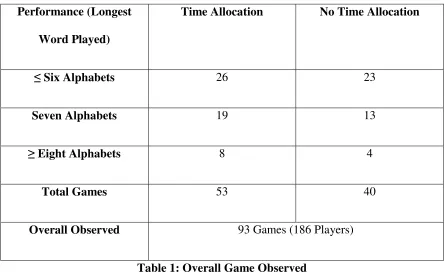
Furthermore, table 1 shows the summary of overall game observed via Thaibg.com. The
7
the longest word played in each game. Time restrictions on each game were categorized as time
allocation game and no time allocation game.
Performance (Longest
Word Played)
Time Allocation No Time Allocation
≤ Six Alphabets 26 23
Seven Alphabets 19 13
≥ Eight Alphabets 8 4
Total Games 53 40
[image:9.612.84.529.171.446.2]Overall Observed 93 Games (186 Players)
Table 1: Overall Game Observed
Pearson Square was used to determine on our research question. Since the
Chi-Square test value (.657) exceeds p-value at .05, therefore, this result answers our research
question that by allocating more time for each Scrabble game, player will not tend to generate
more words in each turn. Therefore, an increase in time does not have effect on players’
performance. Table 2 is the summary of the result.
Asymp. Sig.
8
Number of Valid Cases 93 Games (186 Players)
Table 2: Summary of the Result
4. Discussion, Managerial Implications, Limitation, and Future Research
Many online game players have problems controlling their playing time as well as they
cannot stop playing a game that they have pleasure with (Rau et al. 2006). But however, playing
game also has positive sides such as pressure relief, enjoyment, and so on. A study by Rau et al.
(2006) mentions that the more time players play games, the more improvement in their skills has
shown. For the managerial implication, webmaster may offer only no time allocation game such
as 5/0, 12/0, and 22/0 in order to avoid high website traffic. The limitation of this research is that
the sample observed is only 93 games. It therefore is not enough to represent the whole
population. Moreover, even though the observation took a period of three days, but the author
did not observe for the whole day or whole night. That is, some games might be overlooked.
The future research should study more about player performance such as score obtained in given
time, frequency of turn played in each game, and etc.
References
Andersen, K. T., Zeng, Y., Christensen, D. D., & Tran, D. (2009). Experiments with online
reinforcement learning in real-time strategy games. Applied Artificial Intelligence, 23(9),
9
BBC (2010). Proper noun come into play in Scrabble rule change. [Online] Available:
http://news.bbc.co.uk/2/hi/8604625.stm (January 6, 2011)
CBS (2010). New Scrabble to allow proper names. [Online] Available:
http://www.cbsnews.com/stories/2010/04/06/entertainment/main6368179.shtml (January 6,
2011)
Harris, H., Bailenson, J. N., Nielsen, A., & Yee, N. (2009). The evolution of social behavior over
time in second life. Presence, 18(6), 434–448.
Lemmens, J. S., Valkenburg, P. M., & Peter, J. (2011). The effects of pathological gaming on
aggressive behavior. Journal of Youth and Adolescence, 40(1), 38–47.
Luthman, S., Bliesener, T., & Staude-Müller, F. (2009). The effect of computer gaming on
subsequent time perception. Cyberpsychology: Journal of Psychosocial Research on
Cyberspace, 3(1), 1–11.
Rau, P. L, Peng, S. Y., & Yang, C. C. (2006). Time distortion for expert and novice online game
players. CyberPsychology & Behavior, 9(4), 396–403.
Wikipedia (2011). Scrabble. [Online] Available: http://en.wikipedia.org/wiki/Scrabble (January