COMMEMORATION AND TRANSITIONAL OBJECTS
ERIC JAMES GREAT-REX
A thesis submitted in partial fulfilment of the requirements of the School of Arts and Digital Industries, University of East London for the degree
of Professional Doctorate in Fine Art
Acknowledgements
I want to thank the University of East London’s research committee for providing the funding for my involvement on the Doctorate Programme over the last five years. I wish to acknowledge the excellent support from the Subject Librarian, Catherine Johnson, and the student services dyslexia team that has provided me with the resources to manage all aspects of the written components within my studies. My thanks go to my fellow students on the programme and Fine Art staff, past and present, for their objective feedback delivered with insight, honesty and wit.
In particular I want to acknowledge Geoff Brunell and Karen Raney for all their support and guidance during the programme, you have made it an exceptional experience. This report and my doctorate exhibition are a culmination of your endorsement of my practice throughout the programme.
I would like to thank my partner Sue Tully for all her support, feedback and consistent encouragement.
Last, but not least, my good friend Grayson Perry for sharing his studio with me and introducing me to the unpredictable and cruel medium of ceramics.
Contents
Page
Introduction 1
Autobiographical context 3
Theory and Creative Practice
Introduction 11
Initial works and research 2008-10 14
Development of work and research 2010-12 21
Creative mistakes 46
Work and research from June 2012 to March 2013 61
Conclusion 67
Professional Practice 69
Bibliography 71
Appendices 75
Introduction
My original research title was ‘Imagination and Contemporary Art Practice’. As my research and creative practice evolved, I felt a more appropriate title would be ‘Commemoration and Transitional Objects.’
The key question for me has been: How do I position myself in relation to my exterior physical world and the internal world of my psyche? In this report I aim to explore my response to this question, and investigate the commemorative and transitional nature of the artworks that have developed during the Doctorate Programme.
The report starts with the autobiographical context of my creative practice, reviewing my formative years at art school and my professional activities until the start of the Doctorate Programme as a part-time student in September 2008. In the main part of the report I discuss my creative practice, my theoretical enquiry and professional practice throughout the Doctorate Programme.
My initial research focused on theories of imagination whilst drawing on my previous research studies of psychotherapy when I worked and trained as a counsellor from 1998-2006. Key theorists on art, imagination, and memory have
been: Richard Kearney, Geoffrey Batchen, Matthew Kieran, Ruth M.J.Byrne andJoan
Gibbons.
As a consequence of this research I was inspired to interview contemporary artists Grayson Perry, Mark Currah, Mark Hampson, Lesley Logue and Susan Stockwell on the subject of imagination and its role in their creative practice.
In June 2011 I attended an International conference at the Royal College of Art entitled ‘Imagining the Imagination’ that provided new connections to my
theoretical research. I began by reading Donald Winnicotts’s (1971) book Playing and
change in title to ‘Commemoration and Transitional Objects’. This new focus lead to
further reading, in particular Sherrie Turkle’s (2007) book Evocative Objects: Things we
think with.
The majority of the work I have made during the Doctorate Programme has been ceramic plates. I start a piece of work by embarking on a process of cutting, pasting, sketching, scanning and manipulating groups of images. I use a variety of tools including computer software as well as more traditional media of pen and pencil. I continue to browse my array of collected information until I have an image that has a resonance to it. My working process seems haphazard and feels unconsciously random until I make a commitment to the idea and then I have to keep a focus on what I’m trying to achieve with my initial intention. At the same time I attempt to be open enough to allow my imagination and intuition to take hold, allowing the work to develop without my rational thought processes taking over. The work proceeds with this constant to and fro from rational thought and analysis to unconscious, intuitive choices that drive the image making process forward.
My strategy has been to use the aesthetics of crafted familiar decorative domestic objects to draw the viewer in and set up certain expectations which are then confounded or challenged as the work undermines the initial propositions, creating a tension between the visual language employed and the underlying content. These works are created in series so that I can investigate a range of themes including love, identity and notions of the ‘self’. I have also included a chapter called ‘creative mistakes’ that documents works which have informed my practice but have not been fully developed during the Doctorate Programme.
Autobiographical Context
I was born in 1957 in Manchester. I started my degree at Sheffield Polytechnic in 1976 in the Fine Art department. During the second year I became increasingly interested in the work of Robert Rauschenberg. His combining of the photographic and hand drawn images of his environment and the energy in his work had a strong appeal for a 20 yr old with very little knowledge of art. My early attempts at making art exploited the work of other artists such as Leonardo da Vinci, Albrecht Durer, Gianlorenzo Bernini, Thomas Gainsborough, Andy Warhol and David Hockney. By
using this approach within screenprinting (Fig 1) I explored the history of art and
started to develop my art practice.
Fig 1.Work from BA Degree show. 35x25ins, Screenprints, 1980.
Left to right Marilyn Mongrel and Portrait of the Artist in an Ornate Gold Frame with Albrecht Durer.
Inspired by my motivational teacher, Edward Mayor, I chose to do my thesis on Gianlorenzo Bernini; specifically on how Bernini and Antony Van Dyck portrayed
Charles 1st. Bernini showed the image of a King whereas Van Dyck was preoccupied
with the image of a man. This simple contrast illustrated that there was no right or wrong way of representation.
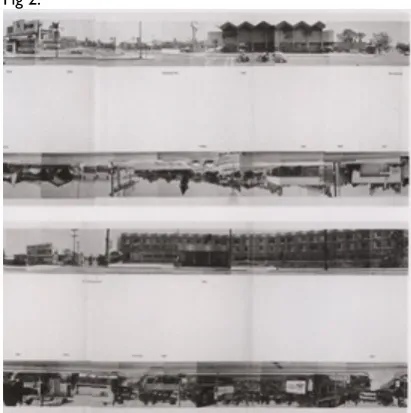
documentation and Chuck Close’s paintings that looked as if they might be photographs. I started making work at Chelsea inspired by Arnulf Rainer. My father had died the year before and looking back I feel Rainer’s seemingly emotional intensity within his photographic and drawn self-portraits resonated with my feelings at that time. I later developed work that used the idea of different forms of visual
representation of the same object and the traces that the objects made (Fig 2-3). This
work was inspired in part by Joseph Kosuth’s ‘One and Three Chairs’ (Fig 1.
Appendix, page 75) and his approach to the relations between objects, definitions and images.
Fig 2. Work from MA Degree show, 30 x 40ins. Fig 3. Work from MA Degree show, 24 x 30ins screenprint, photo etching and relief print, screenprint.1981. Football.
1981. Bob’s Tyre.
journeys across America (Fig 4). These works were inspired by Robert Frank’s ‘The
Americans’ and Ed Rushca’s ‘Every Building on the Sunset Strip’(Fig 2. Appendix, page
75). Roland Barthes Camera Lucida (1980) made an impression on me at this time.
What I took from this book was the idea of the unmediated photograph being the most profound type of photograph for him.
Fig 4. Palladium Print. 10x8ins, 1986. NYC Dock Yards Fig 5. Mixed media, 1984, Letters Home.
New York City at the start of the eighties was dominated by neo-expressionism and questions of post modernism with artists such as Julian Schnabel, David Salle, Cindy Sherman, and Robert Mapplethorpe at the forefront. Artists such as Barbara Kruger and Jenny Holzer inspired me to think about the use of text within art works. I made a number of text works commenting on New York and the USA in the form of boxed 'letters home' inspired by Alistair Cooke’s 'Letters
from America' (Fig 5) I spent seven years in New York, from 1982-89, and in that
time I taught at the State University of New York at Purchase, and at the Pratt Graphic’s Center. I collaborated with Jon Cone, another Printmaker, and we printed
and published editions of artists to show at Cone Editions gallery(Fig 3. Appendix,
page 75, 76), situated at 560 Broadway in New York. We published limited editioned prints from 1986-9 by artists such as Norman Bluhm and Lester Johnson, who are thought of as second-generation abstract expressionist, and younger artists working in New York such as Carole Seborovski and Willy Heeks.
as an art scene and Charles Saatchi had opened his gallery in Swiss Cottage, which reminded me of the New York gallery spaces in its scale. In the early to mid nineties there was much debate about the impact of the digital revolution on photography
with books such as W.J.Mitchell’s (1992) The Reconfigured Eye. Mitchell talked about
the post-photographic era and its consequences for the photographic image. My interests in the digital and photographic image lead me towards a different methodology for making work. I started to scan and manipulate images into the computer and printing them as large format digital photo-collages. I began with appropriated images from William Hogarth’s satirical engravings and added
contemporary newspaper and magazine images (Fig 6). Later on I wanted to develop
what I felt was a less obvious referenced pictorial image and I used only my
photographs in a series entitled Paradox Cemetery (Fig 7) which dealt with the
manipulation of apparently opposing ideas through a constructed reality inspired in part by the work and writings of Jeff Wall. I undertook a ‘Computer into Print’ two-year residency at Staffordshire Polytechnic from 1989-90. I also taught at the Royal college of Art in the Printmaking and Photography departments from 1992-96.
Fig 6. Conflicting Elements. Diptych, Digital ink jet print, 8 x 3.5ft. 1994.
In 1998 I started a counselling course at a centre for humanistic psychology called Spectrum in north London. I originally became interested in counselling and psychotherapy after attending a two-day course delivered by Staffordshire University in 1997 as part of a staff development course. This experience sparked my interest in how my beliefs, attitudes and behaviours are formed and how these have impacted on my art practice. As a result my work started to become more personal in its subject matter and I started to be informed by photographs from my family album, becoming aware of the psychological landscape of my life. I was also looking at the work of Bill Viola (1995) and his writings about his art practice from his book
Reasons for Knocking at an Empty House, writings 1973-1994.
For an exhibition I curated in 1998 at the Real gallery in New York called ‘Digital Collaborations’ I asked Bill Jones (1998) to write an essay for the catalogue.
His essay titled The Painted Photograph opened up for me new possibilities through
digital media when he states:
While muting the truth-telling objectivity of the photographic document, digital media makes the photographic images potentially manipulable and thus handmade. The challenge, therefore, is to find the surrogate for the hand in the new process which combines aspects of painting, drawing, and photography(Jones, 1988).
Later in the year for an exhibition at the East London gallery in 1998 I decided to take photographs in Trafalgar Square at night. The idea of Trafalgar Square as a place of national protest and celebration appealed to me. The pieces used a combination of positive and negative imagery with the intention of creating a work that appears familiar and yet also as if something is out of place, a disruption, a complication in the reading of the image. The images were juxtaposed besides large
flat areas of colour. I was thinking of the works in the Rothko chapel(Fig 4. Appendix,
page 76) in Texas and Barnet Newman’s Who’s Afraid of Red, Yellow and Blue(Fig 5. Appendix, page 76). I also chose to frame the images (10ft x 5ft) in large ornate gold frames to question the idea of reverence and historical readings of representation
Fig 8. For use on Fires. Digital Ink Jet prints, each panel 10x5ft,1998.
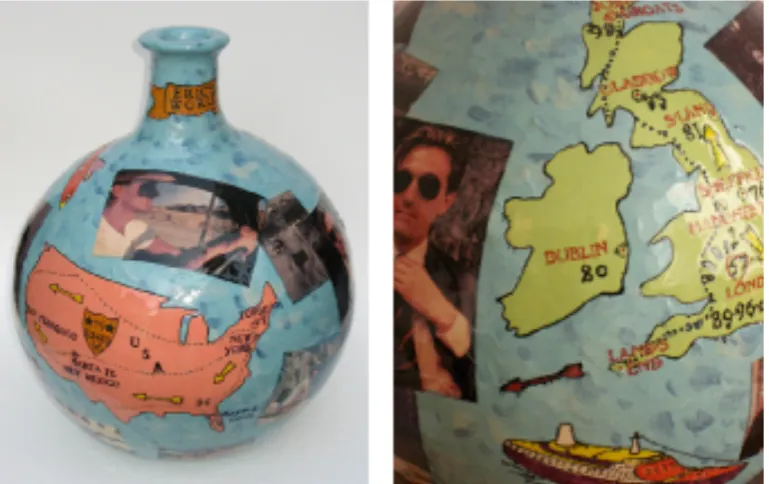
In 2001 I sold my studio, which I had worked in for 12 yrs, and moved to a new location. I needed to clear out and make space but couldn’t bring myself to dispose of my art works completely. I made an urn as a receptacle for the ashes of works that I decided to say goodbye to but couldn’t part with completely. What appealed to me was the manufacture of a vessel that could represent some kind of personal shrine, commemorating my history, my personal interior landscape made as
metaphor through mapping (Fig 9).
Fig 9. Eric’s World Ceramic Urn, 18ins high, 2004.
I was reading Suzie Gablik’s (1998) Conversations before the end of time. The
[image:11.595.107.492.405.647.2]for art’s sake” is the rule’. The resulting work I made was a short looped film of an animated shadow that appeared for several seconds each morning in my bathroom and then disappeared. The idea that it only existed for a short while and then did not exist without the exact alignment of the sun and water and the ability of the photographic image to capture it appealed to me. I wanted to make fragile and fleeting moments visible, the insignificant significant.
In 2005 I ran a 5-day ‘Art Community Group’ workshop, with Grayson and Philippa Perry, for a mixed group of staff and students at the University of East London. This group of 20 people explored the idea of how your personal creative process (what forms your beliefs as an artist) informs your creative practice. Around the same time of the ‘Art Community Group’ I started to make a set of
commemorative plates (Fig 10). I have always thought that each family has its own
secrets, regrets, myths, public and private faces. I thought about the emotional events in my life that stand out and how these events have influenced my beliefs and my attitudes. It was an attempt to look at my Family Album and its histories and re examine the photographic images and meanings within them. Influenced by Dissanayake’s statement I thought of these objects not for a gallery space but located in a personal domestic setting, The Family Album opened wide.
Fig 10. Ceramic commemorative plates, 10x10ins. 2005.
In 2006 I was asked to participate in a show at the William Morris gallery called ‘New News from Nowhere’. The exhibition was a response to Morris’s
(1890) book News from Nowhere. I was interested in exploring the idea of how
people are creative in their daily lives. I wondered if any part of Morris’s
11). From 2004 to the present time I have worked at the same studio as my friend Grayson Perry, who had originally shown me how to make the ceramic urn. Our conversations on art, craft, the gallery system, fame, public art, spirituality, creativity and therapy have helped inform and influence my work on the doctorate programme.
Theory and Creative Practice – Introduction
Two of the key influences on my practice during the Doctorate Programme have been the assimilation of my past experiences being a client and practitioner within a therapeutic context, and the reassessment of my methodologies in making and researching within my practice.
I trained and worked as a counsellor from 1998-2006. It introduced me to an unrecognised psychological landscape that had always been present. I had not articulated this psychological landscape in words, or fully acknowledged its potential as a component within my art practice.
It was not until the making of an urn, for the ashes of cremated artworks
(Fig 9), and a series of family commemorative plates (Fig 10), that the absorption of the theories and experiences of psychotherapy started to be revealed in the content of the artwork. I started to consider theories such as projection and transference, that examine personal beliefs, behaviours, emotions and thoughts.
The theory of projection was developed by Sigmund Freud and further refined by his daughter Anna Freud. It is described as:
A psychological defence mechanism…unwittingly attributing one’s own traits, attitudes, sentiments, emotions, or subjective processes to others…Thus, projection involves imagining or projecting the belief that others originate those feelings (English and English, 1974, p. 413).
Transference was first described by Sigmund Freud as:
A phenomenon in psychoanalysis characterised by unconscious redirection of feelings from one person to another. One definition of transference is ‘the inappropriate repetition in the present of a relationship that was important in a person's childhood
These psychoanalytical theories mine the everyday and the familiar for broader and deeper layers of meanings that can often lead to the uncovering of less acceptable or acknowledged parts of the psyche.
The content within the urn and family commemorative plates started as an initial investigation into my personal history, looking at memories elicited by personal photographs. Liz Wells describes family photographs that contain memories for the viewer as:
the tension between an ideal image and the ambivalence of lived experience…the uncertain borderline between fantasy and memory(Wells, 1997, p. 142).
The content of the work has developed from objects that investigate the commemoration of personal histories, to objects commemorating the recognition of beliefs and behaviours.
Two key insights I gained from psychotherapy are the ideas of
self-observation and personal stories. Socrates said that ‘The unexamined life is not worth
living’ (Baggini, 2005). I don’t believe this statement but I would support the idea that an
examined life can be enriching.
Self-observation examines the observance of oneself from a distance, without judgement. This allows you to be an eyewitness, acting as a monitor to your behaviours, thoughts and feelings. The aim of observation is to increase self-awareness of how you think, feel and act. This is a constant work in progress, similar to creating artworks and the process of research methodologies.
Personal stories/narratives help you to become aware of how we talk to ourselves and what is the narrative we have created in order to reflect. By becoming aware of your personal narrative you can intervene in the story, rewriting the elements that do not work, or you would like to improve. My friend and
Psychotherapist, Philippa Perry (2012), recounts a story in her book, How to stay
each sale. The way he deals with this rejection is to think that each rejection he gets means he is closer to the next sale. Philippa tells this story to one of her clients Sophie, who is a 55yr old women who has just finished a BA Fine Art degree course.
Sophie believes she is ‘washed up’ and ‘It’s a young persons world’. Sophie laughs at the
salesman’s story and informs Philippa she wants to apply for an artists residency programme. On returning for another therapy session some months later she informs Philippa that it only took her 17 attempts before getting accepted on to a residency programme. This way of talking to her self and re-telling her story allowed her to approach how she looked at her world differently.
My story in this context is that I told myself, prior to the doctorate, that I could make my artwork without regard for the thoroughness of research and the time needed for using my imagination. Working during the doctorate has affirmed that I cannot tell myself that story. This new story has affected my methodology. What has developed significantly over the doctorate programme is the amount of time I dedicate to looking at, reading about and making artworks. I have given myself the permission to explore areas of research that might remain just investigations. I have given myself time for my imagination to make connections and link together all of the elements that inform my art practice. Grayson Perry states, when commenting on the use of his imagination:
Theory and Creative Practice – Initial artworks and research 2008-10
When I started the Doctorate Programme in 2009 I began by making a series
of 50cm diameter ceramic plates (Fig 12). I had initially thought they would be
singular objects without specific themes linking them. I wanted to investigate an array of ideas surrounding belief systems inherent within the structures of a wider culture and my personal identity. I thought that this way of producing work would have an energy that would stimulate the making and thinking, and keep the production lively and interesting for me, the maker. I had chosen an eclectic mix of topics of existential anxiety, personal psychology, love, cultural paradox and sex to begin with. I made the first five plates for my end of year doctorate exhibition in June 2009 and then a further five plates for an exhibition at the Silas Marder Gallery in New York in
November 2009 (Fig 13).
This first group of plates used my version of a font taken from chap-prints
(Fig 14). The text in chap-prints is scored into the woodblocks, like a carving into a tree. I wanted to use this font to echo folk art, to look handmade, but also to shape decorative pattern on the plate. A non-confrontational crafted object that could reveal hidden, possibly darker secrets.
I will now discuss each plate from my first Doctorate Showcase exhibition (2009), and reflect on my thought process when making these objects.
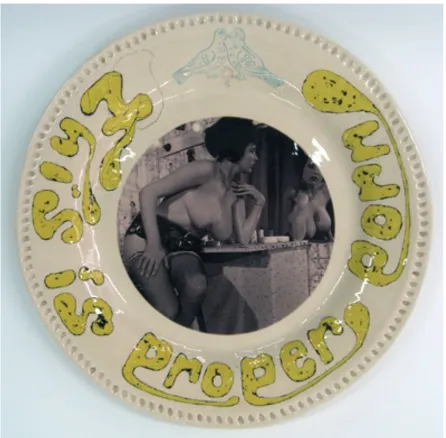
This first group started with the plate, This is proper porn (Fig 6. Appendix, page
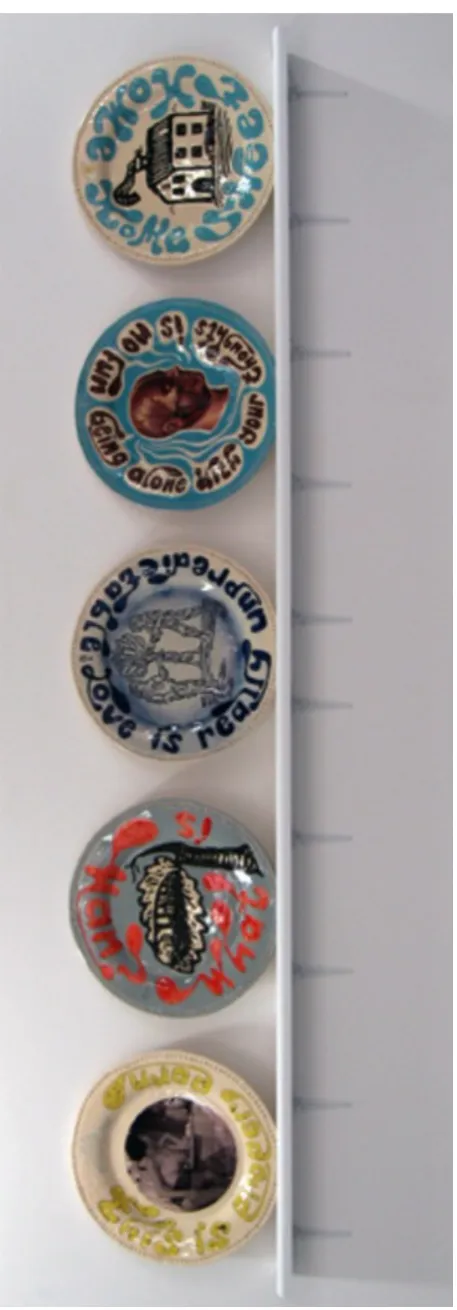
Fig 12. End of Year Doctorate Showcase 2009. Five Ceramic Plates. 50 x 50 cm each. 2009. Bottom to top. This is proper porn. What is man. Love is really unpredictable. Being alone with your thoughts is not fun.
In What is man (Fig 7. Appendix, page 78) I chose to draw a baby on a leaf evoking a biblical story or a Tarzen like fable of a child growing up in the wild. Will it survive or will it die? I was asking myself at the start of the doctorate whether I could survive this new journey examining my art practice.
Love is really unpredictable (Fig 8. Appendix, page 79). This plate developed from thinking about the difficulty of being able to give love and receive love back without expectations. I chose Adam and Eve as hairy wild people looking like they might be a
bit drunk, arguing outside a pub, a ‘he said she said’ scenario taking place.
Being alone with your thoughts is no fun (Fig 9. Appendix page, 80). This came from the idea that the more you internalise and talk to yourself the greater the
chance the story you tell yourself becomes distorted. A friend once said to me ‘every
time you have a conversation with yourself make sure you have one with your partner.’ Good advice for a healthy relationship.
The final plate in this group was called Home sweet home (Fig 10. Appendix
page, 81). It developed from the idea of fear. Of what is going to happen, rather than the experience of what is actually happening. It is an image of an Englishman’s castle, the cute thatched roofed home with a log fire, but now covered with video surveillance and alarms. On a personal note, I was also thinking about a loss of innocence, a longing for another time in my past when I was not so fearful.
The exhibition at the Silas Marder Gallery echoed my first Doctorate Showcase exhibition. I exhibited plates from the Showcase exhibition plus three new single themed plates that expanded on the idea of love and death. For this exhibition the gallery built a mantlepiece for the presentation of the plates. This added an extra layer of meaning to the idea of domestic objects. I might consider in the future using this form of presentation again if it is appropriate. After this exhibition I started to think about producing plates within a series as clear themes started to evolve from the process of making the first dozen plates. I realised I could take one theme and develop it over a number of plates, allowing an idea to be explored more thoroughly. At that time, this change from single objects to themes seemed insignificant. In hindsight, I realised it was exposing a weakness in my methodology. This was connected to my concentration, my use of time in making and thinking, the need to allow ideas to germinate
Fig 14. Chap prints from chapbook. 16thC-19thC. A pocket-sized booklet of disposable printed material depicting popular or folk literature. The term is derived from chapmen, chap coming from the Old English céap meaning "deal, barter,
business", a variety of peddler, who circulated such literature as part of their stock.
My supervisors suggested I took as a potential theoretical starting point the
work of Richard Kearney (1988), and his book, The Wake of the Imagination. This
suggestion excited me as it involved investigating the history of theories around the imagination. This seemed like a logical step given the imagination’s links to psychotherapy. Creativity has always fascinated the professions that concern themselves with the study of the psyche. Just as artworks contain images so do dreams and fantasies, so the interpretation of imagery is relevant to both art and the study of the psyche.
I have recently read Jonah Lehrer’s (2012) book Imagine, how creativity works. This
book attempts to uncover some of the mysteries of the imagination. He asks why so
little research has been done on the subject, ‘a recent survey of psychology papers
published between 1950 and 2000 revealed that less than 1 percent of them investigated aspects of the creative process’ (Lehrer, 2012, p xvi). He looks at the latest research into
individual acts of creativity, brain scanning, work environments, group creativity and ideas of conceptual blending. Lehrer writes:
‘The best way to understand conceptual blending is to look at the classic children's book Harold and the Purple Crayon. The premise of the book is simple: Harold has a magic crayon. When he draws with this purple crayon, the drawing becomes real……But here's the twist that makes Harold and the Purple Crayon such an engaging book: it blends together two distinct concepts of the world. Although the magic crayon is clearly a fantastical invention—a conceit that could never exist—Harold still has to obey the rules of reality. So when Harold draws a mountain and then climbs it, he must try not to slip and fall down. When he does slip—gravity exists even in this crayon universe—Harold has to draw a balloon to save himself. In other words, the book is a delicate blend of the familiar and the fictional; Harold has a surreal tool, but it operates amid the usual constraints
(Lehrer, 2012, p. 38).
Richard Kearney (1988) in his book, The Wake of the Imagination identifies four
1. The ability to evoke absent objects which exist elsewhere, without confusing these absent objects with the things present and here now.
2. The construction and/or use of material forms and figures such as paintings, statues, photographs etc. to represent real things in some ‘unreal’ way.
3. The fictional projection of non-existent things as in dreams or literary narrative. 4. The capacity of human consciousness to become fascinated by illusions, confusing
what is real with what is unreal (Kearney, 1988, p.16).
Kearney takes the position that as a culture we are in the ‘Wake of the
Imagination’, or in other words, nearing the end of it. The idea of imagination has been marginalised as the postmodern undermines the modernist belief in the image
as a bona fide expression. Proliferation of visual culture is such that ‘ We no longer
appear to know who exactly produces or controls the images which condition our unconscious’ (Kearney, 1988, p.3)
He goes on to say:
The Human ability to ‘image ‘ or ‘imagine’ something has been understood in two main ways throughout the history of Western thought - 1) as a representational faculty which produce images of some pre-existing reality, or - 2) as a creative faculty which produces images which often lay claim to an original status in their own right, These basic notions of the imagination have been used from the ancient Greeks to the modern existentialists. (Kearney, 1988, p.15)
We are ‘split beings’ Kearney argues, ‘split between the conscious and the unconscious, strange and familiar, same and other’ (Raney, 2005, p 2). Kearney is
advocating a postmodern imagination that would incorporate both the ‘poetical and
the ethical’ (Kearney,1988,p386), a relationship between the ‘self and the other’ (Kearney,1988,p363). The poetical imagination Kearney writes, ‘is the carnival of
possibilities…The poetical imagination opposes the apartheid logic of black and white’
(Kearney,1988, p 369).
For Kearney, the ethical imagination is defined as ‘where each of us is obliged to
interminable deferment…here and now I face an other who demands of me an ethical response’ (Kearney, 1988, p 361). Kearney suggests that the ethical and poetical
imagination need each other to co-exist, so that the ethical imagination ‘does not
degenerate into a censorious puritanism’ (Kearney, 1988, p 366) and the poetical
imagination does not slide into an attitude of ‘anything goes and everything is everything
else because it is, in the final analysis, nothing at all’ (Kearney, 1988, p 369).
Kearney does not want a return to the ‘humanist cult of autonomous subjectivity
that tended to exclude the other’(Kearney, 1988, p 369). He goes on to talk about the role
of the unconscious as revealed by psychoanalysis as a ‘playground of images and
symbols which defy the laws of formal logic’ (Kearney, 1988, p 368).When the ‘controlling
censorious ego is off-guard, taken by surprise, overtaken from behind by the otherness which precedes the sense of self and subverts the priorities of self-possession’
(Kearney,1988,p368).
Kearney’s writing inspired me to interview other artist regarding how they use their imaginations as I was reflecting on how I used my own. I interviewed Mark Currah, Mark Hampson, Lesley Logue, Susan Stockwell and Grayson Perry. Grayson Perry describes his imagination as:
The engine of play, my job as an artist is to play with purpose and imagination allows your experiences of who you are, the culture you consume to mix together. It makes a soup of content to pluck ideas from. So a good imagination can pluck stuff from the soup and then you make it into your own tradition. So where do I start when I have a blank canvas in front of me? Well, for me the imagination is a mix of my personal iconography from my childhood, the narrative of my childhood and the narrative of the world, and then seeing how they interplay. New ideas are not comfortable and you have to get used to them. In the past I embraced what I found difficult about modern art and now I’m questioning the orthodoxies of modern art! It all goes in the soup! (Perry, 2008)
After the interviews I also reflected on what the other interviewees had talked
about. I identified with Mark Hampson’s thought’s about ‘not forgetting to use the
imagination’ (Hampson, 2008) as I feel in the past that I have not prioritised the time
imagination ‘as making sense of the world by looking at all the various options ’ (Logue, 2008) reminded me to remain open to all possibilities of what a work of art could be
on a visual and intellectual level. Mark Currah’s version of a space that can ‘allow the
mind to drift ’ (Currah, 2008)resonates with how I engage with my imagination. From
Susan Stockwell I respond to the idea of the imagination as ‘quite challenging and quite
uncomfortable sometimes’ (Stockwell, 2008)as it is a thick ‘soup to pluck ideas from’ (Perry, 2008).
Theory and Creative Practice – Development of work and research 2010-12
The plates that were inspired by my family album started out as attempts to use the photograph to explore the issues of memory and interpretations of the lived experience. I decided early on in the Doctorate Programme to follow this line of inquiry as a potential strand of theoretical research.
Geoffrey Batchen’s (2002) Forget me Not, Photography and Remembrance
provided an insight into an area of domestic photographic assemblages made during
the mid 19th and 20th century (Fig 15). These assemblages focus on the relationship
between:
photography and memory, and explores the curious and centuries-old practice of strengthening the emotional appeal of photographs by embellishing them-with text, paint, frames, embroidery, fabric, string, hair, why words, bullets, cigar wrappers, butterfly wings, and more-to create strange and often beautiful hybrid objects, part memento, part obsessive assemblage(Batchen, 2004, p 96).
Fig 15. Makers unknown; photographer: P.E. Lynne, Memorial to a young man, 1910.
Batchen’s comments that the works were meant to be:
Batchen’s remarks reminded me of my first impulse to make the ceramic urn
for my destroyed artworks (Fig 9), a vessel that could represent a form of personal
shrine, commemorating my visual history, containing the residue of my creative memories.
In a chapter on ‘Post Memory’, in Joan Gibbon’s (2007)book, Contemporary
Art and Memory, Images of Recollection and Remembrance, she writes on Christian Boltanski in his work ‘Album of the Family D. 1939-1964 (1971)’;
Boltanski at first saw the piece as a record of the family's existence and the significant events of their lives, he later stated that, rather than teaching about the family D., ‘they sent the viewer back to his or her own past (Gibbons, 2007, p 77).
Reading Batchen and Gibbons opened up interesting avenues into the ideas of memory and commemoration that helped me to question and reflect on the content and intention of the work I had started to develop.
After reading Kearney I had begun to read other philosophical discourses connected with the Imagination. I found the academic theories dense and difficult to
decipher. Books such as Imagination, Philosophy and the Arts edited by Matthew Kieran
and Dominic Mcliver Lopes (2003) contains a number of essays concerning imagination, narrative and emotions, truth in imagination, and sensory imagination.
Kendall Walton’s (1990) Mimesis as Make-Believe: On the Foundations of the
The exception to this was Ruth M.J.Byrne (2007), The Rational Imagination, how people create alternatives to reality, in which she refers to the counterfactual imagination. How people think about what might have been, If only;
for instance, when someone thinks about how an event in the past might have turned out differently, or when someone creates a daydream or a fantasy. They also occur when a child engages in pretend play or chats with an imaginary friend or soft toy. Counterfactual suppositions can be close to the facts ("if Molly had joined the running team, she would have become slim"), or they can be remote ("if Molly had joined the running team, she would have become an Olympic gold medal winner. (Byrne, 2007, p 2)
I have been captivated by these daily imaginings of ‘if only’ or ‘what If’:
Batchen’s ‘imagined, vacant future’ (Batchen, 2004, p 98) and Boltanski’s ‘they sent the
viewer back to his or her own past’ (Gibbons, 2007, p 77). These intriguing ideas have
contributed to the development of my practice. One of my favourite quotes that I have come across during my research is by the British philosopher Raymond Tallis
(2010) who articulates, ‘We all share the human wound of a finite life, a life of
incomplete meanings’ (Creativity and Imagination, 2010).
In June 2011 when I attended an International conference at the Royal College of Art entitled, ‘Imagining the Imagination’, new links started to be revealed.
The abstract for the conference, described the imagination as:
the most significant capacity of humans to interact with the environment. Just with imagination we are able to connect the past with the future, which forms the basis of decision-making processes. To understand the complex and highly determined processes of imagination, the Imagining Imagination International Conference provides an interdisciplinary perspective to understand how culture – images, music, language, poetry – influences and determines our imaginative world. Significantly, all these fields of knowledge-production are currently re-addressing imagination beyond romantic conceptions, as a complex thinking process.(Royal College of Art, 2011)
I hoped that the conference would open new avenues of investigation and help me consolidate my initial enthusiasm for my research involving the imagination.
As part of the conference, the artist Patricia Townsend discussed work she
had made inspired by visiting Morecombe Bay and the surrounding landscape. She
approached her presentation from a psychoanalytic view of the role of the imagination within the creative process of a visual artist. Townsend referred to the writing of Donald Winnicott. Winnicott conceives the imagination as having three parts: An outer world of consciousness of reality, an inner world of unconscious phantasy, and where these collide a third space of play and creativity. Winnicott
refered to this as a ‘transitional’ space. Townsend went on to say that when she made
her work she is in a constant state of synthesis between the three elements of imagination that are contributing to the production of the art work.
I can identify with Townsend and this transitional space of play and creativity. During the doctorate I have re-established this space of play within my practice. My
difficulty in answering my question, ‘how do I use my imagination’, made me realise
that I had marginalised this transitional space. I realised that I had downgraded the importance of time, space, reflection and play, whilst I maintained my academic and commercial art career. The importance of this re-alignment in the act of making and thinking has been crucial to my development. In hindsight, on an unconscious level, I believe I started the doctorate programme to find a transitional space to reignite my creativity beyond the boundaries I had previously imposed upon myself.
After Patricia Townsend’s mention of Winnicott, I started to consider his Theory of Transitional Objects, and researched a number of interpretations that included this summary on the Psychotherapy web site, Changing Minds (2002-12):
the subject of the child's phantasies, for example where a teddy bear is spoken to, hugged, punished, etc. It thus becomes a tool for practicing interaction with the external world. By giving the bear a will of its own, the child is also phantasizing that it is not omnipotent and can yet survive this initially scary state. Play thus provides a pathway to independence. The use of transition objects continues through our lives as we imbue objects with meaning and memories that are associated with other ideas, places and people. Photographs, mementos and other memorabilia are used to remember good times and friends (Changing Minds, 2012).
With theories of Winnicott’s transitional objects in mind I started to further my investigations into possible theoretical support for my creative practice, with
Sherrie Turkle’s (2007) book, Evocative Objects – Things we think with. This book is
edited by Turkle and is a collection of writings by scientists, humanists, artists, and designers that ‘trace the power of everyday things’;
These essays reveal objects as emotional and intellectual companions that anchor memory, sustain relationships, and provoke new ideas…inviting us to look more closely at the everyday objects of our lives, the familiar objects that drive our routines, hold our affections, and open our world in unexpected ways…We find it familiar to consider objects as useful or aesthetic, as necessities or vain indulgences. We are on less familiar ground when we consider objects as companions to our emotional lives or as provocations to thought. The notion of evocative objects brings together these two less familiar ideas, underscoring the inseparability of thought and feeling in our relationship to things. We think with the objects we love; we love the objects we think with. (Turkle, 2007,p 5)
Turkle splits the essays into groups under titles such as, Objects of History and
Exchange, Objects of Transition and Passage, Objects of Mourning and Memory. In an essay
by Tracy Gleason (from Objects of Transition and Passage), entitled Murray: The Stuffed
Bear, Gleason describes her relationship with her younger sister Shayna, and Shayna’s stuffed bear called Murray:
intellect and everything to do with love. The adults in Shayna's life see Murray according to their own desires. For me, Murray has many faces. As a sister, I am grateful to him for bringing me closer to Shayna… As a researcher, he has given me a ringside seat at the performance of Shayna's imagination, even as I remind myself that in fact it was she, as his creator, who bought me the ticket to that seat. (Turkle, 2007,p 174)
In 2011, I visited a collector’s home in New York to see two of my plates in situ, (that had been bought in 2010 from my exhibition at the Silas Marder Gallery). In their house they had built a shelf for the works and also surrounded the plates
with small stuffed dogs (Fig 16). At first I was surprised by the way the collectors had
presented the work. I was uncertain about how to read this arrangement. I was then told that these stuffed animals were love tokens, given to each other over a fifty-year period. This was the first time I had seen an example of how the plates might function among other collected objects. I was transported back to my original idea when I made the urn to make objects for my home, objects imbued with memory, commemoration and reflection.
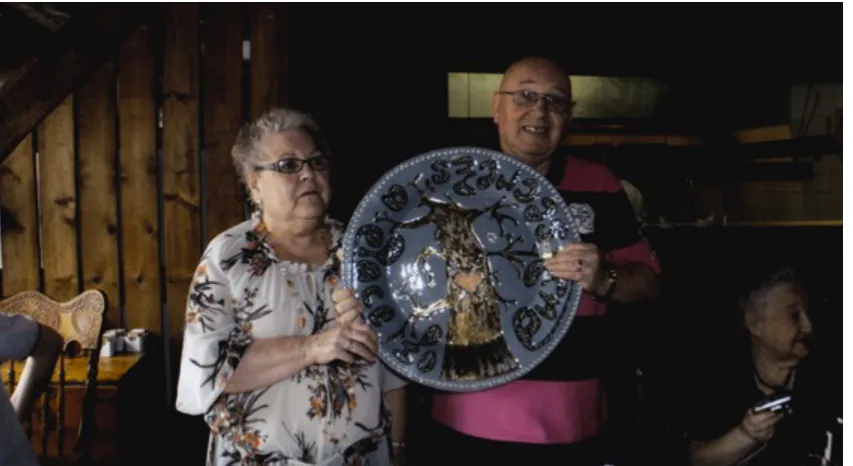
More recently I sold a plate containing a drawing of a golden tree, with the
words, a place to put secrets. It was bought for a golden wedding anniversary and the
purchaser gave me a photograph of the plate being presented to the couple (Fig 17).
When I thanked him for this photograph he said it sat proudly among the family photographs and holiday knick-knacks on the sideboard in the living room. I enjoy the idea of the plates sitting side by side among treasured possessions, on a sideboard or mantle piece. My object becomes part of a family’s home situated amongst family memorabilia.
Fig 17. A place to put secrets Ceramic plate. 50x50cm. 2011.
Whilst visiting the Venice Biennale in 2011 I went to the Peggy Guggenheim
Museum (Fig 18). This provided a stark contrast to the large installation spaces of the
[image:31.595.91.518.292.525.2]Fig 18. Peggy Guggenheim in her home in Venice.
On arriving back in the UK I visited my mother in Manchester (Fig 19-20). I
photographed the objects that she surrounds herself with. I started to wonder what the function of these objects were for my mother. When I asked, she talked about each one, its history, its emotional connection, its beauty, a record of her experiences.
What I responded to in her collection was the idea of her experiences stored in these mementos from her holidays in Spain or Disney world, of family births, deaths and marriages, acting as silent prompts to her memories. These domestic knick-knacks and collectables, I realised, contain transitional characteristics.
Fig 20. Objects in Mrs Great-Rex house. 2011.
In the book entitled, Places of Learning; Media, Architecture, Pedagogy by
Elizabeth Ann Ellsworth (2005), Ellsworth writes about transitional objects and states:
After reading Ellsworth I started thinking about the function of making artworks for myself. I remembered part of Gerhard Richter’s conversation with
Nicholas Serota (2011) from the Tate Modern catalogue Panorama. Serota asks the
question:
NS: So what is the purpose of art?
GR: For surviving this world. One of many, many ... like bread, like love.
NS: And what does it give you?
GR: [laughs] Well, certainly something you can hold on to ... it has the measure of all the infathomable. senseless things, the incessant ruthlessness of our world. And art shows us how to see things that are constructive and good, and to be an active part of that.
NS: So it gives a structure to the world?
GR: Yes, comfort, hope, so it makes sense to be part of that. (Godfrey and Serota, 2011,p 25)
The theoretical discourse and the physical creative act of my making have constantly interweaved and entwined throughout the doctorate programme. In 2010-11, I started to make my first themed series of plates concerned with the
notion of Love, with the intention to complete a group of five plates (Fig 23). I
decided that five was a good number to group the plates together. Five provides an opportunity to have a beginning middle and end, forming a possible narrative. Although I was starting to think of a group I still wanted the plates to exist as autonomous objects in their own right.
For this group of, ‘love’ inspired plates, I wanted to revisit an earlier plate I
had made, ( Love is really unpredictable. Fig 8. Appendix page 79 ). This was the first
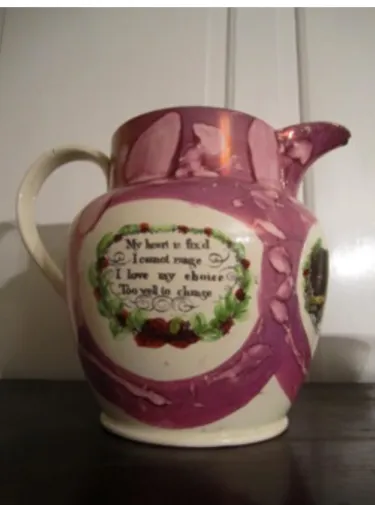
plate I had made in 2009 and the energy and simplicity of the scrafito drawn image directly onto the plate, leaving the clay visible and exploiting the handmade mark, has both a brutality and a beauty that appeals to me. I also wanted to experiment with a change of font, inspired by my research of traditional ceramic ware in the
Fig 21. Puzzle Jug, 1798. Staffordshire Museum. (Fig 22) Thomas Toft, 1670. Maker Unknown Staffordshire Museum
These works made between 1600-1800, have a simplicity of colour and
marks (drawn and written) that interested me. The content would usually be the coronation of Kings and Queens, or poems about love or drinking and morals taken from the bible. I wanted to make my contemporary version of these traditional English wares, following aesthetically in their steps. Using the traditional form to collide with my content, I hoped that the viewer would have a sense of familiarity of having seen it before, but also of difference, a potential new dialogue being realised through my use of imagery and text.
Each plate takes a different idea of what love could encompass, such as A story
to believe in, Love is really unpredictable, If a bird lands on your head does it build a nest, Things are usual and then happiness arrives, Love hot cold stale fresh betrayed denied.
These, ‘love’ inspired plates needed the text to be clearly legible; I did not
Fig 23. End of Year Doctorate Showcase 2011. Love series. Five Ceramic Plates. 50 x 50 cm each. .
The first plate in the series is entitled, A story to believe in (Fig 11. Appendix, page 82). This plate explores romantic love, idealised love, teenage love, love that comes through the movies or magazines. It is a version of love as fantasy. The kind of love that is good to role-play on special occasions, but not great on a daily basis for a relationship that has to manage all of life’s complexities. The image I created is the cliché of love-birds kissing. I attempted to counter balance the sweetness of the image by scoring and scratching into the plate, like a lover’s mark on a tree trunk.
Love is really unpredictable (Fig 12. Appendix, page 83), is a remake of an earlier
plate (Fig 8. Appendix, page 79). I re-used the original idea for this plate that came
from thinking about the difficulty of always being able to give love and receive love without expectations. Each statement about love, on each plate, aims to build a dialogue of the difficulties in describing the complexities of how love can be interpreted.
If a bird lands on your head, does it build a nest? (Fig 13. Appendix, page 84) Part of this text comes from a traditional Amish fable. The moral in the quote is that we all have a choice in love when unexpected opportunities arrive. You decide if you want to take the opportunity or not. The image I created is of an exotic bird spreading his or her wings, or as you might say, showing off his or her bling.
Love, hot cold stale fresh betrayed denied. (Fig 14. Appendix, page 85). Love comes in many disguises and has many descriptions. I created the image of a couple kissing, as I wanted to state that love is all of these things, at different times, and is part of a loving relationship, good and bad, hot and cold, fresh and stale.
Things are usual then happiness arrives. (Fig 15. Appendix, page 86). I was
watching a foreign film and a priest is asked by a young woman ‘how do you know
when love arrives?’ He thinks and says things are usual and then happiness arrives. I am unsure if this is exactly what he said or not, but this is what I remembered. I created an image of a boy and girl on a swing enjoying the arrival of happiness.
I exhibited the Love series of works in the doctorate summer exhibition in
Alan Kane lead the group of myself and four other fellow students. Alan commented
that the plates were ‘striking objects’. He commented on how for him ceramics had ‘a
warm generous feeling, very human, something to use, an object taking a modest art position’. He also talked about how for him, text can be a problem in art works but that these ceramic plates work well with text. A fellow student Lewis Paul talked
about the plates ‘drawing you in through the material, which is associated with the
domestic. The plates connect to a human story, wanting to reflect it back, making a visceral connection to the object’. Lewis asked the question ‘What do we make in a media saturated world screaming for our attention?’. He went on to say that ‘these plates with their craft material are engaging people, it’s not a dashed off graphic but carved into clay.’
Throughout the doctorate programme Grayson Perry has been my main artistic influence as I respond to his use of ceramics and the conflict within his work,
between function and decoration. I also identify with Grayson Perry when he says:
The low status of ceramics is one of the many layers in the work and the prejudices that everyone has about ceramics - whether they be good or bad is the first filter through which all the work is viewed.(Buck, 2000, p.69)
Alan Kane talked about ceramics as ‘an object taking a modest art position’. I am interested in this comment as I want this to be a context of the work. My objective is for the work to draw you in, or as Grayson Perry states:
I want to make something that lives with the eye as a beautiful piece of art, but on closer inspection, a polemic or ideology will come out of it. Not so that it destroys the intrinsic pattern and beauty of it. I don’t want to sacrifice the aesthetic for the idea, I want the two to be so close that they live happily together, or maybe not happily, but so that there is a frisson.(Perry, 2002, p. 24)
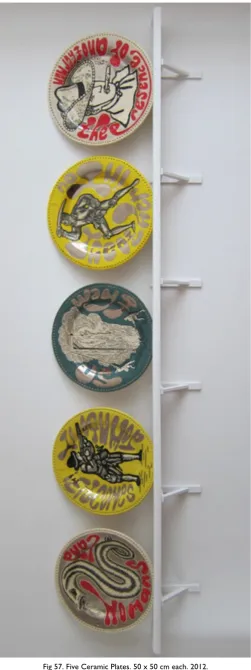
After the Imagination conference at the RCA I decided over the summer of 2011 to begin a new series of plates based around psychoanalytical ideas of
projection, transference and transitional objects. (Fig 24). I had started this series
some eighteen months previously when I made My cat knows what I am thinking
Fig 24. Five Ceramic Plates. 50 x 50 cm each. 2012.
I had always wanted to make a series of works with drawn images of stuffed animals as they are usually seen on greetings cards, and viewed as clichéd or kitsch. I
enjoy the fact that the viewer might question whether the text is ‘fridge magnet’
philosophy, or a serious look at complicated issues, or both.
For this series of plates I used my chap-print inspired font again. I wanted to make these plates fun and highly decorative. This font allows me to exaggerate and fill the plate with my design. I wanted to make images on the plates that look benign at first glance so I chose toy animals. I want the viewer to stand in front of this shiny plate with a drawing of a toy animal on, to be pulled in by the allure of the potential haptic qualities before deciphering the ambiguities within the object.
The first plate in this series is They made me do it. (Fig 16. Appendix, page 87 ).
I worked as a counsellor for an organisation called the Violence Initiative in 2005. One of the reoccurring conversations with the clients was the belief that other people made them act as they did. I chose the rabbit as he looks like he has been fighting, yet he is a bit puny, and stands there claiming they made him do it, looking innocent. I was thinking about how we imagine we take personal responsibility for our actions, but how easy it is to blame others for our behaviours.
My cat knows what I’m thinking. (Fig 17. Appendix, page 88). I always talk to my
mum through her dog. When I ask her how she is she says oh I’m ok. But when I ask
her how the dog is I get a much truer reflection on how she is. When she says the
dogs not feeling well I ask, are you not feeling good today, and she says, no I was up all
night! I used a drawing of a cat as I had, until recently, a cat called ‘Derek’ and sometimes I talk to him, saying how my days gone. Then I project my thoughts of happiness, sadness or anger on to this animal that has no idea of what I am talking about. But what ever my answer is to myself about what I think the cat is thinking, it is information, for what is going on with me that day.
Feeling Invisible. (Fig 18. Appendix, page 89). This plate came out of asking my grandmother what she thought was the worst thing about getting old. She told me
she, ‘felt invisible’. My gran was once a very beautiful woman who ran her own
grandmother made this comment near the end of her life, and it reminds me of what
Joseph Campbell (1988) said: The secret cause of all suffering is mortality itself, which is
the prime condition of life. It cannot be denied if life is to be affirmed. (Campbell, 1988)
Being alone with your thoughts is no fun (Fig 19. Appendix page 90). I had used
this phrase before for one of the first plates I made in 2009 (Fig 12. Forth plate from
the left). This came from the idea that the more you internalise and talk to yourself the greater the chance the story you tell yourself becomes distorted. Rather than an anatomical image of a head, this time I used a small dog looking sad, being with his own thoughts, a dog that thinks too much.
Optimistic outside (Fig 20. Appendix, page 91) is a plate named after me. My partner refers to me as the optimistic outsider. Not an angry outsider or rebel, but a humourist, always looking to do things differently and remove myself from established structures; philosophically acknowledging what I can control and what I cannot control. The image is of a teddy bear that I had from the age of one. My mum sent me it in the post after Grayson Perry and I visited her one evening after a football match. Grayson told her the story of his teddy, Alan Measles. Grayson’s teddy was a transitional object for him as he used it to negotiate his childhood experiences. My teddy was not transitional for me to the same extent but I think the image and the text on the plate are a good portrait of me, a projection of my perceived human qualities.
In his most recent exhibition at the British Museum The Tomb of the unknown
Craftsman (2011-12) Grayson Perry also comments on transitional objects and writes:
I also identify with Grayson Perry in his experience of therapy. In 2005 I
interviewed him for an essay on his prints, and specifically the ‘Map of an Englishman’
(Fig 25) that accompanied an exhibition of Contemporary British Printmakers. The twist that Perry brings is that although it looks like a map of an existing island, it is in fact
an imagined map rather than a pictorial description of a place. Perry says: ‘During
therapy I realised I was not in full possession of my interior landscape’. (Great-Rex, 2005, p10)
Perry describes this map as part of ‘getting the deeds’ (Great-Rex, 2005, p11) to his own
interior landscape.
Fig 25. Grayson Perry, Map of an Englishman, etching, 150 x 120cm 2004.
My supervisors had thought that maybe the way that text operated in my
work could be a potential avenue of research and to think about the ‘instability of
beauty in itself; I like how the abstract shapes in the text hold themselves within the image. I hold off reading them as text, which suggests the text is holding back and has secrecy about it, which you have to take apart, you have to tease it out so that you have to engage and work at it. Text is very dogmatic, it has a sense of closure, we are used to reading things but not to have it made difficult(Currah, 2010).
So I started to research other artists’ use of text in their work. David Hockney says:
that moment you put a word in a painting people read it, it’s like an eye. If there’s an eye in a painting you look at it, and you can’t not read a word. (Sykes, 2011, p.69)
David Beech states in Text Art Today (2009):
The first generation of text art, with artists such as Art & Language, Keith Arnatt, Joseph Kosuth and Lawrence Weiner, were primarily motivated by the analytical philosophy of Wittgenstein, Austin, Willard van Orman Quine and AJ Ayer. The second generation of text artists, including Jenny Holzer, Barbara Kruger, Kay Rosen and Raymond Pettibon, were informed by Structuralist and Poststructuralist theories of language and meaning from
Ferdinand de Saussure, Roland Barthes, Derrida and Jacques Lacan…. for the artists who
emerged in the wake of the second generation of text artists, such as Patterson, Bob and
Roberta Smith, and Titchner, the linguistic turn serves only as a set of background
assumptions which have taken hold in contemporary art. So, with the linguistic turn
thoroughly incorporated into art theory itself, text art develops by drawing on art, its histories and theories. (Selby, 2009, p.31)
I respond to Christopher Wool’s black and white industrial stenciled works, which seem to explore the possibilities of legibility and illegibility by making his texts difficult to decipher, playing with the notion of interpretation and comprehension
Fig 26. Christopher Wool. Unititled. Enamel on Aluminium, 274.5 x183cm. 2000.
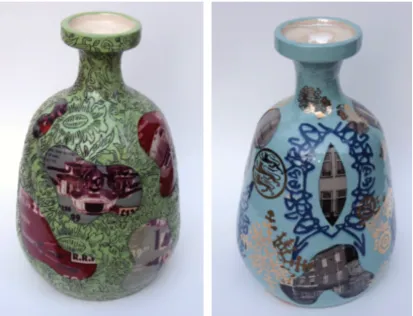
I also see my use of text connected with Grayson Perry’s work (Fig 27) and
when I interviewed him recently he commented that he had:
Fig 27. Grayson Perry. The Rosetta Vase. Glazed Ceramic Pot. 2011.
While making the psychotherapy inspired plates I also started a group of
plates contemplating existentialist questions (Fig 28). I had already made two plates
earlier in my 2009 doctorate exhibition and my exhibition at the Silas Marder Gallery
in 2009-10. These plates were called What is Man (Fig 7. Appendix, page 78) and The
End (Fig 13. Plate on far right of image). I decided to remake these plates for this existential series. I felt the method of drawing directly into the plates, as I did for
the Love series (Fig 13), was a positive way to proceed. I could build on my previous
knowledge and execution of earlier plates for the, ‘love’ series, that took traditional
English commemorative wares as their aesthetic touchstone.
The first plate I made was What is man (Fig 21. Appendix, page 92). I was
thinking about the clarity and significance of the written text this time. I wanted the text to be more legible, easier to read. I used a font similar to traditional
commemorative slipware plates. What is man is a question aimed at the viewer,
rather than a personal question for me as it had been previously.
Its about nothing (Fig 22. Appendix, page 93) is a reaction to what cannot be understood or made sense of. Prior to the making of this plate, a friend of mine committed suicide by hanging himself in his studio. His action is difficult for me to understand on many levels, as there are so many unanswered questions of why and if only. I remembered talking to this friend many years ago when I was a student and I
asked him what’s this life all about? He replied, It’s about nothing.
Fig 28. Five Ceramic Plates. 50 x 50 cm each. 2012.
What have we learnt today (Fig 24. Appendix, page 95) is a question I ask myself daily. I used the image of a tree and a family as visual metaphors for learning and sharing. Asking myself this question raises my self-awareness. This plate makes a clear and optimistic statement, that no matter what happens in life you have to move forward with family and community, the best companions.
The end (Fig 25. Appendix, page 96) is concerned with how we address the end of life. I have always thought a great deal about my relationship to death. My father died when I was 21 and close friends have died suddenly during my life. It has left me with a sense of always being prepared at any time for the unexpected visit of death. This plate is my version of a dance with death who laughs while he climbs a tree holding the hourglass.
In the production of this series I accidentally chipped the corner of one of
the plates (Fig 29). Normally I do not believe in happy accidents as I would like to get
as close as possible to what I originally aimed for. But this chip gave the plate an
implied history. I later experimented with consciously chipping another plate (Fig 30).
This time the effect didn’t work as well as some of the chips looked too large and contrived. It is something I might consider in the future if the idea and images could work together to feed the implied meaning in the artworks.
In a tutorial, Geoff Brunell and Karen Raney remarked on one of the plates
from this series that was inscribed, It's about nothing. They responded to the delicate
finish and allure of the object juxtaposed with an image of a man hanging from a tree. They also commented that the image seemingly broke the edge of the plate and
visually made the object more expansive (Fig 22. Appendix, page 93). I feel when I can
get the disjunction between the plate as the object and the content within it, then the plates start to work as artworks and have layers of meaning for the viewer to work with.
Theory and Creative Practice - Creative Mistakes
In Grayson Perry’s studio, etched into a concrete beam, he has written
Creativity is Mistakes. Creative success is often very close to failure, and often the closer I get to a sense of failure a more interesting work emerges.
The project I describe now, is the part of my practice that has not been developed but has formed part of my learning during the doctorate. Grayson Perry had begun a large body of work for his exhibition at the British Museum called the
Tomb of the Unknown Craftsman, 2011-12. The centrepiece of the exhibition was a
large 12ft iron boat that was to be a metaphorical tomb (Fig 31), a work that he had
started two years previously for the exhibition.
The size and ambition of this piece inspired me to attempt to challenge my scale of production. I had seen how long it had taken Grayson to make this piece so I thought two years for me would be a good length of time to make models and sort out the content before the final doctorate exhibition in 2013. I started to build a small model of a ‘tree/shrine’ (Fig 33), to see if it had a future as a larger artwork approximately eight feet high. The idea was stimulated by looking at roadside shrines
Fig 31. Grayson Perry. Fig 32. Roadside shrine in London. 2010. Tomb of the unknown craftsman. 2012.
This idea excited me even though the form of the object and the ideas behind it were not fully formed. I kept working on the model over the summer of 2011 but in the final analysis I didn’t take it any further. The main reasons for my change of heart was my resistance to give so much time to building it as it would take the bulk of my studio time over the following eighteen months. Also as an artwork it might not achieve what I wanted it to and my own lack of ability at this point to make a three dimensional object was obvious after building the model. I felt I could not be as intuitive as I needed to be if I chained myself to an outcome with a two year
gestation period. Recently I have seen a tree in the exhibition, Bronze, at the Royal
Academy which ignited in me the possibility of remaking this work in the future,