Tree Based Symmetric Key Broadcast Encryption
Sanjay Bhattacherjee and Palash Sarkar Applied Statistics Unit
Indian Statistical Institute
203, B.T.Road, Kolkata, India - 700108.
[email protected] and [email protected]
Abstract
The most influential broadcast encryption (BE) scheme till date was introduced in 2001 by Naor, Naor and Lotspiech (NNL) and is based on binary trees. This paper generalizes the ideas of NNL to obtain BE schemes based on k-ary trees for any k ≥ 2. The treatment is uniform across allk and essentially provides a single scheme which is parameterized by the arity of the underlying tree. We perform an extensive analysis of the header length and user storage of the scheme. It is shown that for a k-ary tree withn users out of which r are revoked, the maximum header length is min(2r−1, n−r,dn/ke). An expression for the expected header length is obtained and it is shown that the expression can be evaluated in O(rlogn) time. Experimental results indicate that for values of r one would expect in applications such as pay TV systems, the average header length decreases ask increases. The number of keys to be stored by any user is shown to be at most (χk−2)`0(`0+1)/2, where`0=dlogkneandχkis the number of cyclotomic cosets modulo 2k−1. In particular,
when the number of users is more than 1024, we prove that the user storage required for k = 3 is less than that of k = 2. For higher values of k, the user storage is greater than that for binary trees. The option of choosing the value ofk provides a designer of a BE system with a wider range of trade-offs between average header length and user storage. The effect of layering on thek-ary tree SD scheme is also explored.
Keyword: Broadcast encryption; subset difference; trees; general arity; probabilistic analysis; header length; transmission overhead; cyclotomic cosets; layering
1
Introduction
Broadcast Encryption (BE) deals with the problem of broadcasting encrypted data. For each transmission (or session), there is a set ofprivileged users who should be able to decrypt the data and a set ofrevoked users who should not be able to do so. In symmetric key BE, there is a center which initially distributes keys to all the users and also broadcasts the encrypted data in each session. In each session, the data to be broadcast is encrypted with a random session key using a symmetric key encryption algorithm. This session key is further encrypted using other keys and the encryptions of the session key are sent as the header with the encrypted body. The number of times the session key is encrypted for each session is called theheader length. Any privileged user will be able to use its secret information to correctly decrypt the session key from the header and hence the message sent in the session. A fully resilient scheme ensures that an adversary with the secret information of all the revoked users cannot decrypt the broadcast correctly. Two important efficiency parameters for a BE scheme are the header length; and the user storage which is the amount of secret information that each user has to store.
has a storage requirement of O(log2n) and a worst case header length of 2r−1, where nis the total number of users and r is the number of revoked users.
The idea of layering introduced by Halevy and Shamir [HS02] reduced the user storage of the NNL-SD scheme from O(log2n) toO(log3/2n) at the cost of increased communication overhead. In [BS14], this layering strategy was generalized to obtain different trade-offs between the user storage and communication overhead. An important optimization was the storage minimal layering that guaranteed minimal storage requirement that could be achieved using layering for a given n.
1.1 Our Contributions
In this work, we extend the ideas of NNL tok-ary trees for any k≥2. Our treatment is general and unified, i.e., the same approach works for all values ofk. Supposenis a power of k, i.e.,n=k`0 for some`
0 ≥1 and consider
the users to be the leaf nodes of a full k-ary tree of height`0. Letj1, . . . , jc, 1≤c≤k, be a set of sibling nodes
in this tree and iis an ancestor of these nodes. Consider the setS of leaf nodes in the subtree formed by taking away the subtrees rooted at j1, . . . , jcfrom the subtree rooted ati. So, the setS is formed as a subset difference
of two sets of users. Subsets of users arising in this manner are called SD sets. The identification of the SD sets is a key aspect of obtaining the k-ary tree scheme. This idea extends the idea of SD sets introduced for binary trees in [NNL01, NNL02].
An intuition behind consideringk-ary trees withk >2 is that the number of SD sets grows with increasing
k and so the header length may come down at the cost of increasing the user storage. This, however, does not turn out to be entirely true. Working out the details of the scheme and the resulting analysis shows up a rich complexity of behavior which is not apparent at the outset. We provide an extensive analysis of the scheme covering the following points.
Cover Generation Algorithm A single cover generation algorithm which
works for all kis developed. This is an intuitively simple algorithm which uses just an array as the underlying data structure. Specializing this algorithm fork= 2 yields the cover finding algorithm given in [NNL01, NNL02]. The description of the algorithm turns out to be considerably simpler that of [NNL01, NNL02].
Traitor Tracing The NNL paper [NNL01, NNL02] provides a mechanism for tracing traitors. With some modification, this idea also fits the k-ary BE scheme. It turns out that compared to binary trees, for k ≥ 3, tracing traitors can be done with lesser number of queries.
Header Length For k-ary trees with n users, the maximum header length of a transmission with r revoked users is shown to be min(2r−1, n−r,dn/ke). Somewhat surprisingly, the first component, i.e., 2r−1 is not affected byk. We show that the bound of 2r−1 is indeed achieved for values ofk greater than 2. Average case analysis of the header length is done under the assumption that the revoked set of users is distributed uniformly among the set of all users. With this assumption, we derive an expression for the expected header length. The method is to compute the probability that any internal node generates a subset in the header. Summing over all these probabilities provide the expected header length. The expression for the expected header length can be computed in O(rlogn) time and O(1) space. We have implemented the algorithm to compute the expected header length and provide representative values to show the average header lengths for different values of k.
generator so that user storage consists of 1 +dlog2ne(dlog2ne+ 1)/2 seeds. The direct combination of this idea with the SD sets of a k-ary tree makes the user storage to be 1 + (2k−1−1)dlogkne(dlogkne+ 1)/2 seeds. We show that a modification based on the use of cyclotomic cosets modulo 2k−1 reduces the user storage to 1 + (χk−2)dlogkne(dlogkne+ 1)/2 seeds, where χk is the number of cyclotomic cosets modulo 2k−1.
Tackling Arbitrary Number Of Users When n is not a power of k, we show that a complete k-ary tree structure can be used to construct the BE scheme. This is an analogue of complete binary trees used in data structures. Average header length analysis of such schemes is performed using simulation studies.
Layering The idea of layering is extended for the k-ary tree generalization of the SD scheme. The choice of the layering strategy determines the user storage of the layered version of the scheme. A dynamic programming algorithm is proposed to compute the layering strategies for which the user storage is minimum. This generalizes the algorithm for k= 2 which was given in [BS14].
Simulation Study Of The Header Length We perform a simulation study of the average header length for
n= 10x (x= 3, . . . ,8) users and fork = 2, . . . ,8. Experimental results indicate that there is a cut-off valueδk
such that forr/n > δk, the average header length of thek-ary scheme is lesser than that of the binary tree based
scheme. Further, the value of δk decreases ask increases. This suggests that by increasing k, it is possible to
reduce the header length for lower values of r. This can be important for applications such as Pay-TV systems. The trade-off is a one-time moderate increase in user storage.
In applications like [AAC] where the storage for the header is fixed in the standard, there is a threshold for the maximum number of users that the system can accommodate. With decrease in the average header length, the system can accommodate more number of revoked users on an average.
1.2 Previous And Related Works
Broadcast Encryption was introduced by Berkovitz and his scheme was based on “k out of n” secret
shar-ing [Ber91]. However, this scheme was “one-time” and the keys had to be updated after every use. BE was first formally studied and the term Broadcast Encryption was coined by Fiat and Naor in [FN93]. The idea of resiliency of a scheme against colluding users was also formally introduced in [FN93]. They proposed a number of schemes that provided trade-offs between the user storage and the transmission length.
Broadcast Encryption for stateless receivers was first considered explicitly by Naor, Naor and Lotspiech in [NNL01, NNL02]. They defined a generic framework, called Subset-Cover framework, encapsulating several
previously proposed revocation methods. The algorithms of the Subset-Cover framework are based on the
principle of covering all non-revoked users by disjoint subsets from a predefined collection. They proposed two tree-based schemes namely the Complete Subtree (NNL-CS) scheme and the Subset Difference (NNL-SD) scheme. Halevy and Shamir [HS02] reduced the user storage in the NNL-SD scheme by dividing the levels of the underlying tree of the SD scheme into layers. The NNL-SD [NNL01, NNL02] and the HS-LSD [HS02] schemes assumed the number of users to be a power of two. In [BS14] the idea of layering was further explored to obtain various layering strategies offering different trade-offs. One out of these optimizations was minimizing the user storage.
Two public key BE schemes were proposed in [Asa02] that assigned keys to subsets following the Complete Subtree (CS) method of [NNL01, NNL02]. While the CS method assumed an underlying binary tree, the schemes in [Asa02] were allowed to have arity greater than or equal to two. The paper does not discuss how to extend the Subset Difference technique of [NNL01, NNL02] for trees of arity greater than two.
“However, in a general a-array tree witha ≥4, there exists sets of nodes that are inconsecutive . . .
Our hash chain approach fails with regard to these inconsecutive points. Thus, the construction of a coalition resistant a-array SD method with reasonable communication, computation, and storage overhead is an open issue.”
For a given upper bound on the user storage of any BE scheme, a lower bound on the header length was shown in [LS98]. Stateless and low-state BE in low-memory devices was considered in [GST04]. One-way chain based BE schemes were proposed in [JHC+05] where the header length was brought down belowr for the first time, while the user storage requirement was quite large. The NNL-SD scheme can also be viewed as a special case of this scheme.
There have been several works on the analysis of the tree based schemes. The analysis of the expected header length for the NNL-CS, the NNL-SD and the HS-LSD schemes was done in [PB06]. This analysis was continued in [EOPR08] which showed that the standard deviations for these schemes are small compared to the means as the number of users gets large. Therefore, the mean number is a good estimate of the number of necessary encryptions used by these schemes. A detailed analysis of expected header lengths and algorithms to compute them have been obtained in [BS13]. Lower bounds on the header length of most subset cover algorithms for
different types of r were found in [AK08]. Detailed worst case header length analysis for the NNL-CS and
NNL-SD schemes of [NNL01, NNL02] have been done in [MMW09].
2
Subset Cover Framework
The Subset-Cover framework for broadcast encryption was proposed in
[NNL01, NNL02]. Almost every known symmetric key broadcast encryption scheme falls under this framework. It has three phases namely,initiation,encryption anddecryption. In the initiation phase, a collectionS of subsets ofN is created. Each subset in S is assigned a secret key. A user gets the secret information which enables it to compute the secret keys of all subsets S of users such that it is a member of S and S ∈ S. Once this initiation phase is over, the system is ready for secured broadcasting. The broadcast messages are sent to the users in blocks. Each block goes with a new session. For each session, the center knows the set of revoked users R. It finds the set of subsets Sc = {Si1, Si2, . . . , Sih} ⊂ S from the collection S such that each privileged user is in some subset inSc. In other words,
N \ R= [
i∈{i1,...,ih}
Si.
This set of subsets Sc is called the subset cover and the algorithm to find Sc is called the cover generation or
cover finding algorithm. A message block is encrypted with a randomsession key Kchosen anew for each session and forms the body of the message. This session key is further encrypted for each subsetSi inSc, using its key.
These encryptions of the session key accompany the message body as the header. The number of subsets in the cover h =|Sc|is called the header length. For decryption, a privileged user first decrypts the session key from
the header, using which it decrypts the message block.
2.1 The (Binary Tree) Subset Difference Scheme
The Naor-Naor-Lotspiech Subset Difference (NNL-SD) scheme [NNL01, NNL02] is the most popular BE scheme and falls under the Subset-Cover framework. The NNL-SD scheme assumes the number of users to be a power of two. During initiation, the users are associated with the leaves of a full binary tree T0. A subtree of T0 rooted
at node iin the tree is denoted as Ti. A subtree Ti also identifies the set of users at its leaves. The subsets in
the collectionS are of the formSi,j whereSi,j consist of the leaf nodes of the subgraphTi\ Tj such thatj (6=i)
Keys are associated to each subset Si,j ∈ S as follows. Every internal (non-leaf) node i in T0 is assigned
a uniform random seed Li. All descendant nodes j in the subtree Ti are associated with seeds derived from
Li in the following manner. A cryptographic pseudo-random generator G : {0,1}k → {0,1}3k is chosen. The
output of G is thrice the length of its input. The three equal portions of the output are denoted asG(seed) =
GL(seed)||GM(seed)||GR(seed). Let a nodei have some (random or derived) seedi. The left child of i gets the
derived seed GL(seedi) and the right child of i gets the derived seedGR(seedi). The derived seed for a node j
from the uniform random seedLi of an ancestor nodeiis denoted asLi,j. The key for the subsetSi,j isGM(Li,j).
A user receives the secret information from which it can derive the secret keys of all subsets to which it belongs. It is to be noted that if a user belongs to a subset Si,j, i is an ancestor of the leaf corresponding to
the user and j (being in the subtree Ti), is not an ancestor of that leaf. Let i be an ancestor of the leaf node
associated with the user. Let j1 be a node directly attached to the path joining the user leaf and the node i.
The seed derived from Li by the node j1 is Li,j1. The user receives this derived seedLi,j1 as part of its secret
information. It can be seen that using Li,j1, the user can derive the key for any subset Si,j where j is in the
subtree rooted at nodej1. Similarly, the user receives the seeds derived fromLi for all nodes directly attached to
the path joining the leaf of the user and the ancestor i. From the derived seeds that the user gets, it can derive the keys for all subsets Si,j to which it belongs.
A cover finding algorithm is described in [NNL01, NNL02] which allows the center to find a collection of subsets which covers all the privileged users. We do not describe this here, since, later we provide a cover finding algorithm for k-ary trees which has the binary tree cover finding algorithm as a special case.
3
The
k
-ary Tree Subset Difference Scheme
The description of the scheme is given in two parts – initiation and the cover generation algorithm.
3.1 Initiation
Fix the arity of the underlying tree to be a positive integerk≥2 and let the number of usersnto be a power of
k, say n=k`0. (Later, we describe how to handle the case whennis not a power of k.) Let T0 be a full k-ary
tree havingn=k`0 leaf nodes. There are `
0+ 1 levels in T0. The root node is considered to be at level`0 while
the leaf nodes are considered to be at level 0. The total number of nodes in T0 is
1 +k+k2+. . .+k`0 = nk−1
k−1 .
The users are assumed to be at the leaf nodes ofT0. So, the setN of all users consists of the leaf nodes ofT0.
Numbering Of The Nodes In T0 The nodes in T0 are numbered as follows: the root is numbered 0; thek
children of an internal nodeiare numbered from left to right aski+ 1,ki+ 2, . . . , ki+k. The nodes inT0 are
identified by their numbers. So, the parent of any nodeiis i−1 k
. For a nodei, we denote byTi the subtree of T0 rooted ati.
The CollectionS Letibe an internal node and supposeJ is a set of nodes inTi which have a common parent
(and so the nodes in J are siblings) such that 1≤ |J|< k. LetSi,J be the set of leaf nodes in the subgraph
Ti\ [ j∈J
Tj.
Si,J is a subset of the leaf nodes of T0 and so a subset of the set of all users N. DefineS to be the collection of
0
1
4
13 14 15
5
16 17 18 6
19 20 21
2
7
22 23 24
8
25 26 27
9
28 29 30
3
10
31 32 33
11
34 35 36
12
[image:6.595.115.482.88.182.2]37 38 39
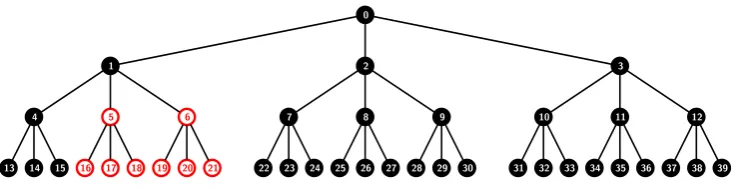
Figure 1: The k-ary treeT0 with k= 3 and n= 27 users. The subset S
0,{5,6} contains all users (leaves) in the subtree T0 but not inT5 orT6. Hence,S
0,{5,6}={13,14,15,22,23, . . . ,39}.
Number Of Subsets In The Collection S We count the number of subsetsSi,J inS. Fix an internal node
iand suppose it is at level`. Let us now consider the number of subsets of nodesJ such thatSi,J is inS. There
are two conditions on J: all nodes in J have the same parent and 1 ≤ |J| ≤k−1. The common parent of the nodes in J is an internal node in Ti. So an internal node in Ti gives rise to 2k−2 possible subsets of nodesJ.
The number of internal nodes inTi is 1 +k+k2+. . .+k`−1 = (k`−1)/(k−1). So for a fixed nodeiat level`,
there are a total of (2k−2)((k`−1)/(k−1)) possible subsets Si,J.
InT0, there arek`0−` internal nodes at level `. Therefore, the number of subsets generated by all the nodes
at level`is (k`−1)/(k−1)×(2k−2)×k`0−`. Summing this by varying `from 0 to`
0 we get the total number
of subsets Si,J inS. Additionally, we have to count the setN of all users. Hence, the total number of subsets
inS is
|S|= 1 + (2k−2)P`0
`=1k
`−1
k−1(k
`0−`) = 1 +2
k−2
k−1
`0−1 X
`=0
(n−k`)
= 1 +2kk−−12
n`0+nk−−11
. (1)
For n = 16, and k = 2, the number of subsets in S is 159. For n = 16, and k = 4, the number of subsets
in S is 323. We observe that for a fixed n, the number of subsets in the collection increases with increasing
k. Intuitively, it seems that increasing the number of subsets in S by increasing k should decrease the header length. This, however, is not always true. Later, we make a detailed analysis of both the maximum and the average header length of the scheme.
Key Assignment To Subsets In S Given an m-bit string, we need to obtain 2k−1 m-bit strings. This is achieved as follows:
LetG:{0, . . . ,2k−2} × {0,1}m→ {0,1}m be a cryptographic hash function. DefineG
σ(seed)=∆G(σ, seed).
This definesGσ(seed) for anm-bit stringseedand 0≤σ≤2k−2. One advantage of this method is that givenσ
it allows directly “jumping” to a particularGσ(seed). We note though that the description of the key assignment
method given below does not depend on the particular manner in which Gσ has been defined.
The key assigned to a subsetSi,J is defined indirectly. The procedure is described as follows.
1. Every internal nodeiis assigned an independent and uniform random seed Li.
2. Every node j 6= i in the subtree Ti is assigned a seed L
i,{j} derived from Li using G in the following
manner.
(a) Suppose j is an immediate child of i and write j as j = ki+s+ 1 for some 0 ≤ s≤ k−1. Define
(b) If j is not an immediate child ofi, then leti=t0, . . . , tp =j be a sequence of nodes fromi toj. Let
tq=ktq−1+sq+ 1 where 0≤sq≤k−1 for 0≤q ≤p. Define Li,{j}=G2sp(G2sp−1(· · ·G2s1(Li))).
3. Let j (possibly equal to i) be an internal node in Ti and let J ⊂ {kj + 1, kj + 2, . . . , kj +k} with
2 ≤ |J| ≤ k−1. The previous step has already defined the seed Li,{j}. Let s be the unique integer in
{0, . . . ,2k−2} such that the k-bit binary representation of s encodes J, i.e., the bth bit of this binary representation is 1 if and only if kj+bis in J. Define Li,J =Gs(Li,{j}).
4. For each possible subset Si,J, the above procedure defines the seed Li,J. The key assigned to the subset
Si,J is G0(Li,J).
0 L0
1
G1(L0) G2(L0) 2 3 G4(L0)
10 G1(G4(L0))
32 G2(G1(G4(L0)))
[image:7.595.121.483.241.369.2]11 12
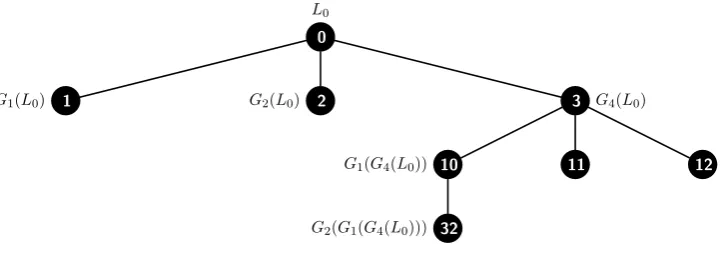
Figure 2: Seeds derived by node 32 and its ancestors 3 and 10 from L0. L0,{32} =G2(G1(G4(L0))).
To illustrate the assignment of seeds, let us consider the tree T0 with k = 3 and n= 27 users as shown in
Figure 1. The internal nodes 0, . . . ,12 get uniform random seeds L0, . . . , L12 respectively. The seeds derived
from L0 by nodes at levels 2 and 1 are as follows:
For level 2:
L0,{1} =G1(L0),L0,{2} =G2(L0),L0,{3}=G4(L0),
L0,{1,2} =G3(L0),L0,{2,3}=G6(L0), L0,{1,3} =G5(L0).
For level 1:
L0,{4} =G1(G1(L0)), L0,{5}=G2(G1(L0)),L0,{6} =G4(G1(L0)),
L0,{4,5} =G3(G1(L0)), L0,{5,6}=G6(G1(L0)), L0,{4,6}=G5(G1(L0)),
L0,{7} =G1(G2(L0)), L0,{8}=G2(G2(L0)),L0,{9} =G4(G2(L0)),
L0,{7,8} =G3(G2(L0)), L0,{8,9}=G6(G2(L0)), L0,{7,9}=G5(G2(L0)),
L0,{10}=G1(G4(L0)),L0,{11} =G2(G4(L0)), L0,{12} =G4(G4(L0)),
L0,{10,11} =G3(G4(L0)), L0,{11,12} =G6(G4(L0)),L0,{10,12}=G5(G4(L0)).
Similarly, the seeds derived from L0 for subtrees at level 0 and their combinations, can be determined.
Figure 2 shows how node 32 of Figure 1 gets its derived seed from the uniform random seedL0. There will
be seeds derived from every such Li.
Storage Per User During initiation, a user will receive information (a set of derived seeds), from which it can derive the keys of all subsets it belongs to and no more. A user is associated to a leaf node inT0. The SD
subsets Si,J the user will belong to, will be rooted at some ancestor node iof that leaf. However, none of the
• iis an ancestor of the user leaf, and
• none of the nodes j1, . . . , js are on the path joining the root node and the user leaf.
A user has to receive seeds such that it can generate the keys of all such subsets. We have already seen how keys for subsets are derived from seeds assigned to nodes inT0. Out of these seeds, a user gets the derived seeds from
which it can generate the keys of subsets to which it belongs and no more.
The general strategy for assignment of seeds to users is as follows. Let us consider the path joining the user leaf and the root node in T0. Let i be a node on this path and hence an ancestor of that user. The key for a
subset Si,J to which the user belongs will be derived from Li. None of the nodes in J are on the path joining
the user leaf and i(a part of the path with the root). Hence, the nodes inJ are siblings that are either directly attached to this path or are in a subtree attached to this path. The user gets the seeds derived from Li of all
nodes and their combinations that are directly attached with (or “falling-off ” from) this path. Using these seeds and G, the user can derive the keys of every subsetSi,J to which it belongs and no more.
To illustrate the assignment of seeds to the users, let us again consider the tree in Figure 1. As an example, we look at the information that has to be given to the user at leaf 13. For that, we first identify the subsets to which the user at 13 belongs. The user at leaf 13 has three ancestor nodes 4,1 and 0. Hence, it belongs to subsets of the form S0,J,S1,J and S4,J where nodes in the respective subsets J are not ancestors of the leaf 13.
If the user at leaf 13 gets the derived seed L0,{2}, it can derive using G, the key for any subsetS0,J where nodes
in J are in the subtree rooted at node 2. Similarly, with the derived seed L0,{3}, the user can derive the key for any subset S0,J where nodes in J are in the subtree rooted at node 3. Additionally, it needs the key for the
subsetS0,{2,3}. We know that, if the user at leaf 13 gets the derived seedsLi,J for every ancestor nodeiand the
set J has a node (or a combination of nodes) directly attached to the path joining the leaf 13 to the root node 0, it can derive the key for any subset it belongs to.
Using this strategy, the user at leaf node 13 gets the seeds for S0,J for the following J: {2}, {3}, {2,3}, {5},{6},{5,6},{14},{15},{14,15}. It gets the seeds for S1,J for the followingJ: {5}, {6},{5,6},{14},{15}, {14,15}. It gets the seeds forS4,J for the followingJ: {14},{15},{14,15}. Hence, the user at leaf node 13 gets
the following seeds:
derived fromL0:
G2(L0), G4(L0), G6(L0),
G2(G1(L0)),G4(G1(L0)), G6(G1(L0)),
G2(G1(G1(L0))),G4(G1(G1(L0))),G6(G1(G1(L0))).
derived fromL1:
G2(L1), G4(L1), G6(L1),
G2(G1(L1)),G4(G1(L1)), G6(G1(L1)).
derived fromL4:
G2(L4), G4(L4), G6(L4).
Next we compute the number of seeds that the user will have to store. The number of seeds derived from seedLi of an ancestor nodeiat level`, will be 2k−1−1 for each level below`. Thus, the total number of derived
seeds due to node iwill be (2k−1−1)`. Since there are`0 such ancestor nodes of the user at each level 1, . . . , `0,
the total number of seeds to be stored by the user will be
1 + (2k−1−1)
`0 X
`=1
`= 1 +`0(`0+ 1)
2 (2
k−1−1). (2)
no revoked users. The factor (2k−1−1) in (2) can be reduced using a modified method of distributing secret information to the users. We describe how to do this in Section 6.
3.2 Cover Finding Algorithm
Once the initiation is over and users have been given their secret information, the center can start broadcasting encrypted messages to the set of privileged users. If there is no revoked user, the only set for which the messages are encrypted is the set N of all users. Otherwise, for a given set of revoked users, the center finds the subset cover using the iterative algorithm outlined below. The subset cover contains subsets of the formSi,J where all
nodes inJ are siblings and hence are at the same level.
The algorithm runs on a listLof nodes inT0 that lie on the paths joining revoked leaf nodes to the root node.
To start with, the list L consists of all revoked leaves from left to right in T0. In the course of the algorithm, L is appended with all nodes on the paths joining the revoked leaves to the root. This is done as follows. Once
L is populated with the revoked leaves, the algorithm runs iteratively from left to right on L. In iteration t, it considers the tth node j from the left in L. If j is not the root, the parenti of j is appended to L, if it is not already present there. Hence L keeps growing on the right, with nodes at higher levels on the tree (up to the root) getting added to its right end. The root node eventually gets appended to L. The algorithm terminates after working on the root node.
For each nodej inL, a summary of requisite information about the subtreeTj is maintained inLalong with
the nodej. Each nodejinLhas an associated setSDnodes[j]. The setSDnodes[j] contains roots of all subtrees that will be subtracted from Tj, in case an SD subset is generated from node j. The cover finding algorithm
ensures that all nodes in SDnodes[j] for any node j are at the same level in T0. For each leaf node j in the
initial list L,SDnodes[j] ={j}. If a nodej gives rise to a subset Sj,J in the algorithm, thenJ =SDnodes[j]. In
the course of the algorithm, each such node j from which a subset Sj,SDnodes[j] should be generated, have to be identified. To that end, each node inL gets marked as “intermediate” or “covered” depending upon its position in the tree. Every iteration of the algorithm works on a particular node and based on the mark of that node and its siblings, subsets for the cover may or may not be generated. Let the tth node from the left inL be denoted by L[t]. The nodeL[t] is processed in thetth iteration.
The Algorithm Takes as input the setRof revoked users and outputs the subset cover Sc.
1. Form the initial list L with all revoked leaf nodes at level 0 of T0. Mark each node j ∈ L as coveredand
set SDnodes[j] ={j}.
2. Process nodes in Lfrom left to right. If L[t] is the root node, go to step 3. Otherwise, let ibe the parent of L[t]. At the tth iteration:
(a) If L[t] andL[t+ 1] have the same parent, skip the step below and continue to the next iteration for
L[t+ 1].
(b) Else, append itoL. Let{j1, . . . , jc}be the children of iinL. The following mutually exclusive cases
occur:
i. Case when all nodes j1, . . . , jc arecovered:
A. If c < k, markiasintermediate and setSDnodes[i] ={j1, . . . , jc}.
B. For c=k, markiascoveredand set SDnodes[i] ={i}. ii. Case when c= 1 and j1 is intermediate:
Markias intermediateand copySDnodes[j1] toSDnodes[i].
iii. Case when c >1 and there is at least one intermediatenode in{j1, . . . , jc}:
A. If c < k, markiasintermediate and setSDnodes[i] ={j1, . . . , jc}.
B. For c=k, markiascoveredand set SDnodes[i] ={i}.
3. If the root node is marked as intermediate, add S0,SDnodes[0] to the coverSc.
When the iterations terminate at step 2 in the above algorithm, if the root is marked ascovered, it implies that all privileged users have been covered and hence no more SD subsets are added in step 3. The subset cover Sc
output by the algorithm is a collection of subsets of the form Si,SDnodes[i].
0
1
4
13 14 15
5
16 17 18 6
19 20 21
2
7
22 23 24 8
25 26 27 9
28 29 30
3
10
31 32 33
11
34 35 36
12
[image:10.595.117.481.207.296.2]37 38 39
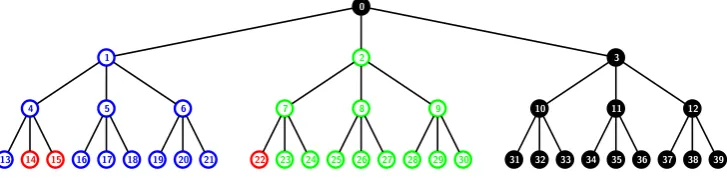
Figure 3: The subset cover Sc forR={14,15,22} will contain the SD subsetsS1,{14,15},S2,{22} and S0,{1,2}.
Algorithm Demonstration To demonstrate the above algorithm, let us consider the revocation patternR=
{14,15,22}in the treeT0 with 27 users in Figure 3. The listLthat is operated on iteratively in the algorithm, is
eventually populated with the nodes{14,15,22,4,7,1,2,0}. These are nodes that lie on the paths joining revoked users with the root node. Nodes 14,15 and 22 are initiallycovered. The parent 4 of 14 and 15 is appended to the list and marked as intermediate with SDnodes[4] ={14,15}. Similarly, 7 is appended to the list and marked as
intermediatewithSDnodes[7] ={22}. Next 1 is appended and marked asintermediatewithSDnodes[4] ={14,15}
copied to SDnodes[1]. Then 2 is appended and marked as intermediate with SDnodes[7] = {22} copied to
SDnodes[2]. Finally, 0 is appended to the list. Since 0 has two children in the list which are notcovered, the subsets
S1,SDnodes[1]andS2,SDnodes[2]are added to the coverSc. Node 0 is marked asintermediatewithSDnodes[0] ={1,2}.
Finally, the subsetS0,SDnodes[0] is added to Sc. Hence, forR={14,15,22},Sc={S1,{14,15}, S2,{22}, S0,{1,2}}.
Once the subset cover Sc has been constructed, the message M is encrypted using a random session key,
which in turn is encrypted for each set in the cover. These encryptions of the session key are sent along with the encrypted message as the header part of the cipher-text. The number of sets in the cover, also called the header length, is the parameter determining the transmission overhead of the scheme.
Nodes That Generate A Subset Nodes inLare the only nodes ofT0 that are processed in the cover-finding
algorithm. Hence, subsets in the cover are generated from nodes in L only. In other words, if Sj,SDnodes[j] is in
the cover, then j ∈ L and SDnodes[j]⊂ L. The following Lemma 1 identifies the properties of the node j and the set of nodes SDnodes[j].
Lemma 1. Suppose Sj,SDnodes[j] is in the subset cover. Node j and the nodes in SDnodes[j] have the following properties:
(1-a) Not all k children of j are in L, and
(1-b) j is either the root or an internal node with a sibling in L.
(2-a) If SDnodes[j] ={v}, then v is either a leaf node or an internal node with all its children in L. (2-b) If |SDnodes[j]|>1, then all nodes of SDnodes[j] are siblings.
Proof. First we show that j is either the root or an internal node with a sibling in L. At step 3 of the cover finding algorithm described above, we see that SD subsets of the form S0,SDnodes[0] may be generated. Hence,
node j can be the root. If node j is not the root, then the only other way a subset may be generated is in step 2-b-iii of the algorithm. In this step, the algorithm considers a node iinL with a set{j1, . . . , jc} of its children
inLwherec >1. Everyj∈ {j1, . . . , jc}that is marked asintermediateat that point, generates a subset. Hence,
a non-root nodej that generates a subset, must have a sibling in L.
Next, we show that not allkchildren ofjare inL. The root node generates a subset in step 3 of the algorithm only if it is marked as intermediate. A node j that generates a subset in step 2-b-iii, is marked as intermediate
until that point. Hence j is not marked covered until the subset Sj,SDnodes[j] is generated from it. This implies
that in previous iterations, when the children of j inL were being processed, it was not marked as covered. A node may be marked as covered in either (1) step 2-b-i-B or 2-b-iii-B when all its children are in L, or (2) step 2-b-iii after it has generated a subset. If j=L[t], then until the tth iteration,j remains marked as intermediate
if the number of children of j inLis less than k. Thus, not all kchildren of j are inL.
In the cover finding algorithm, step 1 and the three mutually exclusive steps within step 2-b are the only places from where a set SDnodes[j] may arise. From step 1 of the algorithm, we see that for each leaf node j,
SDnodes[j] is singleton. From steps 2-b-i-B and 2-b-iii-B, we see that if allkchildren of an internal nodej are in
L, thenSDnodes[j] is singleton. These are the only two ways in whichSDnodes[j] for a nodej can be singleton. A set SDnodes[j] with more than one node is created only in steps 2-b-i-A and 2-b-iii-A. Clearly, the nodes inSDnodes[j] have a common parentiand hence are siblings of each other. Hence, if |SDnodes[j]|>1, then all nodes in SDnodes[j] are siblings. It is also clear from steps 2-b-i-A and 2-b-iii-A that SDnodes[j] can have at mostk nodes. Hence,|SDnodes[j]|< kfor any j.
Correctness Of The Algorithm We prove that the algorithm described above, generates subsets that were assigned keys during initiation as has been described in Section 3.1. We also show that all privileged users are in some subset in Sc and no revoked user is included in any of the subsets.
Theorem 2. A subsetSj,SDnodes[j]generated by the algorithm is such that (1) 1≤ |SDnodes[j]|< k, (2) all nodes
in SDnodes[j] are siblings of each other, and (3) j is their ancestor. The union of the subsets in Sc include all
privileged leaves and no revoked leaves.
Proof. From Lemma 1 we know that all nodes in SDnodes[j] are siblings of each other and 1≤ |SDnodes[j]|< k. It can be seen from steps 1 and 2-b of the algorithm that a nodej1 gets inserted into a setSDnodes[j] only if j
is an ancestor of j1.
A subsetSi,SDnodes[i]output by the algorithm, represents all leaf nodes in the induced subgraph
Ti\ ∪
j∈SDnodes[i]Tj.
In other words, the subset Si,SDnodes[i] has leaves in Ti that are not in the subtrees in SDnodes[i]. It can be
seen from steps 2-b-i and 2-b-iii that a covered node in L is always within some subtree in the set SDnodes of its parent and ancestors thereon. Hence, once marked covered, a node is not in any set Si,SDnodes[i] inSc that is
included thereafter. From steps 1 and 2-b-1 of the cover finding algorithm, we know that each revoked leaf j is inSDnodes[j] and hence in some subtree inSDnodes[i] for every ancestoriofj. This implies that a revoked leaf cannot be in any subset inSc.
We next show that any privileged leaf is in a subset inSc. Let us consider the path joining a privileged leaf to the root in T0. Since the root node is inL, hence there will be at least one node on this path that is in L.
Letj1 be the node on this path that is inLand is nearest to the privileged leaf. All subsequent nodes above j1
are in L. Again, since the root node is on the path (j1, . . . ,0), at least one of the nodes on this path generate
a subset in Sc. Let the node in (j1, . . . ,0) that is nearest to the privileged leaf and generates a subset be j.
all leaves in Tj but not in any of the subtrees in SDnodes[j]. The privileged leaf is in Tj. We show that it is
not in any of the subtrees in SDnodes[j]. From steps 1 and 2-b in the algorithm, we know that SDnodes[j] has nodes that have been covered. Nodes between the privileged leaf and before j1 are not in L and hence cannot
be covered. Sincej is the only node on the path (j1, . . . , j) that generates a subset, all nodes on this path are
intermediateuntil the subsetSj,SDnodes[j]is generated fromj. Consequently,SDnodes[j] does not have any of the
nodes on the path joining the privileged leaf andj. Hence, the privileged leaf is not in any of the subtrees rooted at nodes in∪j0∈SDnodes[j]Tj
0
. Hence, the privileged user is in the subset Sj,SDnodes[j].
Relation To The NNL-SD Scheme The case k = 2 of the above scheme is exactly the NNL-SD scheme described in [NNL01, NNL02]. So, the new scheme is a generalization of the NNL-SD scheme and subsumes it. One important advantage of the new scheme is a uniform description of the cover generation algorithm irrespective of the value of k. We note that this description is simpler than the description for k = 2 given in [NNL01, NNL02] which is phrased in terms of Steiner trees. It turns out that the more elementary description of the cover generation algorithm is cleaner which leads to an easier implementation.
Relation To The Ternary Tree Scheme In [FKTS08] For k = 3, the collection S that we consider is the same as that in [FKTS08]. However, the method for assigning keys to these subsets is different. The work [FKTS08] uses a hash chain method and mentions that it does not extend tok-ary trees for k≥4. On the other hand, our method of distributing secret keys to the users is general and works for all k. In Section 6, we describe a modified method of distributing secret keys which further lowers the user storage requirement.
3.3 Traitor Tracing
Traitor tracing is the mechanism to identify leaked user keys from a pirate decoder by treating it as a “black-box”. Traitor tracing for the NNL-SD scheme was discussed in details in [NNL01, NNL02]. They showed that traitor tracing can be done on any scheme that assigns keys to subsets which satisfy the bifurcation property. The bifurcation property states that given any subset that is in the collection S and hence has been assigned a key, it is possible to partition the set into two (or a constant number of ) almost equal subsets from S. The
bifurcation value is defined to be the ratio of the size of the largest subset to that of the set itself.
For thek-ary tree SD scheme, a subsetSi,J in its collection S is such that all nodes in the setJ are siblings
and are in the subtreeTi. If the parent of the nodes inJ isi, then the subsetS
i,J is split into equal sized subsets Tj where j is a child of iand j /∈J. Thus, each child subtree of iwhose root is not inJ forms a subset in the
split. All the subsets formed by splitting Si,J will be of equal size and hence the bifurcation value in this case
is 1/(k− |J|). The worst case (maximum bifurcation value) occurs when there are two child subtrees of ithat are not in J (and are hence privileged). The maximum bifurcation value is 1/2. If the parent of nodes in J is a descendant of i, then the subset Si,J will be split into exactly k subsets each formed from a child subtree of
node i. There will be one subset formed from the child subtree of ithat contains the nodes in J. This subset will be smaller than the rest of the k−1 equal-sized subsets. The bifurcation value in this case will be 1/k. All subsets in the collection S of the layered k-ary tree SD scheme belong to the collection of subsets that are assigned keys in the k-ary tree SD scheme. Hence, the bifurcation property also holds for those subsets. Thus, a traitor tracing mechanism can be devised for the scheme introduced in this work in a manner similar to the one described in [NNL01, NNL02].
The number of queries required by the traitor tracing algorithm depends on the bifurcation value. At every step of the traitor tracing algorithm, a subsetS of users that contains a traitor is divided into subsetsS1, . . . , St
using the bifurcation property as mentioned above. Each subset St is tested for containment of a traitor. The
ratio |St|/|S| is at most the bifurcation value. Lesser the bifurcation value, lesser is the size of the remaining
for k ≥ 3. Hence, the traitor tracing mechanism for the k-ary tree SD scheme will be more efficient than the NNL-SD scheme.
4
Header Length Analysis
When there are no revoked users, the header length is 1. Henceforth, we assume the set R of revoked users to be non-empty.
Theorem 3. Fix k ≥ 2, n ≥ 1 and 1 ≤ r ≤ n. Then the maximum header length that can be achieved is
min(2r−1, n−r, n/k).
Note: When r is small, the bound 2r−1 applies. For k = 2, the upper bound of 2r−1 was given in [NNL01, NNL02]. The more general form of the bound for binary trees was mentioned in [BS13]. For k= 3, it has been shown that the scheme in [FKTS08] has an upper bound of min(2r−1, n/3).
Proof. The bound n−r on the header length arises since each of the n−r privileged users can be covered by singleton subsets in the header.
The boundn/kis obtained as follows. Suppose the header consists ofhsubsets. Writeh=h1+· · ·+hk−1+hk
where for 1≤i≤k−1,hi is the number of subsets in the header having exactlyiprivileged users andhkis the
number of subsets in the header having at least k privileged users.
SupposeS is a subset counted in hi for someiin [1, k−1]. From the cover finding algorithm, it necessarily
follows that the leaf nodes in S are siblings and the other siblings of the nodes in S are revoked. So, for each subsetS counted inhi, there corresponds a total ofkusers (iusers inS and the otherk− |S|revoked siblings of
the users inS). As a result, the total number of users accounted for byh1, . . . , hk−1 isk(h1+· · ·+hk−1). Since
each subset counted inhk has at leastkusers, the total number of users nis at leastk(h1+· · ·+hk−1) +khk =
k(h1+· · ·+hk−1+hk) =kh. From this it follows that h≤n/k.
Now, we turn to the bound 2r−1. The subtreeTj may be written as a union of all its child subtrees. Hence,
Tj = [
j0∈{kj+1,...,kj+k}
Tj0.
Thus, the nodej can be replaced by{kj+ 1, . . . , kj+k}. For a subsetSi,J ∈ Sc, ifj∈J such that allkchildren
of j are inL, we replacej with {kj+ 1, . . . , kj+k}in J to getJ0.
J0= (J\ {j})∪ {kj+ 1, . . . , kj+k}.
We keep replacing nodes in J0 having k children in L by their children until all nodes in J0 have less than k
children inL. Some nodes inJ0 may have no children (leaf nodes) inL. These are revoked leaf nodes ofT0 that
were inserted in L in step 1 of the algorithm. The new representationSc0 of the subset coverSc will have
Sc0 = (Sc\Si,J)∪Si,J0.
However, the privileged users inSi,J0 are exactly the privileged users inSi,J. We do this for all subsets inSc to
complete the new representation Sc0 ofSc.
We first show that all internal nodes inJ0 generate a subset each. From Lemma 1 we know that forSi,J ∈ Sc,
We construct a graph Υ such that for each subsetSi,J0 inSc0, node iand all nodes in J0 are in Υ. For every
subset Si,J0 in Sc0, there is an edge (i, j) for each j ∈ J0 in Υ. A node j ∈ J0 that is an internal node in T0
generates a subset and hence is an internal node in Υ. A leaf node in J0 is a leaf node in Υ.
We first show that Υ is a forest with one or more component trees. Once a subsetSi,J is included inScat step
2-b-iii of the algorithm,iis marked ascoveredand SDnodes[i] =i. Hence for an ancestor i1 of i, any descendant
of iis not inSDnodes[i1]. IfSi1,J1 is included in the cover, it may haveiinJ1. Sinceigenerates a subset in the
cover, the transformation ofJ1 toJ10 will not reach any descendant ofi. Hence, J10 will not have any descendant
of i. Consequently, there will be an edge (i, j) in Υ for each j ∈J0 but there will be no other edge between j
and any other ancestor of j. Since this is true for any nodej ∈Υ, it is an acyclic graph. Additionally, the cover might not have a subset generated from the root. Thus, components of Υ may not be connected. Hence, it is a forest with one or more component trees.
The nodes in Υ are either internal nodes in T0 that generate a subset each, or revoked leaf nodes. Hence,
the number of internal nodes in Υ is the number of subsets in the subset cover. For a subsetSi,J ∈ Scif|J|= 1,
then by Lemma 1 the node in J is either an internal node with all its k children in L or a leaf node. In the corresponding Si,J0 ∈ Sc0, an internal node in j ∈ J with all its k children in L has been replaced by its child
nodes. Hence, if a subset Si,J0 ∈ Sc0 is such that |J0|= 1, then the set J0 has a single leaf node. Hence, if an
internal node i in Υ has only one child, it will be a leaf. Any other internal node in Υ will have at least two children in Υ.
The transformation ensures that each of ther revoked leaves ofT0is a leaf in Υ. Hence, there can be at most
r internal nodes that have leaf nodes amongst their children in Υ. The graph Υ is reduced to Υ0 by merging an internal node having a single leaf child, with its child. Consequently, Υ0 is a forest with at most r leaves and internal nodes in Υ0 have at least two children each. Hence, there are at most r−1 internal nodes in Υ0. Thus, the maximum number of internal nodes in Υ is r+r−1 = 2r−1. Hence, there can be at most 2r−1 subsets in the subset cover.
0
1
4
13 14 15
5
16 17 18 6
19 20 21
2
7
22 23 24
8
25 26 27 9
28 29 30
3
10
31 32 33
11
34 35 36
12
[image:14.595.122.481.434.525.2]37 38 39
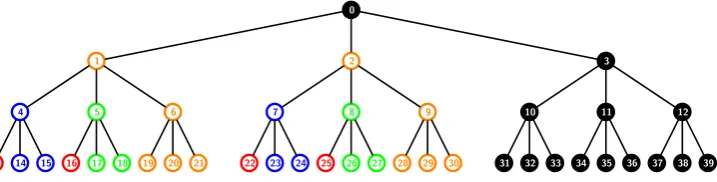
Figure 4: Example showing that the upper bound of 2r−1 on the header length is tight for k= 3. The subset cover for R = {13,16,22,25} in the tree T0 with k = 3, will contain the SD subsets S
4,{13}, S5,{16}, S7,{22},
S8,{25},S1,{4,5},S2,{7,8} and S0,{1,2}.
This upper bound of 2r−1 on the maximum header length can be achieved for a givenr and any fixed value of k providedn can be made as large as required. Fork= 2, this bound has been shown to be tight in [BS13]. For k = 3, let us consider the tree T0 of Figure 4 where the set of revoked users is R = {13,16,22,25}. The
nodes inP are{13,16,22,25,1,2,0}. The subsets in the cover areS4,{13},S5,{16},S7,{22},S8,{25},S1,{4,5},S2,{7,8} and S0,{1,2}. It can be seen from this figure that for higher arities (> 3), additional subtrees are added to all the internal nodes. Assuming that the revoked users remain the same as marked in the figure, we notice the following. The subsetS4,{13} gets additional users that are attached to the node 4. Similarly, each of the subsets
S5,{16},S7,{22},S8,{25},S1,{4,5},S2,{7,8} andS0,{1,2} get the additional users attached to the nodes 5,7,8,1,2 and 0 respectively. Hence, this upper bound is tight for any arityk in general providedncan be chosen to be large.
Lemma 4. For a givenk and n=k`0, the maximum header length of 2r−1 is achieved for r= 2`0−1.
Proof. We prove this by induction on`0. For`0= 1, n=kand r= 1. Letj1 be the only revoked leaf. The only
subset in the cover is S0,{j1} and hence the header length is 2r−1 = 1. We assume that the maximum header
length that can be achieved for 2`0−2 revoked users in a full tree of arity kand withk`0−1 users is 2`0−1−1. Let
us consider a tree with n = k`0 users and r = 2`0−1 revoked users such that two of the subtrees (out of k) of
the root node, which are rooted at nodes j1 and j2, haver/2 = 2`0−2 revoked users in each and the rest of the
subtrees of the root node do not have any revoked user in them. Since each of these two subtrees havek`0−1 users
in each, hence by assumption they give rise to 2`0−1−1 subsets each in the cover. Additionally, there will be a
subsetS0,{j1,j2} in the cover. Hence, the total number of subsets generated by this construction forr = 2
`0−1 is
2×(2`0−1−1) + 1 = 2r−1.
We need to show that these subsets do not combine to reduce the header length. Two SD subsetsSi1,SDnodes[i1]
and Si2,SDnodes[i2] can be combined into one SD subset if (1) SDnodes[i1] = {i2} orSDnodes[i2] ={i1} or (2) if
nodes in SDnodes[i1] are siblings of nodes in SDnodes[i2]. Any two SD subsets Si1,SDnodes[i1] and Si2,SDnodes[i2]
from the subtrees rooted atj1andj2 respectively cannot satisfy either of the above two conditions. For the same
reason, the subset S0,{j1,j2} cannot be combined with any of the SD subsets in these two subtrees. Hence, none
of these subsets combine to reduce the total number of subsets 2r−1 in the subset cover. Hence, for r= 2`0−1,
the maximum header length of 2r−1 is achieved for a fixedk and n=k`0.
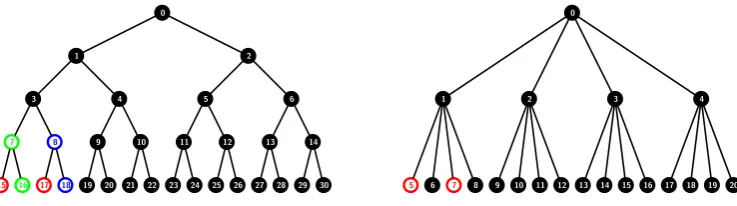
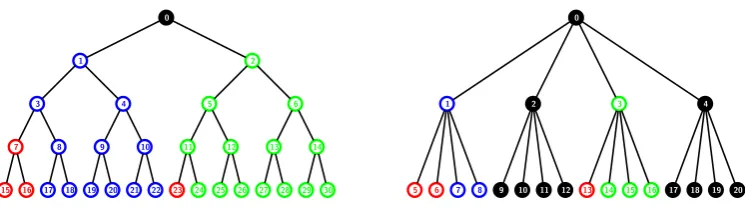
Effect Of k On The Header Length In the Subset-Cover framework, the subsets in the collection S are used to cover the privileged users. It seems intuitive that if the number of subsets in the collection increases, the number of subsets required to form a cover would decrease. As mentioned earlier, for n = 16, the number of subsets in the collection for k= 4 is more than that for k= 2. More subsets in the collection should reduce the header length. In Figure 5 we see that the header length due to the given revocation pattern is smaller for the 4-ary tree as compared to the 2-ary one. However, this may not always happen. In Figure 6, the revocation pattern is such that the header length is smaller for the 2-ary tree as compared to the 4-ary one. Hence, we see that the header length may not always reduce by increasing the arity. By Theorem 3, the maximum header length is independent of the underlying arityk. The expected header lengths for different values of kwill give a better idea about the effect of arity on the overall communication overhead.
0
1
3
7
15 16
8
17 18
4
9
19 20 10
21 22
2
5
11
23 24 12
25 26 6
13
27 28 14
29 30
0
1
5 6 7 8
2
9 10 11 12 3
13 14 15 16 4
[image:15.595.114.483.490.593.2]17 18 19 20
Figure 5: Example where the header length of 4-ary is better than 2-ary: For n= 16 users, the header length
for R = {15,17} in the 2-ary tree is more for k = 2 than for k = 4. For k = 2, the subset cover Sc =
{S7,{15}, S8,{17}, S0,{3}}. Fork= 4, the subset coverSc={S0,{5,7}}.
4.1 Expected Header Length
0 1 3 7 15 16 8 17 18 4 9 19 20 10 21 22 2 5 11 23 24 12 25 26 6 13 27 28 14 29 30 0 1
5 6 7 8
2
9 10 11 12 3
13 14 15 16 4
[image:16.595.112.485.86.190.2]17 18 19 20
Figure 6: Example where the header length of 2-ary is better than 4-ary: For n= 16 users, the header length for R = {15,16,23} in the 2-ary tree is more for k = 4 than for k = 2. For k = 2, the subset cover Sc = {S1,{7}, S2,{23}}. Fork= 4, the subset coverSc={S1,{5,6}, S3,{13}, S0,{1,3}}.
Theorem 5. Fix k≥2, n=k`0 ≥1 and 1≤r≤n. The expected header length in the k-ary tree SD scheme is
given by
k−1
X c=1 k c
γ`0,c+
`0−1 X
`=1
(k`0−`)γ
`,c
!
where
γ`,c =ηr(n, k`−ck`−1)−ηr(n, k`+1−ck`−1)
− c
X
t=1
(−1)t+1
c t
ηr(n, k`−(c−t)k`−1)
+
c
X
t=1
(−1)t+1
c t
ηr(n, k`+1−(c−t)k`−1) for 1≤`≤`0−1
(3)
and
γ`0,c =ηr(n, k
`0−ck`0−1)−
c
X
t=1
(−1)t+1
c t
ηr(n, k`0 −(c−t)k`0−1). (4)
Proof. Let Xn,r be the random variable taking the value of the header length. The expected header length also
depends on k and so strictly speaking we should be using the notation Xn,r,k to denote this dependence. We
have chosen the simpler notation Xn,r since for a particular implementation, k will be fixed and so clear from
the context.
Each subset in the coverSc is rooted at some internal node iof T0. Each such node in the tree contributes
at most one subset to the cover. Let Xn,ri be the random variable associated with node i, that denotes its contribution to the header length. Hence, Xn,ri ∈ {0,1}. The event Xn,ri = 1 occurs when there is a subset Si,J
in the cover and Xn,ri = 0 otherwise. It can be seen from the cover finding algorithm described in Section 3.2 that the leaf nodes of T0 do not generate SD subsets. Hence, SD subsets are generated only from the internal
nodes inT0. It follows that
Xn,r=Xn,r0 +Xn,r1 +· · ·+X if
n,r (5)
whereif = nkk−−11 −n−1 is the last internal node as per the labeling of the tree T0. By linearity of expectation,
E[Xn,r] =E[Xn,r0 ] +E[Xn,r1 ] +· · ·+E[X if
To find the expected header length, one needs to compute the values ofE[Xn,ri ] for each i∈ {0,1, . . . , if}. Since
Xn,ri ∈ {0,1}, the random variableXn,ri followsBernoulli distribution. Hence,E[Xn,ri = 1] = Pr[Xn,ri = 1]. Thus, to compute the expected header length E[Xn,r] for a random revocation pattern, the probability Pr[Xn,ri = 1]
that a node igenerates a subset has to be computed.
LetI be the set of all child nodes ofiand letpbe the parent node ofiinT0. Hence,I ={ki+ 1, . . . , ki+k}
and p =b(i−1)/kc. Let J ⊂I be a non-empty subset of child nodes of i. The event Xn,ri = 1 occurs when a subset Si,J is in the cover. For a subset Si,J to be in the cover, the following have to be true with respect to
node iinT0:
• At least one but not all child subtrees of iwould contain some revoked nodes; and
• Ifi6= 0 (for a non-root internal node), at least one sibling subtree ofiwould contain a revoked node.
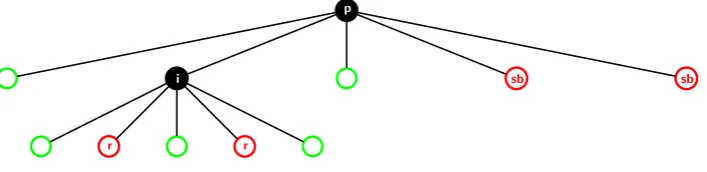
p
i
r r
[image:17.595.124.478.258.344.2]sb sb
Figure 7: Example of a scenario for the eventXn,ri = 1 where a setSi,J occurs in the subset cover. Child nodes
ofimarked withr are roots of subtrees containing at least one revoked user in each. Hence they are in the setJ. The other child subtrees of ido not contain any revoked user. Hence they are in the set I \J. Sibling subtrees of i marked as sb contain at least one revoked user in each. Hence, at least one child subtree of i(not all) has revoked users and at least one sibling subtree of ihas revoked users. Consequently, a subset rooted at nodeiis generated.
In order to formulate these conditions when a subset Si,J rooted at node i occurs in the subset cover, we
define some additional events with respect to the node iand a non-empty subset of its child nodes J ⊂I. The eventRij (wherej∈J) is defined to occur when for a revocation pattern, the subtree rooted at nodejcontains at least one revoked user. Hence, eventRji occurs when the subtree rooted at node j does not contain any revoked user. Let RiJ =V
j∈JRij be the event where each subtree rooted at nodes in J has at least one revoked user.
Hence,RiJ is the event where none of the subtrees rooted at nodes inJ have any revoked user. Fori6= 0, event
Risb is defined to occur when the union of all sibling subtrees of i(children of p other than i) contains at least one revoked node. Hence, a subset Si,J is in the subset cover when the following condition is true
^
j∈J
Rij
∧Risb∧RiI\J =RiJ∧Risb∧RiI\J.
Since a subset Si,J may occur for any non-empty set J ⊂I, hence the event Xn,ri = 1 can also be written as
_
J⊂I,J6=φ
RiJ∧Risb∧RiI\J
.
These events (Risb∧RiJ ∧Ri
I\J) are mutually exclusive and they exhaustively form the eventX i
n,r = 1. Hence,
we can write
Pr[Xn,ri = 1] = X
J⊂I;J6=φ
It can be similarly seen that for the root node with children in {1, . . . , k}
Pr[Xn,r0 ] = X
J⊂{1,...,k};J6=φ
Pr[RiJ∧Ri
I\J]. (8)
The probability Pr[Risb∧RiJ∧RiI\J] can be written as
Pr[Risb∧RiJ∧Ri I\J]
= Pr[Risb∧RiJ|RIi\J]×Pr[RiI\J]
= (1−Pr[Risb∧RJi|RiI\J])×Pr[RiI\J]
= (1−Pr[Ri
sb|RiI\J]−Pr[RJi|RiI\J] + Pr[Risb∧RiJ|RiI\J])×Pr[RIi\J]
= Pr[Ri
I\J]−Pr[Risb∧RiI\J]−Pr[RiJ ∧RiI\J] + Pr[Risb∧RiJ∧RIi\J])
(9)
and for the root node, Pr[RiJ∧Ri
I\J] can be written as
Pr[RiJ∧RiI\J] = Pr[RiI\J]−Pr[RiJ∧RiI\J]. (10)
For the computation of (9) and (10) above, we observe that the event RiJ occurs when at least one j ∈J does not contain any revoked user. Now let us consider two eventsA and B in general such that the eventA occurs when all the sub-events A1, . . . , Acoccur. Hence, A=A1∧. . .∧Ac.
Pr[A∧B] = Pr[A1∧. . .∧Ac|B] Pr[B]
= Pr[A1∨. . .∨Ac|B] Pr[B]
= Pr[A1∧B] +. . .+ Pr[Ac∧B]
−Pr[A1∧A2∧B]−. . .−Pr[Ac−1∧Ac∧B] +. . .
+(−1)c+1 Pr[A1∧. . .∧Ac∧B]
. (11)
Now, when A=RiJ where At=Rijt and B =RiI\J, we get
Pr[Ri
J∧RiI\J] = Pr[Rij1 ∧R
i
I\J] +. . .+ Pr[Rijc∧R
i I\J] −Pr[Rij
1 ∧R
i j2 ∧R
i
I\J]−. . .−Pr[R i
jc−1 ∧R
i jc∧R
i I\J]
+. . .+ (−1)c+1
Pr[Rij1 ∧. . .∧Rijc∧RiI\J]
. (12)
Similarly, for the expression Pr[Ri
J∧RiI\J∧Risb] in (9) we get the following using the result in (11)
Pr[RiJ∧RiI\J ∧Risb] = Pr[Rij
1 ∧R
i I\J ∧R
i
sb] +. . .+ Pr[Rijc∧R
i I\J∧R
i sb] −Pr[Rij1 ∧Rij2 ∧RIi\J ∧Risb]−. . .
−Pr[Ri
jc−1∧R
i jc∧R
i
I\J ∧Risb] +. . .
+(−1)c+1Pr[Rij
1 ∧. . .∧R
i jc∧R
i I\J∧R
i sb]
From (9), (12) and (13) we get
Pr[Rsbi ∧RiJ ∧Ri
I\J] = Pr[RiI\J]−Pr[Risb∧RiI\J]−Pr[RiJ ∧RiI\J]
+ Pr[Risb∧RiJ ∧RiI\J])
= Pr[RiI\J]−Pr[Risb∧RiI\J]
−Pr[Ri j1∧R
i
I\J]−. . .−Pr[Rijc∧R
i I\J]
+ Pr[Rij
1∧R
i j2 ∧R
i
I\J] +. . .
+ Pr[Rijc−1 ∧Rijc∧RiI\J]
−. . .+ (−1)c+2Pr[Ri
j1 ∧. . .∧R
i jc ∧R
i I\J]
+ Pr[Rij
1∧R
i I\J ∧R
i
sb] +. . .
+ Pr[Rijc∧RiI\J∧Risb]
−Pr[Ri j1∧R
i j2 ∧R
i
I\J∧Risb] −Pr[Ri
jc−1 ∧R
i jc∧R
i
I\J∧Rsbi ] +. . .
+(−1)c+1
Pr[Rji1∧. . .∧Rjic∧RiI\J ∧Risb]
.
(14)
To find these probabilities, we define ηr(n, x) to be the probability that r out of n elements are chosen
uniformly at random without replacement butx out of these nelements never get chosen. In other words,
ηr(n, x) = n−x
r
n r
. (15)
Let the number of users in the subtree rooted at node i be λi. Hence, the number of users in all the sibling subtrees of i is λp −λi. Hence, the sum of the number of users in the subtrees rooted at nodes in I \J is
λi−P
j∈Jλj. From (14) and (15) we get
Pr[Risb∧RiJ∧RiI\J]
=ηr(n, λi−
X
j∈J
λj)−ηr(n, λp−
X
j∈J
λj)
−ηr(n, λi−
X
j∈J\{j1}
λj)−. . .−ηr(n, λi−
X
j∈J\{jc}
λj)
+ηr(n, λi−
X
j∈J\{j1,j2}
λj) +. . .+ηr(n, λi−
X
j∈J\{jc−1,jc}
λj)
−. . .+ (−1)c+2ηr(n, λi)
+ηr(n, λp−
X
j∈J\{j1}
λj) +. . .+ηr(n, λp−
X
j∈J\{jc}
λj)
−ηr(n, λp−
X
j∈J\{j1,j2}
λj)−. . .−ηr(n, λp−
X
j∈J\{jc−1,jc}
λj)
Similarly for the root node, from (10), (12) and (15) we get
Pr[RiJ∧Ri I\J]
=ηr(n, λi−
X
j∈J
λj)
−ηr(n, λi−
X
j∈J\{j1}
λj)−. . .−ηr(n, λi−
X
j∈J\{jc}
λj)
+ηr(n, λi−
X
j∈J\{j1,j2}
λj) +. . .+ηr(n, λi−
X
j∈J\{jc−1,jc}
λj)
−. . .+ (−1)c+2ηr(n, λi). (17)
From (6), (7), (8), (16) and (17) we get the algorithm for computing E[Xn,r]. In Section 5, we discuss that
this scheme may be further extended for arbitrary number of users (instead of a power of k). In such a case, the underlying tree may be assumed to be a complete tree (with users at the last two levels of the tree) instead of a full tree. All the above expressions for computing probabilities are also valid for complete trees where the number of users may not be a power ofk.
However, for thek-ary tree SD scheme as it has been described here, the number of users is assumed to be a power ofk. Hence,n=k`0. Letc=|J|be the cardinality of the setJ of some child nodes ofi. Hence, 0< c < k.
There are`0 levels with internal nodes in the treeT0. All subtrees rooted at level `has the same number of leaf
nodesk`. For a non-root iat level `and a corresponding set of child nodesJ (|J|=c), the contribution to the header can be computed from (16) as
Pr[Risb∧RiJ∧RiI\J] =ηr(n, k`−ck`−1)−ηr(n, k`+1−ck`−1)
− c
X
t=1
(−1)t+1
c t
ηr(n, k`−(c−t)k`−1)
+
c
X
t=1
(−1)t+1
c t
ηr(n, k`+1−(c−t)k`−1). (18)
Letγ`,c be the value of this probability given by (18) for a non-root nodeiat level `(1≤`≤`0−1) and|J|=c.
Since there are k`0−` nodes at level`in the treeT0, hence the contribution of all the nodes at level`and a fixed
value of c is (k`0−`)γ
`,c. For the root node 0 at level `0 and a corresponding set of child nodes J ⊂ {1, . . . , k}
(|J|=c), the contribution to the header can be computed from (17) as
Pr[RJ0 ∧R0 I\J]
=ηr(n, k`0−ck`0−1)− c
X
t=1
(−1)t+1
c t
ηr(n, k`0 −(c−t)k`0−1). (19)
The value of this probability given by (19) for the root node at level `0 and |J|=c is denoted by γ`0,c. Hence,
the expected header length for a given k,`0 and r is given by
E[Xn,r] = k−1
X c=1 k c
γ`0,c+
`0−1 X
`=1
(k`0−`)γ
`,c
!
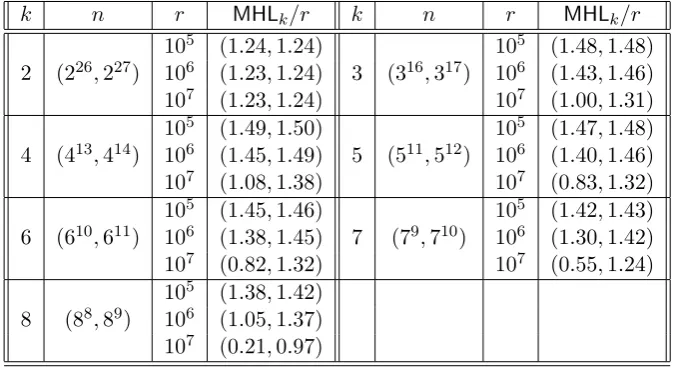
Table 1: Table showing the performance of the algorithm for computing the expected header length. For each
k, we have chosen n to be ka and kb which are the two closest powers of k to 108. The column MHL
k/r gives
the ratio of the mean header length MHLk fork-ary tree to the number of revoked usersr.
k n r MHLk/r k n r MHLk/r
2 (226,227)
105 (1.24,1.24)
3 (316,317)
105 (1.48,1.48)
106 (1.23,1.24) 106 (1.43,1.46)
107 (1.23,1.24) 107 (1.00,1.31)
4 (413,414)
105 (1.49,1.50)
5 (511,512)
105 (1.47,1.48)
106 (1.45,1.49) 106 (1.40,1.46)
107 (1.08,1.38) 107 (0.83,1.32)
6 (610,611)
105 (1.45,1.46)
7 (79,710)
105 (1.42,1.43)
106 (1.38,1.45) 106 (1.30,1.42)
107 (0.82,1.32) 107 (0.55,1.24)
8 (88,89)
105 (1.38,1.42) 106 (1.05,1.37) 107 (0.21,0.97)
Algorithm To Compute The Expected Header Length The result in Theorem 5 can be converted into an algorithm to compute the expected header length. The algorithm takes as input the values of k, n and r. Here n = k`0 for some `
0 ≥ 1 and 1 ≤ r ≤ n. The algorithm computes the values of γ`,c for each level ` in
the tree T0 and each value ofc. For fixed values of `and c, computingγ
`,c requires computing a fixed number
of ηr(·,·). One computation of ηr(·,·) requires O(r) multiplications. Hence, computing γ`,c also requires O(r)
multiplications. Since there are logkn+ 1 levels in the tree, hence computing the expected header length requires
O(rlogn) multiplications. The algorithm requires constant amount of space. Hence, we have an algorithm requiringO(rlogn) time andO(1) space to compute the expected header length in thek-ary tree SD scheme for given values ofk,n andr.
We have implemented the algorithm. Table 1 provides examples of outputs of the algorithm for different values of k,nand r.
5
Tackling Arbitrary Number Of Users
In the description of the scheme so far, we have assumed that n is a power of k. This may turn out to be
restrictive in practice. Here we describe how to modify the scheme so as to be able to handle arbitrary number of users. When n is a power of k, the underlying structure is a full k-ary tree. In the more general case where
nis not a power of k, we work with a completek-ary tree. This is an analogue of complete binary trees used in data structures to describe heap algorithms.
The structure of a completek-ary tree can be described as follows. Let `0 =dlogkne and k`0−1 < n ≤k`0.
By an abuse of notation, we denote byT0 the completek-ary tree withnleaf nodes. The leaf nodes are at levels
0 and 1. Suppose that there aren1 leaf nodes at level 0 and n2 leaf nodes are at level 1. Letn=k`0−1+i with
1 ≤ i≤k`0 −k`0−1. Then a simple calculation shows that n
2 =k`0−1 − di/(k−1)e and n1 = n−n2. In T0,