University of East London Institutional Repository:
This paper is made available online in accordance with publisher policies. Please scroll down to view the document itself. Please refer to the repository record for this item and our policy information available from the repository home page for further information.
To see the final version of this paper please visit the publisher’s website. Access to the published version may require a subscription.
Author(s):Mouratidis, Haralambos; Kolp, Manuel; Giorgini, Paolo; Faulkner, Stephane
Title:An Architectural Description Language for Secure Multi-Agent Systems Year of publication:2010
Citation:Mouratidis, H., Kolp, M., Giorgini, P., Faulkner, S.(2010) ‘An Architectural Description Language for Secure Multi-Agent Systems’ Web Intelligence and Agent Systems 8 (1) pp.99-122
Link to published version:
1
An Architectural Description Language for
Secure Multi-Agent Systems
Haralambos Mouratidis1,a, Manuel Kolpb, Paolo Giorginic, Stephane Faulknerd
a
Innovative Informatics Group, School of Computing, IT and Engineering, University of East London, England
b
Information Systems Research Unit, Catholic University of Louvain (UCL), Belgium c
Department. of Information and Communication Technology, University of Trento, Italy d
Information Management Research Unit, University of Namur, Belgium
Abstract. Multi-Agent Systems (MAS) architectures are gaining popularity for building open, distributed, and evolving
information systems. Unfortunately, despite considerable work in the fields of software architecture and MAS during the last decade, few research efforts have aimed at defining languages for designing and formalising secure agent architectures. This paper proposes a novel Architectural Description Language (ADL) for describing Belief-Desire-Intention (BDI) secure MAS. We specify each element of our ADL using the Z specification language and we employ two example case studies: one to assist us in the description of the proposed language and help readers of the article to better understand the fundamentals of the language; and one to demonstrate its applicability.
Keyword: Architectural Description Language, Multi-Agent Systems, Security, BDI Agent Model, Software Architecture
2 1.Introduction
The characteristics and expectations of new application areas for the enterprise, such as e-business, knowledge management, peer-to-peer computing, and web services, are deeply modifying information systems engineering. Most of the systems designed, for this kind of application areas, are now de facto concurrent and distributed. They tend to be open and dynamic, in that they exist in a changing organizational and operational environment where new components can be added, modified, or removed at any time. It is also important that such systems are secure, since they are often used for the management and storage of sensitive information, such as medical, financial and private data.
Given these needs, many researchers are looking for paradigms that will enable them to conceptualize, design and implement information systems that can operate effectively in such circumstances. In this context, we advocate the use of Multi-Agent Systems (MAS) to build today’s enterprise information systems. MAS architectures appear to be more flexible, modular and robust than traditional; including object-oriented ones. MAS do represent dynamic and evolving structures and components, which can change at run-time to benefit from the capabilities of new system entities or replace obsolete ones. Moreover, MAS represent a suitable paradigm for the consideration of security challenges introduced by the current information systems. Security issues, within an agent system context, will require for the agents of the system to consider the security requirements, when specifying their objectives and interactions, and therefore cause the propagation of security requirements to the whole system [34].
However, as the expectations of business stakeholders are changing day after day; and as the complexity of systems, information and communication technologies and organisations is continually increasing in today’s dynamic environments; developers are expected to produce architectures that must handle more difficult and intricate requirements than ever before.
A critical issue in the design and construction of any complex information system is its architecture. That is, its gross organization as a collection of interacting components. A rigorous architectural design can ensure that a system will satisfy key requirements in such areas as performance, reliability, portability, scalability, and interoperability [40]. To assist developers in specifying information system architectures, architectural description languages are used. An Architectural Description Language (ADL) provides a concrete syntax for specifying architectural abstractions in a descriptive notation. Architectural abstractions concern the structure of the system’s components, their behaviour, and their interrelationships.
3 SKwyRL-ADL2, aims to describe secure Belief-Desire-Intention (BDI) MAS.
The paper is structured as follows. Section 2 overviews the notions of agent and MASs and identifies the main concepts of the BDI model, which is used in our ADL. Section 3 discusses security in MAS and Section 4 models SKwyRL-ADL using the Z specification language. An example case study is used to assist reader understanding of the language’s elements. Section 5 demonstrates the applicability of the proposed ADL with the aid of a real case study from the e-media domain. Section 6 describes related work; it indicates how that work has influenced the presented work, and it discusses how the presented work differs from related work. The last section summarizes the contributions of the paper and discusses future work.
2.Agents and Multi-Agent Systems
An agent defines a system entity, situated in some environment that is capable of flexible autonomous action in order to meet its design objectives [46]. Three key concepts support this definition:
• Situatedness: an agent receives input from the environment it operates and can perform actions, which change the environment in some way;
• Autonomy: an agent is able to operate without direct, continuous supervision. In other words it has full control over its own actions;
• Flexibility: an agent is not only reactive but also pro-active. Reactivity means that an agent has perceptions of the
2 Socio-Intentional ArChitecture for Knowledge
Systems & Requirements ELicitation (www.isys.ucl.ac.be/ skwyrl)
world, which force the agent to act and react to change in quasi real-time fashion. Pro-activeness means that an agent’s behaviour is not exclusively reactive but it is also driven by internal goals, i.e. an agent may take initiative. With these concepts in mind, a MAS can be defined as a set of autonomous and proactive agents that interact with each other to achieve common or private goals. This definition leads us to two different types of MAS: Cooperative or Competitive.
A Cooperative MAS has a unique high-level global goal (or set of goals) decomposed recursively into parallel activities to be performed by the set of agents that compose that MAS. This kind of system is typically adapted to perform distributed problem solving. In a Competitive MAS, each of the component agents has its own set of goals that may or may not meet those of other agents. In this case the MAS is an architecture that allows agents to interact, while each one pursues personal goals and defends own interests. This kind of system meets typical engineering requirements of e-commerce, information retrieval applications, web services or peer-to-peer networks. In such environments, every agent generally represents either a client, aiming at obtaining some resources or have some service accomplished; or a provider, aiming at selling resources or services at a certain (not necessarily financial) cost. Each agent pursues the goals of the (human or system) actor it represents, and these goals can usually be in conflict.
4 or Philosophy. Agent models are proliferating; some include learning capabilities, others intelligent agendas based on statistics, others yet are based on genetic algorithms and so on. An exhaustive evaluation of these models is out of the scope of this paper or even this research work. However, a simple yet powerful and mature model coming from Cognitive Science and Philosophy that has received a great deal of attention, notably in Artificial Intelligence, is the Belief-Desire-Intention (BDI) model [6]. This approach has been intensively used to study the design rationale of agents and is proposed as a keystone model in numerous agent-oriented development environments such as JACK3 or JADE4. The main concepts of the BDI agent model are (except the notion of agent itself that we have just explained):
• Beliefs that represent the informational state of a BDI agent, that is, what the agent knows about itself and the world;
• Desires (or goals) that are its motivational state, that is, what the agent is trying to achieve;
• Intentions that represent the deliberative state of the agent, that is, what plans the agent has chosen for possible execution. In particular, a BDI agent has a set of plans, which defines sequences of actions and steps available to achieve a certain goal or react to a specific situation. The agent reacts to events, which are generated by modifications to its beliefs, additions of new goals, or messages arriving from the environment or from another agent. An event may trigger one or more plans; the agent commits to execute one of them, that is, it becomes its intention. Plans are
3
http://www.agent-software.com.au/jack.html 4
http://jade.tilab.com
executed one step at a time. A step can query or change the beliefs; it can perform actions on the external world; and it can submit new goals. The operations performed by a step may generate new events that, in turn, may start new plans. A plan succeeds when all its steps have been completed; it fails when certain conditions are not met.
3.MAS and Security
Security of software systems, agent-oriented, object-oriented or otherwise, is concerned with methods providing cost effective and operationally effective protection from undesirable events[30]. In principle security is usually defined in terms of the existence of any of the following properties:
• Confidentiality: The property of guaranteeing information is only accessible to authorized entities and inaccessible to others;
• Authentication: the property of proving the identity of an entity;
• Integrity: the property of assuring that the information remains unmodified from source entity to destination entity;
• Access Control: the property of identifying the access rights an entity has over system resources;
• Non-repudation: the property of confirming the involvement of an entity in certain communication;
• Availability: the property of guaranteeing the accessibility and usability of information and resources to authorized entities.
5 confidentiality and availability of an agent needs to be considered according to the environment in which the agent operates. On the other hand, the social behaviour property of an agent involves communication with other agents and other entities and as such the properties of non-repudiation, integrity and access control are important. Therefore, it is crucial for the agents of a MAS to consider, during run-time, the systems’ and their individual security requirements when specifying their objectives and interactions. For this to happen, agent developers must integrate security considerations when they define the architecture of their MAS [4]. However, research efforts so far have been mainly focused on the solution of individual security problems of MAS, such as attacks from an agent to another agent, attacks from a platform to an agent, and attacks from an agent to a platform. Developers of MAS ADLs have mainly neglected security and have failed to provide evidence of successfully integrating security concepts as part of their ADLs. As a result, MAS developers find no help when considering security during the architectural design of a MAS.
4.SKwyRL: An Architectural Language for Secure MAS
4.1.ADL Concepts
Architectural description languages are formal languages that are used to specify the architecture of a system [40]. By architecture, we mean the components that compose a system, the behavioural specification for those components, and the mechanisms for interactions among them. Based on our analysis of existing literature
(see Section 6 for a discussion of related work), we have identified the following concepts as the common foundation of concepts and concerns for system architecture descriptions:
Component. Components are units of computation and data store. Therefore, components are loci of computation and state. A component, in architecture, may be as small as a single procedure (e.g., Wright [1] procedures) or as large as an entire application (e.g., hierarchical components in Rapide [28]). It may require its own data and/or execution space, or it may share them with other components.
Interface. Interfaces are set of interaction points among components and the external world. All ADLs support specification of component interfaces. They differ in terminology and the kinds of information they specify. For example, each interface point in ACME [17]and Wright is called a port. In UniCon [39], an interface point is a player, and in Rapide a constituent. In Darwin [29], the interface consists of a collection of services that are either provided or required.
Type. A type describes how architectural element representation is built up. ADLs can support reuse by modelling abstract components as types and instantiating them in an architectural configuration. All the surveyed ADLs distinguish component types from instances. However, UniCon and Darwin lack explicit means of introducing new component types, as they support only a predefined set. Other ADLs such as Rapide and Wright make explicit use of parameterisation.
6 languages, as opposed to in-line configuration languages. The first-class includes languages such as Wright. On the other hand, Rapide and Darwin are examples of in-line configuration languages. In these languages, connectors cannot be named. They are described solely in terms of bindings between the provided service of a component and the required service of another component.
Configuration. Configurations (or topologies) are connected graphs of components and connectors that describe architectural structures. Configurations are needed to determine whether appropriate components are connected, their interfaces match and their combined semantics result in desired behaviour. Descriptions of configurations enable the assessment of concurrent and distributed aspects of architecture, e.g., potential for deadlocks and starvation, performance, reliability, security, etc. Configurations also enable analysis for adherence to design heuristics and style constraints. In this sense, a major role of configuration is to facilitate the understanding of systems at a high level of abstraction. Therefore, configurations must model structural information with simple and understandable syntax.
Hierarchical Composition. A
hierarchical composition allows the representation of an entire architecture as a single component in another, larger architecture. Several ADLs provide explicit features to support hierarchical composition. For example ACME provides templates, Darwin composition elements, and UniCon and Wright maps.
4.2.The GOSIS example
To assist understanding the specification of the language components, we represent
extracts of the aGent-Oriented Source Integration System (GOSIS) architecture to
compliment our theoretical description of the language. GOSIS provides a MAS architecture that supports the integration of data coming from dynamic, distributed and heterogeneous sources. GOSIS is a hybrid approach that combines the advantages of in-advance and on-demand processes[15]. In such an approach, the user information needs can be extracted in-advance or on-demand by the mediator. The information extracted in-advance is stored in a central database managed by the mediator. The information contents of this central database can be seen as a materialized view where the database resides at the information sources. In this way, in comparison with a basic mediator, a hybrid mediator adds functionalities essentially in order to perform materialized view maintenance.
7 mediator in the native format of the source and also to translate the source response in the data model used by the mediator. The monitor is responsible for detecting changes of interest (e.g., a change which affects a materialized view) in the information source and for reporting them to the mediator. Changes are then translated by the wrapper and sent to the mediator.
It may also be necessary for the mediator to obtain information concerning the localisation of a source, and for the associated wrapper to provide current or future relevant information. This kind of information is provided by the matchmaker agent, which allows a direct interaction between the mediator and the correspondent wrapper. The matchmaker plays the role of a “yellow-page” agent. Each wrapper advertises its capabilities by subscribing to the yellow page agent. Finally, the multi-criteria analyzer reformulates a sub-query (sent by a mediator to a wrapper) through a set of criteria in order to express the user preferences in a more detailed way, and refines the possible domain of results.
4.3.The ADL concepts
Following the identification of the common foundation of components necessary for an ADL; an architecture based on the proposed SKwyRL-Architectural Description Language (ADL) includes the following concepts:
• Component. In SKwyRL-ADL, we
consider an agent as a system component with a set of plans determining its computation dimension and a set of beliefs defining its data space.
• Interface. SKwyRL-ADL specifies an
interface point in the same way as ACME and Wright, with the difference
that a port is either a sensor requiring a service or an effector providing a service for the agent environment. In this sense, like Darwin, an interface can be seen as a collection of provided or required services.
• Type. We introduce parameterisation in
order to distinguish the different instances of each agent type that can appear in a configuration or to expand an agent description from a single system to families of systems. SKwyRL-ADL permits any part of an agent description to be replaced with a “placeholder”, which is then filled with a parameter when the type is instantiated.
• Connector. SKwyRL-ADL follows the
Rapide and Darwin notion of connectors according to the definition of agent interaction that we will discuss in the following section.
• Configuration. Because Wright offers
the most complete and formal definition of configuration specification, we follow it with the aim of describing a complete system architecture. Like a Wright configuration description, the components (i.e., agent) and connectors (i.e., bindings between provided and required services) must be combined into a configuration. In this sense, in SKwyRL-ADL, a configuration is a collection of agent instances combined via bindings between provided and required services.
• Hierarchical Composition.
8 configuration. This is done by supporting the specification of an agent
[image:9.595.145.464.185.527.2]by one or more detailed lower-level descriptions.
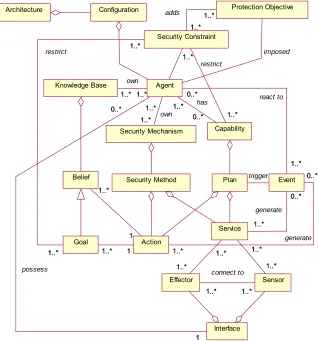
Fig. 1: Conceptualization of SKwyRL-ADL.
4.4.Metamodel
Figure 1 introduces the main entities and relationships of the elements of SKwyRL-ADL. Each entity has been identified from the generic features of current ADLs, from architectural security considerations, and from the concepts defined through the theoretical BDI architecture model.
For clarity we have further subdivided the model into three sub-models: the agent
model; the security model; and the architectural model. The three following sub-sections describe these models in greater detail. Each entity is formalized using the Z specification language [41]. We have adopted Z in order to formalize the concepts and relationships of our ADL model for a number of reasons. Firstly, Z provides modularity and abstraction and is sufficiently expressive to allow for a consistent, unified and structured account of Knowledge Base
Security Mechanism
Belief Security Method
Action 1 1..*
1 1..*
Event 0..*
1..*
0..*
1..*
generate
Plan trigger
Goal
1 1..* 1 1..*
Capability Security Constraint
1..*
1..*
1..*
1..*
restrict
1..* 1..*
1..* 1..*
restrict
Protection Objective
1..* 1..* 1..*
1..*
adds
Architecture Configuration
Effector Sensor 1..* 1..*
Service
0..*
1..*
0..*
1..*
generate
1..*
1..*
1..*
1..* Agent
1..* 1..* 1..* 1..*
own
1..* 1..* 1..*
1..*
own
1..* 0..*
1..* 0..* react to
0..* 1..*
0..* 1..* has
imposed
Interface 1
0..*
possess
1 0..*
connect to
1..* 1..* 1..*
9 a software system and its associated operations. Such structured specifications enable the description of MAS architectures at different abstraction levels, with system complexity being added at successive lower levels. Secondly, Z is particularly suitable in squaring the demands of formal modelling with the need for implementation by allowing for transitions between specification and software. Our approach to formalize the specification of SKwyRL is thus pragmatic: we need to be formal to be precise about the concepts we discuss, yet we want to remain directly connected to implementation issues.
Furthermore, Z is widely used as formal specification language within the software engineering and the artificial intelligence communities. Z has been shown to be clear, concise and relatively easy to learn compared with other languages [27].
4.4.1.Agent Model
The agent model, illustrated in Figure 1, is composed of eight main design entities. An agent needs knowledge about its environment in order to make good decisions. Knowledge is contained in an agent in the form of one or many knowledge bases structuring its informational state. A knowledge base consists of a set of beliefs that the agent has about its environment. A belief represents a view of the current environment of an agent.
However, beliefs about the current state of the environment are not always enough to decide what to do. In other words, in addition to a current state description, the agent needs goal information. A goal describes an environment state that is (or is not) desirable. An agent pursues one or
more goals that represent its motivational state.
The intentional behaviour of an agent is represented by its capabilities to react to events. A capability is a set of events that an agent can handle, post or send to its environment and a set of plans. An event is generated either by an action that modifies beliefs or adds new goals, or by services provided by another agent. Note that services also appear in the structural model because they involve interactions among agents that compose the MAS.
Interactions serve as basic elements to support the construction of configurations. An event may invoke (trigger) one or more plans; the agent is committed to executing one of them, that is, it becomes its intention. A plan defines the sequence of actions or services to be chosen by the agent to accomplish a task or fulfil a goal. An action can query, add or remove beliefs, generate new events or submit new goals.
As an example, consider the model shown in Figure 2 representing a partial specification of the mediator agent of the GOSIS case study. The Mediator agent has a set of interfaces, Knowledge Bases (KB), Protection Objectives (PO), Security Mechanisms (SM) and a set of Capabilities (CP).
10 Agent: { Mediator
Interface:
Sensor[require(query_translation)] Sensor[require(query reformulation)]
Sensor[require(results)]
Sensor[require(locate_wrapper)]
Sensor[require(change_advertizings)] Effector[provide(found_items)] KnowledgeBase:
Results_KB
MatchMaker_Info_KB DataManagement_KB Request_KB
Notification_KB
Protection Objectives: Confidentiality_PO Availability_PO
Security mechanisms:
DataIntegirty_SM
AuthenticationExchange_SM
Capabilities:
Handle_Request_CP Handle_Results_CP Materialized_Views_CP Wrapper_Localization_CP Handle_Change_CP }
Fig. 2: Partial specification of the GOSIS mediator agent.
Knowledge base. A knowledge base is a set of beliefs that the agent has about the environment and itself. A knowledge base (KB) is a means of structuring the informational state of agents and it encapsulates a set of states describing a specific part of the current environment of an agent. Each individual state is called a belief. A knowledge base specification is also described by the type of KB (KBtype) and
a name that assists to identify the KB. Whenever an agent wants to query or modify a KB, it does so by using this name. The set of all names is denoted by [KBname]
and a KB can be specified as in Figure 3. The KBtype describes the kinds of formal
knowledge used by agents that compose the MAS. closedWorld states that an agent knows
only the beliefs included in its knowledge base [25], and anything not in its knowledge
base simply doesn’t exist. Inversely,
openWorld states that an agent accepts every
belief that it “considers” possible [21]. Although closed-world states do not often occur in the real world, they are useful in many simulation and programming environments [12].
[KBname]
[KBtype]:= closedWorld | openWorld
KnowledgeBase
name: KBname
composed_of: ℙ Belief type: KBtype
name ≠∅∧composed_of ≠∅∧type ≠∅
(∀kb:KnowledgeBase) (∃ ag : Agent ) •use(kb,ag)
Fig. 3: KnowledgeBase specification.
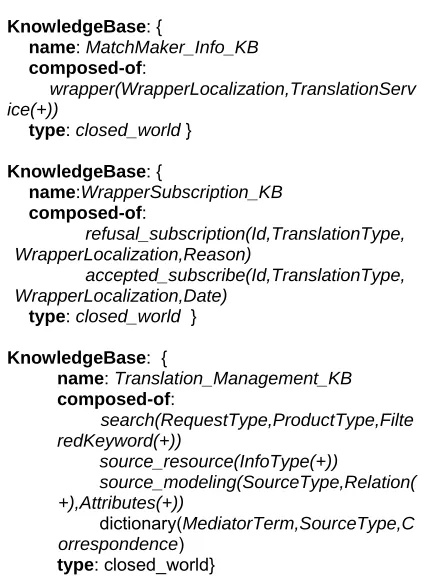
An example of a KB specification for the Mediator agent of the GOSIS system is shown in Figure 4. In particular, three KBs are specified in the agent specification presented above: the Matchmaker_Info, WrapperSubscription and Translation_Management. The contents of these KBs concern, respectively, wrapper localisations and translation abilities; accepted and refused wrapper subscriptions; mediator queries and the specific information needed to translate it. This specific information is represented by the following beliefs:
• source_resource that defines the kind of data available from the connected source;
• source_modeling that describes how the information is structured;
11 KnowledgeBase: {
name: MatchMaker_Info_KB composed-of:
wrapper(WrapperLocalization,TranslationServ ice(+))
type: closed_world }
KnowledgeBase: {
name:WrapperSubscription_KB composed-of:
refusal_subscription(Id,TranslationType, WrapperLocalization,Reason)
accepted_subscribe(Id,TranslationType, WrapperLocalization,Date)
type: closed_world }
KnowledgeBase: {
name: Translation_Management_KB composed-of:
search(RequestType,ProductType,Filte redKeyword(+))
source_resource(InfoType(+))
source_modeling(SourceType,Relation( +),Attributes(+))
dictionary(MediatorTerm,SourceType,C orrespondence)
[image:12.595.75.288.130.421.2]type: closed_world}
Fig. 4: KB specification for the GOSIS mediator agent.
Belief. A belief is a predicate describing a set of states about the current agent environment being either true or false. Beliefs describe the environment of an agent in terms of states of objects with individual identities and properties, and relations on objects as being either true or false. We use predicate symbols to specify a particular relation that holds (or fails to hold) between several objects, and terms to represent objects. Each term can be build from constant, variable or function symbols. Constant symbols are therefore terms. But sometimes it is more convenient to use an expression to refer to an object. This is what function symbols are for. Thus a complex term can be formed by a function symbol followed by a parenthesized list of terms as arguments to the function symbol.
From the above primitives, we can define an AtomicBelief. The set of all predicate,
function, constant and variable symbols are denoted by [PredSymb],[Function],[Constant], and [Variable], respectively. An AtomicBelief is
formed from a predicate symbol followed by a sequence of terms (Figure 5).
[PredSymb] [Funtion]
[Constant] [Variable]
[Term]:=Function(Term,…)|Constant| Variable
AtomicBelief
head: PredSymb
terms: seq Term
head ≠∅∧terms ≠∅
Fig. 5: AtomicBelief Specification.
A Belief is specified either as an AtomicBelief, a negated AtomicBelief, a series of
AtomicBeliefs connected using logic
connectives, or an AtomicBelief characterized
with a temporal pattern. We use the following temporal patterns: ○ (in the next
state), ● (in the previous state), ◊ (some time
in the future), ♦ (some time in the past), □
(always in the future), ■(always in the past),
W(always in the future unless), and U (always in the future until).
[Belief]:=AtomicBelief
|¬AtomicBelief
| Temp_Pattern AtomicBelief
| AtomicBelief Connective AtomicBelief
[Connective] →∧ | ∨ | ⇒
[Temporal_Pattern]:=○ | ● | ◊ | ♦ | □ | ■ |W |U
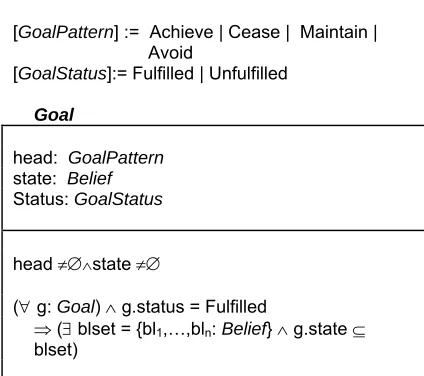
12 describes situations that are (not) desirable. Goal information is an operational objective to be achieved by an agent. Operational means that the objective can be formulated in terms of appropriate state transitions under the control of one agent. We consider goals according to four patterns [10]:
Achieve: P ⇒ ◊Q
Pmeans “state P holds in the current state”
◊Qmeans “state Q holds in the current or in some future state”
Cease: P ⇒ ◊¬Q
Maintain: P ⇒□Q
□Qmeans “state Q holds in the current and in all future states”
Avoid: P ⇒□¬Q
With respect to beliefs, goals can be specified as in Figure 6.
[GoalPattern] := Achieve | Cease | Maintain |
Avoid
[GoalStatus]:= Fulfilled | Unfulfilled
Goal
head: GoalPattern
state: Belief
Status: GoalStatus
head ≠∅∧state ≠∅
(∀ g: Goal) ∧ g.status = Fulfilled
[image:13.595.76.288.424.612.2]⇒ (∃ blset = {bl1,…,bln: Belief} ∧ g.state ⊆ blset)
Fig. 6: Goal specification.
The state explicitly describes (in terms of beliefs) the environment in which the goal is fulfilled. The status indicates whether the goal has been fulfilled or not. The goal patterns influence the set of possible agent behaviours: achieve and cease goals
generate actions, plans, or events; maintain and avoid goals restrict them. When a goal is required, the agent identifies a set of plans to achieve or maintain this goal. From then on, the agent chooses, according to its current beliefs, which of these plans will be executed.
Capability. A capability is a set of plans that an agent can execute and a set of events that it can post to itself or send to its environment. The capability is a means of structuring the intentional behaviour of agents. In a perspective of modularity, it allows to encapsulate a set of agent functionalities that can be plugged in as required. This component approach allows a system architect to build up a library. These components can then be (re)used to add selected functionality to different agents of a system. Also, some of these components can be temporally not available for the agents in the system. Capabilities are structured from a set of events, plans or sub-capabilities that can be combined to provide complex functionality. A Capability specification takes the form in Figure 7.
[CapName]
[AtomicCap] := Plan | Capability | Event
[CapAvaibility]:= Available | Unavailable
Capability
name: CapName
composed_of: ℙ AtomicCap
availability: CapAvailability
name ≠∅∧composed_of ≠∅
(∀ cap: Capability) ∃ ag: Agent ∧ cap ∈ ag.has ⇒ cap.availability = “available”
13 Referring back to the GOSIS case study, the mediator specification holds five capabilities:
• Handle_Request decomposes a user query into one or more sub-queries and sends them to adequate wrappers;
• Handle_Results synthesises the source answers and returns the answers to the broker;
• Materialized_Views manages the storage, the updates, the queries and the results related to a set of materialized views;
• Wrapper_Localization manages the information (provided by the matchmaker) concerning the localisation of a source and its connected wrapper;
• Handle_Change executes the materialised view updates when a monitor detects changes from its source.
The proposed ADL allows the specification of each capability with a name and a body (composed-of) containing the plans that the capability can execute and the events that it can post to itself (handled by one of these plans) or send to other agents. For example, the Handle_Request is specified as in Figure 8.
Capability: {
name: Handle_Request_CP composed-of:
Plan: DecompNmlRq Plan: DecompMCRq SendEvent: FaillUserRq SendEvent: FailDecompMCRq PostEvent: ReadyToHandleRst
availability: available}
Fig. 8: Handle_Request capability specification
The concept of Event and Plan are specified
later in this section.
Action. An action is an internal operation executed in order to achieve goals or accomplish tasks. An operation is a basic executable command of agent behaviour. The type of operation that agents can
perform may be classified as either external (the domain of the operation is the environment outside the agent) or internal (the domain of the operation is the agent itself). Actions concern only internal operations. We will explain later in the paper how external operations are specified in SKwyRL-ADL and why they play an important role in the definition of the system topology. From the set of all internal operations [Operation], we can specify an
AtomicAction as in Figure 9.
[Operation]
AtomicAction
head: Operation
input:Belief
head ≠∅∧input ≠∅
Fig. 9: AtomicAction specification
In order to design agents that present efficient behaviour in specific environment states, preconditions can be defined allowing the agent to choose a better action than it would otherwise have chosen. Once the action is selected, the agent can execute it. This affects (affect) the agent’s informational or motivational states (Figure 10).
Output:= Belief | Goal
function:= Add_KB | Rem_KB [Affect]:= function X output
Action
precondition: ℙ Belief
body: AtomicAction
affect: Affect
body ≠∅∧affect ≠∅
14
Event. An event is a belief or goal occurrence generated by an action or a service, which triggers the execution of a plan. Events are the origin of all activity within an agent-oriented system. In the absence of events, an agent sits idle. Whenever an event occurs, an agent selects between the available plans and executes the selected plan (or plan set depending on the event processing model chosen), until it succeeds or fails. An event is either the effect of an action or a service, or it is exogenous to the system, resulting from an action or a service not accomplished by an agent in the system. We define an event as in Figure 11.
[ExogEffect]
[TriggerEvent]:= Effect | ExogEffect
[Evtype] = postEvent | sendEvent
Event
Trigger: TriggerEvent
destination:ℙ Agent
type: EVtype
Trigger ≠∅
(∀ ev: Event) ev.type = sendEvent ⇒ ev.dest ≠∅
Fig. 11: Event specification
SKwyRL-ADL allows the specification of two types of events: postEvent and sendEvent. A postEvent describes an event that the agent can post. Posting an event means that an agent creates an instance of the event and posts it internally (i.e., sends the event to itself). Such as event needs to be handled by the agent’s own plan. Inversely, a sendEvent identifies events that the agent sends externally (i.e., to another agents) or considered exogenous to the system.
Plan. A plan defines a sequence of actions or/and services to accomplish a task or
achieve a goal. Plans are selected by agents, as described below. Selected plans constrain the agent behaviour and act as intentions. A plan can be specified as in Figure 12 and consists of:
• invocation condition, detailing the
circumstances, in terms of beliefs or goals, that cause the plan to be triggered;
• context, that defines the preconditions of
the plan, i.e., what must be believed by the agent for a plan to be selected for execution;
• the plan body, which specifies either the
sequence of formulae that the agent needs to perform. A formulae being either an action or a service (i.e., action that involves interaction with other agents) to be executed;
• end state, which defines the
post-conditions under which the plan is succeeded;
• a set of services or actions that specify what happens when a plan fails or succeeds.
[PlanName]
[AtomicPlan]:= Action | Service
Plan
name: PlanName
invocation: ℙ Event
Context: ℙ Belief Body: seq AtomicPlan
endState: ℙ Affect succeed: seq Atomicplan
Failure: seq AtomicPlan
name ≠ ∅∧invocation ≠ ∅∧body ≠ ∅
Fig. 12: Plan specification
A Plan is said to have succeeded when it
15 are no available actions or services. For instance, the DecompNmlRq and the DecompMCRq plans of the mediator agent deal with the decomposition of normal and multi-criteria (expressing the user preferences) requests.
Plan: {
name: DecompNmlRq
invocation: Add(Request_KB, user_keyword(pt(+),kw(+))
/* with pt:ProductType From Mediator.Ask( user_info-needs).reply_with and with kw:Keyword
FromMediator.Ask(user_info-needs).reply_with
context: ¬ materialized_view(ProductType = pt(+),Keyword = kw(+))
body: ∀ pt : ProducType ∈
user_keyword(pt(+),kw(+)) Do
Action:
select_wrapper(wrapper(WrapL ocalization,TranslationService(+)) as wp(+): Wrapper
Service:
performative: Ask(query_translation) sender: Mediator
parameters: rt:RequestType∧ pt:ProductType∧ kw(+):Keyword receiver: wp(+): Wrapper Affect:
Add(Translation_Management _KB, search(rt,pt,kw(+)) End-Do
endstate: ∀ pt : ProducType ∈
user_keyword(pt(+),kw(+))
Do
Add(Translation_Management_KB, search(rt,pt,fk(+))
End-Do
suceed:
Action: count(search(rt,pt,kw(+))
Affect: Add(Request_Kb,
old_user_keyword(pt,kw(+))
Failure: Plan: DecompMCRq
}
Fig. 13: DecompNmlRq plan specification
The DecompNmlRq plan, shown in Figure 13, is triggered each time a new user_keyword belief is added to the Request KB. The
argument values of the user_keyword belief are required by the Ask(user_info-needs)
service that the mediator initiates. However, the plan is only executed if a materialized_view belief which has the same argument values as the invocation user_keyword belief does not exist. A materialized_view belief represents a repetitive user information need whose content is extracted from each source, merged with relevant information from other sources, and stored as a belief by the mediator. The complementary condition on the existence of a materialized_view belief is specified by the context. The context helps for the selection of the most appropriate plan in a given situation.
As soon as the invocation condition and the context are true, the sequence of actions or services specified in the plan body can be executed. The plan body of the DecompNmlRq plan is composed by the sequence of an action and a service. The mediator selects from their wrapper beliefs one or more wrappers (wp(+)) capable of translating the decomposed subqueries. Then, a translation service Ask(query_translation) is asked from the selected wrappers.
The plan will only succeed if the statement described by the end state is successful. Moreover, SKwyRL-ADL also allows specifying what happens when a plan reaches its endstate or fails, by considering further courses of action or service. For example, the succeed specification of the DecompNmlRq plan counts the number of occurrences of the current subquery in order to identify a possible new materialized view, while the fail specification returns to the execution of the DecompMCRq plan.
4.4.2.Security Model
16 objective imposes one or more security constraints on the agent. Security constraints might restrict the goals and/or the capabilities of an agent. On the other hand, an agent owns security mechanisms. A security mechanism represents a set of standard security methods that an agent might have and they help towards the satisfaction of the protection objectives of the agent. A security method defines a sequence of actions and/or services to satisfy an agent’s security mechanisms.
Protection Objective. A protection objective indicates a desirable security attribute that an agent might have, such as integrity, and availability. An agent might impose a security objective by itself or more likely a protection objective is imposed to an agent through its environment (e.g. from a security policy or through other agents and/or stakeholders/developers). Moreover, a protection objective alters the agent’s motivational state by adding constraint(s) to the agent with respect to security. A protection objective imposes one or more security constraints to an agent, and each agent might have zero or more protection objectives. A protection objective is specified as in Figure 14.
[POname], [POimposer]:= self | environment
ProtectionObjective
name: POname
imposed_by: POimposer
imposed_to: Agent
constraints: ℙ SecurityConstraint
Name ≠∅∧ imposed_to ≠∅∧ constraints ≠∅
(∀ po: ProtectionObjective)
(∀ ag: Agent) (∀ sc: SecurityConstraint)
[(sc
po) ∧ (po
ag)] ⇔constrain(ag,sc)Fig. 14: Protection objective specification
In particular, a Protection Objective specification is described by a name (Name), which assists to identify the Protection Objective, and an imposer (Imposed_by), which describes who imposes the Protection Objective to the agent. Imposed_to indicates the agent the Protection Objective is imposed to, and Constraints provides the set of security constraints imposed as a result of the specific protection objective.
Referring to the Mediator agent specification, there are two protection objectives (Confidentiality_PO and Availability_PO). Following the Protection Objective specification of the proposed ADL, the Availability_PO is specified as shown in Figure 15. In particular, the Mediator agent is imposed an Availability Protection Objective from its Environment. As a result of this, a security constraint (ConfirmServiceAvailability) is imposed to the Mediator.
Protection Objective: { name: Availability_PO imposed_by: Environment imposed_to: Mediator
constraints: ConfirmServiceAvailability}
Fig. 15: Availability_PO specification
Security Constraint. A security
17 agent must identify alternative ways of satisfying its goals without using the specific capability. It is possible that some restrictions are communication related. For instance, a restriction that might apply for the communication of one agent with another agent, might not apply for the communication of the same agent with a third agent or vice versa. Also, a security constraint might restrict the goals/capabilities of an agent for a specific time frame. For instance, a restriction that might apply today may not be valid tomorrow. A security constraint can be specified as in Figure 16.
[SCname], [SCrestriction] : Goal | Capability [SCtimeFrame]:= All | Function,
[SCcommunication]:= Agent | All
SecurityConstraint
name: SCname
restricts: SCrestriction
timeFrame: SCtimeFrame constraints: SCcommunication
name ≠∅∧ restricts ≠∅
(∀ ag: Agent) [(g: Goal ag) (cap: Capability ag) (sc: SecurityConstraint ag)] restrict(g, sc) restrict(cap,sc)
Fig. 16: Security constraint specification
Going back to the Mediator specification, the ConfirmServiceAvailability security constraint restricts the Mediator’s Keep Materialized View Up-to-date goal at all times and for every communication. This is specified in Figure 17.
Security Constraint: {
name: ConfirmServiceAvailability_SC restricts: Keep_MaterialisedView_Uptodate timeFrame: All
constraints: All
}
Fig. 17: ConfirmServiceAvailability_SCspecification
Security Mechanism. A security
mechanism represents a set of standard security methods that an agent might have and they help towards the satisfaction of the protection objectives of the agent. The security mechanism allows structuring the security behaviour of an agent with respect to its security information. Internally, each security mechanism is structured by a set of different security methods, allowing system architects firstly to build up a library of different security methods, and secondly to build different security mechanisms for different agents of the system, by adding and removing security methods from the library. Because of this, a security mechanism could be either available or unavailable to an agent at a specific point of time.
The security mechanism could be structured by different types of security methods. Some of them related to the detection of security breaches, some of them related to the prevention of security breaches, and some of them related to the recovery from security breaches. Therefore, the type of a security mechanism could be one of the following: (1) detecting: which involves only security methods that aim to detect anomalies; (2) preventing: which involves only security methods used to prevent security intrusions; (3) recovering: which involves security methods used only to recover after a security incident; (4) combinational: which involves security methods of all types. A security mechanism is specified in Figure 18.
18 available for the Mediator agent; it is a combinational type of Security Mechanism and it helps towards the Confidentiality Protection Objective of the agent.
[SMname], [SMavailability]:= Available| Unavailable [SMtype]:= Detecting | Preventing | Recovering |
Combinational
SecurityMechanism
name: SMname
composed_of : ℙ SecurityMethod
type: SMtype
availability: SMavailability
help: ℙ Protection Objective
name ≠∅∧ composed_of ≠∅∧ type ≠∅
(∀ SM: SecurityMechanism) (∃ ag : Agent ) • use(sm,ag)
Fig. 18: Security mechanismspecification
Using the Security mechanisms specification of the proposed language, the above example is specified as shown in Figure 19.
Security Mechanism: { name: DataIntegrity_SM composed_of: Error_detection type: Combinational
availability: Available help: Confidentiality }
Fig. 19: DataIntegrity security mechanismspecification
Security Method. A security method defines a sequence of actions and/or services such as cryptographic algorithms and secure protocols used to realise the protection objectives of the agent. Each security method consists of the following:
• an entry condition, indicating the factor(s) that cause the method to be triggered;
• the security action, which specifies the actions/services that the agent needs to perform with respond to the security method invocation;
• an end condition that specifies the desirable conditions of the security action;
• the results report if the security action has failed or succeeded and what the next steps should be (these steps would be determined by whether the security action succeeded or failed). A security action has succeeded if and only if the output condition corresponds to an end condition.
A security method is specified as in Figure 20.
[SMETname], [SMEToutput]:= Success| Fail
[SMETtype]:=Detect|Prevent|Recovery
SecurityMethod
name:SMETname
type: SMETtype
entry_condition: SMETentrycondition
action:SMETaction
end_condition:SMETdesirable
output:SMEToutput
next_step: SMETnextstep
name ≠∅∧ type ≠∅∧ output ≠∅
(∀ SMET: SecurityMethod) (∃ ag : Agent ) • use(smet,ag)
Fig. 20: Security method specification
19 various agents of the system). The data is encoded so that the encoded data contains additional redundant information about the data. The data is decoded so that the additional redundant information must match the original information. This allows some errors to be detected. A number of error detection methods are currently used. For the sake of this paper we assume that the Mediator agent employs a Cyclic Redundancy Check (CRC) method. CRC is calculated by dividing the bit string of the block by a generator polynomial. The value of the cyclic redundancy check is the reminder of the calculation which is one bit shorter than the generator polynomial. Figure 21 shows an example of the CRC security method specification.
Security Method: {
name:CRC_SM type: Detect
entry_condition:EncodedData action:RunCrcAlgortihm end_condition:NoError output:SMEToutput
}
Fig. 21: Data Integrity security mechanism specification
4.4.3.Architectural Model
The main entities and relationships of the architectural model are illustrated in Figure 1. It is composed of seven main design entities. It describes interactions among the agents that compose the MAS. Configurations are the central concept of architectural design, consisting of interconnected set of agents. The topology of a configuration is defined by a set of bindings between provided and required services. An agent interacts with its environment through an interface composed of sensors and effectors. An effector provides a set of services to the environment. A sensor requires a set of services from the environment. A service is
performed by an agent that interacts by dialoguing with one or several agents. Finally, the whole MAS is specified with an architecture, which is composed of a set of configurations. The concept of architecture allows representing an agent by one or more detailed, lower-level configuration descriptions. In the rest of this section, we define and specify, using Z, each entity of this structural model.
Interface. An interface defines a collection of connection points through which an agent interacts with its environment. An interface is a specification of how an agent appears to the rest of the system. Its primary constituents are a set of effectors and a set of sensors, which model the points through which an agent interacts. An effector provides a service for other agents and/or human users. A sensor requires a service from another agent and/or human user. For each interaction, there is always a correspondence between a service provided by an effector and a service required by a sensor, e.g. the send and receive request services of a client-server application.
We specify an interface as a non-empty, finite set of effectors or sensors that represents the complete set of interaction points through which an agent communicates. These two basic interfaces are distinct, yet they share many characteristics. It can be useful (when appropriate) to consider them as specialisations of the same type. In Z, this can be accomplished by defining them as disjoint subsets of the Interface type. We introduce the AgentInterface type as the
20 [AgentInterface]
Interface
effector: ℙ AgentInterface
sensor: ℙ AgentInterface
(effector, sensor) partition AgentInterface
Fig. 22: Interface specification
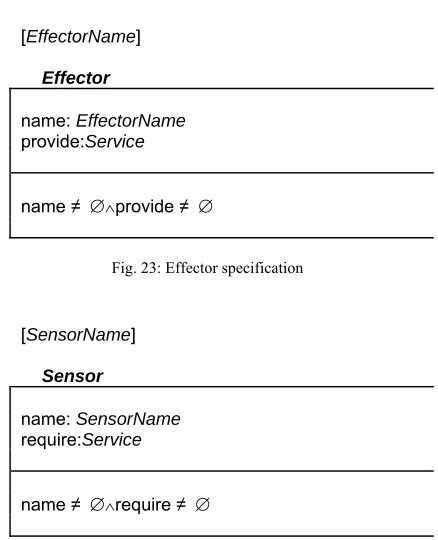
The predicate partition indicates that the sets of effectors and sensors are disjoint. We define an Effector (Figure 23) or a Sensor
(Figure 24) as an individual connection point that defines a set of required or provided services.
[EffectorName]
Effector
name: EffectorName
provide:Service
[image:21.595.72.291.367.637.2]name ≠ ∅∧provide ≠ ∅
Fig. 23: Effector specification
[SensorName]
Sensor
name: SensorName
require:Service
name ≠ ∅∧require ≠ ∅
Fig. 24: Sensor specification
Referring to the GOSIS example, the Mediator needs the query_translation service that the Wrapper provides. Such interface definition points two aspects of an agent. Firstly, it indicates the expectations the
agent has about the agents with which it interacts. Secondly, it reveals that the interaction relationships are a central issue of the architectural description. Such relationships are not only part of the specification of the agent behavior but reflect the potential patterns of communication that characterize the ways the system reason about itself. However, the required query translation service needs to be specified in greater detail. This is possible with the aid of a service.
Service. A service is an operation performed by a sender agent that interacts by dialoguing with one or more receiver agents. We represent a service as a kind of action called speech act in the literature [3]. A speech act is an action available to communicate what an agent knows about the environment. It has the effect of changing the state of the environment just as any action.
A service is specified using the model of action defined in Section 4.4.1, i.e., with preconditions and affects, as described in Figure 25.
Service
precondition: ℙ Belief body: AtomicService
affect: Affect
body ≠∅∧affect ≠∅
Fig. 25: Service specification
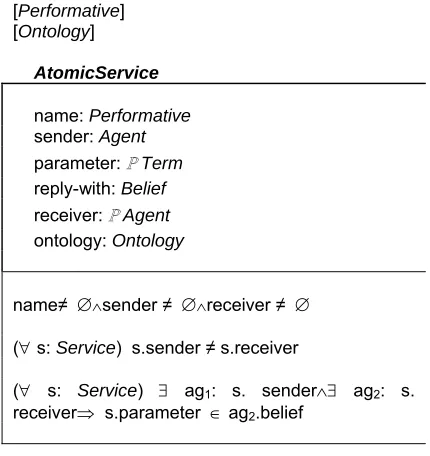
We define an AtomicService (Figure 26) in
the same way as a KQML [10] inter-agent communication. It consists of:
a performative that names the services; a sender
that identifies the agent initiating the services in the architecture; the reply-with that
21 service expresses an interaction; a set of
receivers that identify the agent’s interaction
with the sender; the parameters that define the
information required to execute the service; and an optional ontology that defines the
agreed-upon terms that will be used in the exchange.
[Performative]
[Ontology]
AtomicService
name: Performative
sender: Agent
parameter: ℙ Term
reply-with: Belief
receiver: ℙ Agent
ontology: Ontology
name≠ ∅∧sender ≠ ∅∧receiver ≠ ∅
(∀ s: Service) s.sender ≠ s.receiver
(∀ s: Service) ∃ ag1: s. sender∧∃ ag2: s.
[image:22.595.76.291.238.466.2]receiver⇒ s.parameter ∈ ag2.belief
Fig. 26: AtomicService specification
Referring back to the GOSIS case study, we can see (Figure 27) that the mediator (sender) initiates the service by asking the wrapper (receiver) to translate a query. To this end, the mediator provides to the wrapper a set of parameters allowing the definition of the contents of this query. Such mediator query is specified as belief with the predicate search and the following terms:
search(RequestType,ProductType(+),FilteredKeyword(+))
Each term represents, respectively, the type of the request (normal or advanced in the case of multi-criteria refinement); the type of product; and one or more keywords that must be included in or excluded from the results.
The Affect indicates that a new search
belief is added to the Translation_Management knowledge base of the wrapper.
Service:
performative: Ask(query_translation)
sender: Mediator
parameters: rt: RequestType ∧ pt:ProductType ∧ fk(+):FilteredKeyword
receiver: Wrapper
Affect: Add(Translation_Management_KB, search(rt,pt,fk(+))
Fig. 27: Example of service specification
Configuration. A configuration is an interconnected set of agent instances. A MAS modelled at the architectural level of design is represented as a configuration of instantiated agent components. The topology of the system is defined by a set of bindings between services provided by effector instances and services required by sensor instances. The configuration separates the descriptions of composite structures from the elements in those compositions. This allows reasoning about the composition as a whole and changing of the composition without having to examine each of the individual components in a system. Because there may be more than one uses of a given agent in a MAS, we distinguish the different instances of each agent type that appear in a configuration. To this end, in our ADL we define the type
Instance representing the name given to an
agent instance that has been instantiated within a configuration: [IAgent].
Instantiating an agent also has the secondary effect of instantiating the services that are defined by its interface. We define provided and required service instance types: [IRService] and [IPService].
22 topology of the configuration, by showing which agent instance participates in which interactions. This is done by defining a one-to-many mapping relation between provided and required services. A configuration can be then specified as in Figure 28.
[AgentDescription] [IAgent]
[Instance] := IAgent | IPService | IRService
Configuration
description: ℙ AgentDescription
inst:ance: ℙ Instance
collaboration: (IAgent X IRService) → ( IAgent X IPService)
description≠∅∧instance≠∅∧collaboration≠∅
Fig. 28: Configurationspecification
Part of the GOSIS configuration with instance declarations and collaborations is given in Figure 29.
“(min)...(max)” indicates the smallest acceptable integer, and the largest. An omitted cardinality (as is the case with (max) in the broker, mediator and wrapper agents), means no limitation. Dynamic and evolving structures can change at runtime. Such a configuration allows for dynamic reconfiguration and architecture resolvability at run-time. Configurations separate the description of composite structures from the description of the elements that form those compositions. This permits reasoning about the composition as a whole and allows reconfiguration without having to examine each component of the system.
Architecture. Architecture models the full set of design information defined within an architectural specification. An important property for an ADL is to allow basic
components in architecture to be replaced by (sub) configurations, in order to form new configurations.
Configuration GOSIS Description
Agent Broker[nb: 1…]
Agent Mediator[nm: 1…] Agent Wrapper[nw: 1…nS]
/*with nS = number of information sources Agent Monitor[nmo: 1…nS]
Agent Matchmaker Agent Multi-Critria-analyzer Service Tell(query_translation)
Service Ask(query_translation) Service Achieve(result)
Service Do(result)
Service Tell(subscription_info)
Service Ask(subscription_info)
…
Instance
BRnb: Broker MEnm: Mediator WRnw: Wrapper MOnmo: Monitor MA: Matchmaker
MCA: Multi-Criteria-Analyzer
Tellquerytrans: Tell(query_translation)
Askquerytrans: Ask(query_translation) Achres: Achieve(result)
Dores: Do(result)
Tellsubs: Tell(subscription_info)
Asksubs: Ask(subscription_info)
…
Collaborations
MEnm.Askquerytrans - Tellquerytrans.WRnw; MEnm.Achres --- Tellres.WRnw;
MEnm.Asksubs --- Tellsubs.MA; …
End GOSIS
Fig. 29: Part of the GOSIS configuration
23 hierarchical system descriptions; that is, an agent may be further specified as being implemented by a configuration. An architecture maintains the set of all of the configurations that have been defined, and it can be specified as a non-empty set of configurations that has been defined in the specification (Figure 30).
Architecture
composed_of: ℙ Configuration
composed_of ≠∅
Fig. 30: Architecture configuration
5.The e-commerce system Case Study
E-Media5 is a typical business-to-consumer application we have developed using the ADL described in the previous sections. The application offers an e-commerce architecture supporting the creation of information sources that facilitate the on-line transaction of products, services, and payments resulting in an effective and efficient interaction among sellers, buyers and intermediaries.
This section describes how we have applied SKwyRL ADL to formally specify architectural aspects of the system, such as interfaces, knowledge bases, and security mechanisms. In particular, in section 5.1, we introduce the case study and we discuss with the aid of secure Tropos [5] and i*[47] diagrams the analysis of the system, its requirements and the selected architectural style for the e-media system. In Section 5.2 we illustrate how the proposed ADL was used to support the architectural description
5
(http://www.isys.ucl.ac.be/skwyrl/emedia)
of the system by focusing on one of the system’s main components; the Billing Processor Agent. Then in section 5.3, we explain how the developed architectural solution was implemented and we provide illustrations of the system’s implementation.
5.1.E-Media
24 Confidentiality guarantees that the information is accessible only to authorized entities and inaccessible to others, whereas integrity guarantees that information remains unmodified from source entity to destination entity.
On the other hand, the stakeholder of the E-Media system needs to make sure that the system will always be available for customers to buy; it can confirm the involvement of an entity in certain communications; and it can prove the identity of an entity. In other words, the main security objectives from the e-media’s stakeholder point of view are availability, non-repudiation, and authentication.
Availability guarantees the accessibility and the usability of information and resources to authorized entities, non repudiation confirms the involvement of an entity in certain communications, and authentication proves the identity of an entity.
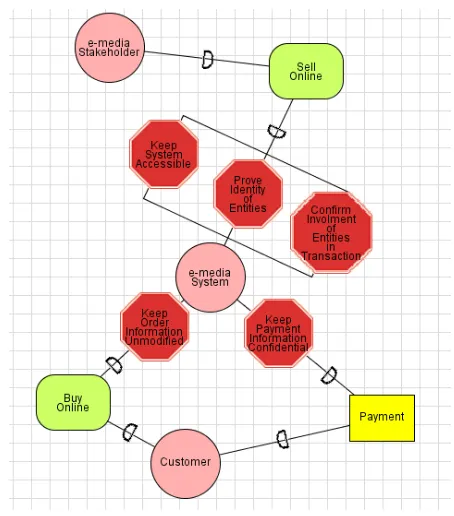
For both, the customer and the e-media stakeholder actors to satisfy their security objectives, some security constraints are imposed on their dependencies. Figure 31 models the dependencies between the customer, the E-Media stakeholder and the E-Media system along with the security constraints imposed by the first two actors on the system, using the secure Tropos language [35] where each node represents an actor (or system component) and each link between two actors indicates a dependency. A dependency describes an “agreement” (called dependum) between two actors: the depender and the dependee. The depender is the depending actor, and the dependee, the actor who is depended upon. The type of the dependency describes the nature of the agreement. Goal dependencies represent delegation of responsibility for fulfilling a goal; soft-goal dependencies are
similar to goal dependencies, but their fulfilment cannot be defined precisely; task dependencies are used in situations where the dependee is required. A Secure Dependency introduces security constraint(s) that must be respected by actors for the dependency to be satisfied [35]. This means that the depender expects from the dependee to satisfy the security constraint(s) and also that the dependee will make effort to deliver the dependum by satisfying the security constraint(s).
[image:25.595.320.547.401.659.2]Actors are represented as circles; dependums – goals, softgoals, tasks and resources – are respectively represented as ovals, clouds, hexagons and rectangles; dependencies have the form depender → dependum → dependee. Security constraints are represented as hexagons.
Figure 31: E-Media dependencies
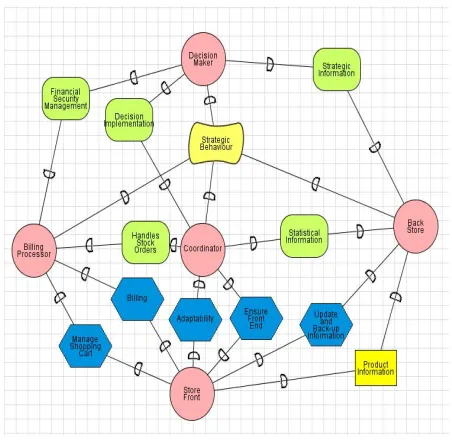
25 identified as suitable for the e-media system. More information about alternative architectural selections can be found in [13]. According to the structure-in-5 style, the organisation of the software architecture can be considered an aggregate of five sub-structures [33]. The Operational Core, which carries out the basic tasks and procedures directly linked to the production of products and services; the Strategic Appex, which makes executive decisions ensuring that the organization fulfills its mission in an effective way and defines the general strategy of the organization in its environment.
The Middle Line, which establishes a hierarchy of authority between the Strategic Apex and the Operational Core; the Technostructure, which serves the organization by making the work of others more effective, typically by standardising work processes, outputs and skills; the Support, which provides specialized services, at various levels of the hierarchy, outside the basic operating workflow. These sub-structures are realized in the case of the e-media architecture by the Store Front, the Back Store, the Billing Processor, the Coordinator and the Decision Maker, as shown in Figure 32.
The Store Front interacts with customers and provides them with a usable front-end web application for consulting, searching and shopping media items. The Back Store constitutes the support component. It manages the product database and communicates to the Store Front relevant product information. To be able to produce statistical information (e.g., analyses, average charts and turnover reports), the Back Store stores and backs up all the appropriate web information about customers, products and sales. Such kind of information is analysed either for a
[image:26.595.312.538.235.455.2]predefined product (when the Coordinator asks it) or on a monthly basis for every product. Based on this monthly statistical analysis, strategic information (e.g., sales increase or decrease, performance charts, best sales, and sales prevision) is also provided to the Decision Maker.
Figure 32: The E-Media Architecture in Structure-in-5