University of East London Institutional Repository:
http://roar.uel.ac.uk
This paper is made available online in accordance with publisher policies. Please
scroll down to view the document itself. Please refer to the repository record for this
item and our policy information available from the repository home page for further
information.
To see the final version of this paper please visit the publisher’s website.
Access to the published version may require a subscription.
Author(s):
Giorgini, Paolo., Mouratidis, Haralambos.
Article Title:
A Constraint-based approach for modeling secure multiagent systems
Year of publication:
2004
Citation:
Giorgini, P., Mouratidis, H. (2004) ‘A Constraint-based approach for
modeling secure multiagent systems’, In Milani, A. ed., Atti della Conferenza Italiana
sui Sistemi Intelligenti CISI-04, 9th AI*IA Convention. Workshop Agenti e Vincoli:
Modelli e Tecnologie per Dominare la Complessità. Perugia, Italy, 2004. Morlacchi
Editore, Perugia.
Link to published version:
http://www.dmi.unipg.it/aiia04/aiia04/WorkshopAV.htm
ISBN:
88-89422-09-2
Publisher statement:
(not stated)
A Constraint-based approach for modeling secure
multiagent systems
1Paolo Giorgini1, Haralambos Mouratidis2
1 DIT, University of Trento, Italy
2 School of Computing and Technology, University of East London, England
Abstract. Security plays an important role in the development of multiagent systems. However, a careful analysis of software development processes shows that the definition of security requirements is, usually, considered after the de-sign of the system. This is, mainly, due to the fact that agent oriented software engineering methodologies have not integrated security concerns throughout their developing stages. The integration of security concerns during the whole range of the development stages could help towards the development of more secure multiagent systems. In this paper2 we introduce a constraint-based
ap-proach that extends the Tropos methodology in order to model security con-cerns throughout the whole development process. A description of the new concepts is given along with a security oriented process that integrates these concepts in Tropos.
1 Introduction
Security plays an important role in the development of multiagent systems and is considered as one of the main issues to be dealt for agent technology to be widely used outside the research community. As a result, research on security for Multiagent systems is an important area within the agent research community. However, the re-search has been mainly focused on the solution of individual security problems of the multiagent systems, such as attacks from an agent to another agent, attacks from a platform to an agent, and attacks from an agent to a platform.
Only very little work has taken place in considering security requirements as an in-tegral part of the whole software development process. None of the existing agent oriented methodologies, to our knowledge, have been demonstrated enough evidence to support claims of adequately integrate security modeling during the whole software development stages. Only recently, some initial steps have been taken towards this
direction. Liu and Yu have initiated work [12] that provides ways of modeling and reasoning about non-functional requirements (with emphasis on security). Yu is using the concept of a soft goal to assess different design alternatives, and how each of these alternatives would contribute positively or negatively in achieving the soft goal.
Lodderstedt et al present a modeling language, based on UML, called SecureUML [13]. Their approach is focused on modeling access control policies and how these (policies) can be integrated into a model-driven software development process. Dif-ferently than these two approaches that are focused in particular stages of the devel-opment (Yu’s effort is focused only in the requirements area while Lodderstedt’s work is focused in the design stage) our approach covers the whole development process. It is important to consider security using the same concepts and notations during the whole development process.
In addition, Huget [14] proposes a new methodology, called Nemo and claims that it tackles security. In his approach, security is not considered as a specific model but it is included within the other models of the methodology. Nemo is a new methodology and as such it has not been extensively presented on literature. From our point of view, the methodology tackles security quite superficial and as the developer states “ par-ticularly, security has to be intertwined more deeply within models” [14]. Thus, more evidence will be required to satisfy the claim of the developer that the methodology tackles security.
Because of the lack of a structured approach to consider security issues in the de-velopment of computer systems, the common approach towards the inclusion of secu-rity within a system is to identify secusecu-rity requirements after the definition of a system. This approach has provoked the emergence of computer systems afflicted with secu-rity vulnerabilities [4]. From the viewpoint of the traditional secusecu-rity paradigm, it should be possible to eliminate such problems through better integration of security and systems engineering.
We believe that security concerns should be considered during the whole develop-ment process of a multiagent system and it should be defined together with the re-quirements specification. Taking security rere-quirements into account together with the functional requirements of a Multiagent system throughout the development stages helps to limit cases of conflict between security and system requirements, by identify-ing them very early in the system development, and find ways to overcome them. On the other hand, adding security as an afterthought not only increases the chances of such a conflict to exist, but it requires huge amount of money and valuable time to overcome it, once they have been identified (usually a major rebuild of the system is needed).
2 Tropos and Secure Tropos
Tropos [5] is a software development methodology, for building agent-oriented software systems, that uses concepts such as actors, goals, soft goals, tasks, resources and intentional dependencies throughout all the phases of the software development [6]. A key feature of Tropos is that it pays great deal of attention to the early require-ments analysis that precedes the specification of the perspective requirerequire-ments, empha-sizing the need to understand the how and why the intended system would meet the organisational goals.
Tropos adopts the i* modelling framework [15], which uses the concepts of actors, goals and social dependencies for defining the obligations of actors (dependees) to other actors (dependers). This means the multiagent system and its environment are viewed as a set of actors, who depend on other actors to help them fulfil their goals.
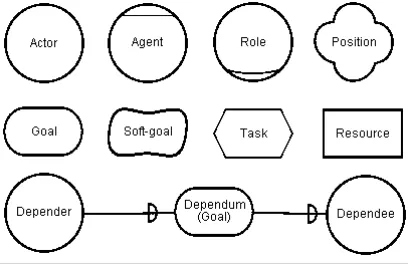
An actor [15] represents an entity that has intentionality and strategic goals within the multiagent system or within its organisational setting. An actor can be a (social) agent, a position, or a role. Agents can be physical agents, such as a person, or soft-ware agents. A role represents an abstract characterisation of the behaviour of a social actor within some specialised context or domain of endeavour [15]. A position repre-sents a set of roles, typically played by one agent.
A (hard) goal [15] represents a condition in the world that an actor would like to achieve. In other words, goals represent actor’s strategic interests. In Tropos, the con-cept of a hard-goal (simply goal hereafter) is differentiated from the concon-cept of soft-goal. A soft-goal is used to capture non-functional requirements of the system, and unlike a (hard) goal, it does not have clear criteria for deciding whether it is satisfied or not and therefore it is subject to interpretation [15]. For instance, an example of a soft-goal is “the system should be scalable”.
A task(also called plan) represents, at an abstract level, a way of doing something [Giu02]. The fulfilment of a task can be a means for satisfying a goal, or for contribut-ing towards the satisficcontribut-ing of a soft-goal. In Tropos different (alternative) tasks, that actors might employ to achieve their goals, are modelled. Therefore developers can reason about the different ways that actors can achieve their goals and decide for the best possible way.
A resource [6, 10] presents a physical or informational entity that one of the actors requires. The main concern when dealing with resources is whether the resource is available and who is responsible for its delivery.
other hand, the depender becomes vulnerable, since if the dependee fails to deliver the dependum, the depender is affected in their aim to achieve their goals.
[image:5.612.210.414.228.364.2]A capability [6, 10] represents the ability of an actor of defining, choosing and exe-cuting a task for the fulfillment of a goal, given certain world conditions and in pres-ence of a specific event.
Figure 1 Error! Reference source not found.depicts a graphical representation of the above-mentioned concepts as used in the Tropos methodology.
Fig. 1. The concepts in Tropos
Tropos supports four development stages, namely early and laterequirements, ar-chitectural design, and detailed design. Early and late requirements analysis repre-sents the initial phases in the Tropos methodology and the final goal is to provide a set of functional and non-functional requirements for the system-to-be. Both phases, early and late, share the same conceptual and methodological approach. This means, that most of the techniques used during the early requirements analysis are used for the late as well. The main difference is that during the early requirements analysis, the devel-oper models the main stakeholders of the system and their dependencies, while in the late requirements analysis the developer models the system itself by introducing it as another actor and model its dependencies with the other actors of the organisation. The architectural design stage defines the system’s global architecture in terms of actors interconnected through data and control flows (represented as dependencies). In addition, during this stage the actors of the system are mapped into a set of software agents, each characterized by its specific capabilities. During the detailed design stage, the developer specifies, in detail, the agents’ goals, beliefs, and capabilities as well as the communication between the agents. For this reason, Tropos employs a set of AUML diagrams [7].
Therefore, we have extended the Tropos methodology to enable developers to ade-quately capture security requirements. The next section describes our extensions.
3 Secure Concepts in Secure Tropos
Extra concepts were introduced to the methodology to enable it to model security requirements during the software development process. These are:
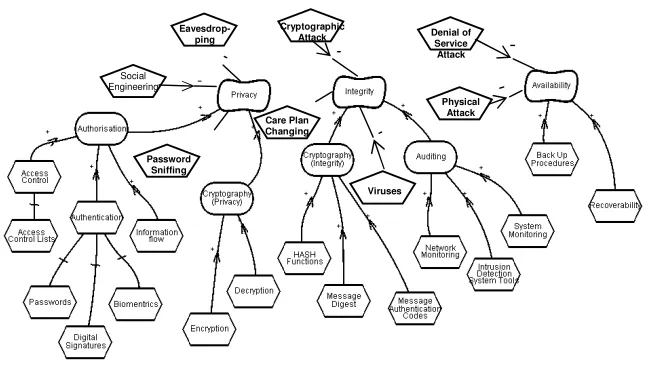
Security Diagram [9], which represents the connection between security features, threats, protection objectives, and security mechanisms that help towards the satisfac-tion of the objectives. Security features [9] represent security related features that the system-to-be must have. Protection objectives [9] represent a set of principles that contribute towards the achievement of the security features. Threats [9] on the other hand represent circumstances that have the potential to cause loss or problems that can put in danger the security features of the system, while security mechanisms [9] iden-tify possible protection mechanisms of achieving protection objectives. The main purpose of the security reference diagram is to allow flexibility during the develop-ment stages of a multiagent system and also to save time and effort. Many systems under development are similar to systems already in existence. Therefore the security reference diagram can be used as a reference point that can be modified or extended according to specific needs of particular systems.
The analysis done during the construction of the security reference diagram can be used later in the development process to identify security constraints that must be introduced to the system-to-be (by taking into account the security needs of the sys-tem) and also by identifying possible means (security mechanisms) that contribute towards the satisfaction of the security constraints that are introduced to the system.
The notation of the security reference diagram can be adapted to reflect the nota-tion of the methodology that the diagram is integrated. This is very useful since it allows developers to work with well-known concepts and allows them to use the same concepts throughout the development process. In this work, concepts from the Tropos methodology such as soft-goals, goals and tasks are used to model security features, protection objectives and security mechanisms respectively
Security Constraint [9], which represents, generally speaking, constraints that are related to the security of the system. A security constraint is defined as a restriction related to security issues, such as privacy, integrity and availability, which can influ-ence the analysis and design of a multiagent system under development by restricting some alternative design solutions, by conflicting with some of the requirements of the system, or by refining some of the system’s objectives [9].
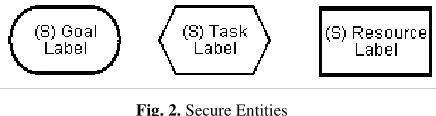
Secure Entities [9], which represent any secure goals/tasks/ resources of the sys-tem. A secure goal represents the strategic interests of an actor with respect to secu-rity. Secure goals are mainly introduced in order to achieve possible security con-straints that are imposed to an actor or exist in the system. However, a secure goal does not particularly define how the security constraints can be achieved, since alter-natives can be considered. The precise definition of how the secure goal can be achieved is given by a secure task. A secure task is defined as a task that represents a particular way for satisfying a secure goal. A secure resource can be defined as an informational entity that is related to the security of the multiagent system. Secure resources can be divided into two main categories. Those that display some security characteristics, imposed by other entities, such as security constraints, secure goals, secure tasks and secure dependencies.
[image:7.612.200.418.321.379.2]In addition, the graphical representation of the Tropos entities has been extended to enable it to model the secure entities. Secure entities are indicated by the presence of an S within brackets before the description of the entity as shown in figure 2.
Fig. 2. Secure Entities
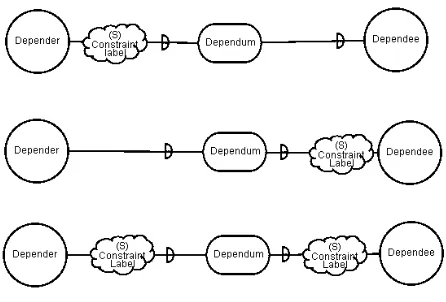
Secure Dependencies [9], represent that a dependency between two actors in-volves the introduction of a security constraint that must be satisfied either by the depender, the dependee or both for the dependency to be valid. Secure dependencies are categorized into depender secure dependency, in which the depender introduces security constraints for the dependency and the dependee must satisfy the security constraints for the dependency to be valid, dependee Secure Dependency, in which the dependee introduces security constraints and the depender must satisfy them, and
double Secure Dependency, in whichboth the depender and the dependee introduce
security constraints for the dependency that both must satisfy for the dependency to be valid. A graphical representation of the different types of secure dependencies is shown in figure 3.
Fig. 3. Secure Dependencies
4 Modeling Security with Secure Tropos
The security-oriented process of secure Tropos is mainly divided into four sub-activities; (1) The identification of security requirements of a multiagent system; (2) the selection amongst alternative architectural styles for the system-to-be according to the identified security requirements; (3) the development of a design that satisfies the security requirements of the system; (4) and the attack testing of the multiagent system under development.
To make the process easier to understand, we use a case study from the health and social care sector, the electronic Single Assessment Process (eSAP) system [9], an agent based health and social are information system.
The process of identifying the security requirements of the system is basically one of analysing the security needs of the stakeholders and the system in terms of security constraints imposed to the system and the stakeholders, and identify secure goals and entities that guarantee the satisfaction of the security constraints.
The first step in the security process consists of the construction of the security ref-erence diagram [9]. For instance, the security refref-erence diagram of the eSAP system is shown in figure 4.
Fig. 4. eSAP security reference diagram
Other important concerns are integrity and availability. Integrity assures that infor-mation is not corrupted and availability ensures the inforinfor-mation is always available to authorised health and social care professionals. If assessment information is corrupted or it is not available the care provided to the patients by the health and social care professionals will not be efficient or accurate. Therefore, it is necessary to find ways to help towards the privacy, the integrity and the availability of personal health and social care information.
When the security reference diagram is complete, the analysis of the actors of the multiagent system takes place and security constraints are imposed to the actors of the system. In addition, security constraints are imposed to the system-to-be, with the aid of the security reference diagram as shown in figure 5.
- Social Engineering
Password Sniffing
Eavesdrop-ping
Cryptographic Attack
Care Plan Changing
Viruses
Denial of Service
Attack
Fig. 5. Analysis of the eSAP actor
When the security requirements of the system-to-be and the involved actors have been identified, the next step in the process consists of identifying an architectural style for the system that will satisfy the security requirements.
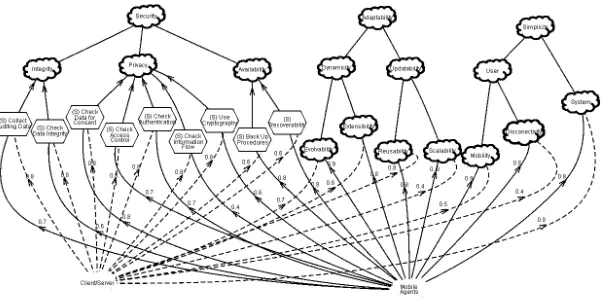
For this reason, we have developed an analysis technique to enable developers to select among alternative architectural styles using as criteria the non-functional re-quirements of the multiagent system under development. The technique is based on an independent probabilistic model, which uses the measure of satisfiability proposed by Giorgini et al. [16]. Satisfiability represents the probability that a non-functional re-quirement will be satisfied. Therefore, the analysis involves the identification of spe-cific non-functional requirements and the evaluation of different architectural styles against these requirements.
The evaluation results in contribution relationships from the different architectural styles to the probability of satisfying the non-functional requirements of the system. To express the contribution of each style to the satisfiability of each non-functional requirement of the system, a weight is assigned. Weights take a value between 0 and 1. For example, 0.1 means the probability that the architectural style will satisfy the non-functional requirement is very low (the style is not suitable for satisfying the re-quirement). On the other hand, a weight of 0.9 means the probability that the architec-tural style will satisfy the non-functional requirement is very high (the style is suitable for satisfying the requirement).
The weights of the contribution links are assigned after reviewing different studies, evaluations, and comparisons involving the architectural styles under evaluation.
re-quirements according to the importance to the system and the identification of the architectural style that best satisfies the most important non-functional requirement using a propagation algorithm, such as the one presented by Giorgini et al. [16].
In this example, we consider two architectural styles, a hierarchical style –
[image:11.612.155.457.237.389.2]client/server - and a mobile code style -mobile agents. As shown in figure 6, each of the two styles satisfies differently each of the non-functional requirements of the sys-tem. For instance, the mobile agents style allows more scalable applications (weight 0.8), because of the dynamic deployment of the mobile code.
Fig. 6. client-Server versus Mobile Agents
As concluded from the analysis presented in figure 6 (and elaborated more in [9]), the client/server style satisfies more the privacy requirements of the system than the mobile agents style. This is mainly because mobility is involved in the mobile agents style. Therefore, although protection of a server from mobile agents, or generally mobile code, is an evolution of security mechanisms applied in other architectural styles, such as client/server; the mechanisms focused on the protection of the mobile agents from the server cannot, so far, prevent malicious behaviour from occurring but may be able to detect it. Consider for example, the Check Information Flowsecure task of the eSAP. The information flow property is more easily damaged by employ-ing mobile agents (weight 0.4) since possible platforms that a mobile agent could visit might expose sensitive information from the agent. In the case of the client/server style (weight 0.8) sensitive information is stored in the server and existing well-proven security measures could be taken to satisfy the information flow attribute.
apply well-proven solutions to solve security problems in a structured and systematic way. The use of security patterns enables non-security specialists to identify patterns for transforming the security requirements of their system into design, and also be aware of the consequences that each of the applied security patterns introduce to their system. Additionally, because security patterns capture well-proven solutions, it is more likely that the application of security patterns will satisfy the security require-ments of the system.
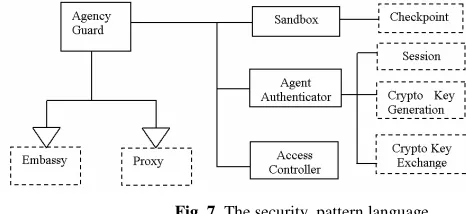
[image:12.612.155.388.300.407.2]Therefore, we have developed a security pattern language [9] and we have inte-grated it within our security-oriented process. Figure 7 describes the relationship of the patterns of the language as well as their relationship with existing patterns. Each box indicates a pattern, where a solid-line box indicates a security pattern that belongs to the language developed by this research and a dashed-line box indicates a related existing pattern. White triangles depict generalisations/ specialisation and solid lines associations of type uses/ requires.
Fig. 7. The security pattern language
The AGENCY GUARD is the starting point of applying the patterns of the lan-guage and it is a variant of the Embassy and the Proxy patterns. It uses the AGENT AUTHENTICATOR pattern to ensure the identity of the agents, the SANDBOX
pattern in order to restrict the actions of agents, and the ACCESS CONTROLER
pattern to restrict access to the system resources.
On the other hand, the SANDBOX pattern can implement the Checkpoint pattern, and the AGENT AUTHENTICATOR pattern can use the Session pattern to store credentials of the agent. Moreover, the AGENT AUTHENTICATOR employs the
Cryptographic Key Generation and the Cryptographic Key Exchange patterns for further cryptographic actions.
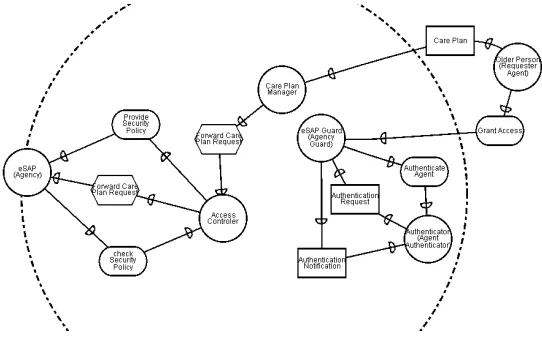
the Access Control, the system should be able to control access to its resources. To meet these goals, The AGENCY GUARD pattern can be used to grant/deny access to the system according to the security policy, the AGENT AUTHENTICATORpattern can be used to provide authentication checks and the ACCESS CONTROLER pat-tern to perform access control checks as shown in figure 8. The use of these patpat-terns not only satisfies the fulfillment of the secure goals of the system but also guarantees the validity of the solution.
Fig. 8. Using the pattern language
The last activity of the security process in secure Tropos involves the testing of the developed solution against potential security attacks. For this reason, we have devel-oped a process that is based on security attack scenarios.
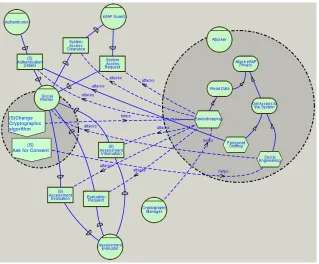
A Security Attack Scenario (SAS) is defined as an attack situation describing the agents of a multiagent system and their secure capabilities as well as possible attack-ers and their goals, and it identifies how the secure capabilities of the system prevent (if they prevent) the satisfaction of the attackers’ goals [9].
A security attack scenario involves possible attacks to a multiagent system, a possible attacker, the resources that are attacked, and the agents of the system related to the attack. An attacker is depicted as an agent who aims to break the security of the sys-tem. The attacker intentions are modelled as goals and tasks and their analysis follows the same reasoning techniques that the Tropos methodology employs for goal and task analysis. Attacks are depicted as dash-lined links, called attack links, which contain an “attacks” tag, starting from one of the attacker’s goals and ending at the attacked re-source.
When the scenarios have been created, they must be validated. Therefore, during the scenario validation process software inspections are used. The inspection of the scenarios involves the identification of any possible violations of the Tropos syntax and of any possible inconsistencies between the scenarios and the models of the previ-ous stages. Such an inspection involves the use of validation checklists. Such a check list has been proposed for instance in [9].
When the scenarios have been validated, the next step aims to identify test cases and test, using those test cases, the security of the system against any potential attacks. Each test case is derived from a possible attack depicted in the security attack scenar-ios. The test cases are applied and a decision is formed to whether the system can prevent the identified attacks or not. The decision whether an attack can be prevented (and in what degree) or not lies on the developer. However as an indication of the decision it must be taken into consideration that at least one secure capability must help an attack, in order for the developer to decide the attack can be prevented. At-tacks that cannot be prevented are notated as solid attack links, as opposed to atAt-tacks that the system can prevent and which are notated as dashed attack links.
For each attack that it has been decided it cannot be prevented, extra capabilities must be assigned to the system to help towards the prevention of that attack. In gen-eral, the assignment of extra secure capabilities is not a unique process and depends on the perception of the developer regarding the attack dangers. However, a good approach could be to analyse the capabilities of the attacker used to perform the attack and assign the system with capabilities that can revoke the attacker’s capabilities.
Fig. 9. An example of a security attack scenario
To accomplish the first sub-goal the Attacker should try to read the data transferred between the Social Worker and the eSAP system’s actors such as the Assessment Evaluatorand the Authenticator. To accomplish the second sub-goal, the Attacker
might use password sniffing or social engineering. In the first case, the Attacker
scans all the resources that flow in the network looking for passwords whereas in the case of social engineering, the Attacker tries to deceive the Social Worker in order to obtain valuable information, such as their authorisation details that will allow them to gain access to the system.
Therefore, for the presented attack scenario, the reaction of the system should be tested against three test cases, read data, password sniffing and social engineering. Due to lack of space we only present the read data test case as shown below.
Test Case 1: read data
Precondition: The Social Worker actor tries to obtain an assessment evaluation. The
Attacker tries to read the transmitted data.
System expected security reaction: The system should prevent Attacker from
(S)Change Cryptographic algorithm
reading any important information.
Discussion: The Attacker will try to read the data from any resource transmitted between the external agents and the eSAP system. However, curerntly the system and its external agents have capabilities to encrypt and decrypt data. As a result all the important data is transmitted across the network encrypted and therefore it is difficult for the Attacker to read it. However, the Attacker might try to obtain (or sometimes even guess) the encryption key.
Test Case Result: The system is protected against read data attacks. However, a recommendation would be for the system to have capabilities to change the cryptographic algorithm often.
5 Conclusions
This paper presents results from our work to extend Tropos methodology to enable it to consider security requirements throughout its development stages. During the process of extending Tropos some very useful observations were obtained. First of all, the concept of constraints is a natural extension of the Tropos methodology and it allows for a systematic approach towards the modelling of security requirements. This is because, although functional and security requirements are defined alongside, a clear distinction is provided. Secondly, the security diagram allows identifying desired security requirements very early in the development stages, and helps to propagate them until the implementation stage, introducing a security-oriented paradigm to the software process. In addition, the iterative nature of the methodology, allows the re-definition of security requirements in different levels therefore providing a better integration with system functionality.
References
[1] N. R. Jennings, M. Wooldridge, “Agent-Oriented Software Engineering” in Handbook of
Agent Technology (ed. J. Bradshaw) AAAI/MIT Press 2001
[2] C. Iglesias, M. Garijo, J. Gonzales, “A survey of agent-oriented methodologies”,
Intelli-gent AIntelli-gents IV, A. S. Rao, J. P. Muller, M. P. Singh (eds), Lecture Notes in Computer Science, Springer-Verlag, 1999
[3] M. Wooldridge, N. R. Jennings, D. Kinny, “ The GAIA Methodology for Agent-Oriented
Analysis and Design”, Journal of Autonomous Agents and Multi-Agent Systems 3, (3) pp.
285-312, 2000
[4] W. Stallings, “Cryptography and Network Security: Principles and Practice”, Second
Edition, Prentice-Hall 1999.
[5] J. Castro, M. Kolp and J. Mylopoulos. “A Requirements-Driven Development
Methodol-ogy,” In Proc. of the 13th Int. Conf. On Advanced Information Systems Engineering
(CAiSE’01), Interlaken, Switzerland, June 2001.
[6] A. Perini, P. Bresciani, F. Giunchiglia, P. Giorgini, J. Mylopoulos. A Knowledge Level
Software Engineering Methodology for Agent Oriented Programming. in Proc. of the
Fifth International Conference on Autonomous Agents, Montreal, Canada, 28 May - 1 June 2001.
[7] B. Bauer, J. Müller, J. Odell, “Agent UML: A Formalism for Specifying Multiagent
Inter-action”. In Agent-Oriented Software Engineering, Paolo Ciancarini and Michael
Wooldridge (eds), Springer, Berlin, pp. 91-103, 2001.
[8] H. Mouratidis, P. Giorgini, G. Manson, I. Philp, “A Natural Extension of Tropos
Method-ology for Modelling Security”, In the Proceedings of the Agent Oriented Methodologies Workshop (OOPSLA 2002), Seattle-USA, November 2002
[9] H. Mouratidis, “A Security Oriented Approach in the Development of Multiagent
Sys-tems: Applied to the Management of the Health and Social Care Needs of Older People in England”, PhD thesis, University of Sheffield, England, 2004
[10]P. Bresciani, A. Perini, P. Giorgini, G. Giunchiglia, J. Mylopoulos, “Modelling early
requirements in Tropos: a transformation based approach”, Agent Oriented Software En-gineering II, M. Wooldridge, G. Wei (eds), Lecture Notes in Computer Science, Springer-Verlag 2222, 2002
[11]H. Mouratidis, i. Philp, G. Manson, “Analysis and Design of eSAP: An Integrated Health
and Social Care Information System”, in the Proceedings of the 7th International
Sympo-sium on Health Information Managements Research (ISHIMR2002), Sheffield, June 2002
[12]L. Liu, E. Yu, J. Mylopoulos, “Analysing Security Requirements as Relationships Among
Strategic Actors”, in the Proceedings of 2nd Symposium on Requirements Engineering for
Information Security, North Carolina - USA, November 2002.
[13]T. Lodderstedt, D. Basin, J. Doser, “SecureUML: A UML-Based Modelling Lan-guage for Model-Driven Security”, in the Proceedings of the 5th International
Con-ference on the Unified Modeling Language, 2002.
[14]M.P. Huget, “Nemo: An Agent-Oriented Software Engineering Methodology”, in the Proceedings of the Agent Oriented Methodologies Workshop (OOPSLA 2002), Seattle – USA, November 2002.