http://dx.doi.org/10.4236/jss.2015.39015
A Game-Theoretic Model for Bystanders’
Behaviour in Classes with Bullying
Yuriko Isada
1, Nobuko Igaki
1, Aiko Shibata
21School of Policy Studies, Kwansei Gakuin University, Hyogo, Japan 2Board of Trustee, International Christian University, Tokyo, Japan
Email: [email protected]
Received 29 August 2015; accepted 15 September 2015; published 18 September 2015
Abstract
In this paper, the behaviour of bystanders in a classroom in which bullying is occurring is analyzed using Game theory. We focus on bystander’s behaviour and formulate a threshold model. Our analysis shows that as class sizes become smaller, the probability of bullying being stopped in-creases.
Keywords
Bullying, Free Rider, Non-Corporative Game
1. Introduction
According to a survey on problematic behaviours by the Ministry of Education, Culture, Sports, Science and Technology (MEXT) in Japan, the number of recognized incidents of bullying at all grade levels nationwide in 2012 was 198,108, 2.82 times than that of the previous year. This represents the largest number of recorded in-cidents since the survey began [1]. Additionally, there were 196 student suicides in 2012, of which 3.1% were understood to have resulted from bullying; this made the issue of bullying a serious social problem that must be solved.
Morita [2] emphasised the importance of bystanders’ behaviour. Shibata et al. [3] conducted an economic analysis on the behaviour of bystanders. Glass and Smith [4] established that a reduced class size can be ex-pected to produce academic achievement. Additionally, Smith and Glass [5] have shown that small class size is effective in improving student attitudes and behaviour.
This paper comprises several sections in which different aspects of bullying analyses are discussed. Section 2 explains our model in detail. Section 3 analyses the Nash equilibrium within the model. Section 4 discusses nu-merical experiments with changes to class size and the impact of these changes on behaviour. Section 5 summa-rizes our results.
2. A Game-Theoretic Model for Bullying
class each bystander can take behaviour R, where a student reports bullying to a teacher, or behaviour S, where a student does not report the bullying. Bullying is resolved when more than t students report the bullying. All players are initially granted a utility level w. When bullying occurs, players incur a negative externality (dis-utility) b. Cost e is constantly incurred for student who selects behaviour R, regardless of whether bullying is stopped or not.
Then, a non-cooperative n-person game model [6] [7] is formulated, shown in Table 1. Each value shows the player’s gain in each case, where X denotes the number of reporters other than himself of herself.
3. Nash Equilibrium in the Bullying Model
Each bystander play this game according to Table 1. Suppose each bystander has the same probability of reporting, q. When players other than oneself select behaviour R with a probability q, the probability of case 1, 2 and 3 are p q1
( )
,p2( ) ( )
q ,p3 q respectively as shown below:( )
(
)
2(
)
11 1 1
0
, , 1
t
n i i
n i
i
p q p q n t C q q
−
− − −
=
= =
∑
− (1)( )
(
)
1(
)
2 2 , , 1 1 1
n t t
n t
p q = p q n t = −C q− − −q − (2)
( )
(
)
1(
)
13 3 , , 1 1
n
n i i
n i
i t
p q p q n t C q q
− − −
− =
= =
∑
− (3)( )
( )
( )
1 2 3 1.
p q +p q +p q = (4)
The Expected utility of ER
( )
q when a player selecting behaviour R, and the Expected utility of ES( )
q when a player selecting behaviour S are expressed with the following equations.( )
(
)
(
)
(
)
( )
1 2 3
1
R
E q p w b e p w e p w e
w e b p q
= − − + − + −
= − − ⋅ (5)
( )
(
)
(
)
( )
( )
(
)
1 2 3
1 2 .
S
E q p w b p w b p w
w b p q p q
= − + − +
= − ⋅ + (6)
1
q= is the state when all players select behaviour R and q=0 is the state when all players select beha-viour S. When ER
( )
q =ES( )
q , the result is as e b/ = p2( )
q .From Equation (2), we have p2
( )
0 =0, p2( )
1 =0 and( )
{
(
)
(
)
(
)(
) ( )
}
(
)
(
(
)
)
{
}
2 1
2 1 1
1 2
1 1
1 1 1 1
1 1 1 ,
n t n t
t t
n t
n t t
n t
p q C t q q q n t q
C q q n q t
− − − − − − − − − − − = − − + − − − = − − + − ′ (7)
It follows that
( )
02 0
0
0 0
0 0, ,1
0 1
for q q
p q for q q
for q q > < <
= =
< < < ′
(8)
where 0 1
1 t q n − = − .
Figure 1 shows that there are two values of 𝑞𝑞 which hold Es
( )
q =ER( )
q when p2( )
q0 >e b/ . Let them denote q1=q n t1( )
, , q2=q2( )(
n t, 0<q1<q2<1)
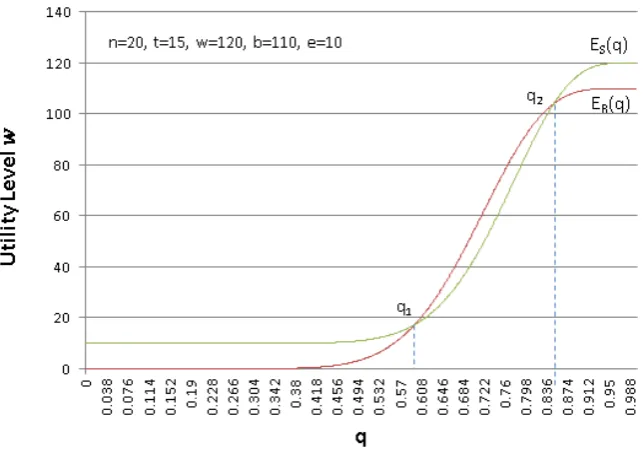
.Figure 2 shows the relationship between Expected utilities ER
( )
q and ES( )
q and for player beha-viours R and S where p2( )
q0 >e b/ .Table 1. Changes to player gain by the number of reporters when selecting either behaviour R or S.
Case 1 (X ≤ t−2) Case 1 (X = t−1) Case 1 (X ≥ t)
Behaviour R w-b-e w-e w-e
Behaviour S w-b w-b w
[image:3.595.117.510.142.620.2]Figure 1. Two intersections of y=p q2
( )
and y=e b/ .Figure 2. Expected utility when there are two intersections of y=p q2
( )
and y=e b/ . Proposition 11) A pure strategy Nash equilibrium always exists in which no player reports bullying. Only when
( )
2 0 /
p q >e b is true, two mixed strategies Nash equilibrium exists.
2) When p2
( )
q0 >e b/ , segment q q1, 2 exists for q where Es( )
q <ER( )
q . Conversely, when( )
( )
( )
2 0 / , S R
[image:3.595.155.477.400.625.2]When examining Figure 1, we see that we can expand the range
[
q q1, 2]
of q by reducing e b/ , since1
q is decreased and q2 is increased. Based on the above, we can make the following propositions. Proposition 2
An increase in b or a decrease in e b/ due to a decrease in e causes a decrease in q1 and an increase in
2
q .
<Proof of Proposition 2>
By differentiating both sides of e b/ =p2
( )
q results indq qb/ = −e b p/ 2 2′( )
q . Because q1 satisfies( )
2 1 0
p′ q > and q2 satisfies p2′
( )
q2 >0, dq1/qb<0, dq2/qb>0, e and e b/ are solved in similar fa- shion. <q.e.d.>4. Behavior Resulting from Changing the Number of Bystanders in the Class
[image:4.595.93.537.399.690.2]Let us examine changes in y=p2
( )
q and y=e b/ that occur at the two intersections with q1 and q2 when changing only n, the number of bystanders in the class, while the ratio of threshold to the number of bystanders is kept constant at t n/ . Figure 3 is a graph of p2( )
q where the number of n is changing. As the value of n becomes smaller, q1 becomes smaller and q2 becomes larger. Thus, the range[
q q1, 2]
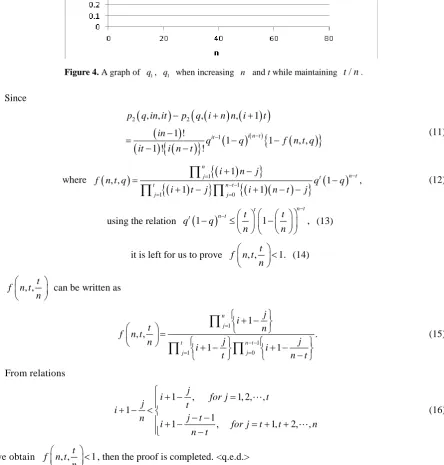
of q expands.Figure 4 is a graph that shows the value of q1 and q2 for four cases, (n, t) = (20, 10), (40, 20)…, where the ratio of t n/ keeps a constant 1 / 2. As n becomes smaller, q1 becomes smaller and q2 becomes larger. Again, the range [ ,q q1 2] of q expands. On the other hand, as class size n becomes larger, q1 becomes larger and q2 becomes smaller. The values of the upper limit q2 decrease, and the lower limit
1
q increase, and the range [ ,q q1 2] of q shrinks. Proposition 3.
1) For i=1, 2,, the following relations hold.
(
)
(
(
) (
)
)
2 , , 2 , 1 , 1 .
p q in it > p q i+ n i+ t (9)
2) For i such as p2
(
(
t−1 /) (
n−1 ,) (
i+1) (
n i, +1)
t)
<e b/ , we have the following in equations.(
)
(
(
) (
)
)
1 , 1 1 , 1
q in it <q i+ n i+ t ,
(
)
(
(
) (
)
)
2 , 2 1 , 1
q in it >q i+ n i+ t . (10)
[image:4.595.93.409.494.693.2]<Proof of Proposition 3>
Figure 4. A graph of q1, q1 when increasing n and t while maintaining t n/ . Since
(
)
(
(
) (
)
)
(
)
(
) (
{
)
}
(
)
( ){
(
)
}
2 2 1, , , , 1
1 !
1 1 , ,
1 ! !
i n t it
p q in it p q i n n i t
in
q q f n t q
it i n t
− − − + + − = − − − − (11)
where
(
)
{
(
)
}
(
)
{
}
1 1{
(
)(
)
}
(
)
1 0
1
, , 1 ,
1 1
n
n t
j t
t n t
j j
i n j
f n t q q q
i t j i n t j
− = − − = = + − = − + − + − −
∏
∏
∏
(12)using the relation
(
1)
1 ,n t t
n t
t t t
q q
n n
− − − ≤ −
(13)
it is left for us to prove f n t, ,t 1.
n <
(14)
, ,t
f n t n
can be written as
1 1 1 0 1 , , . 1 1 n j
t n t
j j
j i
t n
f n t
j j
n
i i
t n t
= − − = = + − = + − + − −
∏
∏
∏
(15)From relations
1 , 1, 2, ,
1
1
1 , 1, 2, ,
j
i for j t
j t
i
j t n
i for j t t n
n t
+ − =
+ − < − −
+ − = + + − (16)
we obtain f n t, ,t 1
n <
, then the proof is completed. <q.e.d.>
Proposition 3 (2) shows that adopting smaller class sizes is effective for reducing bullying. It gives the effectiveness of small-group education.
5. Conclusion
showed by making t n/ , the ratio of a threshold number of reporters to the number of bystanders, constant and decreasing n becomes possible to decrease the lower limit q1 and to increase the upper limit q2 of the probability of reporting bullying. If class sizes are smaller, the number of bystanders should be fewer. This shows the possibility of eliminating bullying by using the smaller number of bystanders. Note that the reason we insist that smaller classes are better, not because it is easier for a teacher to manage smaller classes. More intui-tively, Proposition 3 shows that bystanders can report bullying more easily if they are in a smaller class.
Furthermore, to expand the range [ ,q q1 2] of q, it is useful to raise the disutility b associated with con-tinued bullying and to reduce the cost e of reporting on bullies.
Finally, this study has demonstrated the existence of the “free riding” phenomenon: if the majority of other people report, it is advantageous for any given person not to do so.
Acknowledgements
This work was supported by JSPS KAKENHI Grant Numbers 25350468.
References
[1] MEXT (2011) Heisei 23 nendo “Jidou seito no mondai koudou nado seito shidoujou no shomondai ni kan suru chousa kekka ni tsuite” [Results of the 2011 Survey of Problem Behavior of Students and Various Issues with Instructing Stu-dents]. http://www.mext.go.jp/b_menu/houdou/24/09/__icsFiles/afieldfile/2012/09/11/1325751_01.pdf.
[2] Morita, Y. (2010) Ijime to ha nani ka [What Is Bullying]. Chuko Shinsho, Tokyo.
[3] Shibata, A., Mori, T., Okamura, M. a Soyama, N. (2008) An Economic Analysis of Apathetic Behavior: Theory and Experiment. The Journal of Socio-Economics, 37,90-107. http://dx.doi.org/10.1016/j.socec.2006.12.026
[4] Glass, G.V. and Smith, M.L. (1979) Meta-Analysis of Research on Class Size and Achievement. Educational Evalua-tion and Policy Analysis, 1, 2-16. http://dx.doi.org/10.3102/01623737001001002
[5] Smith, M.L. and Glass, G.V. (1980) Meta-Analysis of Research on Class Size and Its Relationship to Attitudes and In-struction. American Educational Research Journal, 17,419-433. http://dx.doi.org/10.3102/00028312017004419
[6] Nash, J. (1950) Equilibrium Points in n-Person Games. Proceedings of the National Academy of Sciences of the United States of America, 36, 48-49. http://dx.doi.org/10.1073/pnas.36.1.48
![Figure 4q q,] of q shrinks. 2the ratio of larger. Again, the range becomes larger and q increase, and the range [1 is a graph that shows the value of q1 and q for four cases, (n, t) = (20, 10), (40, 20)…, where t n/ keeps a constant 1/ 2](https://thumb-us.123doks.com/thumbv2/123dok_us/8069245.779028/4.595.93.537.399.690/figure-shrinks-larger-larger-increase-cases-keeps-constant.webp)