Effect of Windowing on the Calculation of MFCC
Statistical Parameter for Different Gender in Hindi
Speech
Dheeraj Rana
School of IT GGSIP UniversityDelhi, India
Anurag Jain
School of IT GGSIP UniversityDelhi, India
ABSTRACT
This Paper finds the effects of windowing on the values of mean of first 12 MFCC features excluding energy coefficient for different gender. PRAAT software is used for conducting this experiment which uses Hamming windowing technique by default, Standard low values of window and frame size is used as standard for comparison of MFCC values at increased window and frame sizes by computing Average Deviation from standard values. The main aim of carrying out this experiment is to find out whether all 12 basic MFCCs vary uniformly or not when the window size and subsequently frame size are increased.
To carry out the experiment, a speech database of 8 speakers (5 males & 3 females) is prepared. Each speaker recorded 15 sentences in two emotional states viz. Natural and Anger. The experiments are performed for 7 different cases of window and frame size.
General Terms
MFCC, Emotions, PatternKeywords
MFCC, Window size, Frame size, Hamming Window, Mean, Average Deviation
1.
INTRODUCTION
For every speech recognition, emotion recognition or speaker identification system the first step is to extract features from speech samples that can be used for further processing of the sample, feature extraction is necessary as voice contains infinite information like emotion, gender and speaker identity . So, generally feature extraction is the process of losing some information contained in the speech and extracting only relevant information required for analysis and sufficient for classification. Mel Frequency Cepstral Coefficients (MFCCs) are widely used for emotion identification, speaker identification, speech recognition and provide satisfactory results i.e. success rates of more than 60 % [3] . MFCC is based on known variation of the human ear’s critical bandwidth with frequency, MFCC has types of filter which are spaced linearly at low frequency below 1000 Hz and logarithmic spacing above 1000 Hz [6]. First two basic steps of MFCC computation are Framing and Windowing. Framing is the process of dividing the speech signal into small frames typically in the range of 5 to 50 milliseconds. The next step windowing is the process to window each frame to reduce discontinuities and leakage at start and end of each frame [1]. MFCC features are calculated for each frame. Detailed explanation of all the steps involved in the
Figure1. Hamming Window Function
2.
DATABASE CREATION
India is a country that has a large number of languages and a number of dialects. Hindi is the language spoken by majority of population in India. Hindi is very much phonetic in nature i.e. written symbols and spoken utterances exhibit one-to-one mapping. Detailed explanation about Hindi language can be found in [8]. For performing this experiment, 15 Hindi sentences are given to 8 native speakers (5 males & 3 females) to record utterances in two emotional states Neutral and Anger. Recording of utterances was done in a closed room and noise free environment. For recording a laptop computer, a headphone mic and Audacity software was used. Recorded utterances were then subjected to Background Noise reduction function in Audacity software that minimizes the noise in the recorded utterance to a great extent. The sampling rate used for recording is 16KHz/16bit on mono channel. During recording some portion of the recorded utterance at beginning and end consists mostly as silence portion or some noise. So, these portions are trimmed off the recorded file. In this manner, 150 utterances each of Natural speech and Anger speech are recorded and saved for further processing. Database is divided speaker- wise and gender- wise. Database is stored in different directories on gender basis and each speaker is given an identity for experimental purpose, S1-S5 (Male Speakers) and S6-S8 (Female Speakers). To generate natural emotional feeling of anger in the speakers a long emotional story was dictated to the speakers to induce the same emotional feeling within the speaker. To record neutral utterances no special arrangement needs to be done, any speaker can record an utterance of any sentence long or short in neutral mood. To further check the emotional quality of the utterances, each sentence was uttered 3 times by each speaker and a listening test was also conducted. 10 listeners participated in the listening test, all listeners were in the age group of 17-25 years and with good education. Only those sentences were selected for the experiment whose emotion is identified by more than 75% listeners. Figure 2 shows the list of Hindi sentences used for the speech database.
S.no. Hindi Sentences In English Alphabets
1 येइसमहीनेकातीसरा सोमवारहै।
Ye iss mahine ka teesra somvaar hai.
2 आपकोअपनीबाते सोचकरबोलनी चाहहये।
Aapko apni baatein sochkar bolni chaiye.
3 उस आदमी की कद
काठीबहुतलम्बीहै।
Uss aadmi ki kad kathi bahut lambi hai.
4 इसखेलकेववजेताको
बङापुरस्कारममलेगा।
Iss khel ke vijeta ko bada puraskar milega.
5 हमेएकहोनहारआदमी
कीतलाशहै।
Hume ek honhar aadmi ki talaash hai.
6 तुम्हाराबेटास्कुलजाने लगाहोगा।
Tumhara beta school jaane laga hoga.
7 उसपेङपरऐककबुतर
है।
Uss ped par ek kabootar hai.
8 गुलावकेफूलकीखुशबु भीनीहोतीहै।
Gulaab ke phool ki khushboo bheeni hoti hai.
9 ऊपरके कमरे मेकुछ ककताबेरखीहुईहै।
Upar ke kamre mei kuch kitaabe rakhi hui hai.
10 हमारीपरीशाकीतैयारी पुरीहोचुकीहै।
Hamari pariksha ki taiyari poori ho chuki hai.
11 पूनमघुमनेकेमलये गोमतीएक्सप्रेसआने वालीहै।
Poonam ghoomne ke liye gomti express se aane wali hai.
12 मेरापुरानादोस्तआज भूममपुजनकेमलये आनेवालाहै।
Mera purana dost aaj bhoomi poojan ke liye aane wala hai.
13 पुनमऔरपुजासीधी साधीलङककयााँहै।
Poonam aur pooja seedhi saadhi ladkiya hai.
14 पुननत का घर पुरव
हदशामेंहै।
Punit ka ghar purav disha mei hai.
15 कोयलकीआवाजबहुत मीठीहोतीहै।
Koyal ki aawaz bahut meethi hoti hai.
Figure 2. List of Hindi Sentences used for speech database
3.
EXPERIMENTS
Experiments are divided in two categories emotion-wise and two subcategories gender-wise
i) Effects of windowing in Neutral emotion a) on male speakers
b) on female speakers
ii) Effects of windowing in Anger emotion a) on male speakers
b) on female speakers
For finding the effects of windowing on MFCCs, 7 different cases of window and frame sizes are considered for the experiment. During the experiment it was found that the frame size within a limit does not have much impact on the values of mean of MFCCs if the window size is at least 3 times of the frame size. So, frame size can also be increased to speed up the computation without affecting the outcome of the experiment. Frame size was not increased above 50 milliseconds during experiments. Seven different cases of window and frame size considered for experiment are designed by nearly doubling the size of window and frame (not more than 50 ms) for successive cases.
1) (W: 0.015 ms, F: 0.005 ms) (standard case) 2) (W: 0.03 ms, F: 0.01 ms)
3) (W: 0.06 ms, F: 0.02 ms) 4) (W: 0.1 ms, F: 0.04 ms) 5) (W: 0.2 ms, F: 0.05 ms) 6) (W: 0.4 ms, F: 0.05 ms) 7) (W: 0.5 ms, F: 0.05 ms)
4.
METHOD USED
4
.1 Feature Extraction
PRAAT uses only 6 input variables with no authority to change the detailed implementation of calculating MFCC. PRAAT has a function To MFCC ( 6 input parameters) that can be invoked by an object of sound type. This function returns 1-24(max) number of coefficients plus one energy coefficient. Energy coefficient is not included in this study. Input values to the function To MFCC used for this experiment are :-
1) Number of coefficients 12 2) Window length (in sec) Variable 3) Time step (in sec) Variable 4) Position of first filter (in mel) 100 Hz 5) Distance between filters (in mel) 100 Hz 6) Maximum frequency (in mel) 0 (N.A.)
MFCC values calculated is saved in the format of Spreadsheet file for carrying out further analysis using Microsoft Excel.
4.2 Analysis of Data
MFCCs obtained for first case of low window and frame size are taken as standard and MFCCs for cases of increased values of window and frame size are then compared with MFCCs of standard case for analyzing effect of window size on their values. Steps followed for analysis of MFCC data obtained are (in continuation)
:-i) Mean of each MFCC is calculated for each sentence (15 sentences).
ii) Mean of 15 resultant values of each MFCC is calculated. iii) Above two steps are repeated for all 7 cases of window
and frame size.
iv) Average deviation is calculated of MFCCs obtained for cases 2 to 7 from MFCCs of first case (standard low values of window and frame size) .
v) Average deviation of each MFCC is calculated by formula
vi) Repeat steps i) – v) for each speaker and different emotion.
vii) Take mean of the average deviations of each speaker (gender- wise).
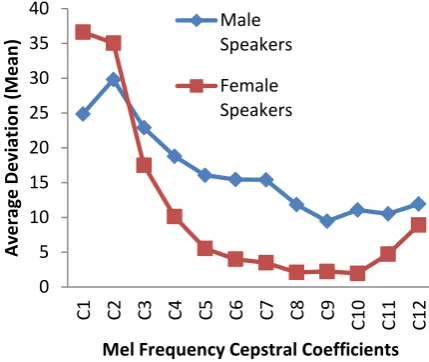
Figure 3(A) Average Deviation of MFCCs by changing window and frame size for Neutral emotion
Figure 3(B) Average Deviation of MFCCs by changing window and frame size for Anger emotion
5.
RESULTS AND DISCUSSION
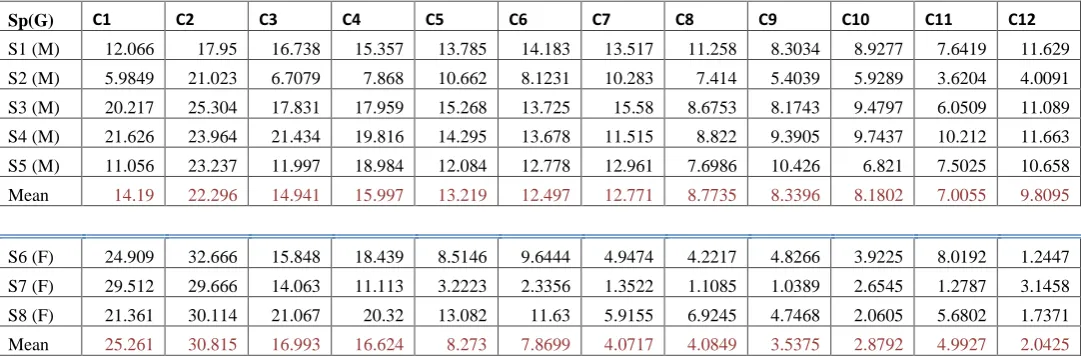
The results of the experiments i) and ii) conducted are depicted in Table I and is plotted in Figure 3(A) and Figure 3(B). Findings obtained after the study of the data produced in the experiments shows that values of low dimensional MFCCs change frequently as compared to high dimensional MFCCs for both male and female speakers and for both emotions i.e. not all MFCCs vary uniformly with change in the window size. Low dimensional MFCCs vary with high degree in anger emotion than in neutral emotion for both male and female speakers.
For female speakers, change in the values of low dimensional MFCCs is very high as compared to the high dimensional MFCCs for both emotions but more clearly visible in anger emotion. For male speakers, this discrepancy between low and high dimensional MFCCs also exist but pattern is nearly same for both emotions.
Summary of the results is that mean value of coefficients C1 to C6 and C12 are relatively more sensitive to change in the window size than the coefficients C7 to C11. This different behavior of coefficients can cause considerable alteration to outcome of experiments but it is concluded in [5] that coefficients C1 to C6 have higher accuracy than C7 to C12 in
0 5 10 15 20 25 30 35
C1 C2 C3 C4 C5 C6 C7 C8 C9 C10 C11 C12
A
ve
rag
e
Devi
ation
(M
e
an
)
Mel Frequency Cepstral Coefficients Male
Speakers Female Speakers
0 5 10 15 20 25 30 35 40
C1 C2 C3 C4 C5 C6 C7 C8 C9 C10 C11 C12
A
ve
rag
e
Devi
ation
(M
e
an
)
Mel Frequency Cepstral Coefficients Male
Speakers
[image:3.595.320.534.74.233.2] [image:3.595.319.534.279.460.2]recognizing emotions, thus the large variation seen between the values of coefficients at increased window sizes for different gender and emotion suggest that better result in emotional classification can be provided by taking mean of MFCCs at large values of window size.
6.
CONCLUSION
In this paper, we found the effects of changing window size on the calculation of MFCC mean and the results presented in
Table suggest varying sensitiveness among MFCCs to window size and found how taking mean of MFCCs at large values of window size will increase accuracy in emotion recognition. There are other patterns also found through the data in the table that may be used for gender identification or even may be for emotional classification between some selected emotions by comparing MFCC mean values calculated using a small window size and a large window size.
Table I
Average Deviation of 12 MFCCs (Mean) over 15 different Hindi Language sentences calculated at different values of window length and frame length from standard (window,frame) length
Standard (W,F) : (0.015, 0.005) in sec ; Sp(G): Speaker Id ( Speaker Gender)
A)
Emotion: Neutral
B)
Emotion: Anger
Sp(G) C1 C2 C3 C4 C5 C6 C7 C8 C9 C10 C11 C12
S1 (M) 21.442 27.184 25.401 18.289 17.583 17.947 18.55 14.888 11.579 11.676 11.548 14.938
S2 (M) 17.621 28.146 13.157 14.21 17.365 12.785 18.07 15.71 9.8646 13.312 9.6047 9.878
S3 (M) 27.693 27.01 21.038 17.864 15.705 16.438 15.551 9.6146 9.1514 12.691 11.207 14.339
S4 (M) 30.53 32.879 30.61 21.546 14.57 14.419 10.104 8.3645 4.6063 5.5932 7.3193 4.3117
S5 (M) 26.938 33.826 24.234 21.951 14.982 15.596 14.691 10.588 12.043 12.031 12.887 16.143
Mean 24.845 29.809 22.888 18.772 16.041 15.437 15.393 11.833 9.4489 11.06 10.513 11.922
S6 (F) 33.006 35.714 16.528 11.754 1.8897 0.4576 2.0311 0.3606 0.8323 1.0858 1.0986 7.2483
S7 (F) 46.454 32.862 11.12 2.6204 5.0512 4.0982 6.0543 2.3383 4.3525 2.8764 9.1284 17.25
S8 (F) 30.417 36.564 24.831 15.975 9.6758 7.4477 2.3563 3.5856 1.4679 1.8457 3.9386 2.1992
Mean 36.626 35.047 17.493 10.117 5.5389 4.0012 3.4806 2.0948 2.2176 1.9359 4.7218 8.8992
Sp(G) C1 C2 C3 C4 C5 C6 C7 C8 C9 C10 C11 C12
S1 (M) 12.066 17.95 16.738 15.357 13.785 14.183 13.517 11.258 8.3034 8.9277 7.6419 11.629
S2 (M) 5.9849 21.023 6.7079 7.868 10.662 8.1231 10.283 7.414 5.4039 5.9289 3.6204 4.0091
S3 (M) 20.217 25.304 17.831 17.959 15.268 13.725 15.58 8.6753 8.1743 9.4797 6.0509 11.089
S4 (M) 21.626 23.964 21.434 19.816 14.295 13.678 11.515 8.822 9.3905 9.7437 10.212 11.663
S5 (M) 11.056 23.237 11.997 18.984 12.084 12.778 12.961 7.6986 10.426 6.821 7.5025 10.658
Mean 14.19 22.296 14.941 15.997 13.219 12.497 12.771 8.7735 8.3396 8.1802 7.0055 9.8095
S6 (F) 24.909 32.666 15.848 18.439 8.5146 9.6444 4.9474 4.2217 4.8266 3.9225 8.0192 1.2447
S7 (F) 29.512 29.666 14.063 11.113 3.2223 2.3356 1.3522 1.1085 1.0389 2.6545 1.2787 3.1458
S8 (F) 21.361 30.114 21.067 20.32 13.082 11.63 5.9155 6.9245 4.7468 2.0605 5.6802 1.7371
[image:4.595.28.569.277.457.2]7.
ACKNOWLEDGMENTS
The authors are thankful to the Guru Gobind Singh Indraprastha University for providing support and students who participated in the preparation of the speech database.
8.
REFERENCES
[1] Jain, A., Prakash,N. and Agrawal, S.S. 2011. Evaluation of MFCC for Emotion Identification in Hindi Speech. In Communication software and Networks (ICCSN) Proceedings, IEEE 3rd International Conference on, May, Xi’an, China.
[2] Sahidullah, Md. and Saha, G. 2012.A Novel Windowing Technique for Efficient Compuation of MFCC for Speaker Recognition. IEEE signal processing letters, vol. 20, no. 2, 2012, pp 149-153.
[3] Kandali, A.B., Routray, A. and Basu, T.K. 2008. Emotion Recognition from Assamese Speech using MFCC features and GMM classifier In TENCON 2008, IEEE Region 10 Conference, 2008, Hyderabad, India.
[4] Kelly, C.K. and Gobl, C. The Effects of windowing on the calculation of MFCCs for different types of speech sounds. In NOLISP'11 Proceedings 5th international conference on Advances in nonlinear speech processing, Nov, 2011.
[5] Sato, N. and Obuchi, Y. “ Emotion Recognition using Mel Frequency Coefficients”, Journal of Natural Language Processing, Information and Media Technologies, vol. 2, no. 3, pp. 835-848, September, 2007.
[6] Muda, L., Begum, M. and Elamvazuthi, I. , “Voice Recognition Algorithms using Mel Frequency Cepstral Coefficient (MFCC) and Dynamic Time Waroing (DTW) Techniques”, Journal of Computing, vol. 2, issue 3, pp. 138-143, March, 2010.
[7] Joshi, D.D. and Zalte, M.B. “ Recognition of Emotion from Marathi Speech Using MFCC and DWT Algorithms”, IJACECT, vol. 2, issue 2, 2013.
[8] Agrawal, S.S. Emotions in Hindi Speech- Analysis, Perception and Recognition. in Speech Database and Assessments. In (Oriental COCOSDA) Proceedings, IEEE International Conference on, October 26-28, 2011, Hsinchu, Taiwan.
[9] Ittichaechareon, C., Suksri, S. and Thaweesak, “ Speech Recognition using MFCC”, ICGSM, July 28-29, 2012, Pattaya, Thailand.
[10] Zheng, F. , Zhang, G. and Song, Z. “ Comparisons of Different Implementations of MFCC”, Journal of Computer Science and Technology, vol. 16, no. 6, pp. 582-589, September, 2011.
[11] Khan, S., lslam, M.R. and Faizul, M. Automatic Speaker Recognition In 3rd international conference on electrical and computer engineering (ICECE), December 28-30,2004, Dhaka, Bangladesh.
[12] http://practicalcryptography.com/miscellaneous/machine- learning/guide-mel-frequency-cepstral-coefficients-mfccs/