FINANCING EDUCATION AND
DEVELOPMENT IN ERITREA –
SOME IMPLICATIONS
Rena, Ravinder
Head of Economics, Department of Business Studies, The Papua
New Guinea University of Technology, Private Mail Bag, LAE 411,
Morobe Province, PAPUA NEW GUINEA
2007
Online at
https://mpra.ub.uni-muenchen.de/11048/
FINANCING EDUCATION AND DEVELOPMENT IN ERITREA –
SOME IMPLICATIONS
Ravinder Rena
∗∗∗∗Head of Economics, Department of Business Studies Papua New Guinea University of Technology- Lae
Papua New Guinea
Abstract
Education has long been recognized as a central element in development. The human capital formation is receiving increased attention from policy makers and scholars in different parts of the world particularly in developing countries. Eritrea is a newly born nation in Africa and is striving hard to develop its higher education. An attempt is made in this paper to analyze the sources of finance, the strategies and challenges for higher educational development in the country. Furthermore, the paper also delves the development of higher education in the country since independence. The paper provides some implications for the for the policy purpose to develop higher education so as to curb the use of expatriate manpower in different sectors of the economy .
Keywords: Higher Education, Economic Development, Unit costs, Eritrea, Africa, Human capital.
________________________________________________________________________
I. INTRODUCTION
Education has long been recognized as a central element in development. It is a vital input in modernization where the developing countries particularly in Africa began their drive for social and economic development since their independence. Education is perceived as a means not only of raising political and social consciousness, but also of increasing the number of skilled workers and raising the level of trained manpower (Tilak, 1994; Rena, 2002). Ultimately, the human capital formation is receiving increased attention from policy makers and scholars interested in promoting economic development in Third World countries. In line with this, Education has been widely recognised and accepted as a leading instrument for promoting economic growth. For Africa, where growth is essential if the continent is to climb out of poverty, education is particularly important (Bloom, Canning, and Chan, 2006:1).
Indeed, it is understood that higher education can lead to economic growth through both private and public channels. The private benefits for individuals are well established and include better employment prospects, higher salaries, and a greater ability to save and
∗ Email: [email protected] ; [email protected]
invest (Akkari, 2004). These benefits may result in better health and improved quality of life, thus setting off a virtuous spiral in which life expectancy improvements enable individuals to work more productively over a longer time further boosting lifetime earnings(Thompson, 1981; Tilak, 1992; Rena, 2002; Varghese, 2004). Higher education is a determinant as well as a result of income, and can produce public and private benefits (Bloom, Hartley, and Rosovsky, 2006).
Besides, short-term economic impacts of higher education are the net changes in regional output, value added, labor income, and employment that are due to new investments flowing into Africa from a the event of economic development. Economists speak of economic impacts in terms of the changes in output, value added, labor income, or employment that occur in industries (including households) when they produce goods and services to satisfy demand by consumers, businesses, investors, or governments that are from outside Africa (Thompson, 1981; Psacharopoulos, 1994; Soudien, 1994). Wolff and Gittleman showed that university enrollment rates are correlated with labor productivity growth. The number of scientists and engineers per capita is also associated with economic growth (Wolff and Gittleman, 1993).
De Meulemeester and Rochat, in their study of six developed countries showed that higher education had a strong causal impact on economic growth in France, Japan, Sweden, and the United Kingdom, but no impact in Australia and Italy. The authors conclude that higher education is necessary for growth but not sufficient. “It is vital,” they argue, “that the social, political, and economic structures and the technological level of the society to which the educational system belongs are such that graduates can actually make use of their accumulated knowledge (De Meulemeester and Rochat, 1995).”
Bloom, Hartley, and Rosovsky showed that workers in American states where the proportion of college graduates is high earn significantly more than those in states with few graduates, whether or not they have received a tertiary education themselves(Bloom, Hartley, and Rosovsky, 2006). The same study showed a positive correlation between higher education and entrepreneurship (Bloom, Hartley, and Rosovsky, 2006:37).
1.2 Methodology and Method of Data Analysis
their institutions. For these reasons, the Heads are considered most resourceful persons for the purposes of this study.
An attempt is made in this paper to analyze the financing of higher education in Eritrea. This paper also provides some review of relevant literature. The paper is been divided into five sections. The second part deals with the higher education and trends in post-independent Eritrea. Section three provides a brief note on financing of education. Section four discusses some of the major challenges in Eritrean education and provides some implications, the final section ends with concluding remarks.
II. HIGHER EDUCATION IN ERITREA 2.1 Country Profile
Eritrea is located in the northeast Africa. It has an area of 121,144 sq km and population of 4.5 million (including about 350,000 Eritrean refugees in Sudan). It is bordered on the northeast by the Red Sea, on the southeast by Djibouti, on the south by Ethiopia, and on the northwest by Sudan. Its per capita income is less than $200 and about 75 per cent of the total population depends on Agriculture (Rena, 2007).
The educational profile of the country: at tertiary level, there was one University which remained closed since September 2006 due to the Government policy. The newly established Eritrea Institute of Technology (EIT) at Mai Nefhi possesses 4 colleges and 5 other colleges located in different parts of the country.1 The total number of students at all levels was about 186,000 in 1991 and reached to about 700,000 in 2006. Eritrea places strong emphasis on education. The emphasis on education is also reflected on the government’s policy on poverty eradication.
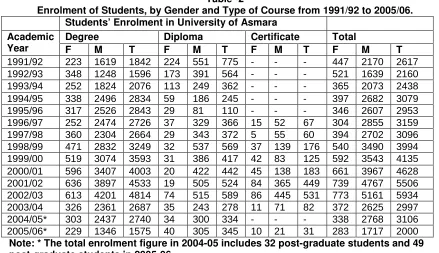
Table-2 provides the information on the Asmara University students’ and their enrolment during the period 1991-92 to 2005-2006(Rena, 2006). In 1999-2000, total enrollment at the institution topped 4,500. By 2005, the university has graduated batches for the 14th time since independence with a total of 10,160 students of which 70 per cent are in degree. As in many African nations, female participation in higher education is a challenge. A quick look at enrollment figures reveals stark differences in male and female patterns of participation in Eritrean higher education. In 1991-92, female students2 accounted for 577 (19.6%) of 2,942 students enrolled in the university’s day and evening programs. But, in 1998-99, they were 540 (13.5%) in 3,994 students, a 6 per cent decrease in a 7-year period (Cheryl, 2003; Rena, 2006). Moreover, apart from the regular classes, the university is giving summer class program to 580 secondary school level teachers for the 5th consecutive time and degree extension program for 450 students.
usually got disinterested in their studies). The most rational way of increasing access to university education is to increase university level facilities. As the reforms are required to be consistent with the educational policy of the country, the government adopted a strategy of decentralizing the tertiary education system. Accordingly, the decision was made to establish various colleges at different locations of the country (Ministry of Education, 2006).
The number of degree and diploma programs that are offered by the colleges presented in the Table -1. It is to be noted that there is a dramatic increase in the diploma programs in the colleges. In terms of students’ population, at its peak the UoA had a student population of about 6,000, while the current total number of students at the tertiary level is about 12,000. In just a period of four years, the student population has doubled (Rena, 2005; MoE, 2006).
Table – 1
The Degree and Diploma Programmes in Various Colleges in Eritrea
Institution Degree Diploma
Eritrea Institute of Technology 12 16
College of Marine Science 3 3
College of Business and Economics 6 4
College of Agriculture 5 6
College of Health Sciences 5 7
College of Arts and Social Sciences 3 2
Total 34 38
University of Asmara 30 3
Source: Ministry of Education, 2006
With the opening of the new colleges, access to tertiary education has increased to about 45 per cent. This is in contrast to the corresponding figure of 10% - 15% before the opening of the colleges ( MoE, 2006). In 2003, the first batch of students who completed their 12th grade at the Sawa High School was given an opportunity to learn in the EIT- Mai Nefhi. The University of Asmara did not enroll any freshman students in the academic year 2003/2004. In 2004 the university was again informed that all the students who were finishing high school in Sawa are sent only to EIT (Rena, 2005). With regard to this, Isaias Afewerki, President of Eritrea, made clear during his visit to the University of Asmara in 2005 that “the staff should not be surprised if they don’t get any fresh students in the coming 4-5 years. The reason, he explained, is that “we are in a transition period.” Accordingly, the University was closed.
subsidized housing, in addition to higher salaries. In 2003, the government took over payment of all salaries from the UNDP. The university then came under the direct jurisdiction of the Department of Education, Ministry of Education. However, by all accounts, the university is completely closed in the academic year 2006(Rena, 2007). However, the enrollment trend in the Asmara University presented in the following Table-2.
Table -2
Enrolment of Students, by Gender and Type of Course from 1991/92 to 2005/06. Students’ Enrolment in University of Asmara
Degree Diploma Certificate Total
Academic
Year F M T F M T F M T F M T
1991/92 223 1619 1842 224 551 775 - - - 447 2170 2617
1992/93 348 1248 1596 173 391 564 - - - 521 1639 2160
1993/94 252 1824 2076 113 249 362 - - - 365 2073 2438
1994/95 338 2496 2834 59 186 245 - - - 397 2682 3079
1995/96 317 2526 2843 29 81 110 - - - 346 2607 2953
1996/97 252 2474 2726 37 329 366 15 52 67 304 2855 3159
1997/98 360 2304 2664 29 343 372 5 55 60 394 2702 3096
1998/99 471 2832 3249 32 537 569 37 139 176 540 3490 3994
1999/00 519 3074 3593 31 386 417 42 83 125 592 3543 4135
2000/01 596 3407 4003 20 422 442 45 138 183 661 3967 4628
2001/02 636 3897 4533 19 505 524 84 365 449 739 4767 5506
2002/03 613 4201 4814 74 515 589 86 445 531 773 5161 5934
2003/04 326 2361 2687 35 243 278 11 71 82 372 2625 2997
2004/05* 303 2437 2740 34 300 334 - - - 338 2768 3106
2005/06* 229 1346 1575 40 305 345 10 21 31 283 1717 2000
Note: * The total enrolment figure in 2004-05 includes 32 post-graduate students and 49 post-graduate students in 2005-06.
Source: University of Asmara Records
In order to foresee the challenges of tertiary education in Eritrea, the MoE estimated the enrollment patterns at the 12th grade level and also the corresponding enrollments at the tertiary level. The Ministry of Education has prepared these forecasts for the next 10 years for the 12th grade level. If the current levels of access are maintained, then assuming even a lower figure of 40 per cent (15% degree and 25% diploma) access rate to tertiary education, the picture looks like that shown in table -3. To obtain the estimates of the total student population at the tertiary education institutions, degree programs are assumed to have durations of 4 to 5 years while the corresponding figures for the diploma programs are assumed to be 2 to 3 years (MoE, 2006).
Table - 3.
Forecast of student enrollment at the 12th grade level and at tertiary institutions.
Academic year Students
enrolled in the 12th grade
Students accepted for tertiary education
Total number of students attending tertiary education
2006/2007 21,700 5,400 16,700
2007/2008 22,600 8,700 21,400
2009/2010 27,900 10,000 28,800
2010/2011 31,400 11,200 32,400
2011/2012 35,600 12,600 36,400
2012/2013 40,400 14,200 41,100
2013/2014 45,200 16,200 46,400
2014/2015 49,900 18,100 52,400
Source: Ministry of Education, 2006
III. FINANCING OF EDUCATION IN ERITREA
It is a strong belief that by spending enormous amounts of money on educational development, the government of Eritrea will enhance the physical, human, and institutional capacity of the system. In line with this, the Government has been committed to reconstruct and develop the country to recover from the devastating effects of the war. Virtually all-critical Government policy documents clearly emphasize “people” as the most central resource that Eritrea has and on which the country can depend for its reconstruction and development. A document developed in 1999 for human resources development “Our People Are Our Future” summarizes this conviction (MoE, 1999). Although still not adequate, the Government has been steadily increasing expenditure on education. Between 1993 and 1997, expenditure on basic and secondary education increased by 15 percent annually and these levels has been maintained through to 2000. Between 2000 and 2001, the recurrent budget has increased by 8percent, and the overall budget has increased over 10 percent. As a percentage of GDP, spending in education rose from 4.9 percent in 1997 to 7.7 percent in 2000 and dropped to 5.0 percent in 2001 but remains close to the average for sub-Saharan Africa, The Government recognizes the need to increase spending on education as a percentage of total Government spending which still stands at an average of about 7.6 percent. The Government's plans for the education sector are well articulated. The draft Eritrea National Education Policy (February 2003) clearly spells out the policies and strategies for the sector while the draft of the Eritrea Education Sector Investment Program (EESIP): Framework 2003/04 - 2007/08 (April 2003) prioritizes additional expenditures on basic and secondary education over five years (GoE, 2003; World Bank, 2003:20).
Tanzania, Kenya, and Uganda, the average cost of classrooms is around $5,000. High unit cost in Eritrea is arguably due to the imported construction materials, as well as the current construction mode of using contractors with little community involvement and contribution in kind. High unit cost is a major factor that delays the solution of the classroom over-crowding issue. Given the current limited resources, the moderate target for the following 5 years would still require double-shifting of classroom utilization. However, the double-shifting ratio is expected to reduce gradually: from 60 percent to 35 percent at elementary level, from over 100 per cent to 40 per cent at middle level and secondary level (World Bank, 2003 GoE, 2003 Rena, 2007). The development costs also include textbook printing and provision. Free provision of textbooks up to 1: 1 book-pupil ratio covers all subjects at elementary and middle level. The current 1:3 book-book-pupil ratio at secondary level is also assumed to be maintained. The unit cost of book-printing is low in Eritrea (see Table -4).
Table -4
Project Costs by component and Sub-component in Eritrea Education sector Improvement Project. (Project cost summary amount in US $ ‘000)
Different heads Cost
including contingencies % of total IDA credit Financing % of financing
A] Increasing equitable enrollment in basic education
Elementary education 13,176.2 22.1 9,551.9 72.5
Middle education 11,963.9 20.1 8,504.5 71.1
Subtotal 25,140.1 42.2 18,056.3 71.8
B]Improved quality of basic and secondary school education
1.Teacher training, development and
professional support
5,343.0 9.0 4,281.4 80.1
2.Replacement of expatriate secondary teachers
5,567.4 9.4 5,010.7 90.0
3. Curriculum and pedagogical reforms 1,500.6 2.5 1,215.0 81.0
4.Text book printing, distribution and utilisation
3,917.9 6.6 3,172.1 81.0
5. Expansion and strengthening of national assessment and examinations
823.6 1.4 621.8 75.5
6. Reducing overcrowding of in secondary schools
10,825.7 18.2 7,499.6 69.3
7.computer classrooms for secondary schools
1,415.0 2.4 1,112.6 78.6
Subtotal 29,393.2 49.4 22,913.1 78.0
C] Enhanced capacity
For sector-wise planning and monitoring 543.9 0.9 440.4 81.0
For service delivery 1,676.9 2.8 1,356.7 80.9
Subtotal 2,220.0 3.7 1,797.0
D]Support equitable provision of education 1,401.6 2.4 1,134.8 80.9
E] Project Management 1,357.2 2.3 1,097.9 81.0
Grand Total 59,512.1 100.0 44,999.2 75.6
It is believed that the government expenditure on education is expected to provide economic benefits in such as i] providing the basis for poverty reduction, overall human capital development, and accelerated economic growth; and ii] rationalization of public expenditures for the welfare of the people in Eritrea.
I] Poverty reduction and economic growth. Education is a key element of the government's strategy to reduce poverty. Weak system capacity, including inadequate physical infrastructure, insufficient numbers and untrained teachers, and limited management capacity for service delivery, has been one of the key factors responsible for unsatisfactory education sector performance, reflected in low enrollment ratios and poor education quality. Hence, the Government of Eritrea focuses on capacity enhancement for education service delivery at elementary, middle, secondary, and tertiary levels. The construction and rehabilitation of classrooms will enhance the physical capacity of the system to absorb more children into formal education. Strengthened teacher-training programs would enhance the human capacity of service delivery. Curriculum reforms are aimed at improving the relevance and quality of the education system. In the meantime, resources invested in strengthening the institutional capacity at the center and Zoba (province) level to ensure more effective and efficient system management. Thus, strengthening Eritrea's education system capacity is important from the perspective of economic growth.
II] Rationalization of public expenditures.The Government's total spending on basic and secondary education was US dollar 33.9 million, 34.9 million and 26.8 million in years 1998, 1999, and 2000.3 As stated earlier, between 2000 and 2001, MoE recurrent expenditure increased by 8 per cent. Social and economic progress requires a broad-based education and training sector reform with the establishment of sustainable sector financing accompanied by an adequate planning and budgeting process. Furthermore, it is envisaged that the education sector development program is also incorporated in the Interim Poverty Reduction Strategy Plan and integrated into the Medium Term Expenditure Framework prepared in 2004.
The demand for classrooms, at all levels of education, to accommodate out of school children and achieve the Millennium Development Goals (or even Education For All), greatly exceeds both the current institutional capacity and the current resources of Eritrea. The high cost of school construction is estimated to be more than US $35,000 4 (in some instances) obstructs both the number of classrooms that can be constructed and the rate of construction. Various partners have considerable experience to share on these issues and UNICEF has completed a study of the costs of classroom construction. The designs and implementation of school construction arrangements have been agreed, and the Government has committed to implement low-cost and durable classroom construction. Another technical problem is the capacity to manage construction within MoE. It is observed that the contracts run late and over cost. MoE is conscious of this and has appointed two qualified and experienced staff to the Project Management Unit as well as nine engineers at Zoba level.
Like most African countries, higher education in Eritrea is free, with the government supporting both tuition and living allowances for students (Rena, 2005). The rationale for free higher education in Eritrea was based among other things, on the country’s desire to create highly trained manpower. In turn, graduates were bound to work in the public sector for a minimum of one and half years under national service.5 Among other factors, economic difficulties and the high increase in population coupled with rising oil prices of 2004-2006 changed this trend, first resulting in the reduction of the recurrent budget allocated to higher education, and then, paving the way for the introduction of user charges in higher education in Eritrea. The performance of higher education in Eritrea is contestable both on equity and efficiency grounds. Austerity in the public budget for higher education, coupled with the poor performance of the sector in promoting access and equity, has led the government of Eritrea to intensify the mechanisms for cost-sharing and user charges in higher education. Asmara University has launched Masters programme in the 6 disciplines and began to charge enormous fee like about US$ 10,000 which is exorbitant when we look at the earning capacity of the people. Unless and otherwise the Master programme is supported by the organizations per se, where that particular student is working, it would be literally impossible for an individual to pay for their master’s study. This has also led to the introduction of Eri-British – a private university6 in that, as more students began to pay for their cost of education, they began to choose between institutions. This way, private educational institutions began to attract students. Among the 45 master’s graduates, in 2006, 27 did their post graduate studies at Asmara University while the rest followed a correspondence with Stony Brook in the United States and UNISA in South Africa. They followed courses in Sustainable Livestock Production, Agronomy, Horticulture, Applied Soil Science, Development Economics’ and Organic Chemistry.
installments after graduation when they obtain employment. This is the most economically feasible and sensible way forward. It is reported that in 2003, the World Bank has sanctioned $ 200 million long term loan for the development of tertiary education in Eritrea which includes all the established colleges. The fund has been particularly given for the construction of main building at EIT with libraries and laboratories.7
IV. EDUCATIONAL CHALLENGES
Education in Eritrea has seen several challenges before attaining its present status. The Italians, the British and the Ethiopians have left their respective marks. The extensive educational reforms currently taking place at all levels is aimed at structuring education to respond to the development needs of the country and to enable Eritrea to participate appropriately in this 21st century characterized by globalization and widespread knowledge based activities (MoE, 2006). The Eritrean education system faces challenges that are fairly common to other education systems in Sub-Saharan Africa. These are limited access; low quality; doubtful relevance; inefficiencies; inadequate financial and non-financial resources; and poor delivery capacity. The Government's vision for addressing these pressing challenges is well- articulated across key policy documents (Government of Eritrea, 2003:8).
4.1 Demand and Supply of Teachers
Over-crowding of classrooms is a very serious issue currently. It is observed that, the pupil-classroom ratio is at 63: 1 at elementary level, 83: 1 at middle level, and 97: 1 at secondary level. It is surprising to note the same or even more pupil-classroom ratio is found in Asmara University and EIT with more than 90. Although these higher learning institutions function at double-shifting (morning and afternoon), but still they could not accommodate many aspirants who seek for higher education. This may be due to the matriculation that offered in Sawa Warsay Yikiallo Secondary School, almost 50 per cent of the 11th grade students (especially girls) from various secondary schools in Eritrea are not prepared to go. In practice, to alleviate the stress of limited classroom capacity, increasing class size is very common at all levels (MoE, 2001; Rena, 2005).
There is an acute shortage of teachers both in terms of the quantity available at the different levels and in terms of the quality of teaching provided. The Government’s commitment to Education for All plus an extension of the middle school program to three years have created a greater demand for teachers. Class sizes are too large at present and the institutional capacity for teacher education is limited. There are no specific facilities for the training of college lecturers. Unqualified staff or under qualified staff are to be found at all levels of the school and college level system and the quality of in-service training and supervision of teachers/ lecturers leaves much to be desired. The proportion of female teachers in the system is low.
54 respectively whereas in EIT it is about 65-70 (Rena, 2005). These ratios are unlikely to ensure the quality of instruction required. In addition, there are problems of modalities of teacher preparation with a one-year program in Asmara Teacher Training Institute and a program for minority language groups in Mai Nefhi Teacher Training Institute (MTTI) at Mai Nefhi, being the only support for elementary school teachers, was closed with the advent of Eritrea Institute of Technology (EIT) in 2004(Rena, 2006). There is no specific focus for the training of college teachers and there is also no clear articulation of demand by the Ministry of Education and the supply of lecturers from the Higher learning institutions in the country. Government projections of college teachers’ requirements are posited on the development of new colleges with Masters programme. Although some of these institutions (like College of Education and College of Arts and Social Sciences) are functioning within EIT but no graduate programmes are conducted till 2007. But it has been decided to start Masters Programmes in certain colleges like Science, Education, Business and Economics etc. from September 2008.
On the other hand, the EIT or any of the colleges did not produce any graduate or diploma holder till 2007. Hence, severe shortage of teacher supply will remain for coming years. To some extent, this gap has been filled with more than 500 Indian expatriate (secondary school) teachers working at different zobas of the country for more than a decade. Phasing out these expatriate secondary teachers is another urgent challenge for the MoE. The salary of an expatriate teacher is eight times more than Eritrean teacher (World Bank, 2003, GoE, 2003).
Skills shortages in the teaching profession at colleges, particularly in Engineering, Medicine, Science and mathematics, are currently met by the employment of expatriate lecturers/professors on contract basis. The Ministry needs support to finance these professors on a short-term basis until local capacity is built up. Pressure on enrolments at the college level also makes the employment of such faculty members critical to delivery of education at this stage. It is however planned to phase out all expatriate lecturers/professors in the coming years. But it will take more time than expected (World Bank, 2003: 30-35; Rena, 2007)
The newly established higher education institutions in Eritrea are expected to add more colleges and will evolve to become full-fledged universities able to offer the services that the country needs. Accordingly, the current phase of establishment should proceed to the phases of consolidation and growth. For this to happen appropriately, a significant amount of human and material resources are required. Some of the disciplines, particularly those in the sciences and engineering and technology, require extensive laboratory and workshop facilities with appropriately trained personnel to operate them. These commodities, together with the buildings required to house them, are really quite expensive. And above all, the newly established higher education institutions require highly qualified Eritrean core staff to lead and build the various programs (the lack of high-level Eritrean staff was, for example, one of the main problems faced by the EIT). Faced with this formidable problem, the government opted to re-allocate the existing resources at the disposal of some higher education institutions (MoE, 2006). It is useful to emphasize here that the recent re-allocation of the resources of the University of Asmara to the various newly established higher education institutions should be viewed in this context.9
4.2 Curriculum, Instruction, and Educational Materials:
The proposed curriculum reforms and the planned rapid expansion of educational access is straining the capacities of the Curriculum Development Division and of the Textbook Production Unit in the General Education Department. The curriculum reforms are introduced in 2003-2004(Rena, 2005). In line with this, various new subjects are introduced. It is to be noted that the Curriculum Development Officers who are appointed to develop the curricula for the new subjects found to have the less expertise required to develop appropriate syllabi and instructional materials. Hence, the support is being taken from Danish International Development Agency (DANIDA) for some of this work and the technical support which may enable the Division to effectively plan for and implement the ongoing educational reforms. A more difficult problem to resolve is the impact of the Government's proposal to develop the higher education curriculum.
This is likely to substantially increase costs and affect the sustainability of the higher education system. Specialized teaching rooms, specialized faculty for elective subjects, special equipment and other teaching and learning materials have yet to be equipped. Similarly, there is acute shortage of curricula and text books in the higher educational institutions such as EIT and other colleges. There are no text books and the faculty was asked to prepare the handouts and then students make photo copy with their own money (Rena, 2007). Many students expressed that it is beyond their limit to bear such expenses. It is observed that many subjects neither have proper curricula nor the text books. So these institutions badly need the experts and financial assistance to develop the required curricula and text books and thus maintain the good higher educational standards in par with the standards of international arena.
publish materials of a high standard as well as to deliver them to schools and colleges in a timely manner. In addition, the capacity of the private publishers to effectively take on some of the volume of work is not readily available. The performance of the Textbook Production Unit and of private publishers have to closely monitored and reviewed. If it is necessary, the Technical Assistance from experienced countries like India, Pakistan or any country from Europe can be taken to overcome these problems in order to design a more effective system for textbooks and materials production and delivery.
At this juncture, the establishment of a-distance learning system for training new middle school teachers is essential. In line with this, in-service program for the training of middle school teachers to the diploma level has to be given.10 It will combine the use of distance
learning materials with face-to-face teaching and the use of a variety of media. A budget of US$1.63 1 million is allocated to this activity in improving the physical facilities at ATTI and Mai Nefhi. A budget of US$ 460,000 is allocated to the activities: development of improved pedagogic approaches for ATTI staff in the light of school curriculum changes (World Bank, 2003, GoE, 2003).
4.3 Low productivity of the total labor force
One of the challenges facing development efforts in Eritrea is the low productivity of the total labor force (including those engaged in subsistence farming). This can only improve through education and tertiary education has a big role to play. In fact, the economically developed societies of today, characterized by globalization and widespread knowledge based activities; require a critical mass of people with solid higher education. It is known, for example, that in the highly developed countries of Europe, about 40 per cent of the population are engaged in sectors that require high standards of knowledge that can only be obtained through university education.
4.4. Some Implications
Alternative sources of finance include enhancement of entrepreneurship at institutional level through leasing of assets, selling faculty expertise and carrying out contracted research. Additional assistance could be gained from the government, foundations and other donors. Other options include setting up a higher education sector loan or grant for capital development, a soft loan facility for both public and private educational institutions in the country. These would easily provide the much needed pool of resources. The loan or grant could be national or regional but long term.
Further on educational finances, the Government of Eritrea can set up an Educational Bank that can consider pegging student loan ceilings to fees charged to enhance affordability of private university education in Eritrea. There is need to spearhead the formation of a consortium of private universities in Eritrea or in the region as a way of pulling or sourcing development capital. The government should also encourage and continue supporting the establishment of private universities by providing the necessary infrastructure such as roads, electricity, offering tax rebates, or land grants as a way of encouraging private university education ventures in areas and courses that are important to Eritrea’s higher education goals and which cannot be left to market forces.
It is an established fact that private universities in many countries like USA, China, India, Kenya etc., have done better than their public counterparts in ensuring gender balance, a general impression is that private university education in Eritrea is beyond the reach of the average citizen. Institutions therefore need to come up with innovative ways to widen access to their programmes especially among the poor and the marginalized groups who are serving the country under national service with limited earnings for many years. Several measures could be put in place to address this issue. The financial aid instruments are currently a paltry fraction of the tuition and related costs.
The investments in education are justified by the contributions which education makes to economic growth, poverty reduction and social welfare in Eritrea. Education contributes to economic growth directly by increasing the productivity of labor, the principal asset of the poor. It also facilitates the development of new technologies, and integrates these technologies into economic activity of Eritrea. Education is also a welfare indicator per se, reflected in improved health and reduced infant mortality. Education also creates positive social externalities by promoting institutions of civil society, improving social equity, strengthening national cohesiveness, and lowering crime rates. For the last 16 years of Independence, Eritrea has produced thousands of educated youth, who contributed more in the economic development of the country in a multi-faceted way.
V. CONCLUSION
Educational investment has long been considered as a stimulant for economic development. Educational investment is one of the important economic activities that can play a major role in boosting a country’s economy. Past studies linking education to economic growth have focused predominantly on the effects of primary and secondary education. It is quite obvious that, the tertiary education also has an important role in promoting economic growth. This study examines the impact of tertiary education on economic growth. The analysis suggests that increasing tertiary education may be important in promoting faster technological catch-up and improving a country’s ability to maximize its economic output. However, the challenges in Eritrean education are serious like: lack of finance resulted teacher shortage, inadequacy of schools, low standards, border-conflict, drought and other socio-economic reasons. Therefore, investing in tertiary education in Eritrea may accelerate technological diffusion, which would decrease knowledge gaps and help reduce poverty in the country and the same is applicable to the African continent.
Despite over 16 years of political independence, Eritrea’s aspirations and hopes remain today largely unfulfilled. This has not been, however, a period of mitigated failure in the history of the country. It is generally believed that while the investment the government has made in the higher education sector since its independence seems to be quite commendable, the trend may not be continued due to current economic problems (Rena, 2005). Current development of an Interim Poverty Reduction Strategy and reforms of economic policy should provide the basis for accelerated economic growth in the future. Accelerated poverty reduction and economic growth will, however, only be achievable and sustainable, if an adequately educated work force is available. The ever increasing pressure for structural adjustment by the World Bank and other donors aside, the tertiary education sector itself is being questioned internally for its limited capacity to provide access to most eligible applicants. Worse, this limited participation in higher education is compounded by gender, 11 socio-economic status, and regional disparities. Therefore, the
situation in Eritrean education sector needs a systematic study. To do this, the Eritrean educators and scholars have special responsibility in the national effort. They also can deploy their resources, talents, imaginations, the goodwill and hard work that are necessary for the success of educational development in Eritrea.
NOTES
sectors. For instance, the College of Marine Biology has work relation with the Ministry of Fisheries and is located in Massawa, Northern Red Sea Region,” the then Minister of Education Osman Saleh stated on the eve of University graduation day in July 2006. All these colleges have been established to provide college level education in the country.
2. In fact, with the UoA being the only university in the country, the gross enrolment ratio for tertiary education is 2 per cent only (see World Bank, 2000); since independence, on an average 14 per cent of students at the UoA have been women.
3. See Eritrea Education and Training Sector. It is to be noted that spending for basic and secondary education includes spending by the MoE and all other line ministries who are involved in education activities.
4. In 2004, Adikeyah school, was constructed with exorbitant cost of Nacfa 18 million near Adiguadad which is about 10 km far from the capital city.
5. There is one area of continuity with (Eritrean people’s Liberation Front (EPLF) earlier practices; national service is required of all young people (men and women alike) who did not serve in EPLF(who brought Eritrea’s independence). They receive six months of military training and are then deployed in rural areas for a year or more to help with road building, reforestation, and other projects. Some Muslim Eritreans have tried to argue for the exemption of Muslim women and some families apparently tried to use marriage as an exemption for women, but the government has held fast to the requirement that all young citizens regardless of gender, religion, or marital status must do their national service. The requirement of not only national service but military training for women is a significant legacy of EPLF’s revolutionary culture. It also can be interpreted as emphasizing the supreme authority of the government over its female citizens over and above patriarchal domestic and religious authorities.
6. This Eri-British Institute was started in mid- 2004 and was accredited by the Edexel in UK. Financial aid to students who cannot meet their educational financial requirements is an essential contribution towards achieving equity of access especially in private universities where the fees charged is quite high. However, this Institute also closed in June 2006.
7.
Although, EIT was set up in the early 2004 with a temporary construction, till mid 2007, the permanent constitutions are not been made for the class rooms, libraries and laboratories etc.
8. As stated earlier in this article Asmara University (and other distance learning programmes from outside) produced about 45 Post-Graduates in 2006. However, this programme is temporarily stopped in 2006. If this tendency continues, it would be difficult for Eritrea to attain its own teachers (self sufficiency) for higher education development and it will take much longer time than expected.
9. For further details, see the government’s directive on the re-allocation of resources of the University of Asmara of August 2006.
11. For example, in 2004-2006 it is observed that the enrollment of girl students in higher education institutions is found to be less than 25 percent.
REFERENCES
Akkari Abdeljalil (2004), “Education in the Middle East and North Africa: The Current Situation and Future Challenges”.International Education Journal, Vol. 5 No 2, pp.144-153, http://iej.cjb.net
Bloom David, David Canning, and Kevin Chan (2006), “Higher Education and Economic Development in Africa Human Development Sector, Africa Region”, (February) This research was commissioned by the World Bank (AFTHD)
Bloom, DE., M Hartley, and H Rosovsky (2006), “Beyond Private Gain: The Public Benefits of Higher Education” in James J. F. Forest and Philip G. Altbach, (eds.), International Handbook of Higher Education, Boston: International Institute of Higher Education.
Cheryl, Sternman (2003), “Rule, African Higher Education: An International Reference Handbook” in Damtew Teferra and Philip. G. Altbach, (eds.), Indiana University Press, pp. 309-315.
De Meulemeester, Jean-Luc and Denis Rochat (1995), “A Causality Analysis of the link Between Higher Education and Economic Development”, Economics of Education Review, Vol. 14 No.4, pp. 251–361.
Government of Eritrea (April, 2003), “Education Sector Improvement Project (ESIP) Environmental And Social Management Framework (ESMF), Document No. E737, Asmara: The Government of Eritrea.
Ministry of Education (June 1999), “Our People, Our Future. A Framework for the Development of Human Resources in the Education Sector”, Asmara: Ministry of Education.
Ministry of Education (2001), “Action Plan for the Development of National Framework”, Asmara: Ministry of Education.
Ministry of Education (2006), “Tertiary Education in Eritrea: Issues, Policies, and Challenges”, Eritrea Profile, Vol. 13, No. 56(Part- I on 20 September); Vol.13, No. 57 (Part-II on 23 September).
Psacharopoulos, G. (1994), “Returns to Investment in Education: a Global update”,
World Development, 22, 1325–1343.
Rena, Ravinder (2002), “Financing and Cost Recovery in Higher Education: A Study with Special Reference to Private Colleges in Andhra Pradesh”, (Ph.D. Abstract),
Finance India Journal Vol.16, No. 2, June, pp.662-666.
Maakel”, Albany (USA): The African Symposium, - A Publication of the African Educational Research Network Volume 5 No. 3, pp.113-128. www2.ncsu.edu/ncsu/aern/TAS5.3Rena.pdf
Rena, Ravinder (2006), “Education and Human Resource Development in Post-independent Eritrea: An Explanatory Note”, West Indies: International Journal of Education and Development using ICT, vol.2.no.4. pp. 67-81 http://ijedict.dec.uwi.edu/viewarticle.php?id=159
Rena, Ravinder (2007), “Higher Education in Africa – a Case of Eritrea,” New Delhi:
Journal of Educational Planning and Administration, Vol. 21 No.2, pp.125-140.
Soudien, C. (1994), “Equality and Equity in South Africa: Multicultural education and change”, Equity and Excellence in Education, Vol. 27 No. 3, pp. 55-60.
Thompson, A.R. (1981), “Education and Development in Africa”, St. Martin’s Press, New York.
Tilak, J.B.G. (1994), “Education for Development in Asia”, Sage Publications, New Delhi.
Tilak, J.B.G. (2003), “Higher Education and Development”, Conference Paper:
International Seminar: University XXI. Internet:
www.mec.gov.br/univxxi/pdf/Jandhyala.pdf (Last accessed: February 21, 2006).
Varghese, N.V., (2004), “Institutional Restructuring in Higher Education in Asia: Trends and Patterns”, UNESCO-IIEP, Paris.
Wolff, EN., and M Gittleman (1993), “The Role of Education in Productivity Convergence: does higher education matter?”. in A Szirmai, B van Ark, and D Pilat (eds), Explaining Economic Growth. North-Holland, Amsterdam.
World Bank (2000), “Peril and Promise: Higher Education in Developing Countries”, World Bank, Washington DC:
World Bank (2003), “Project Appraisal Document on A Proposed Credit to The Government Of Eritrea For An Eritrea Education Sector Investment Project”, The World Bank Report No: 25909
Ziderman, A. and D. Albrecht (1995), “Financing Universities in Developing Countries”, The Falmer Press, Washington, D.C.