http://dx.doi.org/10.4236/am.2015.612185
A Computational Study with Finite Element
Method and Finite Difference Method for 2D
Elliptic Partial Differential Equations
George Papanikos, Maria Ch. Gousidou-Koutita
School of Mathematics, Aristotle University, Thessaloniki, GreeceReceived 21 September 2015; accepted 27 November 2015; published 30 November 2015
Copyright © 2015 by authors and Scientific Research Publishing Inc.
This work is licensed under the Creative Commons Attribution International License (CC BY).
http://creativecommons.org/licenses/by/4.0/
Abstract
In this paper, we consider two methods, the Second order Central Difference Method (SCDM) and
the Finite Element Method (FEM) with P1 triangular elements, for solving two dimensional general
linear Elliptic Partial Differential Equations (PDE) with mixed derivatives along with Dirichlet and Neumann boundary conditions. These two methods have almost the same accuracy from theoret-ical aspect with regular boundaries, but generally Finite Element Method produces better ap-proximations when the boundaries are irregular. In order to investigate which method produces better results from numerical aspect, we apply these methods into specific examples with regular boundaries with constant step-size for both of them. The results which obtained confirm, in most of the cases, the theoretical results.
Keywords
Finite Element Method, Finite Difference Method, Gauss Numerical Quadrature, Dirichlet Boundary Conditions, Neumann Boundary Conditions
1. Introduction
deriva-tion of Finite Element Methods come from the theory of Hilbert Space, and Sobolev Spaces as well as from var-iational principles and the weighted residual method (see [5]-[12]).
In this paper, we will describe the Second order Central Difference Scheme and the Finite Element Method for solving general second order elliptic partial differential equations with regular boundary conditions on a rec-tangular domain. In addition, for both of these methods, we consider the Dirichlet and Neumann Boundary con-ditions, along the four sides of the rectangular area. Also, we make a brief error analysis for Finite element me-thod. Moreover, for the finite element method, we site two other important numerical methods which are impor-tant in order that the algorithm can be performed.
These methods are the bilinear interpolation over a linear Lagrange element, Gauss quadrature and contour Gauss Quadrature on a triangular area. Furthermore, these two schemes lead to a linear system which we have to solve. For the purpose of this paper, we solve the outcome systems with Gauss-Seidel method which is briefly discussed. In the last section, we contacted a numerical study with Matlab R2015a. We apply these methods into specific elliptical problems, in order to test which of these methods produce better approximations when the Di-richlet and Neumann boundary conditions are imposed. Our results show us that the accuracy of these two me-thods depends on the kind of the elliptical problem and the type of boundary conditions. In Section 2, we study the Second order Central Difference Scheme. In Section 3, we give the Finite Element Method, bilinear interpo-lation in P1, Gauss Quadrature, Finite Element algorithm and error analysis. In Section 4, we give some numeri-cal results, in Section 5, we give the conclusions and finally in Section 6 we give the relevant references.
2. Second Order Central Difference Scheme
The second order general linear elliptic PDE of two variables x and y given as follow:
2 2 2
1 2
2 2
u u u u u
p s q b b ru f
x y x y
x y
∂ ∂ ∂ ∂ ∂
+ + + + + =
∂ ∂ ∂ ∂
∂ ∂ (1)
with u defined on a rectangular domain Ω =
[ ] [ ]
a b, × c d, ⊂2, it holdss
2−
4
pq
<
0
. Also( )
1 1 2
, , , , , ,
p q s b b r f∈C Ω and u∈C
( )
Ω C2( )
Ω Moreover in this paper two types of boundary conditions are considered:( ) ( )
,
,
on
1u x y
=
g x y
Γ
(Dirichlet Boundary Conditions).( )
1 on 2
u g x n
∂ = Γ
∂ (Neumann Boundary Conditions).
The boundary ∂Ω = Γ1Γ2 and n is the normal vector along the boundaries. We divide the rectangular domain Ω in a uniform Cartesian grid
(
x yi, j)
=(
(
i−1) (
h, j−1)
k)
:i=1, 2,,N, j=1, 2,,M where N, M are the numbers of grid points in x and y directions andand 1
1 1
b d
h k
N M
= = −
− −
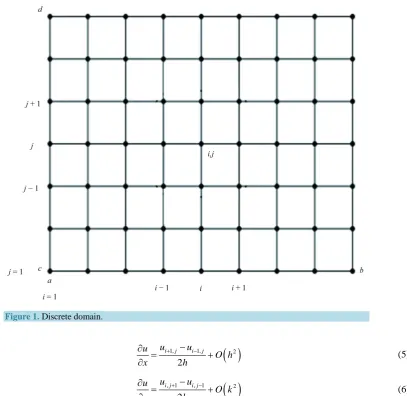
are the corresponding step sizes along the axes x and y. The discretize domain are shown in Figure 1.
Using now the central difference approximation we can approximate the partial derivatives of the relation (1) as follows:
( )
2
1, , 1, 2
2 2
2
i j i j i j
u u u
u
O h
x h
+ − + −
∂ = +
∂ (2)
(
)
2
1, 1 1, 1 1, 1 1, 1 2 2
4
i j i j i j i j
u u u u
u
O k h
x y hk
+ + − − + − + − + − −
∂ = + +
∂ ∂ (3)
( )
2
, 1 , , 1 2
2 2
2
i j i j i j
u u u
u
O k
y k
+ − + −
∂
= +
Figure 1.Discrete domain.
( )
1, 1, 2
2
i j i j
u u
u
O h
x h
+ − − ∂
= +
∂ (5)
( )
, 1 , 1 2
2
i j i j
u u
u
O k
y k
+ − − ∂
= +
∂ (6) where
( ) ( )
2 2(
2 2)
, and
O h O k O k +h are the truncation errors.
We now approximate the PDE (1) using the relations (2), (3), (4), (5), (6) and we obtain the second order cen-tral difference scheme:
(
)
2 2 2 2 2 2
, , , , , 1 , 1, , 1 , 1,
2 2 2 2
, 2 , , 1 , 2 , , 1 , 1, 1 1, 1 1, 1 1, 1 ,
4 2 2 2 2 2 2
2 2 2 2 4
i j i j i j i j i j i j i j i j i j i j
i j i j i j i j i j i j i j i j i j i j i j i j
h k r k p h q u k p b h u k p b h u
h q b k u h q b k u s hk u u u u h k f
+ −
+ − + + − + + − − −
− − + + + −
+ + + − + − − + = (7)
With truncation error
(
2 2)
O k +h .
The relation (7) can be written as a linear system:
Au=b (8)
Dirichlet Boundary Conditions
The dimensions of the above linear system depends on the boundary conditions. More specific, if we have the Dirichlet Boundary Conditions:
( )
( )
( )
(
)
0, ,
,0 ,
, , for each 0,1, ,
, , for each 0,1, ,
j j N j j
i i i M i
u g a y u g a y j M
u g x c u g x d i N
= = =
= = =
then the dimensions of the matrix A, u and b are:
(
N
−
1
)(
M
− ×
1
)
1
for the vectors u, b and(
N
−
1
)(
M
− ×
1
) (
N
−
1
)(
M
−
1
)
for the matrix A. Moreover, the form of matrix A and the vector u are given by:
1 1
2 2 2
3 3 3
3 2 3
2 2 2
1 1
M M M
M M M
M M
B D O O O O O O
G B D O O O O O
O G B D O O O O
A
O O O O C B D O
O O O O C B D
O O O O O G B
− − − − − − − − = and
1,1, 2,1, 3,1, , N 1,1, 1,2, 2,2, 3,2, , N 1,2, , 1,M 1, , N1,M1
u u u u − u u u u − u − u − −
=
u
As we can see the matrix A is tri-diagonal block Matrix. These block matrices 1, 2, , 1; , 2, 3, , 1;
, , 1, 2, , 2
k l m
B k= M− G l= M− D m= M−
are tri-diagonal as well of order
(
N
−
1
)(
N
−
1
)
Neumann Boundary Conditions
(
)
( )
( )
( )
( )
( )
(
)
( )
1 3 2 4 , , , , u ux d g x x c g x
y y
u u
b y g y a y g y
x x ∂ ∂ = = ∂ ∂ ∂ ∂ = = ∂ ∂
We approximate the Neumann boundary conditions in every side of the rectangular domain as follows
1st side (North side of the rectangular area)
(
)
( )
, 1 , 11 1 , 1 , 1 1
, 2 for , 1, 2, , 1
2
i M i M
i i M i M i
u u
u
x d g x g u u kg j M i N
y k
+ −
+ −
−
∂ = ⇒ = ⇒ = + = = −
∂ (9)
2nd side (East side of the rectangular area)
( )
( )
1, 1,2 2 1, 1, 2
, 2 for 1, 2, , 1,
2
N j N j
j N j N j j
u u
u
b y g y g u u hg j M i N
x h + − + − − ∂ = ⇒ = ⇒ = + = − =
∂ (10)
3rd side (South side of the rectangular area)
( )
( )
,1 , 13 3 , 1 ,1 3
, 2 for 0, 1, 2, , 1
2
i i
i i i i
u u u
x c g x g u u kg j i N
y k − − − ∂ = ⇒ = ⇒ = − = = −
∂ (11)
4th side (West side of the rectangular area)
(
)
( )
1, 1,4 4 1, 1, 4
, 2 for 1, 2, , 1, 0
2
j j
j j j j
u u u
a y g y g u u hg j M i
x h
−
− −
∂ = ⇒ = ⇒ = − = − =
∂ (12)
Using the relations (9), (10), (11), (12) the values ui M, +1,uN+1,j,ui, 1− andu−1,j which lies outside the rectangular domain can be eliminated when appeared in the linear system.
0 0
1 1 1
2 2 2
3 3 3
2 2 2
1 1 1
M M M
M M M
M M
B L O O O O O O O
C K D O O O O O O
O C K D O O O O O
O O C K D O O O O
A
O O O O O C K D O
O O O O O O C K D
O O O O O O O L B
− − −
− − −
=
and
0,0, 1,0, 2,0, , N,0, 0,1, 1,1, 2,1, , N,1, , 0,M, , N 1,M, N M,
u u u u u u u u u u − u
=
u
where B L ll, l, =0,M andC K D kk, k, k, =1, 2,,M−1 are tri-diagonal matrices with dimensions
(
)
2
1
M+ . In order to solve the linear system (8), we use the Gauss-Seidel method (GSM) (see [2] [3]). An important property that the matrix A must have is to be strictly diagonally dominant in order the GCM to converge.
Theorem 1
If A is strictly diagonally dominant, then for any choice of u( )0 , Gauss-Seidel method give sequence
{ }
( ) 0k
k ∞
=
u that converge to the unique solution of Au=b.
The proof of theorem 1 can be found in [2] [3].
3. Finite Element Method
In this section we consider an alternative form of the general linear PDE (1)
2 2
u s u s u u u u
p q c d ru f
x x x y y x y y x y
∂ ∂ + ∂ ∂ + ∂ ∂ + ∂ ∂ + ∂ + ∂ + =
∂ ∂ ∂ ∂ ∂ ∂ ∂ ∂ ∂ ∂ (13) where 1
( )
1( )
1( )
1( )
1( )
( )
( )
, , , , , ,
p∈C Ω q∈C Ω s∈C Ω c∈C Ω d∈C Ω r∈C Ω f∈C Ω and 2
( )
( )
u∈C Ω C Ω . With boundary conditions
( )
,
( )
,
on
1u x y
=
g x y
Γ
(Dirichlet Boundary Conditions).( )
1 on 2
u g x n
∂ = Γ
∂ (Neumann Boundary Conditions). And the boundary ∂Ω = Γ1Γ2
In order to approximate the solution of (13) with FEM algorithm we must transform the PDE into its weak form and solve the following problem.
Find
( )
1 1 u∈HΓ Ω( ) ( )
11( )
,
a u v
=
l v
∀ ∈
v
H
ΓΩ
(14)where
( )
, d d2 2
u v u v s u v s u v u u
a u v p q c v d v ruv x y
x x y y y x x y x y
Ω
∂ ∂ ∂ ∂ ∂ ∂ ∂ ∂ ∂ ∂
= + + + − − −
∂ ∂ ∂ ∂ ∂ ∂ ∂ ∂ ∂ ∂
∫∫
and
( )
2 1
d d d
l v fv x y g v s
Ω Γ
= −
∫∫
+
∫
are bilinear and linear functionals as well.
It is sufficient now to consider that
u
∈
L
2( )
Ω
, u, u L2( )
x y∂ ∂ ∈ Ω
( )
2( )
, , , , ,
,
p q s c d r
∈
L
∞Ω
f
∈
L
Ω
andg
1∈
L
2( )
Γ
2 when the Neumann boundary Conditions are applied2
1 d 0
g v s
Γ
≠
∫
, else if we have only Dirichlet Boundary conditions then the line integral is equal to zero.The finite element method approximates the solution of the partial differential Equation (13) by minimizing the functional:
( )
1( )
2 2 2 2 1 1 1
d d d
2
v v v v v v
J v p q s c v d v rv fv x y g v s v H
x y y x x y Γ
Ω Γ
∂ ∂ ∂ ∂ ∂ ∂
= + + − − − + − ∀ ∈ Ω
∂ ∂ ∂ ∂ ∂ ∂
∫∫
∫
(15)where
( )
{
( )
}
1
1 1
1
on
HΓ Ω = u∈ Η Ω u=g Γ and 1
( )
{
( )
( )
}
2 : 2
u L Du L
Η Ω = ∈ Ω ∈ Ω . Also with D we denote the weak derivatives of u. The spaces Η Ω1
( )
,1
1
HΓ are Sobolev function spaces which also considered to be Hilbert spaces(see [7]-[9]).
The uniqueness of the solution of weak form (14) depends on Lax-Milgram theorem along with trace theo-rem (see [7]). In addition according to Rayleigh-Ritz theorem the solution of the problem (14) are reduced to minimization of the linear functional
( )
1
1
:
J HΓ Ω →, (see [7]).
The first step in order the FEM algorithm to be performed is the discretization of the rectangular domain
[ ] [ ]
2, ,
a b c d R
Ω = × ⊂ by using Lagrange linear triangular elements.
We denote with Pk the set of all polynomials of degree ≤k in two variables [7]. For k = 1 we have the linear
Lagrange triangle and
( )
(
)
{
}
( )
1= ϕ∈C Ω ,ϕ x y, = +a bx+cy , dim 1 =3
Also the triangulation of the rectangular area should have the below properties:
We assume that the triangular elements
T
i,1
≤ ≤
i
κ κ κ
,
=
( )
h
, are open and disjoint, where h is the maxi-mum diameter of the triangle element. The vertices of the triangles all call nodes, we use the letter V for vertices and E for nodes.
We also assume that there are no nodes in the interior sides of triangles.
3.1. Bilinear Interpolation in
P
1Let as consider now the triangulation of the rectangular domain Ω =
[ ] [ ]
a b, × c d, ⊂R2 as we describe to a pre-vious section. In every triangle Ti of the domain we interpolate the function u with the below linear polynomial:( )i
( )
,x y a bx cy
ϕ = + +
with interpolation conditions:
( )i
(
,) (
,)
, 1, 2, 3 j xj yj u xj yj jϕ = =
in every vertex Vj =
(
x( )ji ,y( )ji)
of a triangular element.Thus it creates the below linear system with unknown coefficients a, b, c. ( )
(
)
( )(
)
( )(
)
( ) ( ) ( ) ( ) ( ) ( )1 1 1 1 1
2 2 2 2 2
3 3 3 3 3
, 1
, 1
, 1
i i i
i i i
i i i
x y x y a
x y x y b
c
x y x y
ϕ ϕ ϕ =
Solving the system we find the approximate polynomial of u
( )
( )
( )( )
( )(
)
( )( )
( )(
)
( )( )
( )(
)
( )
( )
( )(
)
1 1 1 1 2 2 2 2 3 3 3 3 3
1
, , , , , , ,
, ,
i i i i i i i
i i
j j j j
j
x y N x y x y N x y x y N x y x y
N x y x y
ϕ ϕ ϕ ϕ
ϕ =
= + +
=
∑
( )
( )
( ) ( ) ( )( )
( )
( ) ( ) ( )( )
( )
( ) ( ) ( )1 1 1 1
2 2 2 2
3 3 3 3
, , ,
i i i i
i i i i
i i i i
N x y a b x c y
N x y a b x c y
N x y a b x c y
= + + = + + = + + and ( ) ( ) ( ) ( ) ( )
(
)
( ) ( ) ( )(
)
( ) ( ) ( )(
)
( ) ( ) ( ) ( ) ( )(
)
( ) ( ) ( )(
)
( ) ( ) ( )(
)
( )(
( ) ( ) ( ) ( ))
( )(
( ) ( ))
( )(
( ) ( ))
2 3 3 2 2 3 3 2
1 1 1
3 1 1 3 3 1 1 3
2 2 2
1 2 2 1 1 2 2 1
3 3 3
, ,
2 2 2
, ,
2 2 2
, ,
2 2 2
i i i i i i i i
i i i
i i i i i i i i
i i i
i i i i i i i i
i i i
x y x y y y x x
a b c
A A A
x y x y y y x x
a b c
A A A
x y x y y y x x
a b c
A A A
− − − = = = − − − = = = − − − = = =
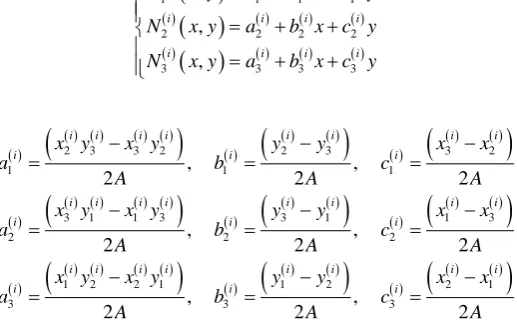
The function N( )ji
(
x y,)
=a1( )i +b x1( )i +c y1( )i is the interpolation function or shape function and it has the fol-lowing property:( )
(
)
1, , 1, 2, 3
0
i
j k k
j k
N x y k
j k ν ν Α = = = Α ≠
3.2. Gauss Quadrature
An important step in order to implement the Finite Element algorithm is to compute numerically the double and line integrals which occurs in every triangular element (see [5][12]).
Gauss Quadrature in Canonical Triangle
As a canonical triangle we consider the triangle with vertices (0, 0), (0, 1) and (1, 0) and we denote
(
)
{
, : 0 , 1}
Tκ= x y ≤x x+ ≤y . The approximation rule of the double integral in canonical triangle is given below:
(
)
(
)
(
)
(
)
1
1
, d d , , , ,
2 g
n
i i i g i i
i T
f x y x y w f x y f x y P n x y
κ
κ
=
≈
∑
∀ ∈∫∫
Where ng is the number of Gauss integration points, wi are the weights and
(
x y
i,
i)
are the Gauss integrationpoints.
The linear space Pκ is the space of all linear polynomial of two variables of order k
The followingTable 1 gives the number of quadrature points for degrees 1 to 4 as given in Ref. [10]. It should be mentioned that for some N, the corresponding ng is not necessarily unique. (see [10] and references therein).
Gauss quadrature in general triangular element
Initially we transform the general triangle Τ into a canonical triangle using the linear basis functions:
(
)
(
)
(
)
1 2 3 , 1 , ,ξ η
ξ η
ξ η
ξ
ξ η
η
Ν = − −
Ν =
[image:7.595.184.443.100.262.2]Ν =
Table 1.Quadrature points for degrees 1 to 4.
Quadrature points for degrees 1 to 4
N dim( )N ng
1 3 1
2 6 3
3 10 4
The variables x, y for the random triangle can be written as affine map of basis functions:
(
)
(
)
(
)
(
)
(
)
(
)
(
)
(
)
(
)
(
)
3
1 1 1 2 2 3 3
1 3
2 1 1 2 2 3 3
1 , , , , , , , , , , i i i i i i
x r x x x x
y r y y y y
ξ η ξ η ξ η ξ η ξ η
ξ η ξ η ξ η ξ η ξ η
=
=
= = Ν = Ν + Ν + Ν
= = Ν = Ν + Ν + Ν
∑
∑
Also we have the Jacobian determinant of the transformation
( )
( )
( )
, , 2 , k x y x y J A x y ξ ξ ξ η ξ η η η ∂ ∂ ∂ ∂ ∂ = = = ∂ ∂ ∂ ∂ ∂Using the above relations we obtain the Gauss quadrature rule for the general triangular element:
( )
(
1(
) (
2)
)
1
, d d , , ,
g
n
k i i i i i
i T
I F x y x y A w F r ξ η r ξ η
=
=
∫∫
≈∑
with
(
)
(
)
(
)
1 2 3 2 3 1 3 1 2
2
k
x y y x y y x y y
A = − + − + −
is the area of the triangle.
Contour quadrature rule
In the Finite Element Method when the Neumann boundary conditions are imposed it is essential to compute numerically the below Contour integral in general triangular area.
(
,)
d(
,)
d ji
P
P
I=
∫
g x y s=∫
g x y sThe basic idea is to transform the straight contour PiPj to an interval
l
=
[ ]
a b
,
, and then the Gaussianqua-drature for single variable function.
Using the basis functions we have the following relations in every side of the triangle Along side 1 (P1P2):
( )
(
) (
)
(
(
)
(
)
)
(
) (
)
(
)(
)
(
)(
)
(
) (
)
(
)(
)
(
)(
)
2 1 1 2 22 1 2 1 1 2 1 1 2 1
0
2 2 1
2 1 2 1 2 1 2 1
1 1
1
2 2
2 1 2 1 2 1 2 1
1 1
1
, d , d
1 1
, d
2 2 2
1 1
,
2 2 2
P P N i i i i
g x y s x x y y g x x x y y y
x x y y x x y y
g x y
x x y y x x y y
c g x y
ξ ξ ξ
ξ ξ ξ ξ ξ − = = − + − + − + − − + − − + − + = + + − + − − + − + ≈ + +
∫
∫
∫
∑
Along side 3: (P3P1):
( )
(
) (
)
(
(
)
(
)
)
(
) (
)
(
)(
)
(
)(
)
(
) (
)
(
)(
)
(
)(
)
1 3 1 2 23 1 3 1 1 3 1 1 3 1
0
2 2
1
3 1 3 1 3 1 3 1
1 1
1
2 2
3 1 3 1 3 1 3 1
1 1
1
, d , d
1 1
, d
2 2 2
1 1
,
2 2 2
P P N i i i i
g x y s x x y y g x x x y y y
x x y y x x y y
g x y
x x y y x x y y
c g x y
η η η
Along side 2: (P2P3):
( )
(
) (
)
(
(
)
(
)
)
(
) (
)
(
)(
)
(
)(
)
(
) (
)
(
)(
)
(
)(
)
3 2 1 2 23 2 3 2 2 3 2 2 3 2
0
2 2
1
3 2 3 2 3 2 3 2
2 2
1
2 2
3 2 3 2 3 2 3 2
2 2
1
, d , d
1 1
, d
2 2 2
1 1
,
2 2 2
P P N i i i i
g x y s x x y y g x x x y y y
x x y y x x y y
g x y
x x y y x x y y
c g x y
η η η
η η η η η − = = − + − + − + − − + − − + − + = + + − + − − + − + ≈ + +
∫
∫
∫
∑
The error of the bilinear interpolation Gauss quadrature depend on the dimension of the polynomial subspace (see [11]).
3.3. Finite Element Algorithm
The Finite element algorithm has the purpose to find the approximate solution of the problem (15) in a subspace of 1
1
HΓ . We consider as subspace the 1 of all piecewise linear polynomials with two variables polynomials of degree one. i.e.:
( )i
( )
,x y a bx cy
ϕ = + +
The index i represents the number of triangular elements which exist in the rectangular domain. The polyno-mials must be piecewise because the linear combination of them must form a continuous and integrable function with continuous first and second derivatives.
The existence and uniqueness of the approximate solution is ensured by the Lax-Milgram-Galerkin and Rayleight- Ritz theorems (see [1][7][8]).
Firstly as we describe in a previous section, we have to triangulate the domain before the algorithm evaluated. After that the algorithm seeks approximation of the solution of the form:
(
)
(
)
1
, ,
m
h i i
i
u x y γ ϕ x y
= =
∑
where ϕ =i,i 1, 2,,m is the linear combination of independent piecewise linear polynomials and γ =i,i 1, 2,,m
are constants with m is the number of nodes. Actually, the polynomials ϕi corresponds to shape functions , 1, 2, 3
j j
Ν = in every vertex of the triangles. Thus the approximate solution is the linear combination of all the independent interpolation functions multiplied with some constant γi. Some of these constants for example,
1, 2, ,
n n m
γ + γ + γ are used to ensure that the Dirichlet boundary conditions if there are exist
( ) ( )
,
,
h
u
x y
=
g x y
are satisfied on Γ1 and the remaining constants γ γ1, 2,,γn are used to minimize the functional
J u
( )
h .Inserting the approximate solution
(
)
(
)
1
, ,
m
h i i
i
u x y γ ϕ x y
=
=
∑
for v into the functionalJ v
( )
and we have:2 2
1 1 1 1 1 1 1
2
1 1 1
1 2
m m m m m m m
i i i i i
i i i i i i i i i
i i i i i i i
m m m
i
i i i i i
i i i
J p q s c
x y y x x
d r
y
ϕ ϕ ϕ ϕ ϕ
γ ϕ γ γ γ γ γ γ ϕ
ϕ
γ γ ϕ γ ϕ
= Ω = = = = = =
= = = ∂ ∂ ∂ ∂ ∂ = + + − ∂ ∂ ∂ ∂ ∂ ∂ − − ∂
∑
∫∫
∑
∑
∑
∑
∑
∑
∑
∑
∑
2 1 1 1d d d
m m
i i i i
i i
f γ ϕ x y g γ ϕ s
= Γ =
+ −
∑
∫
∑
(16)Consider J as a function of γ γ1, 2,,γn. For minimum to occur we must have
0, 1, 2, ,
Differentiating (16) gives
2 1
1
1
2 2 ?
d d
2 2
d d d
2 2
n
j j j j
i i i i
i
j j
i i
j i j i i j i
m
i k i k i
j j
k n
s s
p q
x x y x x y y y
c d
r x y
x x y y
s s
f x y g s p
x x y x x
ϕ ϕ ϕ ϕ
ϕ ϕ ϕ ϕ
ϕ ϕ
ϕ ϕ ϕ ϕ ϕ ϕ ϕ ϕ γ
ϕ ϕ ϕ ϕ ϕ ϕ
ϕ ϕ = Ω = + Ω Γ ∂ ∂ + ∂ ∂ + ∂ ∂ + ∂ ∂ ∂ ∂ ∂ ∂ ∂ ∂ ∂ ∂ ∂ ∂ ∂ ∂ − ∂ + ∂ − ∂ + ∂ − ∂ ∂ ∂ ∂ ∂ ∂ = − + − + + ∂ ∂ ∂ ∂ ∂
∑ ∫∫
∑
∫∫
∫
d d 2 2 ki k i k i k
k i k i i k k
y
c d
q r x y
y y x x y y
ϕ ϕ ϕ ϕ ϕ ϕ ϕ ϕ ϕ ϕ ϕ ϕ γ
Ω ∂ ∂ ∂ ∂ ∂ ∂ ∂ + ∂ ∂ − ∂ + ∂ − ∂ + ∂ −
∫∫
for each j=1, 2,,n .This set of equations can be written as a linear system:
Ac=b (17) where c=
(
γ γ1, 2,,γn)
t, A=( )
aij and(
1, 2, ,)
t n
β β β
=
b are defined by
2 2
d d
2 2
j j j j
i i i i
ij
j j
i i
j i j i i j
s s
a p q
x x y x x y y y
c d
r x y
x x y y
ϕ
ϕ
ϕ
ϕ
ϕ
ϕ
ϕ
ϕ
ϕ
ϕ
ϕ
ϕ
ϕ
ϕ
ϕ
ϕ
ϕ ϕ
Ω ∂ ∂ ∂ ∂ ∂ ∂ ∂ ∂ = + + + ∂ ∂ ∂ ∂ ∂ ∂ ∂ ∂ ∂ ∂ ∂ ∂ − + − + − ∂ ∂ ∂ ∂
∫∫
for each i=1, 2,, ,n j=1, 2,,m.
2 1
1
d d d
2 2
d d
2 2
m
i k i k i k
i j j
k n
i k i k i k
k i k i i k k
s s
f x y g s p
x x y x x y
c d
q r x y
y y x x y y
ϕ ϕ ϕ ϕ ϕ ϕ
β ϕ ϕ
ϕ ϕ ϕ ϕ ϕ ϕ ϕ ϕ ϕ ϕ ϕ ϕ γ
= +
Ω Γ Ω
∂ ∂ ∂ ∂ ∂ ∂ = − + − ∂ ∂ + ∂ ∂ + ∂ ∂ ∂ ∂ ∂ ∂ ∂ ∂ + ∂ ∂ − ∂ + ∂ − ∂ + ∂ −
∑
∫∫
∫
∫∫
The choice of subspace 1 for our approximation is important because can ensure us that the matrix A will be positive definite and band( [2]-[4]). According to the previous analysis leads again to a linear system, which can be solved as we described in a previous section with Gauss-Seidel Method (see [2]-[4]).
3.4. Error Analysis
Let us consider again the problem (14)
Find
( )
1
1
u∈HΓ Ω :
( ) ( )
1( )
1
,
a u v =l v ∀ ∈v HΓ Ω (18) The approximation of finite element of the problem (18) is given below:
Find uh∈1:
(
) ( )
1
,
1h h h h h
u
∈
a
u v
=
l v
∀ ∈
v
(19)Cea’s lemma
The finite element approximation uh∈1 of the weak solution
( )
11
u∈HΓ Ω is the best fit to 𝑢𝑢 in the norm
( )
1 1
HΓ Ω
• i.e:
( ) ( ) 1 1 1 1 1 0 min h h
h H v V h H
c
u u u v
c
Γ Ω ∈ Γ Ω
− ≤ −
Now we will present without proof the following statement [7]. ( )
( )
11 min
h h
s h H
v∈V u−v Γ Ω ≤C u h (20)
where
C u
( )
is positive constant dependent on the smoothness of the function u, h is the mesh size parameter and s is a positive real number, dependent on the smoothness of u and the degree of the piecewise polynomials com-prising in 1. In our case we have the Lagrange linear elements so the degree of the piecewise polynomials is one. Combining, relations Cea’s lemma we shall be able to deduce that:( )
( )
11
1
0
h H
c
u u C u h
c
Γ Ω
− ≤ (21) The relation (21) gives a bound of the global error e= −u uh in terms of the size mesh parameter h. Such a bound on the global error is called priori error bound.
L2-norm
For proving an error estimate in L2-norm the regularity of the solution of (13) plays an essential role. By the Aubin-Nitsche duality argument the error estimate in L2 norm between u and its finite element approximation uh
is
O h
( )
. However this bound can be improved to O h( )
2 , (see [1][7]).4. Numerical Study
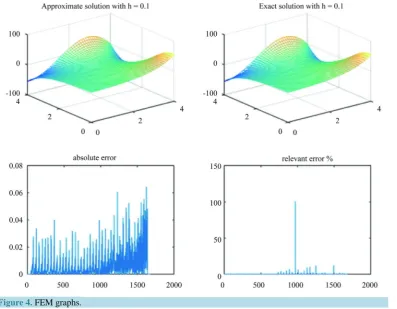
In this section we contact a numerical study using Matlab R2015a. For the purpose of this paper we cite repre-sentative examples of second order general elliptic partial differential equations in order to make comparisons between these two methods with various step-sizes and the mesh size parameters of finite element method. Thus in each example we present results for the absolute and relevant absolute errors in L2 norm along with their graphs. Also we make graphical representations of the exact and approximate solution of the specific problem as well.
The problems of the examples can be found in [13][14].
Example 1
Find the approximate solution of the partial differential equation
2 2
2 2 0, 0 4, 0 4
u u
x y
x y
∂ ∂
+ = ≤ ≤ ≤ ≤
∂ ∂
with Dirichlet boundary conditions along the rectangular domain
( )
, e cosy e cos ,x( )
, u x y = x− y x y ∈ ∂Ωand exact solution
( )
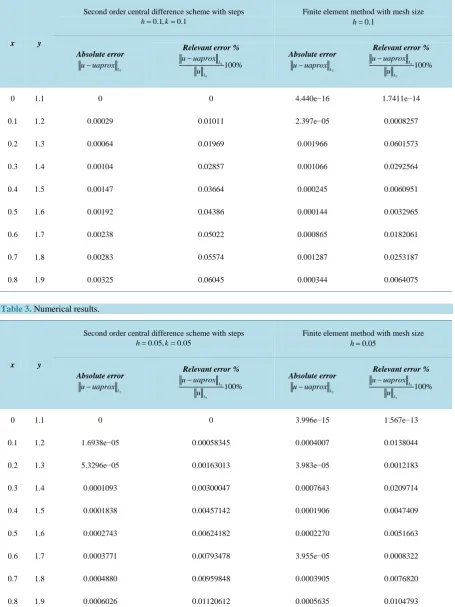
, e cosx e cosy u x y = x− yResults (Table 2 and Table 3)
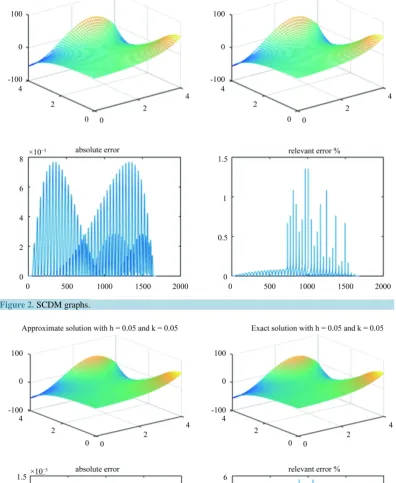
In Figure 2 and Figure 3we have the graphs for SCDM and inFigure 4 and Figure 5 for FEM.
Example 2
Find the approximate solution of the partial differential equation
( )
2 2 2 2
1
, , 0 1, 0 1 10
u u u
f x y x y
y
x y
∂ ∂ ∂
− − + = ≤ ≤ ≤ ≤
∂
∂ ∂
with Dirichlet boundary conditions along the rectangular domain 0
u= on three lower side of ∂Ω and Neumann boundary condition
( )
,1 0u x y ∂
= ∂
and exact solution
(
,)
sin( )
π sin π 2y u x y = x
Table 2.Numerical results.
x y
Second order central difference scheme with steps
0.1, 0.1 h= k=
Finite element method with mesh size 0.1
h=
Absolute error
2 L
u−uaprox
Relevant error %
2
2
100% L
L u uaprox
u
− Absolute error
2 L
u−uaprox
Relevant error %
2
2
100% L
L u uaprox
u −
0 1.1 0 0 4.440e−16 1.7411e−14
0.1 1.2 0.00029 0.01011 2.397e−05 0.0008257
0.2 1.3 0.00064 0.01969 0.001966 0.0601573
0.3 1.4 0.00104 0.02857 0.001066 0.0292564
0.4 1.5 0.00147 0.03664 0.000245 0.0060951
0.5 1.6 0.00192 0.04386 0.000144 0.0032965
0.6 1.7 0.00238 0.05022 0.000865 0.0182061
0.7 1.8 0.00283 0.05574 0.001287 0.0253187
0.8 1.9 0.00325 0.06045 0.000344 0.0064075
Table 3. Numerical results.
x y
Second order central difference scheme with steps
0.05, 0.05 h= k=
Finite element method with mesh size 0.05
h=
Absolute error
2 L
u−uaprox
Relevant error %
2
2
100% L
L u uaprox
u
− Absolute error
2 L
u−uaprox
Relevant error %
2
2
100% L
L u uaprox
u −
0 1.1 0 0 3.996e−15 1.567e−13
0.1 1.2 1.6938e−05 0.00058345 0.0004007 0.0138044
0.2 1.3 5.3296e−05 0.00163013 3.983e−05 0.0012183
0.3 1.4 0.0001093 0.00300047 0.0007643 0.0209714
0.4 1.5 0.0001838 0.00457142 0.0001906 0.0047409
0.5 1.6 0.0002743 0.00624182 0.0002270 0.0051663
0.6 1.7 0.0003771 0.00793478 3.955e−05 0.0008322
0.7 1.8 0.0004880 0.00959848 0.0003905 0.0076820
Figure 2. SCDM graphs.
Figure 4. FEM graphs.
[image:14.595.127.508.402.706.2]Approximate solution with h = 0.05 Exact solution with h = 0.05
Results (Table 4 and Table 5)
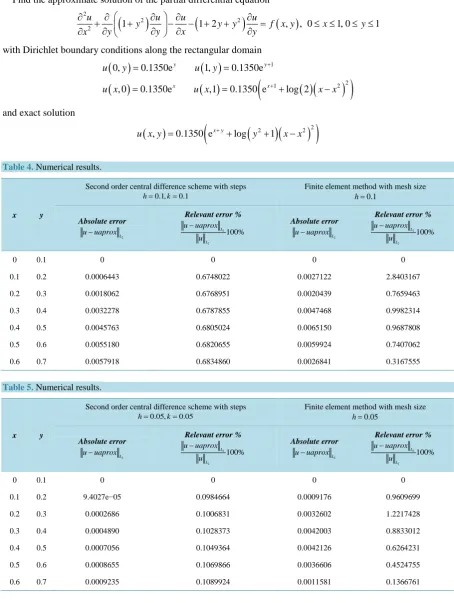
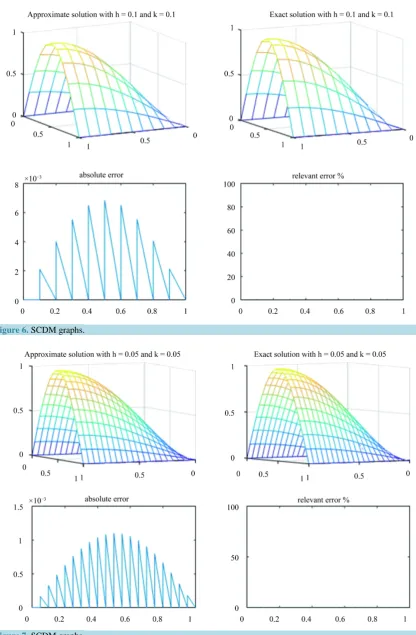
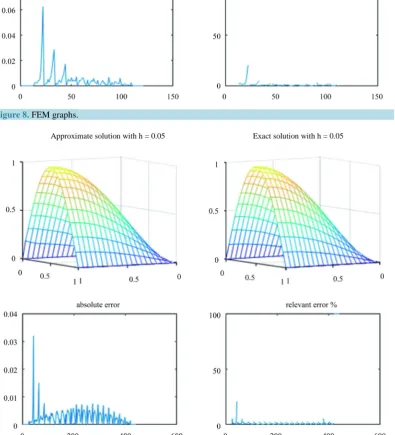
In Figure 6 and Figure 7we have the graphs for SCDM and in Figure 8andFigure 9 for FEM.
Example 3
Find the approximate solution of the partial differential equation
(
)
(
)
( )
2
2 2
2 1 1 2 , , 0 1, 0 1
u u u u
y y y f x y x y
y y x y
x
∂ ∂ ∂ ∂ ∂
+ + − − + + = ≤ ≤ ≤ ≤
∂ ∂ ∂ ∂
∂
with Dirichlet boundary conditions along the rectangular domain
( )
( )
( )
( )
(
( )
(
)
)
1
2
1 2
0, 0.1350e 1, 0.1350e
, 0 0.1350e ,1 0.1350 e log 2
y y
x x
u y u y
u x u x x x
+
+
= =
= = + −
and exact solution
( )
(
(
2)(
2)
2)
, 0.1350 ex y log 1
[image:15.595.84.539.128.732.2]u x y = + + y + x−x
Table 4. Numerical results.
x y
Second order central difference scheme with steps
0.1, 0.1 h= k=
Finite element method with mesh size 0.1
h=
Absolute error
2 L
u−uaprox
Relevant error %
2
2
100% L
L u uaprox
u
− Absolute error
2 L
u−uaprox
Relevant error %
2
2
100% L
L u uaprox
u −
0 0.1 0 0 0 0
0.1 0.2 0.0006443 0.6748022 0.0027122 2.8403167
0.2 0.3 0.0018062 0.6768951 0.0020439 0.7659463
0.3 0.4 0.0032278 0.6787855 0.0047468 0.9982314
0.4 0.5 0.0045763 0.6805024 0.0065150 0.9687808
0.5 0.6 0.0055180 0.6820655 0.0059924 0.7407062
0.6 0.7 0.0057918 0.6834860 0.0026841 0.3167555
Table 5.Numerical results.
x y
Second order central difference scheme with steps
0.05, 0.05 h= k=
Finite element method with mesh size 0.05
h=
Absolute error
2 L
u−uaprox
Relevant error %
2
2
100% L
L u uaprox
u
− Absolute error
2 L
u−uaprox
Relevant error %
2
2
100% L
L u uaprox
u −
0 0.1 0 0 0 0
0.1 0.2 9.4027e−05 0.0984664 0.0009176 0.9609699
0.2 0.3 0.0002686 0.1006831 0.0032602 1.2217428
0.3 0.4 0.0004890 0.1028373 0.0042003 0.8833012
0.4 0.5 0.0007056 0.1049364 0.0042126 0.6264231
0.5 0.6 0.0008655 0.1069866 0.0036606 0.4524755
Figure 6. SCDM graphs.
Figure 8. FEM graphs.
Approximate solution with h = 0.05 Exact solution with h = 0.05
[image:17.595.120.516.261.697.2]Results (Table 6 and Table 7)
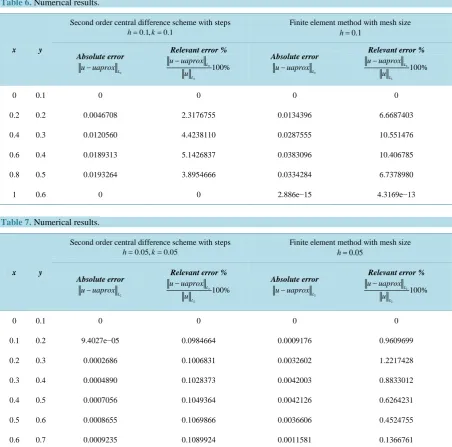
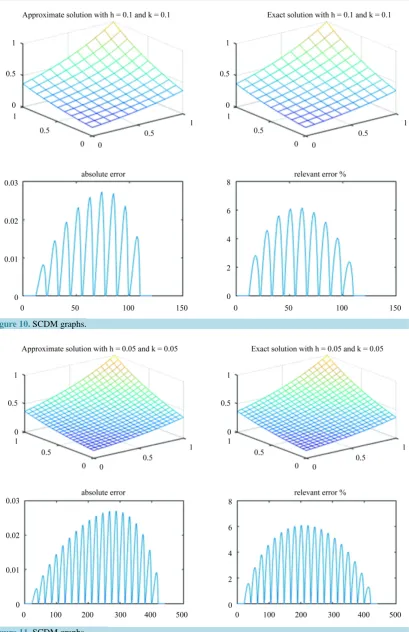
In Figure 10and Figure 11we have the graphs for SCDM and inFigure 12 and Figure 13 for FEM.
[image:18.595.86.539.268.715.2]Overall, what stands out from these examples is that the finite element method has better approximations for the first problem compared to finite difference method for all the step-sizes that we have. But in the second problem we have a small difference in the results with better accuracy for the finite difference method and in the third problem the finite element method has bigger relevant errors than the difference method. More specifically, in example 1 according to the tables we have better approximations for the finite element method in both of step sizes and the mesh size parameters to specific points but the graphs of the percentage of relevant errors suggest that the second order central finite difference scheme produce better approximations generally. On the other hand, in the other two examples according to the tables and the graphs of errors in the second problem we have a small difference between these methods and in the third problem we have better approximations of the second order central difference scheme almost in all points of the domain. Conclusively, we can notice that in the third example for both of these methods the results which we obtained are almost identical when different step sizes are applied in CFDM and mesh size parameters in FEM.
Table 6. Numerical results.
x y
Second order central difference scheme with steps
0.1, 0.1 h= k=
Finite element method with mesh size 0.1
h=
Absolute error
2 L
u−uaprox
Relevant error %
2
2
100% L
L u uaprox
u
− Absolute error
2 L
u−uaprox
Relevant error %
2
2
100% L
L u uaprox
u −
0 0.1 0 0 0 0
0.2 0.2 0.0046708 2.3176755 0.0134396 6.6687403
0.4 0.3 0.0120560 4.4238110 0.0287555 10.551476
0.6 0.4 0.0189313 5.1426837 0.0383096 10.406785
0.8 0.5 0.0193264 3.8954666 0.0334284 6.7378980
1 0.6 0 0 2.886e−15 4.3169e−13
Table 7. Numerical results.
x y
Second order central difference scheme with steps
0.05, 0.05 h= k=
Finite element method with mesh size 0.05
h=
Absolute error
2 L
u−uaprox
Relevant error %
2
2
100% L
L u uaprox
u
− Absolute error
2 L
u−uaprox
Relevant error %
2
2
100% L
L u uaprox
u −
0 0.1 0 0 0 0
0.1 0.2 9.4027e−05 0.0984664 0.0009176 0.9609699
0.2 0.3 0.0002686 0.1006831 0.0032602 1.2217428
0.3 0.4 0.0004890 0.1028373 0.0042003 0.8833012
0.4 0.5 0.0007056 0.1049364 0.0042126 0.6264231
0.5 0.6 0.0008655 0.1069866 0.0036606 0.4524755
Figure 10.SCDM graphs.
Figure 12. FEM graphs.
5. Conclusion
Finally, we can say that the data which we obtained from these examples show that both of these methods pro-duce quite sufficient approximations for our problems. Also the results prove that the accuracy of them depends on the kind of the elliptical problem and the type of boundary conditions. For further research, the approxima-tions of these methods can be improved. This improvement can be made if in the second order difference scheme we keep more taylor series terms in order to approximate the derivatives and in finite element method if we use higher order elements such as quadratic Lagrange triangular elements or cubic Hermite triangular ele-ments.
References
[1] McDonough, J.M. (2008) Lectures on Computational Numerical Analysis of Partial Differential Equations.
http://www.engr.uky.edu/~acfd/me690-lctr-nts.pdf
[2] Gousidou-Koutita, M.C. (2014) Computational Mathematics. Tziolas, Ed.
[3] Gousidou-Koutita, M.C. (2009) Numerical Methods with Applications to Ordinary and Partial Differential Equations. Notes, Department of Mathematics, Aristotle University of Thessaloniki, Thessaloniki.
[4] Gousidou-Koutita, M.C. (2004) Numerical Analysis. Christodoulidis, K., Ed.
[5] Dunavant, D.A. (1985) High Degree Efficient Symmetrical Gaussian Quadrature Rules for the Triangle. International Journal for Numerical Methods in Engineering, 21, 1129-1148.http://dx.doi.org/10.1002/nme.1620210612
[6] Reynolds, A.C., Burden, R.L. and Faires, J.D. (1981) Numerical Analysis. Second Edition. Youngstown State Univer-sity, Youngstown.
[7] Dougalis, V.A. (2013) Finite Element Method for the Numerical Solution of Partial Differential Equations. Revised Edition, Department of Mathematics, University of Athens, Zografou and Institute of Applied Mathematics and Com-putational Mathematics, FORTH, Heraklion.
[8] Suli, E. (2012) Lecture Notes on Finite Element Method for Partial Differential Equations. Mathematical Institute, University of Oxford, Oxford.
[9] Everstine, G.C. (2010) Numerical Solution of Partial Differential Equations. George Washington University, Wash-ington DC.
[10] Szabó, B. and Babuska, I. (1991) Finite Element Analysis. Wiley, New York.
[11] Isaacson, E. and Keller, H.B. (1996) Analysis of Numerical Methods. John Wiley and Sons, New York.
[12] Papanikos, G. (2015) Numerical Study with Methods of Characteristic Curves and Finite Element for Solving Partial Differential Equations with Matlab. Master’s Thesis.
[13] Yang, W.Y., Cao, W., Chung, T.S. and Morri, J. (2005) Applied Numerical Methods Using MATLAB. John Wiley & Sons, Hoboken.