Design and Development of a Novel Algorithm for
Search on Encrypted File
R. Priya
Assistant Technical Officer Department of Computer Science Bharathiar University,Coimbatore–46
T.Devi, Ph.D
Associate Professor & Head i/c,
Department of Computer Applications Bharathiar University, Coimbatore–46
ABSTRACT
Everyone has secrets and some have more than others. Each and every one wanted to have their data and information to be more secure and confidential. There are many ways to maintain the data and information to be safe. The main objective of this paper is to be maintained the file or data to be secure. So, proposed system has developed for searching keyword in encrypted format and search with encrypted file.
General Terms
Data security, Encryption, Decryption and keyword searching algorithm
Keyword
Data security, File security, System security and Encryption
1. INTRODUCTION
This paper is concerned with the study and analysis of computer security, encryption methods in order to provide an effective security system through search on encrypted file. There are many ways to maintain the data and information to be safe. The main objective of this paper is File Security and Data Security.
2. SECURITY AND ENCRYPTION
[image:1.595.305.554.268.443.2]Security is mainly used to secure the computer at 3 levels: hardware, information and service. Different security methods that is available for maintaining security in computer [1]. Computer security have many types based on working methods, tools, hardware, software etc., Main types of computer security is shown in fig 1. That is, physical security of computers and networks equipment, local area network security, network server security, switch/router/hub security, web server security and system security. In system security has two types. One is data security and other is disk security. This paper mainly focuses the data security.
Figure 1. Types of Computer Security
Encryption is mainly used for Data protection. Data security refers to mathematical calculations and algorithmic schemes that transform plaintext into cipher text, a form that is non-readable to unauthorized parties [2].
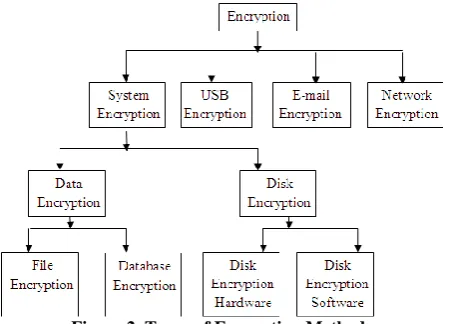
Figure 2. Types of Encryption Method
[image:1.595.319.544.520.682.2]can be divided into many types. Mainly it can be divided into 5 types as shown in fig 2. Data encryption can be divided in two types and they are (1) File encryption and (2) Database encryption. File encryption used to protect a file with encryption mechanism. Similarly Database encryption used for database security with encryption mechanism.
3.
SEARCH
AND
SEARCH
ON
ENCRYPTED FILE
Data Extraction is the operation of extracting data from a source file [4]. Designing and creating the extraction process is often one of the most time-consuming tasks process. The source files might be very complex and poorly documented and thus determining extracted data can be difficult.
Data extraction is the act or process of retrieving data out of (usually unstructured or poorly structured) data sources for further data processing or data storage (data migration). Data extraction method is called Information retrieval [5]. The process of searching specific information among a large number of information items is known as information retrieval (IR).
CRYPTOGRAPHIC MECHANISM
Cryptography can be achieved through various mechanisms. The goal is more specific in that the invention provides a privacy cryptographic mechanism and implementation that guarantees that an interloper must perform an average amount of work to recover the secret that is much greater than the amount of work required to create the secret between the two parties [6]. Some of the cryptographic mechanisms are given below:
Secret Key Algorithms
[image:2.595.306.539.64.498.2]Secret key algorithms otherwise known as ‘Symmetric’ key encryption, which uses the same key for both, encrypt and decrypt a message. Some of the secret key algorithms are given below. Fig 3 is shows that algorithm for search keywords.
Figure 3. Algorithms for Search Keywords
4.
PROPOSED
ALGORITHM
FOR
SEARCHING
ENCRYPTED
KEYWORD
FROM
ENCRYPTED
FILE
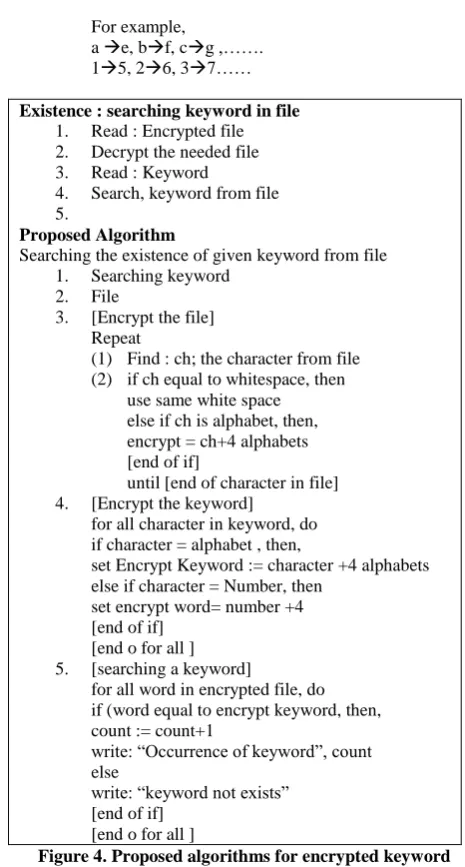
Any method can use for creating encrypted file by authorized persons. In this proposed system is created encrypted file with +4 methods. i.e., alphabets and numbers are the contents of the file, each and every alphabet and numbers have to change with next to four letters. Fig 4 shows the proposed algorithm for searching encrypted keyword from encrypted file.
For example,
a e, bf, cg ,……. 15, 26, 37……
Existence : searching keyword in file 1. Read : Encrypted file 2. Decrypt the needed file 3. Read : Keyword
4. Search, keyword from file 5.
Proposed Algorithm
Searching the existence of given keyword from file 1. Searching keyword
2. File
3. [Encrypt the file] Repeat
(1) Find : ch; the character from file (2) if ch equal to whitespace, then
[image:2.595.55.281.509.679.2]use same white space else if ch is alphabet, then, encrypt = ch+4 alphabets [end of if]
until [end of character in file] 4. [Encrypt the keyword]
for all character in keyword, do if character = alphabet , then,
set Encrypt Keyword := character +4 alphabets else if character = Number, then
set encrypt word= number +4 [end of if]
[end o for all ] 5. [searching a keyword]
for all word in encrypted file, do if (word equal to encrypt keyword, then, count := count+1
write: “Occurrence of keyword”, count else
write: “keyword not exists” [end of if]
[end o for all ]
Figure 4. Proposed algorithms for encrypted keyword searching from encrypted file
In existence method can fetch records or information from the file with keywords ([7] and [8]) . If give keyword for searching from information and get back information’s from file [9]. But in this method unauthorized persons can fetch the information from file and also can corrupt the original file [10]. So it is not a security process. But there is no method for keeping security for data retrieval [11]. Overcome this problem, proposed system had been developed with encrypted file and encrypted keyword. Many methods are there for encryption process. In this method, original file stored in encrypted format. Searching keyword is also encrypted. Which encryption method is used for the encryption file, the same method is used for encrypt the keyword also. So Authorized persons only known which method is used for encryption. Unauthorized persons cannot find the encryption methods for original file and keyword. So it is a purely security process.
5.
DESIGN OF ALGORITHM
Searching Encrypted File with Encrypted Keyword (SEFE (K)) method architecture of the prototype is as shown in fig 5.
Figure 5. Architecture of SEFE Method
The overall software prototype is subdivided in to three types of modules namely,
1. Encrypt Module : Given an input text file, this module applies encryption on the contents of the file and output an encrypted file.
2. Decrypt Module : Given an input encrypted file, this module applies decryption on the contents of the file and output a text file.
3. Search Encrypted Files: Given a keyword and the encrypted data file as input this program initially encrypts the keyword using the same method by which the encryption has been carried out. Then, the encrypted keyword text is searched in the encrypted file and the records where the match occurs are retrieved and shown to the user. If there is no match, “None records found” is reported to the user.
6.
DEVELOPMENT
OF
SOFTWARE
PROTOTYPE
Has mentioned earlier this module carries out the searching function of the prototype. The step by step process is this module is explained in fig 6. In the searching function, initially user taken for searching keyword with encrypted file. The keyword should be encrypted in the same encryption method of encrypted file. After encryption process of the keyword, the encrypted keyword searches the matching records or contents in the encrypted file. If matching contents are there, the output will be displayed. Otherwise, “There is no matching” is reported to the user. In this module can calculate the time also. Total time of process also displayed. Searching time is depends of size of the files. If size of file is increasing, the searching time also increase.
Figure 6. Step by Step Process of SEFE Search
6.1 Encryption Module
Given an input text file, this module applies encryption on the contents of the file and output an encrypted file. i.e, if text file is given, the file convert to encrypted file with this encryption module and then output file come out from the process in encrypted format. Sample input data is shown in fig 7.
101 priya 75
102 vidya 80
103 kalai 60
104 S.Priya 50 105 Shanmugapriya 79
Figure 7. Sample input data
The crux of the module is the mathematical function which is used for encryption. For example, “+4” is used to encrypt the file. The sample output is shown in fig 8.
545$$$tvm}e$$$$$$$$$$;9546$$$zmh}e$$$$$$$$$$<454 7$$$oepem$$$$$$$$$$:4548$$$W2Tvm}e$$$$$$$$94549 $$$Wlerqyketvm}e$$;=
Figure 8. Sample output data
The algorithm is used for this module is given in fig 4. In this algorithm, the given text file is taken for encryption, initially the character of the contents files taken one by one and convert into encrypt format as above. Ie., if c is the character, fI = c + 4 is the encryption function for the input given in fig 7.
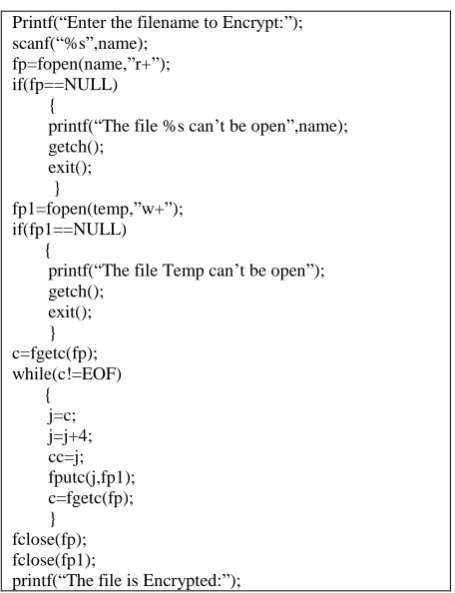
[image:3.595.340.531.138.201.2]In this SEFE method, the thesis used the methods is only add with 4 characters of the text character. But based on this method use can modify the addition numbers as their wishes. The sample source code of the encryption module is given in fig 9. In this source code directly get any text file name with scanf method and put the character one by one and add with 4 for getting encrypted file. If there is no any file like this name, “The file %s can’t be open“ is reported to the user. In this command %s denotes text file.
Printf(“Enter the filename to Encrypt:”); scanf(“%s”,name);
fp=fopen(name,”r+”); if(fp==NULL) {
printf(“The file %s can’t be open”,name); getch();
exit(); }
fp1=fopen(temp,”w+”); if(fp1==NULL) {
printf(“The file Temp can’t be open”); getch();
exit(); } c=fgetc(fp); while(c!=EOF) {
j=c; j=j+4; cc=j; fputc(j,fp1); c=fgetc(fp); }
fclose(fp); fclose(fp1);
printf(“The file is Encrypted:”);
[image:3.595.315.543.462.759.2] [image:3.595.59.272.540.728.2]6.2 Decryption Module
Decryption module is just reverse of the encryption module. In the decryption function, each and every character is taken for decryption and then minus with 4 to each character. For example e turns to a, f written to b, g written to c and so on.
For example tvm}e priya.
Given an input Decrypted file, this module applies for decryption on the contents of the file and output a text file. i.e, if decrypted file is given, the file convert to decrypted file with this decryption module and then output file come out from the process in original text format. Sample input data is shown in fig 10.
545$$$tvm}e$$$$$$$$$$;9546$$$zmh}e$$$$$$$$$$<4 547$$$oepem$$$$$$$$$$:4548$$$W2Tvm}e$$$$$$$$9 4549$$$Wlerqyketvm}e$$;=
Figure 10. Sample input data for decryption module
The crux of the module is the mathematical function which is used for decryption. For example, “-4” is used to decrypt the file. The sample output is shown in fig 11.
101 priya 75
102 vidya 80
103 kalai 60
[image:4.595.324.543.65.444.2]104 S.Priya 50 105 Shanmugapriya 79
Figure 11. Sample output data for decryption module
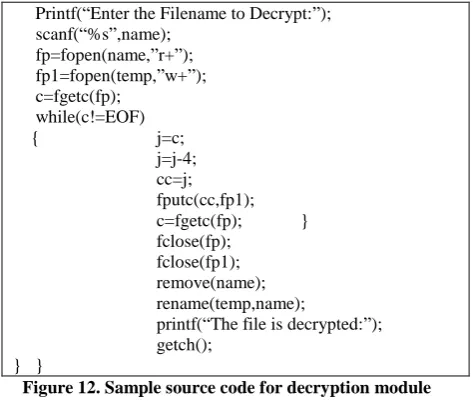
Based on Fig 4, user can decrypt any encrypt file into original text format. Fig 12 shows the source code for getting directly any encrypted file name and put the character one by one and minus with 4 for getting original text file.
Printf(“Enter the Filename to Decrypt:”); scanf(“%s”,name);
fp=fopen(name,”r+”); fp1=fopen(temp,”w+”); c=fgetc(fp);
while(c!=EOF)
{ j=c;
j=j-4; cc=j; fputc(cc,fp1); c=fgetc(fp); } fclose(fp);
fclose(fp1); remove(name); rename(temp,name);
printf(“The file is decrypted:”); getch();
} }
Figure 12. Sample source code for decryption module
6.3
Searching
Encrypted
file
with
Encrypted Keyword
(
SEFE) Search
In the searching function, initially user taken for searching keyword with encrypted file. The keyword should be encrypted in the same encryption method of encrypted file. After encryption process of the keyword, the encrypted keyword searches the matching records or contents in the encrypted file. If matching contents are there, the output will be displayed in encrypted format. Basic source code of the SEFE module is displayed in Fig 13.
Clock_t start, end; clrscr();
start = clock();
printf(“The time start: %f\n”, start);
printf(“\n\tEnter the file name: “); scanf(“%s”,&f);
f1=fopen(f,”r”);
f2=fopen(“time.txt”,”at”); c=fgetc(f1);
while(c!=EOF) {
printf(“%c”,c); c=fgetc(f1); }
n=I;
printf(“\n\n\tEnter the keyword : “); scanf(“%s”,&b);
len=strlen(b); rewind(f1); i=0;
strcpy(strtemp,””); tempi=0;
while(!feof(f1)) {
c=fgetc(f1); if(c-4==’\n’) {
strtemp[tempi++]=’\0’; reccnt=reccnt+1;
if((stricmp((strstr((strlwr(strtemp)),(strlwr(b)))),””))!=0) {
printf(“%s\n”,strtemp); recmatch++;
[image:4.595.53.290.433.638.2]}
Figure 13. Sample source code of SEFE Search
7.
DISCUSSIONS
This thesis proposed to unique method. It is a new method for fetching data from text file. Administrator only knows which methods are used for encrypted file and encrypted keyword. Both are maintained with same encryption methods. So unauthorized persons cannot find out the correct encryption method and they cannot get any information from this file. It is a very security method for fetch information from file.
8. TESTING AND RESULTS
Figure 14. Integration Testing for Encryption Module and Decryption Module
Figure 15. Integration Testing for SEFE Search
9. TESTING WITH REAL DATA
[image:5.595.311.535.265.455.2]Fig 16 shows the list of files for processing time of encryption module, decryption module and SEFE search module. The system is tested with big real data. In this figure, the Asha project in Tamilnadu details in ashaproj.txt file. State population details are in statepop.txt, state wise population and male, female population details are in stpop.txt. Similar to total population of the world is explained in totpop.txt. These are the original files. These text files are downloaded from internet. The system is used for any text file like these files.
Figure 16. Sample Text File for Encryption Module, Decryption Module and
SEFE Search Module
The result of obtained through this is as given in table 1. In fig 17 shows the relationship between the four different type of text file. If the size of file changed, then automatically time of encryption module, decryption module and SEFE search also changed.
Table 1. Details of Time Processing in Encryption Module, Decryption Module and SEFE Search Module Sl.
No
File name Size of file Encryption process time
Decryption process
time
SEFE search
time 1 Ashaproj.txt 1.316 KB 10.7692 10.8791 29.65155 2 Stpop.txt 73.055 KB 50.8241 51.9230 437.3749 3 Statepop.txt 9,088 KB 13.1868 16.2087 191.3186 4 Totpop.txt 34,350 KB 28.7912 30.2747 310.4329
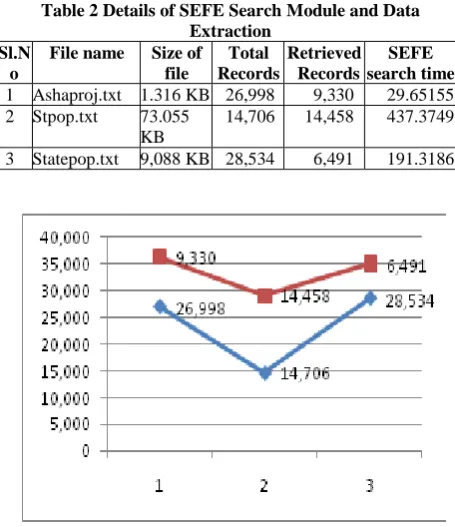
Encryption and decryption modules taken time was more or less equal. But SEFE search module taken more time than other modules. Approximately 75 MB file taken nearby 45 minutes. In fig 18 explains that the comparison between total records and retrieved records. Table 2 shows the details of size of file, total records, retrieved records and SEFE search time.
[image:5.595.55.300.288.427.2]Figure 17.Comparison of Four Real Data Text File
Table 2 Details of SEFE Search Module and Data Extraction
Sl.N o
File name Size of file
Total Records
Retrieved Records
SEFE search time 1 Ashaproj.txt 1.316 KB 26,998 9,330 29.65155 2 Stpop.txt 73.055
KB
14,706 14,458 437.3749
3 Statepop.txt 9,088 KB 28,534 6,491 191.3186
[image:5.595.313.541.474.738.2] [image:5.595.45.293.575.651.2]10. CONCLUSIONS
This results work aims at developing concepts and design in a search algorithm on encrypted data to improve the security. A detailed study on Analysis on encryption methods have been carried out. A novel technique to search a given encrypted keyword an on encrypted file has been invented, an algorithm is carried out and outcome output is also in encrypted format. So authorized person only known the details of which encryption method is used for this encrypted keyword search in encrypted file. This software is designed and developed using Turbo C.
Data encryption has many ideas. But this proposed system is new idea for keeping security of the file.
The developed prototype has been tested data and real big data and found successfully.
The developed prototype has been tested with unique and integration testing successfully.
Disk encryption is a unique method and in this paper, gives some suggestions for proposed model.
11. REFERENCES
1. Deborah Russell & G.T. Gangemi, Sr, “Computer Security Basics”, 1st Edition July 1991, 0-937175-71-4, Order Number: 714, 464 pages
2. Dorothy E. Denning and Peter J.Denning, “Data Security”, Computer Science Department, Purdue University, West Lafayette, Indiana, 47907, Vol.11, No.3, September 1979
3. Prof. Christof Paar, “applied cryptography and data security”, version 2.5 | January 2005
3. Kristina Unnebrink And Ju Rgen Windeler, “Sensitivity Analysis by Worst and Best Case Assessment: Is it really sensitive?” Drug Information Journal, Vol. 33, Pp. 835– 839, 1999
4. http://docs.oracle.com/cd/B10501_01/server.920/a96520/ extract.htm
5. John E. Hershey, Radha Krishna R. Yarlagadda, Lawrence H. Ozarow, “PUBLIC KEY CRYPTOGRAPHIC MECHANISM”, General Electric Company, Appl. No.: 739,263, 1991
6. Maryam Hourali and Gholam Ali Montazer, “An Intelligent Information Retrieval Approach Based on Two Degrees of Uncertainty Fuzzy Ontology”, Volume 2011 (2011), Article ID 683976, 11 pages
7. Y.-C. Chang and M. Mitzenmacher, “Privacy preserving keyword searches on remote encrypted data,” in Proc. of ACNS’05, 2005
8. D. Song, D. Wagner, and A. Perrig, “Practical techniques for searches on encrypted data,” in Proc. of IEEE Symposium on Security and Privacy, 2000
9. Dawn Xiaodong Song David Wagner Adrian Perrig “Practical Techniques for Searches on Encrypted Data”, University of California, Berkeley
10. Whitepaper, “Advantages and disadvantages of EFS and effective recovery of encrypted data”, Copyright (c) 2007 ElcomSoft Co.Ltd.