2019 International Conference on Computation and Information Sciences (ICCIS 2019) ISBN: 978-1-60595-644-2
Multi-pipe Routing in Bundles for
Aero-engine using MOPSO
Hongfei Zhao, Qiang Liu and Bingzhang Tong
ABSTRACT
Complex equipment such as aero-engine commonly contains a number of pipes. Appropriately routing these pipes poses a considerable challenge to complex product developments. In some cases, pipes need to be paved in bundles to save space, improve stability and obtain artistic configurations. In this paper, a bundled pipe routing method for aero-engine based on Multi-Objective Particle Swarm Optimization (MOPSO) is presented. Firstly, space modeling and problem description are introduced. Subsequently, the individual encoding for bundled routing is designed, where the nodes of a reference pipe is selected as particle encoding, and the coordinates of other pipe nodes are obtained according to geometrical constraints such as pipe spacing and diameters. Further, objective function formulation and constraint processing method are given. By using MOPSO, the Pareto set in which pipes are paved in bundles on routing layers are solved. Finally, some routing examples on a simplified CAD piping model are performed to demonstrate the feasibility of the presented method.
1. INTRODUCTION
Complex equipment such as aero-engine pipe routing space is very limited, and there are a lot of constraint areas. In order to improve the quality and efficiency of pipe routing, scholars at home and abroad have proposed various automatic pipe layout optimization algorithms, but the algorithms
Hongfei Zhao, School of Information and Control Engineering, Liaoning Shihua University, Fushun 113001, China
Qiang Liu, School of Information and Control Engineering, Liaoning Shihua University, Fushun 113001, China
mainly focused on the conventional two-endpoint pipe layout with the minimum length as the main index (or the linear weighting of multiple targets into a single target).For example, cell-decomposition methods [1], heuristic algorithm [2], graph-based optimization network techniques [3], and intelligent optimization based pipe layout method [4].The development of graph theory provides a method to build models in the space of the planning field of pipe layout, among which the most typical are: the Euclidean visual graph method [5]to solve the shortest distance of Euclidean evasive obstacles, and the escape diagram method [6] to solve the shortest path problem of right-angle evasive obstacles. Dijkstra [7], a Dutch computer scientist, put forward in 1959 the Dijkstra algorithm, which is a classical algorithm widely recognized by the academia. Liu and Wang [8-9] used the European viewable method to establish the viewable view of the curved surface in the space, which was used to solve the layout planning of the shortest pipe on the surface of the casing of typical complex aviation engine with complex equipment. Based on the European viewable method, they studied and rose to the Manhattan visibility graph to solve the problem of the shortest pipe planning of right-angle pipe [10].
In recent years, branch pipe layout optimization has gradually attracted the attention of scholars at home and abroad, and achieved certain research results. JIANG [11] proposed a branch pipe routing method based on ant colony algorithm in 2015, which dealt with the problem as "one-to-many" routing problem and applied the cooperative thinking to solve the pipe. SUI [12] combined maze algorithm and genetic algorithm to study the routing of rectangular branch pipes in 2016.In the same year, QU [13] modeled the routing space based on three-dimensional routing map, and studied the problem of branch pipe routing with parallel ant colony algorithm. Two scholars, Zongran Dong and Yan Lin [14], proposed a method to handle the coordinated routing of multiple pipes and pipes with branches for research. This paper studies the complex problem of bundle routing and designs a solution algorithm of bundle routing based on MOPSO [15].The Pareto set in which pipes are paved in bundles on routing layers are solved by the MOPSO.
2. OPTIMIZED MODEL OF PIPE ROUTING IN BUNDLES
Figure 1. Modeling of aero-engine pipe routing space.
3. ROUTING PIPE BASED ON MOPSO
3.1Particle coding
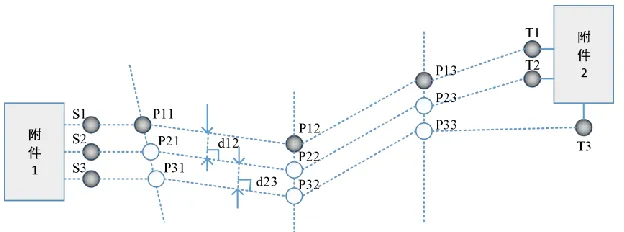
Taking three pipes as bunching routing example, the model of multiple pipes bunching layout in two-dimensional space is shown in Figure 2.
Figure 2. 2D model of pipe layout in bundles.
[image:3.596.118.430.379.495.2]3.2 Fitness value calculation and constraint processing
There are two or more fitness functions in the design of multi-objective particle swarm algorithm for multi-pipes paved in bundles in complex equipments. Two optimization objectives in this paper are to make sure the shortest total length and the biggest smoothness for pipes paved in bundles. The total distance of pipes paved in bundles as a function of fitness value can be expressed as f1 (x);
m is the number of all control nodes in the bundled pipes that contain the various start and end points, n is the number of pipes paved in bundles.
The smoothness of the bundled pipe routing, that is, the angle value of the average corner of the bundled pipe routing. In line Angle computing (smoothness), each Angle can be seen as two sides of the Angle, like Ɵ can be expressed as (3.1);
If the number of included angles is p, the angles are: , then the smoothness of bunched layout pipes can be expressed as (3.2);
Considering that the multi-objective PSO is iteratively refinement on the minimum value of the target, and the smoothness optimization objective is to obtain the maximum solution of the Angle, therefore, it is necessary to invert (3.2) that is to turn the maximization problem into the minimization, f2 can be
expressed as (3.3);
When pipe intersects with the obstacle in paving a single pipe, just add a larger penalty function after solving f1 and f2 .Finally, the optimized control
3.3 Clustering analysis
Hierarchical clustering is a common traditional clustering method, which is used in cluster analysis, the specific process is: Step 1: Find the distance between each pair of elements in the data set; Step 2: The elements are classified according to the distance to form a hierarchical clustering tree; Step 3: Determine how to partition the hierarchical cluster tree to get different classes.
3.4 Algorithm flow
The routing algorithm scheme for multiple pipe of aero engine based on multi-objective PSO algorithm needs to be realized through the combination of Simense NX and MATLAB. The algorithm flow chart is shown in Figure 3:
3.5 Pipe layqut
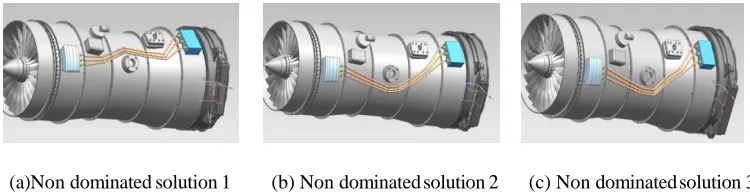
The intermediate point and the rightmost point represent smaller differences in length and smoothness. Visualized pipe formation of the above three situations through Simense NX re-developed through Grip, we can obtain the engine pipe layout diagram corresponding to the non-dominant solution in Figure 4 respectively.
[image:6.596.98.473.260.358.2](a)Non dominated solution 1 (b) Non dominated solution 2 (c) Non dominated solution 3
Figure 4. Engine line layout corresponding to the non-dominant solution.
As shown in Figure 4, the three results avoid obstacles, but do not guarantee the shortest and smoothest total length of pipe.
4. CONCLUSIONS
This paper studies the optimization of pipe layout for multi-pipe routing in bundles by taking the complex equipment: aero-engine as an example. The MOPSO algorithm is applied on multi-objectives to obtain the pareto non-dominated solution set. Meanwhile, optimize the total length of the layout pipes and the smoothness of pipes paved in bundles. Systematically cluster the pareto non-dominated solution, delete the partial solution with no obvious pipe routing, finally layout the obtained solutions repectively on the aero-engine for comparing the best. Follow-up studies can further consider the related derived problems in the process of bunching pipe routing, such as adding clamp constraints based on the original optimization problem of bunching pipe routing.
REFERENCES
optimization technology based on engineering constraints,” Journal of Mechanical, 51(21): 121-131.
3. Liu Q, Wang C.2015. “A graph-based pipe routing algorithm in aero-engine
rotationalspace,” Engineering, 51(21): 121-131.
4. Ren T, Zhu Z L, Dimirovski G M, et al. 2014. “A new pipe routing method for aero-engines
based on genetic algorithm,” Proceedings of the Institution of Mechanical Engineers, Part
G: Journal of Aerospace Engineering, 228(3):424-434.
5. Lozano-perez T. and Wesley M. A. 1979. “An Algorithm for Planning Collision-Free Paths
Among Polyhedral Obstacles,” Communications of the ACM, 22(10): 560-570.
6. Ganley J L, Cohoon J P. 1994. “Routing a muti-terminal critical net: Steiner tree construction
in presence of obstacles,” Proceedings of IEEE International Symposium on Circuits and
System (ISCAS), London, 113-116.
7. Dijkstra E W. 1959. “A Note on Two Problems in Connection with Graphs,” Numerische
Mathematics, 1(1):269--271.
8. Liu Q, Wang C. 2015. “A graph-based pipe routing algorithm in aero-engine rotational
space,” Journal of Intelligent Manufacturing, 26 (6): 1077-1083.
9. Liu Q, Wang C.2015. “A graph-based pipe routing algorithm in aero-engine rotational
space,” Springer-Verlag New York, Inc.
10. Liu Q.2016. “A rectilinear pipe routing algorithm: Manhattan visibility graph,” International
Journal of Computer Integrated Manufacturing, 29 (2): 202-211.
11. Jiang W, Lin Y, Chen M, et al. 2015. “A co-evolutionary improved multi-ant colony optimization for ship multiple and branch pipe route design,” Ocean Engineering, 102: 63-70.
12. Sui H T, Niu W T. 2016. “Branch-pipe-routing approach for ship using improved genetic
algorithm,” Frontiers of Mechanical Engineering, 11(3):316-323.
13. Qu Y, Jiang D, Yang Q. 2016. “Branch pipe routing based on 3D connection graph and
concurrent ant colony optimization algorithm,” Journal of Intelligent Manufacturing, 1-11.
14. Zongran Dong, Yan Lin. 2016. “Ship pipe layout method based on coevolution and parallel
computing,” Journal of dalian university of technology, 56(04):367-374.
15.Qiang Liu, Mao Li. 2018. “Multi-objective Layout Optimization for Branch Pipe of