2018 International Conference on Computational, Modeling, Simulation and Mathematical Statistics (CMSMS 2018) ISBN: 978-1-60595-562-9
Research on the Shortest Hyperpath Algorithm of
Hypernetwork and Its Application
Zheng GUO
1,2,*, Dan JI
3and
Fu-hong WANG
1,2.1Shanghai Association for Quality, China
2Shanghai Zhong-de Quality Technology Research Center Shanghai, 200052, China
3Shanghai JiaoTong University, 200240, China
*Corresponding author
Keywords: Hypernetwork, Shortest hyperpath algorithm, Efficiency of hypernetwork, Betweenness of nodes and hyperedges.
Abstract. Hypernetwork based on the theory of hypergraph can better describe some problems which complex network cannot describe. Many scholars pay more attention to hypernetwork theory study. From a literature review, There are many researches on the theory of hypernetwork, but the research on the shortest hyperpath analysis algorithm of hypernetwork is a blank at present. In this paper, based on the incidence matrix of hypergraph, we use the combination of iterative algorithm and breadth-first algorithm and depth-first algorithm to calculate the shortest distance between any two points in the hypernetwork, and then calculates the maximum diameter of hypernetwork, average of hyperpath length, the propagation efficiency of hypernetwork, nodes and hyperedges of betweenness of hypernetwork are further calculated according to the shortest distance between any two points. These studies are the basis of exploring the dynamic mechanism of hypernetwork.
Introduction
In the theory of complex networks, a adjacency matrix based a graph is used to calculate the
shortest distance between any two points using Dijkstra[1-2] or Floyd[3-4]algorithm. Thus the network
diameter, average of path length and network efficiency can be further calculated and analyzed according to the shortest distance. The research and optimization on shortest path algorithm has wide application. for example: resource allocation and management, flow analysis, evaluation of the importance of nodes and edges and so on.
But complex network can only express the relationship between the two nodes, and cannot well description of the relationship between nodes with more than two elements. Although bipartite graphs can describe relationships with more than two elements. the homogeneity of nodes and
edges are lost. Complex networks have some limitations when portraying the real world[5-7]
With the development of hypergraph theory, hypernetwork theory based on Hypergraph has attracted the attention of scholars both at home and abroad[8-10]. The mathematical basis of hypernetworks is the incidence matrix. However, how to calculate the shortest distance between any two points in the hypernetwork based on incidence matrix is a research gap now.
According to the research of Feng Keqin [11] and Ma [12], first, we need to map the node set and edge set in the hypergraph into the bipartite graph, and then define the adjacency matrix of the hypergraph according to bipartite graph. Based on this adjacency matrix, we get the shortest path between any nodes of hypergraph and get the diameter of hypergraph. But this transformation is sometimes rather complicated, and not reasonably reflect the interaction and restriction among nodes of hypernetwork. Furthermore, the adjacency matrix of the hypernetwork cannot fully express the entire relationship between the nodes and edges of the hypernetwork. Therefore, this kind of research has certain limitations in theory.
In this paper, we propose a new algorithm, which based on the incidence matrix of the hypernetwork, the shortest path of any two points is calculated directly. Furthermore, we can use this algorithm to calculate the maximum diameter of the whole hypernetwork, the average of shortest hyperpath, the efficiency of the whole hypernetwork and so on. This new the shortest hyperpath algorithm of hypernetwork is also different from the shortest hyperpath algorithm proposed by document [12] to transform hypergraphs into graphs.
Related Concepts
The Definition of Hypernetwork
Suppose V {v1,v2,...,vn}is a finite set, whereV {v1,v2,...,vn}is the set of nodes (or vertices),
and Eh {E1,E2,...,Em}is the set of the hyperedges, which contain an arbitrary number of nodes. And it is easily to realized that Ei
(i1,2,..,m)andim1E
i V
, We Call H (V,Eh)is ahypergraphH[13]. If two nodes belong to the same hyperedge, we consider the two nodes are
adjacent; If the intersection of two hyperedge is not empty, we say the two edges are adjacent. As shown in Figure 1, A hypergraph is H (V,E) , a vertices set is V
v1,v2,v3,v4,v5,v6
,hyperedge is as follow:
1
E =
v4,v2,v6
,E2
v1,v4
,E3
v1,v3,v5
,E4
v3,v5,v6
,E5
v2,v5,v6
, E6
v1,v6
If the number of vertices in each hyperedge are equal, it is called uniform hypergraph, if
V and Eh are both finite, call H is finite hypergraph., as shown in figure 1.A k -uniform
hypergraph is a hypergraph that all hyperedges are formed with k nodes. In this way, the
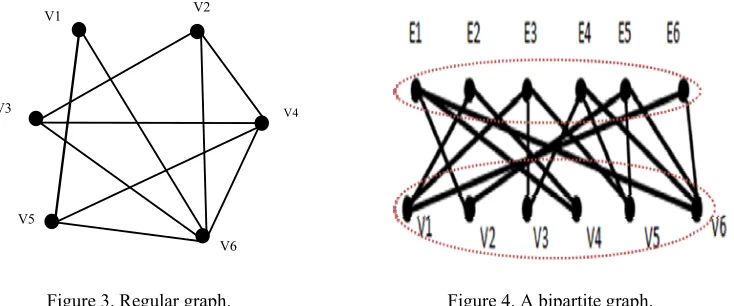
2-uniform hypergraph as shown in figure 2 is just the regular graph as shown in figure 3. Hypergraph in figure1 can be transformed into a bipartite graph of complex network theory, as shown in figure 4.
Figure 1. A non-uniform Hypergraph and hypernetwork simple.
Figure 3. Regular graph. Figure 4. A bipartite graph.
The incidence matrix of hypergraph ( as shown in Figure 1 is expressed byBm n , If node Vis the
element of edge E, then we call A and B are associated. We define
i j,n m
B b
, if and only if
i j
v
E
, where B i j, 1, Otherwisebi j, 0 Such that1
2 3 4 5 6 1
2 3 4 5 6
0 1 0 1 0 1 1 0 0 1 0 0 1 0 1 0 1 0 0 0 1 0 1 1 0 1 0 0 1 1 1 0 0 0 0 1
m n
v v v v v v
E
E
E B
E
E
E
Based on the above definition, Guo[14] give mathematical definition of the hypernetwork. Suppose
(V,Eh),(V,Eh)
is a finite hypergraph and G is a map from T
0, into;for any given
t
0,G
(t
) (V
(t
),E
h(t
))is a finite hypergraph. The index tis often interpretedas time. A hypernetwork
G t t( ), T
is a collection of hypergraphs.The Definition of Characteristic Parameters of Hypernetwork
In the hypergraph H, if viei,then vi is associated with the hyperedge ei. If vief and
i R
v e , It is called ef and eRis adjacent. Suppose the vertex hyperedge interleave sequence:
v1,e1,v2,e2,es,es1
,a. v v1, ,2 vs is different from each other in H.
b. e1,e2,,es is different from each other in H.
C. vR,vR1eR , R1, 2, , , g this sequence is a hyperpath. If v1vg1, It is called a
hyper-loop.
The number of hyperedges between two nodes passing a hyperpath with the least number of hyperedges is called the hyper-distance between two nodes. The diameter of the hypernetwork is defined as the maximum of all hyper-distances.
1 ,maxi j N ij
D d
(1) WhereNis the number of all nodes in the hypernetwork and dijis the length of the hyperpath
V3 V4
V1 V2
V5
between the node iand the nodej.
Average of hyperpath length of hypernetwork:
2 1 ij i j D D N N
(2)Global efficiency of hypernetwork:
1 E
D
(3) Hyper-betweenness of node:
,
jl i
j l V ij j l N i B N
(4)V represents a node set, N jl
i is the number of shortest hyperpath between nodejand nodelpassing through nodei, andNijis the total number of shortest hyperpaths between all nodes in the
hypernetwork.
Hyper-betweenness of edge:
1 , , ,, i i m i gl jj gl j
E E
g l E g l i V
N E B E N E
(5)
gl i
N E is the number of shortest hyperpath passing through the edge Ei, and Ngl
Ej is thetotal number of shortest hyperpath passing through all hyperedges in the hypernetwork.
Graph Algorithm
The traversal algorithm for graphs and special subgraphs (such as trees and hypertrees) is one of the most useful graph algorithms. There are two common approaches to searching a graph: depth-first search and breadth-first search.
Depth First Searching Algorithm. Start with one nodevifirst, and then visting any node, vjin its neighbor node collectionO v
i , vjO v
i , Performing DFS on the node vj, in turn visitingother neighbor nodes in O v
i . DFS searches for a node as deep as possible and then traces back toother neighbor nodes.
Breadth-First Searching Algorithm. Starting from a node in the graph, first visiting all its directly neighbors and then move to their second-level nodes by traversing their neighbors. BFS searches for a node as widely as possible in the graph and then moves to the next layer of nodes for accesse.
In this paper, we combines two traversal algorithms: depth first search (DFS) and breadth first searching (BFS) to analysis the shortest hyper-distance between any two points of incidence matrix based on hypernetwork.
The Shortest Hyperpath Algorithm of Hypernetwork Based on Incidence Matrix
An algorithm of finding the shortest path from the source node Vs to the target node Vd based on
the incidence matrix.
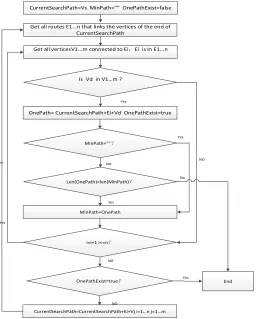
The "OnePath" variable represents a path, for example: onePath=VsE1E2Vd. The "MinPath" variable represents the shortest path.
The "OnePathExist" variable represents whether a path is found or not. BEGIN
Step1:Initialize the variables, including current searching path: CurrentSearchPath=Vs,shortest path, MinPath=””, OnePathExist=false
Step2:Get all routes E1n that links the vertices of the end of CurrentSearchPath Step3: Get all vertices V1m connected to Ei, Ei is in E1n.
Step4: Check if Vd is in V1m?, if “Yes” we get a path: CurrentSearchPath+Ei+ Vd,so we set OnePathExist=true, .if MinPath=”” then assign the path to MinPath, else if Len(OnePath)<len(MinPath), we set the path to MinPath too, else goto Step 6 . if Vd is not in
1 m
V , goto Step 5
Step5: i i 1 , if in goto Step3, else if OnePathExist=true, goto Step6, else CurrentSearchPath=CurrentSearchPath Ei V ij, 1n j, 1m and goto Step2.
Step6: END .Of course we have gotten thes shortest path: MinPath.
The flow chart of the shortest hyperpath algorithm of hypernetwork is shown in Figure 5.
CurrentSearchPath=Vs MinPath=”” OnePathExist=false
Get all verticesV1...m connected to Ei,Ei is In E1...n
OnePath= CurrentSearchPath+Ei+Vd OnePathExist=true
MinPath=OnePath
Is Vd in V1…m ?
MinPath=””?
Len(OnePath)<len(MinPath)?
i=i+1 i<=n?
OnePathExist=true?
CurrentSearchPath=CurrentSearchPath+Ei+Vj i=1…n j=1…m
End
NO Yes
NO
Yes Yes
Yes
Get all routes E1...n that links the vertices of the end of CurrentSearchPath
NO
NO
No
Yes Yes
[image:5.612.186.442.322.641.2]
Figure 5. Flow chart of the shortest hyperpath algorithm of hypernetwork.
China High Speed Rail Hypernetwork Model Based on Simple Hypergraph Data Source Description
China High Speed Rail Hypernetwork Model Based on Simple Hypergraph
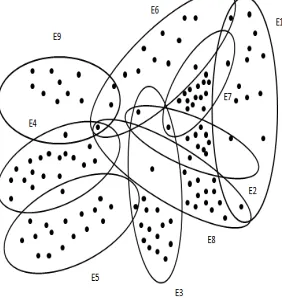
[image:6.612.226.367.118.267.2]We use each station as a node in the hyper network, and each high-speed railway line is regarded as a edge of the hypernetwork, we establish a high-speed rail network model as shown figure 6.
Figure 6. A schematic illustration of hypernetwork structure of high-speed railway in China.
In figure 6, the black dot represents the site for the node, E1, E9 is treated as hyperedges representing the lines, Considering the simplicity of the study, we do not consider the repeating route. Each lines is regarded as an hyperedge which mean spans all the stations that the train visits. The shortest hyperpath algorithm based on the hypernetwork’s incidence matrix is presented in this paper. Taking Shanghai Station as an example, the shortest hyperpath between Shanghai and any other station is shown in Table 1.
Table 1. Some of shortest hyperpath from Shanghai station to any other station.
any two stations shortest hyperpath
Shanghai-Anyang Shanghai-Jinghu line-Beijing-Jinggang line-Anyang
ShangHai-Baiyin Shang hai-Jinghu line-Beijing-Shenlan line-Baiyin
Shanghai-Baotou Shang hai-Jinghu line-Beijing-Shenlan line-BaoTou
Shanghai-Baoji Shang hai-Hahu line-Yancheng-Yanxi line-Baoji
Shanghai-Baoding Shang hai-Jinghu line-Beijing –Jinggang line-Baoding
Shanghai-Beihai Shang hai-Hunan line-Nanning –Xizhan line-Beihai
Shanghai-Dazhou Shang hai-Hunan line-Nanning –Xizhan line-Dazhou
According to the formula (1) and(2), China's high-speed rail hypernetwork with 19 hyperedges and 192 stations, which is a connected hypernetwork with a maximum diameter of 4, which means any two points can be reached through a turnover of four lines.According to formula (2), the average minimum distance is 2. 338, which means any two points can be reached by minimum average of 2.338 line. According to the formula (3), the maximum efficiency of the whole hypernetwork is 0.4227.According to the formula(4), the node with the largest hyper-betweeness is Shanghai Station, and the edge with the largest hypere-betweeness is the Jin-Kun Line.
Conclusions and Future Research
[image:6.612.113.501.391.496.2]References
[1]Peng W., Hu X., Zhao F., et al. A Fast Algorithm to Find All-Pairs Shortest Paths in Complex
Networks [J]. Procedia Computer Science, 2012, 9(11): 557-566.
[2]Xu M.H., Liu Y.Q., Huang Q.L., et al. An improved Dijkstra’s shortest path algorithm for
sparse network [J]. Applied Mathematics & Computation, 2007, 185(1): 247-254.
[3]Wei D. An Optimized Floyd Algorithm for the Shortest Path Problem[J]. Journal of Networks,
2010, 5(12): 1496-1504.
[4]Diestel R. Graph theory [J]. Mathematical Gazette, 1997, 173(502): 67-128.
[5]Liu J.G., Yang G.Y., Hu Z.L. A knowledge generation model via the hypernetwork. [J]. Plos
One, 2014, 9(3): e89746.
[6]Estrada E. The structure of complex networks: theory and applications [M]. Oxford University
Press, 2012.
[7]Estrada E., Rodriguez-Velazquez J.A. Subgraph centrality in complex networks [J]. Physical
Review E, 2005, 71(5): 056103
[8]Hu, Feng, Zhao, HaiXing, Ma, XiuJuan. An evolving hypernetwork model and its properties [J].
Scientia Sinica, 2013, 43(1): 16.
[9]Maslennikov O.V., Shchapin D.S., Nekorkin V.I. Transient sequences in a hypernetwork
generated by an adaptive network of spiking neurons. [J]. Philosophical Transactions, 2017, 375(2096).
[10]Agnati L.F., Marcoli M., Maura G., et al. The brain as a "hyper-network": the key role of neural networks as main producers of the integrated brain actions especially via the "broadcasted" neuroconnectomics [J]. Journal of Neural Transmission, 2018, 13(4): 1-15.
[11]Feng K., Li W.C.W. Spectra of Hypergraphs and Applications [J]. Journal of Number Theory,
1996, 60(1): 1-22.
[12]Ma X.J., Zhao H.X., Hu F. Cascading failure analysis in hypernetwork based on hypergraph.
Acta Physica Sinica 1-8.
[13]Berge, C. Graphs and hypergraphs. North-Holland publishing company, Amsterdam, 1973.
[14]Guo J.L., Zhu X.Y., Suo Q., et al. Non-uniform Evolving Hypergraphs and Weighted Evolving
Hypergraphs [J]. Scientific Reports, 2016, 6.
[15]Voloshin V.I. Introduction to graph and hypergraph theory [M]// Introduction to graph and
hypergraph theory /. Nova Science Publishers, 2009: xiv+287.
[16]Andrzej Dudek, Alan Frieze, Andrzej Ruciński, et al. Embedding the Erdős–Rényi hypergraph