2018 3rd International Conference on Computational Modeling, Simulation and Applied Mathematics (CMSAM 2018) ISBN: 978-1-60595-035-8
A Mobile Streaming Media on Demand System Based on SVC Encoding
and Its Performance Optimization Design and Implementation
Fang-liang HUANG, Lei YU
*, Guang-en
CHEN and Sheng HU
School of Medical Information Engineering, Anhui University of Chinese Medicine, Hefei, China *Corresponding author
Keywords: SVC, Bit plane encoding, Streaming media, Optimization scheme.
Abstract.The terminal is taken by the same quality standards in the process of receiving program source once it is determined in the traditional streaming media system. This is bound to reduce the Service Quality of the streaming media system caused by the difference in terminal performance, network bandwidth and others. In view of this, we propose a SVC solution based on Bit Plane Encoding which is integrated in the Android platform. The optimized strategy is formulated according to the different needs of the end customer, the heterogeneity of the terminal equipment and the change of the network bandwidth to realize the video quality of different stream can be transmitted in real time. Experimental results show that the network environment is automatically detected by the terminal equipment, which is accorded to encode the video so that the corresponding quality of the streaming media service is recommended for users.
Introduction
The transmission of video data on Internet has become an important direction for the development of multimedia services. Video is different from the general data and it is very sensitive to bandwidth, network delay and data packet loss and other factors. However, because of the isomerism and heterogeneity of the user terminal physical performance and the "flickering" of the network situation and other characteristics, Internet cannot guarantee the quality of service (QoS) for this request put forward by users, that is, it needs for different quality videos. Therefore, Internet video transmission faces many challenges. Researchers have also proposed a variety of video transmission schemes based on the application layer. At present, the proper way to solve this problem is to adopt SVC (Scalable Video Coding, which is a scalable video coding technology) [1-2].
The research on SVC technology is rising both at home and abroad, especially after SVC becomes an extension of H.264/AVC video coding standard. And more and more researchers have paid more attention to this research. Using SVC coding technology, the video can be divided into data stream with multiple layers, that is, it includes a base layer data stream and one or more enhancement layer data streams. The video images with different quality requirements and different resolutions can be formed through the combination of the basic layer and the different number of enhancement layers. Reference [3] researches and designs a real-time system to integrate scalable video into the traditional media service platform, and also proposes an Unequal Erasure Protection strategy which is to ensure the transmission of scalable video, but the article does not involve too many transmissions and control strategies for scalable video. Reference [4] explores and discusses the aspects of error concealment of SVC technology that is not concerned about, and proposes a strategy with low complexity, which only discusses about the spatial scalability. Reference [5] using the variable macro-block sequences in H.264 to propose a SVC encoding method that can support multiple interest regions.
Mechanism of Scalable Video Coding
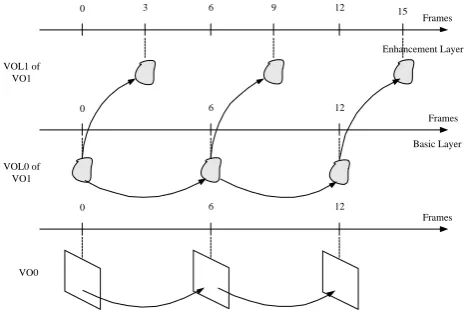
An object-based scalable coding mechanism [5] is provided in MPEG-4, and figure 1~ 3 represent a time scalable coding scheme with two types of enhanced forms in MPEG-4 [6].
The first category refers to the video object layer VOL0 is an entire frame with an object and a background, while VOL1 represents a special object in VOL0, VOL0 by low frame rate encoding offers high frame rate to achieve object-based classification. The objects in Figure 1 VOL1 are predicted by using frames in VOL0, and figure 2 uses the frames in VOL0 to obtain the objects in the VOL1 enhancement layer using bidirectional prediction.
The second category refers to the video object VO0, it is a sequence of entire frames containing only backgrounds without a scalable layer, VO1 is a special sequence of objects with two tiers VOL0 and VOL1, and VOL1 represents a video object layer with the same video information as VOL0, encoded at a frame rate higher than VOL0. The VOL1 is regarded as the basic layer, and the VOL1 is considered as an enhanced layer.
Enhancement Layer Frames
0 2 4 6 8 10 12
Basic Layer Frames
0 6 12
VOL1
VOL0
[image:2.595.186.415.259.381.2]
Figure 1. The time scalable structure for P-VOP prediction of type 1.
Enhancement Layer Frames
0 2 4 6 8 10 12
Basic Layer Frames
0 6 12
VOL1
[image:2.595.183.418.405.531.2]VOL0
Figure 2. The time scalable structure for B-VOP prediction of type 1.
Enhancement Layer Frames
0 3 6 9 12
Basic Layer Frames
0 6 12
VOL1 of VO1
VOL0 of VO1
15
Frames
0 6 12
VO0
[image:2.595.181.414.561.717.2]Bit Bit-plane Coding
Similar to traditional run length coding, the bit bit-plane coding treats every bit-plane of the residual block transform coefficient as a coded object. It scans the bit-plane of each block in the scanning order of Zig-Zag, and encodes the bits of each value of 1 together with the 0 continuous run lengths coding in front of them as a coding unit. Each unit is recorded as (RUN, EOB), thereinto, the RUN represents the length of the 0 run length coding in front of the each encoding unit 1, and when EOB (End of Block) is equal to 0, which indicates that this coded bit-plane is not encoded after the current coded run, and the 1 is also not encoded, EOB is equal to 1 indicating that this encoding unit is the last one in the current bit-plane and at present, all the coding units in the bit-planes have been coded. A sign bit is represented by a single bit.
For each block that is individually encoded by FGS, it needs to set a syntax element to save the FGS bit-plane number of the current block. The bit-plane number is determined by the bit-plane number that required by the maximum transformation coefficient. It can be expressed as:
N= [log ] 1
)]} , , ( {max[
2
k j i c
Among them, C (i, j, k) represents the DCT coefficient at the location (i, j) in the block K. Here is an example to illustrate the coding process. Through the Zig-Zag scanning, the element values are as follows:
11, 0, 0, 6, 0, 0, 0, 2, 0, 3, 0, …, 0 (absolute value)
0, X, X, l, X, X, X, 0, X, l, X, …, X (sign bit)
As you can see, the maximum absolute value of the value is 11. Therefore, the current numerical string can be encoded by 4 bit planes, and the value of each bit plane of the numeric absolute value is as follows:
1, 0, 0, 0, 0, 0, 0, 0, 0, 0, 0, 0, …, 0 (MSB)
0, 0, 0, 1, 0, 0, 0, 0, 0, 0, 0, 0, …, 0 (MSB-1)
1, 0, 0, l, 0, 0, 0, l, 0, l, 0, 0, ... , 0 (MSB-2)
0, 0, 0, 0, 0, 0, 0, 0, 0, l, 0, 0, …, 0 (MSB-3) Encoding the above four bit planes as (RUN, EOB) symbols to obtain:
(0, 1) (MSB)
(3, 1) (MSB-1)
(0, 0), (2, 0), (3, 0), (1, 1) (MSB-2)
(9, 1) (MSB-3)
Encoding the each variable symbol together with its maximum non-zero bit coding and processing by the Variable Length Coding (VLC) to obtain:
(0, 1), 0 (MSB)
(3, 1).1 (MSB-1)
(0, 0), (2, 0), (3, 0), 0, (1, 1), 1 (MSB-2)
To variable-length encode the above symbol (RUN, EOB) and its corresponding sign bit, and then the FGS code stream is formed.
A Design of on Demand System Based on Bit Bit-plane Coding
System Structure
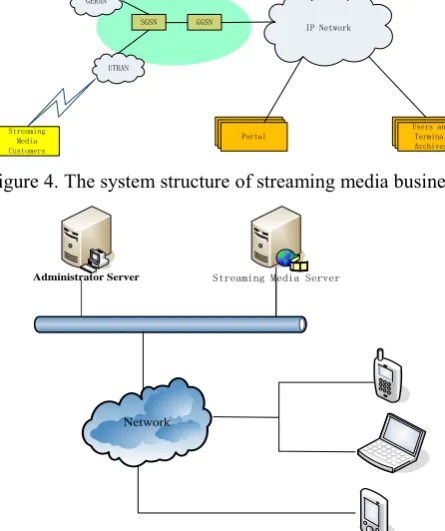
The system structure of streaming media business is shown in Figure 4, which mainly includes content server and streaming media client, and may also involves other components, such as portal, file server, buffer server, good proxy, etc.
UTMS Core Network
IP Network Content Server Content Buffer
Portal GERAN
UTRAN Streaming
Media Customers
Streaming Media Customers
SGSN GGSN
Users and Terminal Archives
[image:4.595.180.419.209.331.2]
Figure 4. The system structure of streaming media business.
Network
Administrator Server Streaming Media Server
Figure 5. The architecture diagram of streaming media on demand system.
The streaming media on demand system designed in this paper includes two parts: the server side and the client side. The server includes the media resource management server and the streaming media server. The media resource management server is mainly responsible for the tasks of uploading, storing and retrieving the media resources, that is, to manage the functions, such as the portal page displaying, retrieving and downloading, which can be seen by the clients. The main function of the streaming media server is to convert the media resources uploaded by the media resource management server into the form of "stream", which is convenient for the network transmission, and provide the basic resources for the implementation of SVC. The client mainly includes the terminals that can accept streaming media resources, such as mobile phones, laptops, palm computers and so on. The architecture diagram of this system is shown in Figure 5.
Functional Modules and Specific Work
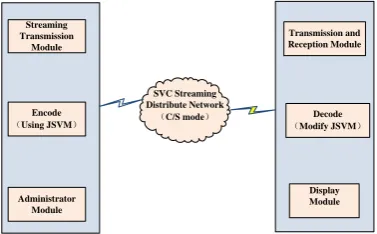
[image:4.595.184.407.250.516.2]implementation of mobile streaming media on demand system, the content distribution network in this paper is based on C/S structure. The expected objective of the system is that the server side is only coding once, according to the network and the isomerism of the terminals, it provides the best quality video stream for different users adaptively. When the client is in the low network bandwidth, it can play the low quality video smoothly, and it can automatically adjust to play the high quality video when the bandwidth is high. Figure 6 shows the functional modules and specific work of the system.
Streaming Transmission
Module
Administrator Module Encode (Using JSVM)
Transmission and Reception Module
Display Module Decode (Modify JSVM) SVC Streaming
[image:5.595.206.395.169.286.2]Distribute Network (C/S mode)
Figure 6. The function module of streaming media on demand system.
Research Methods and Implementation Schemes
Encoder: to cut and optimize JSVM.
Fluidization transmission and receiving module: according to 3GPP PSS specification, according to SVC's code format to realize programming.
Decoder: to cut the JSVM and increase the functions of SVC.
Player: to play the streaming media, using the Helix Server streaming media server produced by the Real Networks Company.
The design and implementation of content distribution network transmission protocol based on the C/S structure.
Integration of Each Module
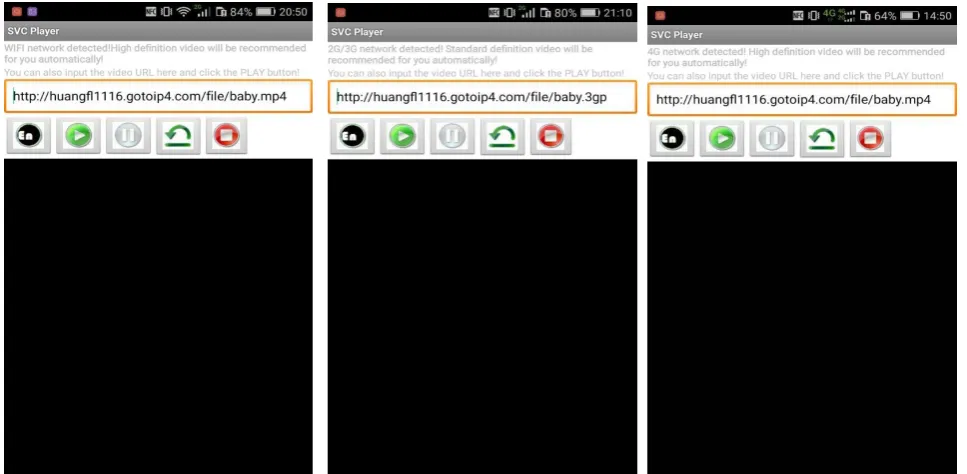
Figure 7. The APP initialization Figure 8. The APP automatic detect Figure 9. The APP automatic detect Interface. equipment network environment is 2G. equipment network environment is 4G.
System Test
Platform Usage Method
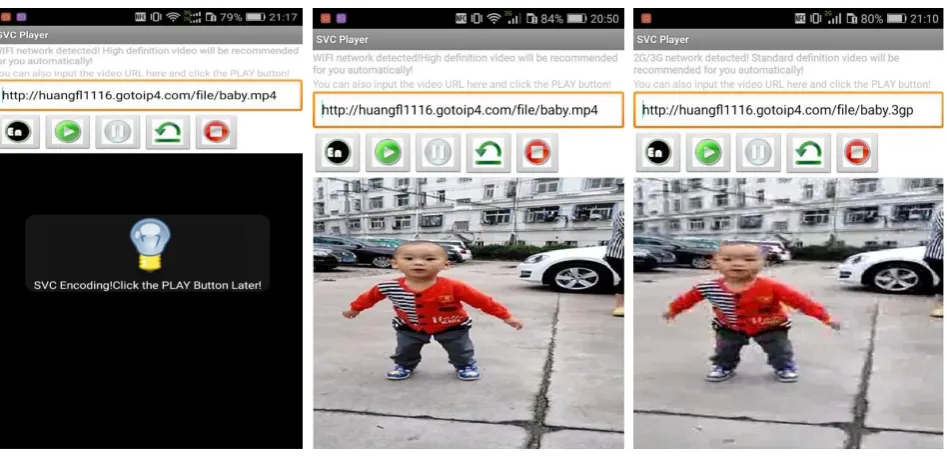
In order to observe the operation of the system easily, it used a mobile phone to film a video about 10 seconds. The video file was named baby.mp4 and its size was 8.23MB. Upload the video file to the streaming media server huangfl1116.gotoip4.com and download the file mount point. Because the system is used for testing, it has simplified some user operations. Opening the APP posterior interface, it will directly display the video file URL of the streaming media server in the text box, and if users have their own streaming media URL, they can also manually enter text boxes.
In the process of initialization, APP will first detect the network environment of the device. In this definition, if the network environment of the device is detected for WIFI or 4G network, it will give priority to recommend the high definition video service. If the network environment is 3G or 2G, it suggested that the standard quality of video service is recommended. As shown in Figure 8 and Figure 9.
Figure 10. When the source is on demand for the first time, it needs
to be SVC coded.
Figure 11. The playing effect in WIFI network environment.
Figure 12. The playing effect in 3G network environment.
Test Process and Result
The test equipment is a HUAWEI glory 4X Telecom version double Netcom cell phone, carrying the Android 4.4.1 system, to simulate the two network environments, namely, WIFI network (Unicom 6M bandwidth) and 3G network. In the WIFI network environment, after clicking the play button for about 3 seconds, it starts to play the video, in the playback process, it is clear and without buffer and pause phenomenon, the effect is shown in Figure 11.
In the 3G network environment, after clicking the play button for about 7 seconds, it starts to play the video, in the playing process, it is fuzzier and occasionally has the buffer and pause phenomenon, and the effect is shown in Figure 12.
Summary
This paper focuses on the strategy of optimizing the performance of streaming media services on the mainstream smartphone platform Android on the market. It has studied the SVC coding technology and implemented by using the bit bit-plane coding scheme, made the video coding based on the network environment of the user terminals to provide streaming media service of corresponding stream quality for the users with different heterogeneous states. The developed APP Demo runs normally on the mainstream Android platform mobile phones, and it will further optimize the interface design to enhance the user experience on the basis of Demo.
Acknowledgment
References
[1] O. Abboud, K. Pussep, A. Kovacevic, et al .Quality Adaptive Peer-to-Peer StreamingUsing Scalable Video Coding. Proceedings of the12th IFIP/IEEE InternationalConference on Management of Multimedia and Mobile Networks and Services. 2009.
[2] M.Wien, R. Cazoulat, A.Graffunder, et al. Real-time System for Adaptive Video Streaming Based on SVC. IEEE Transaction on circuits and systems for video technology, Sep.2007:1227-1237.
[3] Y.Chen, K.Xie, F.Zhang, et al. Frame Loss Error Concealment for SVC. Journal of Zhengjiang University Science, 2006:677-683.
[4] T.Schierl, K.Ganger, C.Hellge, et al. SVC-Based Multisource Streaming for Robust Video Transmission in Mobile Ad Hoc Networks. IEEE Wireless Communications, October 2006:96-105.
[5] Wang xianghai.MPEG-4 Natural Video Coding Tools and Algorithms. Computer Science, 2001, 1:1~7.
[6] Chih-Heng Ke.myEvalSVC: an Integrated Simulation Framework for Evaluation of H.264/SVC Transmission. KSII Transactions on Internet and Information Systems. 2012
[7] Junping Song,Xu Zhou,Yan Zhang, et al.A Playback Length Changeable chunk scheduling algorithmfor SVC based P2P streaming systems. GOLBECOM 2012. 2012
[8] Osama Abboud, Thomas Zinner, Konstntin Pussep. A QoE-Aware P2P Streaming System using Scalable Video Coding. IEEE International Conference on Peer-to-Peer. Computing. 2010
[9] Wang Xianghai and Tan Ru. The Scalable Coding Algorithms in Video Data Compression Standards. Computer Science, 2007, 34(8).
[10] K.Nguyen, T. Nguyen, S.Cheung. Peer-to-Peer Streaming with Hierarchical Network Coding. 2007 IEEE International Conference on Multimedia and Expo, July 2007:396-399.